The Legal Wife
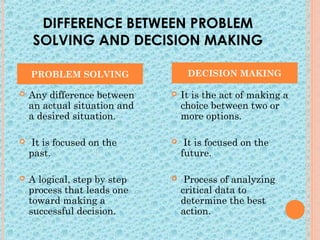
DIFFERENCE BETWEEN PROBLEM
SOLVING AND DECISION MAKING
 Any difference between
an actual situation and
a desired situation.
 It is focused on the
past.
 A logical, step by step
process that leads one
toward making a
successful decision.
 It is the act of making a
choice between two or
more options.
 It is focused on the
future.
 Process of analyzing
critical data to
determine the best
action.
PROBLEM SOLVING DECISION MAKING
Kinds of
Problems• Simple Problems
- occur suddenly, and the cause of the
problem may be obvious.
• Crisis Problems
- problems that can lead to a disaster if
not resolved quickly and appropriately.
•What is the right thing to do?
•What can go wrong?
Murphy’s Law of Management
“ If anything can go wrong, it will”
• How can I prevent the problem
from happening?
• What is my alternative plan?
•When should the alternative plan
take over?
Steps in Problem Solving
State the problem.
Define the present state of affairs.
State the objective.
List the possible cause.
Select the most likely cost.
List alternative solutions.
Evaluate alternatives.
Make a decision.
Draw up a plan of action.
Evaluates the results.
specific clear
solution
The Decision Tree
A series of if-then statements about possible
solutions to a problem in which alternatives are
gradually eliminated in reaching the best
decision.
Advantages
of Decision Tree
 Simple to understand and interpret.
 Worst, best and expected values can be
determined for different scenarios.
 Possible scenarios can be added.
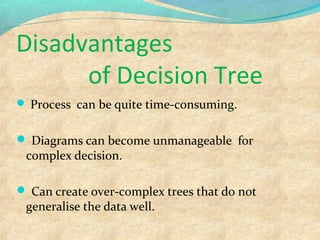
Disadvantages
of Decision Tree
 Process can be quite time-consuming.
 Diagrams can become unmanageable for
complex decision.
 Can create over-complex trees that do not
generalise the data well.
 “ Optimizing” Versus “ Satisficing”
Optimizing involves adopting a strategy to 
select the best possible solution from 
the available options.
Satisficing is a conjunction of the 
words satisfy and suffice, and means the 
finding of a solution which is "good enough”.
Example: 
A task is to sew a patch onto a pair of jeans. 
The best needle to do the threading is a 4 inch 
long needle with a 3 millimeter eye. This needle is 
hidden in a haystack along with 1000 other 
needles varying in size from 1 inch to 6 inches. 
Satisficing claims that the first needle that can 
sew on the patch is the one that should be used. 
Spending time searching for that one specific 
needle in the haystack is a waste of energy and 
resources. 
 Lessons from the Orient
Peter Drucker suggest that American 
might learn something from the 
Japanese approach in decision making.
 Group Decision Making
Delphi method
    -  process of collecting group of opinion through 
a series of questionnaires; initial responses are fed 
back to participants so that subsequent decisions 
can reflect input from all participants.
Nominal Group Technique
 similar to “brainstorming”  
 a group decision process whereby individual opinions or 
    ideas are solicited and merged into a master list for the 
     entire group. During this consolidation process, these ideas 
        are evaluated and ranked.
 A combination approach of incorporating both written 
     responses and face to face discussion to arrived at expert 
     consensus.
     
Nominal Group
Technique
 Making Decisions About
Personal Goals
Successful people know 
where they want to be 
and how they plan to get 
there.
When you have collected the available , relevant  
facts, then make the decision.
Your knowledge and past experiences are 
valuable guides.
It is important to know when not to make a
decision.
Weigh and interpret our emotions carefully.
Communication skills play a critical role in
decision making.
Any good decision includes the flexibility to
allow for unforeseen occurrences and new
information.
There is a delicate balance between perfecting
the plan and carrying it out.
“ Will I have the courage to do what is best, even
everyone else does not agree?”
Effective decision making

Effective decision making