

MANAGERS TODAY RAZA KAMAL PAF-KIET
SCOPE FOR TODAY’S TALK The Changing World Pakistani Work Environment Military Vs Business Manager-ship Areas of Concern Today Roles/ Skills Role of HRM Performance Leadership
THE CHANGING WORLD   OLD IS GOLD Frontiers limit competition Rigid hierarchy limit access to information Blue collar jobs Homogeneous population Driven by large organisations Customer at mercy of business NEW IS NEWER Operating boundaries Limitless Information is open to all Job for knowledgeable  Cultural diversity Business accepts social responsibility Entrepreneurial spirit Customer is the king 07/20/10
THE PAKISTANI SCENARIO COPING WITH BRAIN DRAIN. JOB INSECURITY MAKES YOU TIMID. CONCENTRATE ON ACTIVITY RATHER THAN RESULTS. ANCHORED TO THE HOMETOWN. JOB ASSURANCE FOR TECHNOCRATS. LOWER STAFF POORLY TRAINED. UNWRITTEN LOYALTY CONTRACT BROKEN. UNPREDICTABILITY/UNCERTAINTY HEIGHTENS STRESS. LOW ETHICAL VALUES.
THE BUSINESS ORGANISATION Employees prefer temporary upward mobile jobs Dismantle hierarchy to increase flexibility Workdays have no boundaries Downsizing has led to low commitment Women are here to stay Pay for performance Flexi-timing is the necessity of external pressures Employees prefer self directed careers Workers do not put heart and soul in work 07/20/10
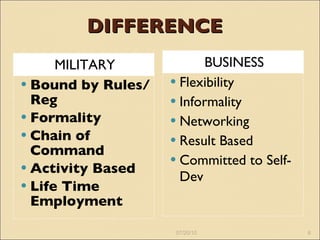
DIFFERENCE MILITARY BUSINESS Bound by Rules/ Reg Formality Chain of Command Activity Based Life Time Employment Flexibility Informality Networking Result Based Committed to Self- Dev 07/20/10
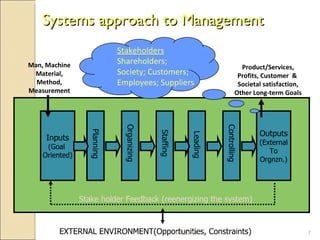
Inputs (Goal  Oriented) Outputs (External To Orgnzn.) Planning Organizing Staffing Leading Controlling Product/Services, Profits,   Customer  &  Societal  satisfaction, Other Long-term  Goals Man, Machine Material, M ethod, Measurement Stake holder  Feedback (reenergizing the system) EXTERNAL ENVIRONMENT (Opportunities, Constraints) Stakeholders Shareholders; Society; Customers; Employees; Suppliers Systems approach to Management   07/20/10
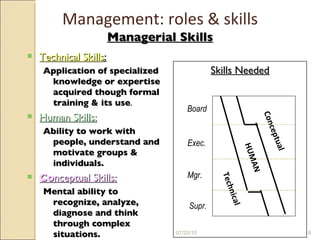
Managerial Skills Technical Skills : Application of specialized knowledge or expertise acquired though formal training & its use . Human Skills: Ability to work with people, understand and motivate groups & individuals. Co nceptual Skills: Mental ability to recognize, analyze, diagnose and think through complex situations. Skills Needed Management : roles & skills 07/20/10 Board  Exec. Mgr.  Supr. HUMAN Conceptual Technical
DECISION MAKING MILITARY OFFICER BY PROFESSION IS A DECISION MAKER; UNCERTAINTY IS HIS OPPONENT, OVERCOMING IT IS HIS MISSION.
07/20/10 See that he doesn’t sweep away those papers under the carpet.  I have to take decisions on them!
GROUP THINK CONDITIONS Highly cohesive group Under pressure to make decision SYMPTOMS Not being critical of each other’s ideas. Selective in gathering information. Believe in group morality. Lack of accountability. FAULTY DECISION MAKING STYLE WHICH DESIRES UNANIMITY AT THE EXPENSE OF QUALITY  DECISION
HUMAN RESOURCE MANAGEMENT AND THE CHANGE
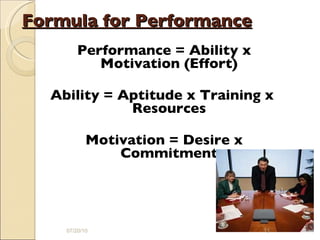
Formula for Performance Performance = Ability x Motivation (Effort) Ability = Aptitude x Training x  Resources Motivation = Desire x Commitment 07/20/10 6 -
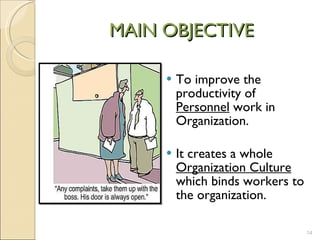
MAIN OBJECTIVE To improve the productivity of  Personnel  work in Organization. It creates a whole  Organization Culture  which binds workers to the organization.
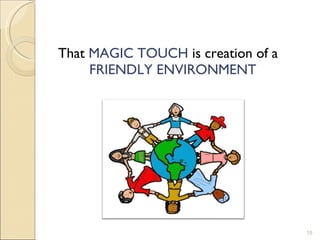
That  MAGIC TOUCH  is creation of a  FRIENDLY ENVIRONMENT
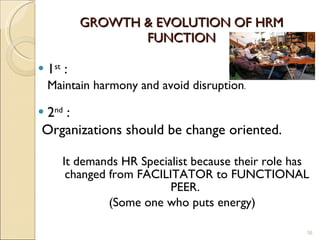
GROWTH & EVOLUTION OF HRM FUNCTION 1 st  : Maintain harmony and avoid disruption . 2 nd  : Organizations should be change oriented. It demands HR Specialist because their role has changed from FACILITATOR to FUNCTIONAL PEER.  (Some one who puts energy)
EMPOWERING HUMAN CAPITAL
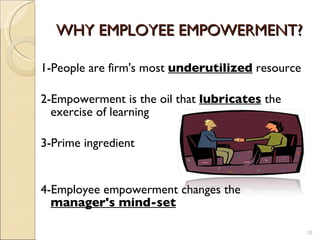
WHY EMPLOYEE EMPOWERMENT?  1-People are firm's most  underutilized  resource 2-Empowerment is the oil that  lubricates  the exercise of learning 3-Prime ingredient 4-Employee empowerment changes the  manager's mind-set
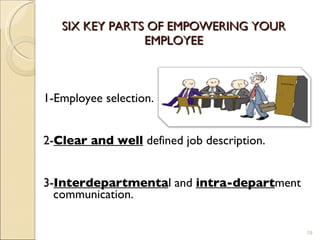
SIX KEY PARTS OF EMPOWERING YOUR EMPLOYEE 1-Employee selection. 2- Clear and well  defined job description. 3- Interdepartmenta l and  intra-depart ment communication.
Contd… 4-Give them autonomy to work in their own style and restrict yourself to the monitoring without putting yourself  over   their heads . 5-One who is responsible is ultimately  accountable  for his work. 6-Whether need to get more  involvements.
It helps the sender communicate accurately and honestly without jeopardizing interpersonal relationships. Supportive Communication
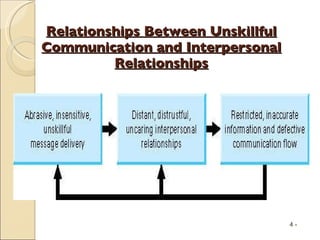
Relationships Between Unskillful Communication and Interpersonal Relationships 4 -
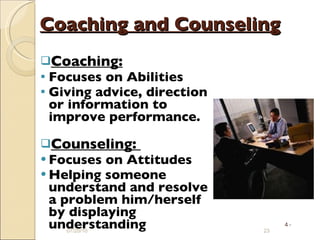
Coaching and Counseling Coaching:   Focuses on Abilities Giving advice, direction or information to improve performance. Counseling:  Focuses on Attitudes Helping someone understand and resolve a problem him/herself by displaying understanding 07/20/10 4 -
When to Coach: Lack of ability Insufficient information Incompetence Subordinate must understand the problem When to Counsel Personality clashes Defensiveness Other factors tied to emotions “ I can help you recognize that a problem exists.” 07/20/10 4 -
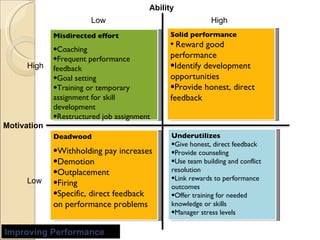
Misdirected effort Coaching Frequent performance feedback Goal setting Training or temporary assignment for skill development Restructured job assignment  Solid performance  Reward good performance  Identify development opportunities Provide honest, direct feedback  Deadwood Withholding pay increases Demotion Outplacement  Firing Specific, direct feedback on performance problems Underutilizes Give honest, direct feedback Provide counseling  Use team building and conflict resolution Link rewards to performance outcomes Offer training for needed knowledge or skills Manager stress levels  Low High  Motivation Ability Low High  Improving Performance
Traits of a Good Leader? Survey Findings  When asked values people must look for & admired in  a leader the majority of respondents selected the following (Over 50%) Honest 90% Forward Looking 70% Competent Inspiring 07/20/10 SURVEY FINDING
07/20/10 ENERGY  LIKEABILITY  INTELLIGENCE INTEGRITY  DRIVE COMMUNICATOR ASSERTIVENESS Personality Traits
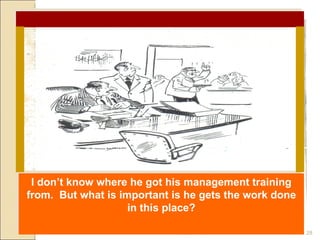
07/20/10 I don’t know where he got his management training from.  But what is important is he gets the work done in this place?
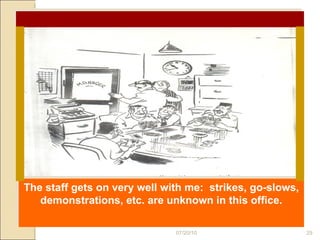
07/20/10 The staff gets on very well with me:  strikes, go-slows, demonstrations, etc. are unknown in this office.
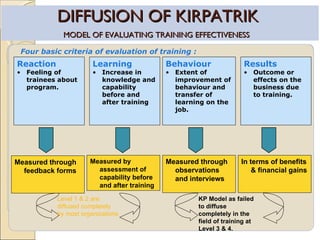
DIFFUSION OF KIRPATRIK   MODEL OF EVALUATING TRAINING EFFECTIVENESS   Four basic criteria of evaluation of training : Reaction Feeling of trainees about program. Measured through feedback forms Learning Increase in knowledge and capability before and after training Behaviour Extent of improvement of behaviour and transfer of learning on the job.  Results Outcome or effects on the business due to training.   In terms of benefits & financial gains Measured through observations and interviews Measured by assessment of capability before and after training Level 1 & 2 are diffused completely by most organizations KP Model as failed to diffuse completely in the field of training at Level 3 & 4.
DUAL CAREER PATHS  AND PLATEAUING
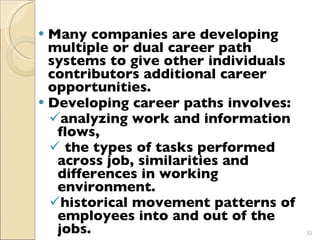
Many companies are developing multiple or dual career path systems to give other individuals contributors additional career opportunities. Developing career paths involves: analyzing work and information flows, the types of tasks performed across job, similarities and differences in working environment. historical movement patterns of employees into and out of the jobs.
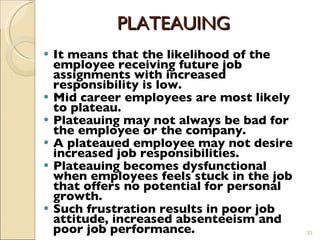
PLATEAUING  It means that the likelihood of the employee receiving future job assignments with increased responsibility is low. Mid career employees are most likely to plateau. Plateauing may not always be bad for the employee or the company. A plateaued employee may not desire increased job responsibilities. Plateauing becomes dysfunctional when employees feels stuck in the job that offers no potential for personal growth. Such frustration results in poor job attitude, increased absenteeism and poor job performance.
REASONS FOR PLATEAUING Discrimination based on gender, race or age. Lack of ability Lack of training Low need for achievement Unfair pay decisions Confusion about job responsibilities Slow company growth.
REMEDIES FOR PLATEAUED EMPLOYEES Employee understands the reason for Plateauing. Employee is encouraged to participate in developmental activities Employee is encouraged to seek career counseling Employee does a reality check on solution.
CONCLUSION LEARNING FROM OTHERS IS A VIRTUE AND ADAPTING IT TO OWN ENVIRONMENT AN ART  07/20/10

Managers today

  • 1.
    MANAGERS TODAY RAZAKAMAL PAF-KIET
  • 2.
    SCOPE FOR TODAY’STALK The Changing World Pakistani Work Environment Military Vs Business Manager-ship Areas of Concern Today Roles/ Skills Role of HRM Performance Leadership
  • 3.
    THE CHANGING WORLD OLD IS GOLD Frontiers limit competition Rigid hierarchy limit access to information Blue collar jobs Homogeneous population Driven by large organisations Customer at mercy of business NEW IS NEWER Operating boundaries Limitless Information is open to all Job for knowledgeable Cultural diversity Business accepts social responsibility Entrepreneurial spirit Customer is the king 07/20/10
  • 4.
    THE PAKISTANI SCENARIOCOPING WITH BRAIN DRAIN. JOB INSECURITY MAKES YOU TIMID. CONCENTRATE ON ACTIVITY RATHER THAN RESULTS. ANCHORED TO THE HOMETOWN. JOB ASSURANCE FOR TECHNOCRATS. LOWER STAFF POORLY TRAINED. UNWRITTEN LOYALTY CONTRACT BROKEN. UNPREDICTABILITY/UNCERTAINTY HEIGHTENS STRESS. LOW ETHICAL VALUES.
  • 5.
    THE BUSINESS ORGANISATIONEmployees prefer temporary upward mobile jobs Dismantle hierarchy to increase flexibility Workdays have no boundaries Downsizing has led to low commitment Women are here to stay Pay for performance Flexi-timing is the necessity of external pressures Employees prefer self directed careers Workers do not put heart and soul in work 07/20/10
  • 6.
    DIFFERENCE MILITARY BUSINESSBound by Rules/ Reg Formality Chain of Command Activity Based Life Time Employment Flexibility Informality Networking Result Based Committed to Self- Dev 07/20/10
  • 7.
    Inputs (Goal Oriented) Outputs (External To Orgnzn.) Planning Organizing Staffing Leading Controlling Product/Services, Profits, Customer & Societal satisfaction, Other Long-term Goals Man, Machine Material, M ethod, Measurement Stake holder Feedback (reenergizing the system) EXTERNAL ENVIRONMENT (Opportunities, Constraints) Stakeholders Shareholders; Society; Customers; Employees; Suppliers Systems approach to Management 07/20/10
  • 8.
    Managerial Skills TechnicalSkills : Application of specialized knowledge or expertise acquired though formal training & its use . Human Skills: Ability to work with people, understand and motivate groups & individuals. Co nceptual Skills: Mental ability to recognize, analyze, diagnose and think through complex situations. Skills Needed Management : roles & skills 07/20/10 Board Exec. Mgr. Supr. HUMAN Conceptual Technical
  • 9.
    DECISION MAKING MILITARYOFFICER BY PROFESSION IS A DECISION MAKER; UNCERTAINTY IS HIS OPPONENT, OVERCOMING IT IS HIS MISSION.
  • 10.
    07/20/10 See thathe doesn’t sweep away those papers under the carpet. I have to take decisions on them!
  • 11.
    GROUP THINK CONDITIONSHighly cohesive group Under pressure to make decision SYMPTOMS Not being critical of each other’s ideas. Selective in gathering information. Believe in group morality. Lack of accountability. FAULTY DECISION MAKING STYLE WHICH DESIRES UNANIMITY AT THE EXPENSE OF QUALITY DECISION
  • 12.
  • 13.
    Formula for PerformancePerformance = Ability x Motivation (Effort) Ability = Aptitude x Training x Resources Motivation = Desire x Commitment 07/20/10 6 -
  • 14.
    MAIN OBJECTIVE Toimprove the productivity of Personnel work in Organization. It creates a whole Organization Culture which binds workers to the organization.
  • 15.
    That MAGICTOUCH is creation of a FRIENDLY ENVIRONMENT
  • 16.
    GROWTH & EVOLUTIONOF HRM FUNCTION 1 st : Maintain harmony and avoid disruption . 2 nd : Organizations should be change oriented. It demands HR Specialist because their role has changed from FACILITATOR to FUNCTIONAL PEER. (Some one who puts energy)
  • 17.
  • 18.
    WHY EMPLOYEE EMPOWERMENT? 1-People are firm's most underutilized resource 2-Empowerment is the oil that lubricates the exercise of learning 3-Prime ingredient 4-Employee empowerment changes the manager's mind-set
  • 19.
    SIX KEY PARTSOF EMPOWERING YOUR EMPLOYEE 1-Employee selection. 2- Clear and well defined job description. 3- Interdepartmenta l and intra-depart ment communication.
  • 20.
    Contd… 4-Give themautonomy to work in their own style and restrict yourself to the monitoring without putting yourself over their heads . 5-One who is responsible is ultimately accountable for his work. 6-Whether need to get more involvements.
  • 21.
    It helps thesender communicate accurately and honestly without jeopardizing interpersonal relationships. Supportive Communication
  • 22.
    Relationships Between UnskillfulCommunication and Interpersonal Relationships 4 -
  • 23.
    Coaching and CounselingCoaching: Focuses on Abilities Giving advice, direction or information to improve performance. Counseling: Focuses on Attitudes Helping someone understand and resolve a problem him/herself by displaying understanding 07/20/10 4 -
  • 24.
    When to Coach:Lack of ability Insufficient information Incompetence Subordinate must understand the problem When to Counsel Personality clashes Defensiveness Other factors tied to emotions “ I can help you recognize that a problem exists.” 07/20/10 4 -
  • 25.
    Misdirected effort CoachingFrequent performance feedback Goal setting Training or temporary assignment for skill development Restructured job assignment Solid performance Reward good performance Identify development opportunities Provide honest, direct feedback Deadwood Withholding pay increases Demotion Outplacement Firing Specific, direct feedback on performance problems Underutilizes Give honest, direct feedback Provide counseling Use team building and conflict resolution Link rewards to performance outcomes Offer training for needed knowledge or skills Manager stress levels Low High Motivation Ability Low High Improving Performance
  • 26.
    Traits of aGood Leader? Survey Findings When asked values people must look for & admired in a leader the majority of respondents selected the following (Over 50%) Honest 90% Forward Looking 70% Competent Inspiring 07/20/10 SURVEY FINDING
  • 27.
    07/20/10 ENERGY LIKEABILITY INTELLIGENCE INTEGRITY DRIVE COMMUNICATOR ASSERTIVENESS Personality Traits
  • 28.
    07/20/10 I don’tknow where he got his management training from. But what is important is he gets the work done in this place?
  • 29.
    07/20/10 The staffgets on very well with me: strikes, go-slows, demonstrations, etc. are unknown in this office.
  • 30.
    DIFFUSION OF KIRPATRIK MODEL OF EVALUATING TRAINING EFFECTIVENESS Four basic criteria of evaluation of training : Reaction Feeling of trainees about program. Measured through feedback forms Learning Increase in knowledge and capability before and after training Behaviour Extent of improvement of behaviour and transfer of learning on the job. Results Outcome or effects on the business due to training. In terms of benefits & financial gains Measured through observations and interviews Measured by assessment of capability before and after training Level 1 & 2 are diffused completely by most organizations KP Model as failed to diffuse completely in the field of training at Level 3 & 4.
  • 31.
    DUAL CAREER PATHS AND PLATEAUING
  • 32.
    Many companies aredeveloping multiple or dual career path systems to give other individuals contributors additional career opportunities. Developing career paths involves: analyzing work and information flows, the types of tasks performed across job, similarities and differences in working environment. historical movement patterns of employees into and out of the jobs.
  • 33.
    PLATEAUING Itmeans that the likelihood of the employee receiving future job assignments with increased responsibility is low. Mid career employees are most likely to plateau. Plateauing may not always be bad for the employee or the company. A plateaued employee may not desire increased job responsibilities. Plateauing becomes dysfunctional when employees feels stuck in the job that offers no potential for personal growth. Such frustration results in poor job attitude, increased absenteeism and poor job performance.
  • 34.
    REASONS FOR PLATEAUINGDiscrimination based on gender, race or age. Lack of ability Lack of training Low need for achievement Unfair pay decisions Confusion about job responsibilities Slow company growth.
  • 35.
    REMEDIES FOR PLATEAUEDEMPLOYEES Employee understands the reason for Plateauing. Employee is encouraged to participate in developmental activities Employee is encouraged to seek career counseling Employee does a reality check on solution.
  • 36.
    CONCLUSION LEARNING FROMOTHERS IS A VIRTUE AND ADAPTING IT TO OWN ENVIRONMENT AN ART 07/20/10

Editor's Notes

  • #4 No class in history has ever risen faster than the blue collar worker. And no class in history has ever fallen faster
  • #10 School of Logistics & Managment
  • #22 COACHING AND COUNSELLING
  • #23 SUPPORTIVE COMM
  • #31 Diffusion is a process by which an innovation is communicated through certain channels over time among members of a social system.