Crisis Decision-Making

For:
       Asia-Pacific Security Conference – February 2009
            Bruce T. Blythe, CEO
              www.cmiatl.com
               404-841-3400
Crisis Decision-Making

Crisis decision-making is . . .


     “. . . located somewhere between analysis and
                        intuition”
                                             Bruce T. Blythe
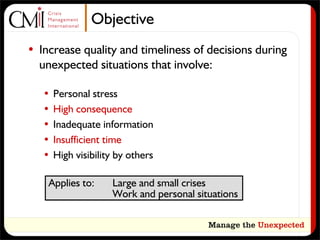
Objective
• Increase quality and timeliness of decisions during
  unexpected situations that involve:

   •   Personal stress
   •   High consequence
   •   Inadequate information
   •   Insufficient time
   •   High visibility by others

    Applies to:      Large and small crises
                     Work and personal situations
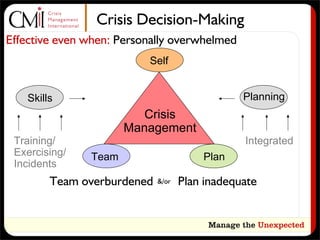
Crisis Decision-Making
Effective even when: Personally overwhelmed
                          Self


    Skills
     Skills                                      Planning
                          Crisis
                       Management
 Training/                                       Integrated
 Exercising/    Team                     Plan
 Incidents
          Team overburdened   &/or   Plan inadequate
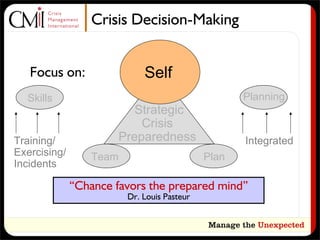
Crisis Decision-Making


   Focus on:                  Self
  Skills
   Skills                                            Planning
                            Strategic
                             Crisis
Training/                Preparedness                Integrated
Exercising/       Team                        Plan
Incidents

              “Chance favors the prepared mind”
                          Dr. Louis Pasteur
Decision-Making Context
Decisions made when:
• Partial information
• Time is limited
• Future is uncertain
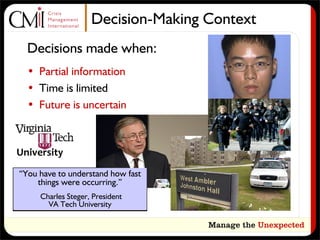
Decision-Making Context
  Decisions made when:
  • Partial information
  • Time is limited
  • Future is uncertain


University
“You have to understand how fast
    things were occurring.”
     Charles Steger, President
       VA Tech University
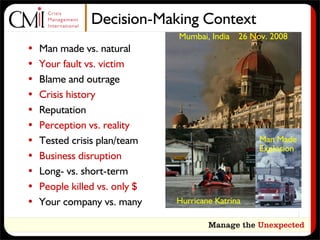
Decision-Making Context
                               Mumbai, India   26 Nov. 2008
•   Man made vs. natural
•   Your fault vs. victim
•   Blame and outrage
•   Crisis history
•   Reputation
•   Perception vs. reality
•   Tested crisis plan/team                         Man Made
                                                    Explosion
•   Business disruption
•   Long- vs. short-term
•   People killed vs. only $
•   Your company vs. many      Hurricane Katrina
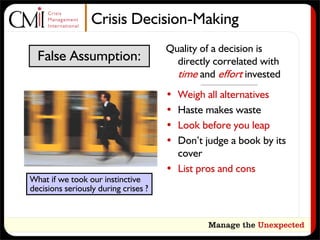
Crisis Decision-Making
                                      Quality of a decision is
  False Assumption:                     directly correlated with
                                        time and effort invested
                                             ________________________________


                                      • Weigh all alternatives
                                      • Haste makes waste
                                      • Look before you leap
                                      • Don’t judge a book by its
                                        cover
                                      • List pros and cons
What if we took our instinctive
decisions seriously during crises ?
Science of Intuitive Decision-Making

    How people make
    judgments and
    decisions
    . . . in uncertain
    situations


                                                  Men are as accurately intuitive
•    Based on research
                                                           as women
•    Max Plank Institute for Human Development,
     Berlin, Germany                                    [Study of 15,000 people]
Crisis Decision-Making
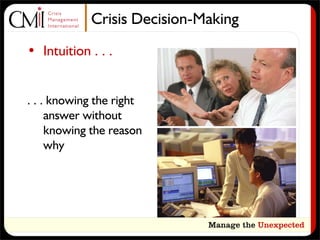
• Intuition . . .


. . . knowing the right
     answer without
     knowing the reason
     why
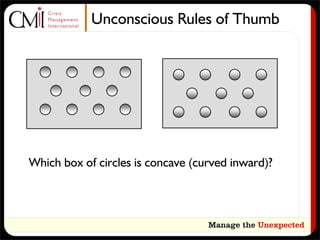
Unconscious Rules of Thumb


Which box of circles is concave (curved inward)?
Crisis Decision-Making
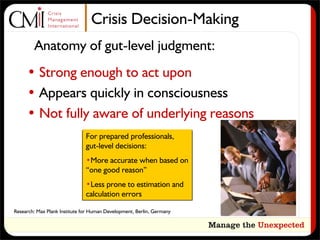
        Anatomy of gut-level judgment:
     • Strong enough to act upon
     • Appears quickly in consciousness
     • Not fully aware of underlying reasons
                               For prepared professionals,
                               gut-level decisions:
                               •More accurate when based on
                               “one good reason”
                               •Less prone to estimation and
                               calculation errors

Research: Max Plank Institute for Human Development, Berlin, Germany
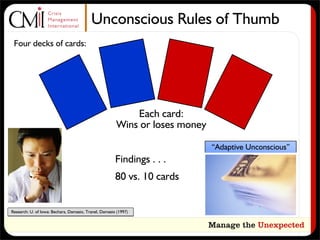
Unconscious Rules of Thumb
 Four decks of cards:


                                                           Each card:
                                                       Wins or loses money

                                                                             “Adaptive Unconscious”
                                                       Findings . . .
                                                       80 vs. 10 cards


Research: U. of Iowa: Bechara, Damasio, Tranel, Damasio (1997)
Crisis Decision-Making
         Simple Rules of Thumb

          • Can predict complex
            phenomena

             . . . as well or better than


          • Complex rules do
Crisis Decision-Making
         Simple Rules of Thumb

          Contradict 2 core
          beliefs:


         • More information is always
           better

         • More choice is always better
Crisis Decision-Making
                                  Simple Rule of Thumb

                                  Based on . . .

                                 • One good reason
                                 • That’s good enough

Research: Catching a fly ball
           Picking stocks
           Putting a golf ball             . . . less is more
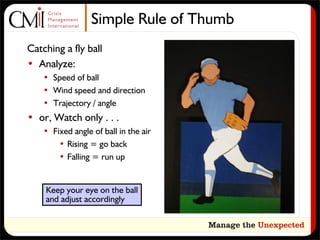
Simple Rule of Thumb
Catching a fly ball
• Analyze:
    • Speed of ball
    • Wind speed and direction
    • Trajectory / angle
• or, Watch only . . .
    • Fixed angle of ball in the air
        • Rising = go back
        • Falling = run up


    Keep your eye on the ball
    and adjust accordingly
Simple Rule of Thumb
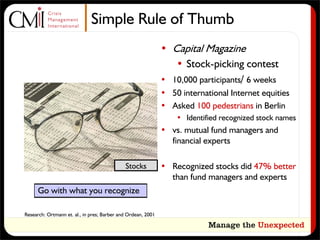
                                                              • Capital Magazine
                                                                 • Stock-picking contest
                                                              • 10,000 participants/ 6 weeks
                                                              • 50 international Internet equities
                                                              • Asked 100 pedestrians in Berlin
                                                                  • Identified recognized stock names
                                                              • vs. mutual fund managers and
                                                                financial experts

                                             Stocks           • Recognized stocks did 47% better
                                                                than fund managers and experts
      Go with what you recognize

Research: Ortmann et. al., in pres; Barber and Ordean, 2001
Simple Rule of Thumb
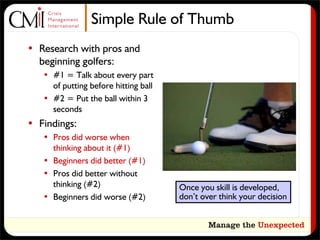
• Research with pros and
  beginning golfers:
   • #1 = Talk about every part
     of putting before hitting ball
   • #2 = Put the ball within 3
     seconds
• Findings:
   • Pros did worse when
     thinking about it (#1)
   • Beginners did better (#1)
   • Pros did better without
     thinking (#2)                    Once you skill is developed,
   • Beginners did worse (#2)         don’t over think your decision
Crisis Decision-Making
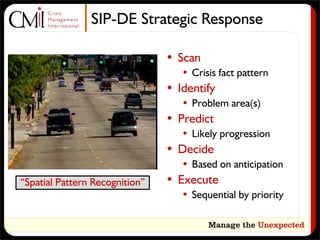
SIP-DE Strategic Response

                                • Scan
                                   • Crisis fact pattern
                                • Identify
                                   • Problem area(s)
                                • Predict
                                   • Likely progression
                                • Decide
                                   • Based on anticipation
“Spatial Pattern Recognition”   • Execute
                                   • Sequential by priority
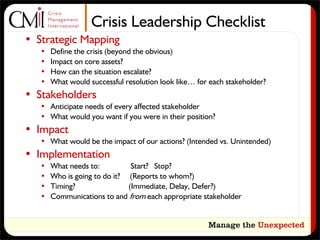
Crisis Leadership Checklist
• Strategic Mapping
   •   Define the crisis (beyond the obvious)
   •   Impact on core assets?
   •   How can the situation escalate?
   •   What would successful resolution look like… for each stakeholder?
• Stakeholders
   • Anticipate needs of every affected stakeholder
   • What would you want if you were in their position?
• Impact
   • What would be the impact of our actions? (Intended vs. Unintended)
• Implementation
   •   What needs to:          Start? Stop?
   •   Who is going to do it? (Reports to whom?)
   •   Timing?                (Immediate, Delay, Defer?)
   •   Communications to and from each appropriate stakeholder
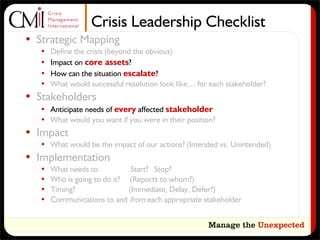
Crisis Leadership Checklist
• Strategic Mapping
   •   Define the crisis (beyond the obvious)
   •   Impact on core assets?
   •   How can the situation escalate?
   •   What would successful resolution look like… for each stakeholder?
• Stakeholders
   • Anticipate needs of every affected stakeholder
   • What would you want if you were in their position?
• Impact
   • What would be the impact of our actions? (Intended vs. Unintended)
• Implementation
   •   What needs to:          Start? Stop?
   •   Who is going to do it? (Reports to whom?)
   •   Timing?                (Immediate, Delay, Defer?)
   •   Communications to and from each appropriate stakeholder
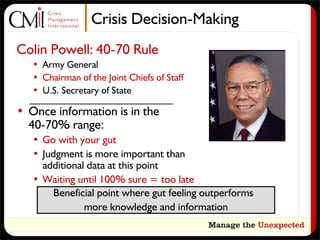
Crisis Decision-Making
Colin Powell: 40-70 Rule
   • Army General
   • Chairman of the Joint Chiefs of Staff
   • U.S. Secretary of State

• Once information is in the
  40-70% range:
   • Go with your gut
   • Judgment is more important than
     additional data at this point
   • Waiting until 100% sure = too late
        Beneficial point where gut feeling outperforms
               more knowledge and information
Crisis Decision-Making

Crisis decision-making is . . .


     “. . . located somewhere between analysis and
                        intuition”
                                             Bruce T. Blythe
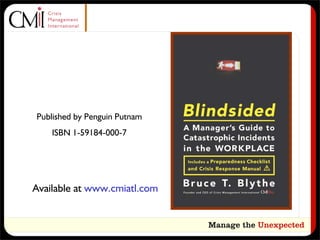
Published by Penguin Putnam
    ISBN 1-59184-000-7


Available at www.cmiatl.com
Objective
• Increase quality and timeliness of decisions during
  unexpected situations that involve:

   •   Personal stress
   •   High consequence
   •   Inadequate information
   •   Insufficient time
   •   High visibility by others

    Applies to:      Large and small crises
                     Work and personal situations
Crisis Decision-Making

For:
       Asia-Pacific Security Conference – February 2009
            Bruce T. Blythe, CEO
              www.cmiatl.com
               404-841-3400

Crisis Decision Making

  • 1.
    Crisis Decision-Making For: Asia-Pacific Security Conference – February 2009 Bruce T. Blythe, CEO www.cmiatl.com 404-841-3400
  • 2.
    Crisis Decision-Making Crisis decision-makingis . . . “. . . located somewhere between analysis and intuition” Bruce T. Blythe
  • 3.
    Objective • Increase qualityand timeliness of decisions during unexpected situations that involve: • Personal stress • High consequence • Inadequate information • Insufficient time • High visibility by others Applies to: Large and small crises Work and personal situations
  • 4.
    Crisis Decision-Making Effective evenwhen: Personally overwhelmed Self Skills Skills Planning Crisis Management Training/ Integrated Exercising/ Team Plan Incidents Team overburdened &/or Plan inadequate
  • 5.
    Crisis Decision-Making Focus on: Self Skills Skills Planning Strategic Crisis Training/ Preparedness Integrated Exercising/ Team Plan Incidents “Chance favors the prepared mind” Dr. Louis Pasteur
  • 6.
    Decision-Making Context Decisions madewhen: • Partial information • Time is limited • Future is uncertain
  • 7.
    Decision-Making Context Decisions made when: • Partial information • Time is limited • Future is uncertain University “You have to understand how fast things were occurring.” Charles Steger, President VA Tech University
  • 8.
    Decision-Making Context Mumbai, India 26 Nov. 2008 • Man made vs. natural • Your fault vs. victim • Blame and outrage • Crisis history • Reputation • Perception vs. reality • Tested crisis plan/team Man Made Explosion • Business disruption • Long- vs. short-term • People killed vs. only $ • Your company vs. many Hurricane Katrina
  • 9.
    Crisis Decision-Making Quality of a decision is False Assumption: directly correlated with time and effort invested ________________________________ • Weigh all alternatives • Haste makes waste • Look before you leap • Don’t judge a book by its cover • List pros and cons What if we took our instinctive decisions seriously during crises ?
  • 10.
    Science of IntuitiveDecision-Making How people make judgments and decisions . . . in uncertain situations Men are as accurately intuitive • Based on research as women • Max Plank Institute for Human Development, Berlin, Germany [Study of 15,000 people]
  • 11.
    Crisis Decision-Making • Intuition. . . . . . knowing the right answer without knowing the reason why
  • 12.
    Unconscious Rules ofThumb Which box of circles is concave (curved inward)?
  • 13.
    Crisis Decision-Making Anatomy of gut-level judgment: • Strong enough to act upon • Appears quickly in consciousness • Not fully aware of underlying reasons For prepared professionals, gut-level decisions: •More accurate when based on “one good reason” •Less prone to estimation and calculation errors Research: Max Plank Institute for Human Development, Berlin, Germany
  • 14.
    Unconscious Rules ofThumb Four decks of cards: Each card: Wins or loses money “Adaptive Unconscious” Findings . . . 80 vs. 10 cards Research: U. of Iowa: Bechara, Damasio, Tranel, Damasio (1997)
  • 15.
    Crisis Decision-Making Simple Rules of Thumb • Can predict complex phenomena . . . as well or better than • Complex rules do
  • 16.
    Crisis Decision-Making Simple Rules of Thumb Contradict 2 core beliefs: • More information is always better • More choice is always better
  • 17.
    Crisis Decision-Making Simple Rule of Thumb Based on . . . • One good reason • That’s good enough Research: Catching a fly ball Picking stocks Putting a golf ball . . . less is more
  • 18.
    Simple Rule ofThumb Catching a fly ball • Analyze: • Speed of ball • Wind speed and direction • Trajectory / angle • or, Watch only . . . • Fixed angle of ball in the air • Rising = go back • Falling = run up Keep your eye on the ball and adjust accordingly
  • 19.
    Simple Rule ofThumb • Capital Magazine • Stock-picking contest • 10,000 participants/ 6 weeks • 50 international Internet equities • Asked 100 pedestrians in Berlin • Identified recognized stock names • vs. mutual fund managers and financial experts Stocks • Recognized stocks did 47% better than fund managers and experts Go with what you recognize Research: Ortmann et. al., in pres; Barber and Ordean, 2001
  • 20.
    Simple Rule ofThumb • Research with pros and beginning golfers: • #1 = Talk about every part of putting before hitting ball • #2 = Put the ball within 3 seconds • Findings: • Pros did worse when thinking about it (#1) • Beginners did better (#1) • Pros did better without thinking (#2) Once you skill is developed, • Beginners did worse (#2) don’t over think your decision
  • 21.
  • 22.
    SIP-DE Strategic Response • Scan • Crisis fact pattern • Identify • Problem area(s) • Predict • Likely progression • Decide • Based on anticipation “Spatial Pattern Recognition” • Execute • Sequential by priority
  • 23.
    Crisis Leadership Checklist •Strategic Mapping • Define the crisis (beyond the obvious) • Impact on core assets? • How can the situation escalate? • What would successful resolution look like… for each stakeholder? • Stakeholders • Anticipate needs of every affected stakeholder • What would you want if you were in their position? • Impact • What would be the impact of our actions? (Intended vs. Unintended) • Implementation • What needs to: Start? Stop? • Who is going to do it? (Reports to whom?) • Timing? (Immediate, Delay, Defer?) • Communications to and from each appropriate stakeholder
  • 24.
    Crisis Leadership Checklist •Strategic Mapping • Define the crisis (beyond the obvious) • Impact on core assets? • How can the situation escalate? • What would successful resolution look like… for each stakeholder? • Stakeholders • Anticipate needs of every affected stakeholder • What would you want if you were in their position? • Impact • What would be the impact of our actions? (Intended vs. Unintended) • Implementation • What needs to: Start? Stop? • Who is going to do it? (Reports to whom?) • Timing? (Immediate, Delay, Defer?) • Communications to and from each appropriate stakeholder
  • 25.
    Crisis Decision-Making Colin Powell:40-70 Rule • Army General • Chairman of the Joint Chiefs of Staff • U.S. Secretary of State • Once information is in the 40-70% range: • Go with your gut • Judgment is more important than additional data at this point • Waiting until 100% sure = too late Beneficial point where gut feeling outperforms more knowledge and information
  • 26.
    Crisis Decision-Making Crisis decision-makingis . . . “. . . located somewhere between analysis and intuition” Bruce T. Blythe
  • 27.
    Published by PenguinPutnam ISBN 1-59184-000-7 Available at www.cmiatl.com
  • 28.
    Objective • Increase qualityand timeliness of decisions during unexpected situations that involve: • Personal stress • High consequence • Inadequate information • Insufficient time • High visibility by others Applies to: Large and small crises Work and personal situations
  • 29.
    Crisis Decision-Making For: Asia-Pacific Security Conference – February 2009 Bruce T. Blythe, CEO www.cmiatl.com 404-841-3400