DE STIJL 
De Stijl also known as neoplasticism, was a Dutch artistic 
movement founded in 1917 in Amsterdam. The De Stijl consisted 
of artists and architects. In a narrower sense, the term De Stijl is 
used to refer to a body of work from 1917 to 1931 founded in 
the Netherlands. De Stijl is also the name of a journal that was 
published by the Dutch painter, designer, writer, and critic Theo 
van Doesburg (1883–1931) that served to propagate the group's 
theories. Next to van Doesburg, the group's principal members 
were the painters Piet Mondrian (1872–1944), Vilmos Huszár 
(1884–1960), and Bart van der Leck (1876–1958), and the 
architects Gerrit Rietveld (1888–1964), Robert van’t Hoff (1887– 
1979), and J. J. P. Oud (1890–1963). The artistic philosophy that formed a basis for the 
group's work is known as neoplasticism—the new plastic art (or Nieuwe Beelding in Dutch). 
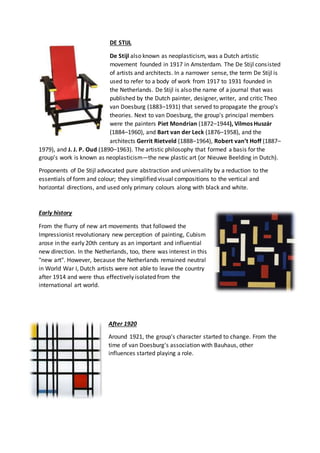
Proponents of De Stijl advocated pure abstraction and universality by a reduction to the 
essentials of form and colour; they simplified visual compositions to the vertical and 
horizontal directions, and used only primary colours along with black and white. 
Early history 
From the flurry of new art movements that followed the 
Impressionist revolutionary new perception of painting, Cubism 
arose in the early 20th century as an important and influential 
new direction. In the Netherlands, too, there was interest in this 
"new art". However, because the Netherlands remained neutral 
in World War I, Dutch artists were not able to leave the country 
after 1914 and were thus effectively isolated from the 
international art world. 
After 1920 
Around 1921, the group's character started to change. From the 
time of van Doesburg's association with Bauhaus, other 
influences started playing a role.

De stijl

  • 1.
    DE STIJL DeStijl also known as neoplasticism, was a Dutch artistic movement founded in 1917 in Amsterdam. The De Stijl consisted of artists and architects. In a narrower sense, the term De Stijl is used to refer to a body of work from 1917 to 1931 founded in the Netherlands. De Stijl is also the name of a journal that was published by the Dutch painter, designer, writer, and critic Theo van Doesburg (1883–1931) that served to propagate the group's theories. Next to van Doesburg, the group's principal members were the painters Piet Mondrian (1872–1944), Vilmos Huszár (1884–1960), and Bart van der Leck (1876–1958), and the architects Gerrit Rietveld (1888–1964), Robert van’t Hoff (1887– 1979), and J. J. P. Oud (1890–1963). The artistic philosophy that formed a basis for the group's work is known as neoplasticism—the new plastic art (or Nieuwe Beelding in Dutch). Proponents of De Stijl advocated pure abstraction and universality by a reduction to the essentials of form and colour; they simplified visual compositions to the vertical and horizontal directions, and used only primary colours along with black and white. Early history From the flurry of new art movements that followed the Impressionist revolutionary new perception of painting, Cubism arose in the early 20th century as an important and influential new direction. In the Netherlands, too, there was interest in this "new art". However, because the Netherlands remained neutral in World War I, Dutch artists were not able to leave the country after 1914 and were thus effectively isolated from the international art world. After 1920 Around 1921, the group's character started to change. From the time of van Doesburg's association with Bauhaus, other influences started playing a role.