DC/AC Inverter (3-Phase)  Simplified SPICE Behavioral Model All Rights Reserved Copyright (C) Bee Technologies Corporation 2011
Contents Model Overview Benefit of the Model Concept of the Model 3-Phase DC/AC Specification (Example) Parameter Settings Input-Output Characteristics 6.1 Simulation Circuit and Setting Line-to-Line Output Characteristics 7.1 Simulation Circuit and Setting Efficiency Characteristics 8.1 Simulation Circuit and Setting Minimum DC Input Voltage 9.1 Simulation Circuit and Setting Simulation Index All Rights Reserved Copyright (C) Bee Technologies Corporation 2011
1.Model Overview This 3-Phase  DC/AC Inverter Simplified SPICE Behavioral Model  is for users who require the model of an Inverter as a part of their system. The model focuses on the input/output relationships of the Inverter block; therefore, it is not using high frequency models (e.g. oscillator and noise models), and is not based on the electronic topologies of the Inverter. The model enables long-term behavior simulation of the system (e.g. in a Photovoltaic system simulation). All Rights Reserved Copyright (C) Bee Technologies Corporation 2011
2.Benefit of the Model Enable Transient Simulation. Can be adjusted to your own 3-Phase DC/AC specifications, by editing the model parameters. The simplified model is an easy-to-use, which can be provided without the circuit detail. Time and costs are saved because only the necessary parts are simulated. All Rights Reserved Copyright (C) Bee Technologies Corporation 2011
3.Concept of the Model The model is characterized by parameters n, Vin_min, Vin_max, Vo_ac and Freq that represent the input-output-relationships of the Inverter.  Where,  P AC  : AC output power P DC  : DC input power 3-Phase DC/AC Inverter  Simplified SPICE Behavioral Model   All Rights Reserved Copyright (C) Bee Technologies Corporation 2011 IN+ IN- U N V IN,MIN ~V IN,MAX  (Vdc) I IN I O ~ ~ V W P OUT( 3-phase)
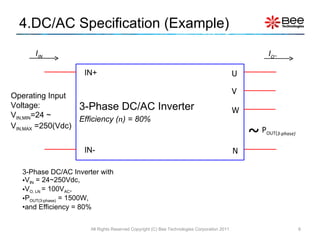
4.DC/AC Specification (Example) 3-Phase DC/AC Inverter with  V IN  = 24~250Vdc,  V O, LN  = 100V AC ,  P OUT(3-phase)  = 1500W, and Efficiency = 80% 3-Phase DC/AC Inverter Efficiency ( n ) = 80% All Rights Reserved Copyright (C) Bee Technologies Corporation 2011 Operating Input Voltage: V IN,MIN =24 ~  V IN,MAX  =250(Vdc) IN+ IN- U N V W ~ P OUT( 3-phase) I O ~ I IN
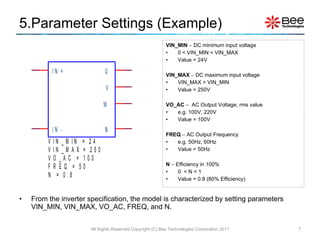
5.Parameter Settings (Example) VIN_MIN     DC minimum input voltage 0 < VIN_MIN < VIN_MAX Value = 24V VIN_MAX     DC maximum input voltage VIN_MAX > VIN_MIN Value = 250V VO_AC      AC Output Voltage, rms value e.g. 100V, 220V Value = 100V FREQ     AC Output Frequency e.g. 50Hz, 60Hz Value = 50Hz N     Efficiency in 100% 0  < N < 1 Value = 0.8 (80% Efficiency) From the inverter specification, the model is characterized by setting parameters VIN_MIN, VIN_MAX, VO_AC, FREQ, and N. All Rights Reserved Copyright (C) Bee Technologies Corporation 2011
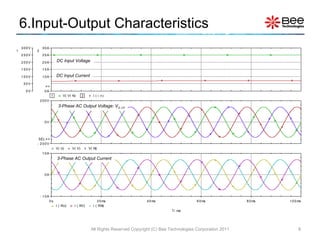
6.Input-Output Characteristics All Rights Reserved Copyright (C) Bee Technologies Corporation 2011 3-Phase AC Output Voltage: V O, LN DC Input Current DC Input Voltage 3-Phase AC Output Current
6.1 Simulation Circuit and Setting *Analysis directives:  .TRAN  0 100ms 0 10us  .PROBE V(*) I(*) W(*) D(*) NOISE(*) All Rights Reserved Copyright (C) Bee Technologies Corporation 2011
7.Line-to-Line Output Characteristics All Rights Reserved Copyright (C) Bee Technologies Corporation 2011 Line-to-Line Output Current Line-to-Line Output Voltage DC Input Voltage DC Input Current
7.1 Simulation Circuit and Setting *Analysis directives:  .TRAN  0 100ms 0 10us  .PROBE V(*) I(*) W(*) D(*) NOISE(*) All Rights Reserved Copyright (C) Bee Technologies Corporation 2011
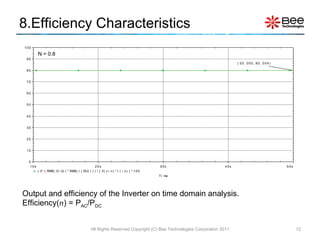
8.Efficiency Characteristics Output and efficiency of the Inverter on time domain analysis. Efficiency( n ) = P AC /P DC All Rights Reserved Copyright (C) Bee Technologies Corporation 2011 N = 0.8
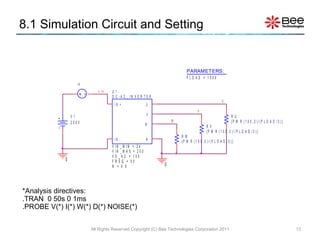
8.1 Simulation Circuit and Setting *Analysis directives:  .TRAN  0 50s 0 1ms  .PROBE V(*) I(*) W(*) D(*) NOISE(*) All Rights Reserved Copyright (C) Bee Technologies Corporation 2011
9.Minimum DC Input Voltage All Rights Reserved Copyright (C) Bee Technologies Corporation 2011 V O(AC)  disable as V IN  < V IN  ,MIN 3-Phase AC Output Voltage DC Input Voltage DC Input Current
9.1 Simulation Circuit and Setting *Analysis directives:  .TRAN  0 250ms 0 10us  .PROBE V(*) I(*) W(*) D(*) NOISE(*) All Rights Reserved Copyright (C) Bee Technologies Corporation 2011
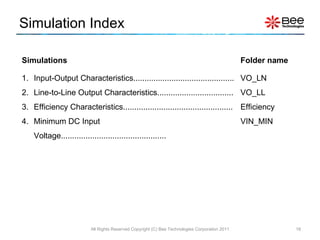
Simulation Index All Rights Reserved Copyright (C) Bee Technologies Corporation 2011 Simulations Folder name Input-Output Characteristics............................................. Line-to-Line Output Characteristics.................................. Efficiency Characteristics................................................. Minimum DC Input Voltage............................................... VO_LN VO_LL Efficiency VIN_MIN

DC/AC 3-Phase Inverter (PSpice Model)

  • 1.
    DC/AC Inverter (3-Phase) Simplified SPICE Behavioral Model All Rights Reserved Copyright (C) Bee Technologies Corporation 2011
  • 2.
    Contents Model OverviewBenefit of the Model Concept of the Model 3-Phase DC/AC Specification (Example) Parameter Settings Input-Output Characteristics 6.1 Simulation Circuit and Setting Line-to-Line Output Characteristics 7.1 Simulation Circuit and Setting Efficiency Characteristics 8.1 Simulation Circuit and Setting Minimum DC Input Voltage 9.1 Simulation Circuit and Setting Simulation Index All Rights Reserved Copyright (C) Bee Technologies Corporation 2011
  • 3.
    1.Model Overview This3-Phase DC/AC Inverter Simplified SPICE Behavioral Model is for users who require the model of an Inverter as a part of their system. The model focuses on the input/output relationships of the Inverter block; therefore, it is not using high frequency models (e.g. oscillator and noise models), and is not based on the electronic topologies of the Inverter. The model enables long-term behavior simulation of the system (e.g. in a Photovoltaic system simulation). All Rights Reserved Copyright (C) Bee Technologies Corporation 2011
  • 4.
    2.Benefit of theModel Enable Transient Simulation. Can be adjusted to your own 3-Phase DC/AC specifications, by editing the model parameters. The simplified model is an easy-to-use, which can be provided without the circuit detail. Time and costs are saved because only the necessary parts are simulated. All Rights Reserved Copyright (C) Bee Technologies Corporation 2011
  • 5.
    3.Concept of theModel The model is characterized by parameters n, Vin_min, Vin_max, Vo_ac and Freq that represent the input-output-relationships of the Inverter. Where, P AC : AC output power P DC : DC input power 3-Phase DC/AC Inverter Simplified SPICE Behavioral Model All Rights Reserved Copyright (C) Bee Technologies Corporation 2011 IN+ IN- U N V IN,MIN ~V IN,MAX (Vdc) I IN I O ~ ~ V W P OUT( 3-phase)
  • 6.
    4.DC/AC Specification (Example)3-Phase DC/AC Inverter with V IN = 24~250Vdc, V O, LN = 100V AC , P OUT(3-phase) = 1500W, and Efficiency = 80% 3-Phase DC/AC Inverter Efficiency ( n ) = 80% All Rights Reserved Copyright (C) Bee Technologies Corporation 2011 Operating Input Voltage: V IN,MIN =24 ~ V IN,MAX =250(Vdc) IN+ IN- U N V W ~ P OUT( 3-phase) I O ~ I IN
  • 7.
    5.Parameter Settings (Example)VIN_MIN  DC minimum input voltage 0 < VIN_MIN < VIN_MAX Value = 24V VIN_MAX  DC maximum input voltage VIN_MAX > VIN_MIN Value = 250V VO_AC  AC Output Voltage, rms value e.g. 100V, 220V Value = 100V FREQ  AC Output Frequency e.g. 50Hz, 60Hz Value = 50Hz N  Efficiency in 100% 0 < N < 1 Value = 0.8 (80% Efficiency) From the inverter specification, the model is characterized by setting parameters VIN_MIN, VIN_MAX, VO_AC, FREQ, and N. All Rights Reserved Copyright (C) Bee Technologies Corporation 2011
  • 8.
    6.Input-Output Characteristics AllRights Reserved Copyright (C) Bee Technologies Corporation 2011 3-Phase AC Output Voltage: V O, LN DC Input Current DC Input Voltage 3-Phase AC Output Current
  • 9.
    6.1 Simulation Circuitand Setting *Analysis directives: .TRAN 0 100ms 0 10us .PROBE V(*) I(*) W(*) D(*) NOISE(*) All Rights Reserved Copyright (C) Bee Technologies Corporation 2011
  • 10.
    7.Line-to-Line Output CharacteristicsAll Rights Reserved Copyright (C) Bee Technologies Corporation 2011 Line-to-Line Output Current Line-to-Line Output Voltage DC Input Voltage DC Input Current
  • 11.
    7.1 Simulation Circuitand Setting *Analysis directives: .TRAN 0 100ms 0 10us .PROBE V(*) I(*) W(*) D(*) NOISE(*) All Rights Reserved Copyright (C) Bee Technologies Corporation 2011
  • 12.
    8.Efficiency Characteristics Outputand efficiency of the Inverter on time domain analysis. Efficiency( n ) = P AC /P DC All Rights Reserved Copyright (C) Bee Technologies Corporation 2011 N = 0.8
  • 13.
    8.1 Simulation Circuitand Setting *Analysis directives: .TRAN 0 50s 0 1ms .PROBE V(*) I(*) W(*) D(*) NOISE(*) All Rights Reserved Copyright (C) Bee Technologies Corporation 2011
  • 14.
    9.Minimum DC InputVoltage All Rights Reserved Copyright (C) Bee Technologies Corporation 2011 V O(AC) disable as V IN < V IN ,MIN 3-Phase AC Output Voltage DC Input Voltage DC Input Current
  • 15.
    9.1 Simulation Circuitand Setting *Analysis directives: .TRAN 0 250ms 0 10us .PROBE V(*) I(*) W(*) D(*) NOISE(*) All Rights Reserved Copyright (C) Bee Technologies Corporation 2011
  • 16.
    Simulation Index AllRights Reserved Copyright (C) Bee Technologies Corporation 2011 Simulations Folder name Input-Output Characteristics............................................. Line-to-Line Output Characteristics.................................. Efficiency Characteristics................................................. Minimum DC Input Voltage............................................... VO_LN VO_LL Efficiency VIN_MIN