DC/DC Converter  Simplified SPICE Behavioral Model All Rights Reserved Copyright (C) Bee Technologies Corporation 2010
Contents Model Overview Benefit of the Model Concept of the Model DC/DC Specification (Example) Input-Output Characteristics Simulation Circuit and Setting All Rights Reserved Copyright (C) Bee Technologies Corporation 2010
1.Model Overview This  DC/DC Converter Simplified SPICE Behavioral Model  is for users who require the model of a converter as a part of their system. The model focuses on the input/output relationships of the converter block; therefore, it is not using high frequency models (e.g. oscillator and noise models), and is not based on the electronic topologies of the converter. The model enables long-term behavior simulation of the system (e.g. in a Photovoltaic system simulation), which is increased simulation speed more than 100 times compared to a cycle-to-cycle model. All Rights Reserved Copyright (C) Bee Technologies Corporation 2010
2.Benefit of the Model Enable Transient and DC Sweep Simulation. Can be adjusted to your own DC/DC specifications, step-up or step-down, by editing the model parameters. The simplified model is an easy-to-use, which can be provided without the circuit detail. Time and costs are saved because only the necessary parts are simulated. All Rights Reserved Copyright (C) Bee Technologies Corporation 2010
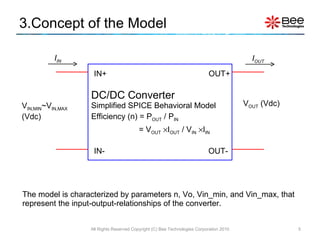
3.Concept of the Model The model is characterized by parameters n, Vo, Vin_min, and Vin_max, that represent the input-output-relationships of the converter.  DC/DC Converter   Simplified SPICE Behavioral Model Efficiency (n) = P OUT  / P IN    = V OUT    I OUT  / V IN    I IN  All Rights Reserved Copyright (C) Bee Technologies Corporation 2010 IN+ IN- OUT+ OUT- V IN,MIN ~V IN,MAX  (Vdc) V OUT  (Vdc) I IN I OUT
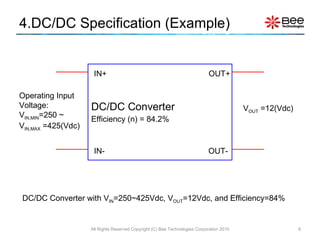
4.DC/DC Specification (Example) DC/DC Converter with V IN =250~425Vdc, V OUT =12Vdc, and Efficiency=84% DC/DC Converter Efficiency (n) = 84.2% All Rights Reserved Copyright (C) Bee Technologies Corporation 2010 IN+ IN- OUT+ OUT- Operating Input Voltage: V IN,MIN =250 ~ V IN,MAX  =425(Vdc) V OUT  =12(Vdc)
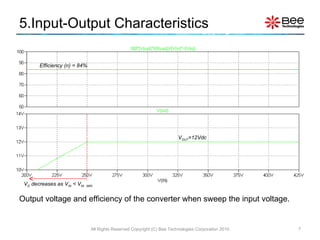
5.Input-Output Characteristics Output voltage and efficiency of the converter when sweep the input voltage. All Rights Reserved Copyright (C) Bee Technologies Corporation 2010 Efficiency (n) = 84% V OUT =12Vdc V O  decreases as V IN  < V IN  ,MIN
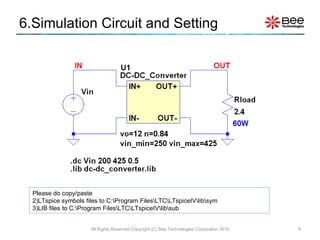
6.Simulation Circuit and Setting All Rights Reserved Copyright (C) Bee Technologies Corporation 2010 Please do copy/paste LTspice symbols files to C:\Program Files\LTC\LTspiceIV\lib\sym LIB files to C:\Program Files\LTC\LTspiceIV\lib\sub
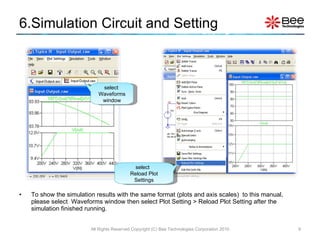
6.Simulation Circuit and Setting To show the simulation results with the same format (plots and axis scales)  to this manual, please select  Waveforms window then select Plot Setting > Reload Plot Setting after the simulation finished running. select  Waveforms window select  Reload Plot Settings All Rights Reserved Copyright (C) Bee Technologies Corporation 2010

DC/DC Converter (LTspice Model)

  • 1.
    DC/DC Converter Simplified SPICE Behavioral Model All Rights Reserved Copyright (C) Bee Technologies Corporation 2010
  • 2.
    Contents Model OverviewBenefit of the Model Concept of the Model DC/DC Specification (Example) Input-Output Characteristics Simulation Circuit and Setting All Rights Reserved Copyright (C) Bee Technologies Corporation 2010
  • 3.
    1.Model Overview This DC/DC Converter Simplified SPICE Behavioral Model is for users who require the model of a converter as a part of their system. The model focuses on the input/output relationships of the converter block; therefore, it is not using high frequency models (e.g. oscillator and noise models), and is not based on the electronic topologies of the converter. The model enables long-term behavior simulation of the system (e.g. in a Photovoltaic system simulation), which is increased simulation speed more than 100 times compared to a cycle-to-cycle model. All Rights Reserved Copyright (C) Bee Technologies Corporation 2010
  • 4.
    2.Benefit of theModel Enable Transient and DC Sweep Simulation. Can be adjusted to your own DC/DC specifications, step-up or step-down, by editing the model parameters. The simplified model is an easy-to-use, which can be provided without the circuit detail. Time and costs are saved because only the necessary parts are simulated. All Rights Reserved Copyright (C) Bee Technologies Corporation 2010
  • 5.
    3.Concept of theModel The model is characterized by parameters n, Vo, Vin_min, and Vin_max, that represent the input-output-relationships of the converter. DC/DC Converter Simplified SPICE Behavioral Model Efficiency (n) = P OUT / P IN = V OUT  I OUT / V IN  I IN All Rights Reserved Copyright (C) Bee Technologies Corporation 2010 IN+ IN- OUT+ OUT- V IN,MIN ~V IN,MAX (Vdc) V OUT (Vdc) I IN I OUT
  • 6.
    4.DC/DC Specification (Example)DC/DC Converter with V IN =250~425Vdc, V OUT =12Vdc, and Efficiency=84% DC/DC Converter Efficiency (n) = 84.2% All Rights Reserved Copyright (C) Bee Technologies Corporation 2010 IN+ IN- OUT+ OUT- Operating Input Voltage: V IN,MIN =250 ~ V IN,MAX =425(Vdc) V OUT =12(Vdc)
  • 7.
    5.Input-Output Characteristics Outputvoltage and efficiency of the converter when sweep the input voltage. All Rights Reserved Copyright (C) Bee Technologies Corporation 2010 Efficiency (n) = 84% V OUT =12Vdc V O decreases as V IN < V IN ,MIN
  • 8.
    6.Simulation Circuit andSetting All Rights Reserved Copyright (C) Bee Technologies Corporation 2010 Please do copy/paste LTspice symbols files to C:\Program Files\LTC\LTspiceIV\lib\sym LIB files to C:\Program Files\LTC\LTspiceIV\lib\sub
  • 9.
    6.Simulation Circuit andSetting To show the simulation results with the same format (plots and axis scales) to this manual, please select Waveforms window then select Plot Setting > Reload Plot Setting after the simulation finished running. select Waveforms window select Reload Plot Settings All Rights Reserved Copyright (C) Bee Technologies Corporation 2010