SURGICALAUDIT
Akinbode O.O.
LUTH
Outline
• Introduction
• Historical Perspective
• Aims of Surgical audit
• Commonly audited Parameters
• Principles of Clinical Auditing
• Types of audit
• Conduct of surgical audit
• Value of audit
• Disadvantages and limitations of audits
• Conclusion
Introduction
• The systematic, critical analysis of the quality of surgical
care that is reviewed by peers against explicit criteria or
recognized standards, and then used to further inform and
improve surgical practice with the goal of improving the
quality of care of the patients.
Introduction
• It is a process by which groups of professionals agree
upon the required levels of excellence in practice, monitor
whether they are being achieved and then resolve
deficits found
• It covers all aspects of surgical care including procedures
used for diagnosis and treatment; the use of resources
and the resulting outcomes and quality of life for patients
• The purpose is to bring about improvements in clinical
practice and patient outcome
Historical Perspective
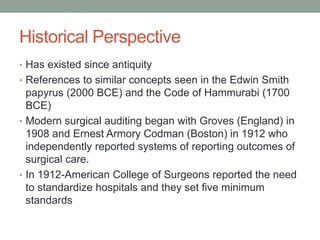
• Has existed since antiquity
• References to similar concepts seen in the Edwin Smith
papyrus (2000 BCE) and the Code of Hammurabi (1700
BCE)
• Modern surgical auditing began with Groves (England) in
1908 and Ernest Armory Codman (Boston) in 1912 who
independently reported systems of reporting outcomes of
surgical care.
• In 1912-American College of Surgeons reported the need
to standardize hospitals and they set five minimum
standards
Aims
• To identify ways of improving and maintaining the quality
of care for patients
• To assist in the continuing education of surgeons
• To help make the most of resources available for the
provision of surgical services.
Advantages of Audit
• Identifies bad practice
• Reduces unnecessary investigations, medications and
treatment
• Decreased length of admission
• Allows continuous refinement of treatment modalities
• Allows objective assessment of quality of care
• Improves efficiency and guides resource allocation
• Improved education, training and feedback
• Healthy competition
Types of Audit
• Retrospective or Concurrent
• Individual, Unit, Hospital, State, Regional, National
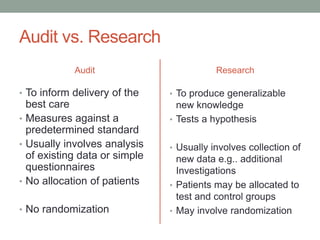
Audit vs. Research
Audit
• To inform delivery of the
best care
• Measures against a
predetermined standard
• Usually involves analysis
of existing data or simple
questionnaires
• No allocation of patients
• No randomization
Research
• To produce generalizable
new knowledge
• Tests a hypothesis
• Usually involves collection of
new data e.g.. additional
Investigations
• Patients may be allocated to
test and control groups
• May involve randomization
Audit vs. Research
Audit
• Only used to assess
modalities currently in use
Research
• May be used to assess
new or experimental
modalities
Principles
• Objectivity
• Honesty
• Accurate and standard forms
• Complete medical records
• All that happened to the patient
• Result of investigations
• Post Op Notes
• Follow up
• Autopsy findings
• Records should be filed in an accessible manner
Principles
• Confidentiality, patient privacy
• Relevance to common clinical problems.
• Clear standards set by peer assessment
• Education not punishment
• Audit should lead to appropriate action
Audit Parameters
• Time utilization
• Cost effectiveness
• Mortality/morbidity assessment
• Quality of diagnostic services
• Monitoring of performance
• Assessment of newer technologies
• Surgical outcome
• Knowledge of patient satisfaction
• Legal implications of surgery
Audit Parameters
• Audit of Structure
• Audit of Process
• Audit of Outcome
Audit of Structure
• Concerned with amount and type of resources available
• No of hospital beds, staff numbers, nurse to patient ratio,
theatres suites, wards, equipment
• Easy to measure
• Does not necessarily correlate with quality or
effectiveness of care
Audit of Process
• Concerned with the amount and type of processes carried
out
• Time utilization, time to surgery (in specific emergencies),
operating time, down time
• More relevant than audit of structure
• Identifies problems in surgical practice and proffers
solutions
• Can be difficult to quantify
Audit of Outcome
• Most relevant indicator of quality of care
• Intra and post op mortality, success rate, morbidity, wound
infection rate, specific complication rates, re-operation
rate, duration of hospital stay, re-admission rate, cost of
care, long term survival, quality of life
• Can be difficult to measure or quantify
• Requires adequate and long-term follow up
• Not always favoured by surgeons
• Doesn’t always tell the whole story
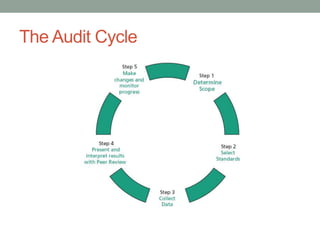
The Audit Cycle
Determining Scope
• Should be clearly defined
• Time bound
• Easy to measure
• Relevant to performance and outcome
Selection of Standards
• Clear cut standard for what is considered acceptable
clinical practice
• Should be evidence based
• Relevant to local trends
• Relevant to specialty and types of patients seen
• Should define adverse events
• Should define sentinel events
Data Collection
• Determine source of information
• Identify relevant information
• Assess accuracy of data
• Assess need to modify data
• Determine minimum acceptable quantity of data
Interpretation of Results
• Results should be presented regularly (e.g. monthly,
biannually)
• Results are evaluated by peers (e.g.. other surgeons or
other centres)
• Results should be compared to those of similar
centres/surgeons
• All sentinel events must be reviewed
• Quality issues should be identified
• Peer review is a learning process not for punishment or
bragging
Appropriate Action
• Recommendations and changes should be made based
on audit findings
• Staff should be educated on reasons behind each change
• Follow up
• Audit cycle should be repeated to assess effects of
changes
Disadvantages of Audit
• Takes considerable time and effort
• Highlights bad practice and “bad doctors”
• Exposes doctors to punitive action
• Doesn’t always tell the full story
• Pointless if no ability to make changes
• Promotes reliance on protocols and guidelines above
clinical judgment
Computers in Clinical Practice
• The availability of computers has significantly changed
the process of surgical audit
• Advantages: Easy storage and analysis of large amounts
of data
• Disadvantages: Translating and entering data to usable
formats, staff training, electricity
• Future trends: Electronic medical records
Local Experience
• Very little audit at individual and hospital level
• Morbidity and Mortality meetings
• Little training or emphasis on audit
• Poor and inconsistent data gathering
• Punitive mentality
Summary
• Surgical audit is a continuous quality improvement
process which systematically reviews surgical care
against explicit criteria to guide the implementation of
change
• It is a non- punitive, educational process aimed at
improving the outcome of patients
• Locally relevant criteria should be compared against
appropriate local standards to guide resource allocation,
surgical practice and decision making
Conclusion
• A good surgeon must never hide his/her faults, but should
learn from them in order to better serve his patients and
improve his practice
THANK YOU

Surgical Audit

  • 1.
  • 2.
    Outline • Introduction • HistoricalPerspective • Aims of Surgical audit • Commonly audited Parameters • Principles of Clinical Auditing • Types of audit • Conduct of surgical audit • Value of audit • Disadvantages and limitations of audits • Conclusion
  • 3.
    Introduction • The systematic,critical analysis of the quality of surgical care that is reviewed by peers against explicit criteria or recognized standards, and then used to further inform and improve surgical practice with the goal of improving the quality of care of the patients.
  • 4.
    Introduction • It isa process by which groups of professionals agree upon the required levels of excellence in practice, monitor whether they are being achieved and then resolve deficits found • It covers all aspects of surgical care including procedures used for diagnosis and treatment; the use of resources and the resulting outcomes and quality of life for patients • The purpose is to bring about improvements in clinical practice and patient outcome
  • 5.
    Historical Perspective • Hasexisted since antiquity • References to similar concepts seen in the Edwin Smith papyrus (2000 BCE) and the Code of Hammurabi (1700 BCE) • Modern surgical auditing began with Groves (England) in 1908 and Ernest Armory Codman (Boston) in 1912 who independently reported systems of reporting outcomes of surgical care. • In 1912-American College of Surgeons reported the need to standardize hospitals and they set five minimum standards
  • 6.
    Aims • To identifyways of improving and maintaining the quality of care for patients • To assist in the continuing education of surgeons • To help make the most of resources available for the provision of surgical services.
  • 7.
    Advantages of Audit •Identifies bad practice • Reduces unnecessary investigations, medications and treatment • Decreased length of admission • Allows continuous refinement of treatment modalities • Allows objective assessment of quality of care • Improves efficiency and guides resource allocation • Improved education, training and feedback • Healthy competition
  • 8.
    Types of Audit •Retrospective or Concurrent • Individual, Unit, Hospital, State, Regional, National
  • 9.
    Audit vs. Research Audit •To inform delivery of the best care • Measures against a predetermined standard • Usually involves analysis of existing data or simple questionnaires • No allocation of patients • No randomization Research • To produce generalizable new knowledge • Tests a hypothesis • Usually involves collection of new data e.g.. additional Investigations • Patients may be allocated to test and control groups • May involve randomization
  • 10.
    Audit vs. Research Audit •Only used to assess modalities currently in use Research • May be used to assess new or experimental modalities
  • 11.
    Principles • Objectivity • Honesty •Accurate and standard forms • Complete medical records • All that happened to the patient • Result of investigations • Post Op Notes • Follow up • Autopsy findings • Records should be filed in an accessible manner
  • 12.
    Principles • Confidentiality, patientprivacy • Relevance to common clinical problems. • Clear standards set by peer assessment • Education not punishment • Audit should lead to appropriate action
  • 13.
    Audit Parameters • Timeutilization • Cost effectiveness • Mortality/morbidity assessment • Quality of diagnostic services • Monitoring of performance • Assessment of newer technologies • Surgical outcome • Knowledge of patient satisfaction • Legal implications of surgery
  • 14.
    Audit Parameters • Auditof Structure • Audit of Process • Audit of Outcome
  • 15.
    Audit of Structure •Concerned with amount and type of resources available • No of hospital beds, staff numbers, nurse to patient ratio, theatres suites, wards, equipment • Easy to measure • Does not necessarily correlate with quality or effectiveness of care
  • 16.
    Audit of Process •Concerned with the amount and type of processes carried out • Time utilization, time to surgery (in specific emergencies), operating time, down time • More relevant than audit of structure • Identifies problems in surgical practice and proffers solutions • Can be difficult to quantify
  • 17.
    Audit of Outcome •Most relevant indicator of quality of care • Intra and post op mortality, success rate, morbidity, wound infection rate, specific complication rates, re-operation rate, duration of hospital stay, re-admission rate, cost of care, long term survival, quality of life • Can be difficult to measure or quantify • Requires adequate and long-term follow up • Not always favoured by surgeons • Doesn’t always tell the whole story
  • 18.
  • 19.
    Determining Scope • Shouldbe clearly defined • Time bound • Easy to measure • Relevant to performance and outcome
  • 20.
    Selection of Standards •Clear cut standard for what is considered acceptable clinical practice • Should be evidence based • Relevant to local trends • Relevant to specialty and types of patients seen • Should define adverse events • Should define sentinel events
  • 21.
    Data Collection • Determinesource of information • Identify relevant information • Assess accuracy of data • Assess need to modify data • Determine minimum acceptable quantity of data
  • 22.
    Interpretation of Results •Results should be presented regularly (e.g. monthly, biannually) • Results are evaluated by peers (e.g.. other surgeons or other centres) • Results should be compared to those of similar centres/surgeons • All sentinel events must be reviewed • Quality issues should be identified • Peer review is a learning process not for punishment or bragging
  • 23.
    Appropriate Action • Recommendationsand changes should be made based on audit findings • Staff should be educated on reasons behind each change • Follow up • Audit cycle should be repeated to assess effects of changes
  • 24.
    Disadvantages of Audit •Takes considerable time and effort • Highlights bad practice and “bad doctors” • Exposes doctors to punitive action • Doesn’t always tell the full story • Pointless if no ability to make changes • Promotes reliance on protocols and guidelines above clinical judgment
  • 25.
    Computers in ClinicalPractice • The availability of computers has significantly changed the process of surgical audit • Advantages: Easy storage and analysis of large amounts of data • Disadvantages: Translating and entering data to usable formats, staff training, electricity • Future trends: Electronic medical records
  • 26.
    Local Experience • Verylittle audit at individual and hospital level • Morbidity and Mortality meetings • Little training or emphasis on audit • Poor and inconsistent data gathering • Punitive mentality
  • 27.
    Summary • Surgical auditis a continuous quality improvement process which systematically reviews surgical care against explicit criteria to guide the implementation of change • It is a non- punitive, educational process aimed at improving the outcome of patients • Locally relevant criteria should be compared against appropriate local standards to guide resource allocation, surgical practice and decision making
  • 28.
    Conclusion • A goodsurgeon must never hide his/her faults, but should learn from them in order to better serve his patients and improve his practice
  • 29.

Editor's Notes

  • #4 quality improvement process seeking at improving patient care and outcomes through systematic review of care against explicit criteria to guide implementation of change
  • #5 All encompassing Aimed at improving patient outcomes and improving efficiency
  • #8 Resources can be channeled to areas where they will give the most benefit
  • #9 Retrospective: analyze past records Concurrent: continuous assessment
  • #12 Honesty, no cheating Audit without action is pointless Standardised forms to ensured data is collected in a consistent manner Complete records including final outcome Confidentiality, anonymization of data Non punitive, not vindictive. For education, training and improvement Audit parameters should be relevant to problems that exist in your local environment. Incidence of malaria in surgical inpatients. Not west Nile Virus Compare statistics with similar centres e.g.. UCH
  • #14 Rate of litigation
  • #16 LUTH has a lot of theatre suites
  • #17 Door to cath lab time in MI (US) Time to work up patient
  • #18 Time till return to work, patient satisfaction, litigation rate Cherry picking
  • #21 Adverse events: unplanned re-operation, excessive blood loss, post-op sepsis, death Sentinel events: unexpected event involving the risk of death, or serious physical or psychological injury e.g.. loss of limb or function. Require immediate investigation and response. Not necessarily due to error
  • #25 Takes considerable time and effort which can be better spent on patient care or research Mob mentality, people only remember the bad stuff Cherry picking
  • #27 Most M&Ms as practiced in Nigeria don’t meet required criteria of surgical audit. No prescribed standards, no changes or follow up