DAY CARE SURGERY
Presentor: Mohammad Masoom Parwez
Moderator: Dr. Bharati Pandya
Introduction
• 50% elective surgery in UK
• 60% elective surgery in USA / Canada
• 23 – 50% elective in India in selected centres
• NEED
• Long surgical waiting list
• Reduction in available beds
• High cost of in patients beds
• Improvement in anaesthesia and pain control
• Minimally invasive surgery
Definition
• “Planned investigations and procedures done on
patients who are admitted and discharged home
the same day as surgery and who require some
facilities and time for recovery.”
• Criteria of inclusion
• Patient who spend few hours in hospital but, do not stay
overnight.
• Patient who spend upto 23 hrs in hospital.
• Minor procedures in outpatient or accident in
emergency department  not included
Historical aspect
• 1909  James Nicholl reported 9000 children operated as day
cases
• 1912  Ralph Waters founded anaesthesia clinic in same way as
today’s day surgery unit
• 1951  Eric Farquharson carried out hernia repair under local
anaesthesia
• 1960  hospital based DSU appeared in USA
• 1969  Walter Heed set up 1st DSU named Phoenix surgicentre….
….
Benefits of day surgery
• Reduced cost
• Low post-operative morbidity
• Reduced thrombo-embolism and hospital acquired
infections
• Minimal disruption to patients life
• Early return to work and normal activities
• Children prefer it
Contd…
• More efficient high volume turnover of patients
• Reduced waiting lists for elective surgery
• In patients bed freed for major and emergency surgery
• Fewer cancellation on day of surgery
Problems of day surgery
• Initial cost of setting up DSU
• Good organization and management needed
• Poor patient and procedure selection
• Trained and efficient staff needed
• Inadequate information given to patient
• Morbidity from anaesthesia and surgery
Contd…
• Burden of care passed to patient’s family
• Increased community health care workload
• Quality of care in day surgery should be of same high standard
as that expected for inpatient surgery
• Lead to emergence of DSU
Desirable features DSU
• Self contained: Reception , ward , theatres and
recovery area
• Adjacent parking
• Well planned patient flow
• Maintain as high standards as inpatient wards and
theatres
• Bed theatre ratios as prescribed
• Set protocols for selection , analgesia and discharge
to be followed
• Good record keeping
Contd…
• Support services readily available
• Trained , experienced staff
• Consultant led anaesthesia and surgery
• Organized training with closed supervision of trainees
• Clinical director in overall charge
• Team work between staff groups
• In tune with community services and GPs
Organization of DSU
• Nurses  experienced with multi-skilling
specialized for children
• Ancillary staff  portering and domestic duties
• Technicians  record keeping, computer savvy
accurate and complete work-skills
high volume with fast turn over
Cont.…
• Medical staff ….
trainees are closely supervised …..
• Clinical director
• A consulant surgeon or anaesthetist
• Implement and audit good standards of care
• Regular multidisciplinary meetings required ….
Essentials of good day care surgery
• Selection of appropriate procedure and patients
• Pre-admission assessment and information
• Anaesthesia and surgery with minimal morbidity and
complication
• Post-operative and post-discharge analgesia
• Discharge criteria and postoperative instructions
• Follow-up and audit
Criteria for suitable procedures
• Minimal physiological alterations
• No excessive blood loss and fluid shifts
• Duration of 1-2 hrs maximum
• Oral analgesia after discharge
• Patient reasonably ambulant after discharge
• Avoid surgical drains
• Urinary catheters may be used
• Ensure minimal complications
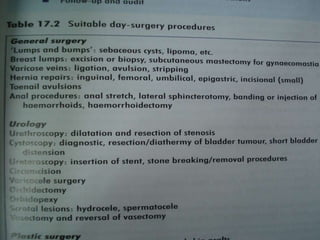
Day care procedures
Selection criteria for patients
• Social criteria
• Age
• Criteria for fitness of patients for general
anaesthesia
Social criteria
• Responsible adult  escort patient home …
• Few stairs to climb
Good toilet facilities
Access to telephone
• Should live within 1 hr of hospital facilities
• Ready access to GPs on discharge …
• Concept of hospital hotels overnight
supervision at low cost in hotels …
• Concept of hospital at home ….
Developing countries  due to long
distance and difficult travelling, day
surgery introduction has been slow
pick up.
Age
• Upper age limit  70 years
• Physiological age is more important than
actual age
• Lower age limit  facilities available
• Experienced staff
• Procedures undertaken
Criteria for selection of anaesthesia
• Patient
• Fit and ambulant
• Not grossly obese ( BMI <30 )
• Able to climb one flight of stairs
• Do not book patients with cardiovascular
disease
• Poorly controlled hypertension (BP > 170/100)
• Angina , CCF or PVD
• MI ,CVA or TIA in last 6 mnths
• Symptomatic valvular disease
• Cadio-myopathy
Contd …
• Respiratory disease
• Severe asthma or COPD
• Others
• IDDM or poorly controlled NIDDM
• Renal, hepatic disease
• Alcoholic , narcotic addiction
• Multiple sclerosis , myasthenia gravis
• Severe psychiatry disease
Contd …
• Do not book patient taking
• Anticoagulants
• Monoamine oxidase inhibitors
• Digoxin
• Systemic steroids
• Anti-arrhythmics
• Oral contraceptives
• GTN
Assessment before admission
• Surgeons are not good in assessing patients ….
• Anesthesiologists  impractical ….time , cost ,
manpower-wise
• Alternative  Filtering process
• Special nurses using planned questionnaire for
assessment
• Investigations done according to answers
• Anaesthesiologists review the case
Pre-admission information…
• On front page
• Time and date of operation with contact nos.
• Need for an escort or taxi to go home
• Females to notify DSU if pregnant or in menses
• Instructions not to drive for 48 hrs
• Fasting instructions
• Do not omit medication unless specified
• Instructions for clothing , valuables
Contd…
• Other information on day surgery
• Map , parking and how to find DSU
• Brief description of what will happen, PEMs
• Duration for stay and time for escort to come
• Post-anaesthetic restrictions on driving etc.
• Who to contact on discharge
Contd…
• Procedure specific information
• Procedure of operation
• Preoperative preparation
• Expected postoperative morbidity
• Rest duration
• Wound management , stitch removal and
follow up
Benefits of pre-admission clinic
• Problems sorted out before admission
• Unnecessary investigations reduced
• Cancellation on day of surgery reduced
• Patients better prepared and informed
• Non-attendance reduced
• Peri operative complications reduced
• Unplanned overnight admission reduced
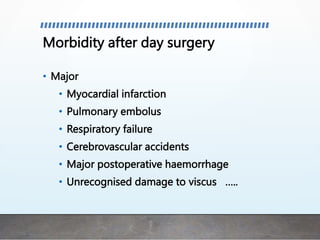
Morbidity after day surgery
• Major
• Myocardial infarction
• Pulmonary embolus
• Respiratory failure
• Cerebrovascular accidents
• Major postoperative haemorrhage
• Unrecognised damage to viscus …..
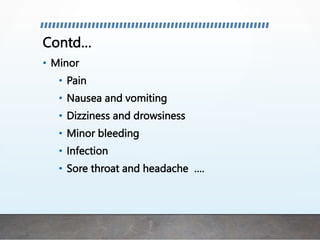
Contd…
• Minor
• Pain
• Nausea and vomiting
• Dizziness and drowsiness
• Minor bleeding
• Infection
• Sore throat and headache ….
Anaesthesia
• Anaesthetic morbidity  major reason for
unplanned readmission
• Two types
• Local /regional anaesthesia
• General anaesthesia
Local anaesthesia
• Ideal
• Excellent for elderly
• Economical
• BUT
• More time consuming
• Requires gentle hand
• Not preferred by patients
Contd…
• Types
• Spinal
• Caudal
• Epidural
• Disadvantage
• Time required to give and start action are more
• Delay in mobilization
• High incidence  urinary retention
Contd …
• Drug used
• Long acting bupivacaine
• If increased speed of onset 
lignocaine added
• Prilocaine , chloroprocaine  Beir
block….
General anaesthesia
• Good for children
• Propofol  drug of choice for IV induction
• Drug of choice for maintenance
• Good anaesthetic condition
• Rapid Problem-free recovery
• Incidence of post op nausea and vomiting is less
Contd…
• Inhalation induction
• Sevoflurane drug of choice for induction
• Has replaced halothane
• Maintenence  volatile agent
• Isoflurane
• Enflurane
• Nitrous oxide in oxygen
Contd …
• Short acting opoid
• Alfentanyl or fentanyl
• Reduces dose
• Provide analgesia  early post op
• Remifentanyl  ultrashort acting opoid .
Analgesia
• Good pain control is essential to prevent
• Delay in discharge
• Unplanned overnight admission
• GP consultation after discharge
• Distress and dis-satisfaction
• Limitation to early mobilisation
• Prolongation of return to normal function
• Morphine
• Less used as sedative PONV
Contd…
• Multimodal analgesia
• NSAIDS
• Local anaesthetics
• Short acting opioid
• Oral analgesics  3-5 days post discharge
Discharge guidelines
• Oriented to time, place, person
• Tolerate oral fluids
• Can void
• Dress
• Walk without assistance
• Patient must not have
• Nausea and vomiting
• Excessive pain
• Bleeding or
• Fever
Follow-up audit and quality control
• Good day care surgery means reduction in:
• Nonattendance
• Cancellation
• Complication before and after discharge
• Overnight admission
• Readmission
• Are audited and improvement made
• Telephone call next day reassures patient 
immediate feedback of analgesia and problems
Future
• It is not the Fastest surgery on the Fittest patient
• But has included older less fit patients with more major procedures
• And with advancement in medical science  has good prospects
THANK YOU

DAY_CARE_SURGERY[249].ppt

  • 1.
    DAY CARE SURGERY Presentor:Mohammad Masoom Parwez Moderator: Dr. Bharati Pandya
  • 2.
    Introduction • 50% electivesurgery in UK • 60% elective surgery in USA / Canada • 23 – 50% elective in India in selected centres • NEED • Long surgical waiting list • Reduction in available beds • High cost of in patients beds • Improvement in anaesthesia and pain control • Minimally invasive surgery
  • 3.
    Definition • “Planned investigationsand procedures done on patients who are admitted and discharged home the same day as surgery and who require some facilities and time for recovery.” • Criteria of inclusion • Patient who spend few hours in hospital but, do not stay overnight. • Patient who spend upto 23 hrs in hospital. • Minor procedures in outpatient or accident in emergency department  not included
  • 4.
    Historical aspect • 1909 James Nicholl reported 9000 children operated as day cases • 1912  Ralph Waters founded anaesthesia clinic in same way as today’s day surgery unit • 1951  Eric Farquharson carried out hernia repair under local anaesthesia • 1960  hospital based DSU appeared in USA • 1969  Walter Heed set up 1st DSU named Phoenix surgicentre…. ….
  • 5.
    Benefits of daysurgery • Reduced cost • Low post-operative morbidity • Reduced thrombo-embolism and hospital acquired infections • Minimal disruption to patients life • Early return to work and normal activities • Children prefer it
  • 6.
    Contd… • More efficienthigh volume turnover of patients • Reduced waiting lists for elective surgery • In patients bed freed for major and emergency surgery • Fewer cancellation on day of surgery
  • 7.
    Problems of daysurgery • Initial cost of setting up DSU • Good organization and management needed • Poor patient and procedure selection • Trained and efficient staff needed • Inadequate information given to patient • Morbidity from anaesthesia and surgery
  • 8.
    Contd… • Burden ofcare passed to patient’s family • Increased community health care workload • Quality of care in day surgery should be of same high standard as that expected for inpatient surgery • Lead to emergence of DSU
  • 9.
    Desirable features DSU •Self contained: Reception , ward , theatres and recovery area • Adjacent parking • Well planned patient flow • Maintain as high standards as inpatient wards and theatres • Bed theatre ratios as prescribed • Set protocols for selection , analgesia and discharge to be followed • Good record keeping
  • 10.
    Contd… • Support servicesreadily available • Trained , experienced staff • Consultant led anaesthesia and surgery • Organized training with closed supervision of trainees • Clinical director in overall charge • Team work between staff groups • In tune with community services and GPs
  • 11.
    Organization of DSU •Nurses  experienced with multi-skilling specialized for children • Ancillary staff  portering and domestic duties • Technicians  record keeping, computer savvy accurate and complete work-skills high volume with fast turn over
  • 12.
    Cont.… • Medical staff…. trainees are closely supervised ….. • Clinical director • A consulant surgeon or anaesthetist • Implement and audit good standards of care • Regular multidisciplinary meetings required ….
  • 13.
    Essentials of goodday care surgery • Selection of appropriate procedure and patients • Pre-admission assessment and information • Anaesthesia and surgery with minimal morbidity and complication • Post-operative and post-discharge analgesia • Discharge criteria and postoperative instructions • Follow-up and audit
  • 14.
    Criteria for suitableprocedures • Minimal physiological alterations • No excessive blood loss and fluid shifts • Duration of 1-2 hrs maximum • Oral analgesia after discharge • Patient reasonably ambulant after discharge • Avoid surgical drains • Urinary catheters may be used • Ensure minimal complications
  • 15.
  • 16.
    Selection criteria forpatients • Social criteria • Age • Criteria for fitness of patients for general anaesthesia
  • 17.
    Social criteria • Responsibleadult  escort patient home … • Few stairs to climb Good toilet facilities Access to telephone • Should live within 1 hr of hospital facilities • Ready access to GPs on discharge … • Concept of hospital hotels overnight supervision at low cost in hotels … • Concept of hospital at home ….
  • 18.
    Developing countries due to long distance and difficult travelling, day surgery introduction has been slow pick up.
  • 19.
    Age • Upper agelimit  70 years • Physiological age is more important than actual age • Lower age limit  facilities available • Experienced staff • Procedures undertaken
  • 20.
    Criteria for selectionof anaesthesia • Patient • Fit and ambulant • Not grossly obese ( BMI <30 ) • Able to climb one flight of stairs • Do not book patients with cardiovascular disease • Poorly controlled hypertension (BP > 170/100) • Angina , CCF or PVD • MI ,CVA or TIA in last 6 mnths • Symptomatic valvular disease • Cadio-myopathy
  • 21.
    Contd … • Respiratorydisease • Severe asthma or COPD • Others • IDDM or poorly controlled NIDDM • Renal, hepatic disease • Alcoholic , narcotic addiction • Multiple sclerosis , myasthenia gravis • Severe psychiatry disease
  • 22.
    Contd … • Donot book patient taking • Anticoagulants • Monoamine oxidase inhibitors • Digoxin • Systemic steroids • Anti-arrhythmics • Oral contraceptives • GTN
  • 23.
    Assessment before admission •Surgeons are not good in assessing patients …. • Anesthesiologists  impractical ….time , cost , manpower-wise • Alternative  Filtering process • Special nurses using planned questionnaire for assessment • Investigations done according to answers • Anaesthesiologists review the case
  • 24.
    Pre-admission information… • Onfront page • Time and date of operation with contact nos. • Need for an escort or taxi to go home • Females to notify DSU if pregnant or in menses • Instructions not to drive for 48 hrs • Fasting instructions • Do not omit medication unless specified • Instructions for clothing , valuables
  • 25.
    Contd… • Other informationon day surgery • Map , parking and how to find DSU • Brief description of what will happen, PEMs • Duration for stay and time for escort to come • Post-anaesthetic restrictions on driving etc. • Who to contact on discharge
  • 26.
    Contd… • Procedure specificinformation • Procedure of operation • Preoperative preparation • Expected postoperative morbidity • Rest duration • Wound management , stitch removal and follow up
  • 27.
    Benefits of pre-admissionclinic • Problems sorted out before admission • Unnecessary investigations reduced • Cancellation on day of surgery reduced • Patients better prepared and informed • Non-attendance reduced • Peri operative complications reduced • Unplanned overnight admission reduced
  • 30.
    Morbidity after daysurgery • Major • Myocardial infarction • Pulmonary embolus • Respiratory failure • Cerebrovascular accidents • Major postoperative haemorrhage • Unrecognised damage to viscus …..
  • 31.
    Contd… • Minor • Pain •Nausea and vomiting • Dizziness and drowsiness • Minor bleeding • Infection • Sore throat and headache ….
  • 32.
    Anaesthesia • Anaesthetic morbidity major reason for unplanned readmission • Two types • Local /regional anaesthesia • General anaesthesia
  • 33.
    Local anaesthesia • Ideal •Excellent for elderly • Economical • BUT • More time consuming • Requires gentle hand • Not preferred by patients
  • 34.
    Contd… • Types • Spinal •Caudal • Epidural • Disadvantage • Time required to give and start action are more • Delay in mobilization • High incidence  urinary retention
  • 35.
    Contd … • Drugused • Long acting bupivacaine • If increased speed of onset  lignocaine added • Prilocaine , chloroprocaine  Beir block….
  • 36.
    General anaesthesia • Goodfor children • Propofol  drug of choice for IV induction • Drug of choice for maintenance • Good anaesthetic condition • Rapid Problem-free recovery • Incidence of post op nausea and vomiting is less
  • 37.
    Contd… • Inhalation induction •Sevoflurane drug of choice for induction • Has replaced halothane • Maintenence  volatile agent • Isoflurane • Enflurane • Nitrous oxide in oxygen
  • 38.
    Contd … • Shortacting opoid • Alfentanyl or fentanyl • Reduces dose • Provide analgesia  early post op • Remifentanyl  ultrashort acting opoid .
  • 39.
    Analgesia • Good paincontrol is essential to prevent • Delay in discharge • Unplanned overnight admission • GP consultation after discharge • Distress and dis-satisfaction • Limitation to early mobilisation • Prolongation of return to normal function • Morphine • Less used as sedative PONV
  • 40.
    Contd… • Multimodal analgesia •NSAIDS • Local anaesthetics • Short acting opioid • Oral analgesics  3-5 days post discharge
  • 41.
    Discharge guidelines • Orientedto time, place, person • Tolerate oral fluids • Can void • Dress • Walk without assistance • Patient must not have • Nausea and vomiting • Excessive pain • Bleeding or • Fever
  • 42.
    Follow-up audit andquality control • Good day care surgery means reduction in: • Nonattendance • Cancellation • Complication before and after discharge • Overnight admission • Readmission • Are audited and improvement made • Telephone call next day reassures patient  immediate feedback of analgesia and problems
  • 43.
    Future • It isnot the Fastest surgery on the Fittest patient • But has included older less fit patients with more major procedures • And with advancement in medical science  has good prospects
  • 44.