PATHOGENESIS OF NON-UNION
Case scenario: MANAGEMENT OF FEMORAL
SHAFT NON-UNION IN A 45YR OLD MAN
DR. ALUMONA CHRISTIAN
Senior Registrar
National Orthopaedic Hospital, Lagos
Nigeria
OUTLINE
• Introduction
• Epidemiology
• Burden of Disease
• Definition
• Pathophysiology
• Normal Bone healing
• Aetiology & Risk factors
• Classification
• Management
• Background
• Aims
Outline cont
• Clinical evaluation
• History
• Physical evaluation
• Imaging
• Plain radiograph
• CT
• Nuclear imaging
• Laboratory investigation
Outline Cont
• Treatment
• General principles
• Non-operative
• Operative
• Adjuncts to operative repair
• Long term outcomes and risk factors for non union repair failure
• Rehabilitation and Follow up
• Conclusion
• References
Introduction
• Bone healing: A complex biological phenomenon.
• Interruptions may delay or impede the process.
• Factors relating to the patient, primary injury or treatment received
• Associated functional impairment, protracted treatment, lost wages
and chronic pain.
• Significant psycho-social impairment, and economic burden to both
the patient and the health system.
Epidemiology
• Overall rate on non-union: 4.9%1,2
• US: 4-9%3
• UK: 5-10%3
• Nigeria: ?
• TBS treated fractures: 25%4 ends up as nonunion
• Open fractures: 2.7%5 results in delayed/non union
• Prevalence expected to be higher in sub-Saharan Africa
• High TBS patronage >80%4
• Late presentation of open fractures
Definition:
• Based on clinical and radiologic findings
• Delayed union: clinical and radiological features of union lags
behind expected time table but healing is still possible
• Nonunion: Failure of a fracture to heal within the expected time
and is not likely to heal without new intervention.
• 6-8months7 or 9months post op8.
• Fracture healing is variable: age, bone, region of bone, type of
fracture, energy of injury, soft tissue state, method of treatment.
• On a cellular level
• Cessation of reparative process antecedent to bony union7
Disease Burden
• Debilitating chronic medical condition.
• Substantial negative effects on health
• Health related quality of life worse than Type 1 DM, stroke and AIDS6
Pathophysiology
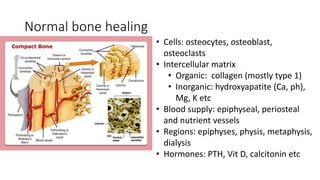
Normal bone healing
• Cells: osteocytes, osteoblast,
osteoclasts
• Intercellular matrix
• Organic: collagen (mostly type 1)
• Inorganic: hydroxyapatite (Ca, ph),
Mg, K etc
• Blood supply: epiphyseal, periosteal
and nutrient vessels
• Regions: epiphyses, physis, metaphysis,
dialysis
• Hormones: PTH, Vit D, calcitonin etc
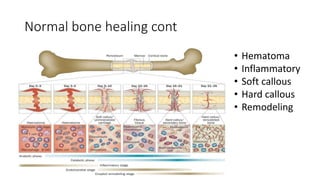
Normal bone healing cont
• Hematoma
• Inflammatory
• Soft callous
• Hard callous
• Remodeling
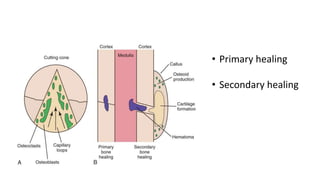
• Primary healing
• Secondary healing
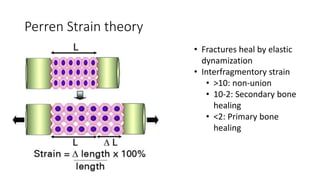
Perren Strain theory
• Fractures heal by elastic
dynamization
• Interfragmentory strain
• >10: non-union
• 10-2: Secondary bone
healing
• <2: Primary bone
healing
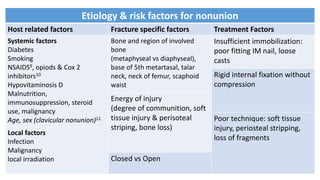
Etiology & risk factors for nonunion
Host related factors Fracture specific factors Treatment Factors
Systemic factors
Diabetes
Smoking
NSAIDS9, opiods & Cox 2
inhibitors10
Hypovitaminosis D
Malnutrition,
immunosuppression, steroid
use, malignancy
Age, sex (clavicular nonunion)11
Bone and region of involved
bone
(metaphyseal vs diaphyseal),
base of 5th metartasal, talar
neck, neck of femur, scaphoid
waist
Insufficient immobilization:
poor fitting IM nail, loose
casts
Rigid internal fixation without
compression
Energy of injury
(degree of communition, soft
tissue injury & perisoteal
striping, bone loss)
Poor technique: soft tissue
injury, periosteal stripping,
loss of fragments
Local factors
Infection
Malignancy
local irradiation Closed vs Open
Classification of Nonunion
• Septic vs Aseptic
• Atrophic vs oligotrophic vs hypertrophic
• Pseudoarthrosis
• Bone defects
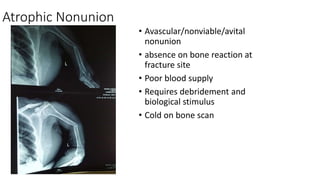
Atrophic Nonunion
• Avascular/nonviable/avital
nonunion
• absence on bone reaction at
fracture site
• Poor blood supply
• Requires debridement and
biological stimulus
• Cold on bone scan
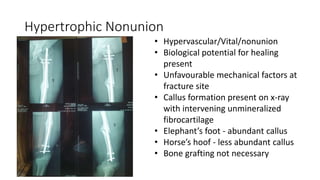
Hypertrophic Nonunion
• Hypervascular/Vital/nonunion
• Biological potential for healing
present
• Unfavourable mechanical factors at
fracture site
• Callus formation present on x-ray
with intervening unmineralized
fibrocartilage
• Elephant’s foot - abundant callus
• Horse’s hoof - less abundant callus
• Bone grafting not necessary
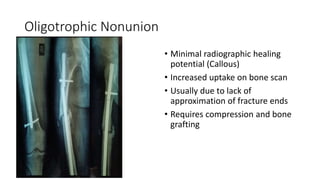
Oligotrophic Nonunion
• Minimal radiographic healing
potential (Callous)
• Increased uptake on bone scan
• Usually due to lack of
approximation of fracture ends
• Requires compression and bone
grafting
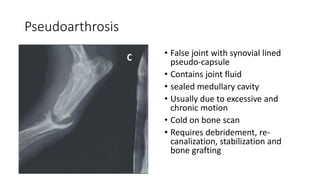
Pseudoarthrosis
• False joint with synovial lined
pseudo-capsule
• Contains joint fluid
• sealed medullary cavity
• Usually due to excessive and
chronic motion
• Cold on bone scan
• Requires debridement, re-
canalization, stabilization and
bone grafting
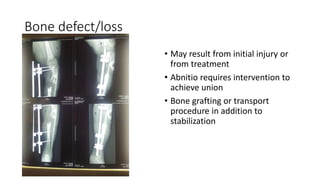
Bone defect/loss
• May result from initial injury or
from treatment
• Abnitio requires intervention to
achieve union
• Bone grafting or transport
procedure in addition to
stabilization
Management
• Background
• 45yr old man
• Femoral shaft nonunion
• Aims
• Appropriately diagnose and classify the pathology
• Identify possible etiology and risk factors in the patient
• Optimize comorbidities
• Accurately describe any associated bone or joint deformity that may require
correction
• Understand impact of disease and selected treatment option to achieve union
• Rehabilitate and reintegrate the patient
Clinical Evaluation: History
• History of present symptoms
• Pain
• Abnormal motion
• Lack of ability to bear weight
• Discharging sinus
• History of index injury
• Mechanism/energy of injury
• soft tissue component; open vs closed
• prior treatments; type and timing, purpose, response
• biopsy mcs result
• complications & recovery
History cont
• Impact of illness
• On social life
• On occupation
• Medical and social History
• DM
• Immunosuppression
• Smoking
• Medications: NSAIDS, Opiods, etc
Physical examination
• General appearance
• Msk exam
• Gait: antalgic, short limb
• signs of inflammation
• Scarification, surgical scars
• Gross motion
• LLD
• Knee stiffness
Investigation: Imaging
• Plain radiographs
• Viability of segments
• Presence of implants
• Features of infection
• CT scan
• Nuclear scan
• determine viability
• detect infection
Laboratory investigation
To rule out infection, comorbidity, determine fitness
• FBC
• ESR, CRP, Serum pro calcitonin
• Serum albumin
• FBS, HBA1c
• wound swab mcs
Treatment
• Considerations
• Prior treatments and response
• Current level of disability
• Time constraints for future weight bearing restrictions
• Occupational needs
• General measures
• Correction on endocrine and metabolic disorders (DM, parathyroid disorders), HIV
• Optimization of nutrition
• Smoking cessation
• Stoppage/reduction of certain medications (NSAIDS, Opiods, steroids, Selective Cox
2 inhibitors, bisphophonates)
• Control/eradication of infection
• Soft tissue management
Non operative management
• Indication
• Little or no clinical symptom
• Acceptable alignment
• Reasonable potential for success with non operative mgt
• Minimal comorbidity associated with time required for non operative mgt
• PT not fit for surgery
• Relative contraindication
• Chronic pain, functional loss, disability
• Progressive fracture malalignment
• Persistent and excessive movement at fracture site
• Infected nonunion
Non-operative mgt: options
• Weight bearing
• Splinting with cast or orthosis
• Electromagnetic stimulation
• DC: invasive
• CC: 24hours/day
• PEMF: 8-12hours/day
• CMF: 30min/day
• Ultrasound stimulation:
• LIPU,
• ESWT
• Parathyroid hormone
Minimaly invasive options
• Percutaneous Mgt
• Percutaneous injection of concentrated bone marrow12
• Percutaneous platelet rich plasma
Operative Mgt
• Indication
• Chronic pain, functional loss, disability
• Progressive fracture malalignment
• Persistent and excessive movement at fracture site
• Infected nonunion
• Preference
• Contraindication
• PT not fit for surgery
Operative management
• IM Nailing
• Primary nailing
• Exchange nailing
• Dynamization
• Primary nailing
• A common option of mgt of diaphyseal femur nonunion13
• Indications: following primary nonoperative mgt, and in well aligned
nonunion initialy mgt with plate fixation
Operative mgt: IM Nailing cont
• Exchange nailing
• Removing a pre existing nail for a new one
• Indication: to correct deficiencies in the existing nail with a
bigger nail
• bone defect,
• lack of rotational control (absence or broken interlocking
screw)
• Lack of stability (undersized nail)
• Added advantage of reaming
• Deposits small bone graft to the nonunion
• Stimulate inflammatory response sufficient to promote healing
Operative mgt: IM Nailing cont
• Recommendations for exchange nailing14
• New nail >2mm
• Different manufacturer’s nail
• Static interlocking
• Correction of any endocrine or metabolic abnormalities
• Secondary nail dynamization
Operative mgt: IM Nailing cont
• Dynamization:
• Removal of interlocking screws at one end of a nail
• To achieve axial shortening on weight bearing
• Mechanism: compression and micro-motion at fracture site
• Forms
• Removal of static screw and retention of a dynamic screw
• Maintains rotational control
• Limits amount of shortening that can be achieved
• Removal of all interlocking screw from one end
• Greater compression at the expense of rotational control
• What end of the nail should be dynamized
• Screws closest to fracture site should be reatined
• Screws opposite the isthmus relative to the fracture site should be removed
• Complications of dynamization
• Loss of rotational control (when all interlocking screws from one end are
removed)
• Loss of length from excessive shortening
• Nail back out into adjacent joint
Operative mgt: Plate osteosynthesis
• Pros
• Can address angular, rotational and translational deformities
• Provide greater compression at fracture site
• Can be used in the case of obliterated medullary cavity associated with some
nonunion
• Cons
• Invasive
• Delayed weight bearing
• Can not address limb shortening from bone loss
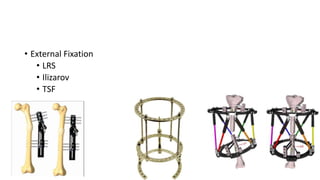
• External Fixation
• LRS
• Ilizarov
• TSF
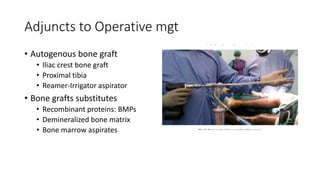
Adjuncts to Operative mgt
• Autogenous bone graft
• Iliac crest bone graft
• Proximal tibia
• Reamer-Irrigator aspirator
• Bone grafts substitutes
• Recombinant proteins: BMPs
• Demineralized bone matrix
• Bone marrow aspirates
Rehabilitation and Follow up
• ROM exercises
• Ambulation training
• Follow up radiographs
• Pin site care
Long term outcomes and risk factors for non union
repair failure
• Pain
• Knee stiffness
• LLD
• COM
• Failed repair: Risk factors include;
• Mechanism of injury
• Increased BMI
• Cortical size defect
• Smoking
• Failed previous surgical interventions
Conclusion
• Fracture nonunion is a chronic debilitating illness that most often
does not receive commensurate attention.
• A holistic approach to management requires a painstaking search for
risk factors and comorbidities in the patient, optimization of such and
the selection of the most appropriate option of treatment while
ensuring that further morbidity are prevented.
• Thanks
References
• 1.Zura R, Xiong Z, Einhorn T, et al. Epidemiology of fracture nonunion in 18 human bones.
JAMA Surg. 2016;151(11):e162775.
• 2.Zura R, Xiong Z, Einhorn T, Watson JT, Ostrum RF, Prayson MJ, Della Rocca GJ, Mehta S,
McKinley T, Wang Z, Steen RG. Epidemiology of Fracture Nonunion in 18 Human Bones. JAMA
Surg. 2016 Nov 16;151(11):e162775. doi: 10.1001/jamasurg.2016.2775. Epub 2016 Nov 16.
PMID: 27603155.
• 3.Madu, Kenechi & Nnyagu, Henry & Ede, Osita. (2018). Non-union treatment outcomes in
South-East Nigeria. Nigerian Journal of Orthopaedics and Trauma. 17. 77.
10.4103/njot.njot_23_18.
• 4.DA OlaOlorun, IO Oladiran, A Adeniran, Complications of fracture treatment by traditional
bonesetters in southwest Nigeria, Family Practice, Volume 18, Issue 6, December 2001, Pages
635–637, https://doi.org/10.1093/fampra/18.6.635
• 5.Ibeanusi SEB, Obalum DC (2019) Open Fractures Treated in a Regional Trauma Centre in
Nigeria: Presentation and Outcome - A Prospective Observational Study. Int Arch Orthop Surg
2:007. doi.org/10.23937/iaos-2017/1710007
• 6. Schottel PC, O'Connor DP, Brinker MR. Time Trade-Off as a Measure of Health-Related Quality of Life: Long Bone
Nonunions Have a Devastating Impact. J Bone Joint Surg Am. 2015 Sep 2;97(17):1406-10. doi: 10.2106/JBJS.N.01090. PMID:
26333735; PMCID: PMC7535097.
• 7. Paul T, William M, Robert F, Margret M, Micheal D, Charles M. Rockwood and Green’s Fractures in Adults. 9th Edition.
Wolters Kluwer; 2020
• 8. Ashley B, David W, Micheal R. Apley & Solomon’s System of Orthopaedics and Trauma. 10th edition. CRC Press; 2018
• 9.Wheatley BM, Nappo KE, Christensen DL, Holman AM, Brooks DI, Potter BK. Effect of NSAIDs on Bone Healing Rates: A
Meta-analysis. J Am Acad Orthop Surg. 2019 Apr 1;27(7):e330-e336. doi: 10.5435/JAAOS-D-17-00727. PMID: 30260913.
• 10.Tian R, Zheng F, Zhao W, Zhang Y, Yuan J, Zhang B, Li L. Prevalence and influencing factors of nonunion in patients with
tibial fracture: systematic review and meta-analysis. J Orthop Surg Res. 2020 Sep 3;15(1):377. doi: 10.1186/s13018-020-
01904-2. PMID: 32883313; PMCID: PMC7469357.
• 11.Robinson CM, Court-Brown CM, McQueen MM, Wakefield AE. Estimating the risk of nonunion following nonoperative
treatment of a clavicular fracture. J Bone Joint Surg Am. 2004 Jul;86(7):1359-65. doi: 10.2106/00004623-200407000-00002.
PMID: 15252081.
• 12.Hernigou P, Poignard A, Beaujean F, Rouard H. Percutaneous autologous bone-marrow grafting for nonunions. Influence
of the number and concentration of progenitor cells. J Bone Joint Surg Am. 2005 Jul;87(7):1430-7. doi:
10.2106/JBJS.D.02215. PMID: 15995108.
• 13.Madu KA, Nnyagu H, Ede O. Non-union treatment outcomes in South-East Nigeria. Niger J Orthop Trauma [serial online]
2018 [cited 2022 May 16];17:77-80. Available from: https://www.njotonline.org/text.asp?2018/17/2/77/250738
• 14.Swanson EA, Garrard EC, Bernstein DT, OʼConnor DP, Brinker MR. Results of a systematic approach to exchange nailing
for the treatment of aseptic femoral nonunions. J Orthop Trauma. 2015 Jan;29(1):21-7. doi:
10.1097/BOT.0000000000000166. PMID: 24978947.

PATHOGENESIS OF NON-UNION.pptx

  • 1.
    PATHOGENESIS OF NON-UNION Casescenario: MANAGEMENT OF FEMORAL SHAFT NON-UNION IN A 45YR OLD MAN DR. ALUMONA CHRISTIAN Senior Registrar National Orthopaedic Hospital, Lagos Nigeria
  • 2.
    OUTLINE • Introduction • Epidemiology •Burden of Disease • Definition • Pathophysiology • Normal Bone healing • Aetiology & Risk factors • Classification • Management • Background • Aims
  • 3.
    Outline cont • Clinicalevaluation • History • Physical evaluation • Imaging • Plain radiograph • CT • Nuclear imaging • Laboratory investigation
  • 4.
    Outline Cont • Treatment •General principles • Non-operative • Operative • Adjuncts to operative repair • Long term outcomes and risk factors for non union repair failure • Rehabilitation and Follow up • Conclusion • References
  • 5.
    Introduction • Bone healing:A complex biological phenomenon. • Interruptions may delay or impede the process. • Factors relating to the patient, primary injury or treatment received • Associated functional impairment, protracted treatment, lost wages and chronic pain. • Significant psycho-social impairment, and economic burden to both the patient and the health system.
  • 6.
    Epidemiology • Overall rateon non-union: 4.9%1,2 • US: 4-9%3 • UK: 5-10%3 • Nigeria: ? • TBS treated fractures: 25%4 ends up as nonunion • Open fractures: 2.7%5 results in delayed/non union • Prevalence expected to be higher in sub-Saharan Africa • High TBS patronage >80%4 • Late presentation of open fractures
  • 7.
    Definition: • Based onclinical and radiologic findings • Delayed union: clinical and radiological features of union lags behind expected time table but healing is still possible • Nonunion: Failure of a fracture to heal within the expected time and is not likely to heal without new intervention. • 6-8months7 or 9months post op8. • Fracture healing is variable: age, bone, region of bone, type of fracture, energy of injury, soft tissue state, method of treatment. • On a cellular level • Cessation of reparative process antecedent to bony union7
  • 8.
    Disease Burden • Debilitatingchronic medical condition. • Substantial negative effects on health • Health related quality of life worse than Type 1 DM, stroke and AIDS6
  • 9.
  • 10.
    Normal bone healing •Cells: osteocytes, osteoblast, osteoclasts • Intercellular matrix • Organic: collagen (mostly type 1) • Inorganic: hydroxyapatite (Ca, ph), Mg, K etc • Blood supply: epiphyseal, periosteal and nutrient vessels • Regions: epiphyses, physis, metaphysis, dialysis • Hormones: PTH, Vit D, calcitonin etc
  • 11.
    Normal bone healingcont • Hematoma • Inflammatory • Soft callous • Hard callous • Remodeling
  • 12.
    • Primary healing •Secondary healing
  • 13.
    Perren Strain theory •Fractures heal by elastic dynamization • Interfragmentory strain • >10: non-union • 10-2: Secondary bone healing • <2: Primary bone healing
  • 14.
    Etiology & riskfactors for nonunion Host related factors Fracture specific factors Treatment Factors Systemic factors Diabetes Smoking NSAIDS9, opiods & Cox 2 inhibitors10 Hypovitaminosis D Malnutrition, immunosuppression, steroid use, malignancy Age, sex (clavicular nonunion)11 Bone and region of involved bone (metaphyseal vs diaphyseal), base of 5th metartasal, talar neck, neck of femur, scaphoid waist Insufficient immobilization: poor fitting IM nail, loose casts Rigid internal fixation without compression Energy of injury (degree of communition, soft tissue injury & perisoteal striping, bone loss) Poor technique: soft tissue injury, periosteal stripping, loss of fragments Local factors Infection Malignancy local irradiation Closed vs Open
  • 15.
    Classification of Nonunion •Septic vs Aseptic • Atrophic vs oligotrophic vs hypertrophic • Pseudoarthrosis • Bone defects
  • 16.
    Atrophic Nonunion • Avascular/nonviable/avital nonunion •absence on bone reaction at fracture site • Poor blood supply • Requires debridement and biological stimulus • Cold on bone scan
  • 17.
    Hypertrophic Nonunion • Hypervascular/Vital/nonunion •Biological potential for healing present • Unfavourable mechanical factors at fracture site • Callus formation present on x-ray with intervening unmineralized fibrocartilage • Elephant’s foot - abundant callus • Horse’s hoof - less abundant callus • Bone grafting not necessary
  • 18.
    Oligotrophic Nonunion • Minimalradiographic healing potential (Callous) • Increased uptake on bone scan • Usually due to lack of approximation of fracture ends • Requires compression and bone grafting
  • 19.
    Pseudoarthrosis • False jointwith synovial lined pseudo-capsule • Contains joint fluid • sealed medullary cavity • Usually due to excessive and chronic motion • Cold on bone scan • Requires debridement, re- canalization, stabilization and bone grafting
  • 20.
    Bone defect/loss • Mayresult from initial injury or from treatment • Abnitio requires intervention to achieve union • Bone grafting or transport procedure in addition to stabilization
  • 21.
    Management • Background • 45yrold man • Femoral shaft nonunion • Aims • Appropriately diagnose and classify the pathology • Identify possible etiology and risk factors in the patient • Optimize comorbidities • Accurately describe any associated bone or joint deformity that may require correction • Understand impact of disease and selected treatment option to achieve union • Rehabilitate and reintegrate the patient
  • 22.
    Clinical Evaluation: History •History of present symptoms • Pain • Abnormal motion • Lack of ability to bear weight • Discharging sinus • History of index injury • Mechanism/energy of injury • soft tissue component; open vs closed • prior treatments; type and timing, purpose, response • biopsy mcs result • complications & recovery
  • 23.
    History cont • Impactof illness • On social life • On occupation • Medical and social History • DM • Immunosuppression • Smoking • Medications: NSAIDS, Opiods, etc
  • 24.
    Physical examination • Generalappearance • Msk exam • Gait: antalgic, short limb • signs of inflammation • Scarification, surgical scars • Gross motion • LLD • Knee stiffness
  • 25.
    Investigation: Imaging • Plainradiographs • Viability of segments • Presence of implants • Features of infection • CT scan • Nuclear scan • determine viability • detect infection
  • 26.
    Laboratory investigation To ruleout infection, comorbidity, determine fitness • FBC • ESR, CRP, Serum pro calcitonin • Serum albumin • FBS, HBA1c • wound swab mcs
  • 27.
    Treatment • Considerations • Priortreatments and response • Current level of disability • Time constraints for future weight bearing restrictions • Occupational needs • General measures • Correction on endocrine and metabolic disorders (DM, parathyroid disorders), HIV • Optimization of nutrition • Smoking cessation • Stoppage/reduction of certain medications (NSAIDS, Opiods, steroids, Selective Cox 2 inhibitors, bisphophonates) • Control/eradication of infection • Soft tissue management
  • 28.
    Non operative management •Indication • Little or no clinical symptom • Acceptable alignment • Reasonable potential for success with non operative mgt • Minimal comorbidity associated with time required for non operative mgt • PT not fit for surgery • Relative contraindication • Chronic pain, functional loss, disability • Progressive fracture malalignment • Persistent and excessive movement at fracture site • Infected nonunion
  • 29.
    Non-operative mgt: options •Weight bearing • Splinting with cast or orthosis • Electromagnetic stimulation • DC: invasive • CC: 24hours/day • PEMF: 8-12hours/day • CMF: 30min/day
  • 30.
    • Ultrasound stimulation: •LIPU, • ESWT • Parathyroid hormone
  • 31.
    Minimaly invasive options •Percutaneous Mgt • Percutaneous injection of concentrated bone marrow12 • Percutaneous platelet rich plasma
  • 32.
    Operative Mgt • Indication •Chronic pain, functional loss, disability • Progressive fracture malalignment • Persistent and excessive movement at fracture site • Infected nonunion • Preference • Contraindication • PT not fit for surgery
  • 33.
    Operative management • IMNailing • Primary nailing • Exchange nailing • Dynamization • Primary nailing • A common option of mgt of diaphyseal femur nonunion13 • Indications: following primary nonoperative mgt, and in well aligned nonunion initialy mgt with plate fixation
  • 34.
    Operative mgt: IMNailing cont • Exchange nailing • Removing a pre existing nail for a new one • Indication: to correct deficiencies in the existing nail with a bigger nail • bone defect, • lack of rotational control (absence or broken interlocking screw) • Lack of stability (undersized nail) • Added advantage of reaming • Deposits small bone graft to the nonunion • Stimulate inflammatory response sufficient to promote healing
  • 35.
    Operative mgt: IMNailing cont • Recommendations for exchange nailing14 • New nail >2mm • Different manufacturer’s nail • Static interlocking • Correction of any endocrine or metabolic abnormalities • Secondary nail dynamization
  • 36.
    Operative mgt: IMNailing cont • Dynamization: • Removal of interlocking screws at one end of a nail • To achieve axial shortening on weight bearing • Mechanism: compression and micro-motion at fracture site • Forms • Removal of static screw and retention of a dynamic screw • Maintains rotational control • Limits amount of shortening that can be achieved • Removal of all interlocking screw from one end • Greater compression at the expense of rotational control
  • 37.
    • What endof the nail should be dynamized • Screws closest to fracture site should be reatined • Screws opposite the isthmus relative to the fracture site should be removed • Complications of dynamization • Loss of rotational control (when all interlocking screws from one end are removed) • Loss of length from excessive shortening • Nail back out into adjacent joint
  • 38.
    Operative mgt: Plateosteosynthesis • Pros • Can address angular, rotational and translational deformities • Provide greater compression at fracture site • Can be used in the case of obliterated medullary cavity associated with some nonunion • Cons • Invasive • Delayed weight bearing • Can not address limb shortening from bone loss
  • 39.
    • External Fixation •LRS • Ilizarov • TSF
  • 40.
    Adjuncts to Operativemgt • Autogenous bone graft • Iliac crest bone graft • Proximal tibia • Reamer-Irrigator aspirator • Bone grafts substitutes • Recombinant proteins: BMPs • Demineralized bone matrix • Bone marrow aspirates
  • 41.
    Rehabilitation and Followup • ROM exercises • Ambulation training • Follow up radiographs • Pin site care
  • 42.
    Long term outcomesand risk factors for non union repair failure • Pain • Knee stiffness • LLD • COM • Failed repair: Risk factors include; • Mechanism of injury • Increased BMI • Cortical size defect • Smoking • Failed previous surgical interventions
  • 43.
    Conclusion • Fracture nonunionis a chronic debilitating illness that most often does not receive commensurate attention. • A holistic approach to management requires a painstaking search for risk factors and comorbidities in the patient, optimization of such and the selection of the most appropriate option of treatment while ensuring that further morbidity are prevented.
  • 44.
  • 45.
    References • 1.Zura R,Xiong Z, Einhorn T, et al. Epidemiology of fracture nonunion in 18 human bones. JAMA Surg. 2016;151(11):e162775. • 2.Zura R, Xiong Z, Einhorn T, Watson JT, Ostrum RF, Prayson MJ, Della Rocca GJ, Mehta S, McKinley T, Wang Z, Steen RG. Epidemiology of Fracture Nonunion in 18 Human Bones. JAMA Surg. 2016 Nov 16;151(11):e162775. doi: 10.1001/jamasurg.2016.2775. Epub 2016 Nov 16. PMID: 27603155. • 3.Madu, Kenechi & Nnyagu, Henry & Ede, Osita. (2018). Non-union treatment outcomes in South-East Nigeria. Nigerian Journal of Orthopaedics and Trauma. 17. 77. 10.4103/njot.njot_23_18. • 4.DA OlaOlorun, IO Oladiran, A Adeniran, Complications of fracture treatment by traditional bonesetters in southwest Nigeria, Family Practice, Volume 18, Issue 6, December 2001, Pages 635–637, https://doi.org/10.1093/fampra/18.6.635 • 5.Ibeanusi SEB, Obalum DC (2019) Open Fractures Treated in a Regional Trauma Centre in Nigeria: Presentation and Outcome - A Prospective Observational Study. Int Arch Orthop Surg 2:007. doi.org/10.23937/iaos-2017/1710007
  • 46.
    • 6. SchottelPC, O'Connor DP, Brinker MR. Time Trade-Off as a Measure of Health-Related Quality of Life: Long Bone Nonunions Have a Devastating Impact. J Bone Joint Surg Am. 2015 Sep 2;97(17):1406-10. doi: 10.2106/JBJS.N.01090. PMID: 26333735; PMCID: PMC7535097. • 7. Paul T, William M, Robert F, Margret M, Micheal D, Charles M. Rockwood and Green’s Fractures in Adults. 9th Edition. Wolters Kluwer; 2020 • 8. Ashley B, David W, Micheal R. Apley & Solomon’s System of Orthopaedics and Trauma. 10th edition. CRC Press; 2018 • 9.Wheatley BM, Nappo KE, Christensen DL, Holman AM, Brooks DI, Potter BK. Effect of NSAIDs on Bone Healing Rates: A Meta-analysis. J Am Acad Orthop Surg. 2019 Apr 1;27(7):e330-e336. doi: 10.5435/JAAOS-D-17-00727. PMID: 30260913. • 10.Tian R, Zheng F, Zhao W, Zhang Y, Yuan J, Zhang B, Li L. Prevalence and influencing factors of nonunion in patients with tibial fracture: systematic review and meta-analysis. J Orthop Surg Res. 2020 Sep 3;15(1):377. doi: 10.1186/s13018-020- 01904-2. PMID: 32883313; PMCID: PMC7469357. • 11.Robinson CM, Court-Brown CM, McQueen MM, Wakefield AE. Estimating the risk of nonunion following nonoperative treatment of a clavicular fracture. J Bone Joint Surg Am. 2004 Jul;86(7):1359-65. doi: 10.2106/00004623-200407000-00002. PMID: 15252081. • 12.Hernigou P, Poignard A, Beaujean F, Rouard H. Percutaneous autologous bone-marrow grafting for nonunions. Influence of the number and concentration of progenitor cells. J Bone Joint Surg Am. 2005 Jul;87(7):1430-7. doi: 10.2106/JBJS.D.02215. PMID: 15995108. • 13.Madu KA, Nnyagu H, Ede O. Non-union treatment outcomes in South-East Nigeria. Niger J Orthop Trauma [serial online] 2018 [cited 2022 May 16];17:77-80. Available from: https://www.njotonline.org/text.asp?2018/17/2/77/250738 • 14.Swanson EA, Garrard EC, Bernstein DT, OʼConnor DP, Brinker MR. Results of a systematic approach to exchange nailing for the treatment of aseptic femoral nonunions. J Orthop Trauma. 2015 Jan;29(1):21-7. doi: 10.1097/BOT.0000000000000166. PMID: 24978947.