Day care surgery:
Presenter: Dr.Manjunatha S B
Moderator:Dr.Shivashankar Bhat
Contents:
• Introduction
• History
• Terminologies
• Development of day care surgery
• Day care surgery procedures
• Pre operative screening and selection of patients
• Anesthesia and analgesia for daycare surgeries
• Discharge criteria and recovery
• Advantages
• Conclusion.
Introduction:
• Day care surgery also called day surgery/same
day surgery/day only surgery/ambulatory
surgery
• Ambualtory surgery is defined as a procedure
excluding an office or outpatient
operation/procedure, where the patient is
discharged on the same day.
History:
• At the end of 20th century foundations for modern day
surgery were laid by James Nicoll with his work at Sick
children hospital and dispensary in Glasgow,Scotland.
• Many day care surgery units established over years.
• With the growth of day care surgery ,group of
enthusiasts came together to form an association to
promote the quality standards,expansion,education
and research in this field.
• In 1995 ,12 national associations agreed to form
International Association for Ambulatory
Surgery(IAAS).
• At present IAAS has 24 countries as members.
International Association for
Ambulatory Surgery(IAAS)
• IAAS is a multidisciplinary association
involving surgeons,anesthetists,nurses and
managers.
• The view of association is team work is
essential for greatest success in day care
surgery.
Indian Association of Day Surgery
• Found in 2003.
• The association has >350 members.
• The association executive committee has
more than 200 publications.
• The association also conducts regular
workshops and conferences(once in 2 years).
Terminologies:
• Office surgery/procedure: An operation or
procedure carried out in a medical practitioners
professional premises which provides an
appropriately designed, equipped and serviced
rooms for its safe performance.
• Ambulatory surgery Centre /Day clinic/Day
surgery Centre / unit, Ambulatory surgery unit: A
Centre (facility) designed for optimum
management of an ambulatory procedure
patient.
Terminologies:
• Extended recovery unit:Purpose constructed/
modified patient accomadation, with an
ambulatory surgery unit,specifically designed
for extended recovery of day care surgery
patients.
Development of Day care surgery:
• Over the last 25 years day care surgery rates
have steadily increased in many countries.
• The growth has occurred as the benefits of
this form of treatment have been increasingly
perceived by medical health care
professionals, health care funders and
patients.
• The process is facilitated by developments in
surgical techniques, anesthesia and analgesia
Devolopment of day care surgery:
• There is large variation in day surgery activity
between the countries and in countries
between the hospitals.
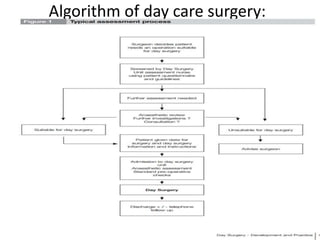
Algorithm of day care surgery:
Day care surgery procedures:
• General surgery: A large number of surgical
procedures can be done on ambulatory basis.
• Day surgery should be considered the
principal option and no longer an alternative
form of treatment.
• Its of paramount importance that all the
patients are carefully selected, taking social,
medical and surgical criteria into account.
• Surgeries suitable for daycare have the following
characteristics:
1.Post op care must be specific but is neither intensive
nor prolonged and will not lead to unexpected
admissions to the hospital.
2.The risk of intra and post operative blood loss
should be low.
3.Duration less than 90 min.
4.Post operative pain easily controlled.
5.During the surgery there should not be unnecessary
tissue traction, tension, manipulation, minimal
ischemia and complete hemostasis.
• 1.Hernia surgery:laparoscopic and open.
• 2.Sphincterotomy
• 3.Fistulectomy
• 4.Exciscion of 1 or 2 hemorrhoids
• 5.Breast surgeries: removal of small lumps like
fibroadenoma, axillary lymph nodes, exciscion
biopsy
• 6.Banding for esophageal varices
• 7.Laparoscopic cholecystectomy
• 8.Laparoscopic fundoplication
• 9.Laparoscopic ventral hernia repair.
In pediatric age group
• Inguinal hernia and hydrocele
• Circumcision
• Orchidopexy
• Umbelical hernia repair
• Diagnostic lap
• Hand and wrist surgeries: correection of
contractures,decompression of carpal
tunnel,arthrodesis of finger joints,exciscion of
ganglion,toe amputation.
• Cosmetic surgery:abdominoplasty,liposuction.
• Urology:Vasectomy,hydrocelectomy,meatomy
for stenosis,endoscopic procedures which
includes removal of stone, stenting, removal
of stent
• Vascular surgery: Varicose vein surgery, AV
fistula, chemoport insertion, thoracoscopic
sympathectomy,endovascular repairs for
aneurysm
Selection of patient:Criteria
• Surgical: selection of the procedure, degree of
surgical trauma, post op pain should be
manageable with oral analgesics, there should be
no continuing blood loss and need for IV fluids.
• Social criteria: To ensure that the patients are
discharged to safe and acceptable home
conditions. Patients should be accompanied by a
responsible physically able adult who can care for
them overnight
Selection of patient:
• Medical criteria: It is based on the physiological
status of the individual. For a patient who is not
healthy, the nature of any preexisting condition,
its stability and functional limitation should be
evaluated.
• Some of the factors to be considered in medical
criteria include: Age, ASA evaluation of chronic
health, obesity, chronic illness, systemic
diseases, diabetes mellitus, hypertension.
• Patients on chronic medications: Oral
hypoglycemics, Antihypertensives,
anticoagulants, steroids, Monoamine oxidase
inhibitors.
Screening tests in day care:
• Routine blood tests, x-rays are of no clinical
benefit.
• All investigations should be clinically directed
based on findings of pre operative evaluation.
In essance, testing should be performed in
sittuations where an otherwise undetectable
abnormality is relatively likely.
Pre-operative assessment:
• Pre-operative assessment is defined as a process
that ensures patient fitness for anesthesia and
planned surgery, minimizes the risk related to
procedures and the risk of late cancellations.
• This can be achieved by implementing a protocol
of patient assessment that should include
assessment of patient medical status, home
circumstances and information for patient and
their carers.
Pre-operative assessment:
• Objectives of pre-operative assessment:
• The process of pre operative assessment in day
care surgery should assure that
1.Patient is suitable for surgery
2.The patient is medically fit for surgery and
anesthesia and risks are minimized as a result of
correct preparation
3.The patient fully understands the proposed
surgical and anesthetic procedures and wishes to
undergo planned procedure.
4.The patient receives and understands oral and
written information covering all aspects of
daycare surgery experience.
5.The patient fully understands the pre and post-
operative instructions including fasting,
medications to be taken or discontinued.
6.The carer is fully informed of the day surgery
process and agrees to escort the patient home.
7.Home support will be provided according to the
patient`s special requirements
8.Anxiety and the fear that the patient may
experience are minimized.
9.The procedure has been booked and confirmed.
Anaesthesia in day care:
• After the establishment of SAMBA: Society for
Ambulatory Anaesthesia there is increase in
day care surgeries.
• Choosing appropriate anaesthesia for
particular day case.
• Choosing anaesthetic agent focusing on safety,
quality and cost efficacy.
• The most important aspects of quality in an
optimum anaesthetic technique is rapid and
clear headed emergence, no post-op pain, no
PONV and minimal side effects.
• Regional anesthesia: spinal and local
anesthesia.
• Important drugs: Levo bupivacaine.
• General anesthesia: propofol, alfentanil, remi
fentanil.
• Sevo flurane, xenon.
Analgesia in day care:
• In order to achieve good pain relief in ambulatory
surgery, below are the practical guidelines:
1.Plan pain management early together with the
patient through adequate information and discussion
pre-operatively.
2.Start planned management pre or intra operatively in
order to provide the best pain relief when the pain is
worst. This can be in the form of nerve blocks, drugs
intra operatively, infiltration of local anesthetic.
3.Use aggressive methods to prevent pain and treat it
early and actively when it occurs.
4.Use drugs in full doses rather than titrating to effect,
especially in early post-operative period.
5.Think of post mobilization and post discharge pain and
plan management before rather than after its
appearance.
6.Treat patients as individuals rather than averages.
Some patients respond better to one drug than other
drugs.
7.Perticularly in children, the presence of parents, a
warm bed and home environment are major factors in
reducing pain.
Management of pain in ambulatory surgery is a
challenge. The development of clinical guidelines
for pain management , which are preferably
procedure specific, is essential to achieve good
results and satisfied patient. Individual patient
requirements should always be considered keeping
in mind the biological variation between the
individuals.
Good pain relief requires teamwork and
incorporates not only the health care team but also
patient and carers.
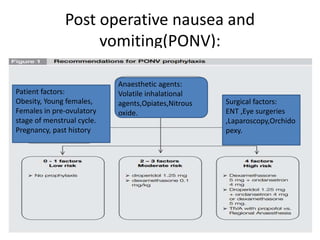
Post operative nausea and
vomiting(PONV):
Surgical factors:
ENT ,Eye surgeries
,Laparoscopy,Orchido
pexy.
Anaesthetic agents:
Volatile inhalational
agents,Opiates,Nitrous
oxide.
Patient factors:
Obesity, Young females,
Females in pre-ovulatory
stage of menstrual cycle.
Pregnancy, past history
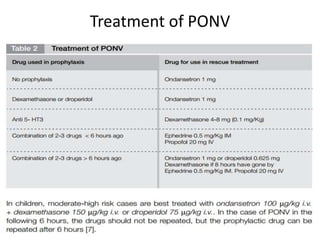
Treatment of PONV
Recovery:
• Recovery is an ongoing process that begins at the end
of intra-operative care and continues until patient
return to their pre-operative physiological state.
• Recovery is divided into 3 phases:
• 1.Early recovery: from discontinuation of anesthetic
agents to recovery of protective reflexes and motor
function.
• 2.Immidiate recovery: when patients achieves criteria
for discharge.
• 3.Late recovery: When patient returns to pre-operative
physiological state.
Fast tracking:
• This is a clinical pathway that involves transferring
the patient from operating room to DSU
bypassing Post anesthesia care unit(PACU).
• The use of ultra short acting drugs, proper
selection of patients and elimination of post-
operative complications will enable patients to
bypass PACU.
• Many scoring systems are available for fast
tracking.
Modified Aldrete scoring system.
Discharge criteria:
• Discharge of patients home from DSU requires
strict adherence to validated criteria to ensure
patient safety and may prevent unnecessary
litigation.
• Discharge assessment may be performed by
treating physician or qualified nurses in DSU
who adhere to a written protocol for patient
discharge.
Discharge:
• Typical outcome based criteria for discharge are also being
used in ambulatory surgery facilities, where each criterion
must be met and include
• 1.Alert and oriented to time and place
• 2.Stable vital signs.
• 3.Pain controlled by oral analgesics.
• 4.Nausea or emesis controlled.
• 5.Able to walk without dizziness.
• 6.regional anesthesia: Block appropriately resolved.
• 7.No unexpected bleeding from operative site.
• 8.Given discharge instructions from surgeon and anesthetist
and prescriptions.
• 9.Patient accepts readiness for discharge.
• 10.Adult present to accompany patient home
outcome:
• During 70`s 80`s ambulatory surgery was considered
low risk as it was based on simple minor surgery in a
healthy individual.
• In recent times the development of new drugs, devices
and equipment allowing impressive advances in
anesthesia and surgery.
• Socially standards of living has risen.
• As a result the scope of day care widened to include
sicker patients undergoing more complex surgery from
a greater cross-section of the population.
• Increasingly governments and other health care
funders are pressing for increase in daycare procedures
because of its financial advantages.
Advantages:
1.To patients:
Day care surgery suited to provide patient centered treatment.
• Receives more personalized care than in-patient.
• Receive treatment that is better suited for their need allowing
them to return home on the day of surgery and recover in a
familiar home environment.
• They can continue their routine medication as before surgery.
• They can avoid problems arising from prolonged hospitalization.
• Less post-operative pain.
• Decreased risk of thromboembolism due to early mobilization.
• Even if wound infection occur ,it usually responds to anti-
biotics.
• Day care surgery is less stressful than inpatient surgery,
especially for pediatric patients who are separated from
parents for as short time possible.
Advantages
• It helps elderly people who are more prone for
disorientation when removed from their familiar home
environment.
• Patient satisfaction is higher. Vast majority of those who
underwent same procedure both as in patient and a day
case prefer the latter form of treatment.
• Scheduling of surgery is easier and registration is less
complicated. Patients can choose a firm date and time for
their operation in the knowledge that it will not be
cancelled at the last minute due to unexpected emergency
admissions.
• Recovery quicker than in patient allowing patients to return
to normal activities, family life, work sooner.
Advantages:
To care givers:
• Saves time in travelling.
• Problems related to accommodation will be
solved.
Advantages: To hospitals
• Since the risk of last minute cancellations is minimal,
hospitals can manage elective surgery more efficiently. This
allows more accurate scheduling and make more effective
use of staff and facilities.
• In nationalized health care system particularly this facilitates
the implementation of booking system and greater patient
choice.
• The lack of need for night and weekend nursing cover makes
work in daycare unit more attractive to nurses, and it
increases greater surgical productivity per nurse. Fixed
schedule and hours is an ideal place for part time nurses to
work.
• More cost effective compared with inpatient surgery as
hospitalization time is reduced, night and weekend staffing
is not required.
Advantages : To healthcare funders
• All health care budgets are under pressure
due to increasing patient demands, the
introduction of new treatment and aging
population. Day care surgery allows
purchasers a way of containing cost whilst
obtaining high quality, accessible and effective
treatment.
Day care in India:
• With the advancements in medical field and
economy in India the day care surgery is
blooming.
• Day care surgery units have been established
in most of the tertiary centres both in govt
and private sectors.
Day care in AJHRC:
• Day care unit in AJHRC ,consists of 8 beds, 4 male
and 4 female.
• Functions from 8.30 am to 5 pm, from Monday to
Saturday.
• Staff: 1 medical officer,2 staff nurse.
• Patients will be received from OPD or causality as
per consultant orders, investigated and shifted to
OT, depending on the recovery pts will be
received directly from ot or post-op.
• Patient will be observed in day care and
discharged with advise as per consultant orders.
Conclusion:
• The advantages of day surgery are clear and well
documented.it has steadily and significantly grown.in a
longer term there is no doubt no country rich or poor,
will be able to resist a move to day surgery.
• It is more advantageous to patient, his family, hospitals
and health professionals
• In near feature the question will not be can this
patient be treated on day basis? But why can`t this
patient be treated as daycase?
• Daycare surgery rather than inpatient surgery will
become the norm for elective surgery.
References:
• 1.bailey and Love`s Short practice of
surgery,26th edition.
• 2.Day care surgery- Development and Practice
•Thank you.

Day care surgery by manjusb

  • 1.
    Day care surgery: Presenter:Dr.Manjunatha S B Moderator:Dr.Shivashankar Bhat
  • 2.
    Contents: • Introduction • History •Terminologies • Development of day care surgery • Day care surgery procedures • Pre operative screening and selection of patients • Anesthesia and analgesia for daycare surgeries • Discharge criteria and recovery • Advantages • Conclusion.
  • 3.
    Introduction: • Day caresurgery also called day surgery/same day surgery/day only surgery/ambulatory surgery • Ambualtory surgery is defined as a procedure excluding an office or outpatient operation/procedure, where the patient is discharged on the same day.
  • 4.
    History: • At theend of 20th century foundations for modern day surgery were laid by James Nicoll with his work at Sick children hospital and dispensary in Glasgow,Scotland. • Many day care surgery units established over years. • With the growth of day care surgery ,group of enthusiasts came together to form an association to promote the quality standards,expansion,education and research in this field. • In 1995 ,12 national associations agreed to form International Association for Ambulatory Surgery(IAAS). • At present IAAS has 24 countries as members.
  • 5.
    International Association for AmbulatorySurgery(IAAS) • IAAS is a multidisciplinary association involving surgeons,anesthetists,nurses and managers. • The view of association is team work is essential for greatest success in day care surgery.
  • 6.
    Indian Association ofDay Surgery • Found in 2003. • The association has >350 members. • The association executive committee has more than 200 publications. • The association also conducts regular workshops and conferences(once in 2 years).
  • 7.
    Terminologies: • Office surgery/procedure:An operation or procedure carried out in a medical practitioners professional premises which provides an appropriately designed, equipped and serviced rooms for its safe performance. • Ambulatory surgery Centre /Day clinic/Day surgery Centre / unit, Ambulatory surgery unit: A Centre (facility) designed for optimum management of an ambulatory procedure patient.
  • 8.
    Terminologies: • Extended recoveryunit:Purpose constructed/ modified patient accomadation, with an ambulatory surgery unit,specifically designed for extended recovery of day care surgery patients.
  • 9.
    Development of Daycare surgery: • Over the last 25 years day care surgery rates have steadily increased in many countries. • The growth has occurred as the benefits of this form of treatment have been increasingly perceived by medical health care professionals, health care funders and patients. • The process is facilitated by developments in surgical techniques, anesthesia and analgesia
  • 10.
    Devolopment of daycare surgery: • There is large variation in day surgery activity between the countries and in countries between the hospitals.
  • 11.
    Algorithm of daycare surgery:
  • 12.
    Day care surgeryprocedures: • General surgery: A large number of surgical procedures can be done on ambulatory basis. • Day surgery should be considered the principal option and no longer an alternative form of treatment. • Its of paramount importance that all the patients are carefully selected, taking social, medical and surgical criteria into account.
  • 13.
    • Surgeries suitablefor daycare have the following characteristics: 1.Post op care must be specific but is neither intensive nor prolonged and will not lead to unexpected admissions to the hospital. 2.The risk of intra and post operative blood loss should be low. 3.Duration less than 90 min. 4.Post operative pain easily controlled. 5.During the surgery there should not be unnecessary tissue traction, tension, manipulation, minimal ischemia and complete hemostasis.
  • 14.
    • 1.Hernia surgery:laparoscopicand open. • 2.Sphincterotomy • 3.Fistulectomy • 4.Exciscion of 1 or 2 hemorrhoids • 5.Breast surgeries: removal of small lumps like fibroadenoma, axillary lymph nodes, exciscion biopsy • 6.Banding for esophageal varices • 7.Laparoscopic cholecystectomy • 8.Laparoscopic fundoplication • 9.Laparoscopic ventral hernia repair.
  • 15.
    In pediatric agegroup • Inguinal hernia and hydrocele • Circumcision • Orchidopexy • Umbelical hernia repair • Diagnostic lap
  • 16.
    • Hand andwrist surgeries: correection of contractures,decompression of carpal tunnel,arthrodesis of finger joints,exciscion of ganglion,toe amputation. • Cosmetic surgery:abdominoplasty,liposuction. • Urology:Vasectomy,hydrocelectomy,meatomy for stenosis,endoscopic procedures which includes removal of stone, stenting, removal of stent • Vascular surgery: Varicose vein surgery, AV fistula, chemoport insertion, thoracoscopic sympathectomy,endovascular repairs for aneurysm
  • 17.
    Selection of patient:Criteria •Surgical: selection of the procedure, degree of surgical trauma, post op pain should be manageable with oral analgesics, there should be no continuing blood loss and need for IV fluids. • Social criteria: To ensure that the patients are discharged to safe and acceptable home conditions. Patients should be accompanied by a responsible physically able adult who can care for them overnight
  • 18.
    Selection of patient: •Medical criteria: It is based on the physiological status of the individual. For a patient who is not healthy, the nature of any preexisting condition, its stability and functional limitation should be evaluated. • Some of the factors to be considered in medical criteria include: Age, ASA evaluation of chronic health, obesity, chronic illness, systemic diseases, diabetes mellitus, hypertension.
  • 19.
    • Patients onchronic medications: Oral hypoglycemics, Antihypertensives, anticoagulants, steroids, Monoamine oxidase inhibitors.
  • 20.
    Screening tests inday care: • Routine blood tests, x-rays are of no clinical benefit. • All investigations should be clinically directed based on findings of pre operative evaluation. In essance, testing should be performed in sittuations where an otherwise undetectable abnormality is relatively likely.
  • 21.
    Pre-operative assessment: • Pre-operativeassessment is defined as a process that ensures patient fitness for anesthesia and planned surgery, minimizes the risk related to procedures and the risk of late cancellations. • This can be achieved by implementing a protocol of patient assessment that should include assessment of patient medical status, home circumstances and information for patient and their carers.
  • 22.
    Pre-operative assessment: • Objectivesof pre-operative assessment: • The process of pre operative assessment in day care surgery should assure that 1.Patient is suitable for surgery 2.The patient is medically fit for surgery and anesthesia and risks are minimized as a result of correct preparation 3.The patient fully understands the proposed surgical and anesthetic procedures and wishes to undergo planned procedure. 4.The patient receives and understands oral and written information covering all aspects of daycare surgery experience.
  • 23.
    5.The patient fullyunderstands the pre and post- operative instructions including fasting, medications to be taken or discontinued. 6.The carer is fully informed of the day surgery process and agrees to escort the patient home. 7.Home support will be provided according to the patient`s special requirements 8.Anxiety and the fear that the patient may experience are minimized. 9.The procedure has been booked and confirmed.
  • 24.
    Anaesthesia in daycare: • After the establishment of SAMBA: Society for Ambulatory Anaesthesia there is increase in day care surgeries. • Choosing appropriate anaesthesia for particular day case. • Choosing anaesthetic agent focusing on safety, quality and cost efficacy.
  • 25.
    • The mostimportant aspects of quality in an optimum anaesthetic technique is rapid and clear headed emergence, no post-op pain, no PONV and minimal side effects. • Regional anesthesia: spinal and local anesthesia. • Important drugs: Levo bupivacaine.
  • 26.
    • General anesthesia:propofol, alfentanil, remi fentanil. • Sevo flurane, xenon.
  • 27.
    Analgesia in daycare: • In order to achieve good pain relief in ambulatory surgery, below are the practical guidelines: 1.Plan pain management early together with the patient through adequate information and discussion pre-operatively. 2.Start planned management pre or intra operatively in order to provide the best pain relief when the pain is worst. This can be in the form of nerve blocks, drugs intra operatively, infiltration of local anesthetic. 3.Use aggressive methods to prevent pain and treat it early and actively when it occurs. 4.Use drugs in full doses rather than titrating to effect, especially in early post-operative period.
  • 28.
    5.Think of postmobilization and post discharge pain and plan management before rather than after its appearance. 6.Treat patients as individuals rather than averages. Some patients respond better to one drug than other drugs. 7.Perticularly in children, the presence of parents, a warm bed and home environment are major factors in reducing pain.
  • 29.
    Management of painin ambulatory surgery is a challenge. The development of clinical guidelines for pain management , which are preferably procedure specific, is essential to achieve good results and satisfied patient. Individual patient requirements should always be considered keeping in mind the biological variation between the individuals. Good pain relief requires teamwork and incorporates not only the health care team but also patient and carers.
  • 30.
    Post operative nauseaand vomiting(PONV): Surgical factors: ENT ,Eye surgeries ,Laparoscopy,Orchido pexy. Anaesthetic agents: Volatile inhalational agents,Opiates,Nitrous oxide. Patient factors: Obesity, Young females, Females in pre-ovulatory stage of menstrual cycle. Pregnancy, past history
  • 31.
  • 32.
    Recovery: • Recovery isan ongoing process that begins at the end of intra-operative care and continues until patient return to their pre-operative physiological state. • Recovery is divided into 3 phases: • 1.Early recovery: from discontinuation of anesthetic agents to recovery of protective reflexes and motor function. • 2.Immidiate recovery: when patients achieves criteria for discharge. • 3.Late recovery: When patient returns to pre-operative physiological state.
  • 33.
    Fast tracking: • Thisis a clinical pathway that involves transferring the patient from operating room to DSU bypassing Post anesthesia care unit(PACU). • The use of ultra short acting drugs, proper selection of patients and elimination of post- operative complications will enable patients to bypass PACU. • Many scoring systems are available for fast tracking.
  • 34.
  • 35.
    Discharge criteria: • Dischargeof patients home from DSU requires strict adherence to validated criteria to ensure patient safety and may prevent unnecessary litigation. • Discharge assessment may be performed by treating physician or qualified nurses in DSU who adhere to a written protocol for patient discharge.
  • 36.
    Discharge: • Typical outcomebased criteria for discharge are also being used in ambulatory surgery facilities, where each criterion must be met and include • 1.Alert and oriented to time and place • 2.Stable vital signs. • 3.Pain controlled by oral analgesics. • 4.Nausea or emesis controlled. • 5.Able to walk without dizziness. • 6.regional anesthesia: Block appropriately resolved. • 7.No unexpected bleeding from operative site. • 8.Given discharge instructions from surgeon and anesthetist and prescriptions. • 9.Patient accepts readiness for discharge. • 10.Adult present to accompany patient home
  • 37.
    outcome: • During 70`s80`s ambulatory surgery was considered low risk as it was based on simple minor surgery in a healthy individual. • In recent times the development of new drugs, devices and equipment allowing impressive advances in anesthesia and surgery. • Socially standards of living has risen. • As a result the scope of day care widened to include sicker patients undergoing more complex surgery from a greater cross-section of the population. • Increasingly governments and other health care funders are pressing for increase in daycare procedures because of its financial advantages.
  • 38.
    Advantages: 1.To patients: Day caresurgery suited to provide patient centered treatment. • Receives more personalized care than in-patient. • Receive treatment that is better suited for their need allowing them to return home on the day of surgery and recover in a familiar home environment. • They can continue their routine medication as before surgery. • They can avoid problems arising from prolonged hospitalization. • Less post-operative pain. • Decreased risk of thromboembolism due to early mobilization. • Even if wound infection occur ,it usually responds to anti- biotics. • Day care surgery is less stressful than inpatient surgery, especially for pediatric patients who are separated from parents for as short time possible.
  • 39.
    Advantages • It helpselderly people who are more prone for disorientation when removed from their familiar home environment. • Patient satisfaction is higher. Vast majority of those who underwent same procedure both as in patient and a day case prefer the latter form of treatment. • Scheduling of surgery is easier and registration is less complicated. Patients can choose a firm date and time for their operation in the knowledge that it will not be cancelled at the last minute due to unexpected emergency admissions. • Recovery quicker than in patient allowing patients to return to normal activities, family life, work sooner.
  • 40.
    Advantages: To care givers: •Saves time in travelling. • Problems related to accommodation will be solved.
  • 41.
    Advantages: To hospitals •Since the risk of last minute cancellations is minimal, hospitals can manage elective surgery more efficiently. This allows more accurate scheduling and make more effective use of staff and facilities. • In nationalized health care system particularly this facilitates the implementation of booking system and greater patient choice. • The lack of need for night and weekend nursing cover makes work in daycare unit more attractive to nurses, and it increases greater surgical productivity per nurse. Fixed schedule and hours is an ideal place for part time nurses to work. • More cost effective compared with inpatient surgery as hospitalization time is reduced, night and weekend staffing is not required.
  • 42.
    Advantages : Tohealthcare funders • All health care budgets are under pressure due to increasing patient demands, the introduction of new treatment and aging population. Day care surgery allows purchasers a way of containing cost whilst obtaining high quality, accessible and effective treatment.
  • 43.
    Day care inIndia: • With the advancements in medical field and economy in India the day care surgery is blooming. • Day care surgery units have been established in most of the tertiary centres both in govt and private sectors.
  • 44.
    Day care inAJHRC: • Day care unit in AJHRC ,consists of 8 beds, 4 male and 4 female. • Functions from 8.30 am to 5 pm, from Monday to Saturday. • Staff: 1 medical officer,2 staff nurse. • Patients will be received from OPD or causality as per consultant orders, investigated and shifted to OT, depending on the recovery pts will be received directly from ot or post-op. • Patient will be observed in day care and discharged with advise as per consultant orders.
  • 45.
    Conclusion: • The advantagesof day surgery are clear and well documented.it has steadily and significantly grown.in a longer term there is no doubt no country rich or poor, will be able to resist a move to day surgery. • It is more advantageous to patient, his family, hospitals and health professionals • In near feature the question will not be can this patient be treated on day basis? But why can`t this patient be treated as daycase? • Daycare surgery rather than inpatient surgery will become the norm for elective surgery.
  • 46.
    References: • 1.bailey andLove`s Short practice of surgery,26th edition. • 2.Day care surgery- Development and Practice
  • 47.