DAY CARE SURGERY
Speaker : Dr. S. M. Sufi Shafi- Ul- Bashar
Assistant registrar (Surgery)
MMCH
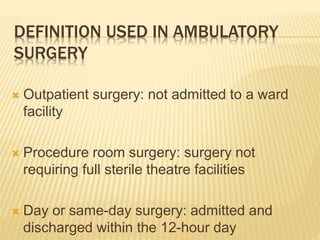
DEFINITION USED IN AMBULATORY
SURGERY
 Outpatient surgery: not admitted to a ward
facility
 Procedure room surgery: surgery not
requiring full sterile theatre facilities
 Day or same-day surgery: admitted and
discharged within the 12-hour day
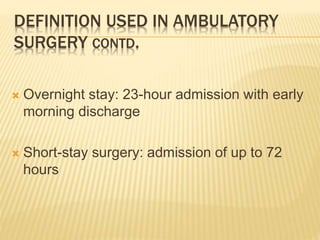
DEFINITION USED IN AMBULATORY
SURGERY CONTD.
 Overnight stay: 23-hour admission with early
morning discharge
 Short-stay surgery: admission of up to 72
hours
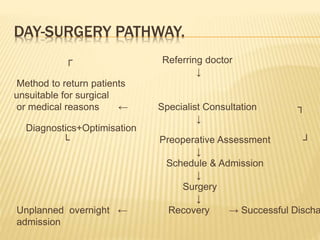
DAY-SURGERY PATHWAY.
┌ Referring doctor
↓
Method to return patients
unsuitable for surgical
or medical reasons ← Specialist Consultation ┐
↓
Diagnostics+Optimisation
└ Preoperative Assessment ┘
↓
Schedule & Admission
↓
Surgery
↓
Unplanned overnight ← Recovery → Successful Discha
admission
CRITERIA
 Medical:
-Age- No upper age limit
-Comorbidity- ASA 1, ASA 2
-Obesity- BMI up to 40 for surface
procedures and 38 for
laparoscopic
procedures are acceptable in
advanced units.
 Social:
-A responsible adult carer must be
available for first 24 hours
-Home conditions need to be suitable
-Ability to contact hospital in an
emergency
 Surgical:
-Operations up to 2 hours
ADVANTAGES
 Patient Comfort
 Reduced burden of Hospital
 Reduced burden of Operative list
 Psychological advantages for child
 Parental preference
 Efficient use of facilities
 Efficient use of staff
 Reduced risk of cross infection
 Cost efficient – up to 50% saving
DISADVANTAGES
 Expensive drugs
 Expensive equipments
 Requires good monitoring & assessment
 Communication skills
 Unplanned postoperative admissions
 Delayed treatment of post-op complications
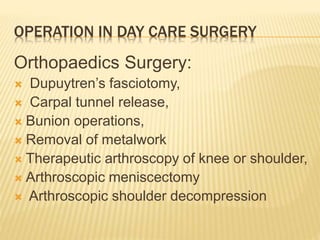
OPERATION IN DAY CARE SURGERY
Orthopaedics Surgery:
 Dupuytren’s fasciotomy,
 Carpal tunnel release,
 Bunion operations,
 Removal of metalwork
 Therapeutic arthroscopy of knee or shoulder,
 Arthroscopic meniscectomy
 Arthroscopic shoulder decompression
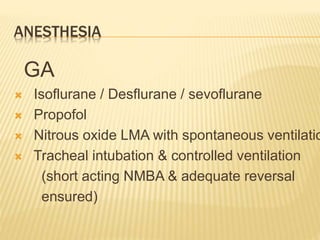
ANESTHESIA
GA
 Isoflurane / Desflurane / sevoflurane
 Propofol
 Nitrous oxide LMA with spontaneous ventilatio
 Tracheal intubation & controlled ventilation
(short acting NMBA & adequate reversal
ensured)
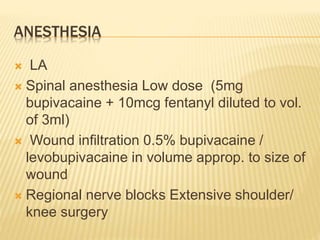
ANESTHESIA
 LA
 Spinal anesthesia Low dose (5mg
bupivacaine + 10mcg fentanyl diluted to vol.
of 3ml)
 Wound infiltration 0.5% bupivacaine /
levobupivacaine in volume approp. to size of
wound
 Regional nerve blocks Extensive shoulder/
knee surgery
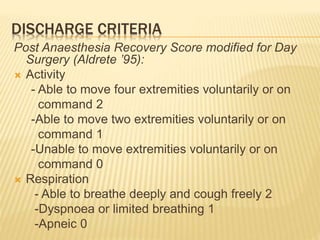
DISCHARGE CRITERIA
Post Anaesthesia Recovery Score modified for Day
Surgery (Aldrete ’95):
 Activity
- Able to move four extremities voluntarily or on
command 2
-Able to move two extremities voluntarily or on
command 1
-Unable to move extremities voluntarily or on
command 0
 Respiration
- Able to breathe deeply and cough freely 2
-Dyspnoea or limited breathing 1
-Apneic 0
DISCHARGE CRITERIA CONTD.
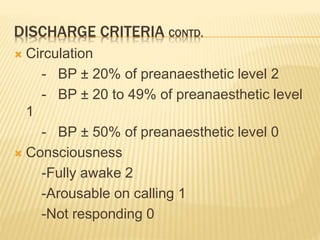
 Circulation
- BP ± 20% of preanaesthetic level 2
- BP ± 20 to 49% of preanaesthetic level
1
- BP ± 50% of preanaesthetic level 0
 Consciousness
-Fully awake 2
-Arousable on calling 1
-Not responding 0
DISCHARGE CRITERIA CONTD.
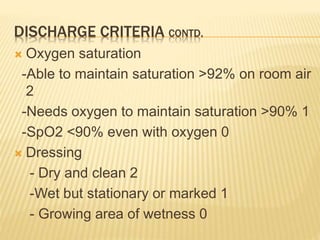
 Oxygen saturation
-Able to maintain saturation >92% on room air
2
-Needs oxygen to maintain saturation >90% 1
-SpO2 <90% even with oxygen 0
 Dressing
- Dry and clean 2
-Wet but stationary or marked 1
- Growing area of wetness 0
DISCHARGE CRITERIA CONTD.
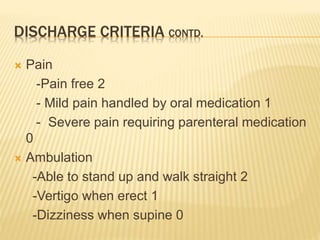
 Pain
-Pain free 2
- Mild pain handled by oral medication 1
- Severe pain requiring parenteral medication
0
 Ambulation
-Able to stand up and walk straight 2
-Vertigo when erect 1
-Dizziness when supine 0
DISCHARGE CRITERIA CONTD.
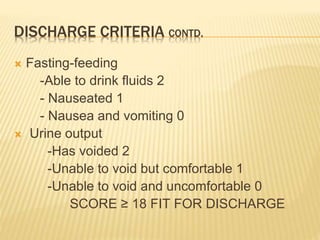
 Fasting-feeding
-Able to drink fluids 2
- Nauseated 1
- Nausea and vomiting 0
 Urine output
-Has voided 2
-Unable to void but comfortable 1
-Unable to void and uncomfortable 0
SCORE ≥ 18 FIT FOR DISCHARGE
RECOVERY FROM REGIONAL
ANESTHESIA
 Assess Return of anal tone
 Passage of urine (bladder func.)
 Power of limbs
 Recovery of proprioception
MEDICATION AND ADVICE DURING
DISCHARGE
 Specific instructions regarding prescribed
analgesia, antiemetics or antibiotics &
Procedure specific information.
 Wound care & when patient is able bath or
shower
 Arrangements for dressing renewal and
suture removal (if appropriate)
 Resuming normal activities
MEDICATION AND ADVICE DURING
DISCHARGE CONTD.
 What ‘normal’ symptoms may be expected
and their duration.
 What would be abnormal symptoms and
what to do if they occur.
 Contact telephone numbers for information
or in an emergency Arrangements for follow -
up (telephone and out-patients).
FUTURE DEVELOPMENTS:
 Sending pts with catheter/ Drains in situ
 2 incision hip replacement
 Single compartment knee replacement
THANK YOU

Day care surgery

  • 1.
    DAY CARE SURGERY Speaker: Dr. S. M. Sufi Shafi- Ul- Bashar Assistant registrar (Surgery) MMCH
  • 2.
    DEFINITION USED INAMBULATORY SURGERY  Outpatient surgery: not admitted to a ward facility  Procedure room surgery: surgery not requiring full sterile theatre facilities  Day or same-day surgery: admitted and discharged within the 12-hour day
  • 3.
    DEFINITION USED INAMBULATORY SURGERY CONTD.  Overnight stay: 23-hour admission with early morning discharge  Short-stay surgery: admission of up to 72 hours
  • 4.
    DAY-SURGERY PATHWAY. ┌ Referringdoctor ↓ Method to return patients unsuitable for surgical or medical reasons ← Specialist Consultation ┐ ↓ Diagnostics+Optimisation └ Preoperative Assessment ┘ ↓ Schedule & Admission ↓ Surgery ↓ Unplanned overnight ← Recovery → Successful Discha admission
  • 5.
    CRITERIA  Medical: -Age- Noupper age limit -Comorbidity- ASA 1, ASA 2 -Obesity- BMI up to 40 for surface procedures and 38 for laparoscopic procedures are acceptable in advanced units.
  • 6.
     Social: -A responsibleadult carer must be available for first 24 hours -Home conditions need to be suitable -Ability to contact hospital in an emergency  Surgical: -Operations up to 2 hours
  • 7.
    ADVANTAGES  Patient Comfort Reduced burden of Hospital  Reduced burden of Operative list  Psychological advantages for child  Parental preference  Efficient use of facilities  Efficient use of staff  Reduced risk of cross infection  Cost efficient – up to 50% saving
  • 8.
    DISADVANTAGES  Expensive drugs Expensive equipments  Requires good monitoring & assessment  Communication skills  Unplanned postoperative admissions  Delayed treatment of post-op complications
  • 9.
    OPERATION IN DAYCARE SURGERY Orthopaedics Surgery:  Dupuytren’s fasciotomy,  Carpal tunnel release,  Bunion operations,  Removal of metalwork  Therapeutic arthroscopy of knee or shoulder,  Arthroscopic meniscectomy  Arthroscopic shoulder decompression
  • 10.
    ANESTHESIA GA  Isoflurane /Desflurane / sevoflurane  Propofol  Nitrous oxide LMA with spontaneous ventilatio  Tracheal intubation & controlled ventilation (short acting NMBA & adequate reversal ensured)
  • 11.
    ANESTHESIA  LA  Spinalanesthesia Low dose (5mg bupivacaine + 10mcg fentanyl diluted to vol. of 3ml)  Wound infiltration 0.5% bupivacaine / levobupivacaine in volume approp. to size of wound  Regional nerve blocks Extensive shoulder/ knee surgery
  • 12.
    DISCHARGE CRITERIA Post AnaesthesiaRecovery Score modified for Day Surgery (Aldrete ’95):  Activity - Able to move four extremities voluntarily or on command 2 -Able to move two extremities voluntarily or on command 1 -Unable to move extremities voluntarily or on command 0  Respiration - Able to breathe deeply and cough freely 2 -Dyspnoea or limited breathing 1 -Apneic 0
  • 13.
    DISCHARGE CRITERIA CONTD. Circulation - BP ± 20% of preanaesthetic level 2 - BP ± 20 to 49% of preanaesthetic level 1 - BP ± 50% of preanaesthetic level 0  Consciousness -Fully awake 2 -Arousable on calling 1 -Not responding 0
  • 14.
    DISCHARGE CRITERIA CONTD. Oxygen saturation -Able to maintain saturation >92% on room air 2 -Needs oxygen to maintain saturation >90% 1 -SpO2 <90% even with oxygen 0  Dressing - Dry and clean 2 -Wet but stationary or marked 1 - Growing area of wetness 0
  • 15.
    DISCHARGE CRITERIA CONTD. Pain -Pain free 2 - Mild pain handled by oral medication 1 - Severe pain requiring parenteral medication 0  Ambulation -Able to stand up and walk straight 2 -Vertigo when erect 1 -Dizziness when supine 0
  • 16.
    DISCHARGE CRITERIA CONTD. Fasting-feeding -Able to drink fluids 2 - Nauseated 1 - Nausea and vomiting 0  Urine output -Has voided 2 -Unable to void but comfortable 1 -Unable to void and uncomfortable 0 SCORE ≥ 18 FIT FOR DISCHARGE
  • 17.
    RECOVERY FROM REGIONAL ANESTHESIA Assess Return of anal tone  Passage of urine (bladder func.)  Power of limbs  Recovery of proprioception
  • 18.
    MEDICATION AND ADVICEDURING DISCHARGE  Specific instructions regarding prescribed analgesia, antiemetics or antibiotics & Procedure specific information.  Wound care & when patient is able bath or shower  Arrangements for dressing renewal and suture removal (if appropriate)  Resuming normal activities
  • 19.
    MEDICATION AND ADVICEDURING DISCHARGE CONTD.  What ‘normal’ symptoms may be expected and their duration.  What would be abnormal symptoms and what to do if they occur.  Contact telephone numbers for information or in an emergency Arrangements for follow - up (telephone and out-patients).
  • 20.
    FUTURE DEVELOPMENTS:  Sendingpts with catheter/ Drains in situ  2 incision hip replacement  Single compartment knee replacement
  • 21.