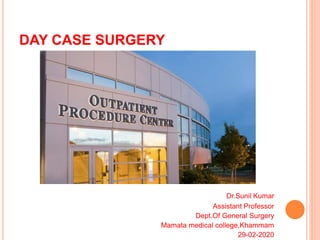

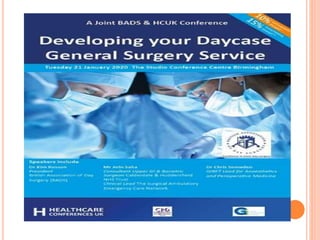

DAY CASE SURGERY
Dr.Sunil Kumar
Assistant Professor
Dept.Of General Surgery
Mamata medical college,Khammam
29-02-2020
LAY-OUT
 Introduction
 Definition
 History
 Merits & demerits
 Space requirements
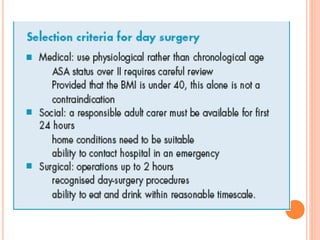
 Selection guidelines
 Suitable procedures
 Pre-op Preparation
 Anesthesia for DCS
 Types of Day Case Surgeries
 Discharge criteria
 Post op morbidity
 Audit in DCS
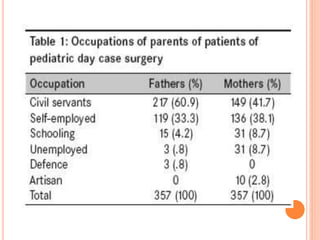
 Children in DCS
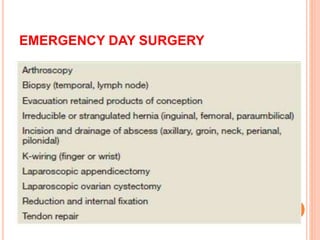
 Emergency day surgery
OBJECTIVES
 To study day case surgery with regards to its merits
,de-merits when compared with IP based surgeries.
 Applicability of day case surgery in present era.
 Day case surgery audit
 Day case surgery in children.
 Emergency day surgery
INTRODUCTION
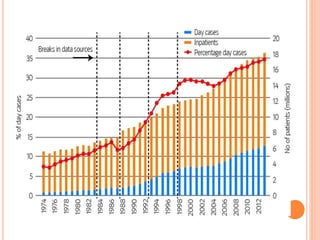
 50 % of elective surgeries in the UK.
 60 % or more in the USA and Canada.
 9.7% in India ( Study @ South India)
 Improvements in anesthesia and pain control,
minimally invasive surgery and changing
attitudes to recovery after surgery have all
promoted the expansion of day surgery.
DEFINITION
 Admission & discharge of a patient for a specific
procedure within the 12-hour working day.
 Procedure room surgery: Surgery not requiring full
sterile theatre facilities.
 Overnight stay : 23-hour admission with early morning
discharge.
 Short stay surgery : Admission of up to 72 hours.
HISTORY
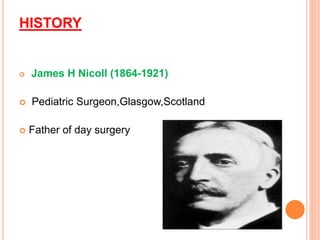
 James H Nicoll (1864-1921)
 Pediatric Surgeon,Glasgow,Scotland
 Father of day surgery
 From 1899-1908 he performed 9000 surgeries on
children as day cases
 Talipes, correction of hare lip & cleft palate, spina
bifida,pyloric stenosis,hernia repair and mastoid
surgery.
 In 1951 Eric Farquharson –
 Adult hernia repairs under local anesthesia.
MERITS & DEMERITS OF DAY-CASE
SURGERY
o Significant reduction in medical costs.
o Increased availability of indoor beds.
o Better comfort & greater control over the
patient’s business & personal lives.
o Some protection from hospital acquired
infections.
 Less social disruption to patients & their families &
minimal need for inpatient hospital resources.
 Particularly in children, short separation from
parents & family very beneficial to the reduce
separation-induced anxiety problems.
 Faster recovery, more rapid discharge & better pain
relief for outpatients.
 Less preoperative testing & postoperative
medication.
DE-MERITS
 Poor patient and procedure selection
 Inadequate information given to patient.
 Morbidity from anesthesia and surgery.
 Burden of care passed to the family members /
community worker.
 Good organization and management needed .
 The need for a responsible person to oversee the
day care patient at home for the first 24-48 hours.
 The restriction of day case surgery to experienced
senior staff; little opportunity for junior staff to
practice.
 Extra work for the general practitioner in the
postoperative period.
 Initial cost is high for set up, but the cost-
effectiveness of the unit is reduced when less
complex cases are dealt with on a day basis.
CONTRA-INDICATIONS
 MEDICAL
 PSYCHOLOGICAL
 SOCIAL
MEDICAL
• Angina at rest
• Myocardial infarct in last six months
• Hypertension - diastolic greater than 110mmHg
• Cardiac failure
• Acute respiratory infection
• Asthma - moderate to severe
• Chronic bronchitis
• Emphysema
• Gross obesity: body mass index > 35
• Insulin dependent diabetics (HBA1c <8.5%)
 PSYCHOLOGICAL
Psychologically unstable, e.g. Psychosis
SOCIAL
• Reliable person to drive patient home after
surgery.
• Look after them for the first 24-48 hours
postoperatively.
• No drives over one hour away from the center.
• No access to a lift, telephone or indoor toilet and
bathroom .
DO NOT BOOK PATIENTS TAKING
o Anticoagulants
o Digoxin
o Steroids
o Anti disarrhythmics(eg. Procainamide)
o OCP
o Nitroglycerin
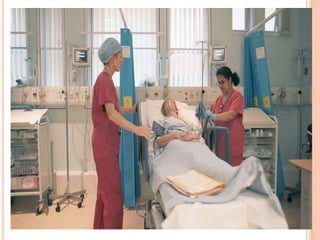
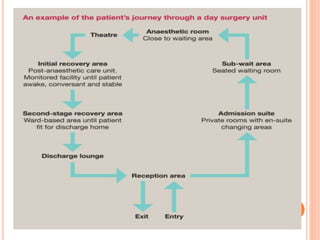
THE DAY SURGERY UNIT
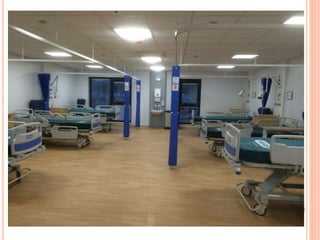
 Self-contained dedicated day surgery facility with
its own reception, operating and recovery areas.
 Nearby parking for escorts collecting patients.
 The balance of beds to operating theatres, and the
scheduling of the operating sessions.
 Procedures needing longer recovery should be
scheduled early in the day, and local anesthetic
cases later.
 The reception area
 Welcoming and large enough to accommodate
patients and their escorts on arrival and
discharge, with adequate space for secretarial
and reception staff.
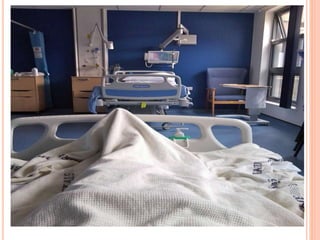
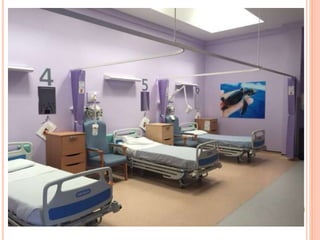
THE DAY SURGERY WARD
 Preoperative assessment and investigations will
already have been carried out.
 Must be assessed before surgery by the surgeon
and the anesthetist.
 Site of surgery marked and consent for the
procedure signed.
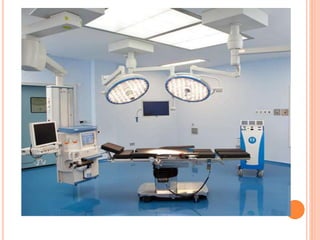
THE ANESTHETIC ROOM & OPERATING
THEATRES
 Precisely the same high-quality specification,
monitoring, safety and surgical equipment as in-
patient operating suites.
 Trained assistance must be provided throughout
the peri-operative period.
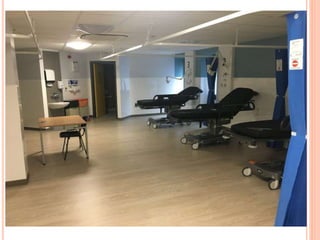
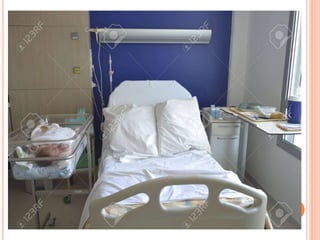
THE RECOVERY AREA
 Fully equipped to in-patient standards and be
adjacent to the theatre.
 UK, patients usually spend only a short time
here before returning to the ward to recover.
 USA -Post anesthesia recovery unit (PACU)
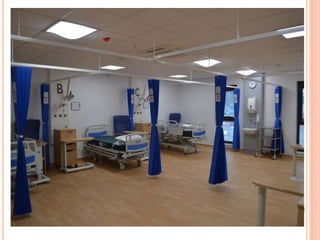
 Until the patient is ambulant and can to be sent
to a step-down area where they remain in a
chair until fit to go home.
 Patients who have had local anesthesia with no
or mild sedation may be able to bypass this area
and go straight to the ward.
STAFFING OF THE DAY SURGERY UNIT
 Experienced day surgery nurses excel at dealing
with problems and giving reassurance and
information.
 Specialized nurses may be needed for children
or for certain types of surgery such as
ophthalmic.
RECORD KEEPING
 Must be accurate and complete
 A folder containing all of the relevant records is
ideal.
 Support services
 Need for laboratory and radiology services is
minimal, these should be available if required.
MEDICAL STAFF AND TRAINING
 Fully trained medical staff, surgical and anesthetic,
to achieve the best results and reduce
complications and risk.
 Clinical director
 Consultant surgeon or an anesthetist, should
manage the DSU and implement and audit good
standards of care.
SPACE REQUIREMENTS
1. Receptionist's Unit 15 m2
2. Waiting area for Patients 25 m2
3. Waiting area for relatives 25 m2
4. Light refreshment service 15 m2
5. Patient lavatories 3 m2
6. Nurses' office-desk 16 m2
7. Clerical Office 12 m2
8. 2 changing rooms with lockers 16 m2
9. An anesthetic room 15 m2
10.An operation room 28 m2
11. Plaster room 22 m2
12. Scrub-up 6 m2
 13. Recovery area with Bed Bays 50 m2
14. Instrument room 10 m2
15. Stores 25 m2
16.Utility room 8 m2
17. Disposal room 8 m2
18.Lab 10 m2
19. X-Ray apparatus room 6 m2
20.Two staff changing rooms 12 m2
21.Staff lounge 12 m2
22.Doctor's office 12 m2
23.Consultation room 12 m2
24.Cleaner's room 4 m2
PROCEDURES SUITABLE FOR DAY CARE
SURGERY
o Minimal risk of post operative hemorrhage
o Minimal risk of post operative airway compression
o Post operative pain controllable by out patient
techniques.
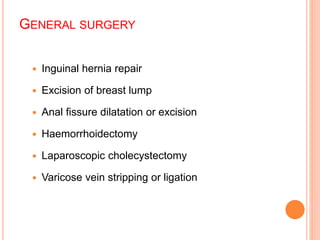
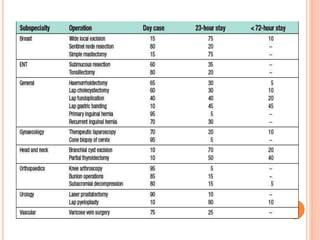
GENERAL SURGERY
 Inguinal hernia repair
 Excision of breast lump
 Anal fissure dilatation or excision
 Haemorrhoidectomy
 Laparoscopic cholecystectomy
 Varicose vein stripping or ligation
ORAL CAVITY
 Conservative dental treatment
 Extraction of deciduous and wisdom teeth
 Orthodontic treatment
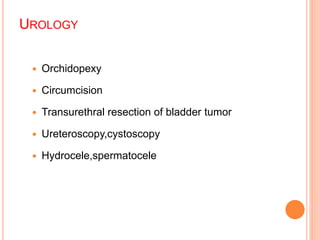
UROLOGY
 Orchidopexy
 Circumcision
 Transurethral resection of bladder tumor
 Ureteroscopy,cystoscopy
 Hydrocele,spermatocele
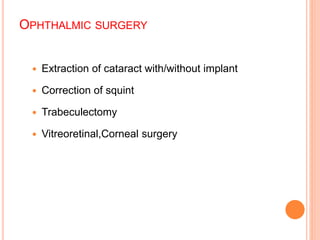
OPHTHALMIC SURGERY
 Extraction of cataract with/without implant
 Correction of squint
 Trabeculectomy
 Vitreoretinal,Corneal surgery
ENT
 Reduction of nasal fracture
 Operation for bat ears
 Myringotomy
 Tonsillectomy
 Sub Mucous resection
 Laryngoscopy,Nasal polyp
GYNECOLOGICAL SURGERY
 Dilatation and Curettage/hysteroscopy
 Laparoscopy
 Termination of Pregnancy
ORTHOPEDIC SURGERY
 Excision of Dupuytren's contracture
 Carpal tunnel decompression
 Excision of ganglion
 Arthroscopy
 Bunion operations
 Nerve and tendon repair and decompression
PLASTIC SURGERY
 Augmentation mammoplasty
 Minor hand surgery
 Rhinoplasty, blepharoplasty
THE ESSENTIALS OF GOOD DAY SURGERY
 Selection of appropriate procedures and patients
 Preadmission assessment and information
 Anesthesia and surgery with minimal morbidity
and complications
 Postoperative and post discharge analgesia
 Discharge criteria and postoperative instructions
 Follow-up and audit.
CRITERIA FOR SUITABLE DAY-CASE
PROCEDURES
 Minimal physiological trespass
 Not associated with excessive blood loss or fluid
shifts
 Very low risk of serious postoperative
complications (e.g. Bleeding or airway
obstruction)
 Duration of up to 1 hour, 2 hours maximum
 Pain must be controllable with oral analgesics
after discharge.
 The patient should be reasonably ambulant
afterwards.
THE SOCIAL CIRCUMSTANCES
 Day surgery needs ready access to a hospital or
GP after discharge, although the demand on these
should be minimal.
 A responsible adult to escort the patient home
and care.
 Patients must have reasonable home
circumstances with good toilet facilities, few
stairs to climb and access to a telephone.
 Within 60 minutes’ travelling distance.
PREOPERATIVE PREPARATION
o Preadmission clerking
o Arrive at 07.00 AM and the nursing staff check
their preoperative medical questionnaire
o Patients are weighed and their vital signs
recorded
o The expected routing and length of stay are
explained again to the patient and escort,
together with advice concerning postoperative
pain and recovery.
o Medical investigations, ideally should be performed
at the outpatient appointment.
o Operating surgeon should explain the nature of the
surgery to be carried out.
BENEFITS OF A PRE ADMISSION
ASSESMENT CLINIC
o Problems are sorted before admission
o Unnecessary investigations reduced
o Cancellation virtually eliminated
o Patients better prepared and informed
o Non attendance is reduced
o Peri-operative complications are reduced
o Unplanned over night admission is reduced.
PRE ADMISION INFORMATION
 Time /date of operation
 Contact telephone
 Escort or taxi
 Not to drive /operate machinery for 48 hrs
 Fasting instructions
 Do not miss the medications
 Pregnancy
 Instructions clothing, valuables
o Map of DSU
o Description of procedure duration
o Post operative anesthetic restriction
o Whom to contact
o Procedure specific information
PATIENT PREPARATION
o Limited solid food may be taken up to 6 hrs prior to
procedure.
o Unsweetened clear fluids totally not more than
200ml per hour in adults may be taken 2hrs prior.
o For infants breast milk may be given 4 hrs prior,
only medications or water ordered by anesthetist
should be taken 3hrs prior.
THE FITNESS OF THE PATIENT FOR GENERAL
ANESTHESIA
 Medically stable
 Screened before admission to exclude major
health problems
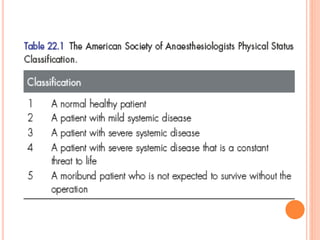
 ASA 1, 2 and stable 3 patients are suitable
 Age: 70 is often taken as an upper age limit
ANALGESIA
 Mild pain- Regular NSAID’S+/ PCT
 Moderate-Severe Pain– NSAID’S+PCT/ Codeine/
Tramadol
DISCHARGE CRITERIA
o Stable vital sign at least for 1 hour.
o Orientation to time, place and person
o Adequate pain control
o Minimal nausea, vomiting and dizziness
o Adequate hydration
o Minimal bleeding or wound drainage
o Patient at significant risk of urinary retention must
have passed urine.
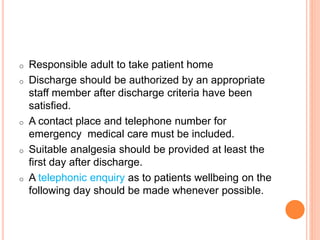
o Responsible adult to take patient home
o Discharge should be authorized by an appropriate
staff member after discharge criteria have been
satisfied.
o A contact place and telephone number for
emergency medical care must be included.
o Suitable analgesia should be provided at least the
first day after discharge.
o A telephonic enquiry as to patients wellbeing on the
following day should be made whenever possible.
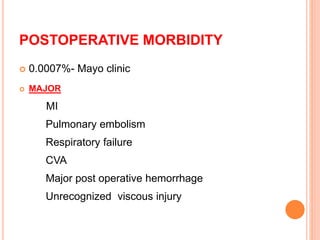
POSTOPERATIVE MORBIDITY
 0.0007%- Mayo clinic
 MAJOR
MI
Pulmonary embolism
Respiratory failure
CVA
Major post operative hemorrhage
Unrecognized viscous injury
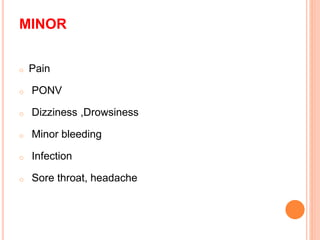
MINOR
o Pain
o PONV
o Dizziness ,Drowsiness
o Minor bleeding
o Infection
o Sore throat, headache
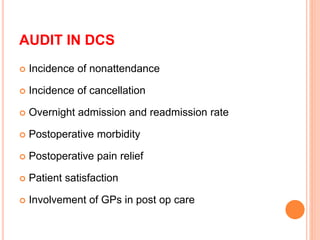
AUDIT IN DCS
 Incidence of nonattendance
 Incidence of cancellation
 Overnight admission and readmission rate
 Postoperative morbidity
 Postoperative pain relief
 Patient satisfaction
 Involvement of GPs in post op care
CHILDREN IN DAY SURGERY
 Ideal for children
 Special trained staff needed
 Prior visit needed
 Child friendly surrounding
 Liaison with GP/community workers
EMERGENCY DAY SURGERY
THANK YOU

Day case surgery

  • 1.
    DAY CASE SURGERY Dr.SunilKumar Assistant Professor Dept.Of General Surgery Mamata medical college,Khammam 29-02-2020
  • 2.
    LAY-OUT  Introduction  Definition History  Merits & demerits  Space requirements  Selection guidelines  Suitable procedures
  • 3.
     Pre-op Preparation Anesthesia for DCS  Types of Day Case Surgeries  Discharge criteria  Post op morbidity  Audit in DCS  Children in DCS  Emergency day surgery
  • 4.
    OBJECTIVES  To studyday case surgery with regards to its merits ,de-merits when compared with IP based surgeries.  Applicability of day case surgery in present era.  Day case surgery audit  Day case surgery in children.  Emergency day surgery
  • 5.
    INTRODUCTION  50 %of elective surgeries in the UK.  60 % or more in the USA and Canada.  9.7% in India ( Study @ South India)  Improvements in anesthesia and pain control, minimally invasive surgery and changing attitudes to recovery after surgery have all promoted the expansion of day surgery.
  • 6.
    DEFINITION  Admission &discharge of a patient for a specific procedure within the 12-hour working day.  Procedure room surgery: Surgery not requiring full sterile theatre facilities.  Overnight stay : 23-hour admission with early morning discharge.  Short stay surgery : Admission of up to 72 hours.
  • 7.
    HISTORY  James HNicoll (1864-1921)  Pediatric Surgeon,Glasgow,Scotland  Father of day surgery
  • 8.
     From 1899-1908he performed 9000 surgeries on children as day cases  Talipes, correction of hare lip & cleft palate, spina bifida,pyloric stenosis,hernia repair and mastoid surgery.  In 1951 Eric Farquharson –  Adult hernia repairs under local anesthesia.
  • 10.
    MERITS & DEMERITSOF DAY-CASE SURGERY o Significant reduction in medical costs. o Increased availability of indoor beds. o Better comfort & greater control over the patient’s business & personal lives. o Some protection from hospital acquired infections.
  • 11.
     Less socialdisruption to patients & their families & minimal need for inpatient hospital resources.  Particularly in children, short separation from parents & family very beneficial to the reduce separation-induced anxiety problems.  Faster recovery, more rapid discharge & better pain relief for outpatients.  Less preoperative testing & postoperative medication.
  • 12.
    DE-MERITS  Poor patientand procedure selection  Inadequate information given to patient.  Morbidity from anesthesia and surgery.  Burden of care passed to the family members / community worker.  Good organization and management needed .
  • 13.
     The needfor a responsible person to oversee the day care patient at home for the first 24-48 hours.  The restriction of day case surgery to experienced senior staff; little opportunity for junior staff to practice.  Extra work for the general practitioner in the postoperative period.
  • 14.
     Initial costis high for set up, but the cost- effectiveness of the unit is reduced when less complex cases are dealt with on a day basis.
  • 15.
  • 16.
    MEDICAL • Angina atrest • Myocardial infarct in last six months • Hypertension - diastolic greater than 110mmHg • Cardiac failure • Acute respiratory infection • Asthma - moderate to severe • Chronic bronchitis
  • 17.
    • Emphysema • Grossobesity: body mass index > 35 • Insulin dependent diabetics (HBA1c <8.5%)  PSYCHOLOGICAL Psychologically unstable, e.g. Psychosis
  • 18.
    SOCIAL • Reliable personto drive patient home after surgery. • Look after them for the first 24-48 hours postoperatively. • No drives over one hour away from the center. • No access to a lift, telephone or indoor toilet and bathroom .
  • 19.
    DO NOT BOOKPATIENTS TAKING o Anticoagulants o Digoxin o Steroids o Anti disarrhythmics(eg. Procainamide) o OCP o Nitroglycerin
  • 20.
    THE DAY SURGERYUNIT  Self-contained dedicated day surgery facility with its own reception, operating and recovery areas.  Nearby parking for escorts collecting patients.  The balance of beds to operating theatres, and the scheduling of the operating sessions.
  • 21.
     Procedures needinglonger recovery should be scheduled early in the day, and local anesthetic cases later.  The reception area  Welcoming and large enough to accommodate patients and their escorts on arrival and discharge, with adequate space for secretarial and reception staff.
  • 22.
    THE DAY SURGERYWARD  Preoperative assessment and investigations will already have been carried out.  Must be assessed before surgery by the surgeon and the anesthetist.  Site of surgery marked and consent for the procedure signed.
  • 23.
    THE ANESTHETIC ROOM& OPERATING THEATRES  Precisely the same high-quality specification, monitoring, safety and surgical equipment as in- patient operating suites.  Trained assistance must be provided throughout the peri-operative period.
  • 26.
    THE RECOVERY AREA Fully equipped to in-patient standards and be adjacent to the theatre.  UK, patients usually spend only a short time here before returning to the ward to recover.  USA -Post anesthesia recovery unit (PACU)
  • 27.
     Until thepatient is ambulant and can to be sent to a step-down area where they remain in a chair until fit to go home.  Patients who have had local anesthesia with no or mild sedation may be able to bypass this area and go straight to the ward.
  • 32.
    STAFFING OF THEDAY SURGERY UNIT  Experienced day surgery nurses excel at dealing with problems and giving reassurance and information.  Specialized nurses may be needed for children or for certain types of surgery such as ophthalmic.
  • 34.
    RECORD KEEPING  Mustbe accurate and complete  A folder containing all of the relevant records is ideal.  Support services  Need for laboratory and radiology services is minimal, these should be available if required.
  • 35.
    MEDICAL STAFF ANDTRAINING  Fully trained medical staff, surgical and anesthetic, to achieve the best results and reduce complications and risk.  Clinical director  Consultant surgeon or an anesthetist, should manage the DSU and implement and audit good standards of care.
  • 36.
    SPACE REQUIREMENTS 1. Receptionist'sUnit 15 m2 2. Waiting area for Patients 25 m2 3. Waiting area for relatives 25 m2 4. Light refreshment service 15 m2 5. Patient lavatories 3 m2 6. Nurses' office-desk 16 m2 7. Clerical Office 12 m2 8. 2 changing rooms with lockers 16 m2 9. An anesthetic room 15 m2 10.An operation room 28 m2 11. Plaster room 22 m2 12. Scrub-up 6 m2
  • 37.
     13. Recoveryarea with Bed Bays 50 m2 14. Instrument room 10 m2 15. Stores 25 m2 16.Utility room 8 m2 17. Disposal room 8 m2 18.Lab 10 m2 19. X-Ray apparatus room 6 m2 20.Two staff changing rooms 12 m2 21.Staff lounge 12 m2 22.Doctor's office 12 m2 23.Consultation room 12 m2 24.Cleaner's room 4 m2
  • 40.
    PROCEDURES SUITABLE FORDAY CARE SURGERY o Minimal risk of post operative hemorrhage o Minimal risk of post operative airway compression o Post operative pain controllable by out patient techniques.
  • 41.
    GENERAL SURGERY  Inguinalhernia repair  Excision of breast lump  Anal fissure dilatation or excision  Haemorrhoidectomy  Laparoscopic cholecystectomy  Varicose vein stripping or ligation
  • 42.
    ORAL CAVITY  Conservativedental treatment  Extraction of deciduous and wisdom teeth  Orthodontic treatment
  • 44.
    UROLOGY  Orchidopexy  Circumcision Transurethral resection of bladder tumor  Ureteroscopy,cystoscopy  Hydrocele,spermatocele
  • 45.
    OPHTHALMIC SURGERY  Extractionof cataract with/without implant  Correction of squint  Trabeculectomy  Vitreoretinal,Corneal surgery
  • 46.
    ENT  Reduction ofnasal fracture  Operation for bat ears  Myringotomy  Tonsillectomy  Sub Mucous resection  Laryngoscopy,Nasal polyp
  • 47.
    GYNECOLOGICAL SURGERY  Dilatationand Curettage/hysteroscopy  Laparoscopy  Termination of Pregnancy
  • 49.
    ORTHOPEDIC SURGERY  Excisionof Dupuytren's contracture  Carpal tunnel decompression  Excision of ganglion  Arthroscopy  Bunion operations  Nerve and tendon repair and decompression
  • 50.
    PLASTIC SURGERY  Augmentationmammoplasty  Minor hand surgery  Rhinoplasty, blepharoplasty
  • 52.
    THE ESSENTIALS OFGOOD DAY SURGERY  Selection of appropriate procedures and patients  Preadmission assessment and information  Anesthesia and surgery with minimal morbidity and complications  Postoperative and post discharge analgesia  Discharge criteria and postoperative instructions  Follow-up and audit.
  • 53.
    CRITERIA FOR SUITABLEDAY-CASE PROCEDURES  Minimal physiological trespass  Not associated with excessive blood loss or fluid shifts  Very low risk of serious postoperative complications (e.g. Bleeding or airway obstruction)  Duration of up to 1 hour, 2 hours maximum
  • 54.
     Pain mustbe controllable with oral analgesics after discharge.  The patient should be reasonably ambulant afterwards.
  • 55.
    THE SOCIAL CIRCUMSTANCES Day surgery needs ready access to a hospital or GP after discharge, although the demand on these should be minimal.  A responsible adult to escort the patient home and care.  Patients must have reasonable home circumstances with good toilet facilities, few stairs to climb and access to a telephone.  Within 60 minutes’ travelling distance.
  • 57.
    PREOPERATIVE PREPARATION o Preadmissionclerking o Arrive at 07.00 AM and the nursing staff check their preoperative medical questionnaire o Patients are weighed and their vital signs recorded o The expected routing and length of stay are explained again to the patient and escort, together with advice concerning postoperative pain and recovery.
  • 58.
    o Medical investigations,ideally should be performed at the outpatient appointment. o Operating surgeon should explain the nature of the surgery to be carried out.
  • 59.
    BENEFITS OF APRE ADMISSION ASSESMENT CLINIC o Problems are sorted before admission o Unnecessary investigations reduced o Cancellation virtually eliminated o Patients better prepared and informed o Non attendance is reduced o Peri-operative complications are reduced o Unplanned over night admission is reduced.
  • 60.
    PRE ADMISION INFORMATION Time /date of operation  Contact telephone  Escort or taxi  Not to drive /operate machinery for 48 hrs  Fasting instructions  Do not miss the medications  Pregnancy  Instructions clothing, valuables
  • 61.
    o Map ofDSU o Description of procedure duration o Post operative anesthetic restriction o Whom to contact o Procedure specific information
  • 62.
    PATIENT PREPARATION o Limitedsolid food may be taken up to 6 hrs prior to procedure. o Unsweetened clear fluids totally not more than 200ml per hour in adults may be taken 2hrs prior. o For infants breast milk may be given 4 hrs prior, only medications or water ordered by anesthetist should be taken 3hrs prior.
  • 63.
    THE FITNESS OFTHE PATIENT FOR GENERAL ANESTHESIA  Medically stable  Screened before admission to exclude major health problems  ASA 1, 2 and stable 3 patients are suitable  Age: 70 is often taken as an upper age limit
  • 64.
    ANALGESIA  Mild pain-Regular NSAID’S+/ PCT  Moderate-Severe Pain– NSAID’S+PCT/ Codeine/ Tramadol
  • 65.
    DISCHARGE CRITERIA o Stablevital sign at least for 1 hour. o Orientation to time, place and person o Adequate pain control o Minimal nausea, vomiting and dizziness o Adequate hydration o Minimal bleeding or wound drainage o Patient at significant risk of urinary retention must have passed urine.
  • 66.
    o Responsible adultto take patient home o Discharge should be authorized by an appropriate staff member after discharge criteria have been satisfied. o A contact place and telephone number for emergency medical care must be included. o Suitable analgesia should be provided at least the first day after discharge. o A telephonic enquiry as to patients wellbeing on the following day should be made whenever possible.
  • 67.
    POSTOPERATIVE MORBIDITY  0.0007%-Mayo clinic  MAJOR MI Pulmonary embolism Respiratory failure CVA Major post operative hemorrhage Unrecognized viscous injury
  • 68.
    MINOR o Pain o PONV oDizziness ,Drowsiness o Minor bleeding o Infection o Sore throat, headache
  • 69.
    AUDIT IN DCS Incidence of nonattendance  Incidence of cancellation  Overnight admission and readmission rate  Postoperative morbidity  Postoperative pain relief  Patient satisfaction  Involvement of GPs in post op care
  • 70.
    CHILDREN IN DAYSURGERY  Ideal for children  Special trained staff needed  Prior visit needed  Child friendly surrounding  Liaison with GP/community workers
  • 72.
  • 74.