Day Case Surgery
Dr. Bhipi Chandra Ray
Resident, Phase A, Urology, Year 02, Block-06
Bangabandhu Sheikh Mujib Medical University
Presenter:
Outlines
• Introduction
• Day surgery pathway
• Patient selection criteria
• Preoperative assessment, counselling & scheduling
• Anaesthesia & analgesia
• Advantages, disadvantages & barriers
• Common day cases in paediatric surgery
• Components of an emergency day case surgery
• Discharge criteria
History of Day Surgery
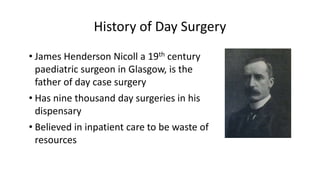
• James Henderson Nicoll a 19th century
paediatric surgeon in Glasgow, is the
father of day case surgery
• Has nine thousand day surgeries in his
dispensary
• Believed in inpatient care to be waste of
resources
What Is Day Case Surgery?
• The admission of selected patients to hospital for a
planned procedure, returning home on same day
• It extends from first contact to final discharge of a patient
• Success depends on each component of this pathway that
will be safe, efficient & performed in sequence
• Over 200 procedures are now considered to be suitable as
day case
Types of Day Surgery
Two types
i. Elective day surgery
ii. Emergency day surgery
Forms of Ambulatory Surgery
• Day or same day surgery: admit & discharge in 12 hours
• Procedure room surgery: No full sterile theatre facilities
• Overnight stay: 23 hours admission with early morning
discharge
• Short stay surgery: up to 72 hours
• Outpatient surgery: Not admitted to ward facility
• Inpatient surgery: Requires more prolong admission
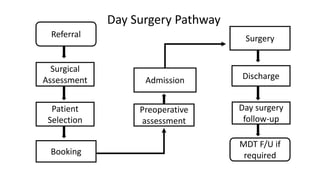
Referral
Surgical
Assessment
Patient
Selection
Booking
Preoperative
assessment
Admission
Surgery
Discharge
Day surgery
follow-up
MDT F/U if
required
Day Surgery Pathway
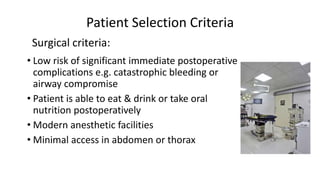
Patient Selection Criteria
• Low risk of significant immediate postoperative
complications e.g. catastrophic bleeding or
airway compromise
• Patient is able to eat & drink or take oral
nutrition postoperatively
• Modern anesthetic facilities
• Minimal access in abdomen or thorax
Surgical criteria:
Continue…
• No arbitrary cuts-off age, weight or criteria
except comorbidities & functional status
• Diabetes: Controlled HbA1C < 8.5%. Return
asap to normal feeding after operation
• Epilepsy: Not contraindicated if controlled
• Obesity: Morbidly obese patients can be
managed safely in expert hands with
appropriate resources
Medical criteria
Continue…
• Suitable home environment with a
responsible, mentally & physically
fit care giver
• Drive at a hospital < 1 hour
Social criteria:
Preoperative Assessment
It has three essential components:
• To educate patients & carers regarding day surgery pathways
• Well-informed & well-prepared patient
• To identify medical risk factors, promote health & optimize
the patient's condition
Patient Counselling Before Day Surgery
Ideally should include
• Proposed operation & its details
• Benefits, risks & complications of operation
• Consequences if operation is not done
• Alternative procedures or medications
• Complications of anaesthesia
Scheduling
• Day surgery ideally will be first on list with inpatient cases
• Avoid complex inpatient cases on same day
Anaesthesia & Analgesia
• Premedication & a multimodal analgesia approach
• Short-acting general anaesthesia agents, day case spinal
or regional anaesthesia techniques should be used to
enable rapid recovery
• TIVA using propofol offers better result with less PONV
• Avoid long acting opiates, e.g. morphine to reduce
sedation & PON
Advantages of Day Case Surgery
For patient:
• Significant reduction of hospital cost
• Better comfort & greater control over patient’s personal life
• Reduces risk of hospital acquired infection
For hospital
• Provide greater patient satisfaction
• Increase availability of inpatient beds
Disadvantages of Day Case Surgery
• Timing delay in operation day due to long queue
• Burden of care passed on to family members
• Good organization & management needed
• Morbidity from anesthesia & surgery
Barriers to Day Surgery
• Patient’s lack of awareness about benefits
• Long distance from hospital to home
• Inadequate infrastructure for transport
• Long outpatient queues & operation dates
Common day cases in Paediatric Surgery
• Ritual circumcision
• Inguinal hernia
• Hydrocele
• Undescended palpable testes
• Dermoid cyst
• Abscess (Axillary, neck, perianal, groin)
• Sebaceous cyst
• DJ stent removal
• Tongue tie
• Mucus retention cyst
• Bakers cyst etc
Continue…
Discharge Criteria
• Vital signs stable for at least 1 hour
• Correct orientation as to time, place & person if
appropriate
• Adequate pain control with supply of oral analgesia
• Understands how to use oral analgesia that supplied
• Ability to dress & walk where appropriate
• Minimal nausea, vomiting or dizziness
Continue…
• Has taken oral fluids
• Minimal bleeding or wound drainage
• Has passed urine
• Has a responsible adult to take home
• Written & verbal instructions given about post
operative care
• Knows when to come back for follow up
• Emergency contact number supplied
Components of an Emergency Day Surgery
• Identification of appropriate procedures
• Ensuring clear pathways are in place
• Determining whether the condition is safe to be left
untreated for up to 24 hours & manageable at home with
oral analgesia
• Providing clear preoperative patient information, ideally in
writing
Take Home Message
• There is no difference in anaesthesia & surgical techniques
between day case surgery & usual operation
• Less disruption of patient’s domestic & social life
• A cost saving approach for both patient & hospital
Thank You

Day Case Surgery by dr bhipi (2).pptx

  • 1.
    Day Case Surgery Dr.Bhipi Chandra Ray Resident, Phase A, Urology, Year 02, Block-06 Bangabandhu Sheikh Mujib Medical University Presenter:
  • 2.
    Outlines • Introduction • Daysurgery pathway • Patient selection criteria • Preoperative assessment, counselling & scheduling • Anaesthesia & analgesia • Advantages, disadvantages & barriers • Common day cases in paediatric surgery • Components of an emergency day case surgery • Discharge criteria
  • 3.
    History of DaySurgery • James Henderson Nicoll a 19th century paediatric surgeon in Glasgow, is the father of day case surgery • Has nine thousand day surgeries in his dispensary • Believed in inpatient care to be waste of resources
  • 4.
    What Is DayCase Surgery? • The admission of selected patients to hospital for a planned procedure, returning home on same day • It extends from first contact to final discharge of a patient • Success depends on each component of this pathway that will be safe, efficient & performed in sequence • Over 200 procedures are now considered to be suitable as day case
  • 5.
    Types of DaySurgery Two types i. Elective day surgery ii. Emergency day surgery
  • 6.
    Forms of AmbulatorySurgery • Day or same day surgery: admit & discharge in 12 hours • Procedure room surgery: No full sterile theatre facilities • Overnight stay: 23 hours admission with early morning discharge • Short stay surgery: up to 72 hours • Outpatient surgery: Not admitted to ward facility • Inpatient surgery: Requires more prolong admission
  • 7.
  • 8.
    Patient Selection Criteria •Low risk of significant immediate postoperative complications e.g. catastrophic bleeding or airway compromise • Patient is able to eat & drink or take oral nutrition postoperatively • Modern anesthetic facilities • Minimal access in abdomen or thorax Surgical criteria:
  • 9.
    Continue… • No arbitrarycuts-off age, weight or criteria except comorbidities & functional status • Diabetes: Controlled HbA1C < 8.5%. Return asap to normal feeding after operation • Epilepsy: Not contraindicated if controlled • Obesity: Morbidly obese patients can be managed safely in expert hands with appropriate resources Medical criteria
  • 10.
    Continue… • Suitable homeenvironment with a responsible, mentally & physically fit care giver • Drive at a hospital < 1 hour Social criteria:
  • 11.
    Preoperative Assessment It hasthree essential components: • To educate patients & carers regarding day surgery pathways • Well-informed & well-prepared patient • To identify medical risk factors, promote health & optimize the patient's condition
  • 12.
    Patient Counselling BeforeDay Surgery Ideally should include • Proposed operation & its details • Benefits, risks & complications of operation • Consequences if operation is not done • Alternative procedures or medications • Complications of anaesthesia
  • 13.
    Scheduling • Day surgeryideally will be first on list with inpatient cases • Avoid complex inpatient cases on same day
  • 14.
    Anaesthesia & Analgesia •Premedication & a multimodal analgesia approach • Short-acting general anaesthesia agents, day case spinal or regional anaesthesia techniques should be used to enable rapid recovery • TIVA using propofol offers better result with less PONV • Avoid long acting opiates, e.g. morphine to reduce sedation & PON
  • 15.
    Advantages of DayCase Surgery For patient: • Significant reduction of hospital cost • Better comfort & greater control over patient’s personal life • Reduces risk of hospital acquired infection For hospital • Provide greater patient satisfaction • Increase availability of inpatient beds
  • 16.
    Disadvantages of DayCase Surgery • Timing delay in operation day due to long queue • Burden of care passed on to family members • Good organization & management needed • Morbidity from anesthesia & surgery
  • 17.
    Barriers to DaySurgery • Patient’s lack of awareness about benefits • Long distance from hospital to home • Inadequate infrastructure for transport • Long outpatient queues & operation dates
  • 18.
    Common day casesin Paediatric Surgery • Ritual circumcision • Inguinal hernia • Hydrocele • Undescended palpable testes • Dermoid cyst • Abscess (Axillary, neck, perianal, groin)
  • 19.
    • Sebaceous cyst •DJ stent removal • Tongue tie • Mucus retention cyst • Bakers cyst etc Continue…
  • 20.
    Discharge Criteria • Vitalsigns stable for at least 1 hour • Correct orientation as to time, place & person if appropriate • Adequate pain control with supply of oral analgesia • Understands how to use oral analgesia that supplied • Ability to dress & walk where appropriate • Minimal nausea, vomiting or dizziness
  • 21.
    Continue… • Has takenoral fluids • Minimal bleeding or wound drainage • Has passed urine • Has a responsible adult to take home • Written & verbal instructions given about post operative care • Knows when to come back for follow up • Emergency contact number supplied
  • 22.
    Components of anEmergency Day Surgery • Identification of appropriate procedures • Ensuring clear pathways are in place • Determining whether the condition is safe to be left untreated for up to 24 hours & manageable at home with oral analgesia • Providing clear preoperative patient information, ideally in writing
  • 23.
    Take Home Message •There is no difference in anaesthesia & surgical techniques between day case surgery & usual operation • Less disruption of patient’s domestic & social life • A cost saving approach for both patient & hospital
  • 25.