Data Warehousing, Data Mining
&
Data Visualisation
Introduction
Data Warehousing
What is a Data Warehouse?
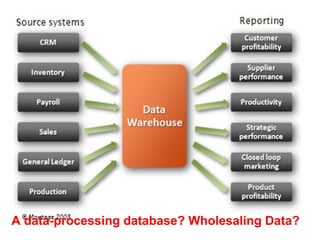
• A data warehouse is a database used for
reporting and analysis.
• The data stored in the warehouse is uploaded
from the operational systems.
• The data may pass through an operational data
store for additional operations before it is used
in the data warehouse for reporting.
A data-processing database? Wholesaling Data?
Benefits of a Data Warehouse
A data warehouse maintains a copy of information from the source
transaction systems. This architectural complexity provides the
opportunity to:
• Maintain data history.
• Integrate data from multiple source systems.
• Improve data quality.
• Present the organisation's information consistently.
• Provide a single common data model for all data of interest regardless of
the data's source.
• Restructure the data so that it makes sense to the business users.
• Restructure the data so that it delivers excellent query performance, even
for complex analytic queries.
• Add value to operational business applications.
History of Data Warehousing
• 1990 — Red Brick Systems, founded by Ralph Kimball,
introduces Red Brick Warehouse, a database management
system specifically for data warehousing.
• 1991 — Prism Solutions, founded by Bill Inmon, introduces
Prism Warehouse Manager, software for developing a data
warehouse.
• 1992 — Bill Inmon publishes the book Building the Data
Warehouse.
• 1995 — The Data Warehousing Institute, a not-for-profit
organisation that promotes data warehousing, is founded.
• 1996 — Ralph Kimball publishes the book The Data
Warehouse Toolkit.
• 2000 — Daniel Linstedt releases the Data Vault, enabling real
time auditable data warehouses.
Dimensional v Normalised
There are two leading approaches to storing data in a data warehouse
— the dimensional approach and the normalised approach.
• The dimensional approach, whose supporters are referred to as
“Kimballites”, believe in Ralph Kimball’s approach in which it is
stated that the data warehouse should be modelled using a
Dimensional Model (DM). For example, a sales transaction can be
broken up into facts such as the number of products ordered and
the price paid for the products, and into dimensions such as order
date, customer name, product number, order ship-to and bill-to
locations, and salesperson responsible for receiving the order.
• The normalised approach, also called the 3NF model, whose
supporters are referred to as “Inmonites”, believe in Bill Inmon's
approach in which it is stated that the data warehouse should be
modelled using Peter Chen’s Entity-Relationship (ER) model with
which, of course, we are all familiar!
Kimball’s Bottom Up Design
• In the bottom-up approach data marts are first
created to provide reporting and analytical
capabilities for specific business processes.
• Data marts contain, primarily, dimensions and facts.
• Facts can contain either atomic data and, if
necessary, summarised data.
• The single data mart often models a specific business
area such as "Sales" or "Production."
• These data marts can eventually be integrated to
create a comprehensive data warehouse.
Inmon’s Top Down Design
Inmon states that the data warehouse is:
• Subject-oriented: The data in the data warehouse is
organised so that all the data elements relating to
the same real-world event or object are linked
together.
• Non-volatile: Data in the data warehouse are never
over-written or deleted — once committed, the data
are static, read-only, and retained for future
reporting.
• Integrated: The data warehouse contains data from
most or all of an organisation's operational systems
and these data are made consistent.
Hybrid Design
• Data warehouse (DW) solutions often resemble hub
and spoke architecture.
• Legacy systems feeding the DW solution often
include customer relationship management (CRM)
and enterprise resource planning solutions (ERP),
generating large amounts of data.
• To consolidate these various data models, and
facilitate the extract transform load (ETL) process,
DW solutions often make use of an operational data
store (ODS).
Data Warehouse Appliances
• IBM Netezza
• Oracle ExaData
• Kognitio 360
• Teradata
Demystifying the Data Warehouse
http://www.youtube.c
om/watch?
v=mgEugd5kZgk&featu
re=related
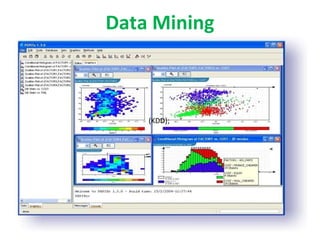
Data Mining
(KDD);
What is Data Mining?
• Data mining is the analysis step of the
Knowledge Discovery in Databases (KDD)
process.
• It is a relatively young and interdisciplinary
field of computer science.
• It is the process of discovering new patterns
from large data sets involving methods at the
intersection of artificial intelligence, machine
learning, statistics and database systems.
The KDD Process
The knowledge discovery in databases (KDD)
process is commonly defined in 5 stages:
(1) Selection
(2) Preprocessing
(3) Transformation
(4) Data Mining
(5) Interpretation/Evaluation
The CRISP-DM Process
The CRoss Industry Standard Process for Data Mining
(CRISP-DM) defines six phases:
(1)Business Understanding
(2) Data Understanding
(3) Data Preparation
(4) Modelling
(5) Evaluation
(6) Deployment
The simplified process is (1) Pre-processing, (2) Data
mining and (3) Results validation
Spatial Data Mining
• Spatial data mining is the application of data mining methods
to spatial data.
• Spatial data mining follows along the same functions in data
mining, with the end objective to find patterns in geography.
• So far, data mining and Geographic Information Systems (GIS)
have existed as two separate technologies, each with its own
methods, traditions and approaches to visualization and data
analysis.
• The immense explosion in geographically referenced data
occasioned by developments in IT, digital mapping, remote
sensing, and the global diffusion of GIS emphasises the
importance of developing data driven inductive approaches
to geographical analysis and modelling.
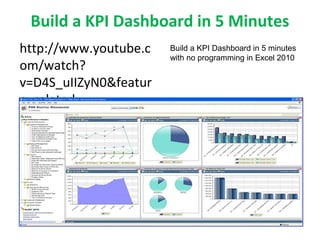
Build a KPI Dashboard in 5 Minutes
http://www.youtube.c
om/watch?
v=D4S_uIIZyN0&featur
e=related
Build a KPI Dashboard in 5 minutes
with no programming in Excel 2010
Data Visualisation
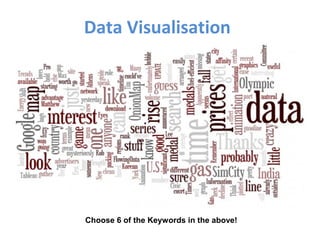
Choose 6 of the Keywords in the above!
Data Visualisation Defined
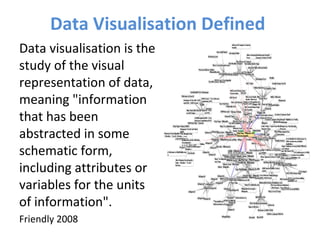
Data visualisation is the
study of the visual
representation of data,
meaning "information
that has been
abstracted in some
schematic form,
including attributes or
variables for the units
of information".
Friendly 2008
Tufte and Data Visualisation
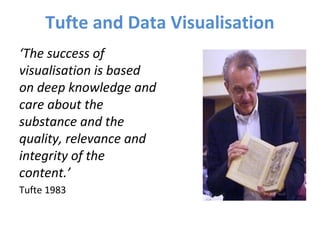
‘The success of
visualisation is based
on deep knowledge and
care about the
substance and the
quality, relevance and
integrity of the
content.’
Tufte 1983
5 Principles of Graphic Display
1. Above all else, show the data.
2. Maximise the data-ink ratio.
3. Erase non-data-ink.
4. Erase redundant data-ink.
5. Revise and edit.
The Beauty of Data Visualisation
http://www.youtube.com/
watch?v=pLqjQ55tz-U
David McCandless
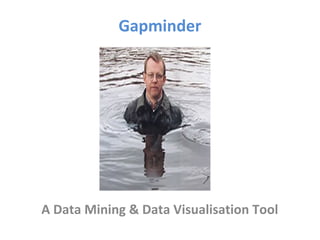
Gapminder
A Data Mining & Data Visualisation Tool
Hans Rosling
• The Gapminder application is the brain-child
of Hans Rosling.
• He thought of the title when he heard the
prompt ‘mind the gap’ on the London
Underground.
• He is Professor of International Health at
Karolinska Institute, Stockholm, Sweden.
• He is a Doctor of Medicine and a Doctor of
Philosophy.
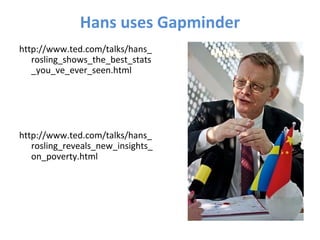
Hans uses Gapminder
http://www.ted.com/talks/hans_
rosling_shows_the_best_stats
_you_ve_ever_seen.html
http://www.ted.com/talks/hans_
rosling_reveals_new_insights_
on_poverty.html
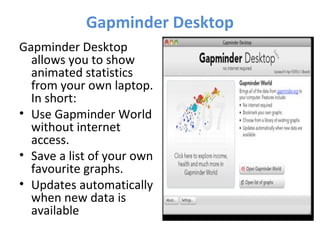
Gapminder Desktop
Gapminder Desktop
allows you to show
animated statistics
from your own laptop.
In short:
• Use Gapminder World
without internet
access.
• Save a list of your own
favourite graphs.
• Updates automatically
when new data is
available
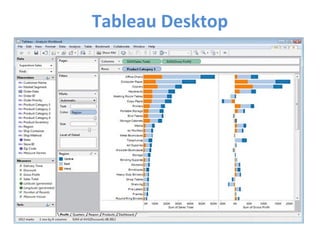
Tableau Desktop
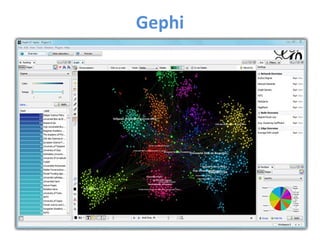
Gephi
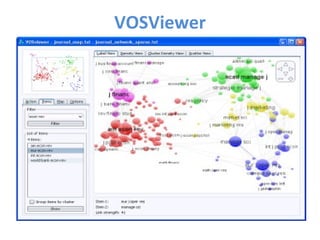
VOSViewer
Hjalmar Gislason
"Falling in Love with Data"
http://www.youtube.co
m/watch?v=fOg0QHUI-
lM&feature=plcp
20 Top Tools for Data
Visualisation
http://m.netmagazine.
com/features/top-20-
data-visualisation-tools
And another angle…
http://deverell.computi
ng.dundee.ac.uk/~cjma
rtin/dataVis.m4v

Data Warehousing, Data Mining & Data Visualisation

  • 1.
    Data Warehousing, DataMining & Data Visualisation Introduction
  • 2.
  • 3.
    What is aData Warehouse? • A data warehouse is a database used for reporting and analysis. • The data stored in the warehouse is uploaded from the operational systems. • The data may pass through an operational data store for additional operations before it is used in the data warehouse for reporting.
  • 4.
    A data-processing database?Wholesaling Data?
  • 5.
    Benefits of aData Warehouse A data warehouse maintains a copy of information from the source transaction systems. This architectural complexity provides the opportunity to: • Maintain data history. • Integrate data from multiple source systems. • Improve data quality. • Present the organisation's information consistently. • Provide a single common data model for all data of interest regardless of the data's source. • Restructure the data so that it makes sense to the business users. • Restructure the data so that it delivers excellent query performance, even for complex analytic queries. • Add value to operational business applications.
  • 6.
    History of DataWarehousing • 1990 — Red Brick Systems, founded by Ralph Kimball, introduces Red Brick Warehouse, a database management system specifically for data warehousing. • 1991 — Prism Solutions, founded by Bill Inmon, introduces Prism Warehouse Manager, software for developing a data warehouse. • 1992 — Bill Inmon publishes the book Building the Data Warehouse. • 1995 — The Data Warehousing Institute, a not-for-profit organisation that promotes data warehousing, is founded. • 1996 — Ralph Kimball publishes the book The Data Warehouse Toolkit. • 2000 — Daniel Linstedt releases the Data Vault, enabling real time auditable data warehouses.
  • 7.
    Dimensional v Normalised Thereare two leading approaches to storing data in a data warehouse — the dimensional approach and the normalised approach. • The dimensional approach, whose supporters are referred to as “Kimballites”, believe in Ralph Kimball’s approach in which it is stated that the data warehouse should be modelled using a Dimensional Model (DM). For example, a sales transaction can be broken up into facts such as the number of products ordered and the price paid for the products, and into dimensions such as order date, customer name, product number, order ship-to and bill-to locations, and salesperson responsible for receiving the order. • The normalised approach, also called the 3NF model, whose supporters are referred to as “Inmonites”, believe in Bill Inmon's approach in which it is stated that the data warehouse should be modelled using Peter Chen’s Entity-Relationship (ER) model with which, of course, we are all familiar!
  • 8.
    Kimball’s Bottom UpDesign • In the bottom-up approach data marts are first created to provide reporting and analytical capabilities for specific business processes. • Data marts contain, primarily, dimensions and facts. • Facts can contain either atomic data and, if necessary, summarised data. • The single data mart often models a specific business area such as "Sales" or "Production." • These data marts can eventually be integrated to create a comprehensive data warehouse.
  • 9.
    Inmon’s Top DownDesign Inmon states that the data warehouse is: • Subject-oriented: The data in the data warehouse is organised so that all the data elements relating to the same real-world event or object are linked together. • Non-volatile: Data in the data warehouse are never over-written or deleted — once committed, the data are static, read-only, and retained for future reporting. • Integrated: The data warehouse contains data from most or all of an organisation's operational systems and these data are made consistent.
  • 10.
    Hybrid Design • Datawarehouse (DW) solutions often resemble hub and spoke architecture. • Legacy systems feeding the DW solution often include customer relationship management (CRM) and enterprise resource planning solutions (ERP), generating large amounts of data. • To consolidate these various data models, and facilitate the extract transform load (ETL) process, DW solutions often make use of an operational data store (ODS).
  • 11.
    Data Warehouse Appliances •IBM Netezza • Oracle ExaData • Kognitio 360 • Teradata
  • 12.
    Demystifying the DataWarehouse http://www.youtube.c om/watch? v=mgEugd5kZgk&featu re=related
  • 13.
  • 14.
    What is DataMining? • Data mining is the analysis step of the Knowledge Discovery in Databases (KDD) process. • It is a relatively young and interdisciplinary field of computer science. • It is the process of discovering new patterns from large data sets involving methods at the intersection of artificial intelligence, machine learning, statistics and database systems.
  • 15.
    The KDD Process Theknowledge discovery in databases (KDD) process is commonly defined in 5 stages: (1) Selection (2) Preprocessing (3) Transformation (4) Data Mining (5) Interpretation/Evaluation
  • 16.
    The CRISP-DM Process TheCRoss Industry Standard Process for Data Mining (CRISP-DM) defines six phases: (1)Business Understanding (2) Data Understanding (3) Data Preparation (4) Modelling (5) Evaluation (6) Deployment The simplified process is (1) Pre-processing, (2) Data mining and (3) Results validation
  • 17.
    Spatial Data Mining •Spatial data mining is the application of data mining methods to spatial data. • Spatial data mining follows along the same functions in data mining, with the end objective to find patterns in geography. • So far, data mining and Geographic Information Systems (GIS) have existed as two separate technologies, each with its own methods, traditions and approaches to visualization and data analysis. • The immense explosion in geographically referenced data occasioned by developments in IT, digital mapping, remote sensing, and the global diffusion of GIS emphasises the importance of developing data driven inductive approaches to geographical analysis and modelling.
  • 18.
    Build a KPIDashboard in 5 Minutes http://www.youtube.c om/watch? v=D4S_uIIZyN0&featur e=related Build a KPI Dashboard in 5 minutes with no programming in Excel 2010
  • 19.
    Data Visualisation Choose 6of the Keywords in the above!
  • 20.
    Data Visualisation Defined Datavisualisation is the study of the visual representation of data, meaning "information that has been abstracted in some schematic form, including attributes or variables for the units of information". Friendly 2008
  • 21.
    Tufte and DataVisualisation ‘The success of visualisation is based on deep knowledge and care about the substance and the quality, relevance and integrity of the content.’ Tufte 1983
  • 22.
    5 Principles ofGraphic Display 1. Above all else, show the data. 2. Maximise the data-ink ratio. 3. Erase non-data-ink. 4. Erase redundant data-ink. 5. Revise and edit.
  • 23.
    The Beauty ofData Visualisation http://www.youtube.com/ watch?v=pLqjQ55tz-U David McCandless
  • 24.
    Gapminder A Data Mining& Data Visualisation Tool
  • 25.
    Hans Rosling • TheGapminder application is the brain-child of Hans Rosling. • He thought of the title when he heard the prompt ‘mind the gap’ on the London Underground. • He is Professor of International Health at Karolinska Institute, Stockholm, Sweden. • He is a Doctor of Medicine and a Doctor of Philosophy.
  • 26.
  • 27.
    Gapminder Desktop Gapminder Desktop allowsyou to show animated statistics from your own laptop. In short: • Use Gapminder World without internet access. • Save a list of your own favourite graphs. • Updates automatically when new data is available
  • 28.
  • 29.
  • 30.
  • 31.
    Hjalmar Gislason "Falling inLove with Data" http://www.youtube.co m/watch?v=fOg0QHUI- lM&feature=plcp
  • 32.
    20 Top Toolsfor Data Visualisation http://m.netmagazine. com/features/top-20- data-visualisation-tools
  • 33.