Data Warehouse andOLAP
Data Mining 2
• Data warehouses generalize and consolidate data in multidimensional space.
– The construction of data warehouses involves data cleaning, data integration,
and data transformation and can be viewed as an important preprocessing step
for data mining.
• Data warehouses provide on-line analytical processing (OLAP) tools for the
interactive analysis of multidimensional data of varied granularities, which
facilitates effective data generalization and data mining.
– Many other data mining functions, such as association, classification,
prediction, and clustering, can be integrated with OLAP operations to enhance
interactive mining of knowledge at multiple levels of abstraction.
3.
Data Mining 3
Whatis a Data Warehouse?
• Data warehousing provides architectures and tools for business executives to
systematically organize, understand, and use their data to make strategic decisions.
• Data warehouses have been defined in many ways:
– A decision support database that is maintained separately from an
organization’s operational databases.
– Data warehouses support information processing by providing a solid
platform of consolidated, historical data for analysis.
• Data warehousing:
– The process of constructing and using data warehouses.
4.
Data Mining 4
MajorFeatures of a Data Warehouse
Subject-Oriented
Four major features of a data warehouse:
• A data warehouse is a subject-oriented, integrated, time-variant, and nonvolatile
collection of data in support of management’s decision-making process.
Subject-Oriented:
• A data warehouse is organized around major subjects, such as customer,
product, sales.
• A data warehouse focuses on the modeling and analysis of data for decision
makers,
not on daily operations or transaction processing.
• A data warehouse provides a simple and concise view around particular subject
issues by excluding data that are not useful in the decision support process.
5.
Data Mining 5
MajorFeatures of a Data Warehouse
Integrated
Integrated:
• A data warehouse is constructed by integrating multiple heterogeneous data
sources such as relational databases, flat files, on-line transaction records.
• Data cleaning and data integration techniques are applied to ensure consistency in
naming conventions, encoding structures, attribute measures, etc.
– When data is moved to the warehouse from operational databases, it is
converted.
6.
Data Mining 6
MajorFeatures of a Data Warehouse
Time-Variant
Time-Variant:
• The time horizon for a data warehouse is significantly longer than that of
operational systems
– Operational database: current value data
– Data warehouse data: provide information from a historical perspective (e.g., past 5-10
years)
• Every key structure in the data warehouse contains an element of time, explicitly or
implicitly.
– But the key structure of operational data may or may not contain “time element”
7.
Data Mining 7
MajorFeatures of a Data Warehouse
Nonvolatile
Nonvolatile:
• A data warehouse is a physically separate store of data transformed from
the operational environment.
• Operational update of data does not occur in a data warehouse environment.
– Does not require transaction processing, recovery, and concurrency
control mechanisms
– Requires only two operations in data accessing:
• initial loading of data and access of data
8.
Data Mining 8
OperationalDatabase Systems
and Data Warehouses
• The major task of on-line operational database systems is to perform on-line
transaction and query processing.
– These systems are called on-line transaction processing (OLTP) systems.
– They cover most of the day-to-day operations of an organization, such as
purchasing, inventory, banking, payroll, registration, and accounting.
• Data warehouse systems, on the other hand, serve users or knowledge workers in
the role of data analysis and decision making.
– Such systems can organize and present data in various formats in order
to accommodate the diverse needs of the different users.
– These systems are known as on-line analytical processing (OLAP)
systems.
9.
Data Mining 9
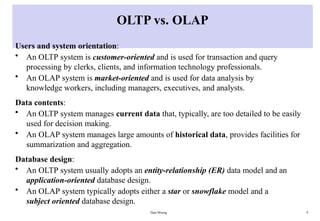
OLTPvs. OLAP
Users and system orientation:
• An OLTP system is customer-oriented and is used for transaction and query
processing by clerks, clients, and information technology professionals.
• An OLAP system is market-oriented and is used for data analysis by
knowledge workers, including managers, executives, and analysts.
Data contents:
• An OLTP system manages current data that, typically, are too detailed to be easily
used for decision making.
• An OLAP system manages large amounts of historical data, provides facilities for
summarization and aggregation.
Database design:
• An OLTP system usually adopts an entity-relationship (ER) data model and an
application-oriented database design.
• An OLAP system typically adopts either a star or snowflake model and a
subject oriented database design.
10.
Data Mining 10
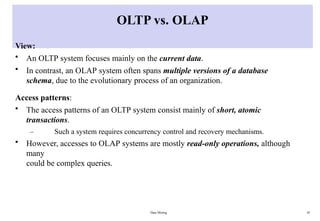
OLTPvs. OLAP
View:
• An OLTP system focuses mainly on the current data.
• In contrast, an OLAP system often spans multiple versions of a database
schema, due to the evolutionary process of an organization.
Access patterns:
• The access patterns of an OLTP system consist mainly of short, atomic
transactions.
– Such a system requires concurrency control and recovery mechanisms.
• However, accesses to OLAP systems are mostly read-only operations, although
many
could be complex queries.
11.
Data Mining 11
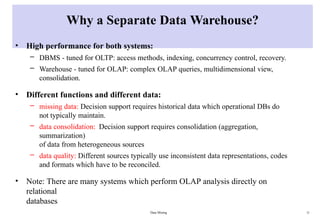
Whya Separate Data Warehouse?
• High performance for both systems:
– DBMS - tuned for OLTP: access methods, indexing, concurrency control, recovery.
– Warehouse - tuned for OLAP: complex OLAP queries, multidimensional view,
consolidation.
• Different functions and different data:
– missing data: Decision support requires historical data which operational DBs do
not typically maintain.
– data consolidation: Decision support requires consolidation (aggregation,
summarization)
of data from heterogeneous sources
– data quality: Different sources typically use inconsistent data representations, codes
and formats which have to be reconciled.
• Note: There are many systems which perform OLAP analysis directly on
relational
databases
12.
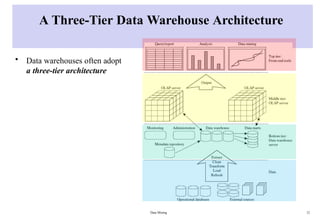
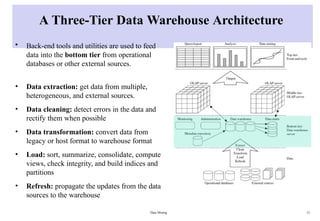
A Three-Tier DataWarehouse Architecture
• Data warehouses often adopt
a three-tier architecture
Data Mining 12
13.
A Three-Tier DataWarehouse Architecture
• Back-end tools and utilities are used to feed
data into the bottom tier from operational
databases or other external sources.
• Data extraction: get data from multiple,
heterogeneous, and external sources.
• Data cleaning: detect errors in the data and
rectify them when possible
• Data transformation: convert data from
legacy or host format to warehouse format
• Load: sort, summarize, consolidate, compute
views, check integrity, and build indices and
partitions
• Refresh: propagate the updates from the data
sources to the warehouse
Data Mining 13
14.
Data Mining 14
MetadataRepository
• Meta data is the data defining warehouse objects.
• A metadata repository contains:
– A description of the data warehouse structure:
• schema, view, dimensions, hierarchies, derived data definitions, data mart locations and contents
– Operational meta-data:
• data lineage (history of migrated data and transformation path),
• currency of data (active, archived, or purged),
• monitoring information (warehouse usage statistics, error reports, audit trails)
– The algorithms used for summarization
– The mapping from operational environment to the data warehouse
– Data related to system performance
• warehouse schema, view and derived data definitions
– Business data
• business terms and definitions, ownership of data, charging policies
15.
Data Mining 15
ThreeData Warehouse Models
• From the architecture point of view, there are three data warehouse models: enterprise
warehouse, data mart and virtual warehouse.
Enterprise Warehouse
• Collects all of the information about subjects spanning the entire organization
Data Mart
• A subset of corporate-wide data that is of value to a specific groups of users.
Its scope is confined to specific, selected groups, such as marketing data mart
Virtual Warehouse
• A set of views over operational databases
• Only some of the possible summary views may be materialized
16.
Data Mining 16
MultidimensionalData Model: Data Cube
• Data warehouses and OLAP tools are based on a multidimensional data model.
• This model views data in the form of a data cube.
• A data cube allows data to be modeled and viewed in multiple dimensions.
– It is defined by dimensions and facts.
– Dimensions are the perspectives or entities with respect to which an organization wants
to keep records.
• Each dimension may have a table associated with it, called a dimension table, which further
describes the dimension. For example, a dimension table for item may contain the attributes item
name, brand, and type.
– Facts are numerical measures.
• Examples of facts for a sales data warehouse include dollars sold units sold
17.
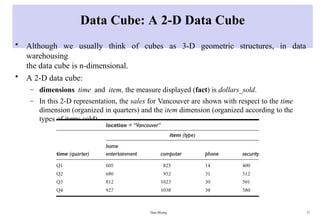
Data Cube: A2-D Data Cube
• Although we usually think of cubes as 3-D geometric structures, in data
warehousing
the data cube is n-dimensional.
• A 2-D data cube:
– dimensions time and item, the measure displayed (fact) is dollars_sold.
– In this 2-D representation, the sales for Vancouver are shown with respect to the time
dimension (organized in quarters) and the item dimension (organized according to the
types of items sold).
Data Mining 17
18.
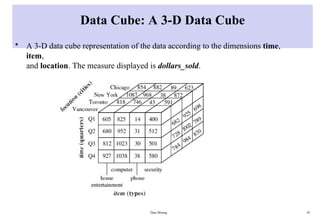
Data Cube: A3-D Data Cube
• A 3-D data cube representation of the data according to the dimensions time,
item,
and location. The measure displayed is dollars_sold.
Data Mining 18
19.
Data Mining 19
FromTables to Data Cubes
• A data warehouse is based on a multidimensional data model which views data
in
the form of a data cube
• A data cube, such as sales, allows data to be modeled and viewed in
multiple dimensions
– Dimension tables, such as item (item_name, brand, type), or time (day,
week,
month, quarter, year)
– Fact table contains measures (such as dollars_sold) and keys to each of
the related dimension tables
• In data warehousing literature,
– An n-D base cube is called a base cuboid.
– The top most 0-D cuboid, which holds the highest-level of summarization, is called the
apex cuboid.
• The lattice of cuboids forms a data cube.
20.
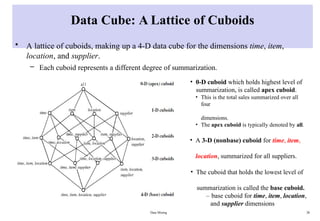
Data Cube: ALattice of Cuboids
• A lattice of cuboids, making up a 4-D data cube for the dimensions time, item,
location, and supplier.
– Each cuboid represents a different degree of summarization.
• 0-D cuboid which holds highest level of
summarization, is called apex cuboid.
• This is the total sales summarized over all
four
dimensions.
• The apex cuboid is typically denoted by all.
• A 3-D (nonbase) cuboid for time, item,
location, summarized for all suppliers.
• The cuboid that holds the lowest level of
summarization is called the base cuboid.
– base cuboid for time, item, location,
and supplier dimensions
Data Mining 20
21.
Data Mining 21
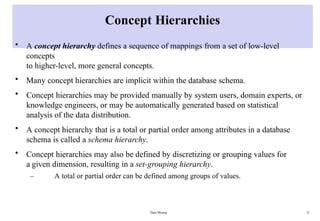
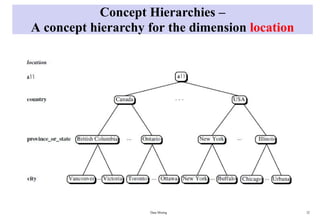
ConceptHierarchies
• A concept hierarchy defines a sequence of mappings from a set of low-level
concepts
to higher-level, more general concepts.
• Many concept hierarchies are implicit within the database schema.
• Concept hierarchies may be provided manually by system users, domain experts, or
knowledge engineers, or may be automatically generated based on statistical
analysis of the data distribution.
• A concept hierarchy that is a total or partial order among attributes in a database
schema is called a schema hierarchy.
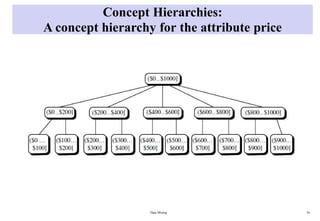
• Concept hierarchies may also be defined by discretizing or grouping values for
a given dimension, resulting in a set-grouping hierarchy.
– A total or partial order can be defined among groups of values.
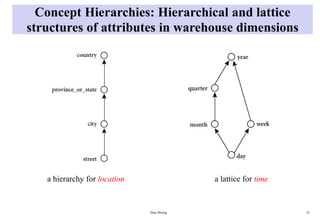
Concept Hierarchies: Hierarchicaland lattice
structures of attributes in warehouse dimensions
a hierarchy for location
Data Mining 23
a lattice for time
Data Mining 25
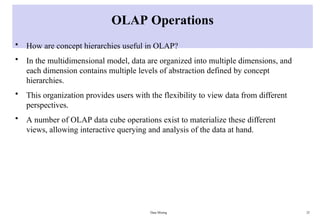
OLAPOperations
• How are concept hierarchies useful in OLAP?
• In the multidimensional model, data are organized into multiple dimensions, and
each dimension contains multiple levels of abstraction defined by concept
hierarchies.
• This organization provides users with the flexibility to view data from different
perspectives.
• A number of OLAP data cube operations exist to materialize these different
views, allowing interactive querying and analysis of the data at hand.
26.
Data Mining 26
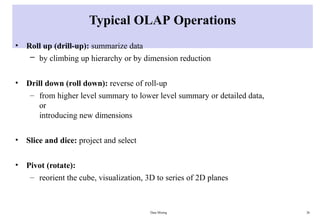
TypicalOLAP Operations
• Roll up (drill-up): summarize data
– by climbing up hierarchy or by dimension reduction
• Drill down (roll down): reverse of roll-up
– from higher level summary to lower level summary or detailed data,
or
introducing new dimensions
• Slice and dice: project and select
• Pivot (rotate):
– reorient the cube, visualization, 3D to series of 2D planes
27.
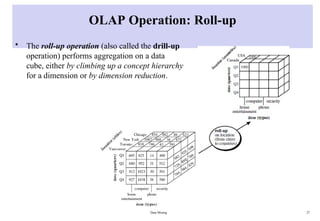
OLAP Operation: Roll-up
•The roll-up operation (also called the drill-up
operation) performs aggregation on a data
cube, either by climbing up a concept hierarchy
for a dimension or by dimension reduction.
Data Mining 27
28.
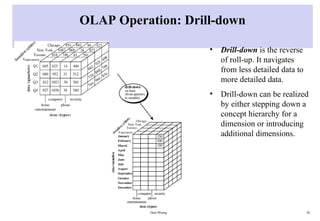
OLAP Operation: Drill-down
•Drill-down is the reverse
of roll-up. It navigates
from less detailed data to
more detailed data.
• Drill-down can be realized
by either stepping down a
concept hierarchy for a
dimension or introducing
additional dimensions.
Data Mining 28
29.
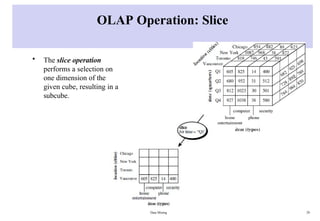
OLAP Operation: Slice
•The slice operation
performs a selection on
one dimension of the
given cube, resulting in a
subcube.
Data Mining 29
30.
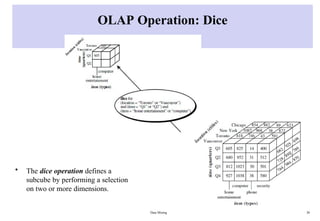
OLAP Operation: Dice
•The dice operation defines a
subcube by performing a selection
on two or more dimensions.
Data Mining 30
31.
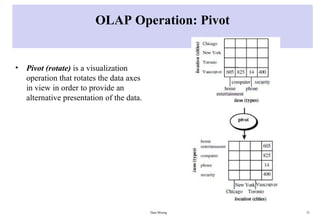
OLAP Operation: Pivot
•Pivot (rotate) is a visualization
operation that rotates the data axes
in view in order to provide an
alternative presentation of the data.
Data Mining 31
32.
Data Mining 32
DataWarehouse Usage
• Three kinds of data warehouse applications
– Information processing
• supports querying, basic statistical analysis, and reporting using
crosstabs, tables, charts and graphs
– Analytical processing
• multidimensional analysis of data warehouse data
• supports basic OLAP operations, slice-dice, drilling, pivoting
– Data mining
• knowledge discovery from hidden patterns
• supports associations, constructing analytical models, performing
classification and prediction, and presenting the mining results
using visualization tools
33.
Data Mining 33
DataWarehouse and OLAP: Summary
• A data warehouse is a subject-oriented, integrated, time-variant, and nonvolatile
collection of data organized in support of management decision making.
– Several factors distinguish data warehouses from operational databases.
– Because the two systems provide quite different functionalities and require different
kinds of data, it is necessary to maintain data warehouses separately from operational
databases.
• A multidimensional data model is typically used for the design of corporate
data warehouses.
– A multidimensional data model can adopt a star schema, snowflake schema, or
fact constellation schema.
– The core of the multidimensional model is the data cube, which consists of a large
set of
facts (or measures) and a number of dimensions.
– Dimensions are the entities or perspectives with respect to which an organization wants
to keep records and are hierarchical in nature.
• A data cube consists of a lattice of cuboids, each corresponding to a different
degree of summarization of the given multidimensional data.
34.
Data Mining 34
DataWarehouse and OLAP: Summary
• Concept hierarchies organize the values of dimensions into gradual levels of
abstraction.
• On-line analytical processing (OLAP) can be performed in data warehouses
using the multidimensional data model.
– Typical OLAP operations include roll-up, drill-down,, slice-and-dice, pivot (rotate), as well as
statistical operations such as ranking and computing moving averages and growth rates.
• Data warehouses often adopt a three-tier architecture.
– The bottom tier is a warehouse database server, which is a relational database system.
– The middle tier is an OLAP server, and
– The top tier is a client, containing query and reporting tools.
• A data warehouse contains back-end tools and utilities for populating and
refreshing the warehouse.
– data extraction, data cleaning, data transformation, loading, refreshing, and warehouse management.
• Data warehouse metadata are data defining the warehouse objects.
– A metadata repository provides details regarding the warehouse structure, data history, the algorithms
used for summarization, mappings from the source data to warehouse form.



![제 23회 보아즈(BOAZ) 빅데이터 컨퍼런스 - [MBOAX] : ABSA를 활용한 소비자 반응 분석 기반 운영 효율화 대시보드 설계](https://cdn.slidesharecdn.com/ss_thumbnails/3-1boaz23rdconferencemboax-260203102709-9d519923-thumbnail.jpg?width=640&height=640&fit=bounds)


