Networks & Knowledge Sharing
New Terms…Old Turns…
 Six Degrees of Separation
 The Strength of Weak Ties
 Small and Clustered Worlds
 Ego-centred Networks
 Power Law Distribution
Today we increasingly recognize that nothing happens in
isolation. Most events and phenomena are connected,
caused by, and interacting with a huge number of other
pieces of a complex universal puzzle. We have come to
see that we live in a small world, where everything is
linked to everything else. We are witnessing a revolution
in the making as scientists from all different disciplines
discover that complexity has a strict architecture. We
have come to grasp the importance of networks.
Barabasi (2003): 7
LINKED…
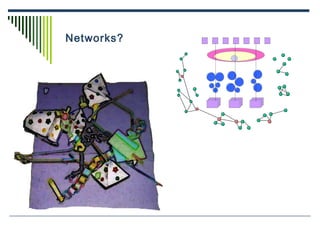
Networks?
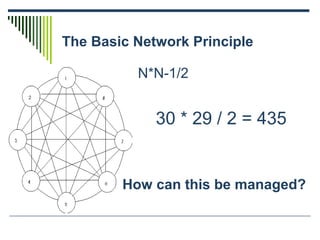
The Basic Network Principle
N*N-1/2
30 * 29 / 2 = 435
How can this be managed?
Making the NetWork
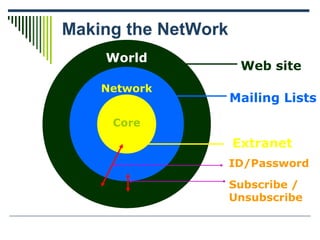
Web site
Mailing Lists
Extranet
ID/Password
Subscribe /
Unsubscribe
World
Network
Core
Making the NetWork
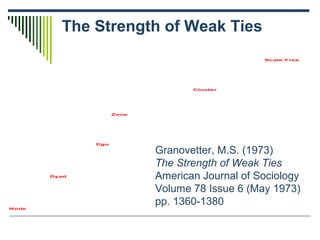
The Strength of Weak Ties
Granovetter, M.S. (1973)
The Strength of Weak Ties
American Journal of Sociology
Volume 78 Issue 6 (May 1973)
pp. 1360-1380Node
Dyad
Ego
Cluster
Scale-Free
Zone
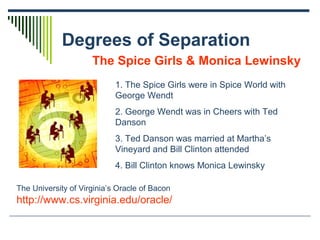
Degrees of Separation
The Spice Girls & Monica Lewinsky
1. The Spice Girls were in Spice World with
George Wendt
2. George Wendt was in Cheers with Ted
Danson
3. Ted Danson was married at Martha’s
Vineyard and Bill Clinton attended
4. Bill Clinton knows Monica Lewinsky
The University of Virginia’s Oracle of Bacon
http://www.cs.virginia.edu/oracle/
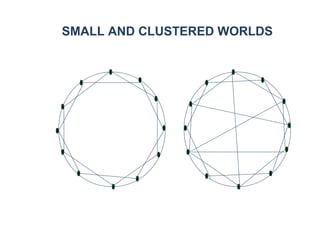
SMALL AND CLUSTERED WORLDS
 
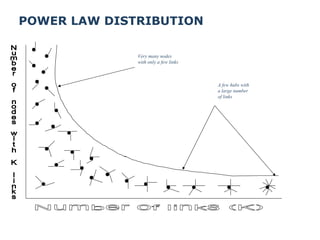
Very many nodes
with only a few links
A few hubs with
a large number
of links
POWER LAW DISTRIBUTION
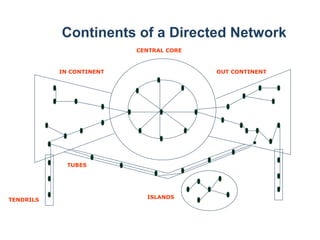
Continents of a Directed Network
TUBES
TENDRILS
ISLANDS
CENTRAL CORE
IN CONTINENT OUT CONTINENT
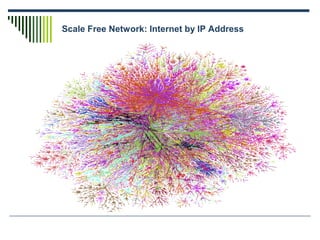
Scale Free Network: Internet by IP Address
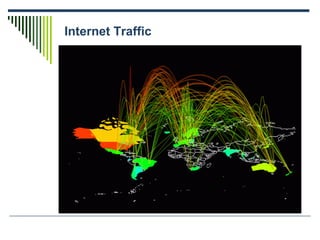
Internet Traffic
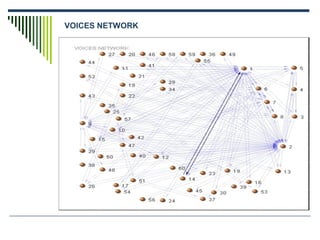
VOICES NETWORK
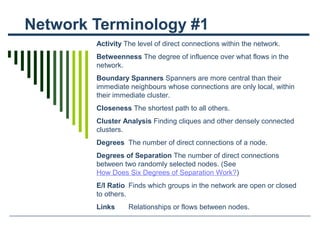
Network Terminology #1
Activity The level of direct connections within the network.
Betweenness The degree of influence over what flows in the
network.
Boundary Spanners Spanners are more central than their
immediate neighbours whose connections are only local, within
their immediate cluster.
Closeness The shortest path to all others.
Cluster Analysis Finding cliques and other densely connected
clusters.
Degrees The number of direct connections of a node.
Degrees of Separation The number of direct connections
between two randomly selected nodes. (See
How Does Six Degrees of Separation Work?)
E/I Ratio Finds which groups in the network are open or closed
to others.
Links Relationships or flows between nodes.
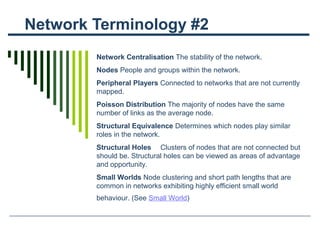
Network Terminology #2
Network Centralisation The stability of the network.
Nodes People and groups within the network.
Peripheral Players Connected to networks that are not currently
mapped.
Poisson Distribution The majority of nodes have the same
number of links as the average node.
Structural Equivalence Determines which nodes play similar
roles in the network.
Structural Holes Clusters of nodes that are not connected but
should be. Structural holes can be viewed as areas of advantage
and opportunity.
Small Worlds Node clustering and short path lengths that are
common in networks exhibiting highly efficient small world
behaviour. (See Small World)
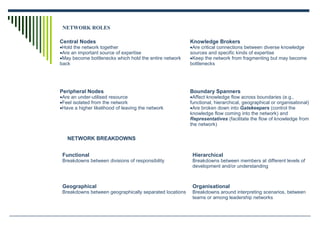
NETWORK ROLES
Central Nodes
•Hold the network together
•Are an important source of expertise
•May become bottlenecks which hold the entire network
back
Knowledge Brokers
•Are critical connections between diverse knowledge
sources and specific kinds of expertise
•Keep the network from fragmenting but may become
bottlenecks
Peripheral Nodes
•Are an under-utilised resource
•Feel isolated from the network
•Have a higher likelihood of leaving the network
Boundary Spanners
•Affect knowledge flow across boundaries (e.g.,
functional, hierarchical, geographical or organisational)
•Are broken down into Gatekeepers (control the
knowledge flow coming into the network) and
Representatives (facilitate the flow of knowledge from
the network)
NETWORK BREAKDOWNS
Functional
Breakdowns between divisions of responsibility
Hierarchical
Breakdowns between members at different levels of
development and/or understanding
Geographical
Breakdowns between geographically separated locations
Organisational
Breakdowns around interpreting scenarios, between
teams or among leadership networks

Networks & Knowledge Sharing

  • 1.
  • 2.
    New Terms…Old Turns… Six Degrees of Separation  The Strength of Weak Ties  Small and Clustered Worlds  Ego-centred Networks  Power Law Distribution
  • 3.
    Today we increasinglyrecognize that nothing happens in isolation. Most events and phenomena are connected, caused by, and interacting with a huge number of other pieces of a complex universal puzzle. We have come to see that we live in a small world, where everything is linked to everything else. We are witnessing a revolution in the making as scientists from all different disciplines discover that complexity has a strict architecture. We have come to grasp the importance of networks. Barabasi (2003): 7 LINKED…
  • 4.
  • 5.
    The Basic NetworkPrinciple N*N-1/2 30 * 29 / 2 = 435 How can this be managed?
  • 6.
  • 7.
    Web site Mailing Lists Extranet ID/Password Subscribe/ Unsubscribe World Network Core Making the NetWork
  • 8.
    The Strength ofWeak Ties Granovetter, M.S. (1973) The Strength of Weak Ties American Journal of Sociology Volume 78 Issue 6 (May 1973) pp. 1360-1380Node Dyad Ego Cluster Scale-Free Zone
  • 9.
    Degrees of Separation TheSpice Girls & Monica Lewinsky 1. The Spice Girls were in Spice World with George Wendt 2. George Wendt was in Cheers with Ted Danson 3. Ted Danson was married at Martha’s Vineyard and Bill Clinton attended 4. Bill Clinton knows Monica Lewinsky The University of Virginia’s Oracle of Bacon http://www.cs.virginia.edu/oracle/
  • 10.
  • 11.
      Very many nodes withonly a few links A few hubs with a large number of links POWER LAW DISTRIBUTION
  • 12.
    Continents of aDirected Network TUBES TENDRILS ISLANDS CENTRAL CORE IN CONTINENT OUT CONTINENT
  • 13.
    Scale Free Network:Internet by IP Address
  • 14.
  • 15.
  • 16.
    Network Terminology #1 ActivityThe level of direct connections within the network. Betweenness The degree of influence over what flows in the network. Boundary Spanners Spanners are more central than their immediate neighbours whose connections are only local, within their immediate cluster. Closeness The shortest path to all others. Cluster Analysis Finding cliques and other densely connected clusters. Degrees The number of direct connections of a node. Degrees of Separation The number of direct connections between two randomly selected nodes. (See How Does Six Degrees of Separation Work?) E/I Ratio Finds which groups in the network are open or closed to others. Links Relationships or flows between nodes.
  • 17.
    Network Terminology #2 NetworkCentralisation The stability of the network. Nodes People and groups within the network. Peripheral Players Connected to networks that are not currently mapped. Poisson Distribution The majority of nodes have the same number of links as the average node. Structural Equivalence Determines which nodes play similar roles in the network. Structural Holes Clusters of nodes that are not connected but should be. Structural holes can be viewed as areas of advantage and opportunity. Small Worlds Node clustering and short path lengths that are common in networks exhibiting highly efficient small world behaviour. (See Small World)
  • 18.
    NETWORK ROLES Central Nodes •Holdthe network together •Are an important source of expertise •May become bottlenecks which hold the entire network back Knowledge Brokers •Are critical connections between diverse knowledge sources and specific kinds of expertise •Keep the network from fragmenting but may become bottlenecks Peripheral Nodes •Are an under-utilised resource •Feel isolated from the network •Have a higher likelihood of leaving the network Boundary Spanners •Affect knowledge flow across boundaries (e.g., functional, hierarchical, geographical or organisational) •Are broken down into Gatekeepers (control the knowledge flow coming into the network) and Representatives (facilitate the flow of knowledge from the network) NETWORK BREAKDOWNS Functional Breakdowns between divisions of responsibility Hierarchical Breakdowns between members at different levels of development and/or understanding Geographical Breakdowns between geographically separated locations Organisational Breakdowns around interpreting scenarios, between teams or among leadership networks

Editor's Notes

  • #6 . . . highly interactive and perhaps more introspective networks. In our work with communities this model of network has been presented and applied by communities as diverse as Kensington in inner city Liverpool and rural Cornwall. By networks linked by their geographical location or by a shared interest.
  • #7 . . . highly interactive and perhaps more introspective networks. In our work with communities this model of network has been presented and applied by communities as diverse as Kensington in inner city Liverpool and rural Cornwall. By networks linked by their geographical location or by a shared interest.
  • #8 We have already considered the type of people that occupy the different part of our network but before we consider what technology we can apply to make our network work, let’s consider the nature of the communication that takes place in the different sectors. This is characterised in two ways: 1) As you move to the centre of the model the nature of communications become richer and more interactive; 2) As you move from the outside you move from promotional/awareness raising activity, through information provision to group working. If we accept this network model ie can adapt it to our own network, we can start to consider how technology can help is to make our network work. A web site is a very cost-effective way of reaching lots of ‘unknown’ people with the message about what it is you do. There is no real way of knowing who we are communicating with in any detail. There is no need to identify oneself to use a basic website. Those that have tried to do this have found it to be counter productive as it turns people away. Your website is also a place where you can ask people to join your network or even your core group. We will see how the Community Action Network do this in a minute. Email-based systems can be used to link ‘Your Network’ but again the level of interaction may still be one-way and between fairly unknown individuals. Participants will only know each other’s email addresses. Rich, 2-way communications can only take place between know individuals and this is the role of ‘Extranets’ such as ruralnet|online.
  • #9 . . . highly interactive and perhaps more introspective networks. In our work with communities this model of network has been presented and applied by communities as diverse as Kensington in inner city Liverpool and rural Cornwall. By networks linked by their geographical location or by a shared interest.
  • #10 . . . highly interactive and perhaps more introspective networks. In our work with communities this model of network has been presented and applied by communities as diverse as Kensington in inner city Liverpool and rural Cornwall. By networks linked by their geographical location or by a shared interest.