Er. Nawaraj Bhandari
Database Design &
Developmentf
Topic 10: Data Warehouse
© NCC Education LimitedV1.0
Data Warehouses Topic 11 - 11.2
Why need a Data Warehouse? - 1
• Two types of database processing
• OLTP - On-line transaction processing.
- It is a class of program that facilitates and manages
transaction-oriented applications.
- It is used for supporting daily business.
• OLAP - On-line analytical processing
- It is a way of viewing data in a multidimensional
format.
- It is used for supporting decision making.
© NCC Education LimitedV1.0
Data Warehouses Topic 11 - 11.3
Why need a Data Warehouse? - 2
• The need for business intelligence
- competitive environment
- strategic planning
- decision making
• Proliferation of different systems
© NCC Education LimitedV1.0
Data Warehouses Topic 11 - 11.4
• Content
• Accessibility
• Form
• Performance
• Availability
• Data Warehouse is a solution
Databases Designed for OLTP are not Suitable
for OLAP
© NCC Education LimitedV1.0
Data Warehouses Topic 11 - 11.5
Stock taking and reordering database
Customer Records database
Internet and
VPN or WAN
LAN
On-line shopping
Webserver and database for
On line shopping
OLTP for point of salesPoint of SaleCustomer with loyalty card
Supermarket Systems
© NCC Education LimitedV1.0
Data Warehouses Topic 11 - 11.6
Activity – Identify the Types of Data been
Collected and Used here?
© NCC Education LimitedV1.0
Data Warehouses Topic 11 - 11.7
And… What Benefits from Bringing this Data
Together? - 1
© NCC Education LimitedV1.0
Data Warehouses Topic 11 - 11.8
And… What Benefits from Bringing this Data
Together?
Sales Trends
Customer Buying habits
Regional variations
Variations by time
Goods generating
profit
© NCC Education LimitedV1.0
Data Warehouses Topic 11 - 11.9
Transform “Data” into “Information”
• Data Warehouse provides a multidimensional view
of an organization’s operational (OLTP) data to help
user make more informed, fast decisions.
© NCC Education LimitedV1.0
Data Warehouses Topic 11 - 11.10
Data Warehouse
• Subject-oriented
• Integrated
• Time-variant
• Non-volatile
Combining data in support
of management’s decisions
What is a Data Warehouse?
© NCC Education LimitedV1.0
Data Warehouses Topic 11 - 11.11
Subject Orientation
Operational System
sales
warehouse
Loyalty
card Online
sales
An application orientation
Data warehouse
supplier
customer
product
A subject orientation
buying
© NCC Education LimitedV1.0
Data Warehouses Topic 11 - 11.12
Integration
OLTP System Data warehouse
App1-m,f
App2-1,0
App3-male,female
Integration
Date(ddmmyy)
App1-date(yymmdd)
App2-date(mmddyy)
App3-date(ddmmyy)
m,f
Integration
© NCC Education LimitedV1.0
Data Warehouses Topic 11 - 11.13
Time Variant
OLTP System Data warehouse
• time horizon – 60-90 days
depending on business
• key will not usually have an
element of time
• data can be changed
• time horizon – long term
5-10 years
• key will contain an
element of time
• data cannot be changed
© NCC Education LimitedV1.0
Data Warehouses Topic 11 - 11.14
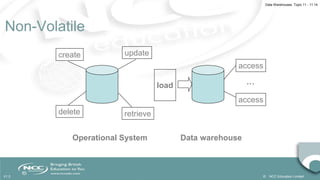
Non-Volatile
Operational System Data warehouse
create update
retrievedelete
load
access
access
…
© NCC Education LimitedV1.0
Data Warehouses Topic 11 - 11.15
The Data Warehouse Functional
Model
Date
Extraction
&Prep
Data base
Or Other
Storage
Query
OLAP
Statistics
Discovery
Mining
Others
Acquisition Storage Access
Users
Users
© NCC Education LimitedV1.0
Data Warehouses Topic 11 - 11.16
• Identifying the necessary data from legacy system
(and other data sources).
• Validating that the data is accurate, appropriate,
and usable.
• Extracting the data from the original source
• Preparing the data for inclusion into the new
environment.
• Staging the information – making the data ready for
loading into the warehouse itself
Acquisition
© NCC Education LimitedV1.0
Data Warehouses Topic 11 - 11.17
Storage
• Storage is the heart of a data warehouse
• An environment (the data warehouse) is constructed to provide a place
from which the data from the source systems can be accessed
© NCC Education LimitedV1.0
Data Warehouses Topic 11 - 11.18
Access Tools
• Query and Reporting Tools
• OLAP Tools
• Statistical Analysis Tools
• Data Discovery / Data mining Tools
• Graphical and Geographic Information Systems
© NCC Education LimitedV1.0
Data Warehouses Topic 11 - 11.19
Seven Steps to Building a Data
Warehouse
• Determine the needs of the end users
• Identify the necessary data sources
• Analyse the data sources in depth
• Use the information to work out how the data will need to be
transformed
• Create the meta data which describes the transformation
and integration that to occur
• Create the physical data warehouse and populate from
various sources
• Create the end use applications
© NCC Education LimitedV1.0
Data Warehouses Topic 11 - 11.20
An Example of A Data Warehouse
Purchasing
System
Transformation/Integration
Process
Applications
Order Processing
System
Inventory
System
Data Warehouse
Meta Data
Production Planning
Distribution
Customer Service
© NCC Education LimitedV1.0
Data Warehouses Topic 11 - 11.21
Data Warehouse Schemas
• Star Schemas
• Snowflake schemas
• Starflake schemas
© NCC Education LimitedV1.0
Data Warehouses Topic 11 - 11.22
Fact Table
e.g. Sales
trends
On-line sales
Customer
loyalty data
Store sales
• Central table surrounded by reference tables
Star Schema
© NCC Education LimitedV1.0
Data Warehouses Topic 11 - 11.23
Fact Table
e.g Sales
Trends
On-line sales
Customer
loyalty
Store sales
Region
information
Store sales
by Item type
Item Type
sales by
customer
Snowflake Schema
• Each dimension can have a number of its own
dimensions
© NCC Education LimitedV1.0
Data Warehouses Topic 11 - 11.24
Fact Table
e.g Sales
Trends
On-line sales Customer
loyalty
Store salesRegion
information
Store sales
by Item type
Starflake Schema
• Some de-normalisation
© NCC Education LimitedV1.0
Data Warehouses Topic 11 - 11.25
OLAP – On-line Analytical
Processing
• Consolidation
• Drilling-down
• Pivoting
• Multi-dimensional data
© NCC Education LimitedV1.0
Data Warehouses Topic 11 - 11.26
34 36
5538 34
34 54
58
60
56
2009
2010
A M J J A
Month
North
South
Midlands
Year
Region
Multi-dimensional data – sales of Ice cream in thousands
© NCC Education LimitedV1.0
Data Warehouses Topic 11 - 11.27
Codd’s Rules for OLAP Tools - 1
• Multi-dimensional conceptual view
• Transparency
• Accessibility
• Consistent reporting performance
• Client-server architecture
• Generic dimensionality
• Dynamic sparse matrix handling
© NCC Education LimitedV1.0
Data Warehouses Topic 11 - 11.28
Codd’s Rules for OLAP Tools - 2
• Multi-user support
• Unrestricted cross-dimensional operations
• Intuitive data manipulation
• Flexible reporting
• Unlimited dimensions
© NCC Education LimitedV1.0
Data Warehouses Topic 11 - 11.29
References
• Benyon-Davies, Paul. Database Systems Palgrave
Third Edition 2004 Chapters 40 and 41
• Connolly, Thomas M., and Begg, Carolyn E.,
Database Systems: A Practical Approach to Design
and Implementation Addision-Wesley, Fourth
Edition 2005 Chapter 31, 32 and 33
• Inmon, W.H., “Building the data warehouse”
http://inmoncif.com/inmoncif-
old/www/library/whiteprs/ttbuild.pdf retrieved 15th
August 2011
ANY QUESTIONS?

Data Warehouse

  • 1.
    Er. Nawaraj Bhandari DatabaseDesign & Developmentf Topic 10: Data Warehouse
  • 2.
    © NCC EducationLimitedV1.0 Data Warehouses Topic 11 - 11.2 Why need a Data Warehouse? - 1 • Two types of database processing • OLTP - On-line transaction processing. - It is a class of program that facilitates and manages transaction-oriented applications. - It is used for supporting daily business. • OLAP - On-line analytical processing - It is a way of viewing data in a multidimensional format. - It is used for supporting decision making.
  • 3.
    © NCC EducationLimitedV1.0 Data Warehouses Topic 11 - 11.3 Why need a Data Warehouse? - 2 • The need for business intelligence - competitive environment - strategic planning - decision making • Proliferation of different systems
  • 4.
    © NCC EducationLimitedV1.0 Data Warehouses Topic 11 - 11.4 • Content • Accessibility • Form • Performance • Availability • Data Warehouse is a solution Databases Designed for OLTP are not Suitable for OLAP
  • 5.
    © NCC EducationLimitedV1.0 Data Warehouses Topic 11 - 11.5 Stock taking and reordering database Customer Records database Internet and VPN or WAN LAN On-line shopping Webserver and database for On line shopping OLTP for point of salesPoint of SaleCustomer with loyalty card Supermarket Systems
  • 6.
    © NCC EducationLimitedV1.0 Data Warehouses Topic 11 - 11.6 Activity – Identify the Types of Data been Collected and Used here?
  • 7.
    © NCC EducationLimitedV1.0 Data Warehouses Topic 11 - 11.7 And… What Benefits from Bringing this Data Together? - 1
  • 8.
    © NCC EducationLimitedV1.0 Data Warehouses Topic 11 - 11.8 And… What Benefits from Bringing this Data Together? Sales Trends Customer Buying habits Regional variations Variations by time Goods generating profit
  • 9.
    © NCC EducationLimitedV1.0 Data Warehouses Topic 11 - 11.9 Transform “Data” into “Information” • Data Warehouse provides a multidimensional view of an organization’s operational (OLTP) data to help user make more informed, fast decisions.
  • 10.
    © NCC EducationLimitedV1.0 Data Warehouses Topic 11 - 11.10 Data Warehouse • Subject-oriented • Integrated • Time-variant • Non-volatile Combining data in support of management’s decisions What is a Data Warehouse?
  • 11.
    © NCC EducationLimitedV1.0 Data Warehouses Topic 11 - 11.11 Subject Orientation Operational System sales warehouse Loyalty card Online sales An application orientation Data warehouse supplier customer product A subject orientation buying
  • 12.
    © NCC EducationLimitedV1.0 Data Warehouses Topic 11 - 11.12 Integration OLTP System Data warehouse App1-m,f App2-1,0 App3-male,female Integration Date(ddmmyy) App1-date(yymmdd) App2-date(mmddyy) App3-date(ddmmyy) m,f Integration
  • 13.
    © NCC EducationLimitedV1.0 Data Warehouses Topic 11 - 11.13 Time Variant OLTP System Data warehouse • time horizon – 60-90 days depending on business • key will not usually have an element of time • data can be changed • time horizon – long term 5-10 years • key will contain an element of time • data cannot be changed
  • 14.
    © NCC EducationLimitedV1.0 Data Warehouses Topic 11 - 11.14 Non-Volatile Operational System Data warehouse create update retrievedelete load access access …
  • 15.
    © NCC EducationLimitedV1.0 Data Warehouses Topic 11 - 11.15 The Data Warehouse Functional Model Date Extraction &Prep Data base Or Other Storage Query OLAP Statistics Discovery Mining Others Acquisition Storage Access Users Users
  • 16.
    © NCC EducationLimitedV1.0 Data Warehouses Topic 11 - 11.16 • Identifying the necessary data from legacy system (and other data sources). • Validating that the data is accurate, appropriate, and usable. • Extracting the data from the original source • Preparing the data for inclusion into the new environment. • Staging the information – making the data ready for loading into the warehouse itself Acquisition
  • 17.
    © NCC EducationLimitedV1.0 Data Warehouses Topic 11 - 11.17 Storage • Storage is the heart of a data warehouse • An environment (the data warehouse) is constructed to provide a place from which the data from the source systems can be accessed
  • 18.
    © NCC EducationLimitedV1.0 Data Warehouses Topic 11 - 11.18 Access Tools • Query and Reporting Tools • OLAP Tools • Statistical Analysis Tools • Data Discovery / Data mining Tools • Graphical and Geographic Information Systems
  • 19.
    © NCC EducationLimitedV1.0 Data Warehouses Topic 11 - 11.19 Seven Steps to Building a Data Warehouse • Determine the needs of the end users • Identify the necessary data sources • Analyse the data sources in depth • Use the information to work out how the data will need to be transformed • Create the meta data which describes the transformation and integration that to occur • Create the physical data warehouse and populate from various sources • Create the end use applications
  • 20.
    © NCC EducationLimitedV1.0 Data Warehouses Topic 11 - 11.20 An Example of A Data Warehouse Purchasing System Transformation/Integration Process Applications Order Processing System Inventory System Data Warehouse Meta Data Production Planning Distribution Customer Service
  • 21.
    © NCC EducationLimitedV1.0 Data Warehouses Topic 11 - 11.21 Data Warehouse Schemas • Star Schemas • Snowflake schemas • Starflake schemas
  • 22.
    © NCC EducationLimitedV1.0 Data Warehouses Topic 11 - 11.22 Fact Table e.g. Sales trends On-line sales Customer loyalty data Store sales • Central table surrounded by reference tables Star Schema
  • 23.
    © NCC EducationLimitedV1.0 Data Warehouses Topic 11 - 11.23 Fact Table e.g Sales Trends On-line sales Customer loyalty Store sales Region information Store sales by Item type Item Type sales by customer Snowflake Schema • Each dimension can have a number of its own dimensions
  • 24.
    © NCC EducationLimitedV1.0 Data Warehouses Topic 11 - 11.24 Fact Table e.g Sales Trends On-line sales Customer loyalty Store salesRegion information Store sales by Item type Starflake Schema • Some de-normalisation
  • 25.
    © NCC EducationLimitedV1.0 Data Warehouses Topic 11 - 11.25 OLAP – On-line Analytical Processing • Consolidation • Drilling-down • Pivoting • Multi-dimensional data
  • 26.
    © NCC EducationLimitedV1.0 Data Warehouses Topic 11 - 11.26 34 36 5538 34 34 54 58 60 56 2009 2010 A M J J A Month North South Midlands Year Region Multi-dimensional data – sales of Ice cream in thousands
  • 27.
    © NCC EducationLimitedV1.0 Data Warehouses Topic 11 - 11.27 Codd’s Rules for OLAP Tools - 1 • Multi-dimensional conceptual view • Transparency • Accessibility • Consistent reporting performance • Client-server architecture • Generic dimensionality • Dynamic sparse matrix handling
  • 28.
    © NCC EducationLimitedV1.0 Data Warehouses Topic 11 - 11.28 Codd’s Rules for OLAP Tools - 2 • Multi-user support • Unrestricted cross-dimensional operations • Intuitive data manipulation • Flexible reporting • Unlimited dimensions
  • 29.
    © NCC EducationLimitedV1.0 Data Warehouses Topic 11 - 11.29 References • Benyon-Davies, Paul. Database Systems Palgrave Third Edition 2004 Chapters 40 and 41 • Connolly, Thomas M., and Begg, Carolyn E., Database Systems: A Practical Approach to Design and Implementation Addision-Wesley, Fourth Edition 2005 Chapter 31, 32 and 33 • Inmon, W.H., “Building the data warehouse” http://inmoncif.com/inmoncif- old/www/library/whiteprs/ttbuild.pdf retrieved 15th August 2011
  • 30.