DATA WAREHOUSINGPresentation Prepared by:Ankur Chandel
CONTENTSDatabase and Data WarehousingHistory of data warehousingEvolution in organization use of data warehousesData Warehouse ArchitectureBenefits of data warehousingStrategic uses of data warehousingDisadvantages of data warehousesData martData miningData mining for decision supportText miningOLAPData warehousing integrationBusiness intelligence
Database and Data Ware Housing….The Difference…DWH Constitute Entire Information Base For All Time..Database Constitute Real Time Information…DWH Supports DM And Business Intelligence.Database Is Used To Running The BusinessDWH Is How To Run The Business
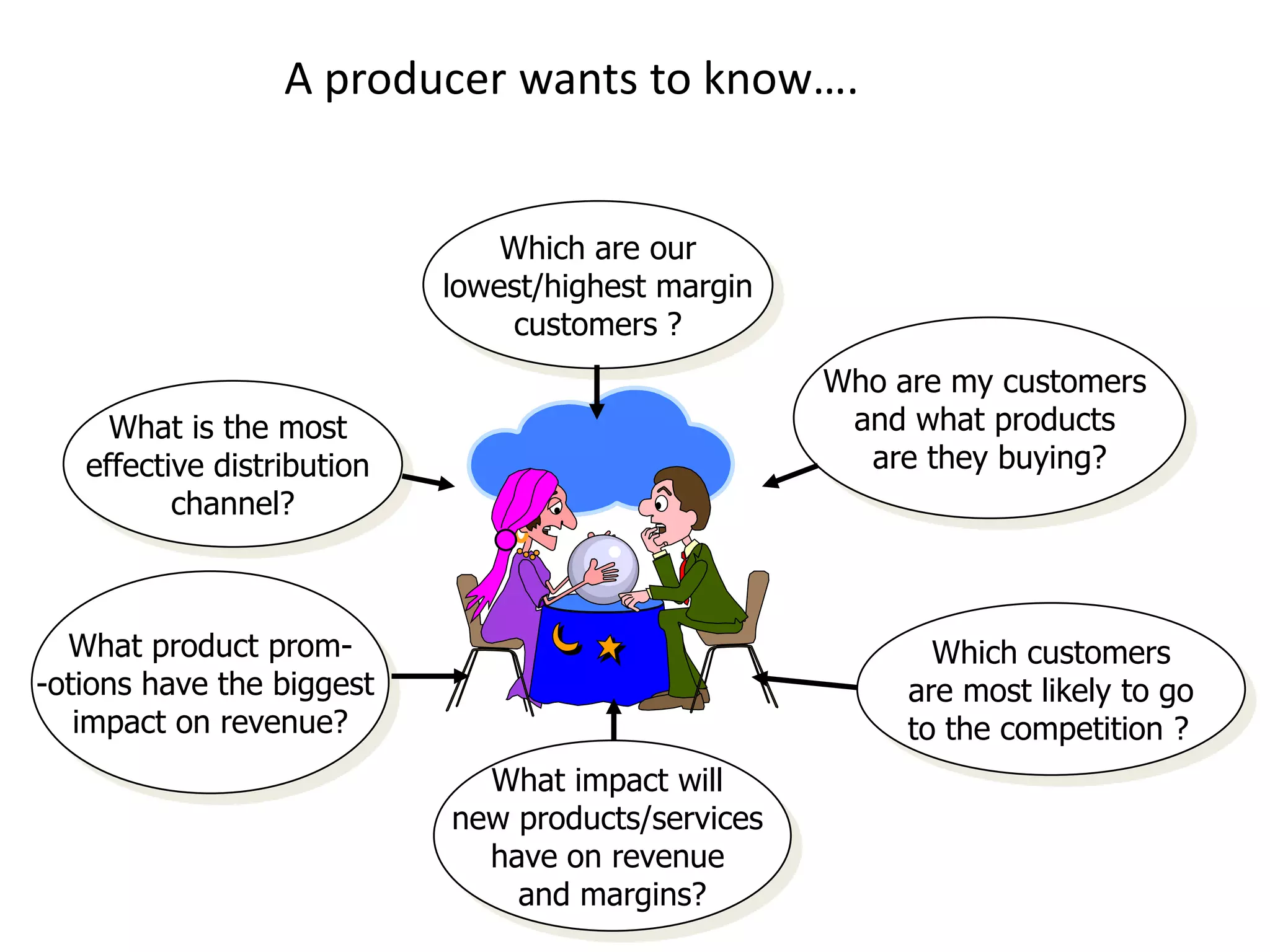
Which are our lowest/highest margin customers ?Who are my customers and what products are they buying?What is the most effective distribution channel?What product prom--otions have the biggest impact on revenue?Which customers are most likely to go to the competition ?What impact will new products/services have on revenue and margins?A producer wants to know….
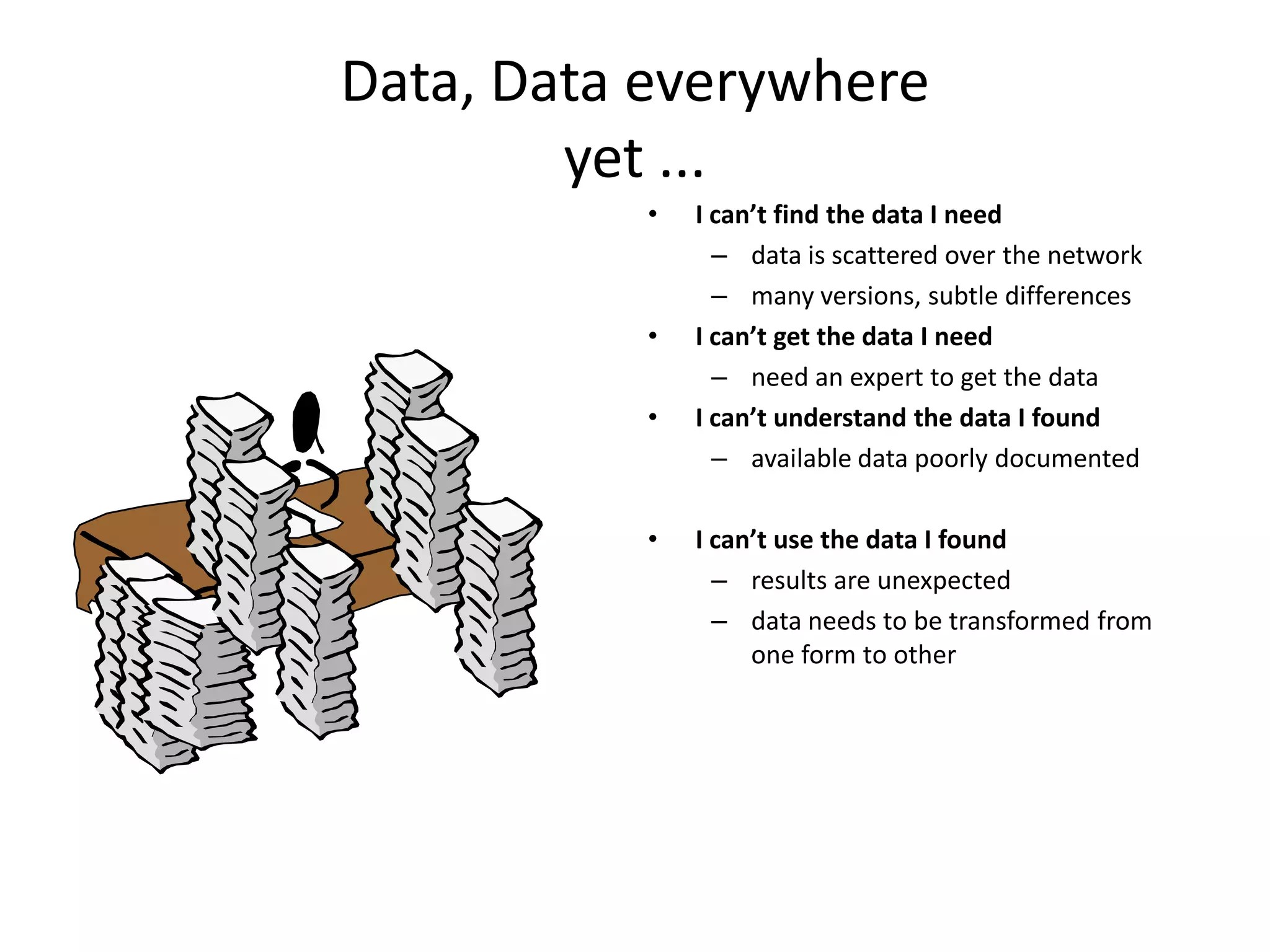
Data, Data everywhereyet ...I can’t find the data I needdata is scattered over the networkmany versions, subtle differencesI can’t get the data I needneed an expert to get the dataI can’t understand the data I foundavailable data poorly documentedI can’t use the data I foundresults are unexpecteddata needs to be transformed from one form to other
What is a Data Warehouse?A single, complete and consistent store of data obtained from a variety of different sources made available to end users in a what they can understand and use in a business context.
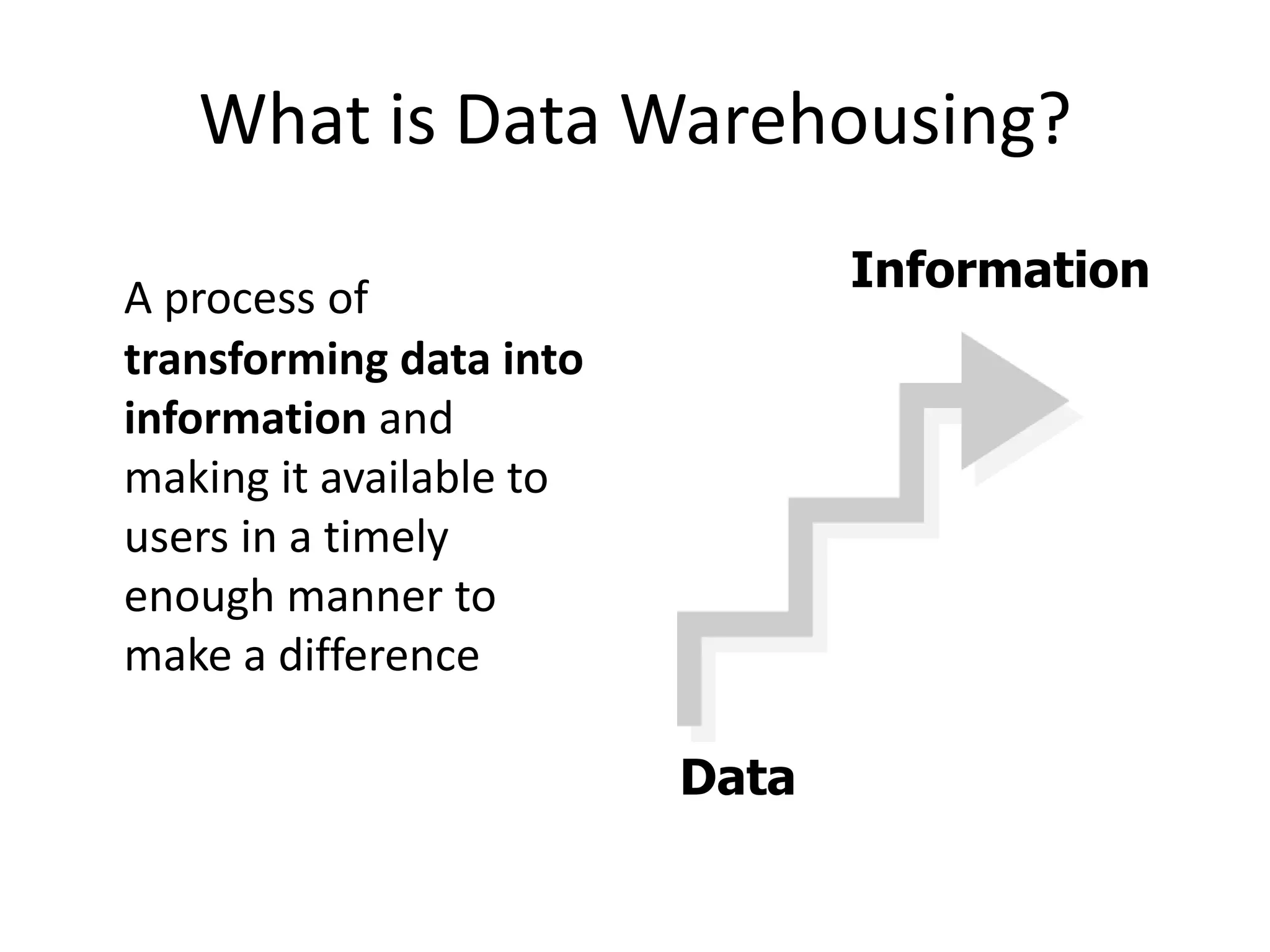
What is Data Warehousing?InformationDataA process of transforming data into information and making it available to users in a timely enough manner to make a difference
Data Warehousing -- a processIt is a relational or multidimensional database management system designed to support management decision making. A data warehousing is a copy of transaction data specifically structured for querying and reporting.Technique for assembling and managing data from various sources for the purpose of answering business questions. Thus making decisions that were not previous possible
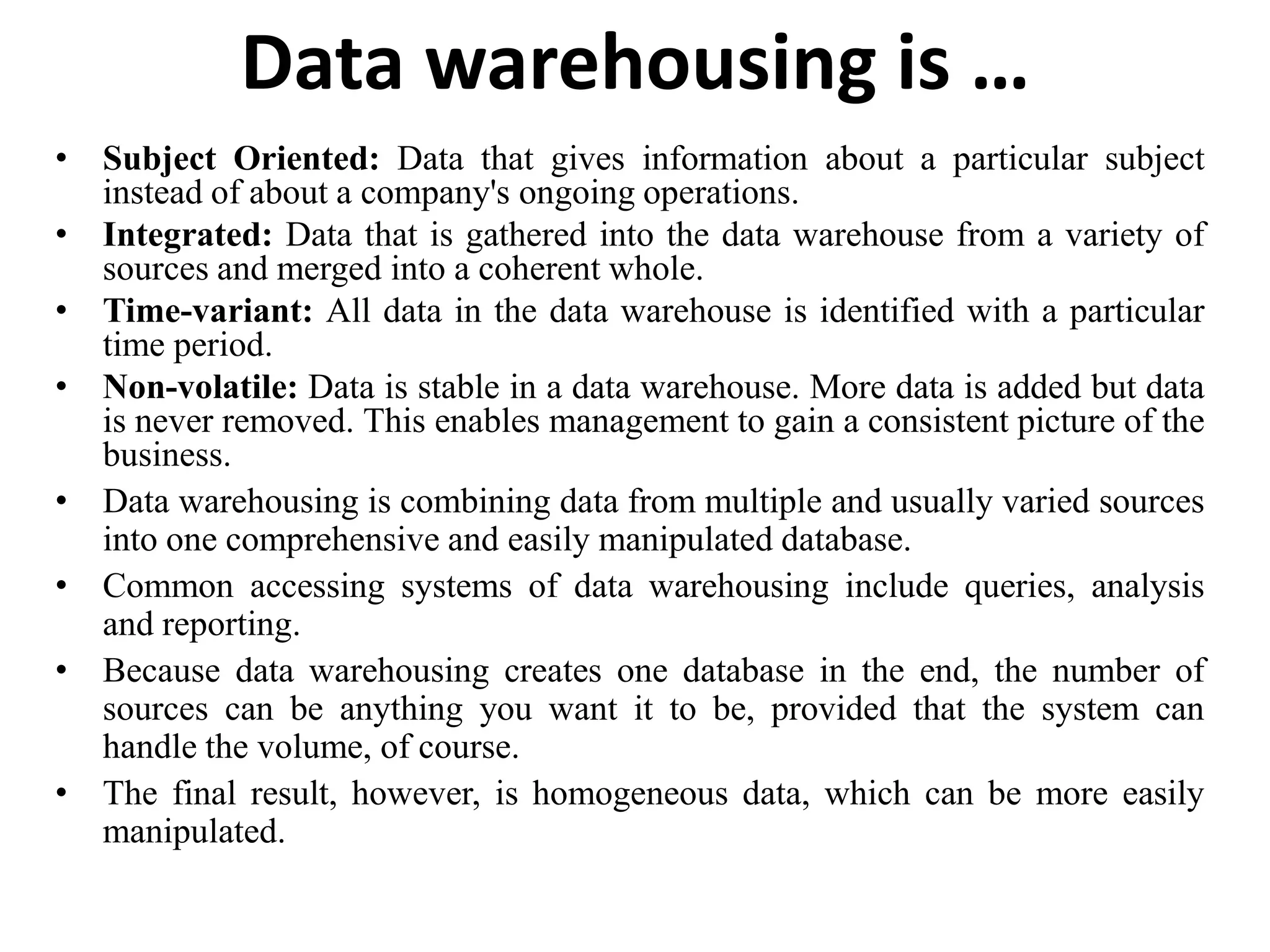
Data warehousing is …Subject Oriented: Data that gives information about a particular subject instead of about a company's ongoing operations. Integrated: Data that is gathered into the data warehouse from a variety of sources and merged into a coherent whole. Time-variant: All data in the data warehouse is identified with a particular time period. Non-volatile: Data is stable in a data warehouse. More data is added but data is never removed. This enables management to gain a consistent picture of the business.Data warehousing is combining data from multiple and usually varied sources into one comprehensive and easily manipulated database. Common accessing systems of data warehousing include queries, analysis and reporting. Because data warehousing creates one database in the end, the number of sources can be anything you want it to be, provided that the system can handle the volume, of course. The final result, however, is homogeneous data, which can be more easily manipulated.
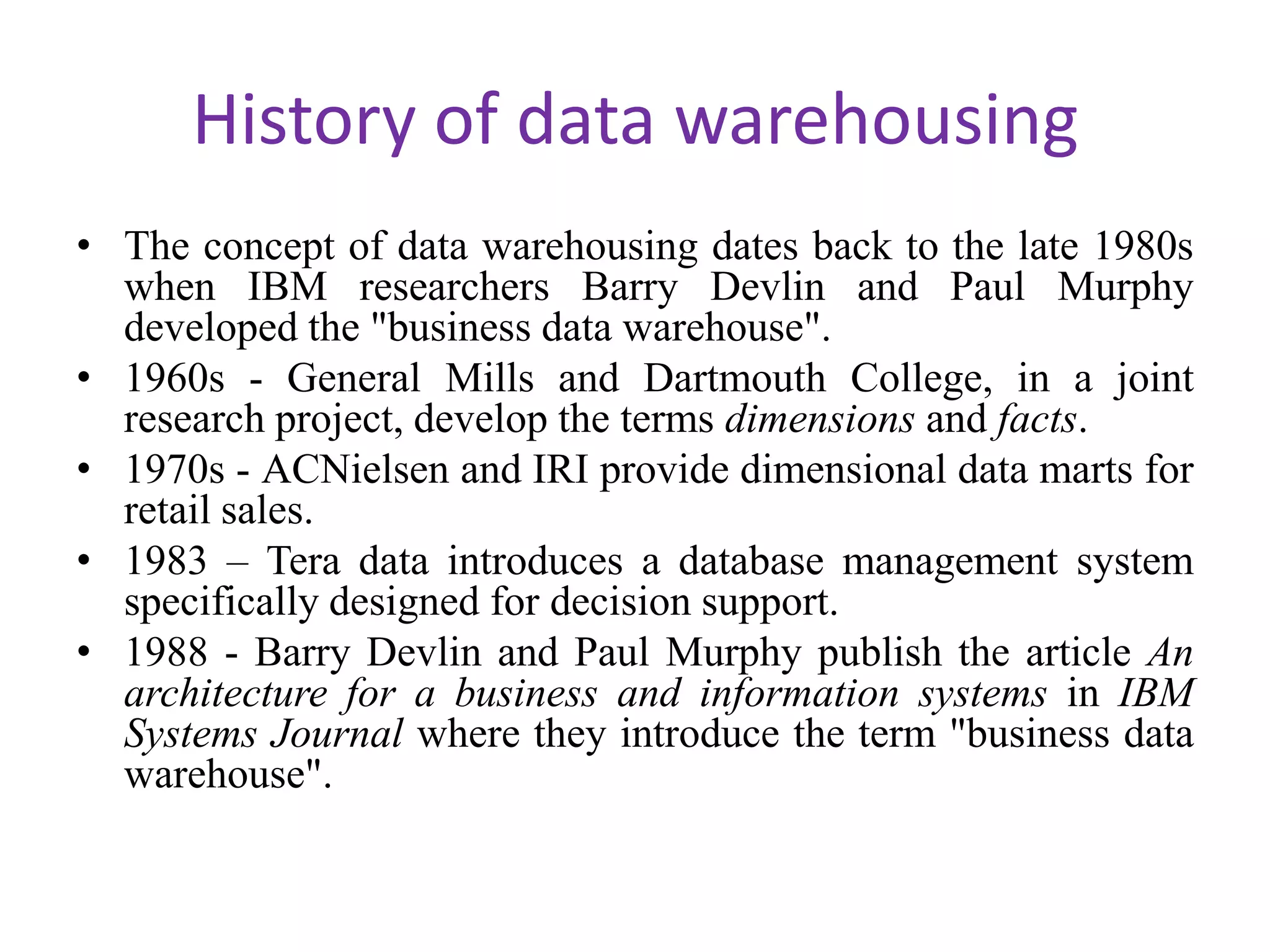
History of data warehousingThe concept of data warehousing dates back to the late 1980s when IBM researchers Barry Devlin and Paul Murphy developed the "business data warehouse". 1960s - General Mills and Dartmouth College, in a joint research project, develop the terms dimensions and facts.1970s - ACNielsen and IRI provide dimensional data marts for retail sales.1983 – Tera data introduces a database management system specifically designed for decision support. 1988 - Barry Devlin and Paul Murphy publish the article An architecture for a business and information systems in IBM Systems Journal where they introduce the term "business data warehouse".
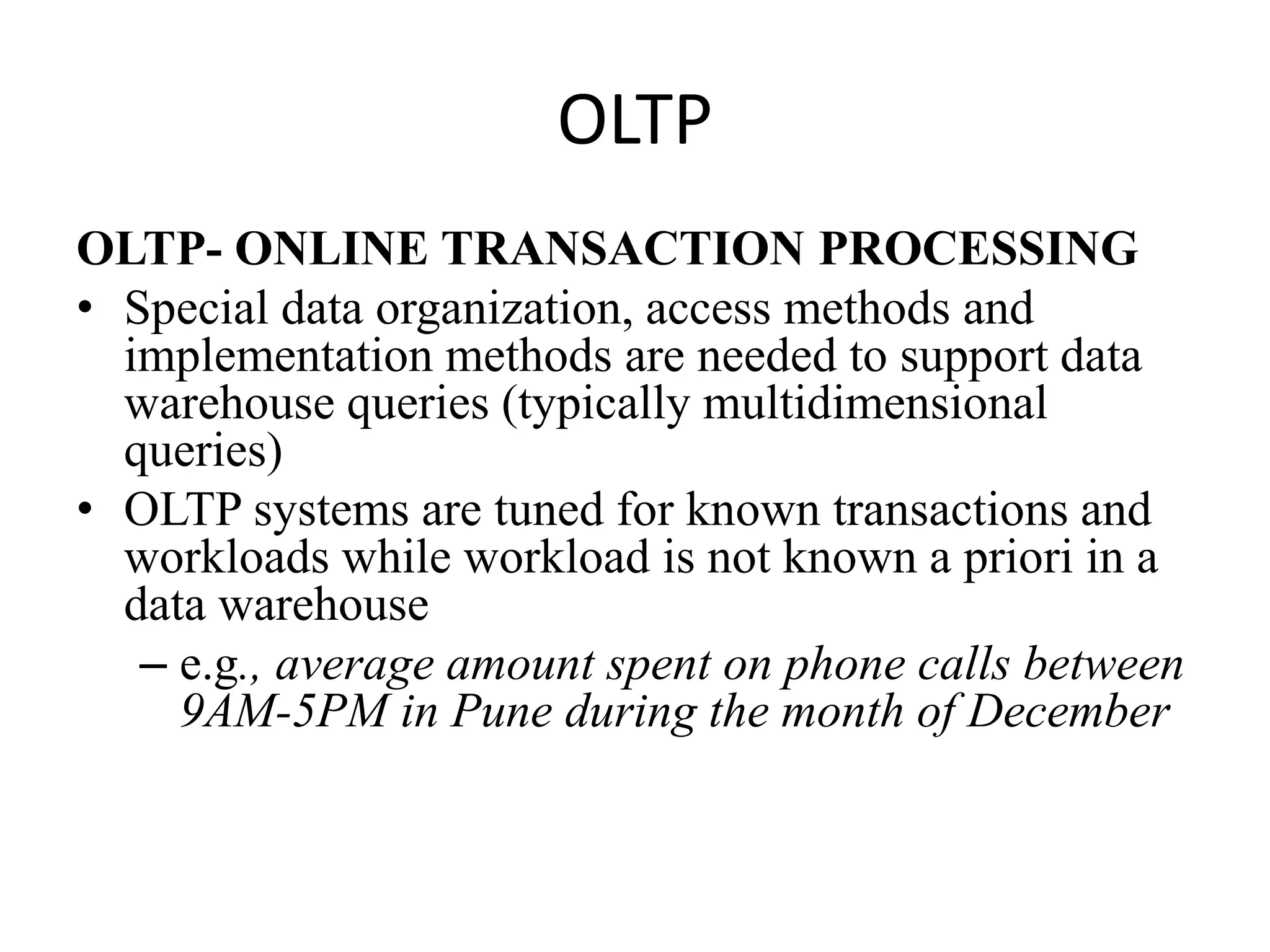
OLTPOLTP- ONLINE TRANSACTION PROCESSINGSpecial data organization, access methods and implementation methods are needed to support data warehouse queries (typically multidimensional queries)OLTP systems are tuned for known transactions and workloads while workload is not known a priori in a data warehousee.g., average amount spent on phone calls between 9AM-5PM in Pune during the month of December
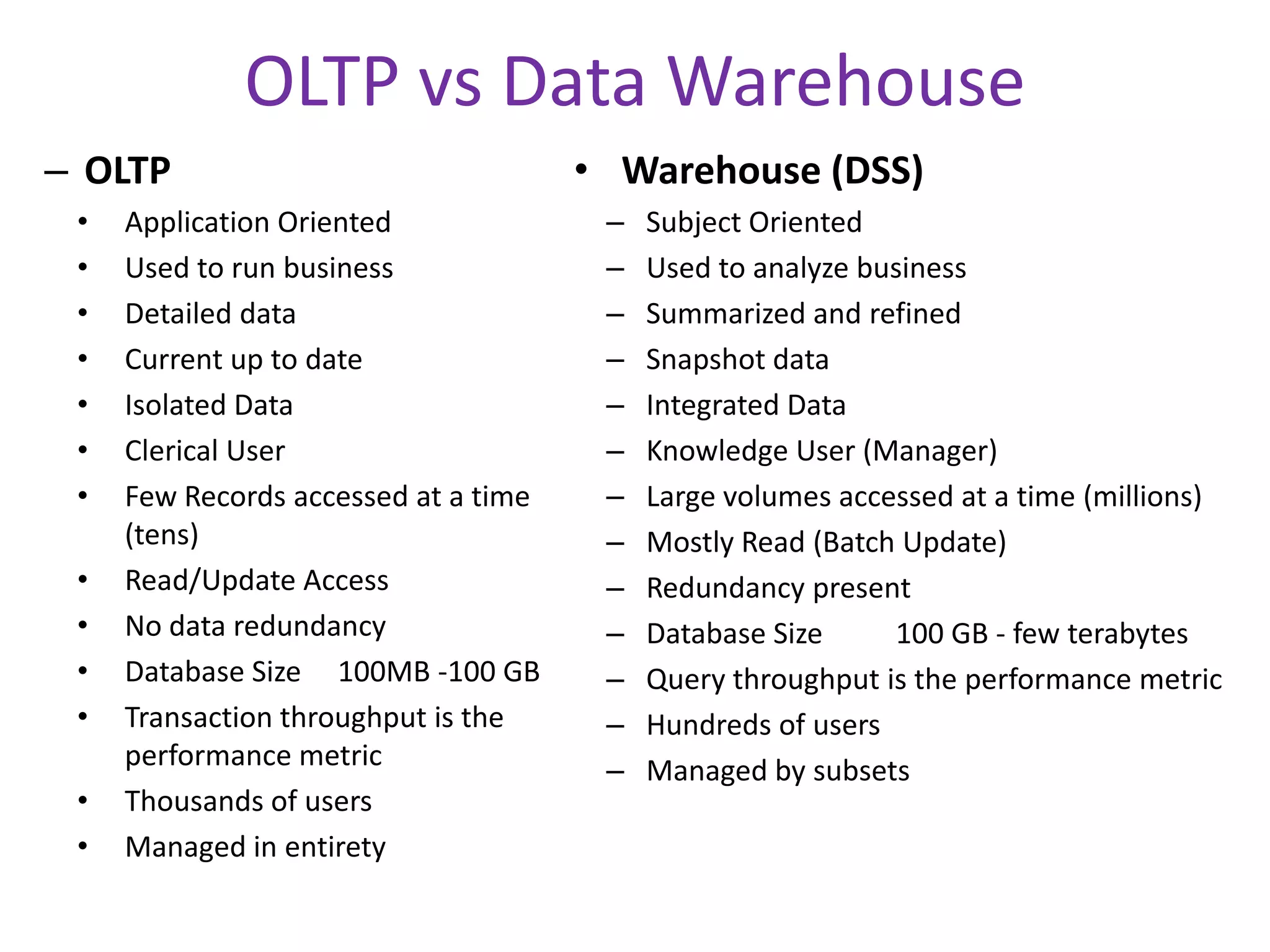
OLTP vs Data WarehouseOLTPApplication OrientedUsed to run businessDetailed dataCurrent up to dateIsolated DataClerical UserFew Records accessed at a time (tens)Read/Update AccessNo data redundancyDatabase Size     100MB -100 GBTransaction throughput is the performance metricThousands of usersManaged in entiretyWarehouse (DSS)Subject OrientedUsed to analyze businessSummarized and refinedSnapshot dataIntegrated DataKnowledge User (Manager)Large volumes accessed at a time (millions)Mostly Read (Batch Update)Redundancy presentDatabase Size          100 GB - few terabytesQuery throughput is the performance metricHundreds of usersManaged by subsets
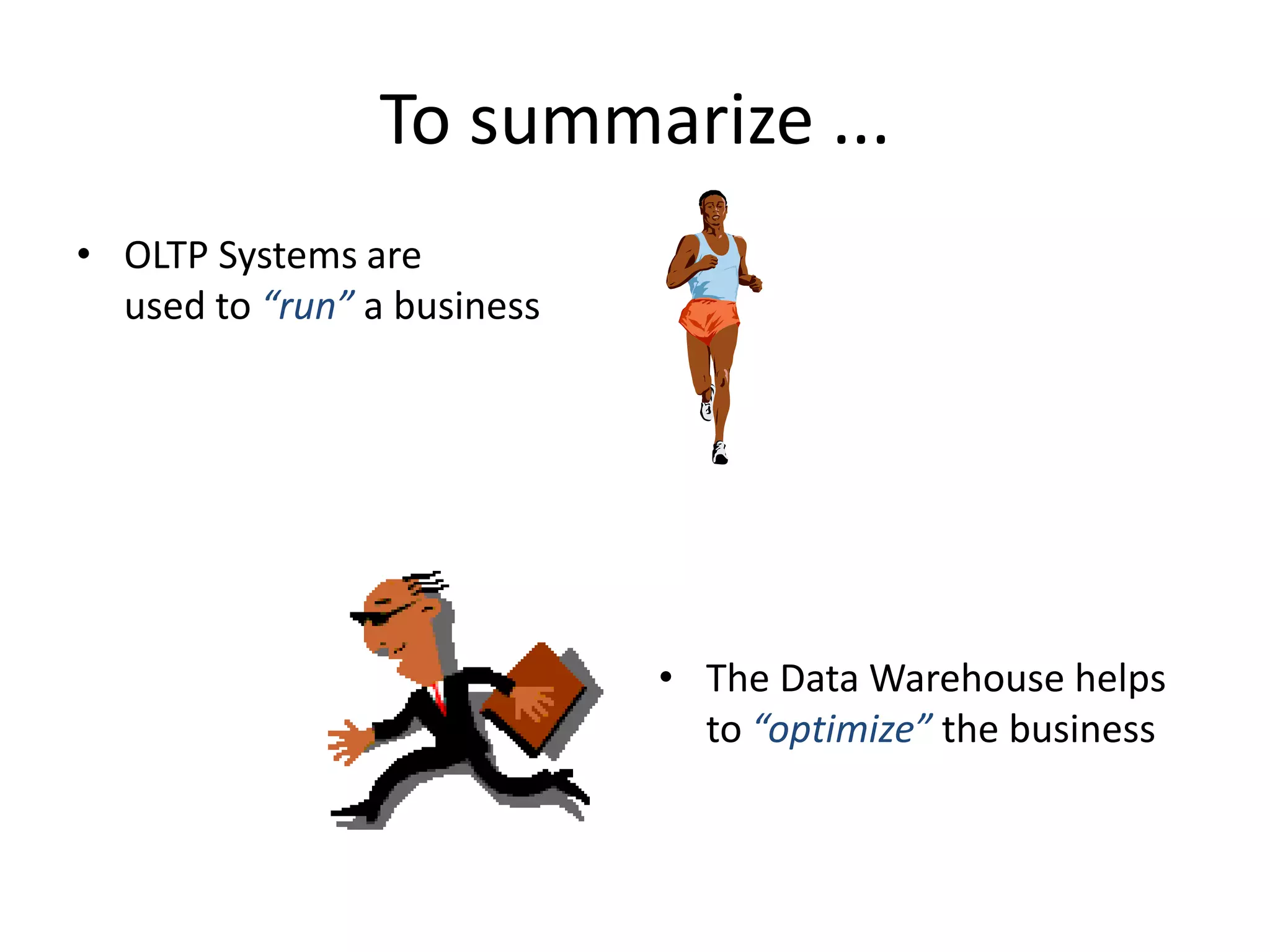
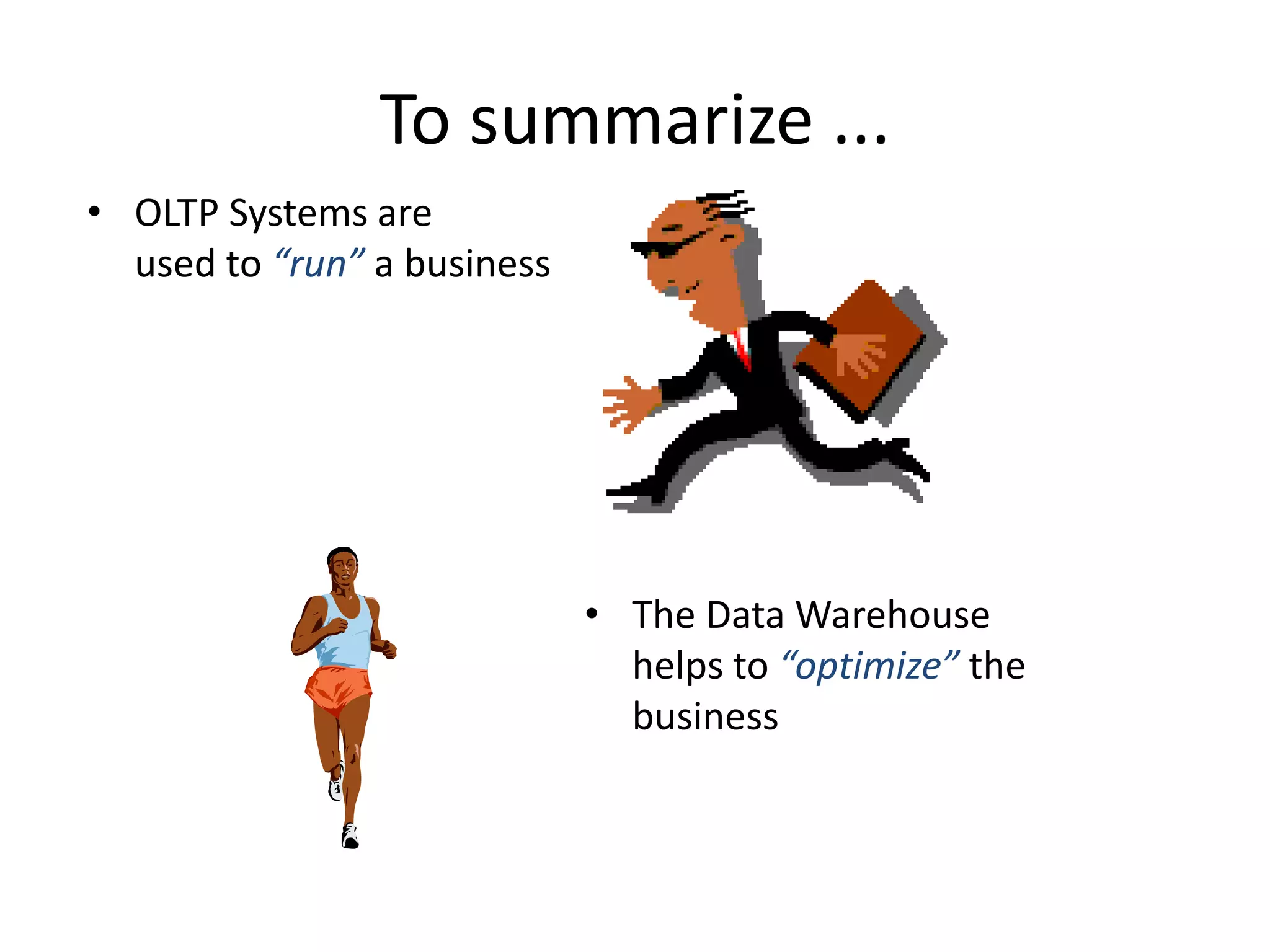
To summarize ...OLTP Systems are used to “run” a businessThe Data Warehouse helps to “optimize” the business
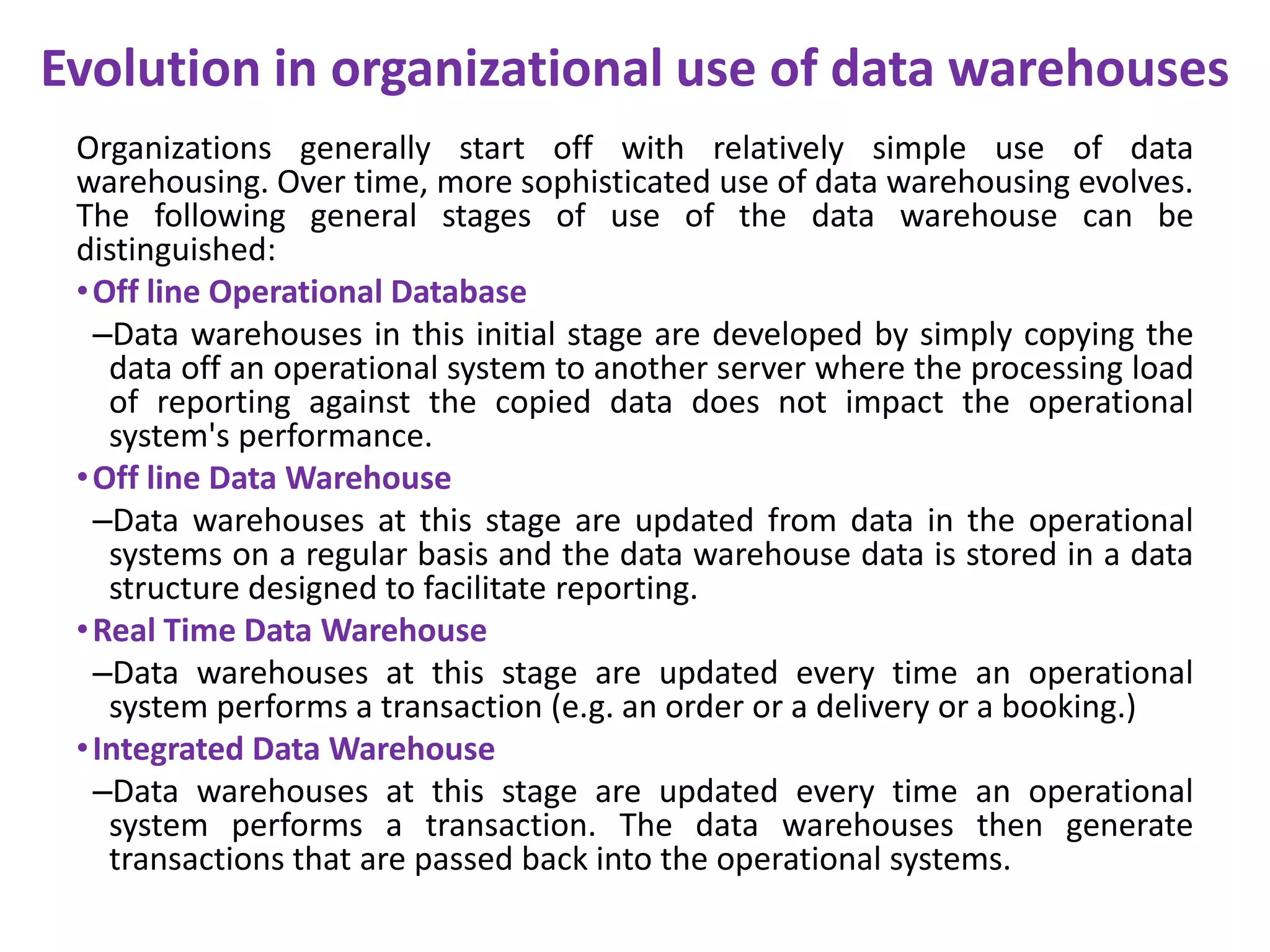
Evolution in organizational use of data warehousesOrganizations generally start off with relatively simple use of data warehousing. Over time, more sophisticated use of data warehousing evolves. The following general stages of use of the data warehouse can be distinguished:Off line Operational Database Data warehouses in this initial stage are developed by simply copying the data off an operational system to another server where the processing load of reporting against the copied data does not impact the operational system's performance. Off line Data Warehouse  Data warehouses at this stage are updated from data in the operational systems on a regular basis and the data warehouse data is stored in a data structure designed to facilitate reporting. Real Time Data Warehouse Data warehouses at this stage are updated every time an operational system performs a transaction (e.g. an order or a delivery or a booking.) Integrated Data Warehouse  Data warehouses at this stage are updated every time an operational system performs a transaction. The data warehouses then generate transactions that are passed back into the operational systems.
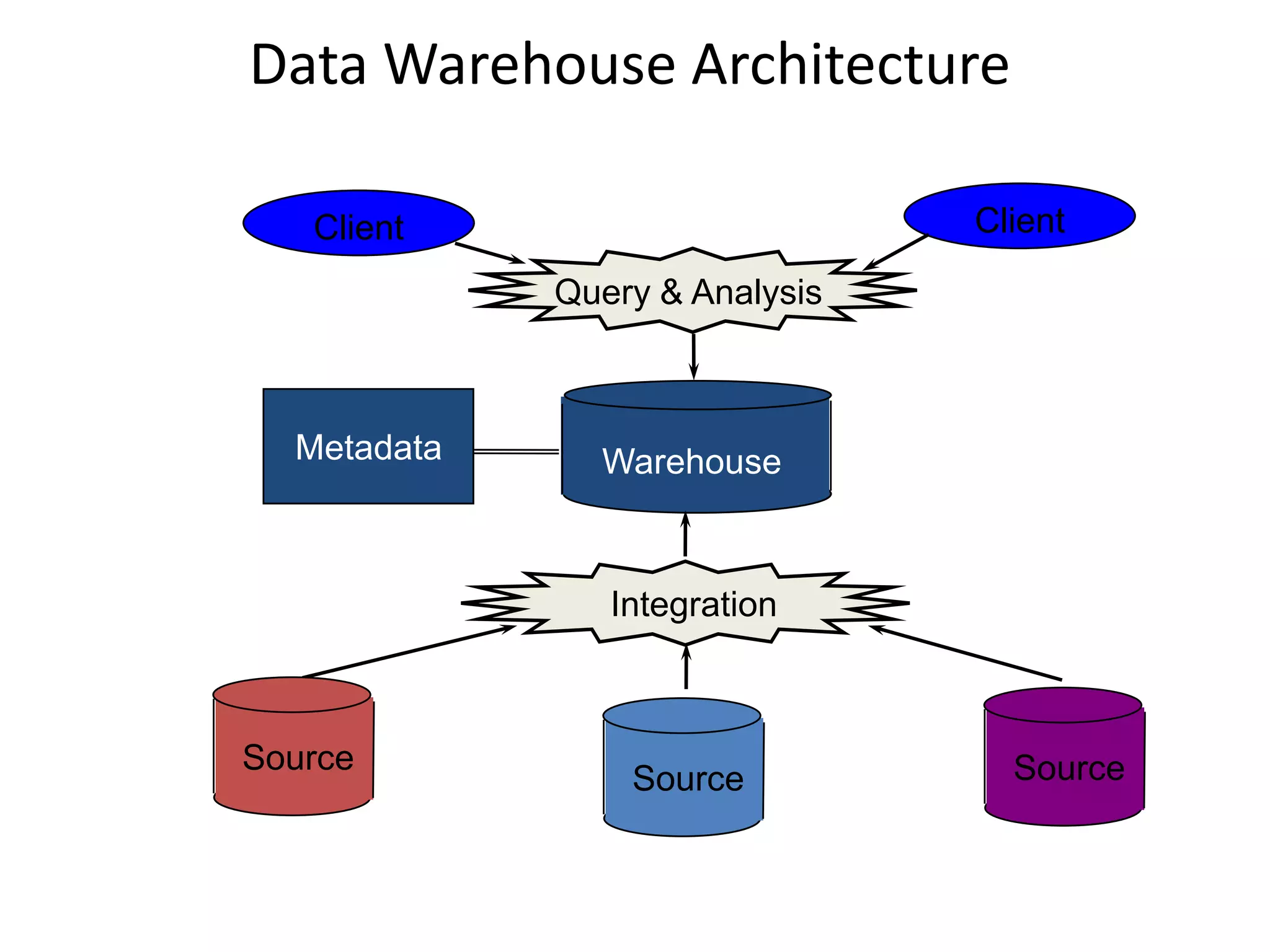
ClientClientQuery & AnalysisWarehouseIntegrationSourceSourceSourceData Warehouse ArchitectureMetadata
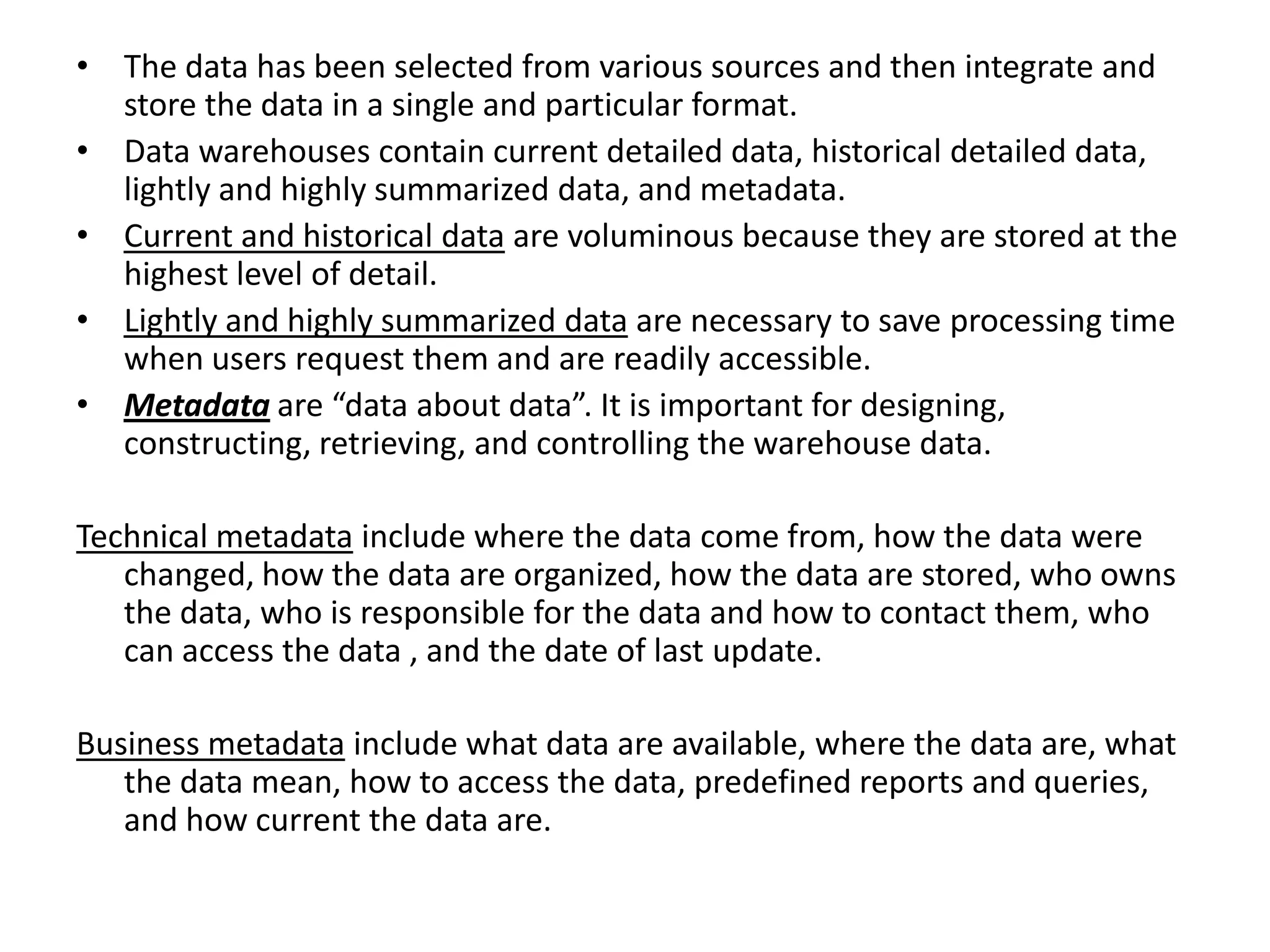
The data has been selected from various sources and then integrate and store the data in a single and particular format.Data warehousescontain current detailed data, historical detailed data, lightly and highly summarized data, and metadata.Current and historical data are voluminous because they are stored at the highest level of detail.Lightly and highly summarized data are necessary to save processing time when users request them and are readily accessible.Metadataare “data about data”. It is important for designing, constructing, retrieving, and controlling the warehouse data.Technical metadatainclude where the data come from, how the data were changed, how the data are organized, how the data are stored, who owns the data, who is responsible for the data and how to contact them, who can access the data , and the date of last update.Business metadatainclude what data are available, where the data are, what the data mean, how to access the data, predefined reports and queries, and how current the data are.
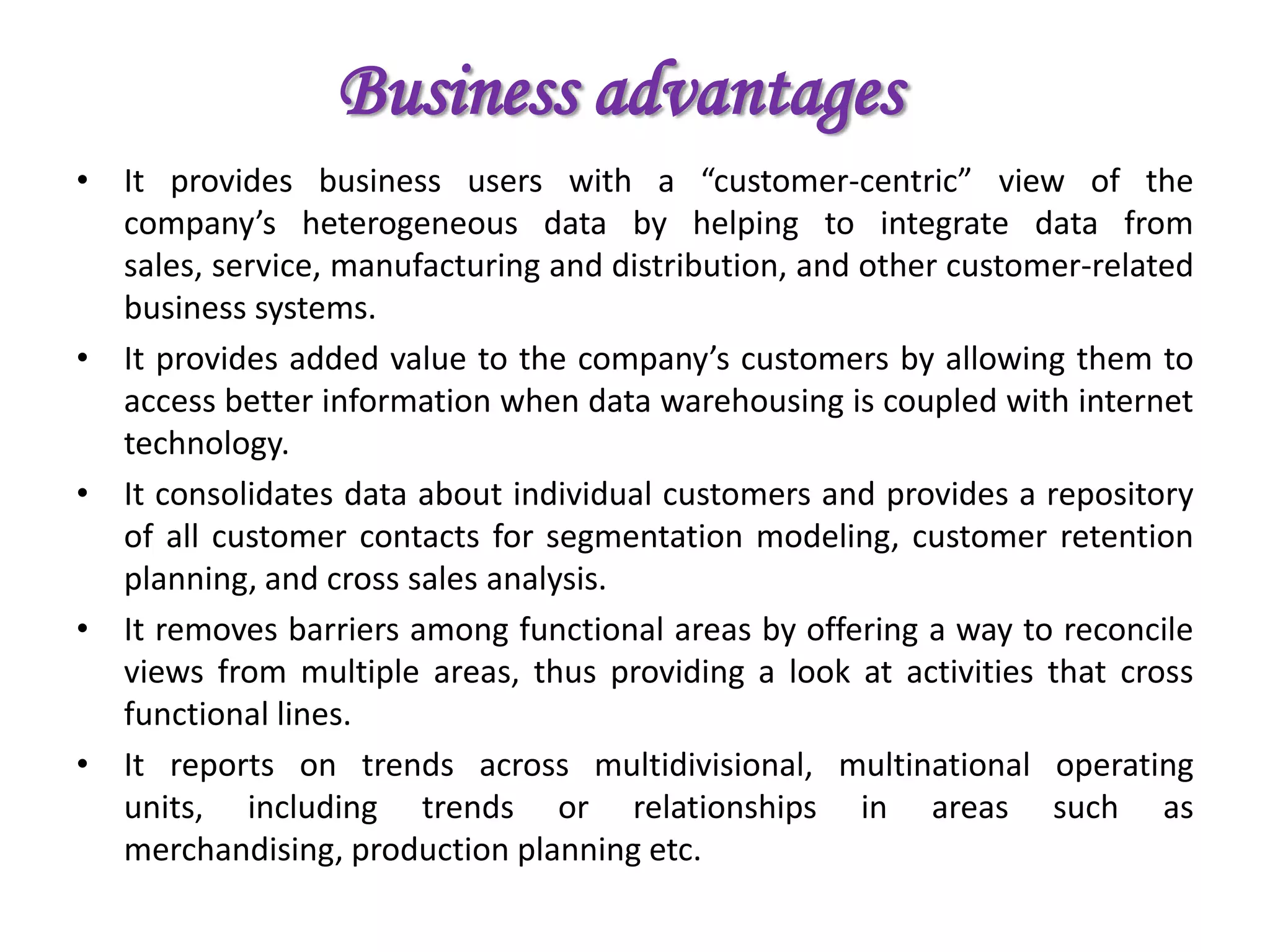
Business advantagesIt provides business users with a “customer-centric” view of the company’s heterogeneous data by helping to integrate data from sales, service, manufacturing and distribution, and other customer-related business systems.It provides added value to the company’s customers by allowing them to access better information when data warehousing is coupled with internet technology.It consolidates data about individual customers and provides a repository of all customer contacts for segmentation modeling, customer retention planning, and cross sales analysis.It removes barriers among functional areas by offering a way to reconcile views from multiple areas, thus providing a look at activities that cross functional lines.It reports on trends across multidivisional, multinational operating units, including trends or relationships in areas such as merchandising, production planning etc.
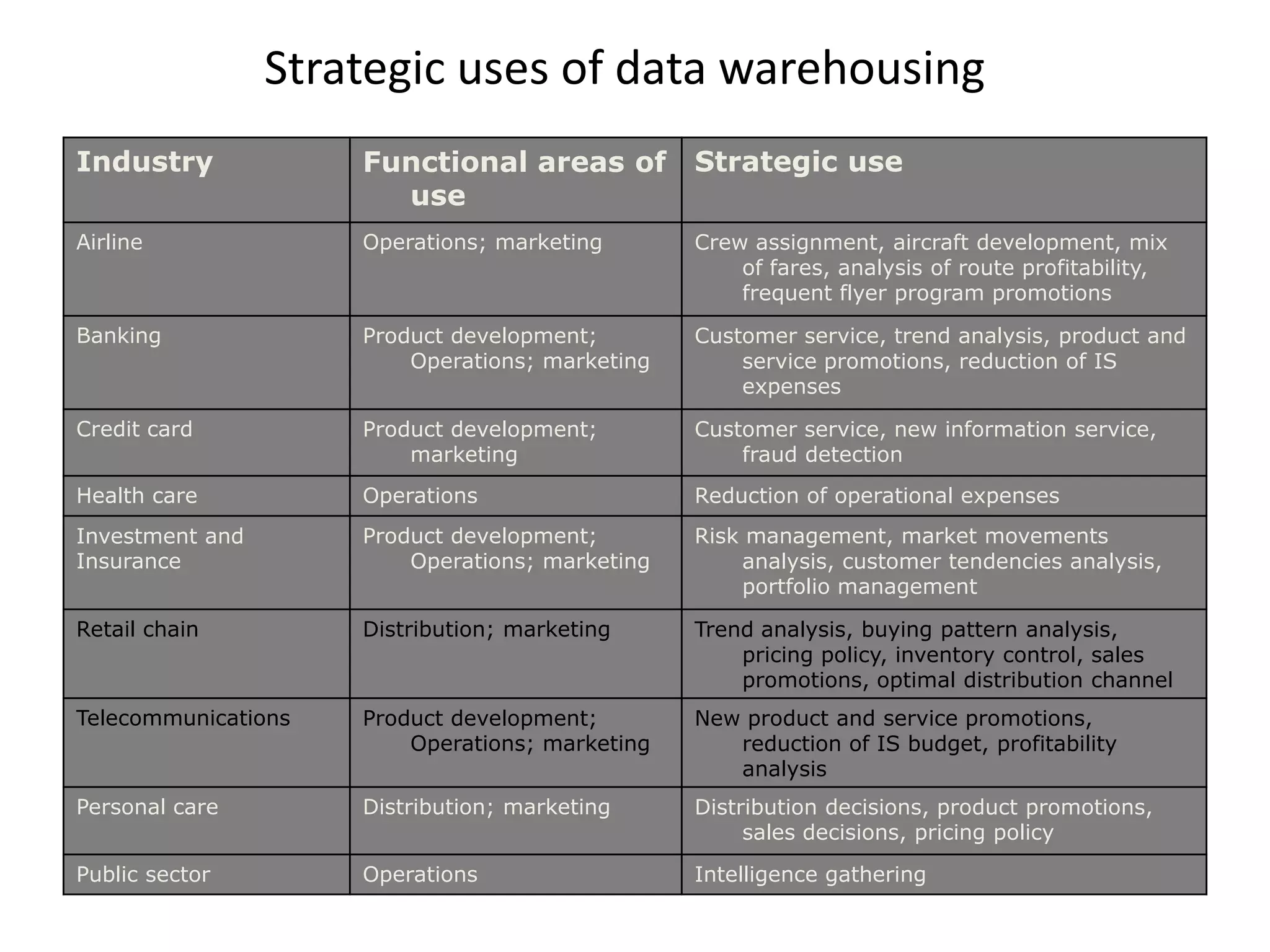
Strategic uses of data warehousing
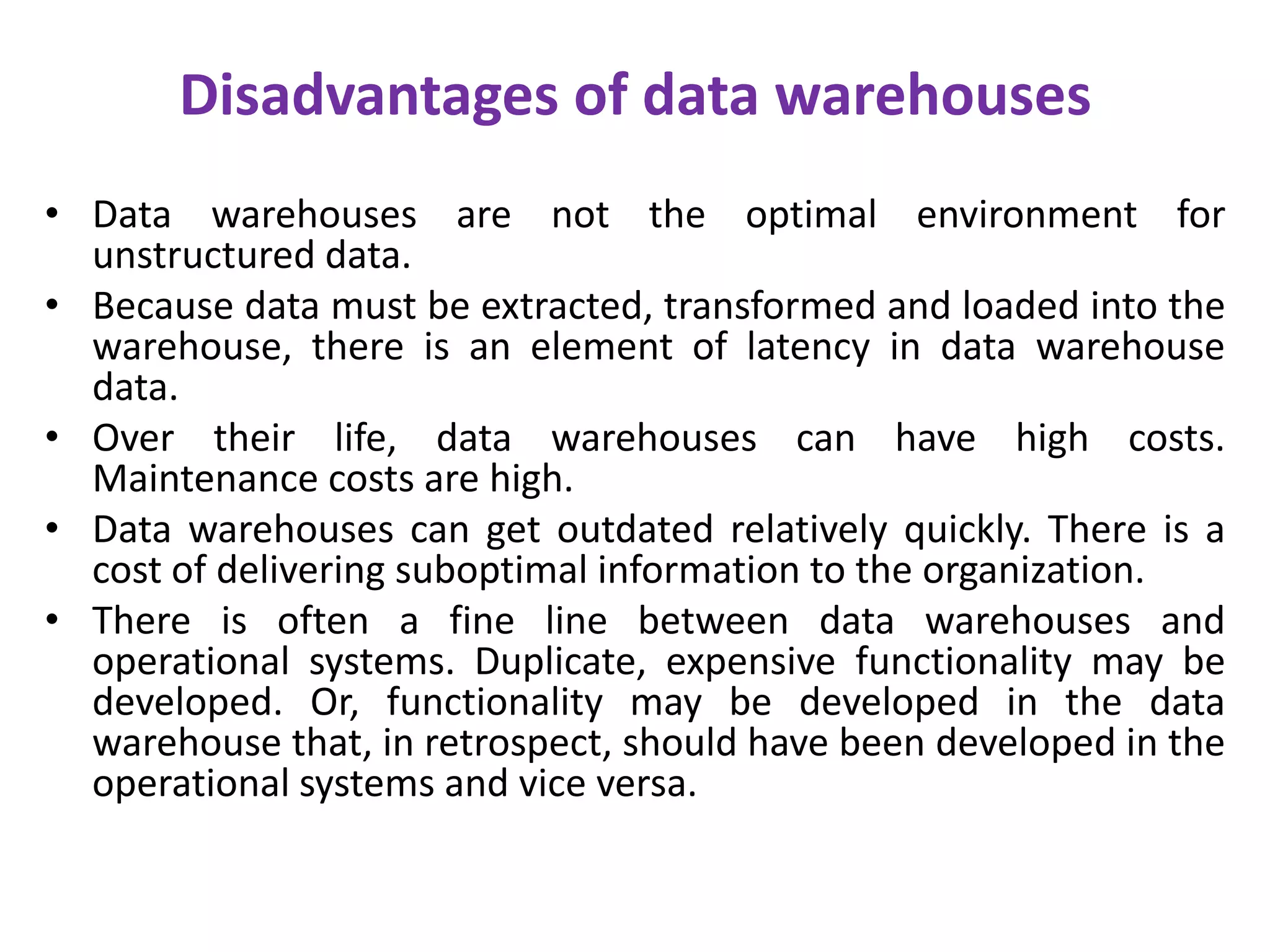
Disadvantages of data warehousesData warehouses are not the optimal environment for unstructured data. Because data must be extracted, transformed and loaded into the warehouse, there is an element of latency in data warehouse data. Over their life, data warehouses can have high costs. Maintenance costs are high. Data warehouses can get outdated relatively quickly. There is a cost of delivering suboptimal information to the organization. There is often a fine line between data warehouses and operational systems. Duplicate, expensive functionality may be developed. Or, functionality may be developed in the data warehouse that, in retrospect, should have been developed in the operational systems and vice versa.
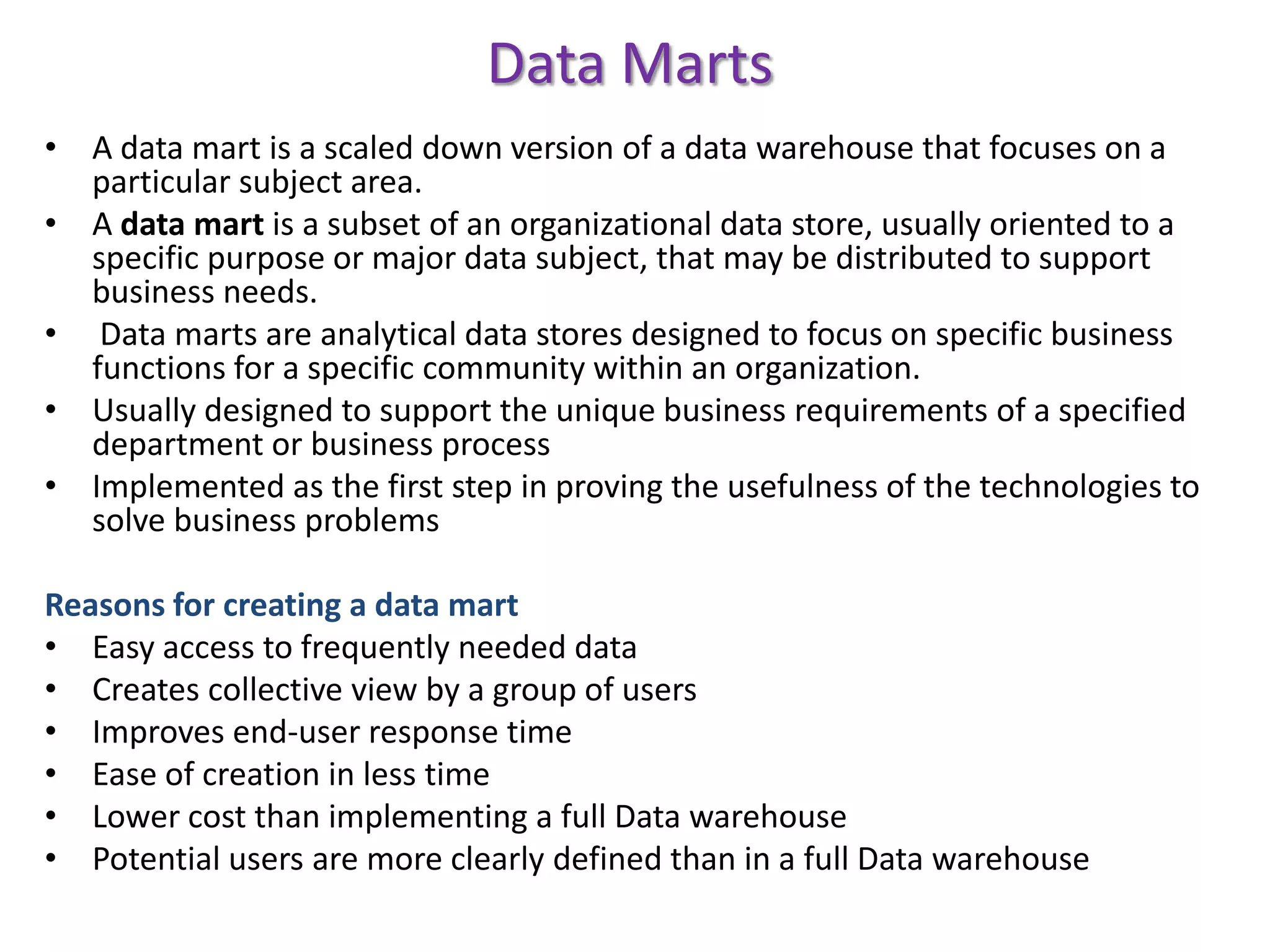
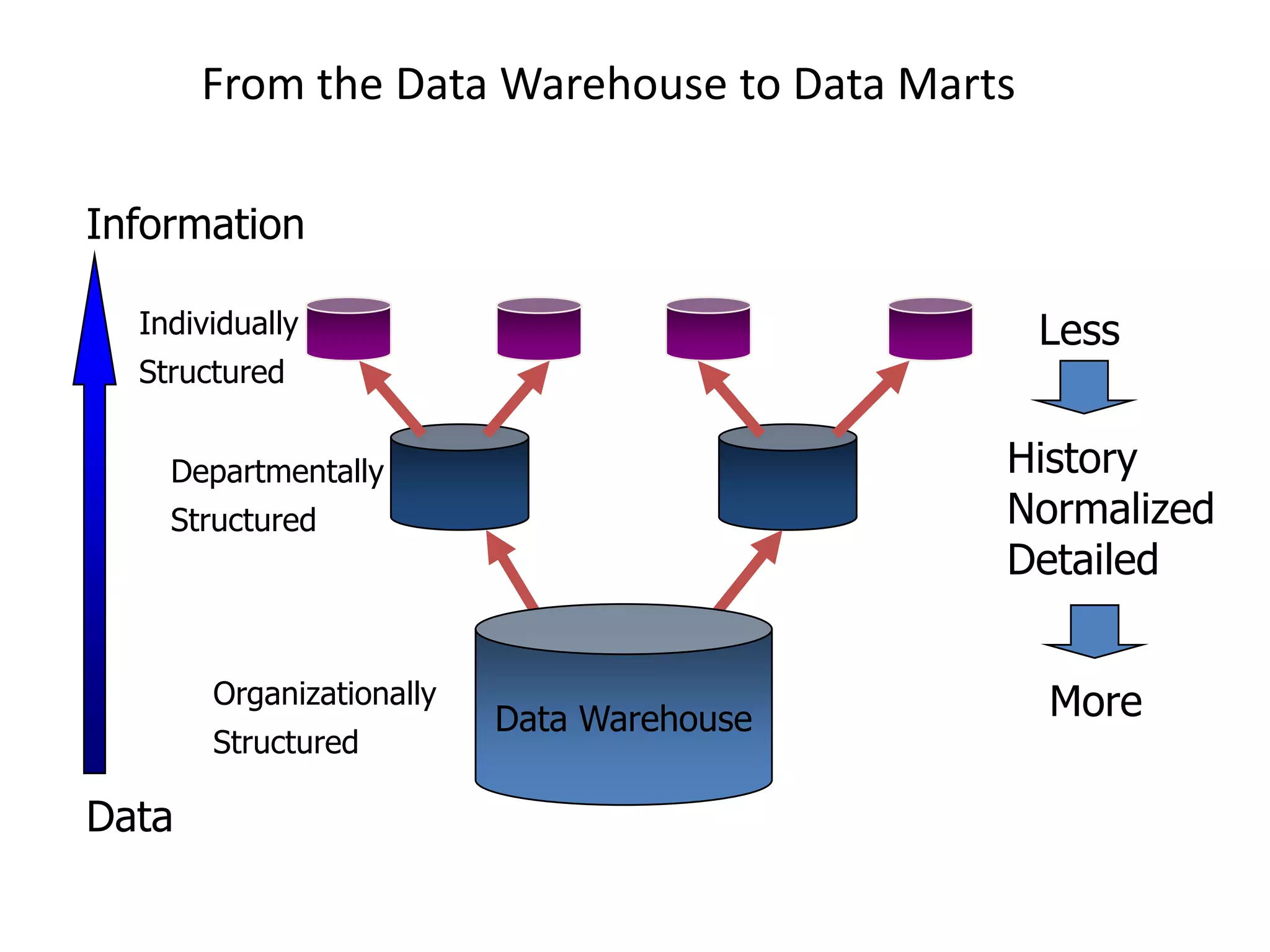
Data MartsA data mart is a scaled down version of a data warehouse that focuses on a particular subject area.A data mart is a subset of an organizational data store, usually oriented to a specific purpose or major data subject, that may be distributed to support business needs. Data marts are analytical data stores designed to focus on specific business functions for a specific community within an organization. Usually designed to support the unique business requirements of a specified department or business processImplemented as the first step in proving the usefulness of the technologies to solve business problemsReasons for creating a data martEasy access to frequently needed data Creates collective view by a group of users Improves end-user response time Ease of creation in less timeLower cost than implementing a full Data warehousePotential users are more clearly defined than in a full Data warehouse
InformationLessIndividuallyStructuredHistoryNormalizedDetailedDepartmentallyStructuredData WarehouseOrganizationallyStructuredMoreDataFrom the Data Warehouse to Data Marts
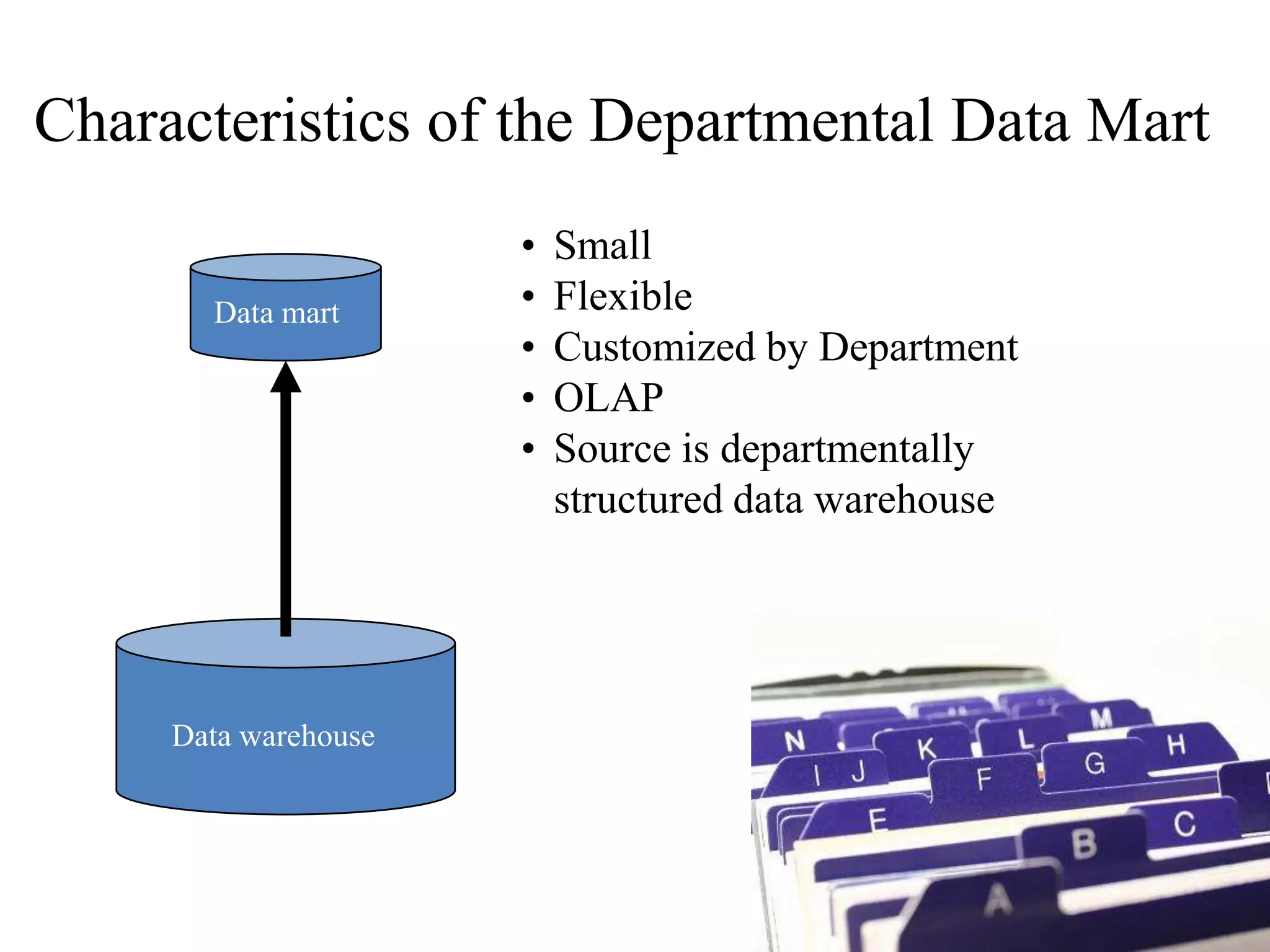
Characteristics of the Departmental Data MartSmall
Flexible
Customized by Department
OLAP
Source is departmentally structured data warehouseData martData warehouse
Data MiningData Mining is the process of extracting information from the company's various databases and re-organizing it for purposes other than what the databases were originally intended for. It provides a means of extracting previously unknown, predictive information from the base of accessible data in data warehouses.Data mining process is different for different organizations depending upon the nature of the data and organization.Data mining tools use sophisticated, automated algorithms to discover hidden patterns, correlations, and relationships among organizational data.Data mining tools are used to predict future trends and behaviors, allowing businesses to make proactive, knowledge driven decisions.For ex: for targeted marketing, data mining can use data on past promotional mailings to identify the targets most likely to maximize the return on the company’s investment in future mailings.
Functions Classification: It infers the defining characteristics of a certain groupClustering: identifies group of items that share a particular  characteristicAssociation: identifies relationships between events that occur at one time Sequencing: similar to association, except that the relationship exists over a period of timeForecasting: estimates future values based on patterns within large sets of data
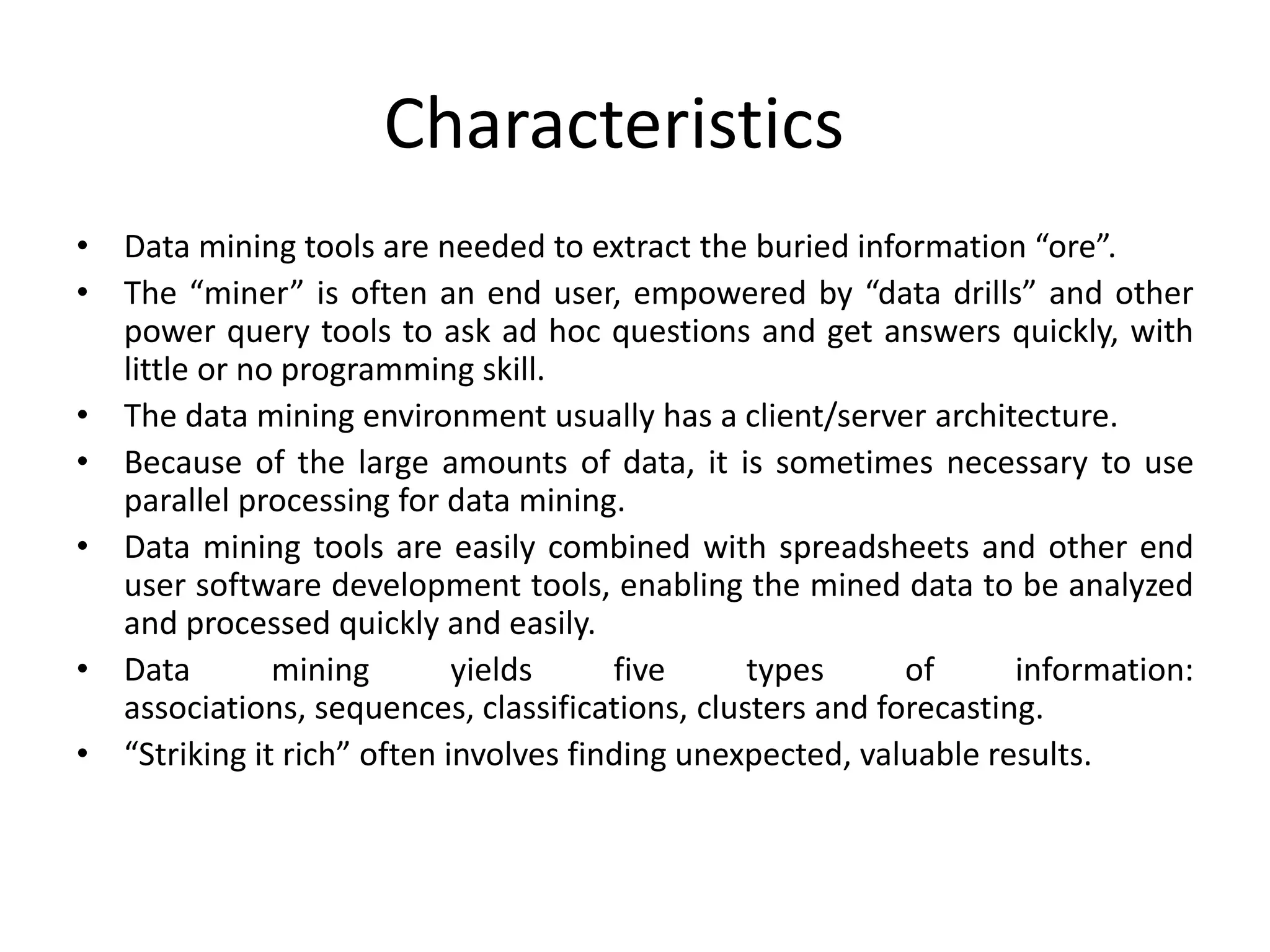
Characteristics Data mining tools are needed to extract the buried information “ore”.The “miner” is often an end user, empowered by “data drills” and other power query tools to ask ad hoc questions and get answers quickly, with little or no programming skill.The data mining environment usually has a client/server architecture.Because of the large amounts of data, it is sometimes necessary to use parallel processing for data mining.Data mining tools are easily combined with spreadsheets and other end user software development tools, enabling the mined data to be analyzed and processed quickly and easily.Data mining yields five types of information: associations, sequences, classifications, clusters and forecasting.“Striking it rich” often involves finding unexpected, valuable results.
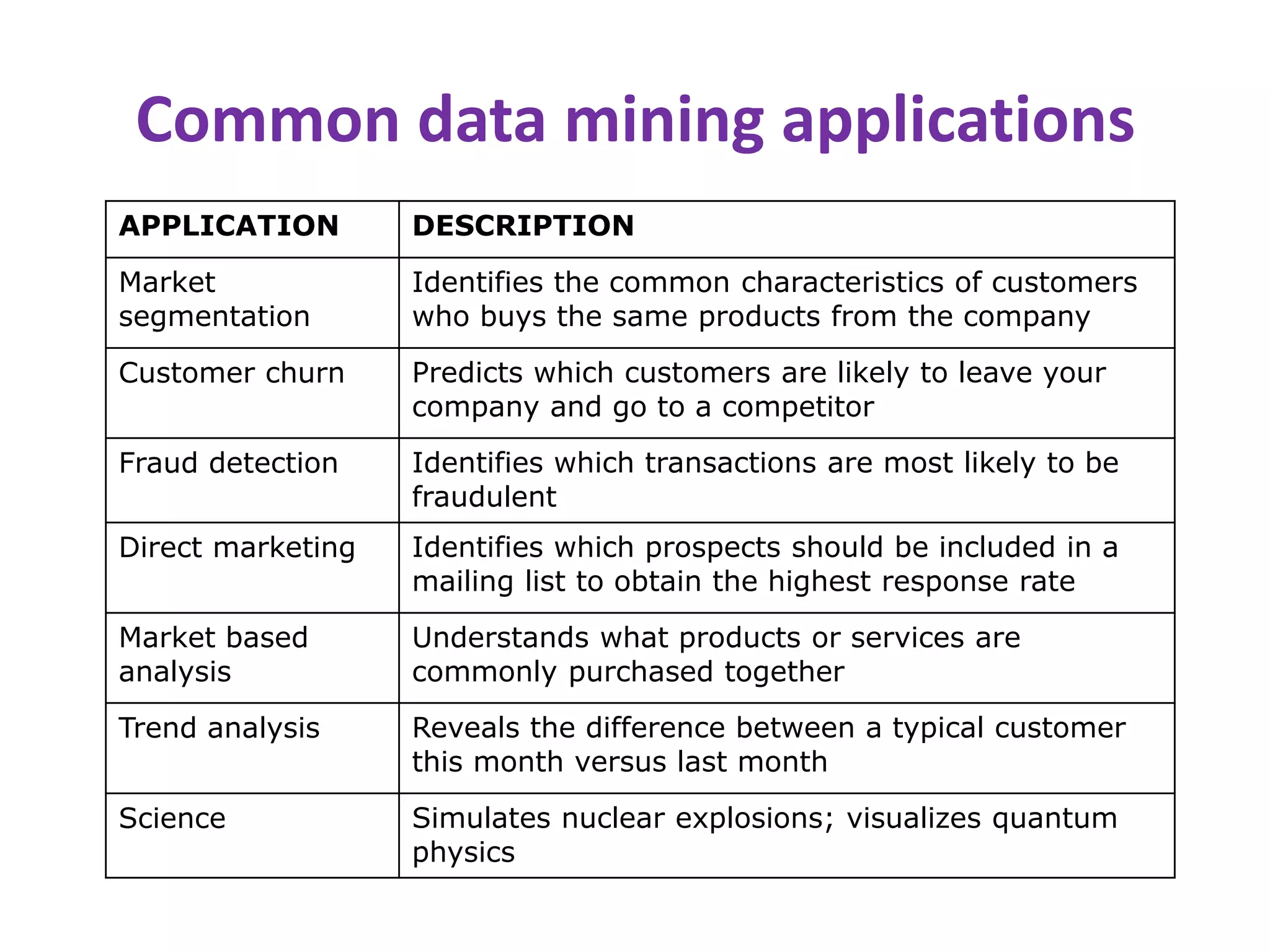
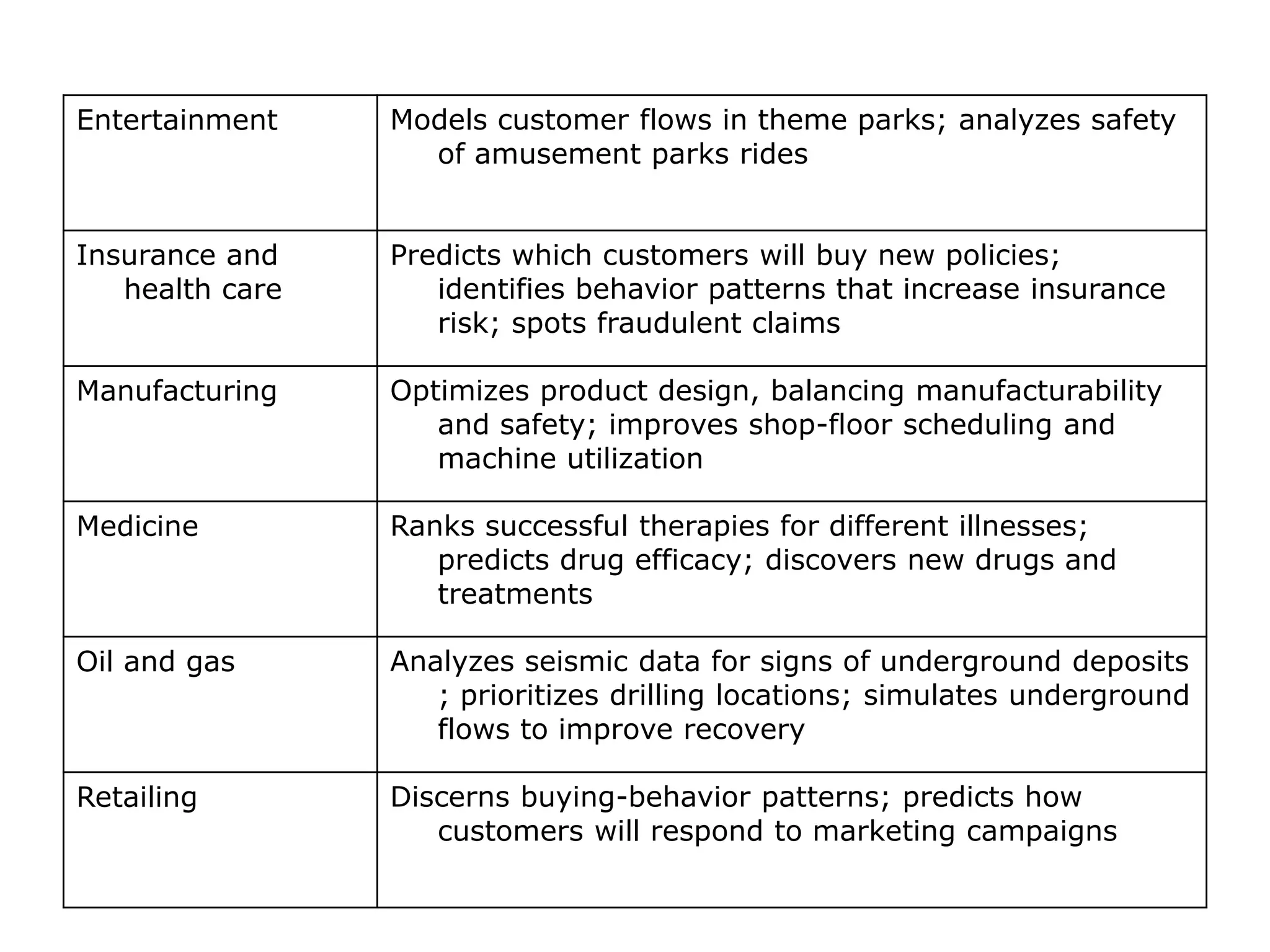
Common data mining applications
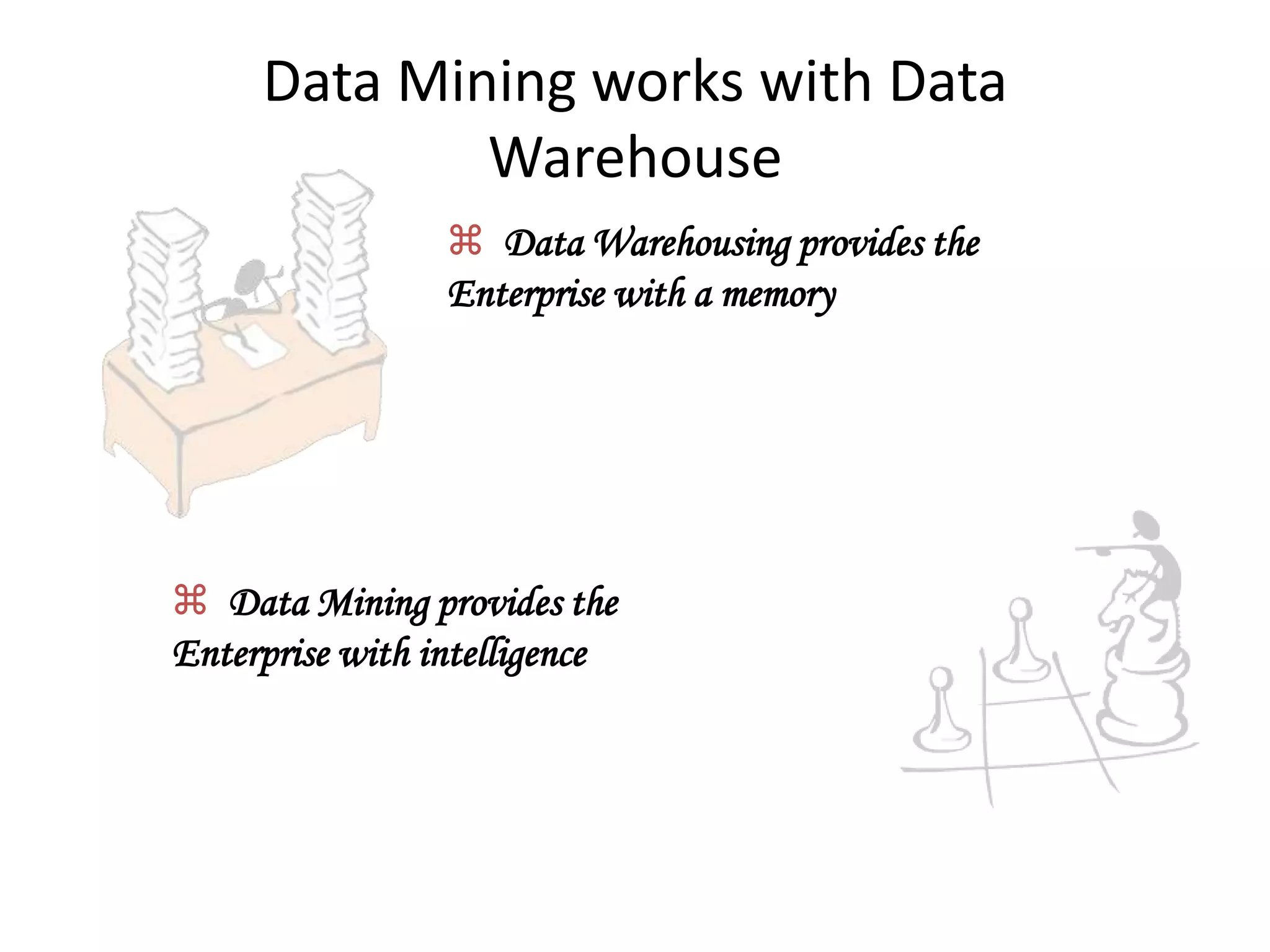
  Data Warehousing provides the Enterprise with a memory
  Data Mining provides the Enterprise with intelligenceData Mining works with DataWarehouse
Data mining for decision supportTwo capabilities are provided new business opportunitiesAutomated prediction of trends and behavior: for ex, targeted marketing.Automated discovery of previously unknown patterns: for ex, detecting fraudulent credit card transactions and identifying anomalous data representing data entry-keying errors.
Data mining toolsIT tools and techniques are used by data miners Neural computing: It is a machine learning approach by which historical data can be examined for patterns.Intelligent agents: It is the promising approach to retrieve information from the internet or from intranet-based databases.Association analysis: An approach that uses a specialized set of algorithms that sort through large data sets and expresses statistical rules among items.
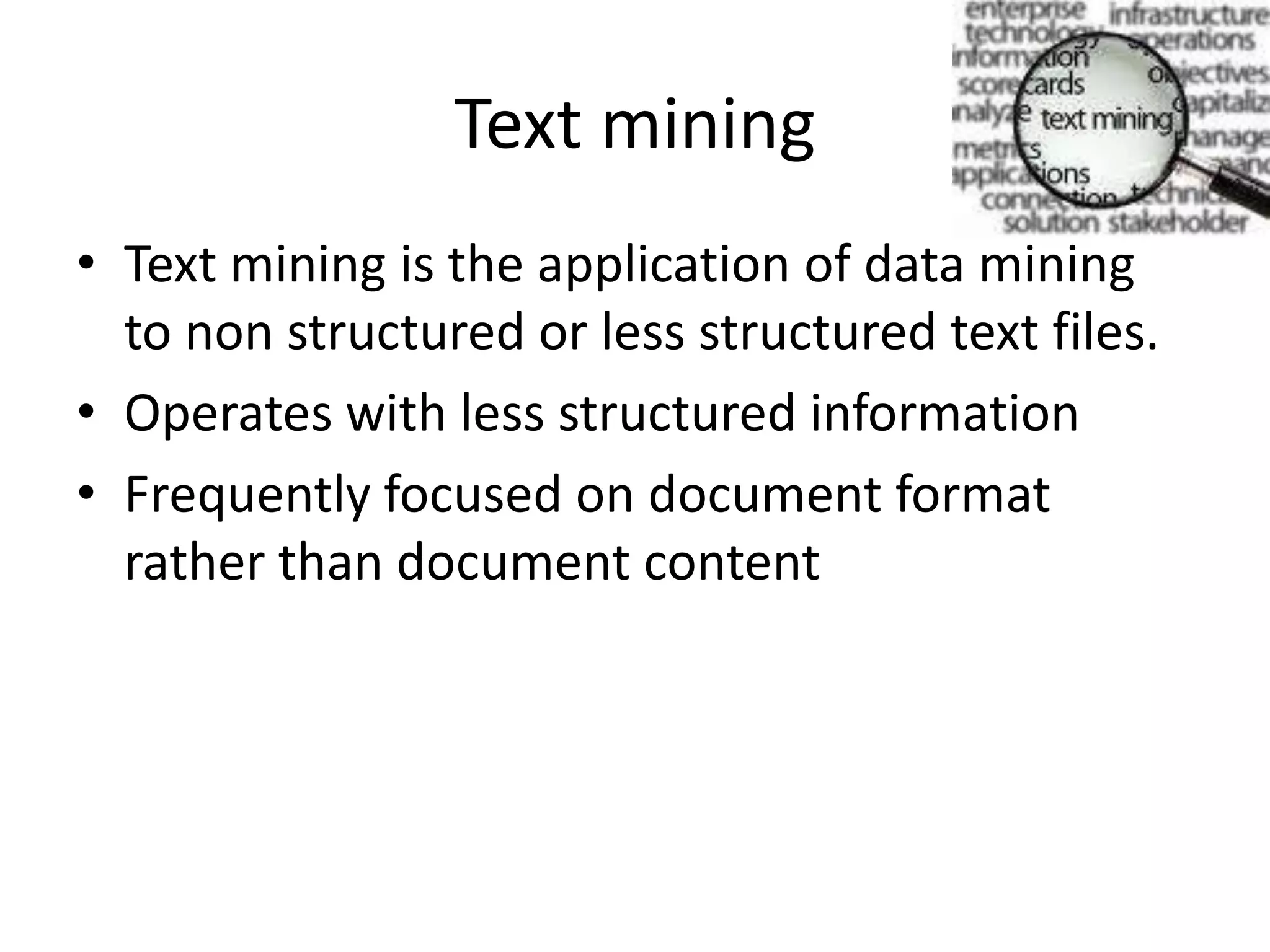
Text mining Text mining is the application of data mining to non structured or less structured text files.Operates with less structured information Frequently focused on document format rather than document content
Text mining helps in….Find the “hidden” content of documents, including additional useful relationshipsRelate documents across previously unnoticed divisions (e.g.: discover that customers in two different product divisions have the same characteristics)Group documents by common themes (e.g.: identify all the customers of an insurance firms who have similar complaints and cancel their policies)
To summarize ...OLTP Systems are used to “run” a businessThe Data Warehouse helps to “optimize” the business
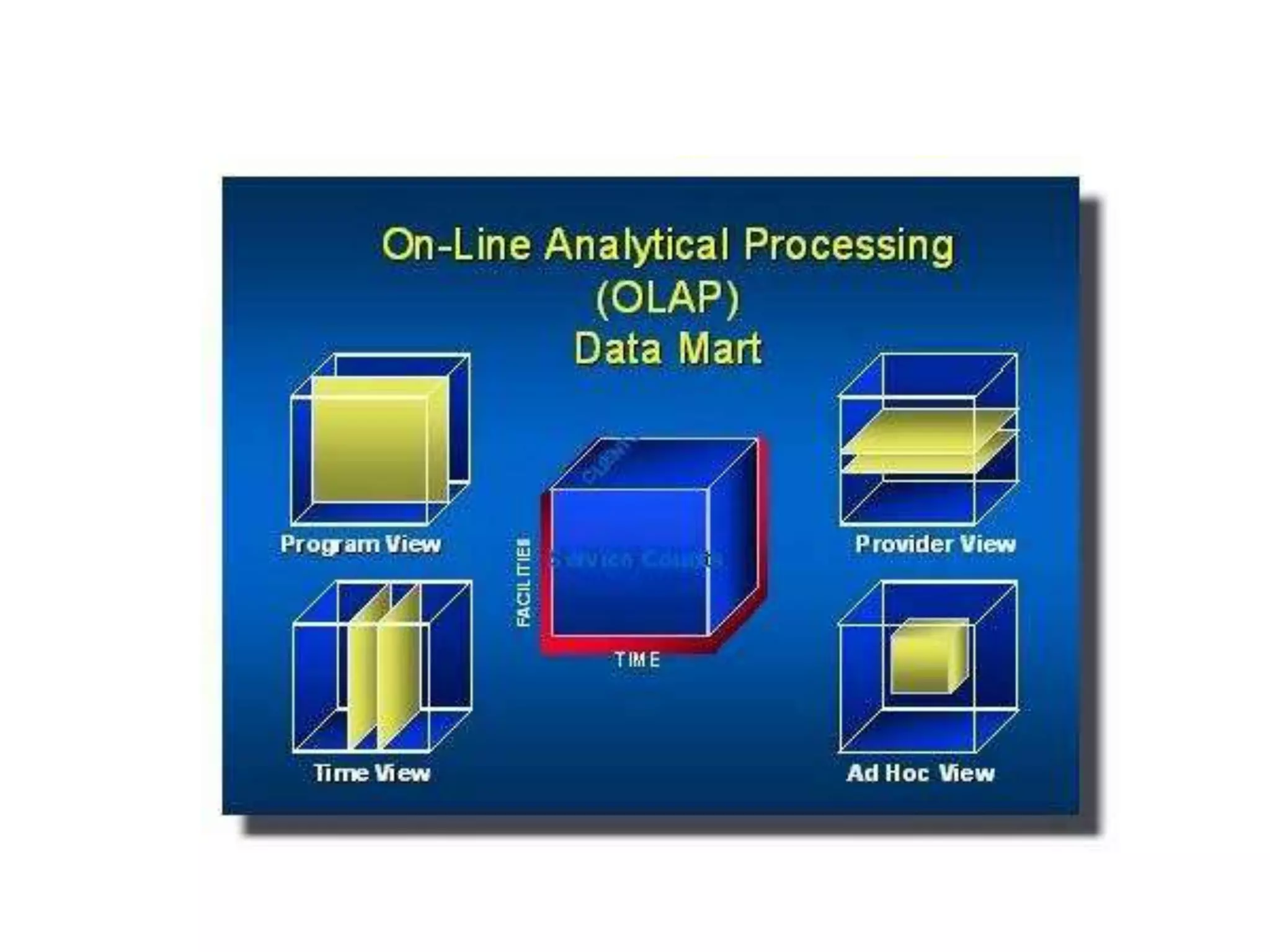
OLAPOnline Analytical Processing - coined by EF Codd in 1994 paper contracted by Arbor SoftwareGenerally synonymous with earlier terms such as Decisions Support, Business Intelligence, Executive Information SystemOLAP = Multidimensional Database
OLAPOnline analytical processing refers to such end user activities as DSS modelling using spreadsheets and graphics that are done online.OLAP involves many different data items in complex relationships.Objective of OLAP is to analyze complex relationships and look for patterns, trends and exceptions.
OLAP Is FASMIFastAnalysisSharedMultidimensionalInformation
Strengths of OLAPIt is a powerful visualization paradigmIt provides fast, interactive response timesIt is good for analyzing time seriesIt can be useful to find some clusters and outliersMany vendors offer OLAP tools such as brio.com, cognus.com, microstrategy.com etc and it is possible to access an OLAP database from web.
Data warehousing integrationEnd Users:
 Decision making and other tasks:
    CRM, DSS, EISDATA SOURCES(databases)DirectuseData organization ; storageInformation Data Warehouse (storage)Use Direct use       Data visualization Use ofknowledgeUseAnalytical processing,       Data miningGenerate knowledgeuse storageOrganizational Knowledge basePurchased knowledgeSTORAGE
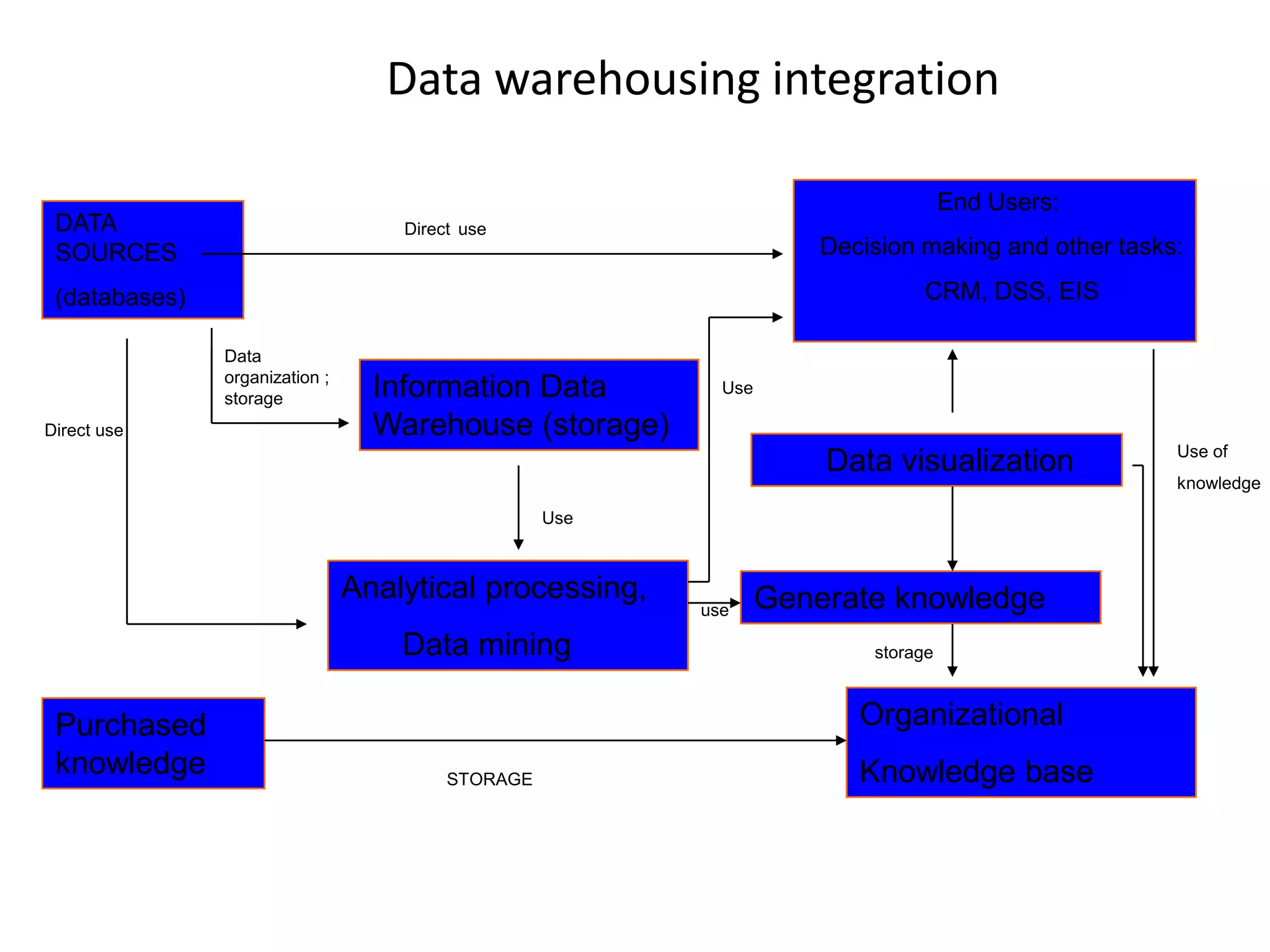
Businesses run on information and the knowledge of how to put that information to use. Knowledge is not readily available, it is continuously constructed from data and/or information, in a process that may not be simple or easy.The transformation of data into knowledge may be accomplished in several ways Data collection from various sources stored in simple databases
Data can be processed, organized, and stored in a data warehouse and then analyzed (e.g.) by using analytical processing) by end users for decision support. Some of the data are converted to information prior to storage in the data warehouse, and some of the data and/or information can be analyzed to generate knowledge.  For example, by using data mining, a process that looks for unknown relationships and patterns in the data, knowledge regarding the impact of advertising on a specific group of customers can be generated.This generated knowledge is stored in an organizational knowledge base, a repository of accumulated corporate knowledge and of purchased knowledge.  The knowledge in the knowledge base can be used to support less experienced and users, or to support complex decision making.  Both the data and the information, at various times during the process, and the knowledge derived at the end of the process, may need to be presented to users.
DATA WAREHOUSING

  • 1.
  • 2.
    CONTENTSDatabase and DataWarehousingHistory of data warehousingEvolution in organization use of data warehousesData Warehouse ArchitectureBenefits of data warehousingStrategic uses of data warehousingDisadvantages of data warehousesData martData miningData mining for decision supportText miningOLAPData warehousing integrationBusiness intelligence
  • 3.
    Database and DataWare Housing….The Difference…DWH Constitute Entire Information Base For All Time..Database Constitute Real Time Information…DWH Supports DM And Business Intelligence.Database Is Used To Running The BusinessDWH Is How To Run The Business
  • 4.
    Which are ourlowest/highest margin customers ?Who are my customers and what products are they buying?What is the most effective distribution channel?What product prom--otions have the biggest impact on revenue?Which customers are most likely to go to the competition ?What impact will new products/services have on revenue and margins?A producer wants to know….
  • 5.
    Data, Data everywhereyet...I can’t find the data I needdata is scattered over the networkmany versions, subtle differencesI can’t get the data I needneed an expert to get the dataI can’t understand the data I foundavailable data poorly documentedI can’t use the data I foundresults are unexpecteddata needs to be transformed from one form to other
  • 6.
    What is aData Warehouse?A single, complete and consistent store of data obtained from a variety of different sources made available to end users in a what they can understand and use in a business context.
  • 7.
    What is DataWarehousing?InformationDataA process of transforming data into information and making it available to users in a timely enough manner to make a difference
  • 8.
    Data Warehousing --a processIt is a relational or multidimensional database management system designed to support management decision making. A data warehousing is a copy of transaction data specifically structured for querying and reporting.Technique for assembling and managing data from various sources for the purpose of answering business questions. Thus making decisions that were not previous possible
  • 9.
    Data warehousing is…Subject Oriented: Data that gives information about a particular subject instead of about a company's ongoing operations. Integrated: Data that is gathered into the data warehouse from a variety of sources and merged into a coherent whole. Time-variant: All data in the data warehouse is identified with a particular time period. Non-volatile: Data is stable in a data warehouse. More data is added but data is never removed. This enables management to gain a consistent picture of the business.Data warehousing is combining data from multiple and usually varied sources into one comprehensive and easily manipulated database. Common accessing systems of data warehousing include queries, analysis and reporting. Because data warehousing creates one database in the end, the number of sources can be anything you want it to be, provided that the system can handle the volume, of course. The final result, however, is homogeneous data, which can be more easily manipulated.
  • 10.
    History of datawarehousingThe concept of data warehousing dates back to the late 1980s when IBM researchers Barry Devlin and Paul Murphy developed the "business data warehouse". 1960s - General Mills and Dartmouth College, in a joint research project, develop the terms dimensions and facts.1970s - ACNielsen and IRI provide dimensional data marts for retail sales.1983 – Tera data introduces a database management system specifically designed for decision support. 1988 - Barry Devlin and Paul Murphy publish the article An architecture for a business and information systems in IBM Systems Journal where they introduce the term "business data warehouse".
  • 11.
    OLTPOLTP- ONLINE TRANSACTIONPROCESSINGSpecial data organization, access methods and implementation methods are needed to support data warehouse queries (typically multidimensional queries)OLTP systems are tuned for known transactions and workloads while workload is not known a priori in a data warehousee.g., average amount spent on phone calls between 9AM-5PM in Pune during the month of December
  • 12.
    OLTP vs DataWarehouseOLTPApplication OrientedUsed to run businessDetailed dataCurrent up to dateIsolated DataClerical UserFew Records accessed at a time (tens)Read/Update AccessNo data redundancyDatabase Size 100MB -100 GBTransaction throughput is the performance metricThousands of usersManaged in entiretyWarehouse (DSS)Subject OrientedUsed to analyze businessSummarized and refinedSnapshot dataIntegrated DataKnowledge User (Manager)Large volumes accessed at a time (millions)Mostly Read (Batch Update)Redundancy presentDatabase Size 100 GB - few terabytesQuery throughput is the performance metricHundreds of usersManaged by subsets
  • 13.
    To summarize ...OLTPSystems are used to “run” a businessThe Data Warehouse helps to “optimize” the business
  • 14.
    Evolution in organizationaluse of data warehousesOrganizations generally start off with relatively simple use of data warehousing. Over time, more sophisticated use of data warehousing evolves. The following general stages of use of the data warehouse can be distinguished:Off line Operational Database Data warehouses in this initial stage are developed by simply copying the data off an operational system to another server where the processing load of reporting against the copied data does not impact the operational system's performance. Off line Data Warehouse  Data warehouses at this stage are updated from data in the operational systems on a regular basis and the data warehouse data is stored in a data structure designed to facilitate reporting. Real Time Data Warehouse Data warehouses at this stage are updated every time an operational system performs a transaction (e.g. an order or a delivery or a booking.) Integrated Data Warehouse  Data warehouses at this stage are updated every time an operational system performs a transaction. The data warehouses then generate transactions that are passed back into the operational systems.
  • 15.
  • 16.
    The data hasbeen selected from various sources and then integrate and store the data in a single and particular format.Data warehousescontain current detailed data, historical detailed data, lightly and highly summarized data, and metadata.Current and historical data are voluminous because they are stored at the highest level of detail.Lightly and highly summarized data are necessary to save processing time when users request them and are readily accessible.Metadataare “data about data”. It is important for designing, constructing, retrieving, and controlling the warehouse data.Technical metadatainclude where the data come from, how the data were changed, how the data are organized, how the data are stored, who owns the data, who is responsible for the data and how to contact them, who can access the data , and the date of last update.Business metadatainclude what data are available, where the data are, what the data mean, how to access the data, predefined reports and queries, and how current the data are.
  • 17.
    Business advantagesIt providesbusiness users with a “customer-centric” view of the company’s heterogeneous data by helping to integrate data from sales, service, manufacturing and distribution, and other customer-related business systems.It provides added value to the company’s customers by allowing them to access better information when data warehousing is coupled with internet technology.It consolidates data about individual customers and provides a repository of all customer contacts for segmentation modeling, customer retention planning, and cross sales analysis.It removes barriers among functional areas by offering a way to reconcile views from multiple areas, thus providing a look at activities that cross functional lines.It reports on trends across multidivisional, multinational operating units, including trends or relationships in areas such as merchandising, production planning etc.
  • 18.
    Strategic uses ofdata warehousing
  • 19.
    Disadvantages of datawarehousesData warehouses are not the optimal environment for unstructured data. Because data must be extracted, transformed and loaded into the warehouse, there is an element of latency in data warehouse data. Over their life, data warehouses can have high costs. Maintenance costs are high. Data warehouses can get outdated relatively quickly. There is a cost of delivering suboptimal information to the organization. There is often a fine line between data warehouses and operational systems. Duplicate, expensive functionality may be developed. Or, functionality may be developed in the data warehouse that, in retrospect, should have been developed in the operational systems and vice versa.
  • 20.
    Data MartsA datamart is a scaled down version of a data warehouse that focuses on a particular subject area.A data mart is a subset of an organizational data store, usually oriented to a specific purpose or major data subject, that may be distributed to support business needs. Data marts are analytical data stores designed to focus on specific business functions for a specific community within an organization. Usually designed to support the unique business requirements of a specified department or business processImplemented as the first step in proving the usefulness of the technologies to solve business problemsReasons for creating a data martEasy access to frequently needed data Creates collective view by a group of users Improves end-user response time Ease of creation in less timeLower cost than implementing a full Data warehousePotential users are more clearly defined than in a full Data warehouse
  • 21.
  • 22.
    Characteristics of theDepartmental Data MartSmall
  • 23.
  • 24.
  • 25.
  • 26.
    Source is departmentallystructured data warehouseData martData warehouse
  • 27.
    Data MiningData Miningis the process of extracting information from the company's various databases and re-organizing it for purposes other than what the databases were originally intended for. It provides a means of extracting previously unknown, predictive information from the base of accessible data in data warehouses.Data mining process is different for different organizations depending upon the nature of the data and organization.Data mining tools use sophisticated, automated algorithms to discover hidden patterns, correlations, and relationships among organizational data.Data mining tools are used to predict future trends and behaviors, allowing businesses to make proactive, knowledge driven decisions.For ex: for targeted marketing, data mining can use data on past promotional mailings to identify the targets most likely to maximize the return on the company’s investment in future mailings.
  • 28.
    Functions Classification: Itinfers the defining characteristics of a certain groupClustering: identifies group of items that share a particular characteristicAssociation: identifies relationships between events that occur at one time Sequencing: similar to association, except that the relationship exists over a period of timeForecasting: estimates future values based on patterns within large sets of data
  • 29.
    Characteristics Data miningtools are needed to extract the buried information “ore”.The “miner” is often an end user, empowered by “data drills” and other power query tools to ask ad hoc questions and get answers quickly, with little or no programming skill.The data mining environment usually has a client/server architecture.Because of the large amounts of data, it is sometimes necessary to use parallel processing for data mining.Data mining tools are easily combined with spreadsheets and other end user software development tools, enabling the mined data to be analyzed and processed quickly and easily.Data mining yields five types of information: associations, sequences, classifications, clusters and forecasting.“Striking it rich” often involves finding unexpected, valuable results.
  • 30.
    Common data miningapplications
  • 32.
    DataWarehousing provides the Enterprise with a memory
  • 33.
    DataMining provides the Enterprise with intelligenceData Mining works with DataWarehouse
  • 34.
    Data mining fordecision supportTwo capabilities are provided new business opportunitiesAutomated prediction of trends and behavior: for ex, targeted marketing.Automated discovery of previously unknown patterns: for ex, detecting fraudulent credit card transactions and identifying anomalous data representing data entry-keying errors.
  • 35.
    Data mining toolsITtools and techniques are used by data miners Neural computing: It is a machine learning approach by which historical data can be examined for patterns.Intelligent agents: It is the promising approach to retrieve information from the internet or from intranet-based databases.Association analysis: An approach that uses a specialized set of algorithms that sort through large data sets and expresses statistical rules among items.
  • 36.
    Text mining Textmining is the application of data mining to non structured or less structured text files.Operates with less structured information Frequently focused on document format rather than document content
  • 37.
    Text mining helpsin….Find the “hidden” content of documents, including additional useful relationshipsRelate documents across previously unnoticed divisions (e.g.: discover that customers in two different product divisions have the same characteristics)Group documents by common themes (e.g.: identify all the customers of an insurance firms who have similar complaints and cancel their policies)
  • 38.
    To summarize ...OLTPSystems are used to “run” a businessThe Data Warehouse helps to “optimize” the business
  • 39.
    OLAPOnline Analytical Processing- coined by EF Codd in 1994 paper contracted by Arbor SoftwareGenerally synonymous with earlier terms such as Decisions Support, Business Intelligence, Executive Information SystemOLAP = Multidimensional Database
  • 40.
    OLAPOnline analytical processingrefers to such end user activities as DSS modelling using spreadsheets and graphics that are done online.OLAP involves many different data items in complex relationships.Objective of OLAP is to analyze complex relationships and look for patterns, trends and exceptions.
  • 42.
  • 43.
    Strengths of OLAPItis a powerful visualization paradigmIt provides fast, interactive response timesIt is good for analyzing time seriesIt can be useful to find some clusters and outliersMany vendors offer OLAP tools such as brio.com, cognus.com, microstrategy.com etc and it is possible to access an OLAP database from web.
  • 44.
  • 45.
    Decision makingand other tasks:
  • 46.
    CRM, DSS, EISDATA SOURCES(databases)DirectuseData organization ; storageInformation Data Warehouse (storage)Use Direct use Data visualization Use ofknowledgeUseAnalytical processing, Data miningGenerate knowledgeuse storageOrganizational Knowledge basePurchased knowledgeSTORAGE
  • 47.
    Businesses run oninformation and the knowledge of how to put that information to use. Knowledge is not readily available, it is continuously constructed from data and/or information, in a process that may not be simple or easy.The transformation of data into knowledge may be accomplished in several ways Data collection from various sources stored in simple databases
  • 48.
    Data can beprocessed, organized, and stored in a data warehouse and then analyzed (e.g.) by using analytical processing) by end users for decision support. Some of the data are converted to information prior to storage in the data warehouse, and some of the data and/or information can be analyzed to generate knowledge. For example, by using data mining, a process that looks for unknown relationships and patterns in the data, knowledge regarding the impact of advertising on a specific group of customers can be generated.This generated knowledge is stored in an organizational knowledge base, a repository of accumulated corporate knowledge and of purchased knowledge. The knowledge in the knowledge base can be used to support less experienced and users, or to support complex decision making. Both the data and the information, at various times during the process, and the knowledge derived at the end of the process, may need to be presented to users.
  • 49.
    Data Warehouse forDecision SupportPutting Information technology to help the knowledge worker make faster and better decisionsUsed to manage and control businessData is historical or point-in-timeOptimized for inquiry rather than updateUse of the system is loosely defined and can be ad-hocUsed by managers and end-users to understand the business and make judgments
  • 50.
  • 51.
    Business IntelligenceOne ultimateuse of the data gathered and processed in the data life cycle is for business intelligence. Business intelligence generally involves the creation or use of a data warehouse and/or data mart for storage of data, and the use of front-end analytical tools such as Oracle’s Sales Analyzer and Financial Analyzer or Micro Strategy’s Web. Such tools can be employed by end users to access data, ask queries, request ad hoc (special) reports, examine scenarios, create CRM activities, devise pricing strategies, and much more.
  • 52.
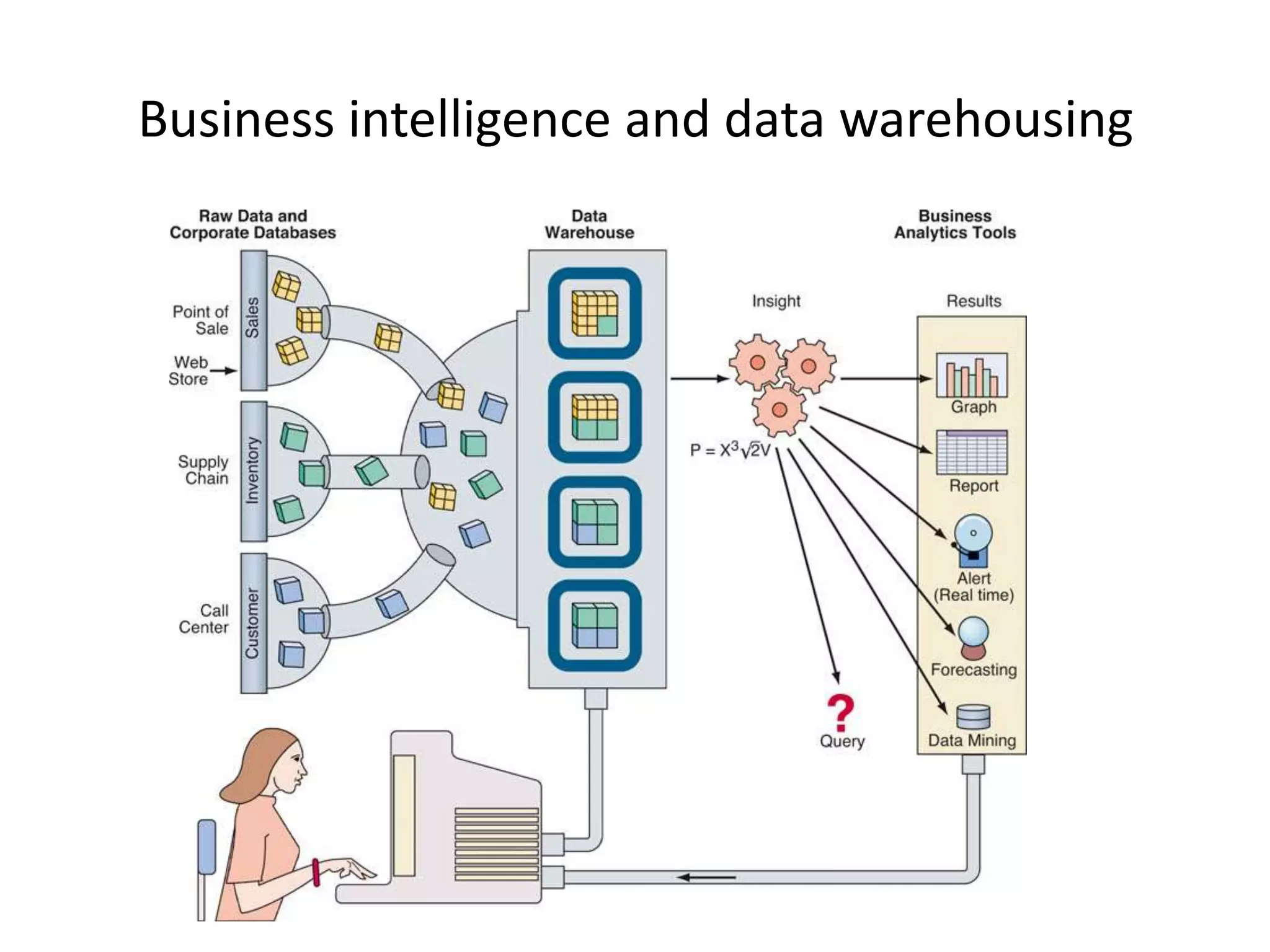
    How business intelligenceworks?The process starts with raw data which are usually kept in corporate data bases. For example, a national retail chain that sells everything from grills and patio furniture to plastic utensils had data about inventory, customer information, data about past promotions, and sales numbers in various databases. Though all this information may be scattered across multiple systems-and may seem unrelated-business intelligence software can being it together. This is done by using a data warehouse. In the data warehouse (or mart) tables can be linked, and data cubes are formed. For instance, inventory information is linked to sales numbers and customer databases, allowing for deep analysis of information.
  • 53.
    Using the businessintelligence software the user can ask queries, request ad-hoc reports, or conduct any other analysis. For example, deep analysis can be carried out by performing multilayer queries. Because all the databases are linked, one can search for what products a store has too much of, determine which of these products commonly sell with popular items, bases on previous sales. After planning a promotion to move the excess stock along with the popular products (by bundling them together, for example), one can dig deeper to see where this promotion would be most popular (and most profitable). The results of the request can be reports, predictions, alerts, and/or graphical presentations. These can be disseminated to decision makers to help them in their decision-making tasks.
  • 54.
    More advanced applicationsof business intelligence include outputs such asfinancial modeling budgeting resource allocation and competitive intelligence.