Advances in Database Querying Satish Bobba Sr.Informatica Developer [email_address]
Acknowledgments Pankaj Gangshettiwar  Anit Jha CGI AMS
Overview Part 1:  Data Warehouses  Part 2:  OLAP Part 3:  Data Mining Part 4:  Query Processing and Optimization
Part 1: Data Warehouses
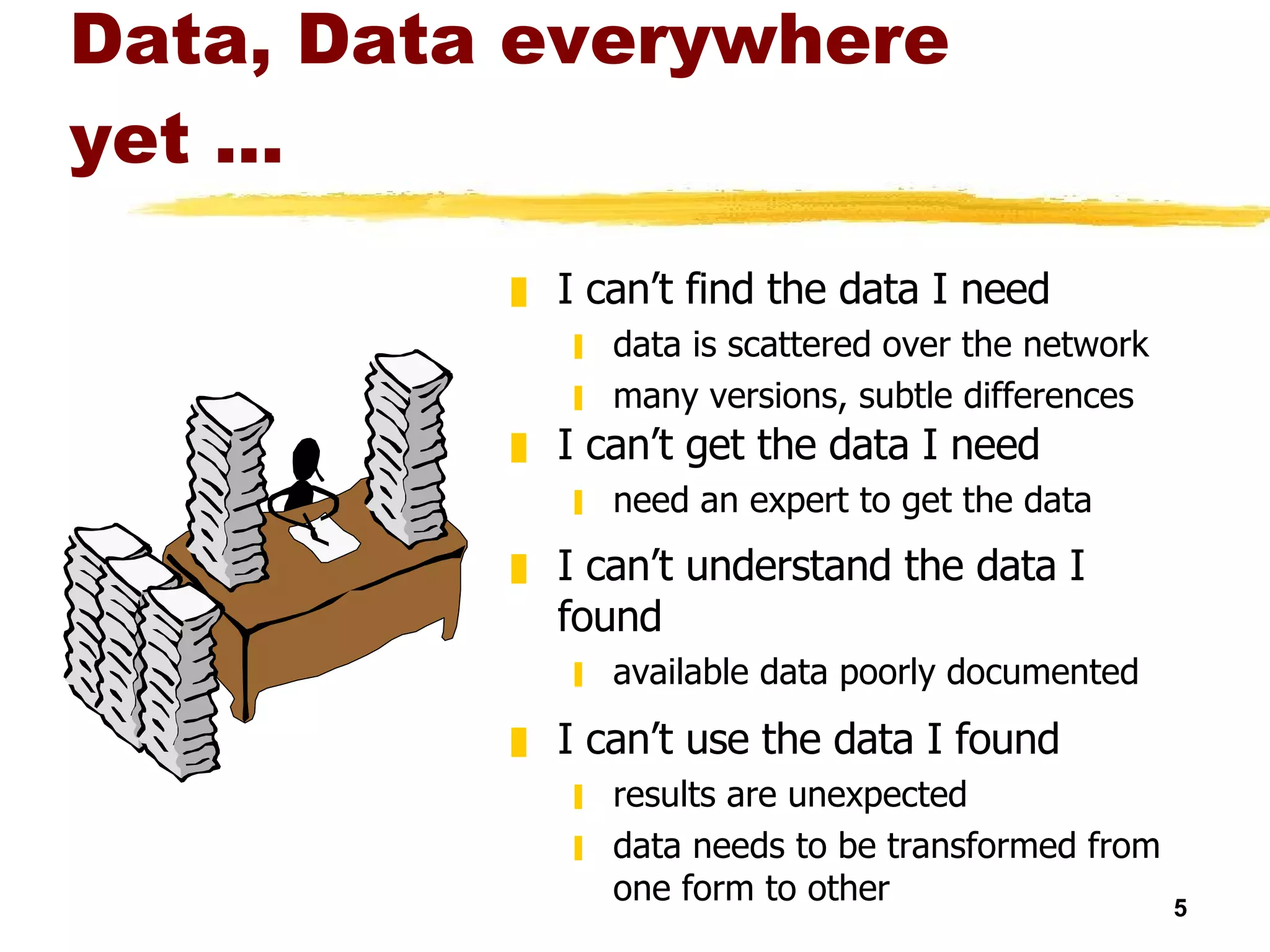
Data, Data everywhere yet ... I can’t find the data I need data is scattered over the network many versions, subtle differences I can’t get the data I need need an expert to get the data I can’t understand the data I found available data poorly documented I can’t use the data I found results are unexpected data needs to be transformed from one form to other
What is a Data Warehouse? A single, complete and consistent store of data obtained from a variety of different sources made available to end users in a what they can understand and use in a business context. [Barry Devlin]
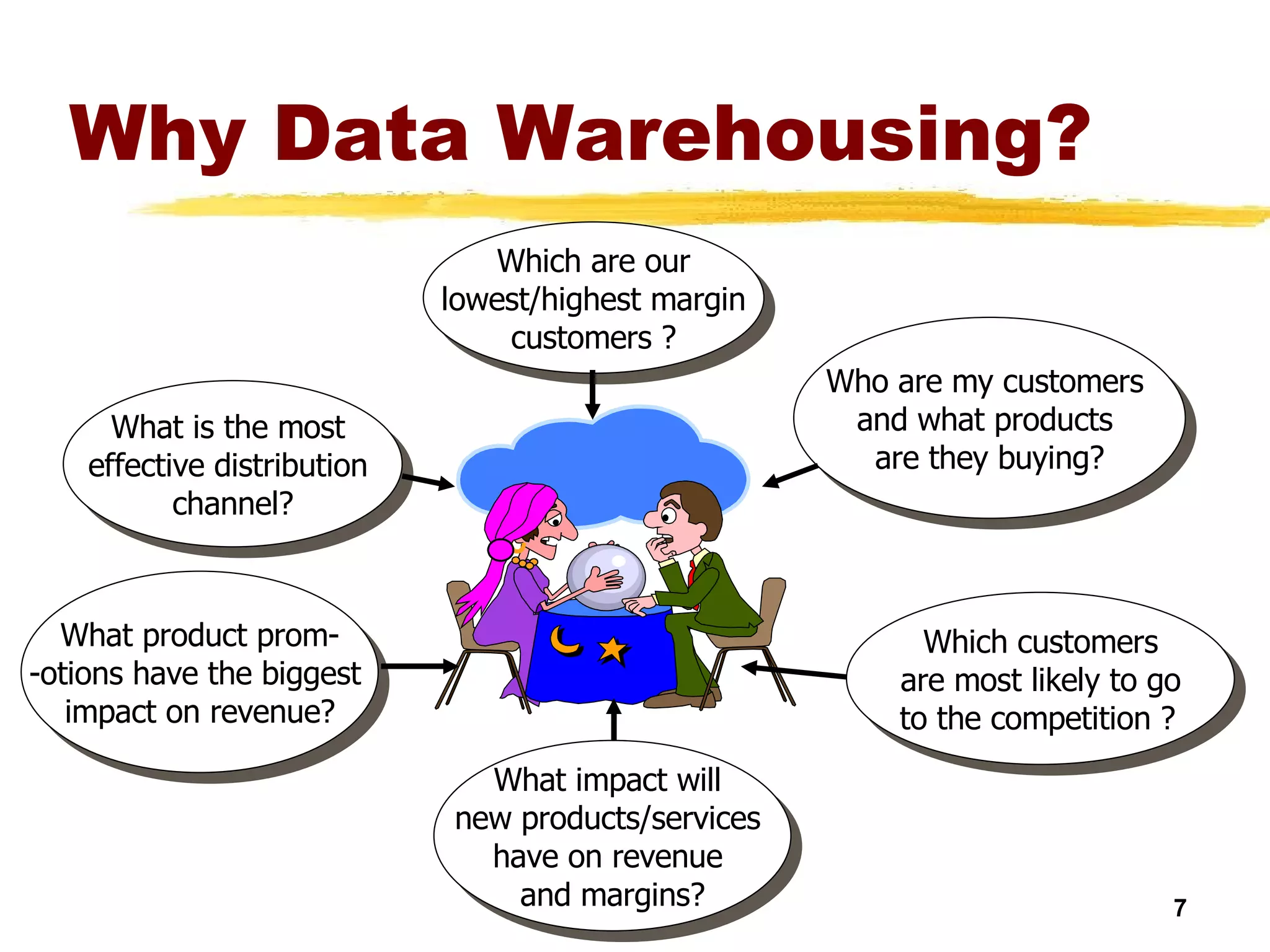
Why Data Warehousing? Which are our  lowest/highest margin  customers ? Who are my customers  and what products  are they buying? Which customers  are most likely to go  to the competition ?   What impact will  new products/services  have on revenue  and margins? What product prom- -otions have the biggest  impact on revenue? What is the most  effective distribution  channel?
Decision Support Used to manage and control business Data is historical or point-in-time Optimized for inquiry rather than update Use of the system is loosely defined and can be ad-hoc Used by managers and end-users to understand the business and make judgements
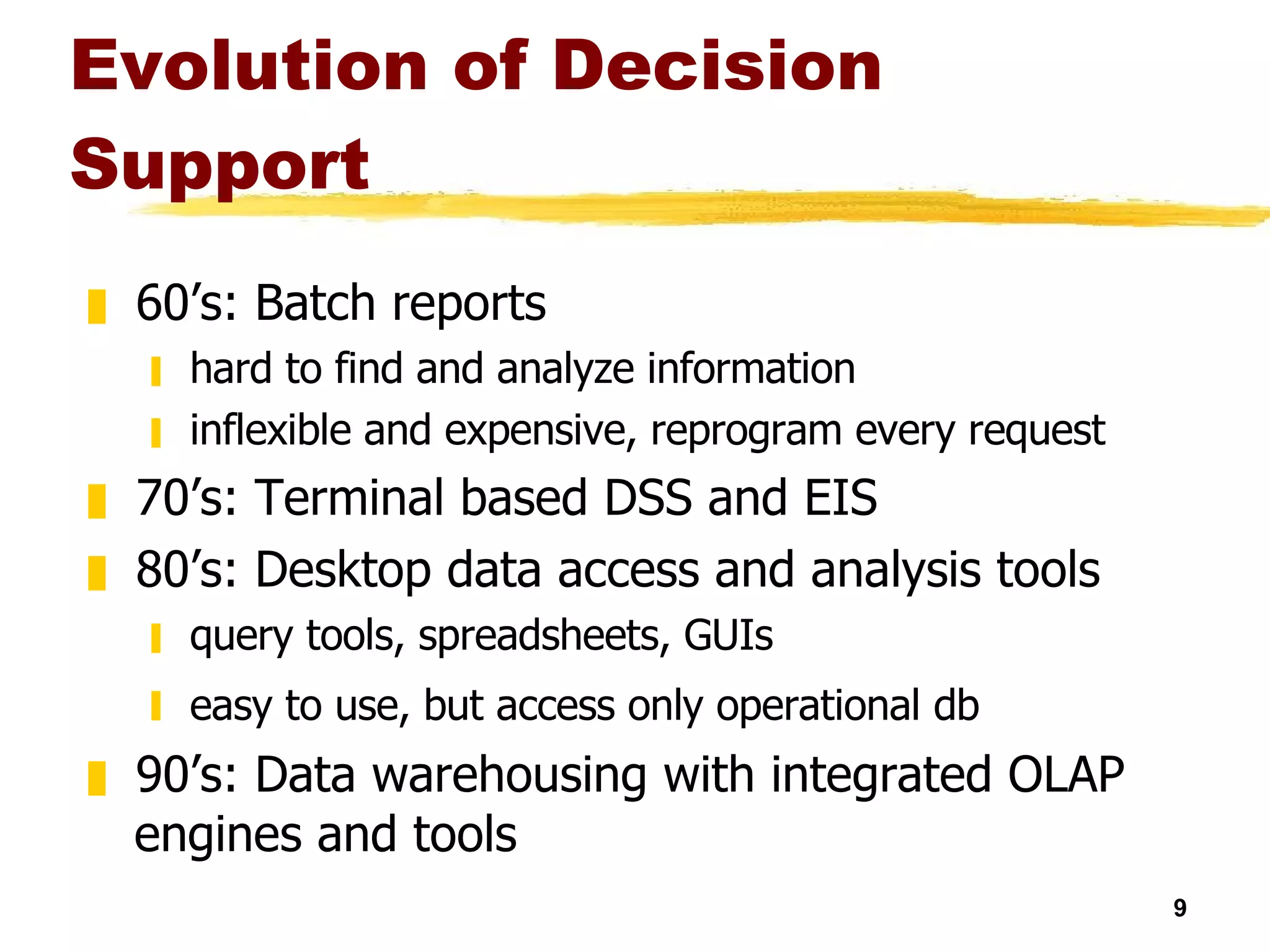
Evolution of Decision Support 60’s: Batch reports hard to find and analyze information inflexible and expensive, reprogram every request 70’s: Terminal based DSS and EIS 80’s: Desktop data access and analysis tools query tools, spreadsheets, GUIs easy to use, but access only operational db   90’s: Data warehousing with integrated OLAP engines and tools
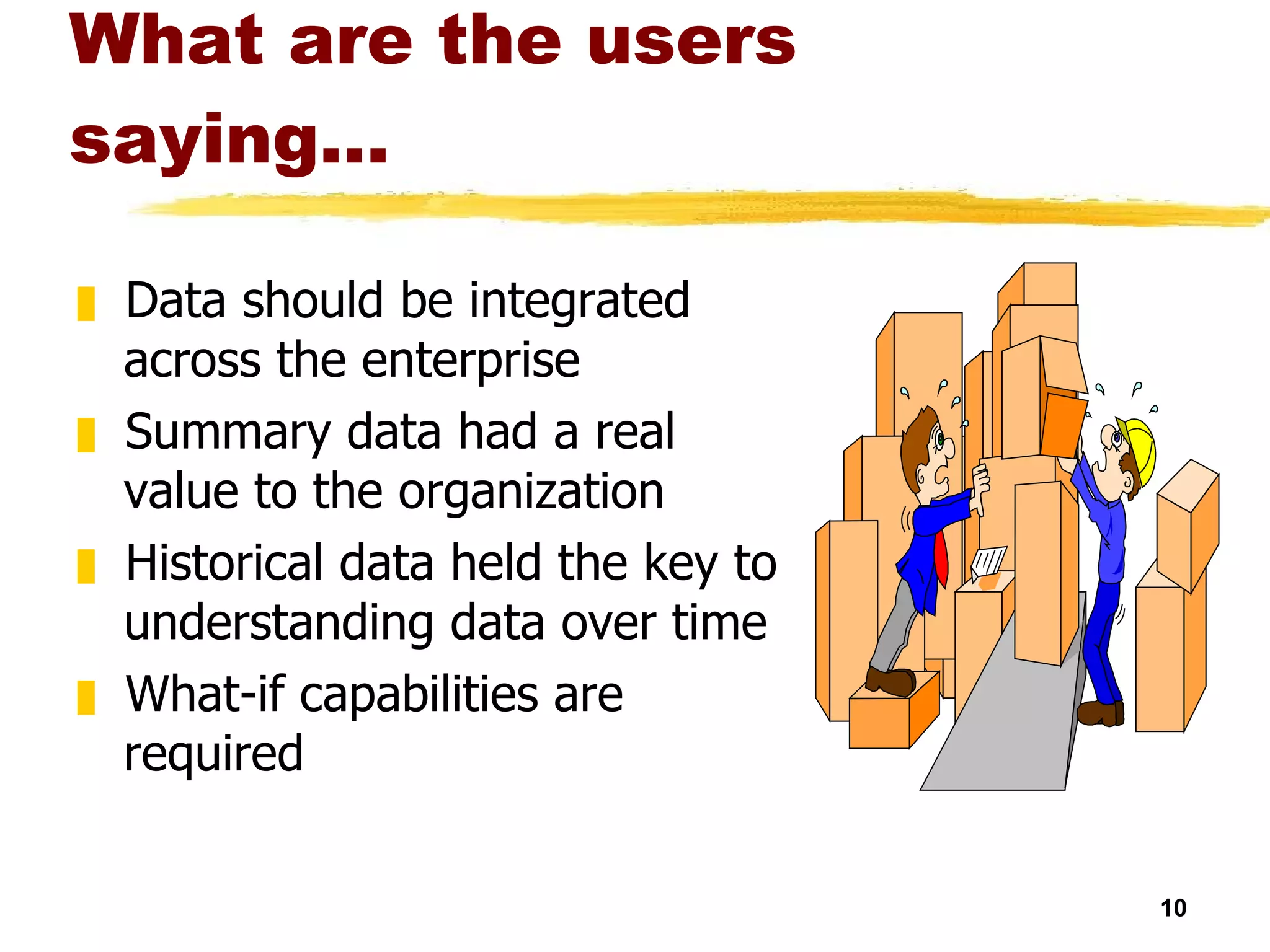
What are the users saying... Data should be integrated across the enterprise Summary data had a real value to the organization Historical data held the key to understanding data over time What-if capabilities are required
Data Warehousing --  It is a process Technique for assembling and managing data from various sources for the purpose of answering business questions. Thus making decisions that were not previous possible A decision support database maintained separately from the organization’s operational database
Traditional RDBMS used for OLTP  Database Systems have been  used traditionally for OLTP clerical data processing tasks detailed, up to date data structured repetitive tasks read/update a few records isolation, recovery and integrity are critical Will call these operational systems
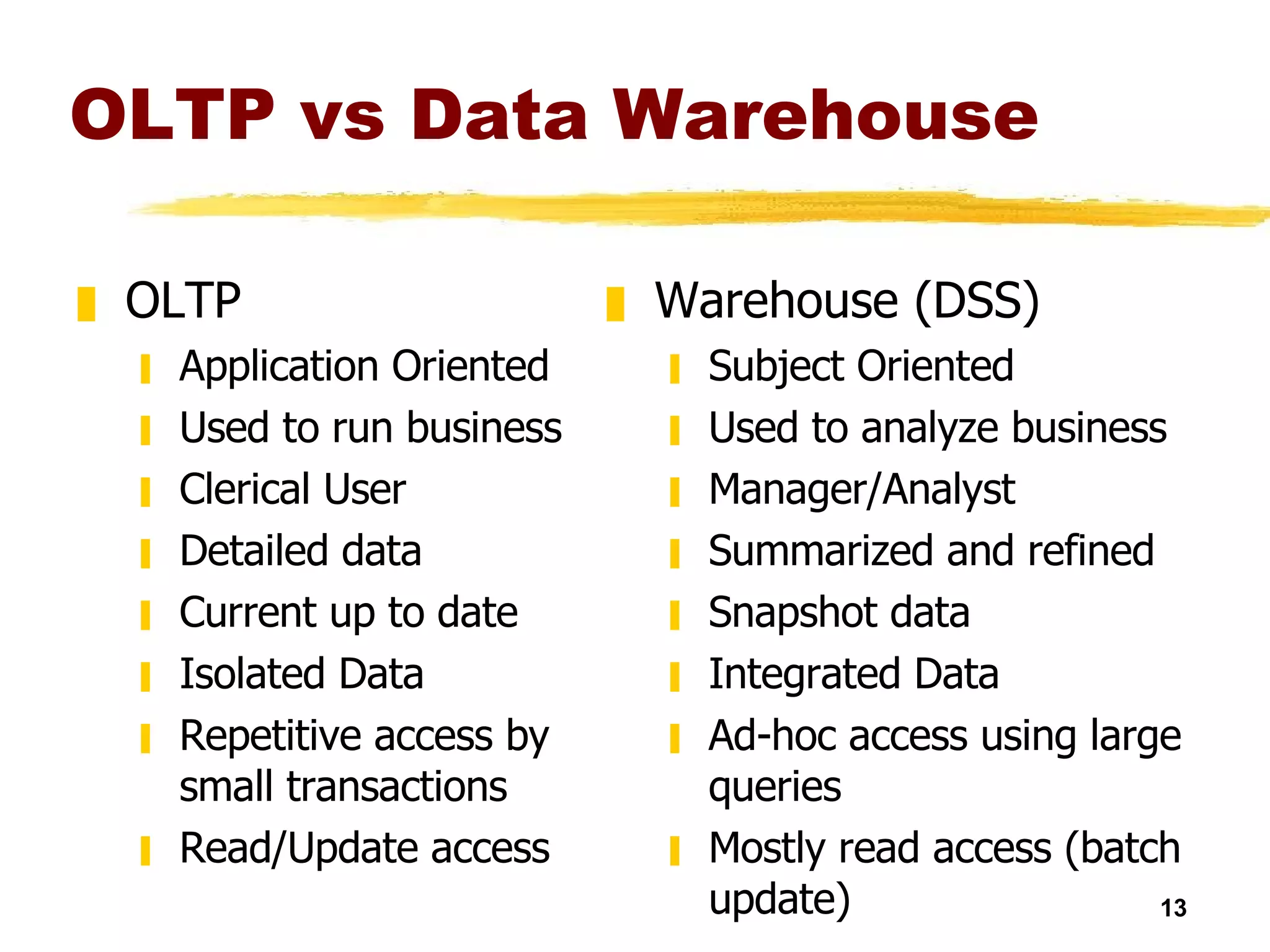
OLTP vs Data Warehouse OLTP Application Oriented Used to run business Clerical User Detailed data Current up to date Isolated Data Repetitive access by small transactions Read/Update access Warehouse (DSS) Subject Oriented Used to analyze business Manager/Analyst Summarized and refined Snapshot data Integrated Data Ad-hoc access using large queries Mostly read access (batch update)
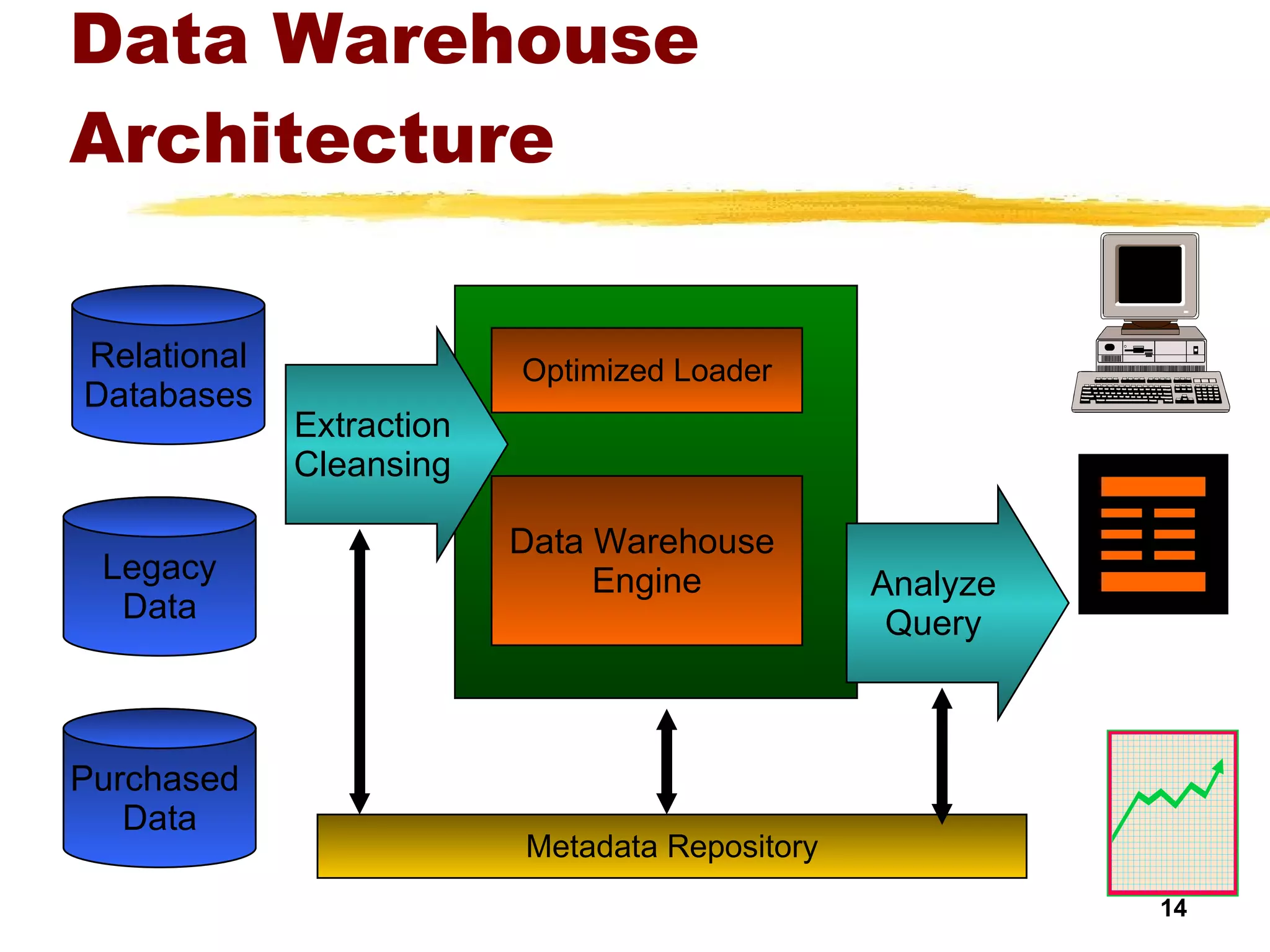
Data Warehouse Architecture Relational Databases Legacy Data Purchased  Data Data Warehouse  Engine Optimized Loader Extraction Cleansing Analyze Query Metadata Repository
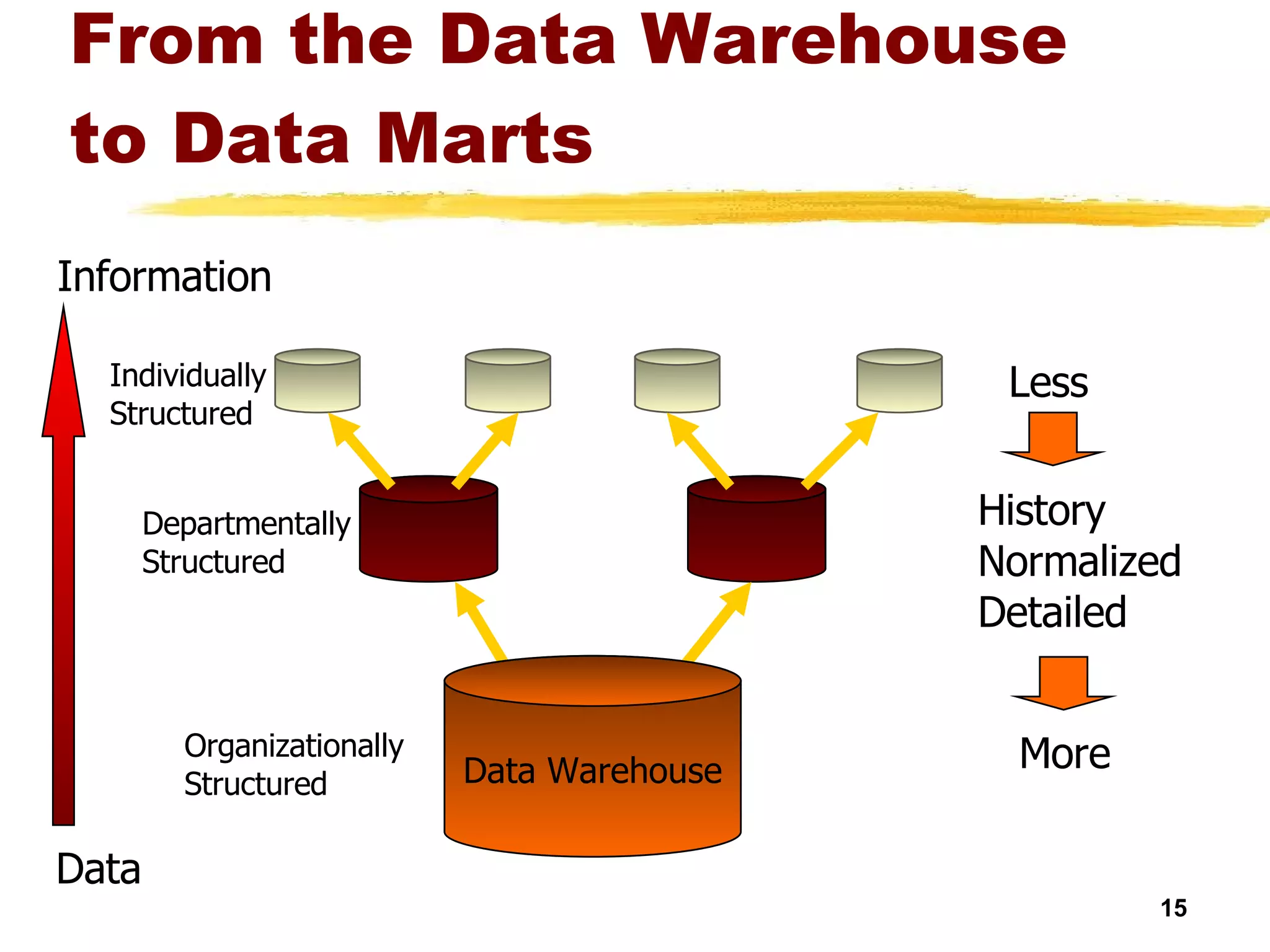
From the Data Warehouse to Data Marts Departmentally Structured Individually Structured Data Warehouse Organizationally Structured Less More History Normalized Detailed Data Information
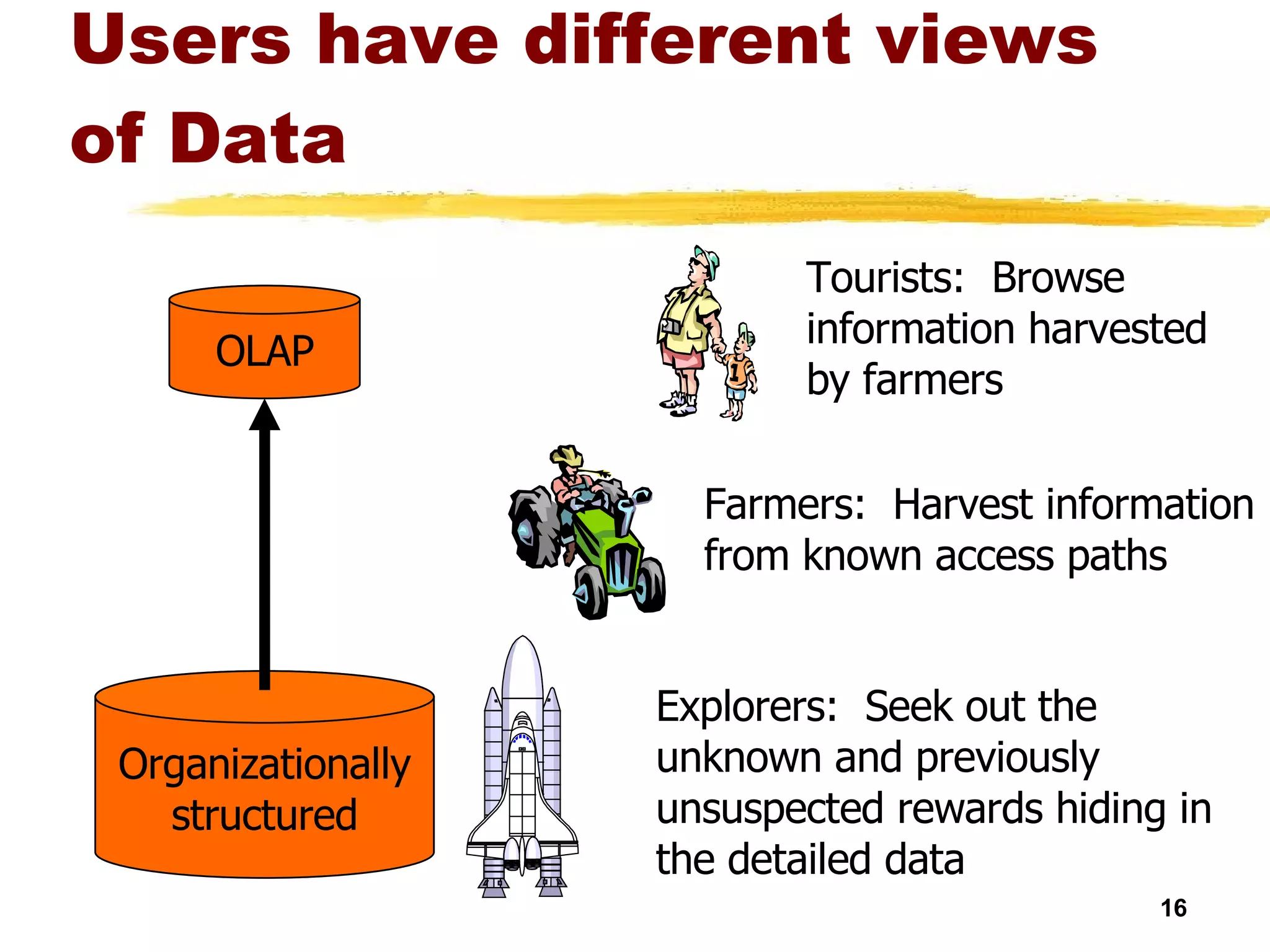
Users have different views of Data Organizationally structured OLAP Explorers:  Seek out the unknown and previously unsuspected rewards hiding in the detailed data Farmers:  Harvest information from known access paths Tourists:  Browse information harvested by farmers
Wal*Mart Case Study Founded by Sam Walton One the largest Super Market Chains in the US Wal*Mart: 2000+ Retail Stores  SAM's Clubs 100+Wholesalers Stores  This case study is from Felipe Carino’s (NCR Teradata) presentation made at Stanford Database Seminar
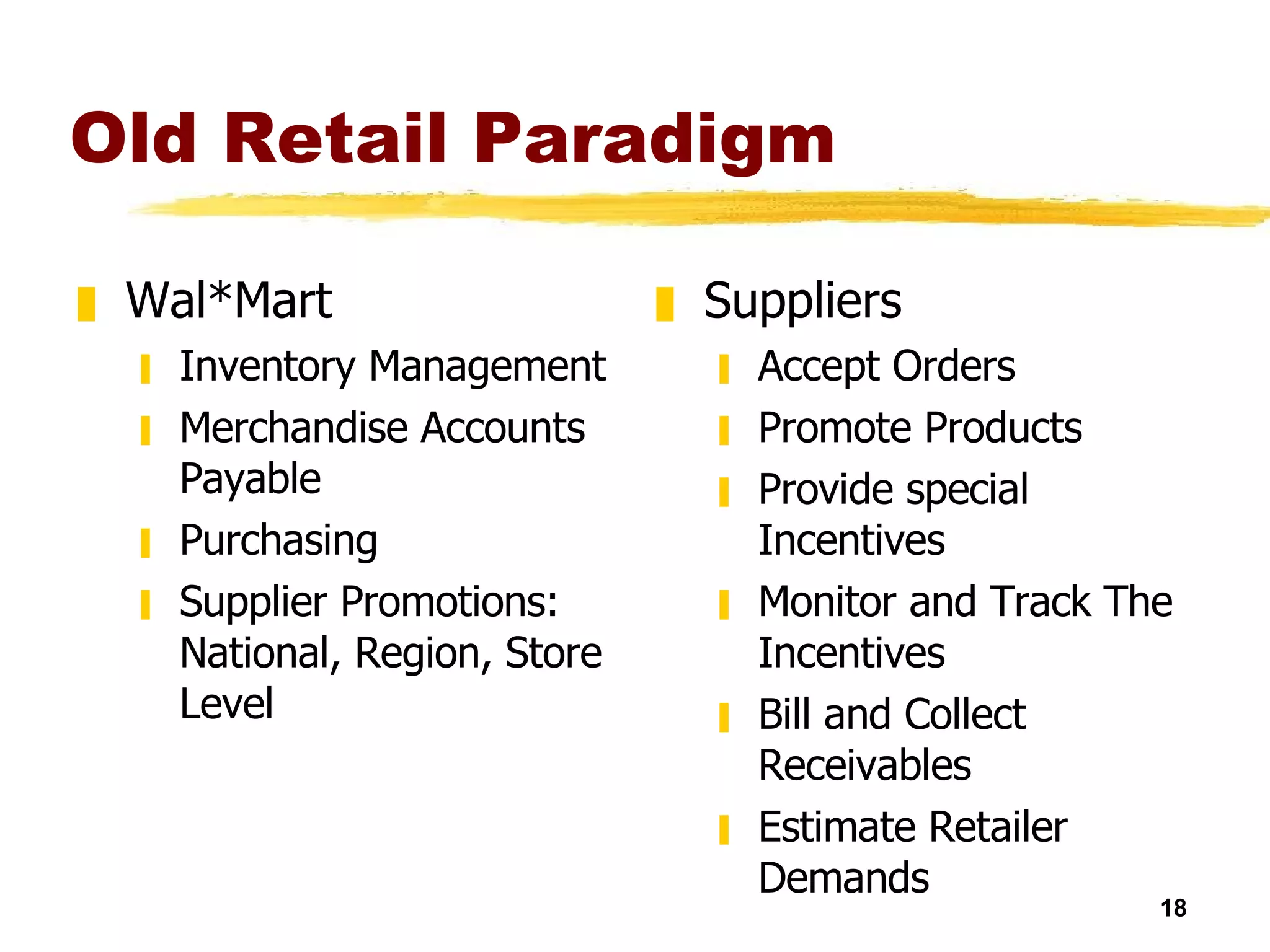
Old Retail Paradigm Wal*Mart Inventory Management  Merchandise Accounts Payable  Purchasing  Supplier Promotions: National, Region, Store Level  Suppliers  Accept Orders  Promote Products  Provide special Incentives  Monitor and Track The Incentives  Bill and Collect Receivables  Estimate Retailer Demands
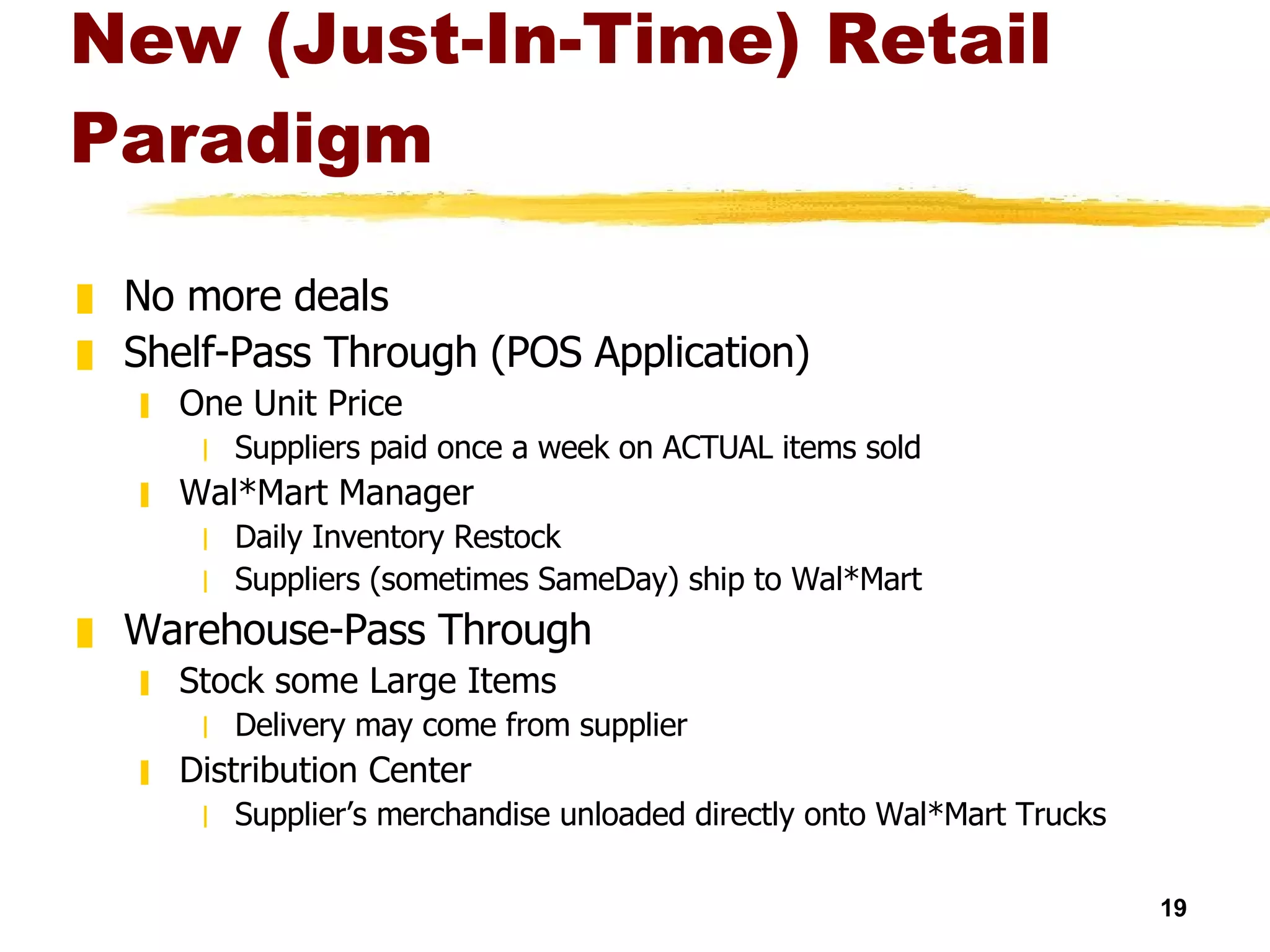
New (Just-In-Time) Retail Paradigm No more deals Shelf-Pass Through (POS Application) One Unit Price Suppliers paid once a week on ACTUAL items sold Wal*Mart Manager Daily Inventory Restock Suppliers (sometimes SameDay) ship to Wal*Mart Warehouse-Pass Through Stock some Large Items Delivery may come from supplier Distribution Center Supplier’s merchandise unloaded directly onto Wal*Mart Trucks
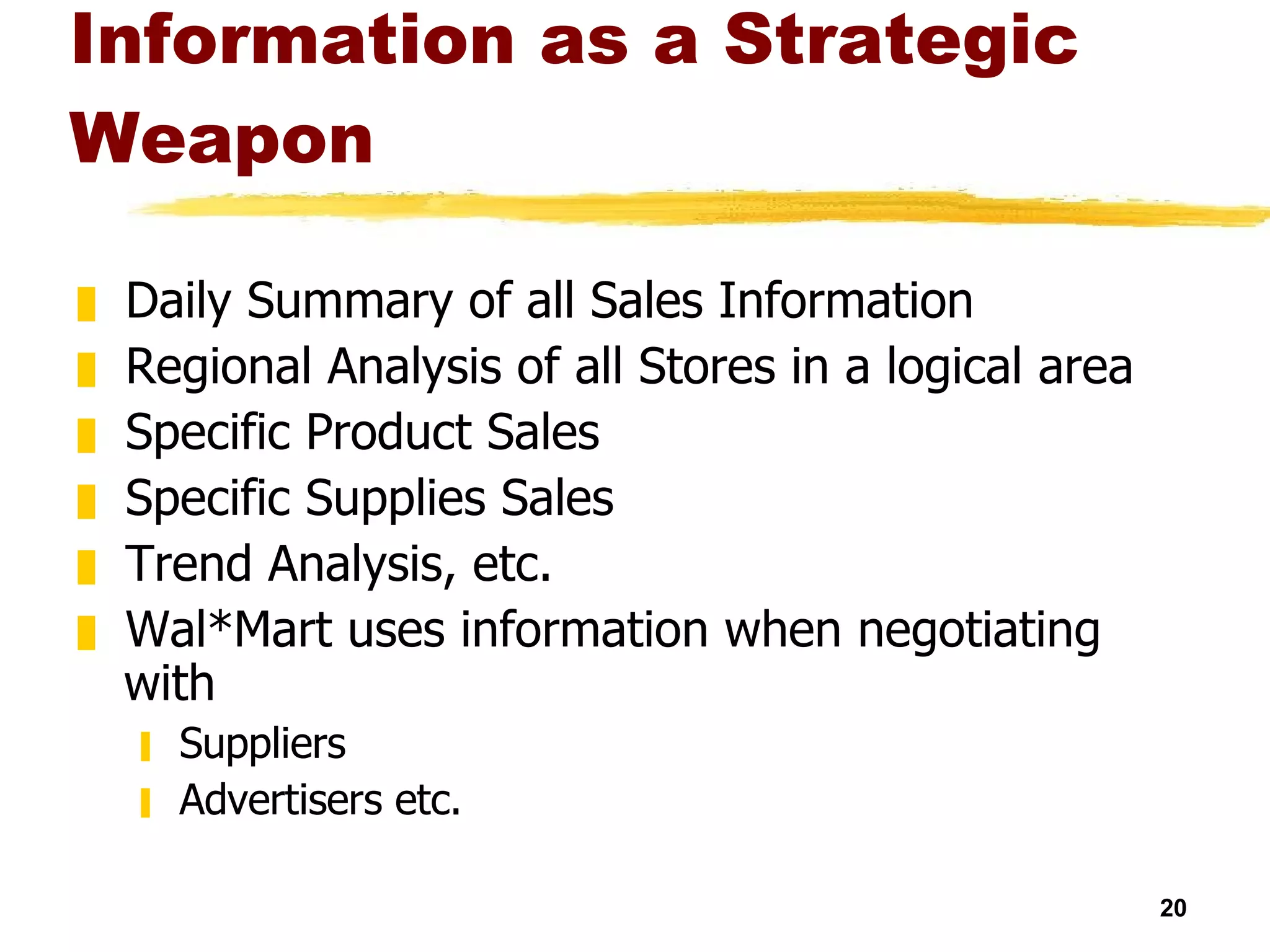
Information as a Strategic Weapon Daily Summary of all Sales Information Regional Analysis of all Stores in a logical area Specific Product Sales Specific Supplies Sales Trend Analysis, etc. Wal*Mart uses information when negotiating with Suppliers Advertisers etc.
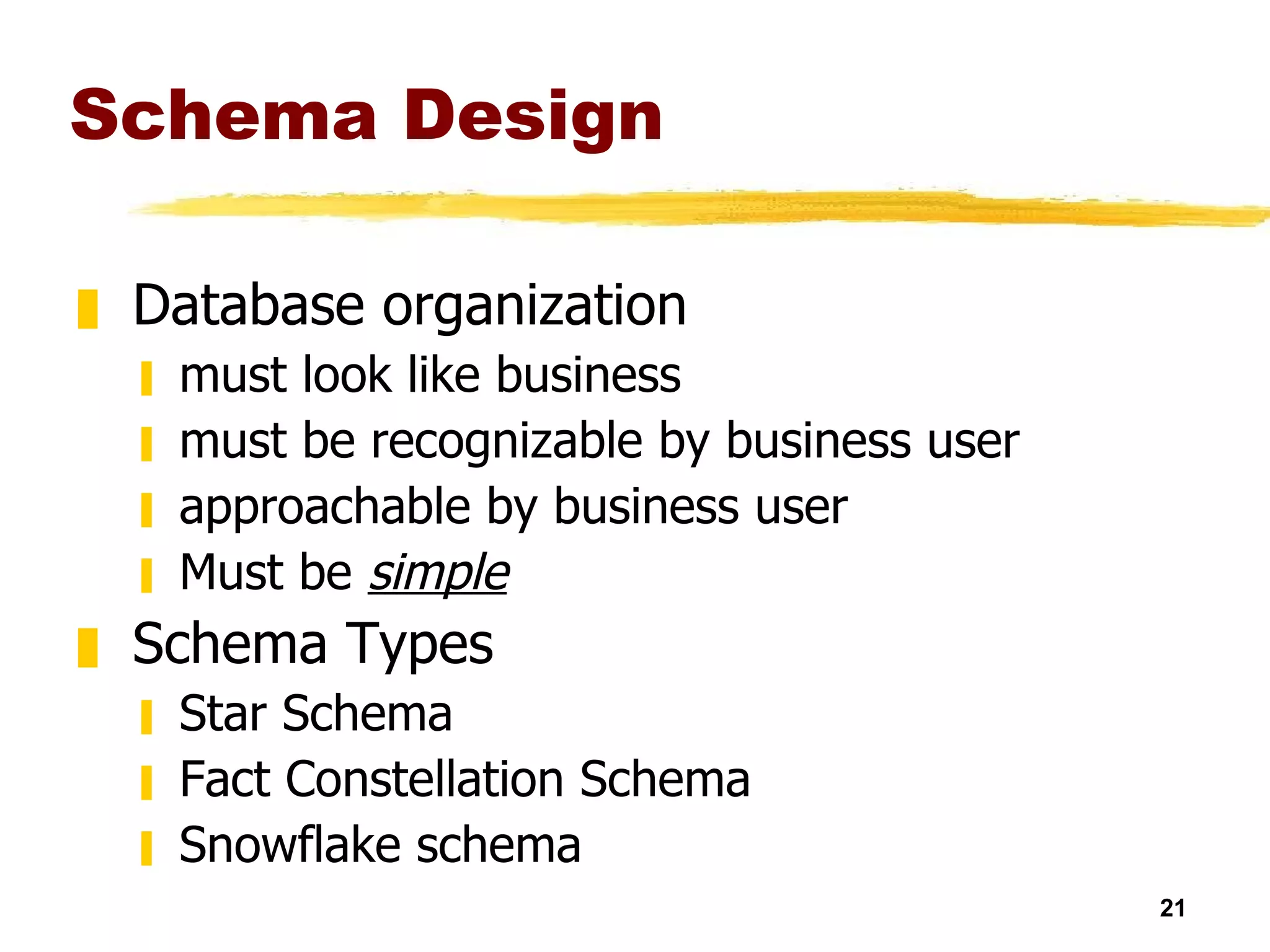
Schema Design Database organization must look like business must be recognizable by business user approachable by business user Must be  simple Schema Types Star Schema Fact Constellation Schema Snowflake schema
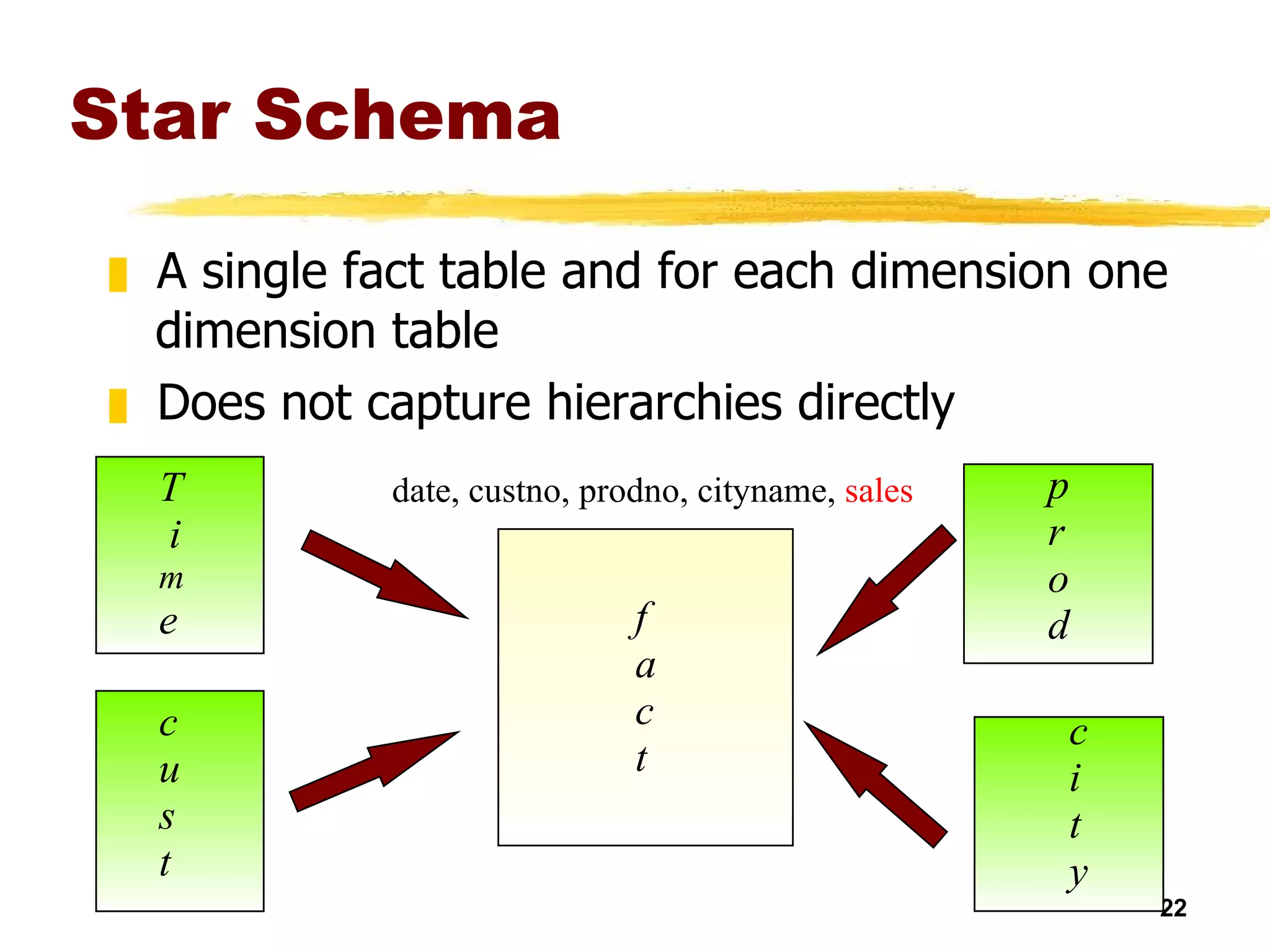
Star Schema A single fact table and for each dimension one dimension table Does not capture hierarchies directly T i m e p r o d c u s t c i t y f a c t date, custno, prodno, cityname,  sales
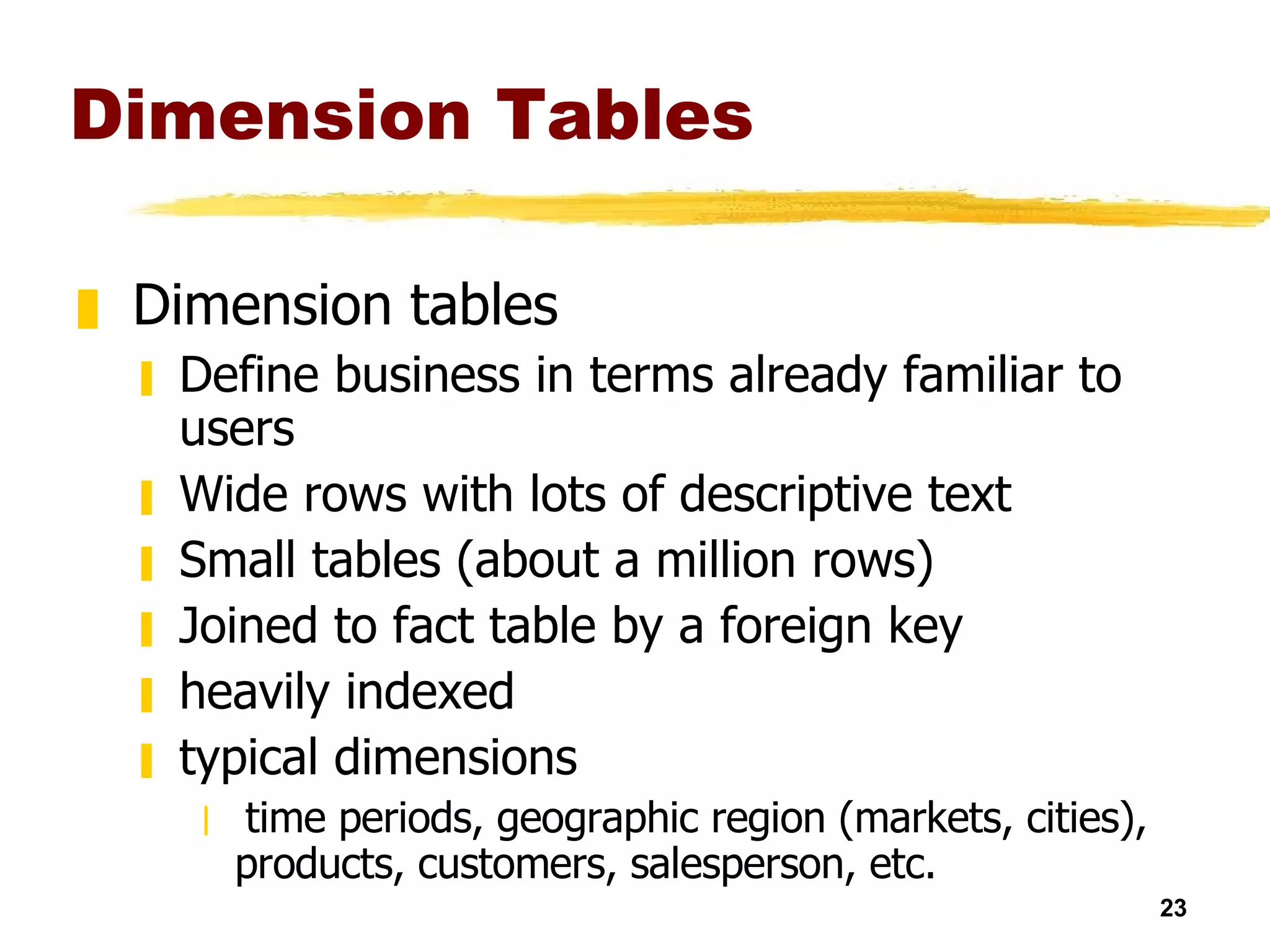
Dimension Tables Dimension tables Define business in terms already familiar to users Wide rows with lots of descriptive text Small tables (about a million rows)  Joined to fact table by a foreign key heavily indexed typical dimensions time periods, geographic region (markets, cities), products, customers, salesperson, etc.
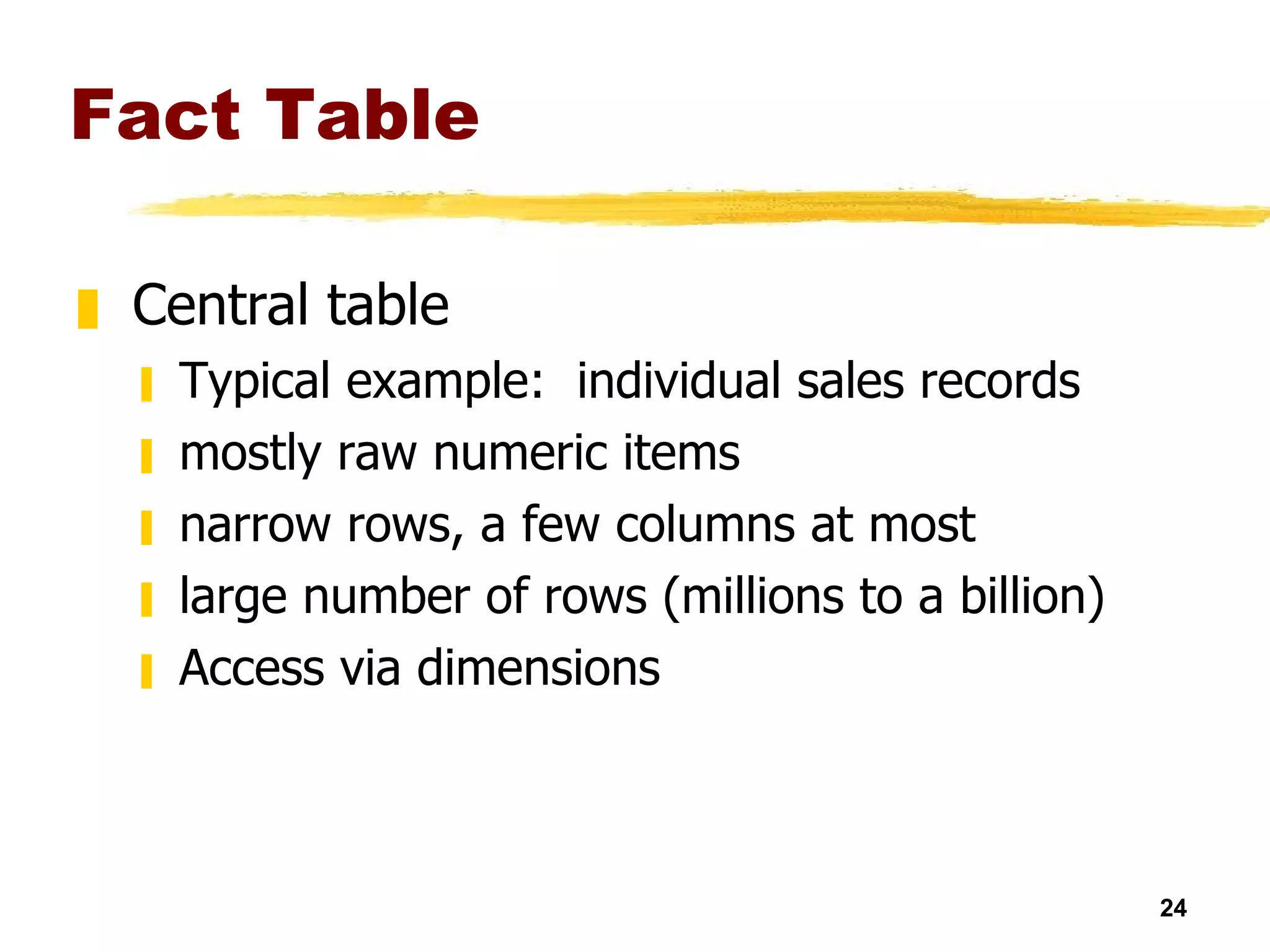
Fact Table Central table Typical example:  individual sales records mostly raw numeric items narrow rows, a few columns at most large number of rows (millions to a billion) Access via dimensions
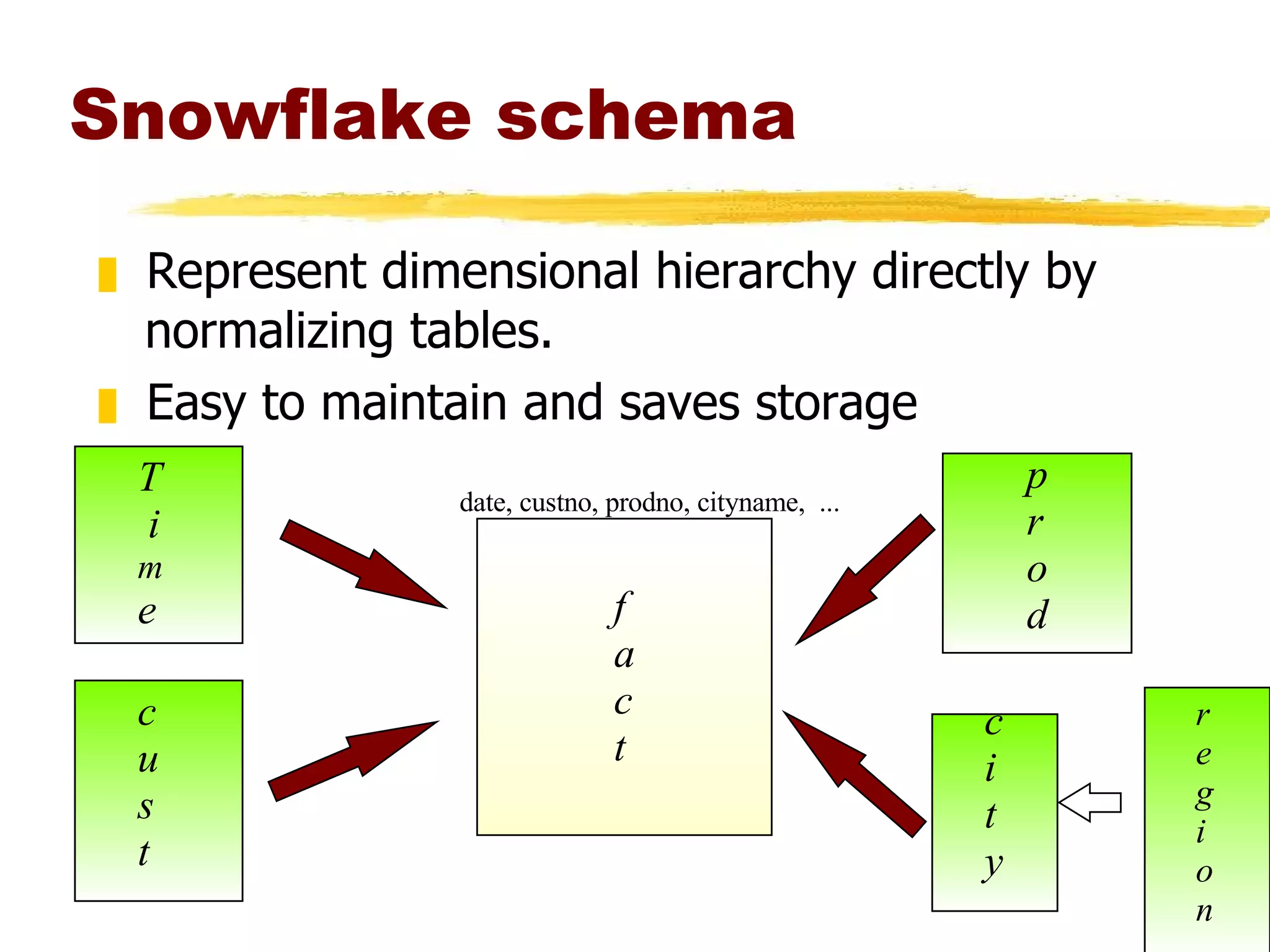
Snowflake schema Represent dimensional hierarchy directly by normalizing tables.  Easy to maintain and saves storage T i m e p r o d c u s t c i t y f a c t date, custno, prodno, cityname,  ... r e g i o n
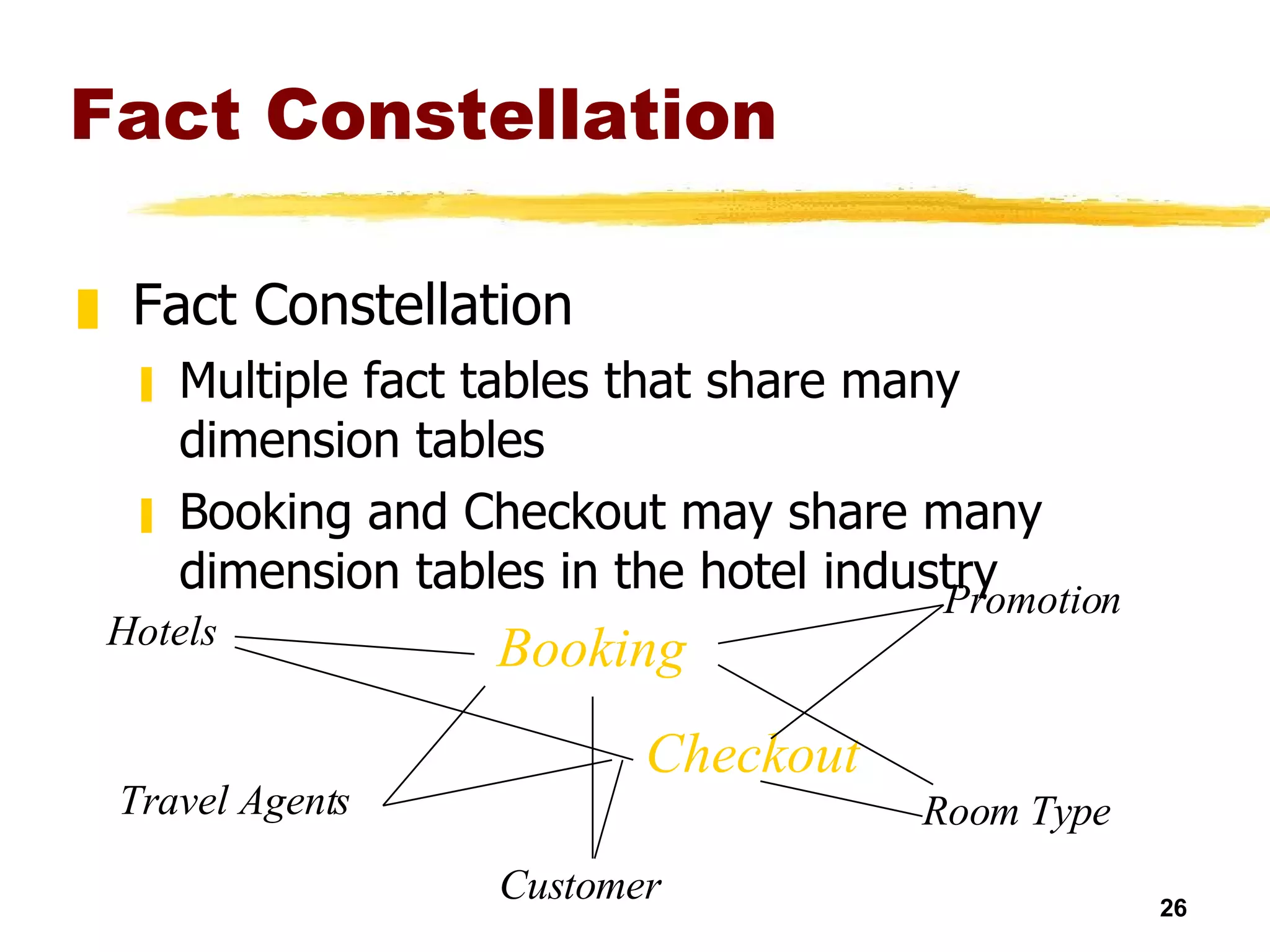
Fact Constellation Fact Constellation Multiple fact tables that share many dimension tables Booking and Checkout may share many dimension tables in the hotel industry Hotels Travel Agents Promotion Room Type Customer Booking Checkout
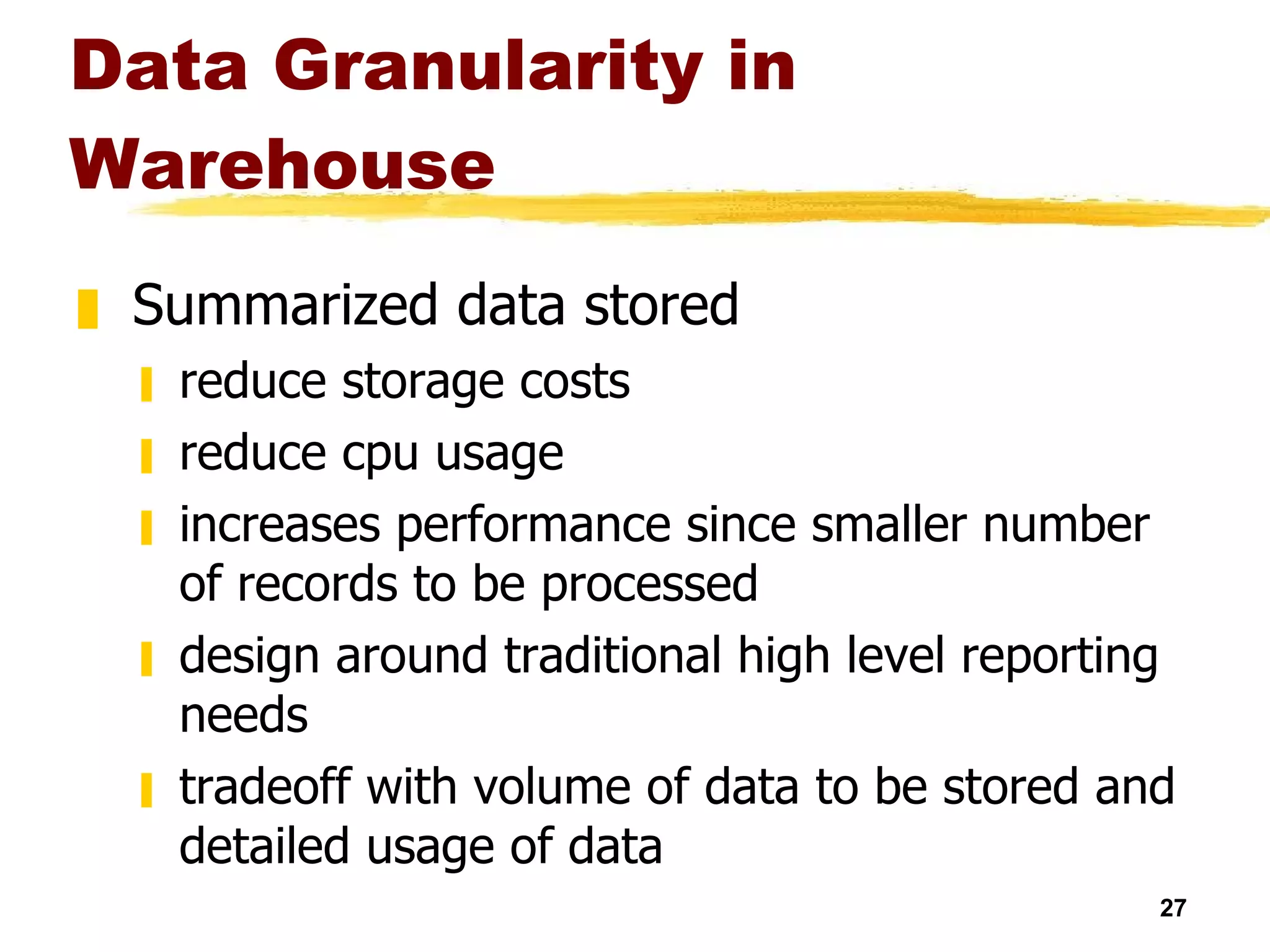
Data Granularity in Warehouse Summarized data stored reduce storage costs reduce cpu usage increases performance since smaller number of records to be processed design around traditional high level reporting needs tradeoff with volume of data to be stored and detailed usage of data
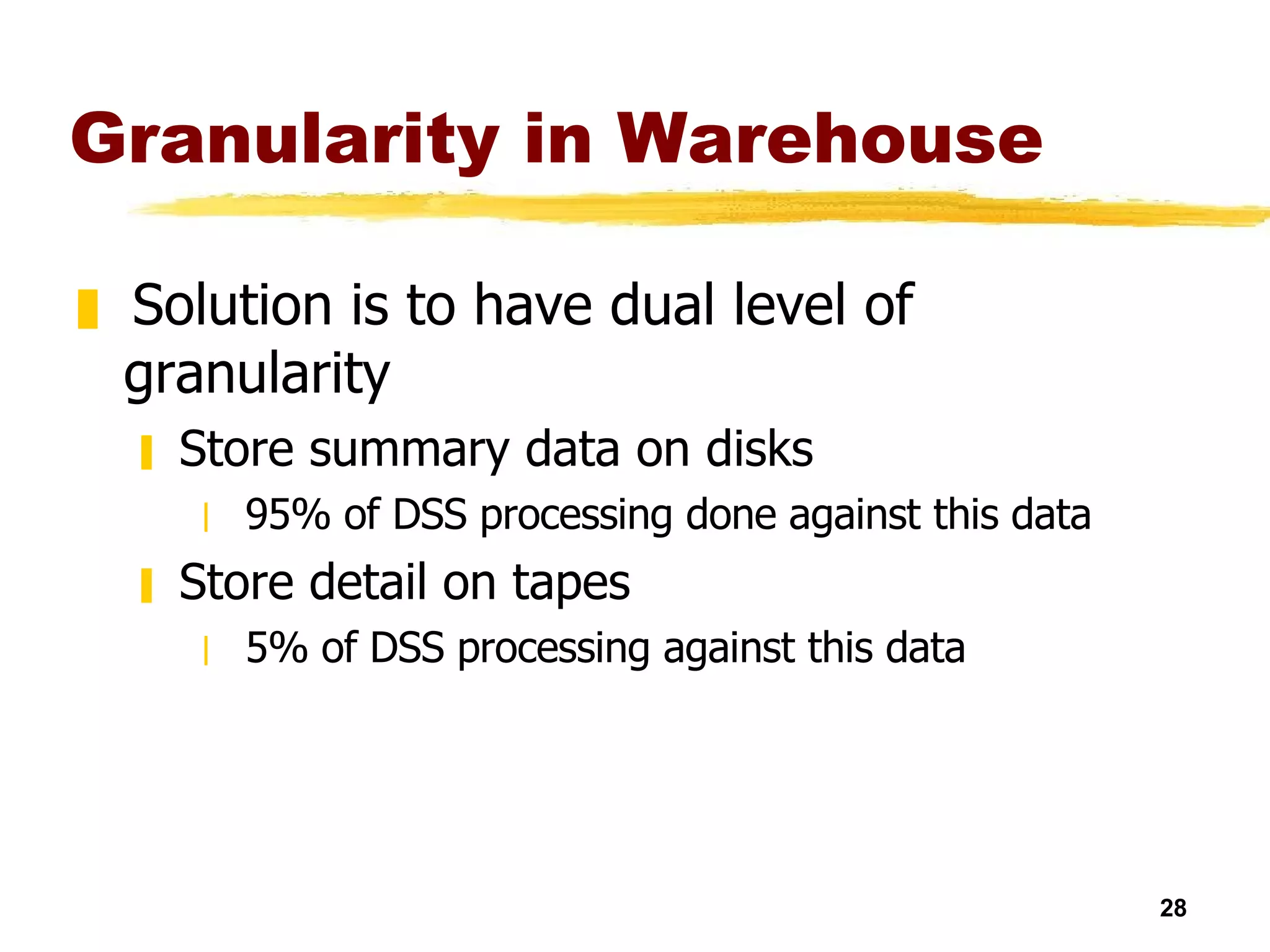
Granularity in Warehouse Solution is to have dual level of granularity Store summary data on disks 95% of DSS processing done against this data Store detail on tapes 5% of DSS processing against this data
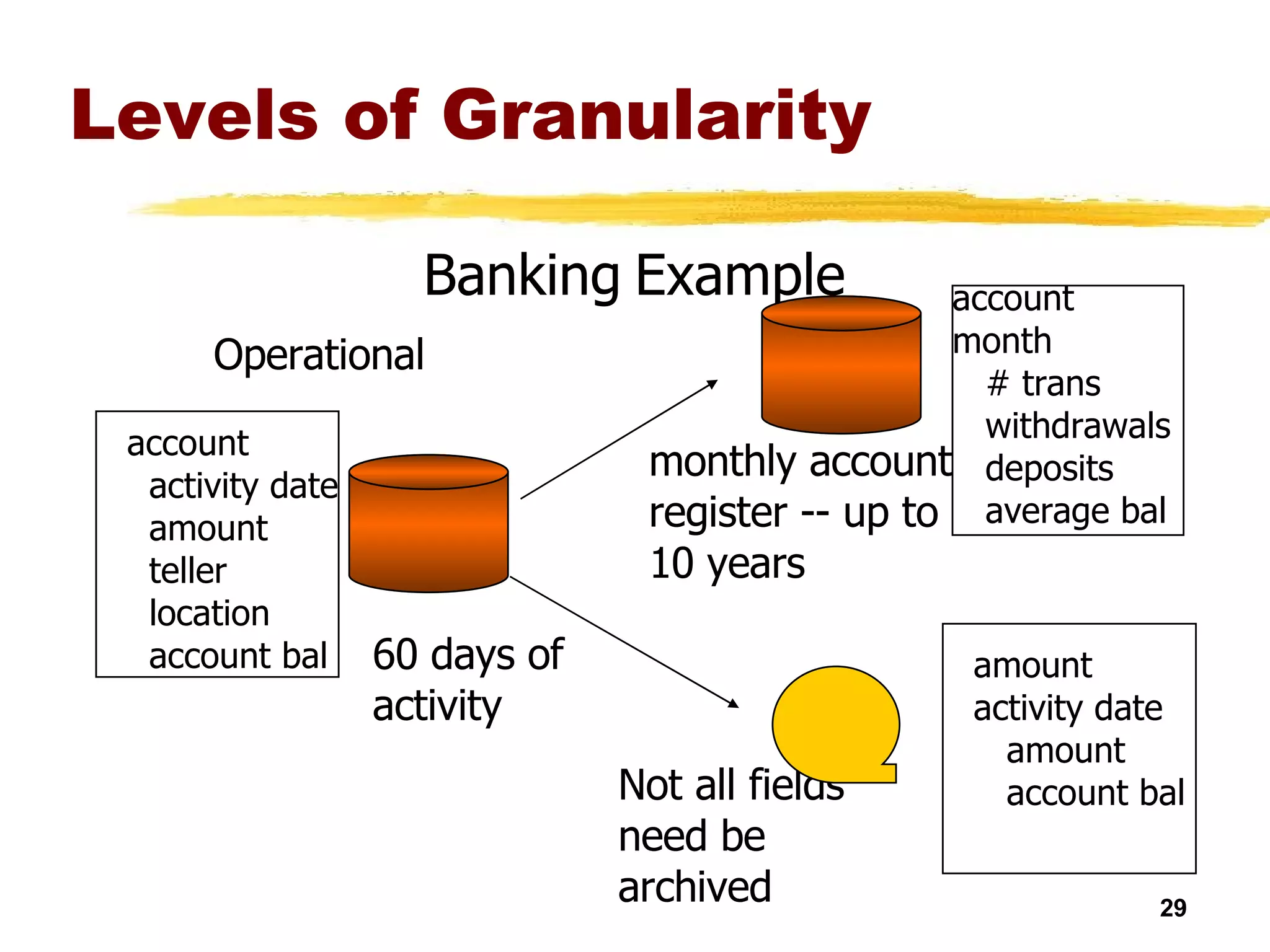
Levels of Granularity Operational 60 days of activity account activity date amount teller location account bal account month # trans withdrawals deposits average bal amount activity date amount account bal monthly account register -- up to  10 years Not all fields need be  archived Banking   Example
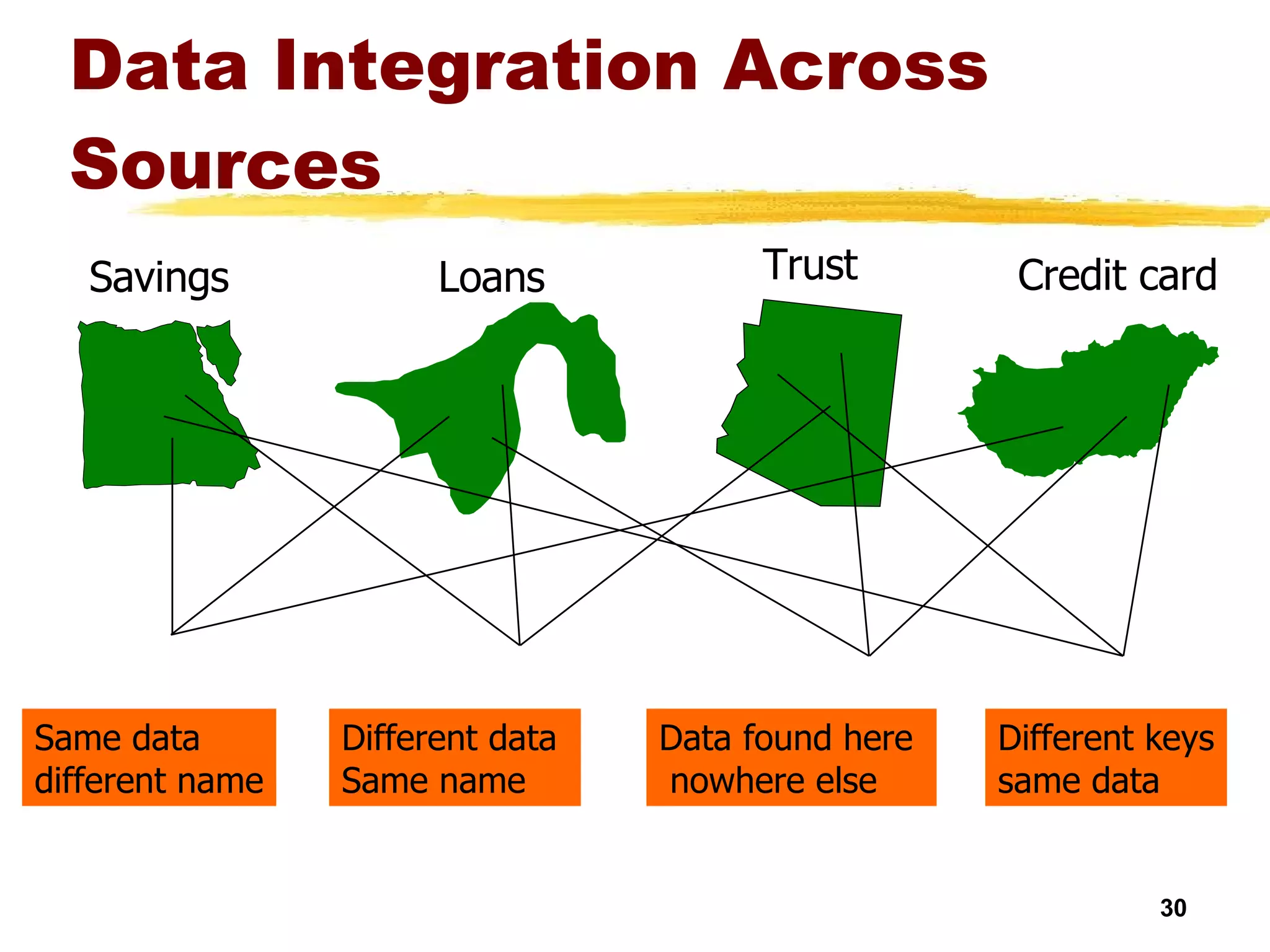
Data Integration Across Sources Trust Credit card Savings Loans Same data  different name Different data  Same name Data found here  nowhere else Different keys same data
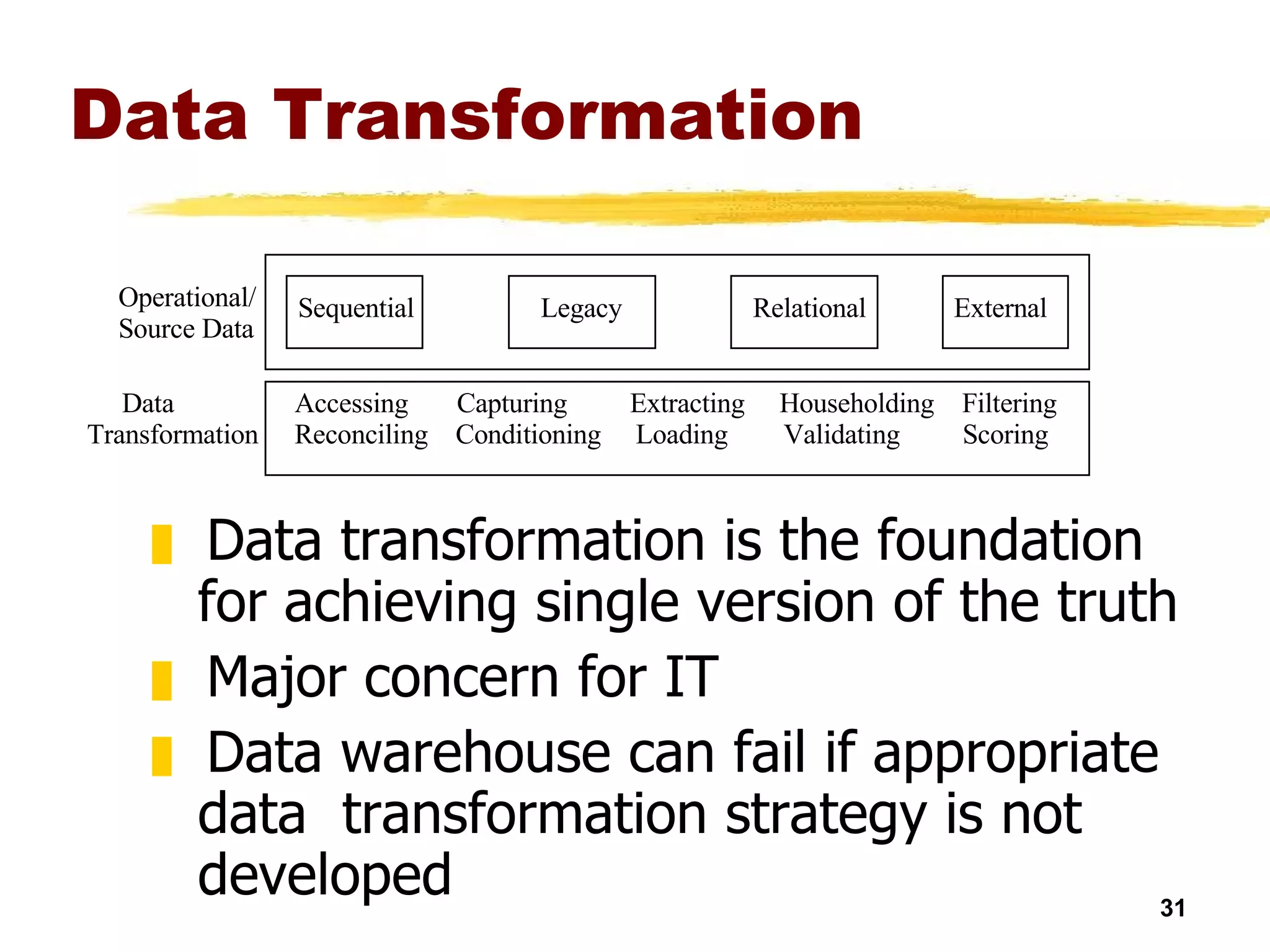
Data Transformation Data transformation is the foundation for achieving single version of the truth Major concern for IT Data warehouse can fail if appropriate data  transformation strategy is not developed Sequential Legacy Relational External Operational/ Source Data Data  Transformation Accessing  Capturing  Extracting  Householding  Filtering Reconciling  Conditioning  Loading  Validating  Scoring
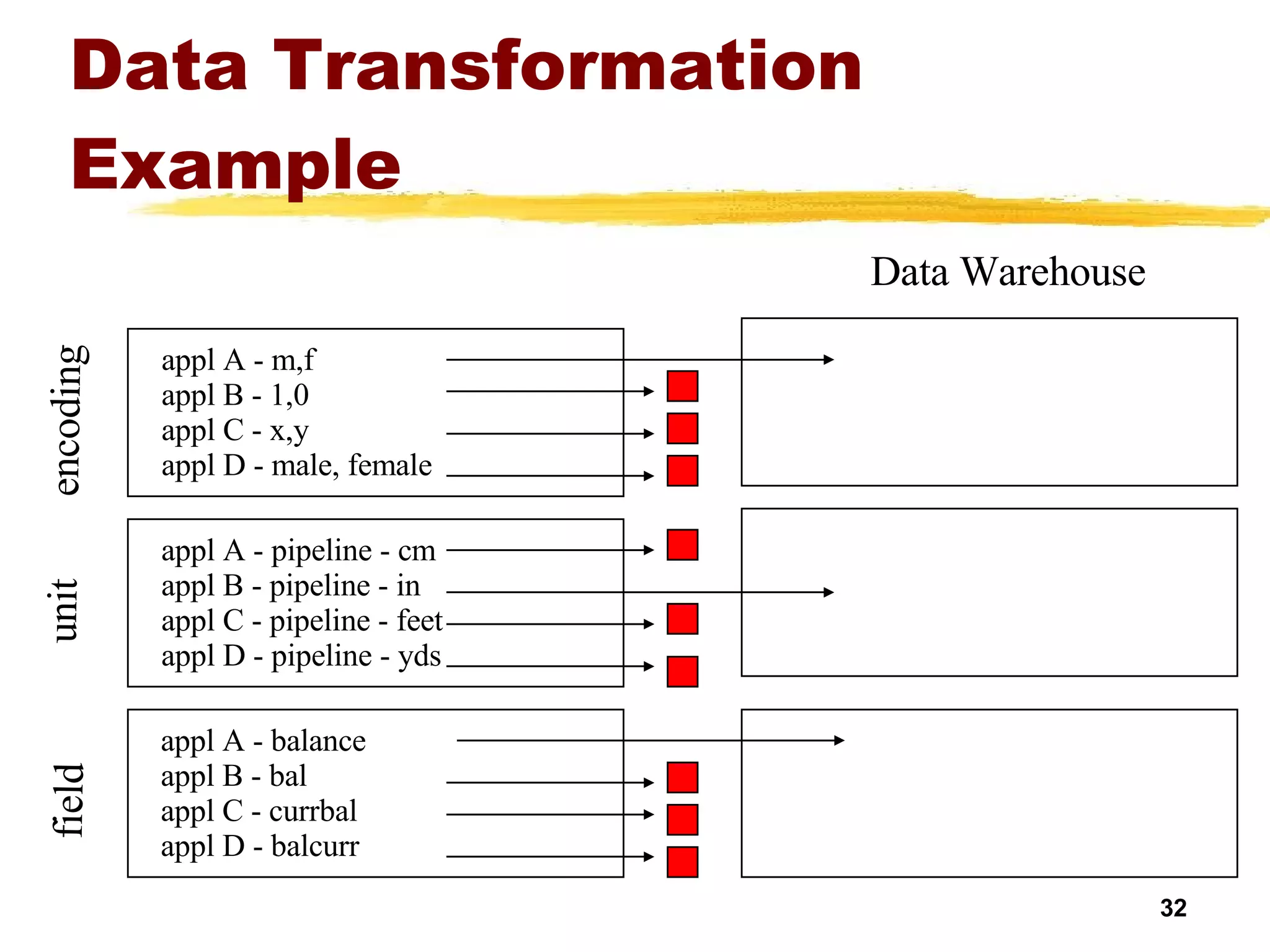
Data Transformation Example encoding unit field appl A - balance appl B - bal appl C - currbal appl D - balcurr appl A - pipeline - cm appl B - pipeline - in appl C - pipeline - feet appl D - pipeline - yds appl A - m,f appl B - 1,0 appl C - x,y appl D - male, female Data Warehouse
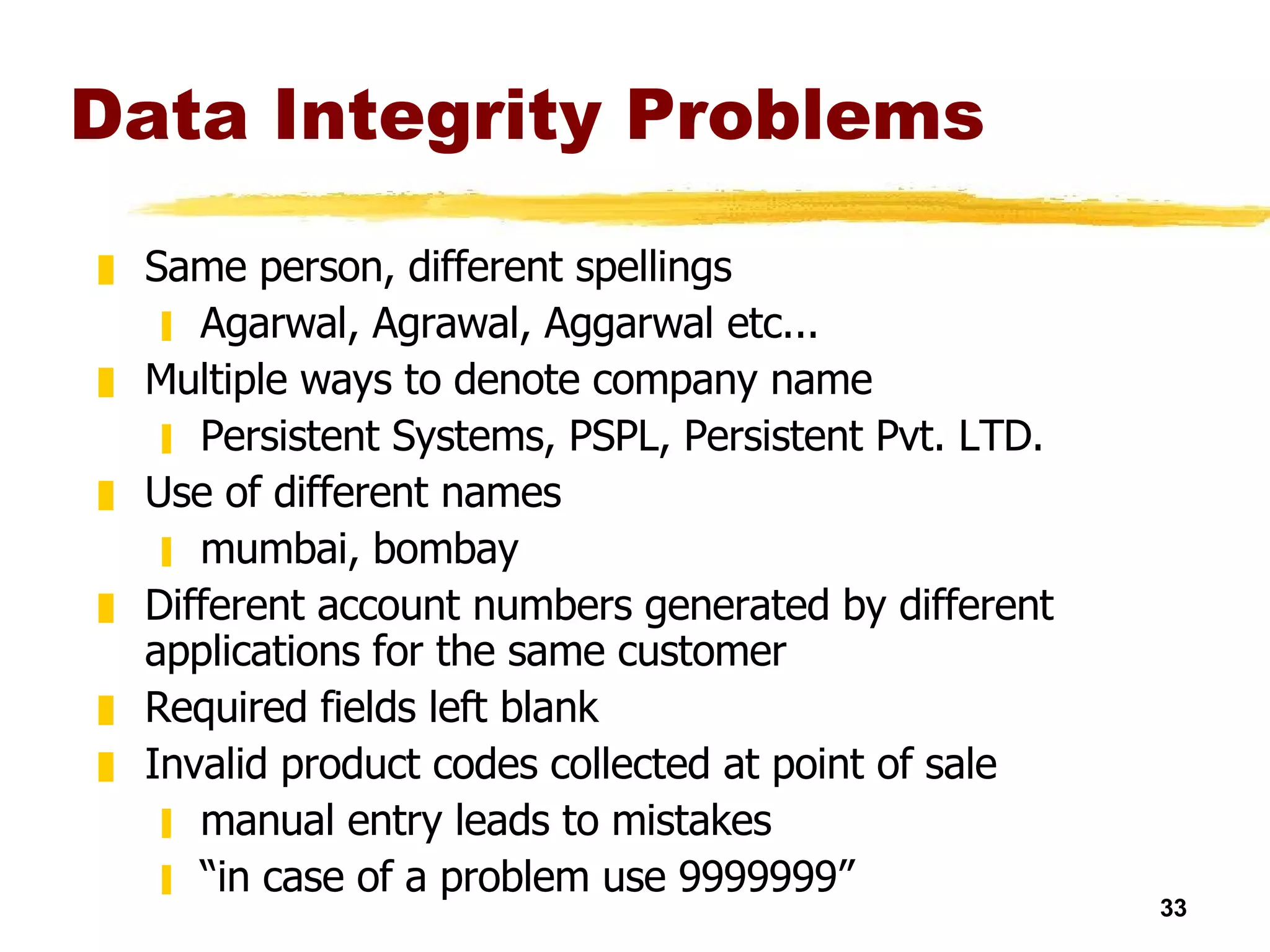
Data Integrity Problems Same person, different spellings Agarwal, Agrawal, Aggarwal etc... Multiple ways to denote company name Persistent Systems, PSPL, Persistent Pvt. LTD. Use of different names mumbai, bombay Different account numbers generated by different applications for the same customer Required fields left blank Invalid product codes collected at point of sale manual entry leads to mistakes “ in case of a problem use 9999999”
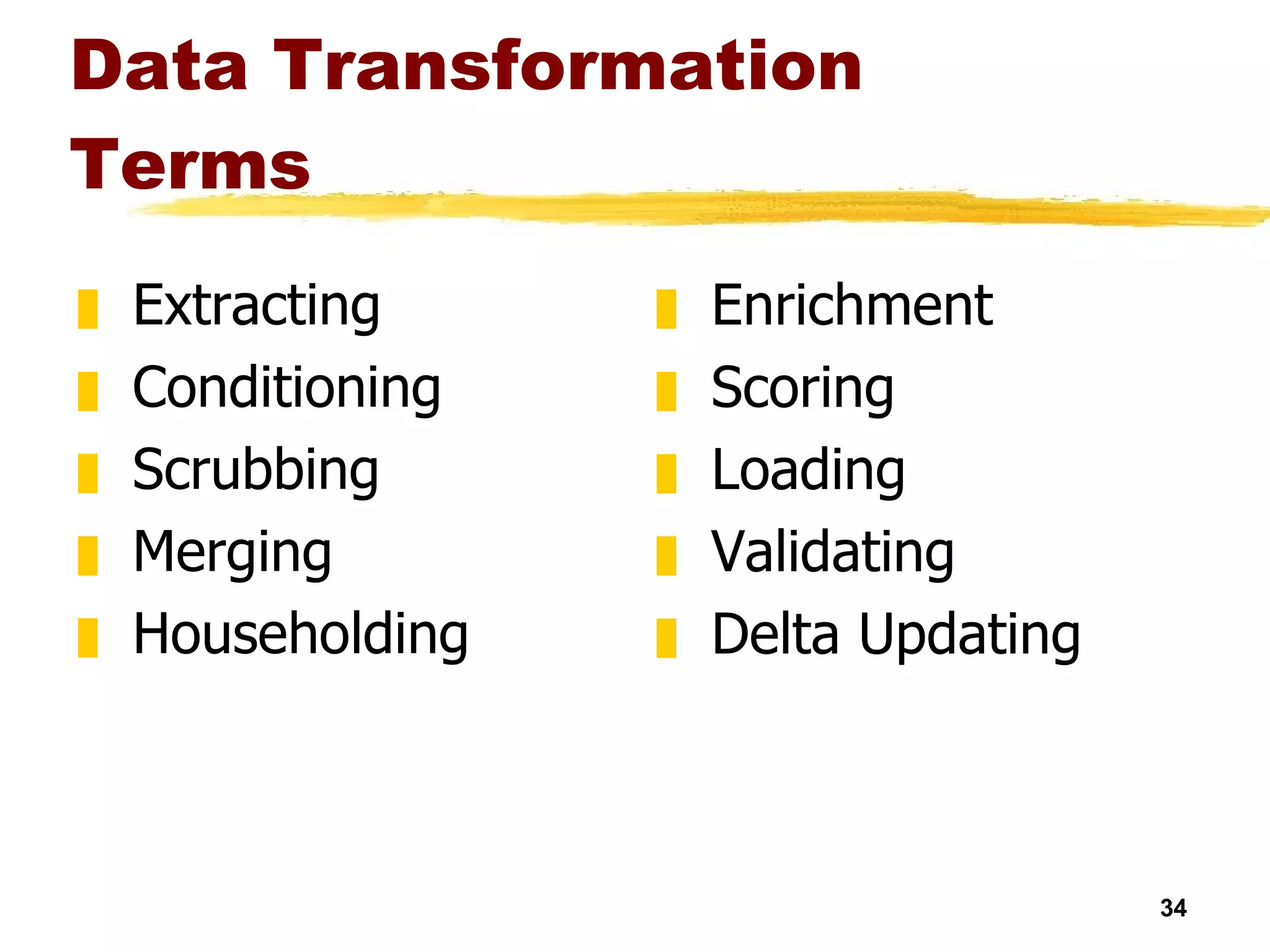
Data Transformation Terms Extracting Conditioning Scrubbing Merging Householding Enrichment Scoring Loading Validating Delta Updating
Data Transformation Terms Householding Identifying all members of a household (living at the same address) Ensures only one mail is  sent to a household Can result in substantial savings: 1 million catalogues at Rs. 50 each costs Rs. 50 million . A 2% savings would save Rs. 1 million
Refresh Propagate updates on source data to the warehouse Issues: when to refresh how to refresh -- incremental refresh techniques
When to Refresh? periodically (e.g., every night, every week) or after significant events on every update: not warranted unless warehouse data require  current data (up to the minute stock quotes) refresh policy set by administrator based on user needs and traffic possibly different policies for different sources
Refresh techniques Incremental techniques detect changes on base tables: replication servers (e.g., Sybase, Oracle, IBM Data Propagator) snapshots (Oracle) transaction shipping (Sybase) compute changes to derived and summary tables maintain transactional correctness for incremental load
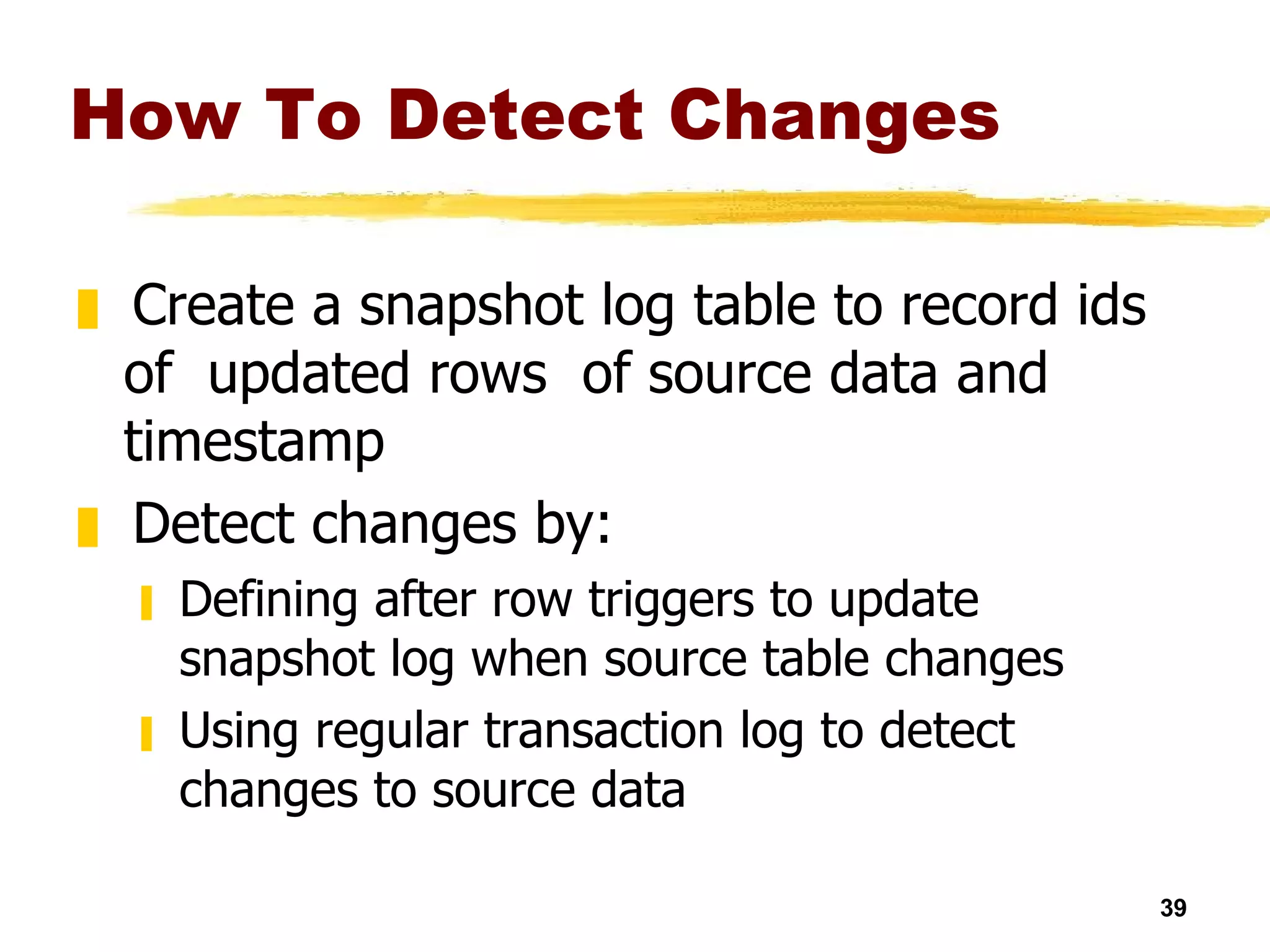
How To Detect Changes Create a snapshot log table to record ids of  updated rows  of source data and timestamp Detect changes by: Defining after row triggers to update snapshot log when source table changes Using regular transaction log to detect changes to source data
Querying Data Warehouses SQL Extensions Multidimensional modeling of data OLAP  More on OLAP later …
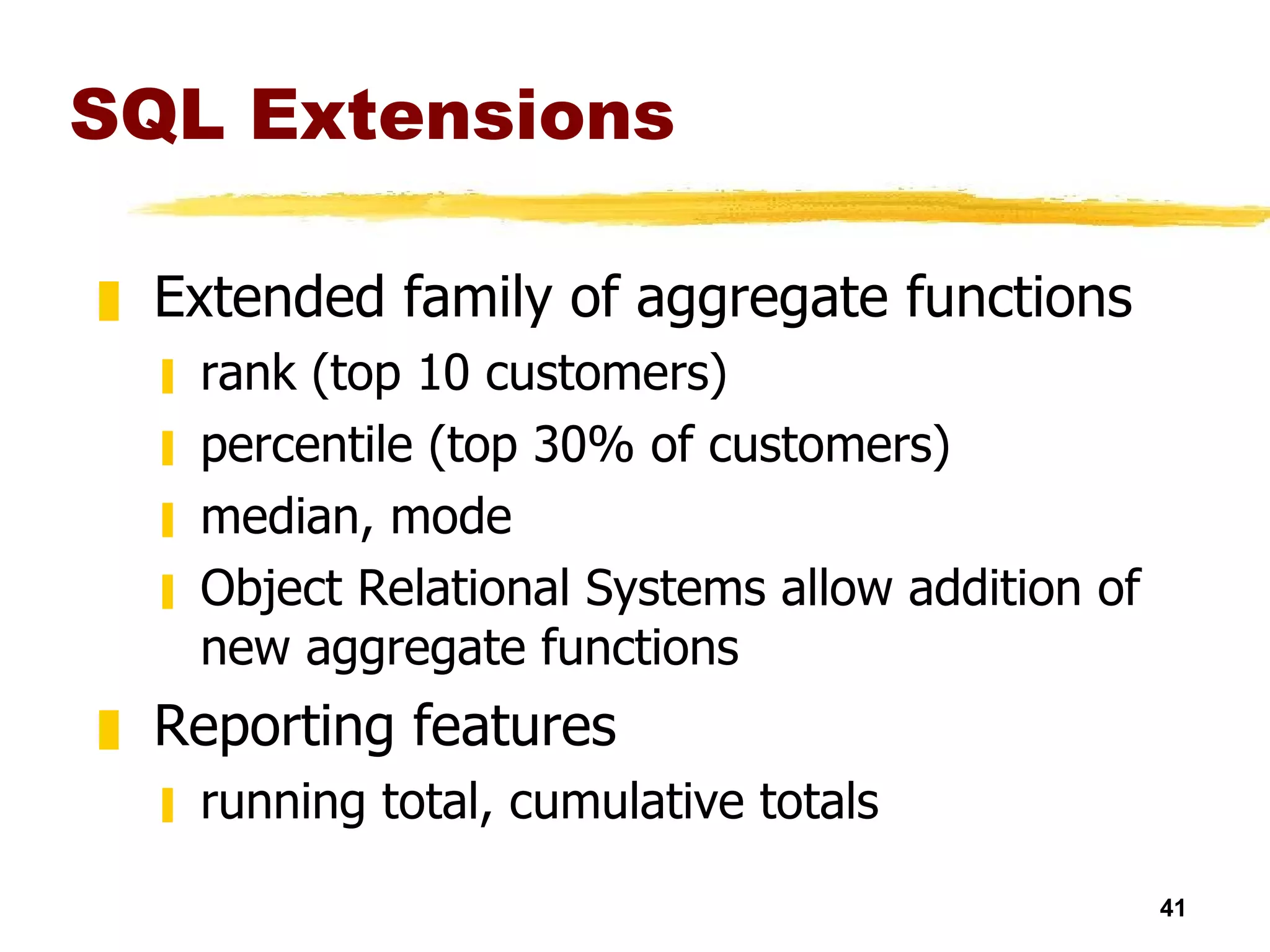
SQL Extensions Extended family of aggregate functions rank (top 10 customers) percentile (top 30% of customers) median, mode Object Relational Systems allow addition of new aggregate functions Reporting features running total, cumulative totals
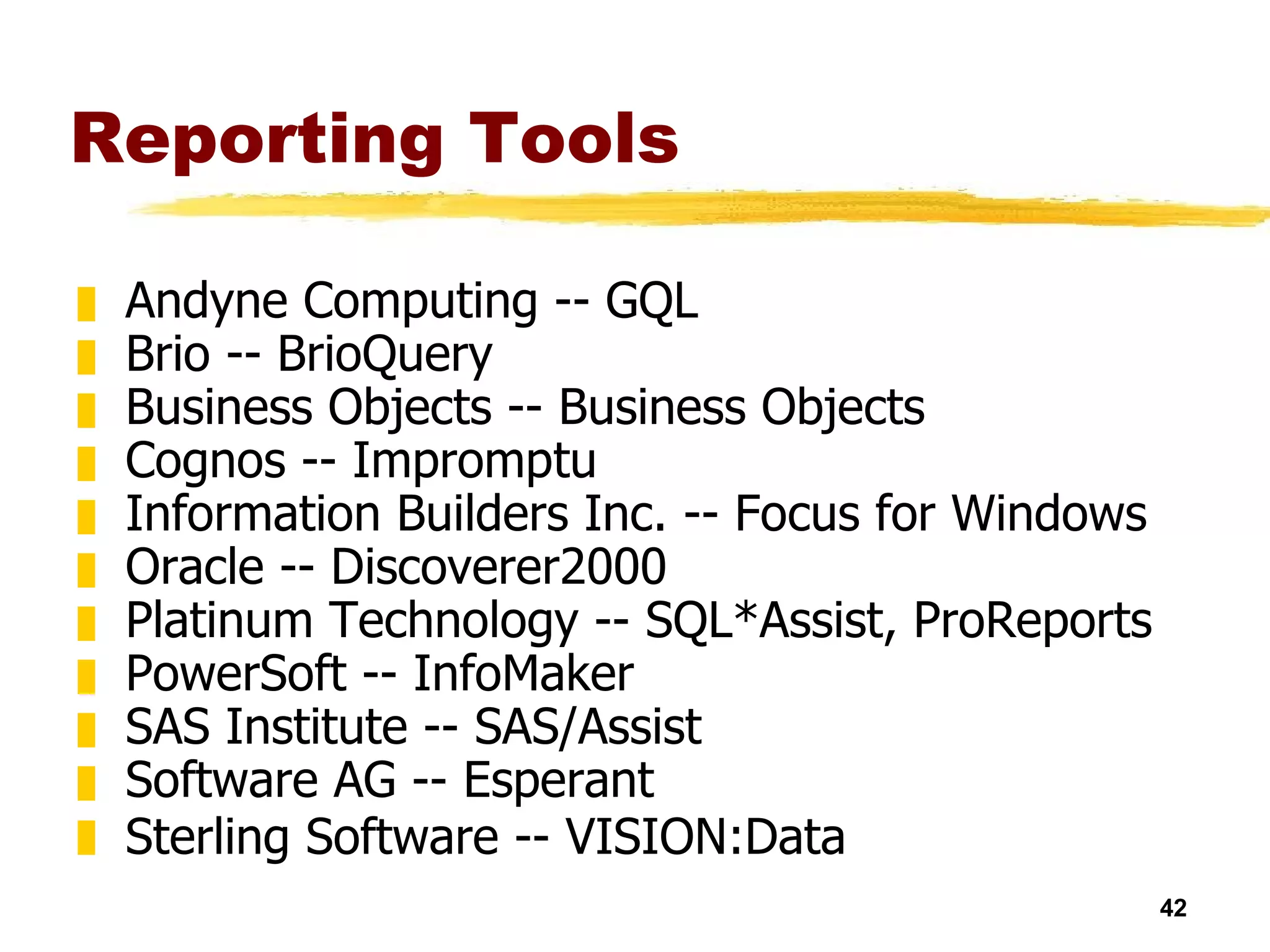
Reporting Tools Andyne Computing -- GQL  Brio -- BrioQuery  Business Objects -- Business Objects  Cognos -- Impromptu  Information Builders Inc. -- Focus for Windows  Oracle -- Discoverer2000  Platinum Technology -- SQL*Assist, ProReports  PowerSoft -- InfoMaker  SAS Institute -- SAS/Assist  Software AG -- Esperant  Sterling Software -- VISION:Data
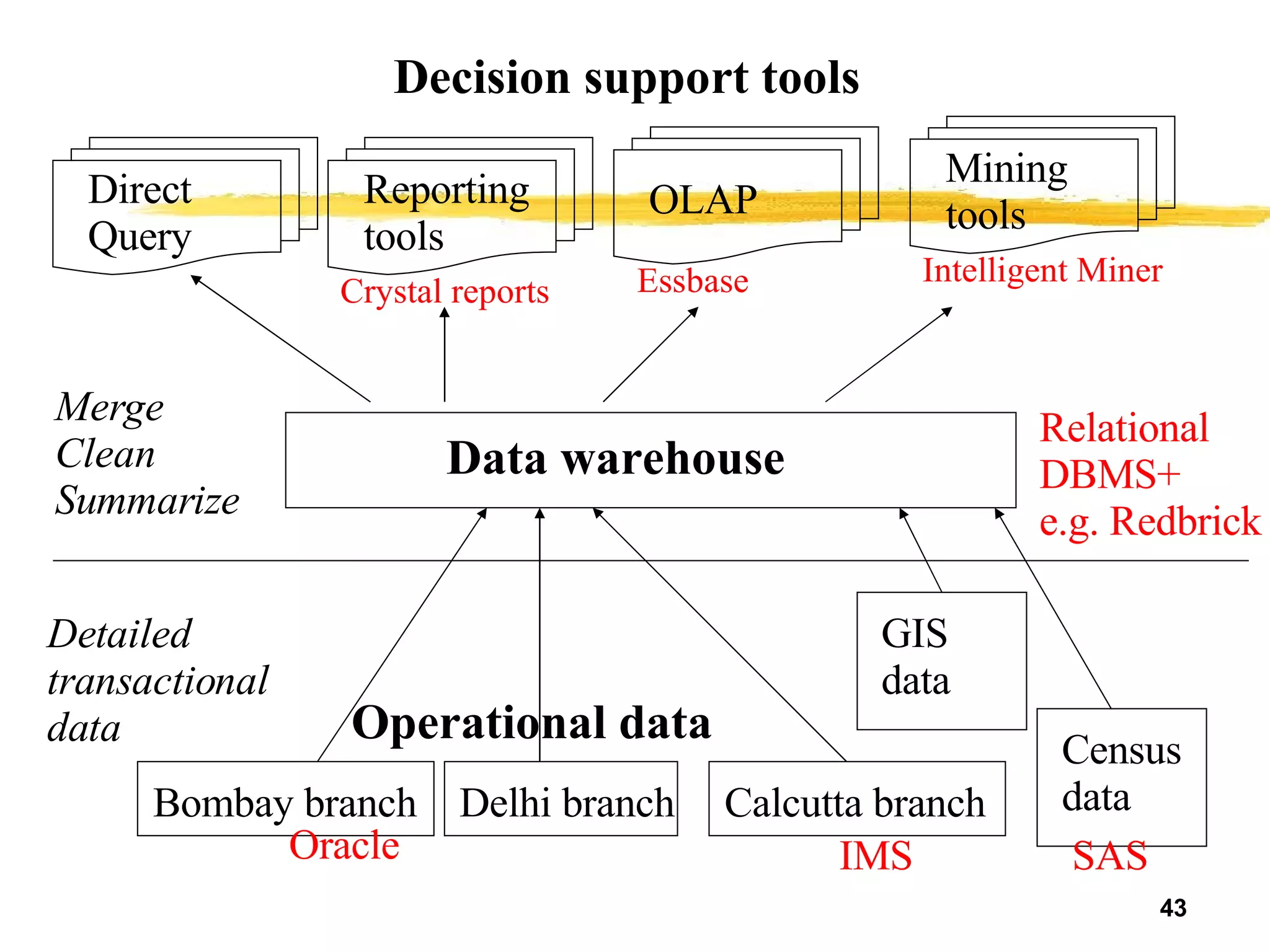
Operational data Detailed  transactional data Data warehouse Merge Clean Summarize Direct Query Reporting tools Mining tools Decision support tools Oracle SAS Relational DBMS+ e.g. Redbrick IMS Crystal reports Essbase Intelligent Miner Bombay branch Delhi branch Calcutta branch Census data OLAP GIS data
Deploying Data Warehouses What business information keeps you in business today? What business information can put you out of business tomorrow? What business information should be a mouse click away? What business conditions are the driving the need for business information?
Cultural Considerations Not just a technology project New way of using information to support daily activities and decision making Care must be taken to prepare organization for change Must have organizational backing and support
User Training Users must have a higher level of IT proficiency than for operational systems Training to help users analyze data in the warehouse effectively
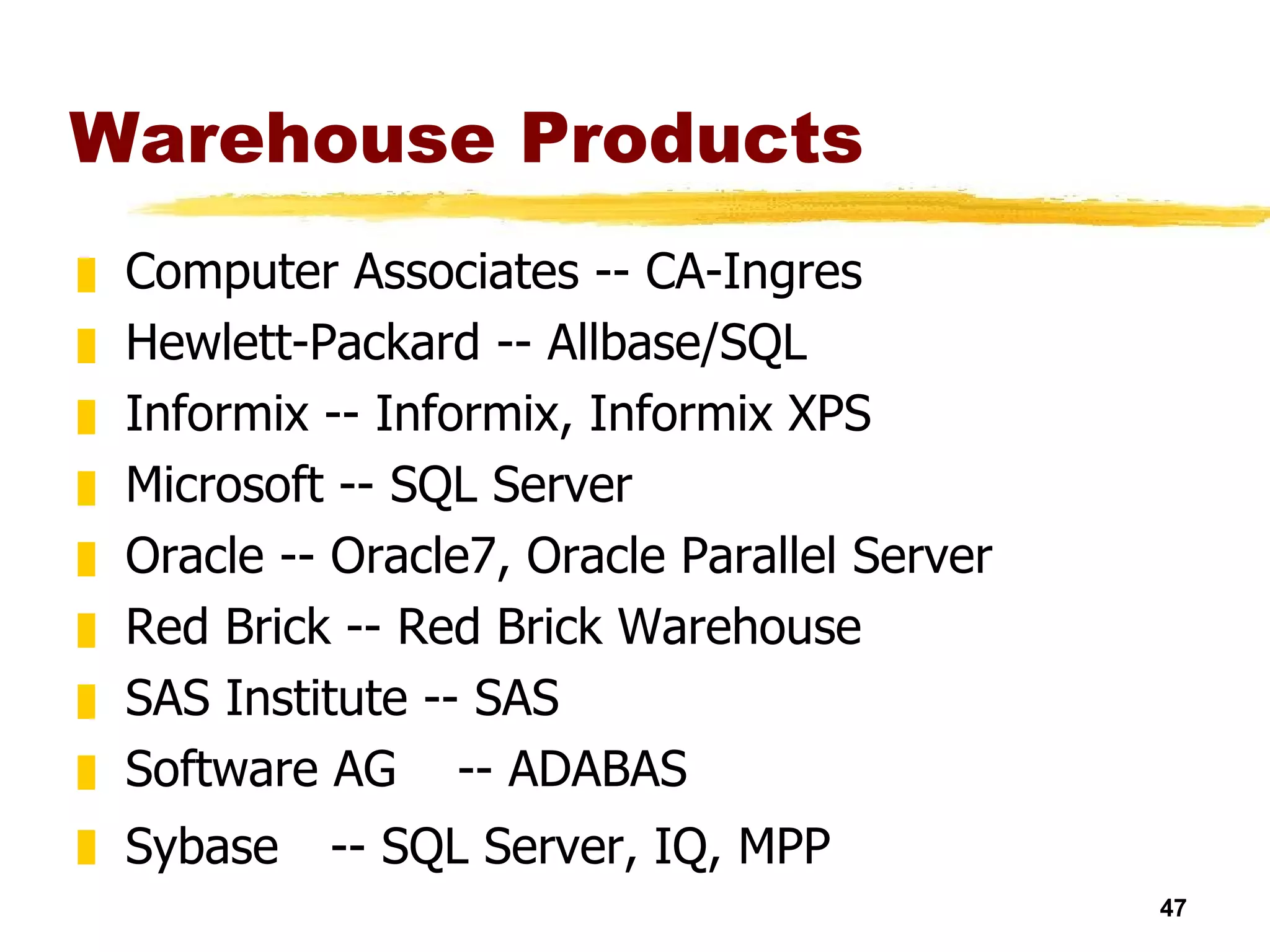
Warehouse Products Computer Associates -- CA-Ingres  Hewlett-Packard -- Allbase/SQL  Informix -- Informix, Informix XPS Microsoft -- SQL Server  Oracle -- Oracle7, Oracle Parallel Server Red Brick -- Red Brick Warehouse  SAS Institute -- SAS  Software AG  -- ADABAS  Sybase  -- SQL Server, IQ, MPP
Part 2: OLAP
Nature of OLAP Analysis Aggregation -- (total sales, percent-to-total) Comparison -- Budget vs. Expenses Ranking -- Top 10, quartile analysis Access to detailed and aggregate data Complex criteria specification Visualization Need interactive response to aggregate queries
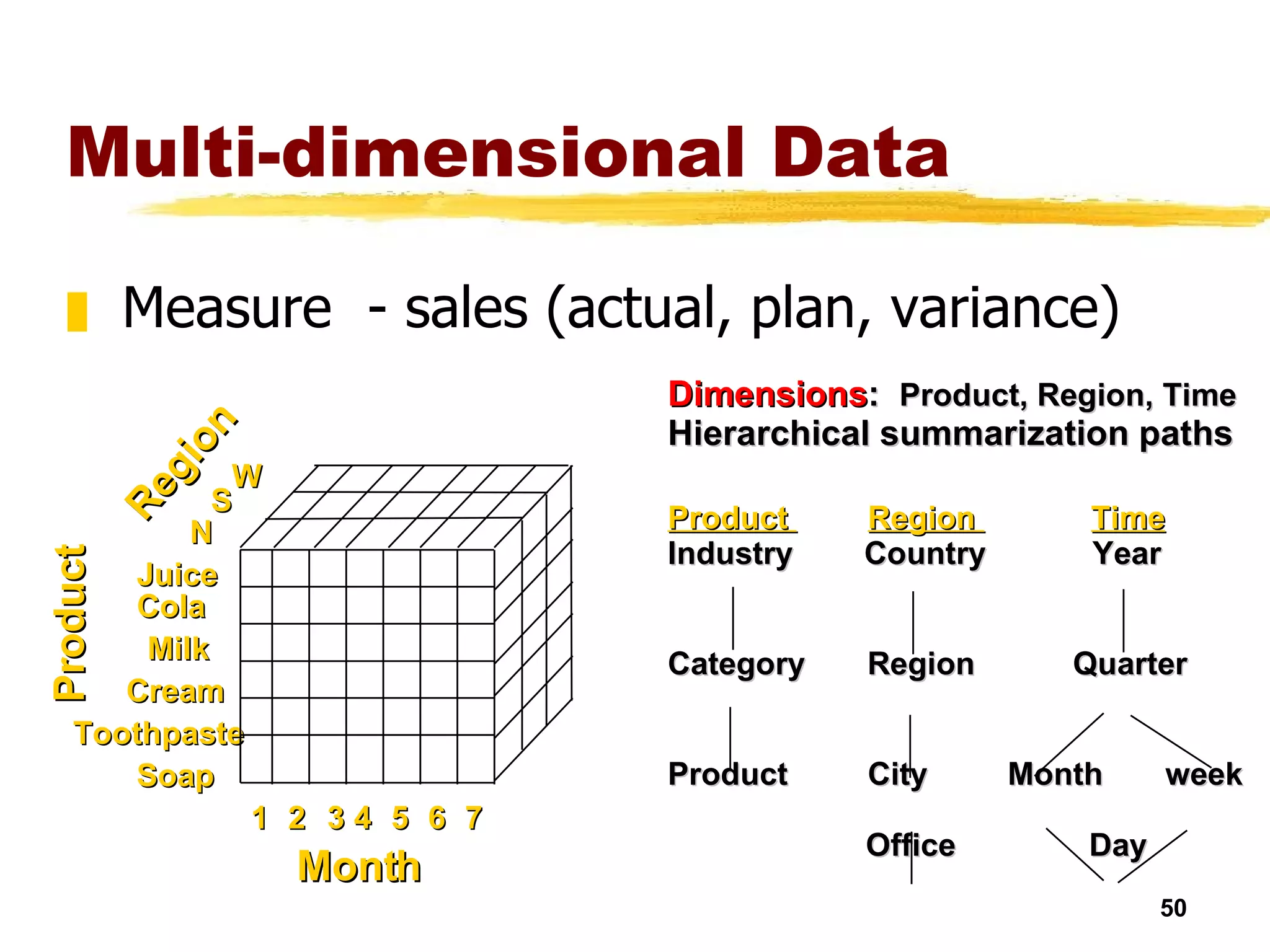
Multi-dimensional Data Measure  - sales (actual, plan, variance) Dimensions :  Product, Region, Time Hierarchical summarization paths Product  Region  Time Industry  Country  Year Category  Region  Quarter  Product  City  Month  week   Office  Day Month 1  2 3  4  7 6  5  Product Toothpaste  Juice Cola Milk  Cream Soap  Region W S  N
Conceptual Model for OLAP Numeric measures to be analyzed e.g.  Sales (Rs), sales (volume), budget, revenue, inventory Dimensions other attributes of data, define the space e.g., store, product, date-of-sale hierarchies  on dimensions  e.g. branch -> city -> state
Operations Rollup: summarize data e.g., given sales data, summarize sales for last year by product category and region Drill down:  get more details e.g., given summarized sales as above, find breakup of sales by city within each region, or within the Andhra region
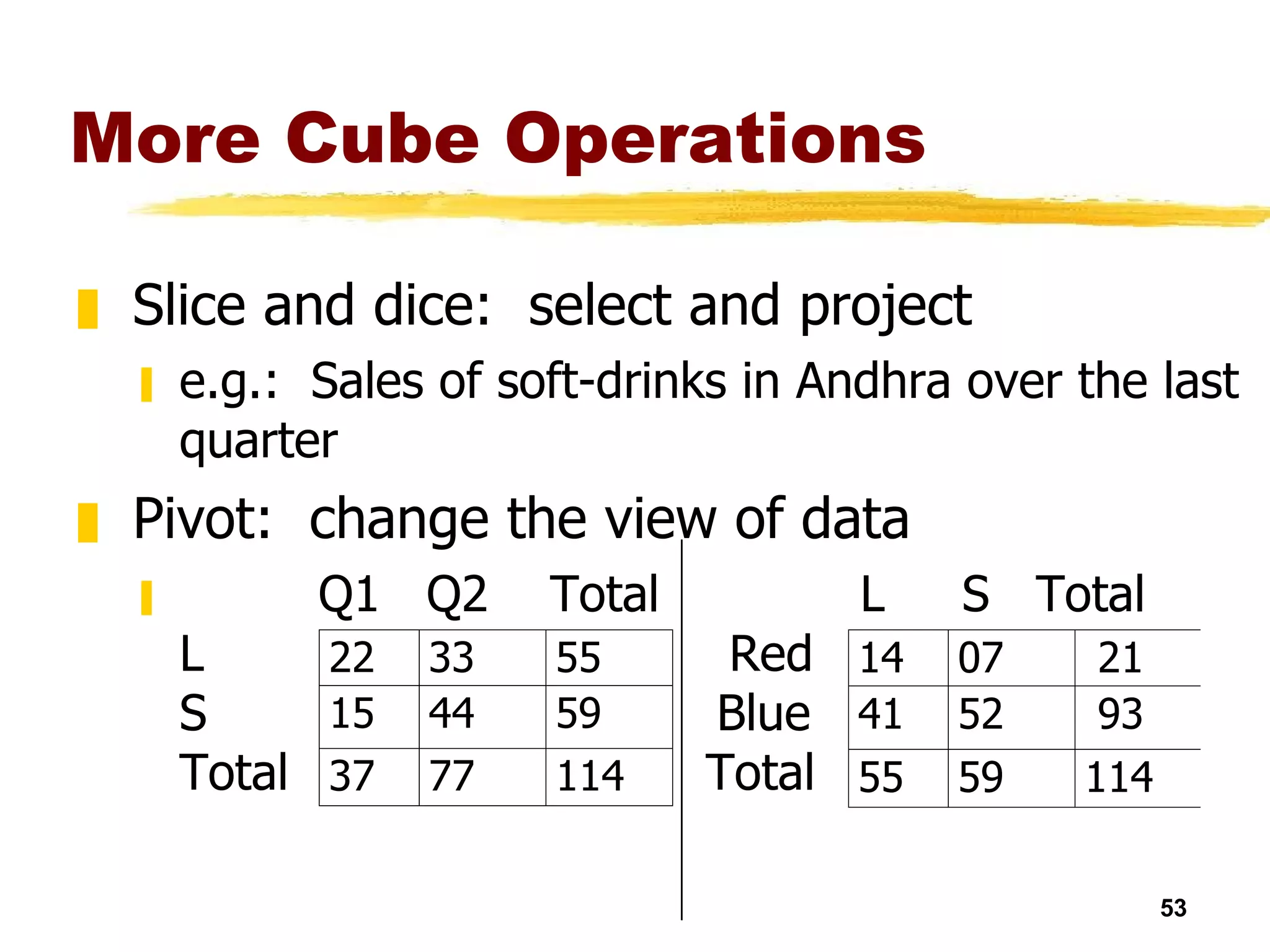
More Cube Operations Slice and dice:  select and project  e.g.:  Sales of soft-drinks in Andhra over the last quarter Pivot:  change the view of data Q1  Q2  Total  L  S  Total L  Red S  Blue Total  Total
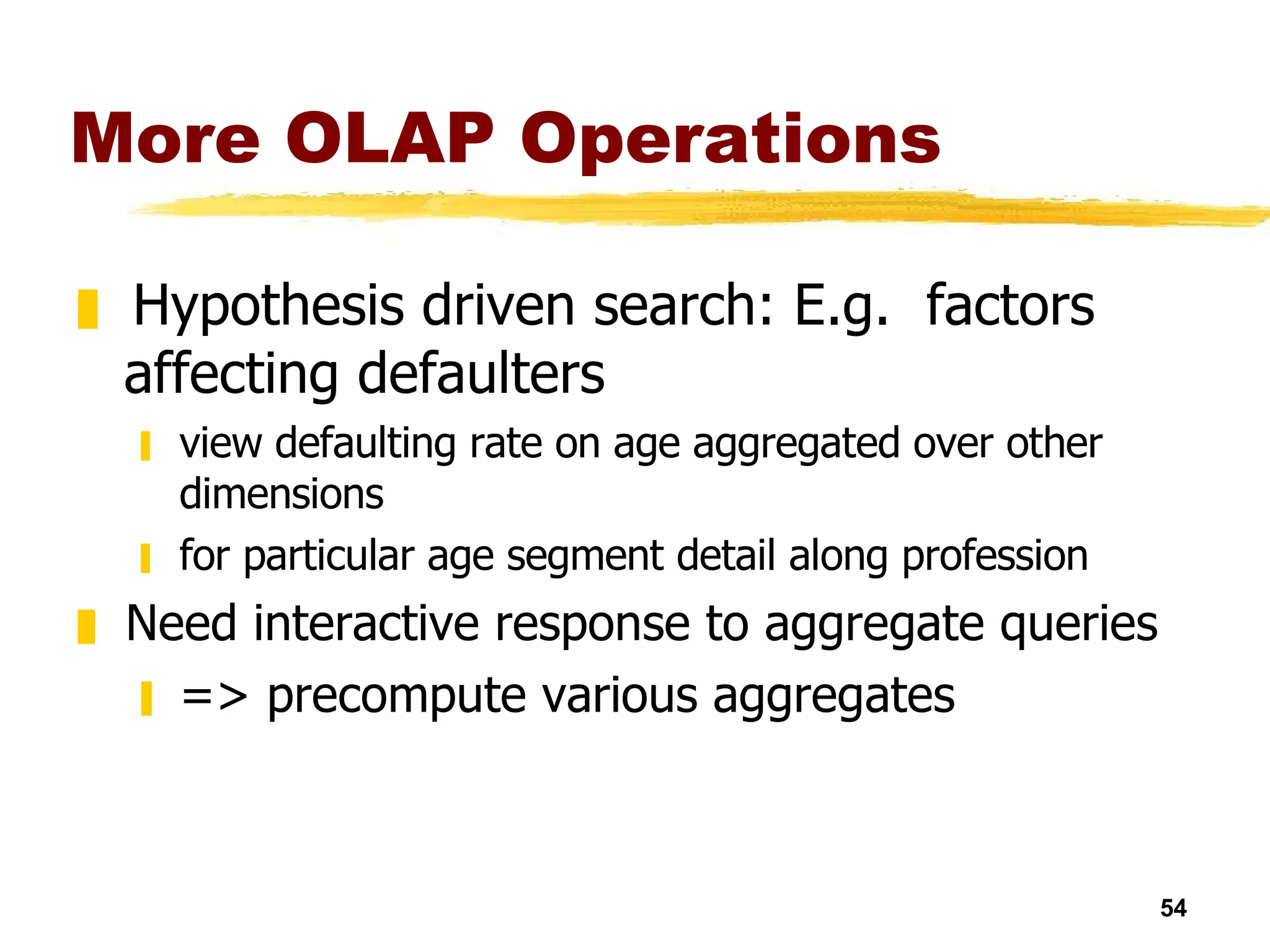
More OLAP Operations Hypothesis driven search: E.g.  factors affecting defaulters view defaulting rate on age aggregated over other dimensions for particular age segment detail along profession Need interactive response to aggregate queries => precompute various aggregates
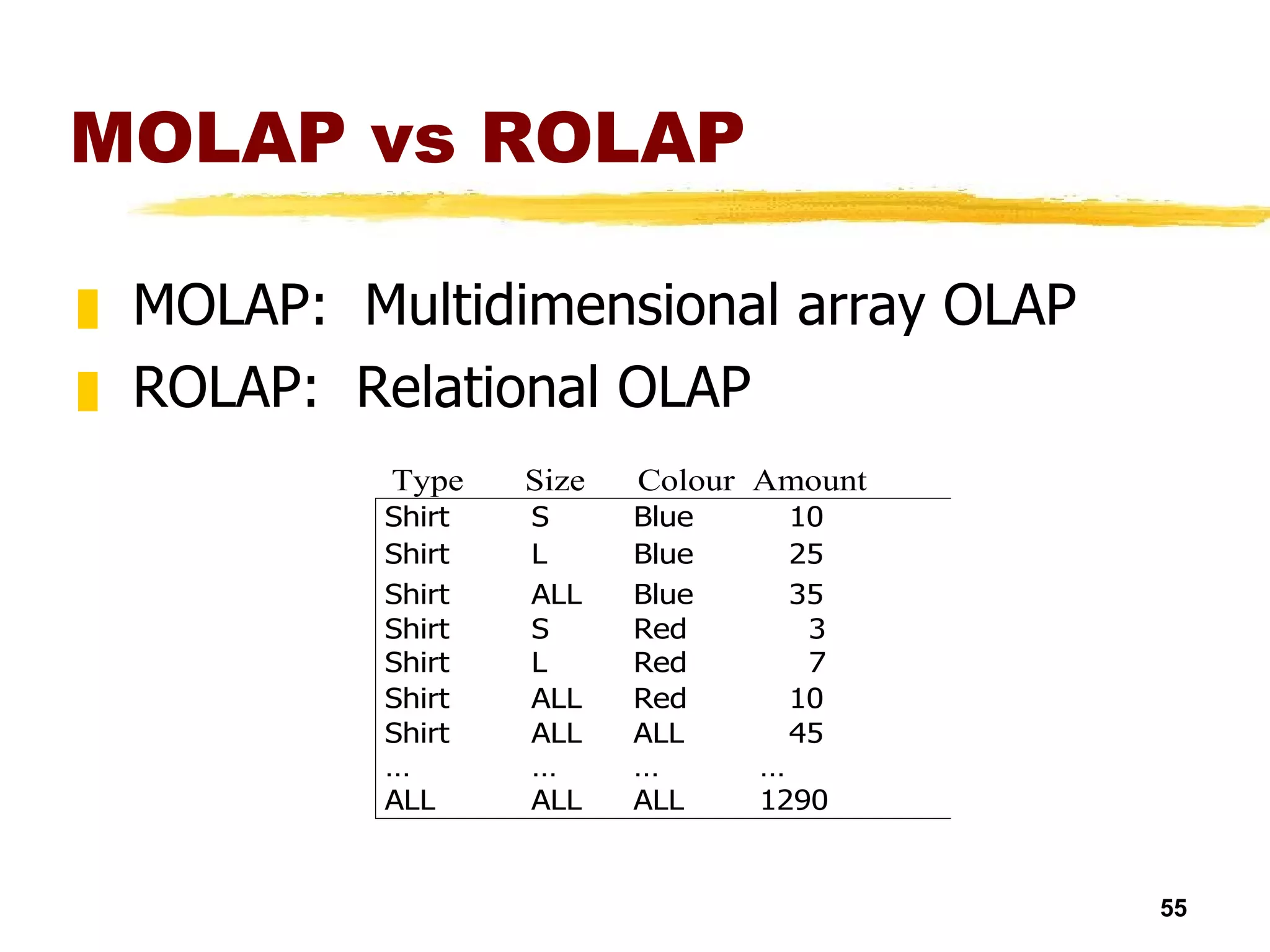
MOLAP vs ROLAP MOLAP:  Multidimensional array OLAP ROLAP:  Relational OLAP
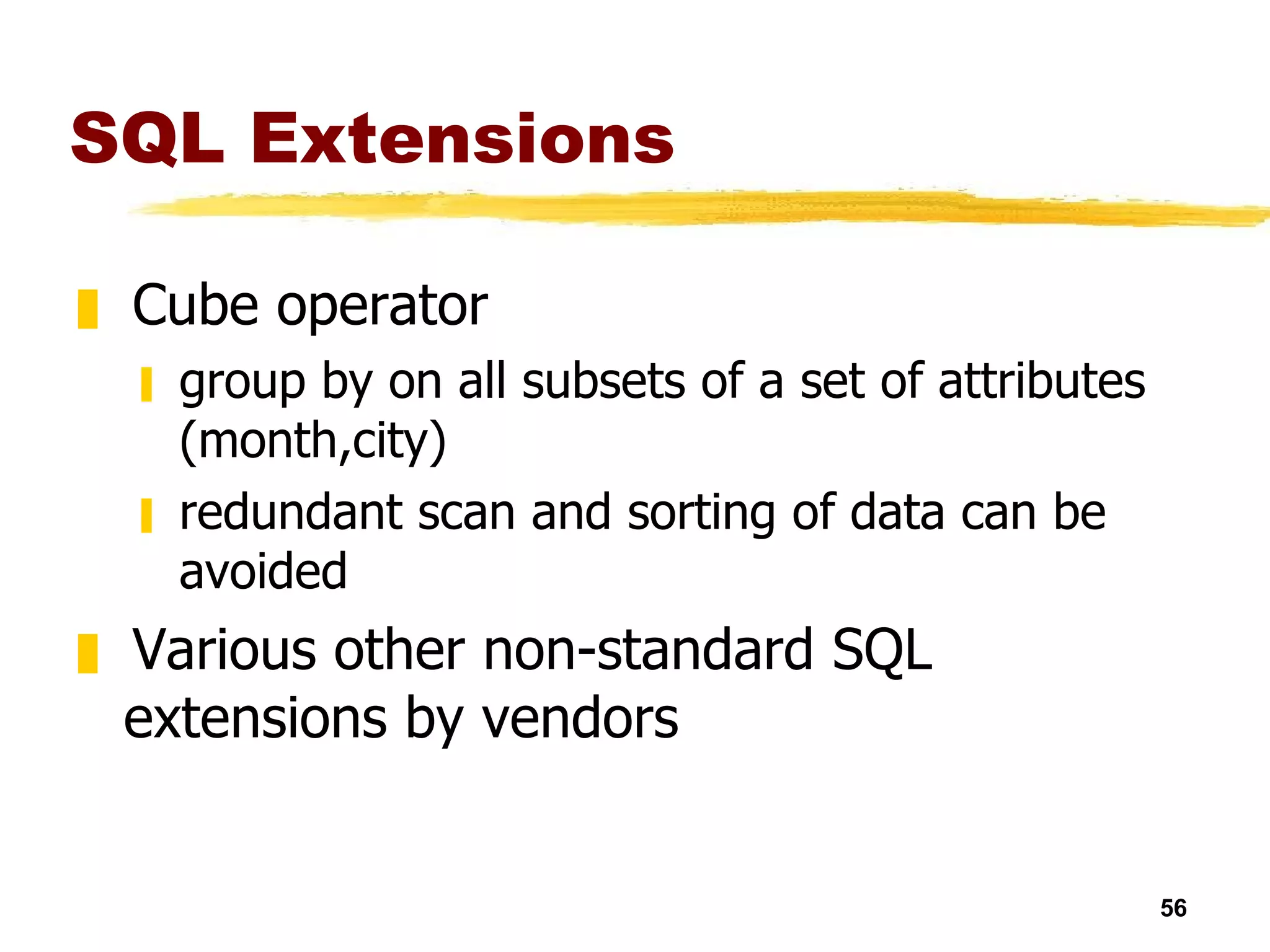
SQL Extensions Cube operator group by on all subsets of a set of attributes (month,city) redundant scan and sorting of data can be avoided Various other non-standard SQL extensions by vendors
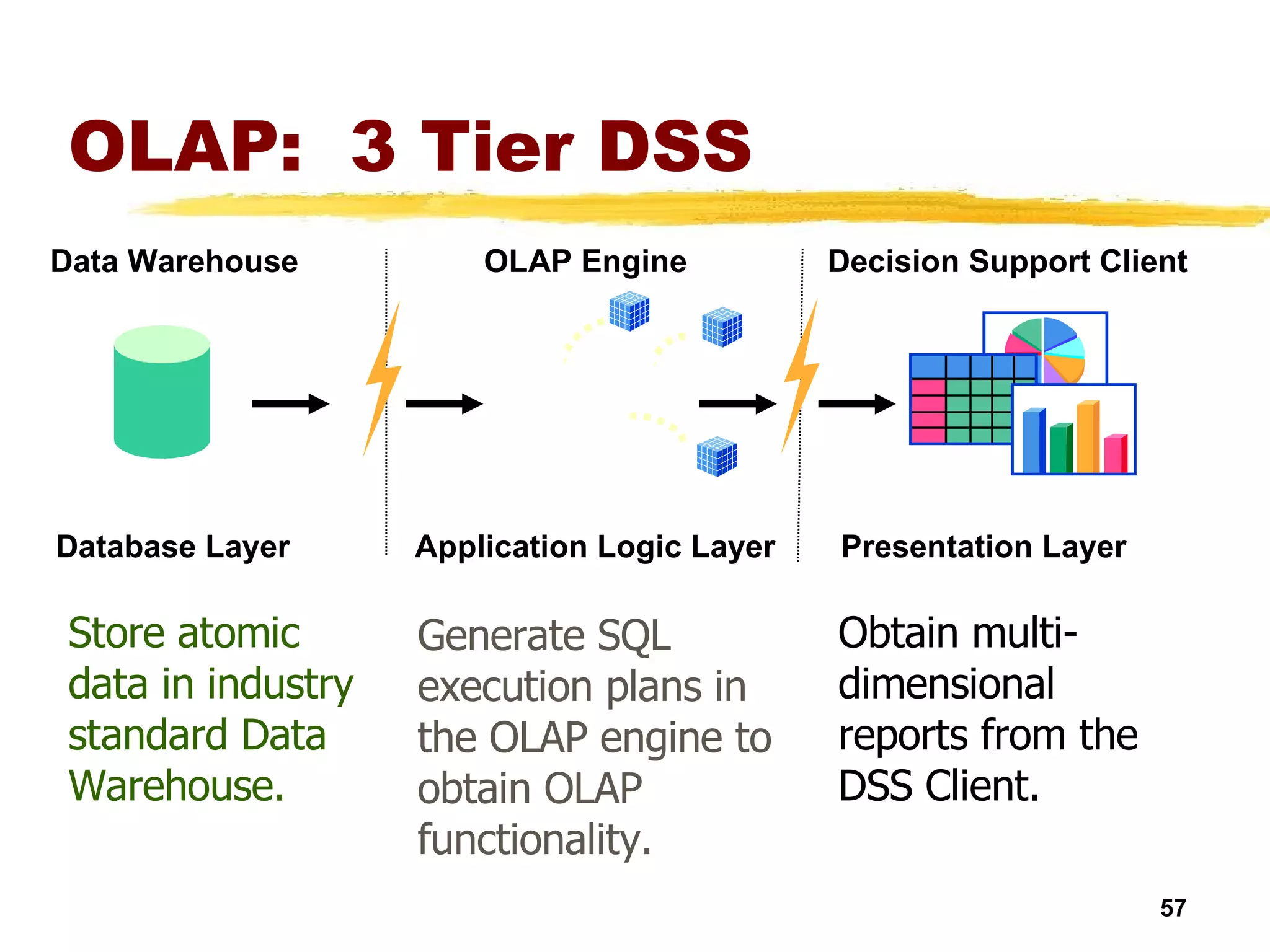
OLAP:  3 Tier DSS Data Warehouse Database Layer Store atomic data in industry standard Data Warehouse. OLAP Engine Application Logic Layer Generate SQL execution plans in the OLAP engine to obtain OLAP functionality. Decision Support Client Presentation Layer Obtain multi-dimensional reports from the DSS Client.
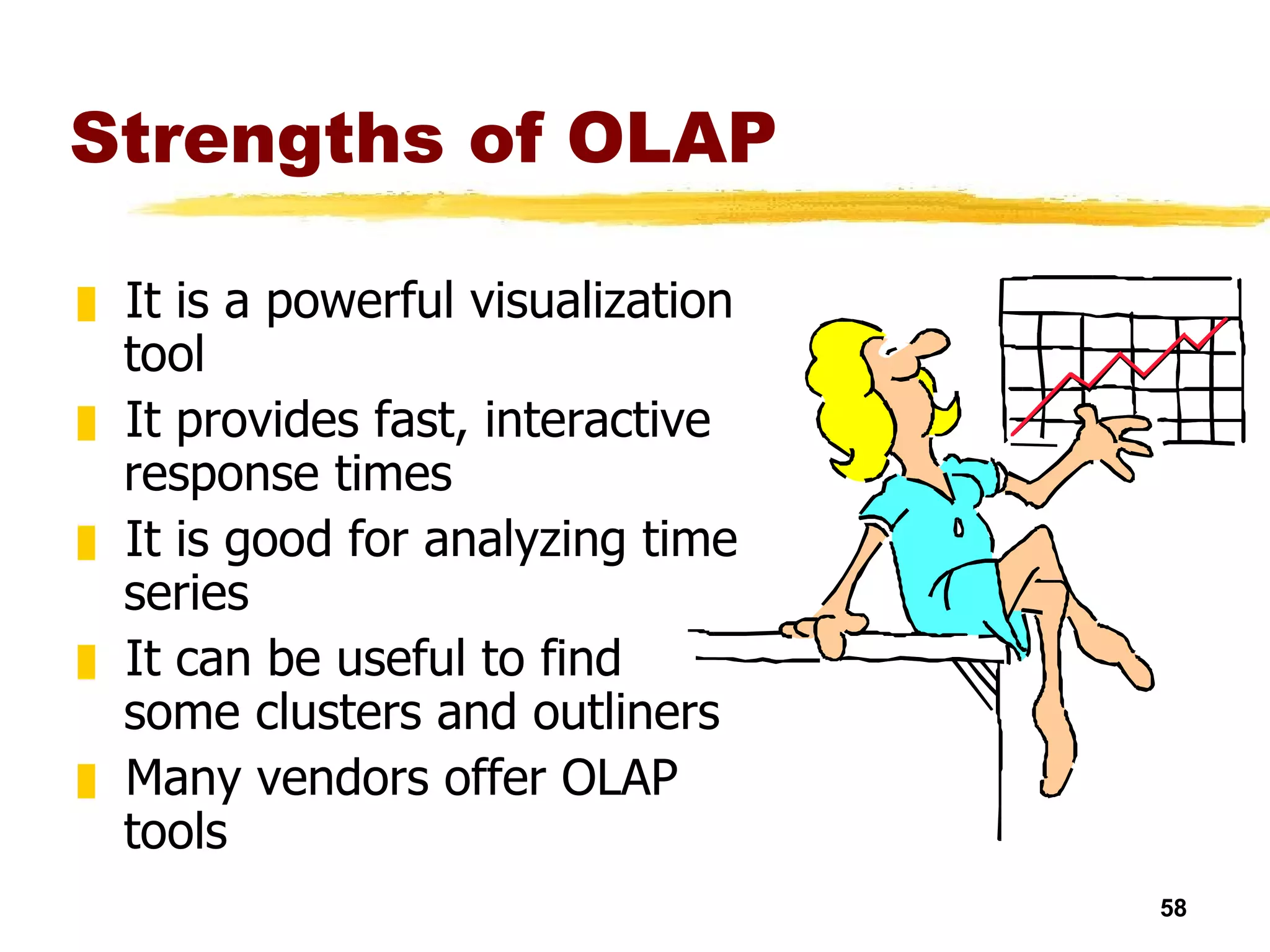
Strengths of OLAP It is a powerful visualization tool It provides fast, interactive response times It is good for analyzing time series It can be useful to find some clusters and outliners Many vendors offer OLAP tools
Brief History Express and System W DSS Online Analytical Processing - coined by  EF Codd in 1994 - white paper  by  Arbor Software Generally synonymous with earlier terms such as Decisions Support, Business Intelligence, Executive Information System MOLAP:  Multidimensional OLAP (Hyperion (Arbor Essbase), Oracle Express) ROLAP:  Relational OLAP (Informix MetaCube, Microstrategy DSS Agent)
OLAP and Executive Information Systems Andyne Computing -- Pablo  Arbor Software --  Essbase  Cognos -- PowerPlay  Comshare -- Commander OLAP  Holistic Systems -- Holos  Information Advantage -- AXSYS, WebOLAP Informix -- Metacube Microstrategies --DSS/Agent Oracle -- Express  Pilot -- LightShip  Planning Sciences -- Gentium  Platinum Technology -- ProdeaBeacon, Forest & Trees  SAS Institute -- SAS/EIS, OLAP++ Speedware -- Media
Microsoft OLAP strategy Plato: OLAP server: powerful, integrating various operational sources  OLE-DB for OLAP: emerging industry standard based on MDX --> extension of SQL for OLAP Pivot-table services:  integrate with Office 2000 Every desktop will have OLAP capability. Client side caching and calculations Partitioned and virtual cube Hybrid relational and multidimensional storage
Part 3:  Data Mining
Why Data Mining Credit ratings/targeted marketing : Given a database of 100,000 names, which persons are the least likely to default on their credit cards?  Identify likely responders to sales promotions Fraud detection Which types of transactions are likely to be fraudulent, given the demographics and transactional history of a particular customer?  Customer relationship management : Which of my customers are likely to be the most loyal, and which are most likely to leave for a competitor?  : Data Mining helps extract such information
Data mining Process of semi-automatically analyzing large databases to find interesting and useful patterns Overlaps with machine learning, statistics, artificial intelligence and databases but more scalable in number of features and instances more automated to handle heterogeneous data
Some basic operations Predictive: Regression Classification Descriptive: Clustering / similarity matching Association rules and variants Deviation detection
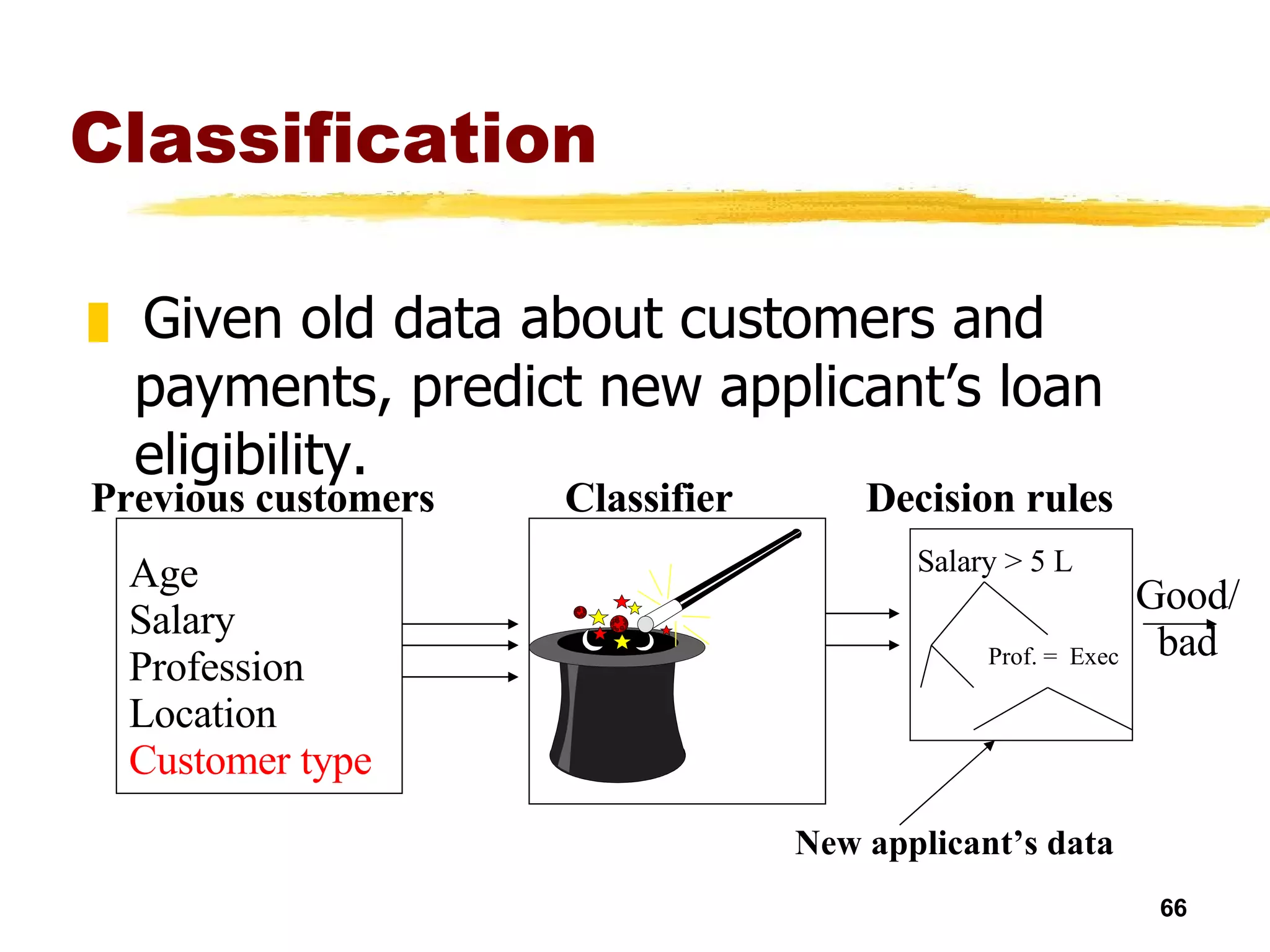
Classification Given old data about customers and payments, predict new applicant’s loan eligibility. Age Salary Profession Location Customer type Previous customers Classifier Decision rules Salary > 5 L Prof. =  Exec New applicant’s data Good/ bad
Classification methods Goal:  Predict class Ci  = f(x1, x2, .. Xn) Regression: (linear or any other polynomial)  a*x1 + b*x2 + c = Ci.  Nearest neighour Decision tree classifier: divide decision space into piecewise constant regions. Probabilistic/generative models Neural networks: partition by non-linear boundaries
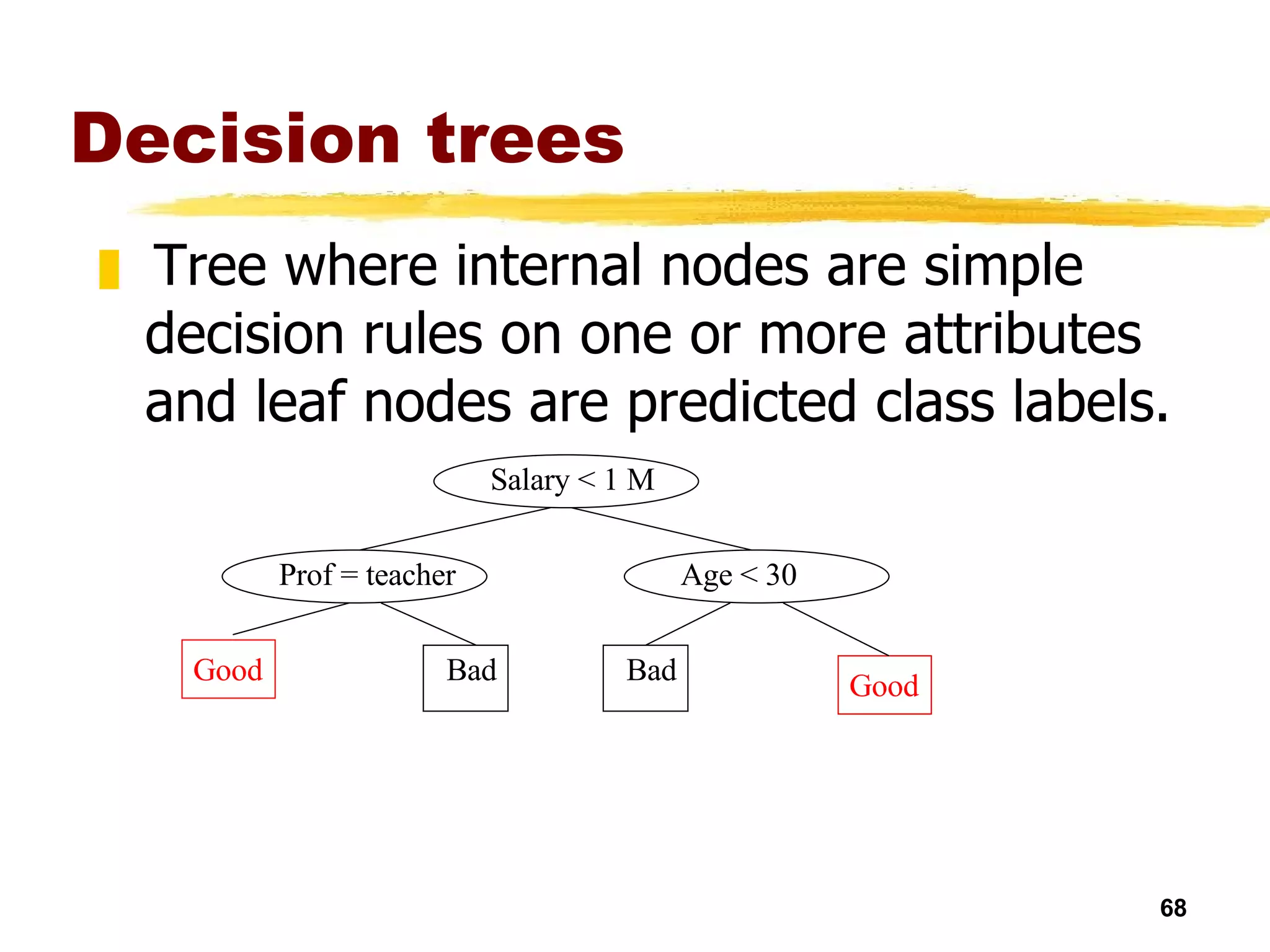
Tree where internal nodes are simple decision rules on one or more attributes and leaf nodes are predicted class labels.  Decision trees Salary < 1 M Prof = teacher Age < 30 Good Bad Bad Good
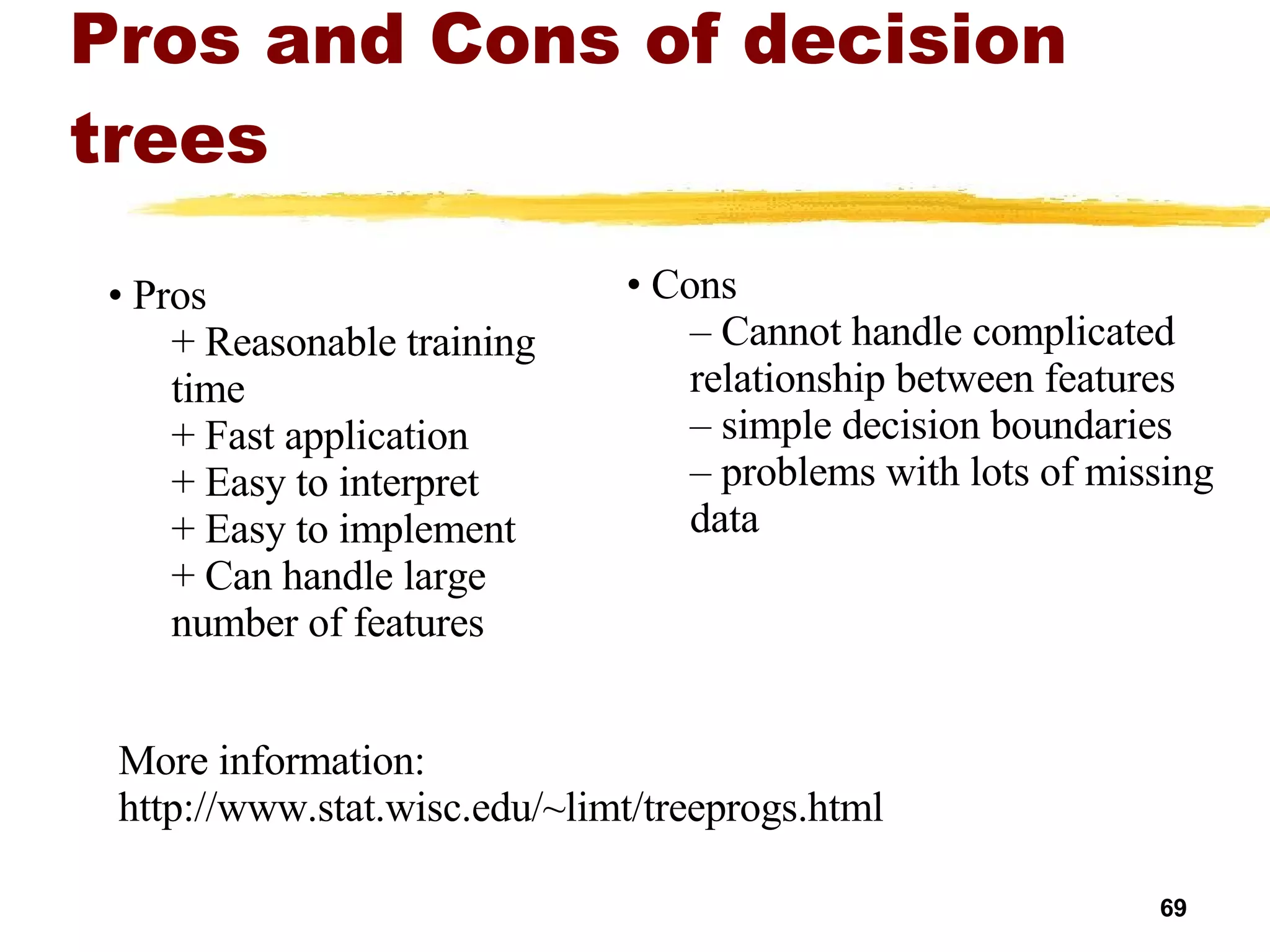
Pros and Cons of decision trees Cons Cannot handle complicated relationship between features simple decision boundaries problems with lots of missing data Pros Reasonable training  time Fast application Easy to interpret Easy to implement Can handle large number of features More information: http://www.stat.wisc.edu/~limt/treeprogs.html
Neural network Set of nodes connected by directed weighted edges Hidden nodes Output nodes x1 x2 x3 x1 x2 x3 w1 w2 w3 Basic NN unit A more typical NN
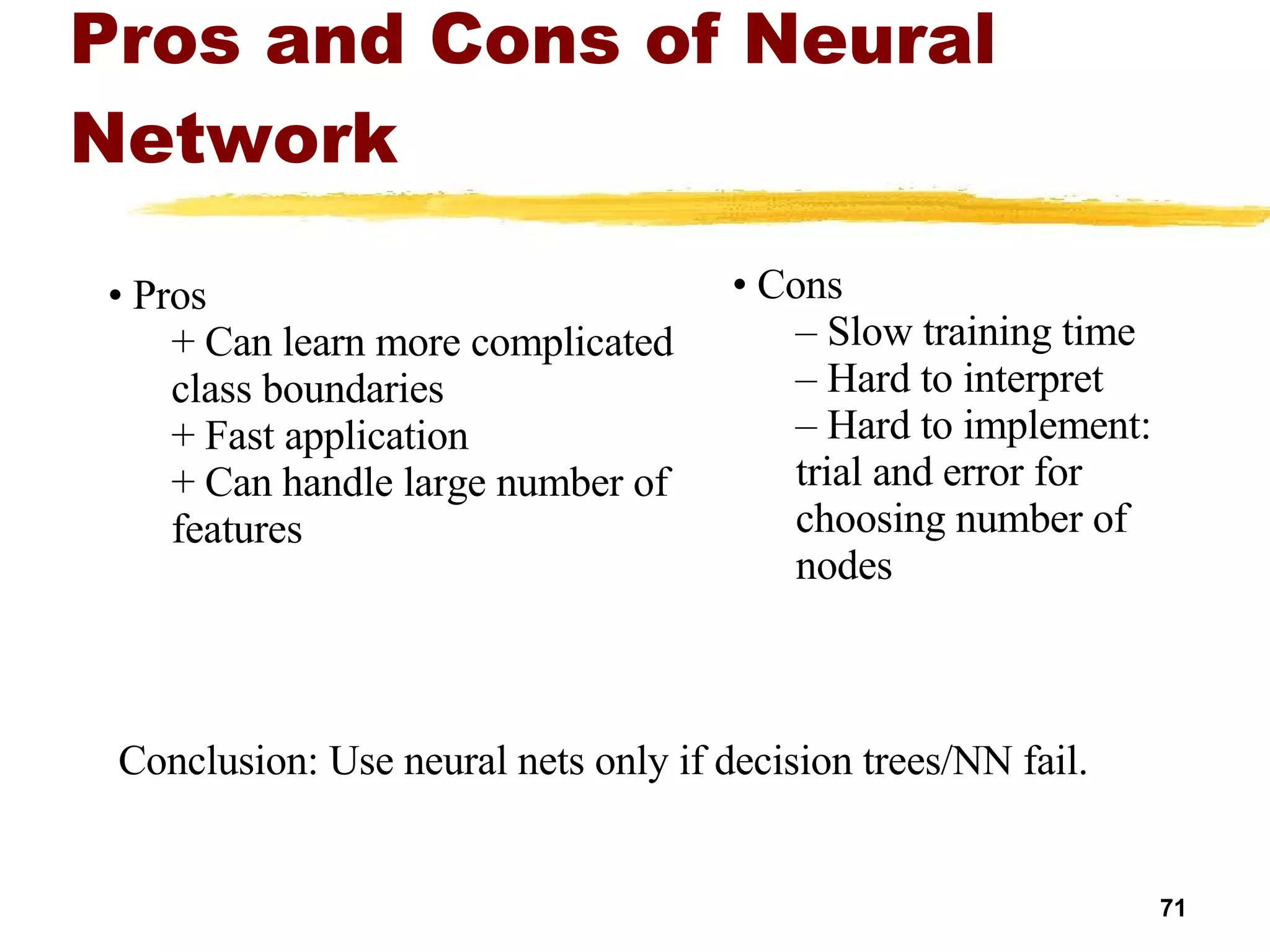
Pros and Cons of Neural Network Cons Slow training time Hard to interpret  Hard to implement: trial and error for choosing number of nodes Pros Can learn more complicated class boundaries Fast application Can handle large number of features Conclusion: Use neural nets only if decision trees/NN fail.
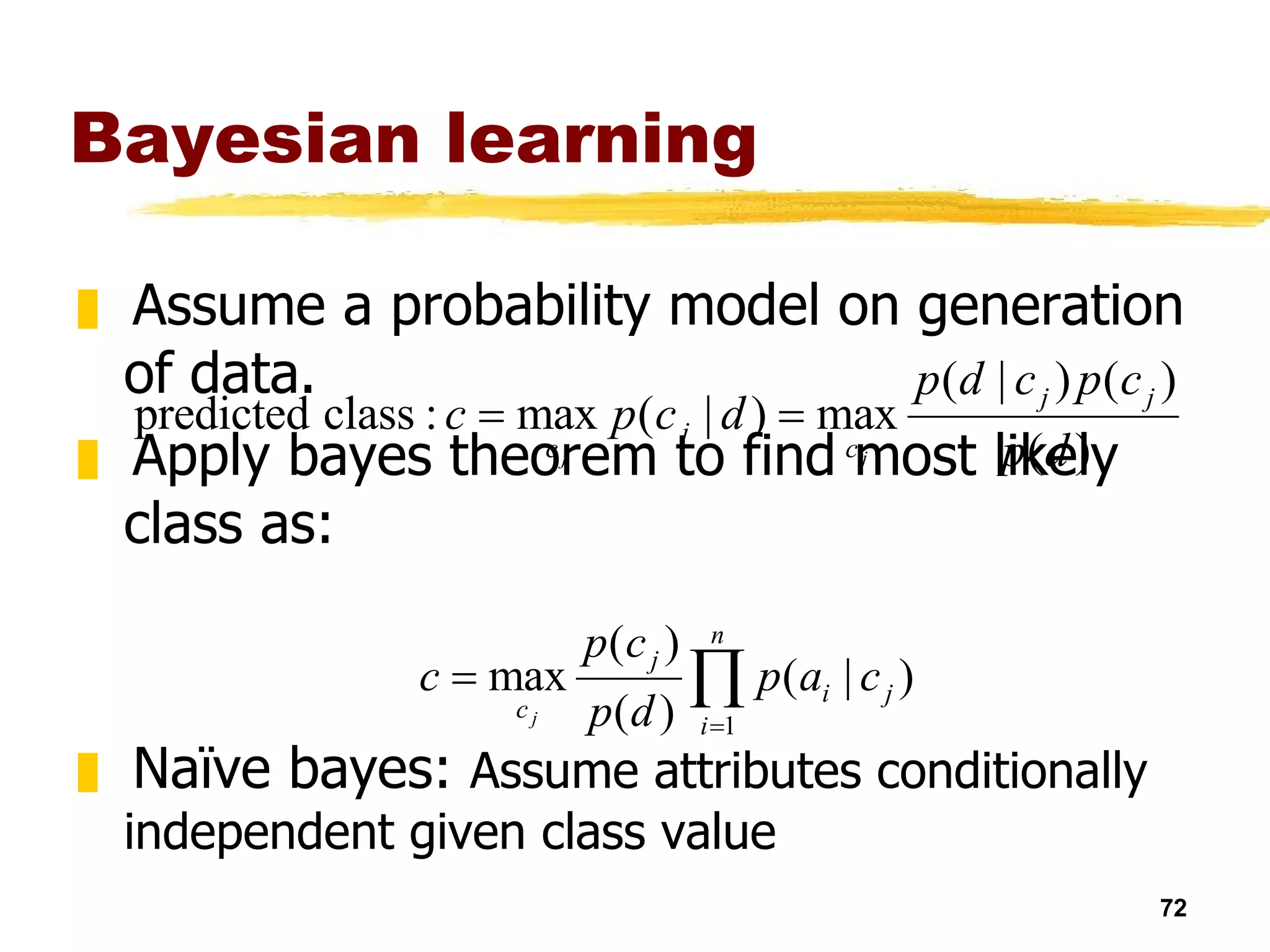
Bayesian learning Assume a probability model on generation of data.  Apply bayes theorem to find most likely class as: Naïve bayes:  Assume attributes conditionally independent given class value Easy to learn probabilities by counting,  Useful in some domains e.g. text
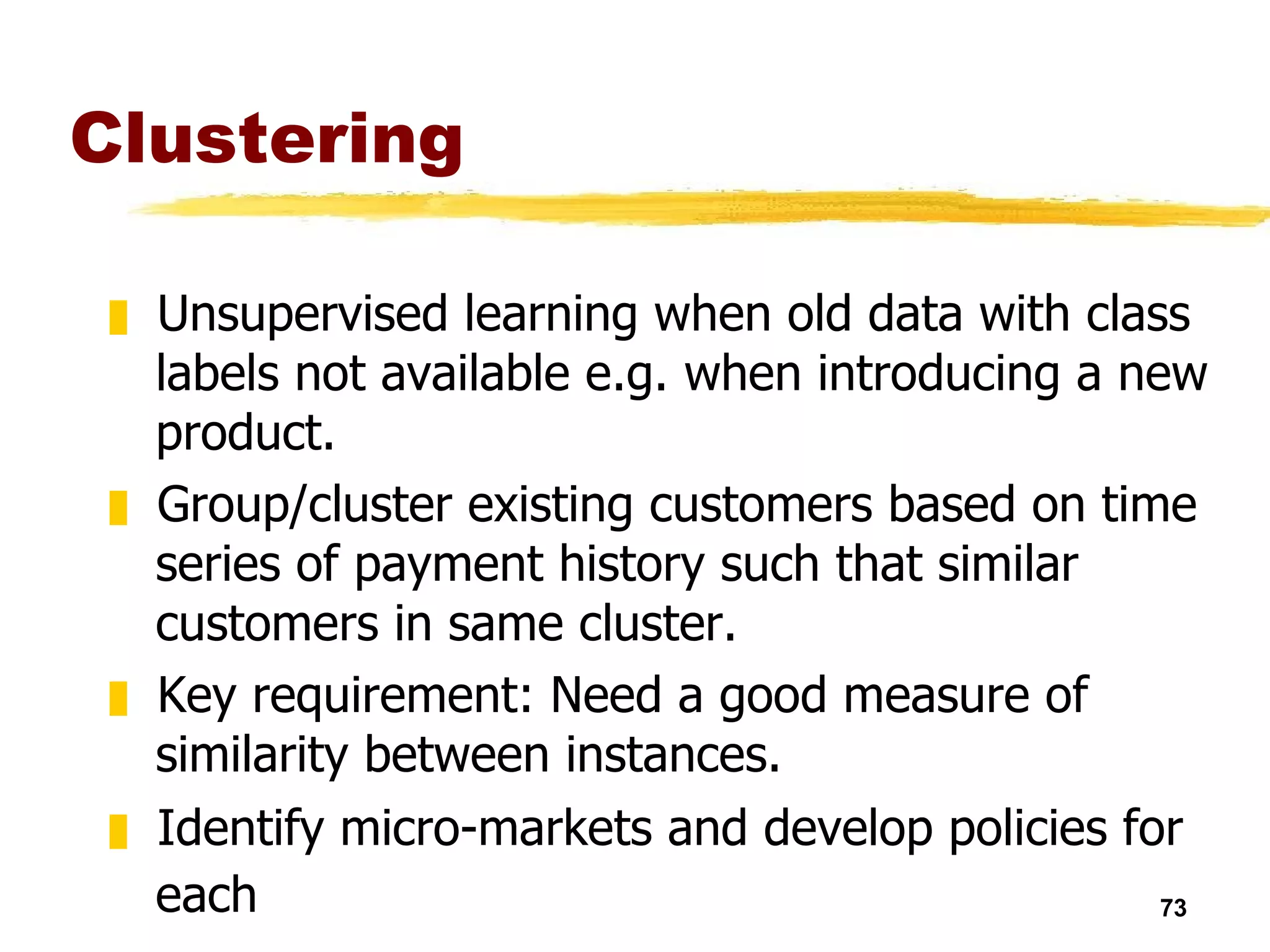
Clustering Unsupervised learning when old data with class labels not available e.g. when introducing a new product. Group/cluster existing customers based on time series of payment history such that similar customers in same cluster. Key requirement: Need a good measure of similarity between instances. Identify micro-markets and develop policies for each
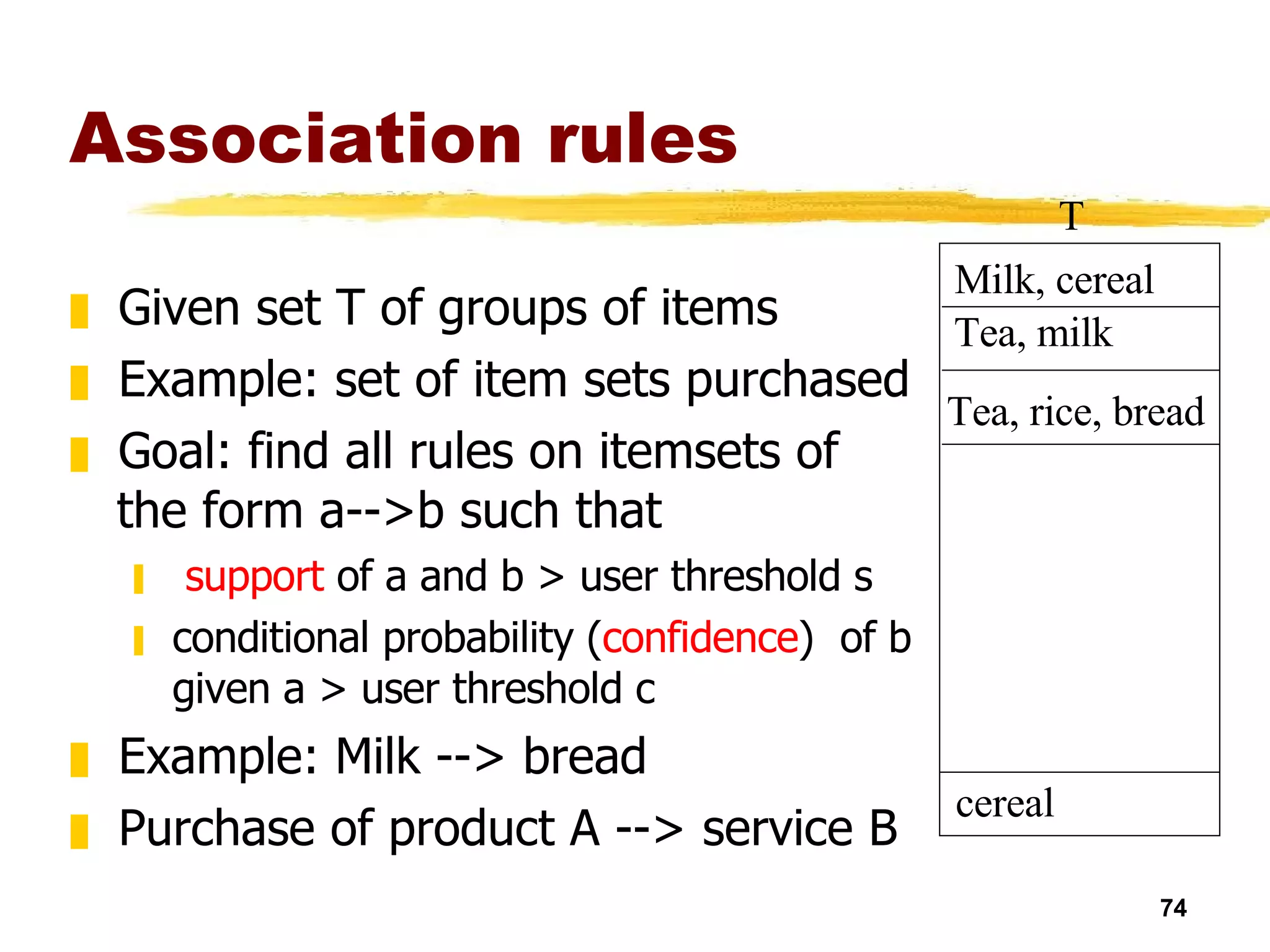
Association rules Given set T of groups of items Example: set of item sets purchased  Goal: find all rules on itemsets of the form a-->b such that support  of a and b > user threshold s  conditional probability ( confidence )  of b given a > user threshold c Example: Milk --> bread Purchase of product A --> service B Milk, cereal Tea, milk Tea, rice, bread cereal T
Variants High confidence may not imply high correlation Use correlations.  Find expected support and large departures from that interesting..  see statistical literature on contingency tables. Still too many rules, need to prune...
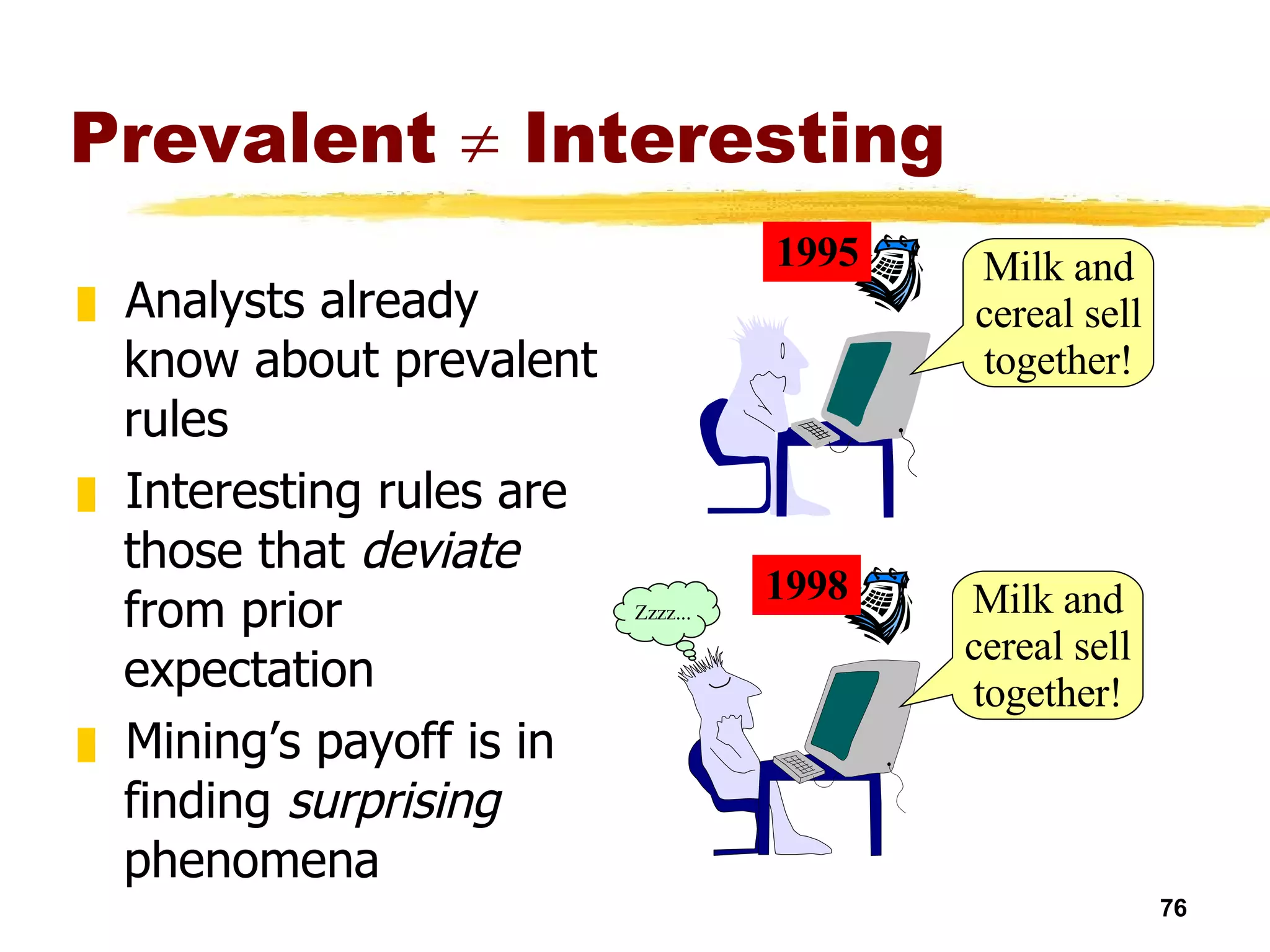
Prevalent    Interesting Analysts already know about prevalent rules Interesting rules are those that  deviate  from prior expectation Mining’s payoff is in finding  surprising  phenomena 1995 Milk and cereal sell together! Milk and cereal sell together! 1998 Zzzz...
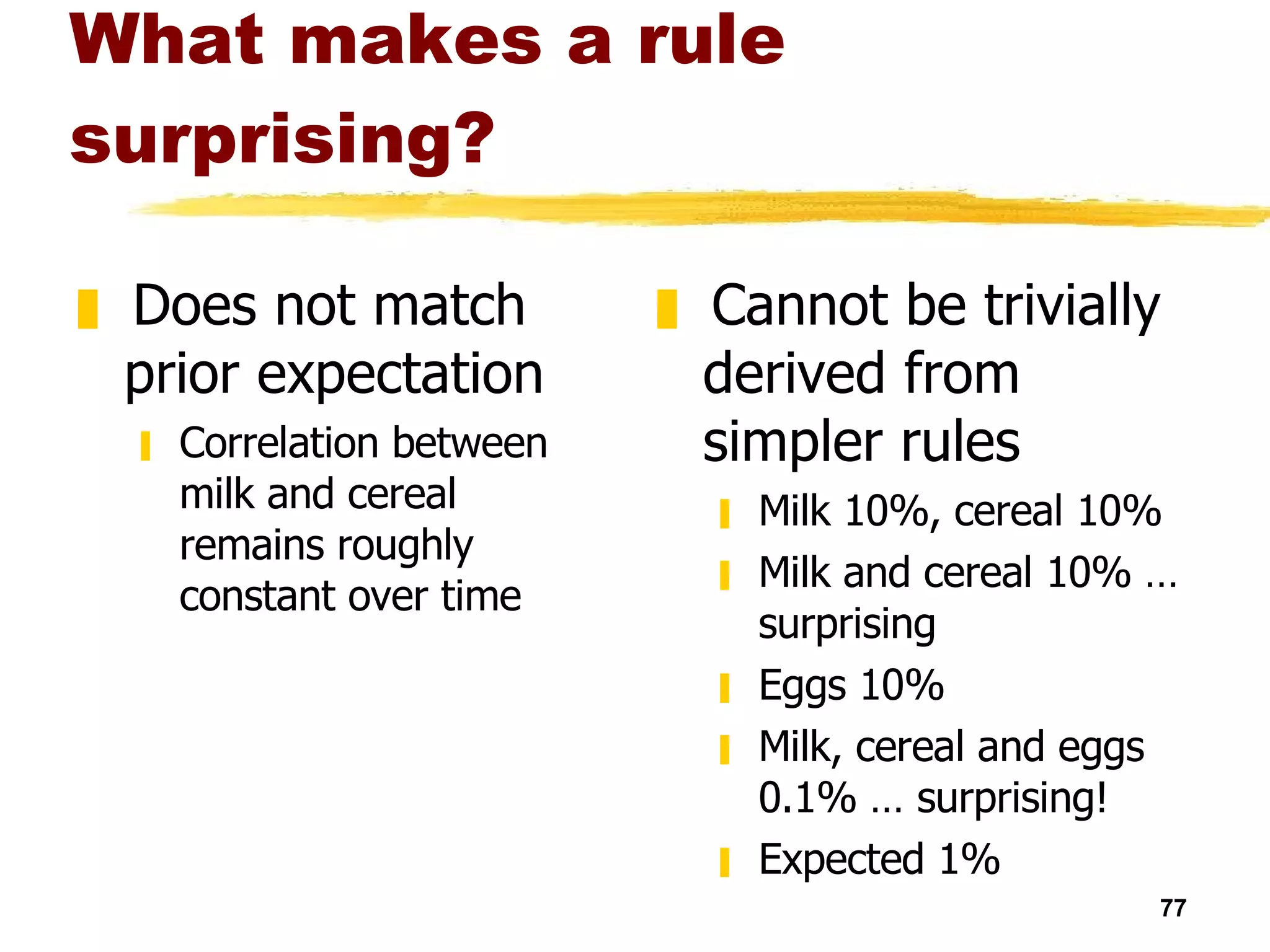
What makes a rule surprising? Does not match prior expectation Correlation between milk and cereal remains roughly constant over time Cannot be trivially derived from simpler rules Milk 10%, cereal 10% Milk and cereal 10% … surprising Eggs 10% Milk, cereal and eggs 0.1% … surprising! Expected 1%
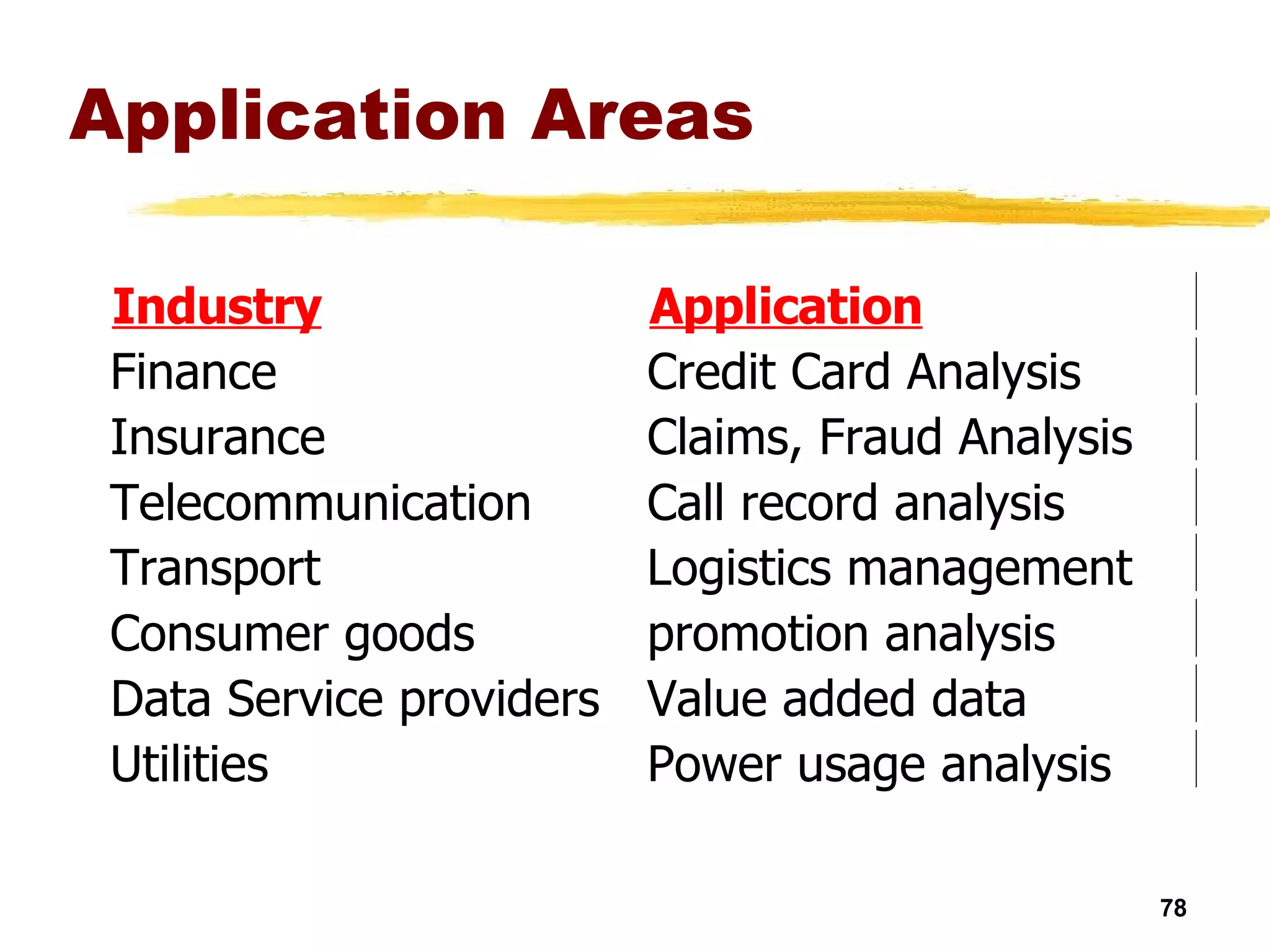
Application Areas Industry Application Finance Credit Card Analysis Insurance Claims, Fraud Analysis Telecommunication Call record analysis Transport Logistics management Consumer goods promotion analysis Data Service providers Value added data Utilities Power usage analysis
Data Mining in Use The US Government uses Data Mining to track fraud A Supermarket becomes an information broker Basketball teams use it to track game strategy Cross Selling Target Marketing Holding on to Good Customers Weeding out Bad Customers
Why Now? Data is being produced Data is being warehoused The computing power is available The computing power is affordable The competitive pressures are strong Commercial products are available
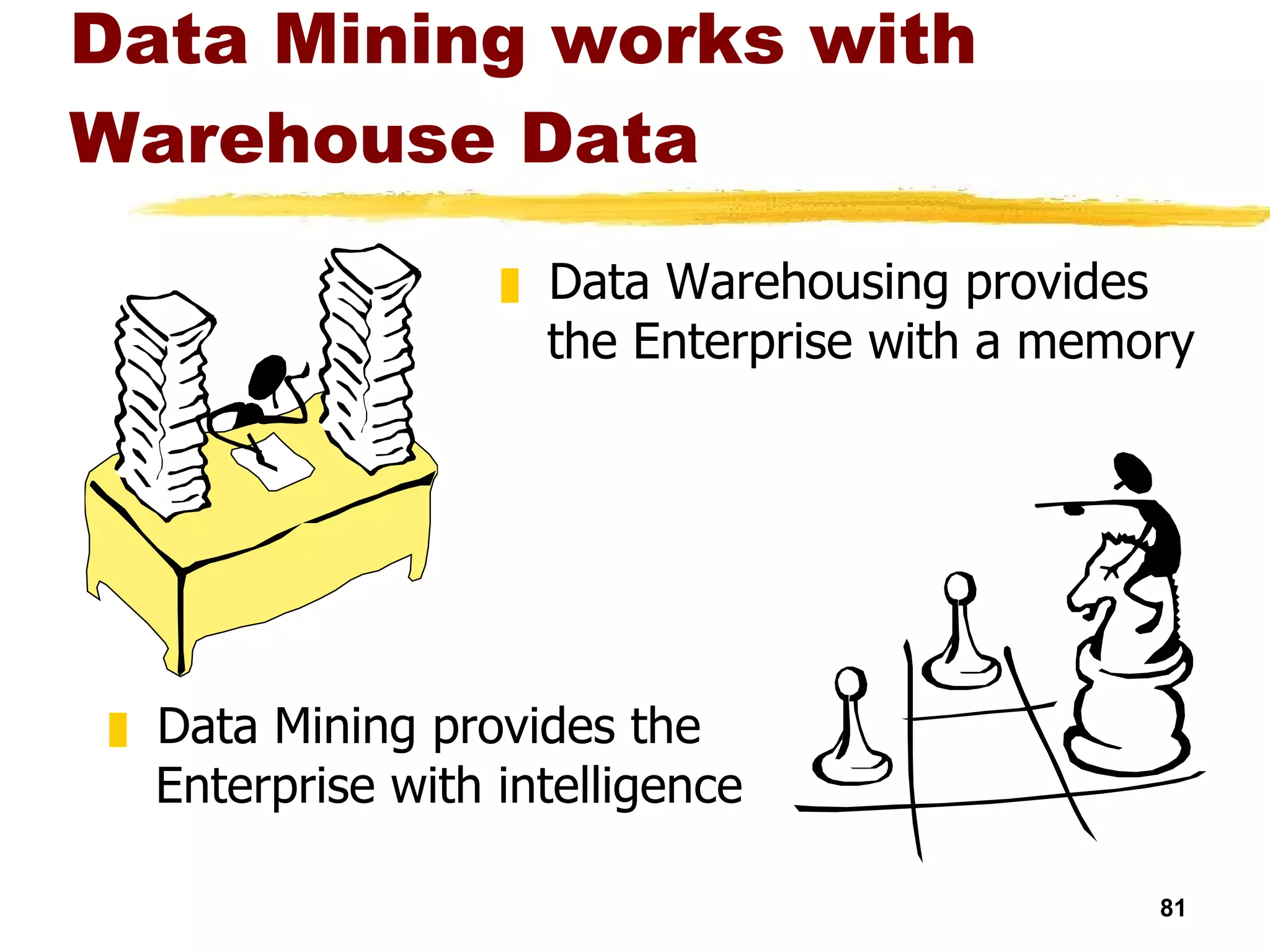
Data Mining works with Warehouse Data Data Warehousing provides the Enterprise with a memory Data Mining provides the Enterprise with intelligence
Mining market Around 20 to 30 mining tool vendors Major players: Clementine,  IBM’s Intelligent Miner,  SGI’s MineSet,  SAS’s Enterprise Miner. All pretty much the same set of tools Many embedded products:  fraud detection, electronic commerce applications
OLAP Mining integration OLAP (On Line Analytical Processing) Fast interactive exploration of multidim. aggregates. Heavy reliance on manual operations for analysis:  Tedious and error-prone on large multidimensional data Ideal platform for vertical integration of mining but needs to be interactive instead of batch .
State of art in mining  OLAP   integration Decision trees [ Information discovery,  Cognos] find factors influencing high profits Clustering  [Pilot software] segment customers to define hierarchy on that dimension Time series analysis: [Seagate’s Holos] Query for various shapes along time: eg. spikes, outliers etc Multi-level Associations [Han et al.] find association between members of dimensions
Vertical integration:  Mining on the web Web log analysis for site design:   what are popular pages,  what links are hard to find. Electronic stores sales enhancements: recommendations, advertisement:  Collaborative filtering :  Net perception, Wisewire  Inventory control: what was a shopper looking for and could not find..
Part 4:  Speeding up Query Processing

Datawarehouse Overview

  • 1.
    Advances in DatabaseQuerying Satish Bobba Sr.Informatica Developer [email_address]
  • 2.
  • 3.
    Overview Part 1: Data Warehouses Part 2: OLAP Part 3: Data Mining Part 4: Query Processing and Optimization
  • 4.
    Part 1: DataWarehouses
  • 5.
    Data, Data everywhereyet ... I can’t find the data I need data is scattered over the network many versions, subtle differences I can’t get the data I need need an expert to get the data I can’t understand the data I found available data poorly documented I can’t use the data I found results are unexpected data needs to be transformed from one form to other
  • 6.
    What is aData Warehouse? A single, complete and consistent store of data obtained from a variety of different sources made available to end users in a what they can understand and use in a business context. [Barry Devlin]
  • 7.
    Why Data Warehousing?Which are our lowest/highest margin customers ? Who are my customers and what products are they buying? Which customers are most likely to go to the competition ? What impact will new products/services have on revenue and margins? What product prom- -otions have the biggest impact on revenue? What is the most effective distribution channel?
  • 8.
    Decision Support Usedto manage and control business Data is historical or point-in-time Optimized for inquiry rather than update Use of the system is loosely defined and can be ad-hoc Used by managers and end-users to understand the business and make judgements
  • 9.
    Evolution of DecisionSupport 60’s: Batch reports hard to find and analyze information inflexible and expensive, reprogram every request 70’s: Terminal based DSS and EIS 80’s: Desktop data access and analysis tools query tools, spreadsheets, GUIs easy to use, but access only operational db 90’s: Data warehousing with integrated OLAP engines and tools
  • 10.
    What are theusers saying... Data should be integrated across the enterprise Summary data had a real value to the organization Historical data held the key to understanding data over time What-if capabilities are required
  • 11.
    Data Warehousing -- It is a process Technique for assembling and managing data from various sources for the purpose of answering business questions. Thus making decisions that were not previous possible A decision support database maintained separately from the organization’s operational database
  • 12.
    Traditional RDBMS usedfor OLTP Database Systems have been used traditionally for OLTP clerical data processing tasks detailed, up to date data structured repetitive tasks read/update a few records isolation, recovery and integrity are critical Will call these operational systems
  • 13.
    OLTP vs DataWarehouse OLTP Application Oriented Used to run business Clerical User Detailed data Current up to date Isolated Data Repetitive access by small transactions Read/Update access Warehouse (DSS) Subject Oriented Used to analyze business Manager/Analyst Summarized and refined Snapshot data Integrated Data Ad-hoc access using large queries Mostly read access (batch update)
  • 14.
    Data Warehouse ArchitectureRelational Databases Legacy Data Purchased Data Data Warehouse Engine Optimized Loader Extraction Cleansing Analyze Query Metadata Repository
  • 15.
    From the DataWarehouse to Data Marts Departmentally Structured Individually Structured Data Warehouse Organizationally Structured Less More History Normalized Detailed Data Information
  • 16.
    Users have differentviews of Data Organizationally structured OLAP Explorers: Seek out the unknown and previously unsuspected rewards hiding in the detailed data Farmers: Harvest information from known access paths Tourists: Browse information harvested by farmers
  • 17.
    Wal*Mart Case StudyFounded by Sam Walton One the largest Super Market Chains in the US Wal*Mart: 2000+ Retail Stores SAM's Clubs 100+Wholesalers Stores This case study is from Felipe Carino’s (NCR Teradata) presentation made at Stanford Database Seminar
  • 18.
    Old Retail ParadigmWal*Mart Inventory Management Merchandise Accounts Payable Purchasing Supplier Promotions: National, Region, Store Level Suppliers Accept Orders Promote Products Provide special Incentives Monitor and Track The Incentives Bill and Collect Receivables Estimate Retailer Demands
  • 19.
    New (Just-In-Time) RetailParadigm No more deals Shelf-Pass Through (POS Application) One Unit Price Suppliers paid once a week on ACTUAL items sold Wal*Mart Manager Daily Inventory Restock Suppliers (sometimes SameDay) ship to Wal*Mart Warehouse-Pass Through Stock some Large Items Delivery may come from supplier Distribution Center Supplier’s merchandise unloaded directly onto Wal*Mart Trucks
  • 20.
    Information as aStrategic Weapon Daily Summary of all Sales Information Regional Analysis of all Stores in a logical area Specific Product Sales Specific Supplies Sales Trend Analysis, etc. Wal*Mart uses information when negotiating with Suppliers Advertisers etc.
  • 21.
    Schema Design Databaseorganization must look like business must be recognizable by business user approachable by business user Must be simple Schema Types Star Schema Fact Constellation Schema Snowflake schema
  • 22.
    Star Schema Asingle fact table and for each dimension one dimension table Does not capture hierarchies directly T i m e p r o d c u s t c i t y f a c t date, custno, prodno, cityname, sales
  • 23.
    Dimension Tables Dimensiontables Define business in terms already familiar to users Wide rows with lots of descriptive text Small tables (about a million rows) Joined to fact table by a foreign key heavily indexed typical dimensions time periods, geographic region (markets, cities), products, customers, salesperson, etc.
  • 24.
    Fact Table Centraltable Typical example: individual sales records mostly raw numeric items narrow rows, a few columns at most large number of rows (millions to a billion) Access via dimensions
  • 25.
    Snowflake schema Representdimensional hierarchy directly by normalizing tables. Easy to maintain and saves storage T i m e p r o d c u s t c i t y f a c t date, custno, prodno, cityname, ... r e g i o n
  • 26.
    Fact Constellation FactConstellation Multiple fact tables that share many dimension tables Booking and Checkout may share many dimension tables in the hotel industry Hotels Travel Agents Promotion Room Type Customer Booking Checkout
  • 27.
    Data Granularity inWarehouse Summarized data stored reduce storage costs reduce cpu usage increases performance since smaller number of records to be processed design around traditional high level reporting needs tradeoff with volume of data to be stored and detailed usage of data
  • 28.
    Granularity in WarehouseSolution is to have dual level of granularity Store summary data on disks 95% of DSS processing done against this data Store detail on tapes 5% of DSS processing against this data
  • 29.
    Levels of GranularityOperational 60 days of activity account activity date amount teller location account bal account month # trans withdrawals deposits average bal amount activity date amount account bal monthly account register -- up to 10 years Not all fields need be archived Banking Example
  • 30.
    Data Integration AcrossSources Trust Credit card Savings Loans Same data different name Different data Same name Data found here nowhere else Different keys same data
  • 31.
    Data Transformation Datatransformation is the foundation for achieving single version of the truth Major concern for IT Data warehouse can fail if appropriate data transformation strategy is not developed Sequential Legacy Relational External Operational/ Source Data Data Transformation Accessing Capturing Extracting Householding Filtering Reconciling Conditioning Loading Validating Scoring
  • 32.
    Data Transformation Exampleencoding unit field appl A - balance appl B - bal appl C - currbal appl D - balcurr appl A - pipeline - cm appl B - pipeline - in appl C - pipeline - feet appl D - pipeline - yds appl A - m,f appl B - 1,0 appl C - x,y appl D - male, female Data Warehouse
  • 33.
    Data Integrity ProblemsSame person, different spellings Agarwal, Agrawal, Aggarwal etc... Multiple ways to denote company name Persistent Systems, PSPL, Persistent Pvt. LTD. Use of different names mumbai, bombay Different account numbers generated by different applications for the same customer Required fields left blank Invalid product codes collected at point of sale manual entry leads to mistakes “ in case of a problem use 9999999”
  • 34.
    Data Transformation TermsExtracting Conditioning Scrubbing Merging Householding Enrichment Scoring Loading Validating Delta Updating
  • 35.
    Data Transformation TermsHouseholding Identifying all members of a household (living at the same address) Ensures only one mail is sent to a household Can result in substantial savings: 1 million catalogues at Rs. 50 each costs Rs. 50 million . A 2% savings would save Rs. 1 million
  • 36.
    Refresh Propagate updateson source data to the warehouse Issues: when to refresh how to refresh -- incremental refresh techniques
  • 37.
    When to Refresh?periodically (e.g., every night, every week) or after significant events on every update: not warranted unless warehouse data require current data (up to the minute stock quotes) refresh policy set by administrator based on user needs and traffic possibly different policies for different sources
  • 38.
    Refresh techniques Incrementaltechniques detect changes on base tables: replication servers (e.g., Sybase, Oracle, IBM Data Propagator) snapshots (Oracle) transaction shipping (Sybase) compute changes to derived and summary tables maintain transactional correctness for incremental load
  • 39.
    How To DetectChanges Create a snapshot log table to record ids of updated rows of source data and timestamp Detect changes by: Defining after row triggers to update snapshot log when source table changes Using regular transaction log to detect changes to source data
  • 40.
    Querying Data WarehousesSQL Extensions Multidimensional modeling of data OLAP More on OLAP later …
  • 41.
    SQL Extensions Extendedfamily of aggregate functions rank (top 10 customers) percentile (top 30% of customers) median, mode Object Relational Systems allow addition of new aggregate functions Reporting features running total, cumulative totals
  • 42.
    Reporting Tools AndyneComputing -- GQL Brio -- BrioQuery Business Objects -- Business Objects Cognos -- Impromptu Information Builders Inc. -- Focus for Windows Oracle -- Discoverer2000 Platinum Technology -- SQL*Assist, ProReports PowerSoft -- InfoMaker SAS Institute -- SAS/Assist Software AG -- Esperant Sterling Software -- VISION:Data
  • 43.
    Operational data Detailed transactional data Data warehouse Merge Clean Summarize Direct Query Reporting tools Mining tools Decision support tools Oracle SAS Relational DBMS+ e.g. Redbrick IMS Crystal reports Essbase Intelligent Miner Bombay branch Delhi branch Calcutta branch Census data OLAP GIS data
  • 44.
    Deploying Data WarehousesWhat business information keeps you in business today? What business information can put you out of business tomorrow? What business information should be a mouse click away? What business conditions are the driving the need for business information?
  • 45.
    Cultural Considerations Notjust a technology project New way of using information to support daily activities and decision making Care must be taken to prepare organization for change Must have organizational backing and support
  • 46.
    User Training Usersmust have a higher level of IT proficiency than for operational systems Training to help users analyze data in the warehouse effectively
  • 47.
    Warehouse Products ComputerAssociates -- CA-Ingres Hewlett-Packard -- Allbase/SQL Informix -- Informix, Informix XPS Microsoft -- SQL Server Oracle -- Oracle7, Oracle Parallel Server Red Brick -- Red Brick Warehouse SAS Institute -- SAS Software AG -- ADABAS Sybase -- SQL Server, IQ, MPP
  • 48.
  • 49.
    Nature of OLAPAnalysis Aggregation -- (total sales, percent-to-total) Comparison -- Budget vs. Expenses Ranking -- Top 10, quartile analysis Access to detailed and aggregate data Complex criteria specification Visualization Need interactive response to aggregate queries
  • 50.
    Multi-dimensional Data Measure - sales (actual, plan, variance) Dimensions : Product, Region, Time Hierarchical summarization paths Product Region Time Industry Country Year Category Region Quarter Product City Month week Office Day Month 1 2 3 4 7 6 5 Product Toothpaste Juice Cola Milk Cream Soap Region W S N
  • 51.
    Conceptual Model forOLAP Numeric measures to be analyzed e.g. Sales (Rs), sales (volume), budget, revenue, inventory Dimensions other attributes of data, define the space e.g., store, product, date-of-sale hierarchies on dimensions e.g. branch -> city -> state
  • 52.
    Operations Rollup: summarizedata e.g., given sales data, summarize sales for last year by product category and region Drill down: get more details e.g., given summarized sales as above, find breakup of sales by city within each region, or within the Andhra region
  • 53.
    More Cube OperationsSlice and dice: select and project e.g.: Sales of soft-drinks in Andhra over the last quarter Pivot: change the view of data Q1 Q2 Total L S Total L Red S Blue Total Total
  • 54.
    More OLAP OperationsHypothesis driven search: E.g. factors affecting defaulters view defaulting rate on age aggregated over other dimensions for particular age segment detail along profession Need interactive response to aggregate queries => precompute various aggregates
  • 55.
    MOLAP vs ROLAPMOLAP: Multidimensional array OLAP ROLAP: Relational OLAP
  • 56.
    SQL Extensions Cubeoperator group by on all subsets of a set of attributes (month,city) redundant scan and sorting of data can be avoided Various other non-standard SQL extensions by vendors
  • 57.
    OLAP: 3Tier DSS Data Warehouse Database Layer Store atomic data in industry standard Data Warehouse. OLAP Engine Application Logic Layer Generate SQL execution plans in the OLAP engine to obtain OLAP functionality. Decision Support Client Presentation Layer Obtain multi-dimensional reports from the DSS Client.
  • 58.
    Strengths of OLAPIt is a powerful visualization tool It provides fast, interactive response times It is good for analyzing time series It can be useful to find some clusters and outliners Many vendors offer OLAP tools
  • 59.
    Brief History Expressand System W DSS Online Analytical Processing - coined by EF Codd in 1994 - white paper by Arbor Software Generally synonymous with earlier terms such as Decisions Support, Business Intelligence, Executive Information System MOLAP: Multidimensional OLAP (Hyperion (Arbor Essbase), Oracle Express) ROLAP: Relational OLAP (Informix MetaCube, Microstrategy DSS Agent)
  • 60.
    OLAP and ExecutiveInformation Systems Andyne Computing -- Pablo Arbor Software -- Essbase Cognos -- PowerPlay Comshare -- Commander OLAP Holistic Systems -- Holos Information Advantage -- AXSYS, WebOLAP Informix -- Metacube Microstrategies --DSS/Agent Oracle -- Express Pilot -- LightShip Planning Sciences -- Gentium Platinum Technology -- ProdeaBeacon, Forest & Trees SAS Institute -- SAS/EIS, OLAP++ Speedware -- Media
  • 61.
    Microsoft OLAP strategyPlato: OLAP server: powerful, integrating various operational sources OLE-DB for OLAP: emerging industry standard based on MDX --> extension of SQL for OLAP Pivot-table services: integrate with Office 2000 Every desktop will have OLAP capability. Client side caching and calculations Partitioned and virtual cube Hybrid relational and multidimensional storage
  • 62.
    Part 3: Data Mining
  • 63.
    Why Data MiningCredit ratings/targeted marketing : Given a database of 100,000 names, which persons are the least likely to default on their credit cards? Identify likely responders to sales promotions Fraud detection Which types of transactions are likely to be fraudulent, given the demographics and transactional history of a particular customer? Customer relationship management : Which of my customers are likely to be the most loyal, and which are most likely to leave for a competitor? : Data Mining helps extract such information
  • 64.
    Data mining Processof semi-automatically analyzing large databases to find interesting and useful patterns Overlaps with machine learning, statistics, artificial intelligence and databases but more scalable in number of features and instances more automated to handle heterogeneous data
  • 65.
    Some basic operationsPredictive: Regression Classification Descriptive: Clustering / similarity matching Association rules and variants Deviation detection
  • 66.
    Classification Given olddata about customers and payments, predict new applicant’s loan eligibility. Age Salary Profession Location Customer type Previous customers Classifier Decision rules Salary > 5 L Prof. = Exec New applicant’s data Good/ bad
  • 67.
    Classification methods Goal: Predict class Ci = f(x1, x2, .. Xn) Regression: (linear or any other polynomial) a*x1 + b*x2 + c = Ci. Nearest neighour Decision tree classifier: divide decision space into piecewise constant regions. Probabilistic/generative models Neural networks: partition by non-linear boundaries
  • 68.
    Tree where internalnodes are simple decision rules on one or more attributes and leaf nodes are predicted class labels. Decision trees Salary < 1 M Prof = teacher Age < 30 Good Bad Bad Good
  • 69.
    Pros and Consof decision trees Cons Cannot handle complicated relationship between features simple decision boundaries problems with lots of missing data Pros Reasonable training time Fast application Easy to interpret Easy to implement Can handle large number of features More information: http://www.stat.wisc.edu/~limt/treeprogs.html
  • 70.
    Neural network Setof nodes connected by directed weighted edges Hidden nodes Output nodes x1 x2 x3 x1 x2 x3 w1 w2 w3 Basic NN unit A more typical NN
  • 71.
    Pros and Consof Neural Network Cons Slow training time Hard to interpret Hard to implement: trial and error for choosing number of nodes Pros Can learn more complicated class boundaries Fast application Can handle large number of features Conclusion: Use neural nets only if decision trees/NN fail.
  • 72.
    Bayesian learning Assumea probability model on generation of data. Apply bayes theorem to find most likely class as: Naïve bayes: Assume attributes conditionally independent given class value Easy to learn probabilities by counting, Useful in some domains e.g. text
  • 73.
    Clustering Unsupervised learningwhen old data with class labels not available e.g. when introducing a new product. Group/cluster existing customers based on time series of payment history such that similar customers in same cluster. Key requirement: Need a good measure of similarity between instances. Identify micro-markets and develop policies for each
  • 74.
    Association rules Givenset T of groups of items Example: set of item sets purchased Goal: find all rules on itemsets of the form a-->b such that support of a and b > user threshold s conditional probability ( confidence ) of b given a > user threshold c Example: Milk --> bread Purchase of product A --> service B Milk, cereal Tea, milk Tea, rice, bread cereal T
  • 75.
    Variants High confidencemay not imply high correlation Use correlations. Find expected support and large departures from that interesting.. see statistical literature on contingency tables. Still too many rules, need to prune...
  • 76.
    Prevalent  Interesting Analysts already know about prevalent rules Interesting rules are those that deviate from prior expectation Mining’s payoff is in finding surprising phenomena 1995 Milk and cereal sell together! Milk and cereal sell together! 1998 Zzzz...
  • 77.
    What makes arule surprising? Does not match prior expectation Correlation between milk and cereal remains roughly constant over time Cannot be trivially derived from simpler rules Milk 10%, cereal 10% Milk and cereal 10% … surprising Eggs 10% Milk, cereal and eggs 0.1% … surprising! Expected 1%
  • 78.
    Application Areas IndustryApplication Finance Credit Card Analysis Insurance Claims, Fraud Analysis Telecommunication Call record analysis Transport Logistics management Consumer goods promotion analysis Data Service providers Value added data Utilities Power usage analysis
  • 79.
    Data Mining inUse The US Government uses Data Mining to track fraud A Supermarket becomes an information broker Basketball teams use it to track game strategy Cross Selling Target Marketing Holding on to Good Customers Weeding out Bad Customers
  • 80.
    Why Now? Datais being produced Data is being warehoused The computing power is available The computing power is affordable The competitive pressures are strong Commercial products are available
  • 81.
    Data Mining workswith Warehouse Data Data Warehousing provides the Enterprise with a memory Data Mining provides the Enterprise with intelligence
  • 82.
    Mining market Around20 to 30 mining tool vendors Major players: Clementine, IBM’s Intelligent Miner, SGI’s MineSet, SAS’s Enterprise Miner. All pretty much the same set of tools Many embedded products: fraud detection, electronic commerce applications
  • 83.
    OLAP Mining integrationOLAP (On Line Analytical Processing) Fast interactive exploration of multidim. aggregates. Heavy reliance on manual operations for analysis: Tedious and error-prone on large multidimensional data Ideal platform for vertical integration of mining but needs to be interactive instead of batch .
  • 84.
    State of artin mining OLAP integration Decision trees [ Information discovery, Cognos] find factors influencing high profits Clustering [Pilot software] segment customers to define hierarchy on that dimension Time series analysis: [Seagate’s Holos] Query for various shapes along time: eg. spikes, outliers etc Multi-level Associations [Han et al.] find association between members of dimensions
  • 85.
    Vertical integration: Mining on the web Web log analysis for site design: what are popular pages, what links are hard to find. Electronic stores sales enhancements: recommendations, advertisement: Collaborative filtering : Net perception, Wisewire Inventory control: what was a shopper looking for and could not find..
  • 86.
    Part 4: Speeding up Query Processing