1
PowerPoint presentation
preparedby:AashishRathod
DATA WAREHOUSE
DATA MART
ETL(EXTRACT TRANSFORM
AND LOAD)
Data Warehouse
A data warehouse is a subject-oriented,
integrated, time-variant and non-volatile
collection of data in support of management's
decision making process.
Definition :
2
preparedby:AashishRathod
 Subject-Oriented: A data warehouse can be used
to analyze a particular subject area. For example,
"sales" can be a particular subject.
 Integrated: A data warehouse integrates data from
multiple data sources. For example, source A and
source B may have different ways of identifying a
product, but in a data warehouse, there will be only
a single way of identifying a product.
Explanation :
3
preparedby:AashishRathod
 Time-Variant: Historical data is kept in a data
warehouse. For example, one can retrieve data from 3
months, 6 months, 12 months, or even older data from a
data warehouse. This contrasts with a transactions system,
where often only the most recent data is kept. For
example, a transaction system may hold the most recent
address of a customer, where a data warehouse can hold
all addresses associated with a customer.
 Non-volatile: Once data is in the data warehouse, it will
not change. So, historical data in a data warehouse should
never be altered.
4
preparedby:AashishRathod
Benefits of a Data Warehouse
 A Data Warehouse Delivers Enhanced
Business Intelligence
By providing data from various sources, managers and
executives will no longer need to make business decisions
based on limited data or their gut. In addition, “data
warehouses and related BI can be applied directly to
business processes including marketing segmentation,
inventory management, financial management, and sales.”
5
preparedby:AashishRathod
 A Data Warehouse Saves Time
Since business users can quickly access critical data from
a number of sources—all in one place—they can rapidly
make informed decisions on key initiatives.
 A Data Warehouse Enhances Data Quality
and Consistency
A data warehouse implementation includes the
conversion of data from numerous source systems into
a common format. Since each data from the various
departments is standardized, each department will
produce results that are in line with all the other
departments. 6
preparedby:AashishRathod
 A Data Warehouse Provides Historical
Intelligence
A data warehouse stores large amounts of historical data so
you can analyze different time periods and trends in order to
make future predictions. Such data typically cannot be stored
in a transactional database or used to generate reports from a
transactional system.
 A Data Warehouse Generates a High ROI
Finally, the piece de resistance—return on investment.
Companies that have implemented data warehouses and
complementary BI systems have generated more revenue and
saved more money than companies that haven’t invested in BI
systems and data warehouses.
7
preparedby:AashishRathod
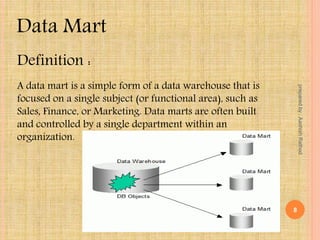
Data Mart
Definition :
A data mart is a simple form of a data warehouse that is
focused on a single subject (or functional area), such as
Sales, Finance, or Marketing. Data marts are often built
and controlled by a single department within an
organization.
8
preparedby:AashishRathod
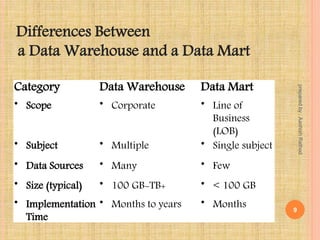
Category Data Warehouse Data Mart
• Scope • Corporate • Line of
Business
(LOB)
• Subject • Multiple • Single subject
• Data Sources • Many • Few
• Size (typical) • 100 GB-TB+ • < 100 GB
• Implementation
Time
• Months to years • Months
Differences Between
a Data Warehouse and a Data Mart
9
preparedby:AashishRathod
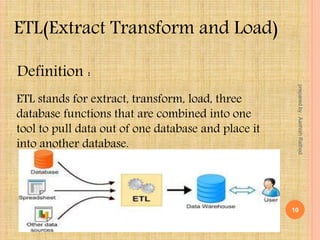
ETL(Extract Transform and Load)
Definition :
ETL stands for extract, transform, load, three
database functions that are combined into one
tool to pull data out of one database and place it
into another database.
10
preparedby:AashishRathod
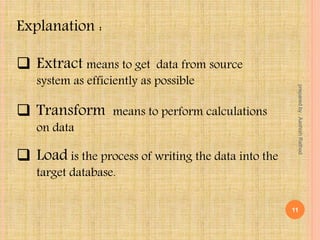
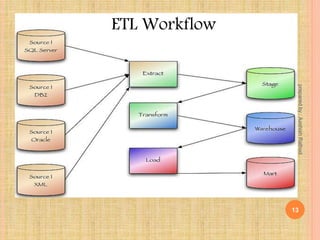
 Extract means to get data from source
system as efficiently as possible
 Transform means to perform calculations
on data
 Load is the process of writing the data into the
target database.
Explanation :
11
preparedby:AashishRathod
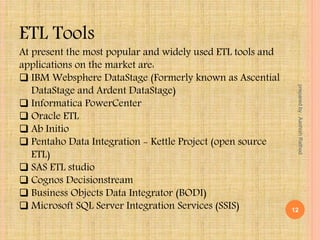
ETL Tools
At present the most popular and widely used ETL tools and
applications on the market are:
 IBM Websphere DataStage (Formerly known as Ascential
DataStage and Ardent DataStage)
 Informatica PowerCenter
 Oracle ETL
 Ab Initio
 Pentaho Data Integration - Kettle Project (open source
ETL)
 SAS ETL studio
 Cognos Decisionstream
 Business Objects Data Integrator (BODI)
 Microsoft SQL Server Integration Services (SSIS) 12
preparedby:AashishRathod
ETL Workflow
13
preparedby:AashishRathod
14
Thank You…
Have a Nice Day…!

data warehouse , data mart, etl

  • 1.
  • 2.
    Data Warehouse A datawarehouse is a subject-oriented, integrated, time-variant and non-volatile collection of data in support of management's decision making process. Definition : 2 preparedby:AashishRathod
  • 3.
     Subject-Oriented: Adata warehouse can be used to analyze a particular subject area. For example, "sales" can be a particular subject.  Integrated: A data warehouse integrates data from multiple data sources. For example, source A and source B may have different ways of identifying a product, but in a data warehouse, there will be only a single way of identifying a product. Explanation : 3 preparedby:AashishRathod
  • 4.
     Time-Variant: Historicaldata is kept in a data warehouse. For example, one can retrieve data from 3 months, 6 months, 12 months, or even older data from a data warehouse. This contrasts with a transactions system, where often only the most recent data is kept. For example, a transaction system may hold the most recent address of a customer, where a data warehouse can hold all addresses associated with a customer.  Non-volatile: Once data is in the data warehouse, it will not change. So, historical data in a data warehouse should never be altered. 4 preparedby:AashishRathod
  • 5.
    Benefits of aData Warehouse  A Data Warehouse Delivers Enhanced Business Intelligence By providing data from various sources, managers and executives will no longer need to make business decisions based on limited data or their gut. In addition, “data warehouses and related BI can be applied directly to business processes including marketing segmentation, inventory management, financial management, and sales.” 5 preparedby:AashishRathod
  • 6.
     A DataWarehouse Saves Time Since business users can quickly access critical data from a number of sources—all in one place—they can rapidly make informed decisions on key initiatives.  A Data Warehouse Enhances Data Quality and Consistency A data warehouse implementation includes the conversion of data from numerous source systems into a common format. Since each data from the various departments is standardized, each department will produce results that are in line with all the other departments. 6 preparedby:AashishRathod
  • 7.
     A DataWarehouse Provides Historical Intelligence A data warehouse stores large amounts of historical data so you can analyze different time periods and trends in order to make future predictions. Such data typically cannot be stored in a transactional database or used to generate reports from a transactional system.  A Data Warehouse Generates a High ROI Finally, the piece de resistance—return on investment. Companies that have implemented data warehouses and complementary BI systems have generated more revenue and saved more money than companies that haven’t invested in BI systems and data warehouses. 7 preparedby:AashishRathod
  • 8.
    Data Mart Definition : Adata mart is a simple form of a data warehouse that is focused on a single subject (or functional area), such as Sales, Finance, or Marketing. Data marts are often built and controlled by a single department within an organization. 8 preparedby:AashishRathod
  • 9.
    Category Data WarehouseData Mart • Scope • Corporate • Line of Business (LOB) • Subject • Multiple • Single subject • Data Sources • Many • Few • Size (typical) • 100 GB-TB+ • < 100 GB • Implementation Time • Months to years • Months Differences Between a Data Warehouse and a Data Mart 9 preparedby:AashishRathod
  • 10.
    ETL(Extract Transform andLoad) Definition : ETL stands for extract, transform, load, three database functions that are combined into one tool to pull data out of one database and place it into another database. 10 preparedby:AashishRathod
  • 11.
     Extract meansto get data from source system as efficiently as possible  Transform means to perform calculations on data  Load is the process of writing the data into the target database. Explanation : 11 preparedby:AashishRathod
  • 12.
    ETL Tools At presentthe most popular and widely used ETL tools and applications on the market are:  IBM Websphere DataStage (Formerly known as Ascential DataStage and Ardent DataStage)  Informatica PowerCenter  Oracle ETL  Ab Initio  Pentaho Data Integration - Kettle Project (open source ETL)  SAS ETL studio  Cognos Decisionstream  Business Objects Data Integrator (BODI)  Microsoft SQL Server Integration Services (SSIS) 12 preparedby:AashishRathod
  • 13.
  • 14.