Home of Quality Education
JAMHURIYA UNIVERSITY OF SCIENCE
AND TECHNOLOGY
EE226 Introduction to
Telecommunications
Instructor: Bashir Abdirahman Hussein
Signals Carried over the
Network
Home of Quality Education
JAMHURIYA UNIVERSITY OF SCIENCE
AND TECHNOLOGY
Signals Carried over the Network
 Services that the telecommunications networks provide have
different characteristics.
 Required characteristics depend on the applications we use.
 To meet these different requirements, many different network
technologies that are optimized for each type of service are in use.
 To understand the present structure of the telecommunications
network, we have to understand what types of signals are
transmitted through the telecommunications network and their
requirements.
3.1 Types of Information and Their
Requirements
In this chapter we look at the requirements of various applications,
characteristics of analog voice channels, fundamental differences between
analog and digital signals, analog-to-digital conversion, and a logarithmic
measure of signal level, the decibel.
Modern digital networks transmit digital information transparently; that is,
the network does not necessarily need to know what kind of information the
data contain.
The information that is transmitted through the network may be any one of
the following:
• Speech (telephony, fixed, or cellular);
• Moving images (television or video);
• Printed pages or still picture (facsimile or multimedia messaging);
• Text (electronic mail or short text messaging);
• Music;
• All types of computer information such as program files.
Cont.…
Cont.…
 For digital transmission, analog signals such as speech are encoded
into digital form and transmitted through the network as a sequence
of bits in the same way computer files are transmitted.
 However, although all information is coded into digital form, the
transmission requirements are highly dependent on the application;
because of these different requirements, different networks and
technologies are in use. Video and e-mail applications, for example,
require different architectures.
 Network technologies have taken two main development paths: one
for speech services and another for data services.
 The telephone network and the Integrated Services Digital Network
(ISDN) have been developed for constant-bit-rate voice
communication that is well suited to speech transmission.
 Data networks such as LANs and the Internet have been developed
for bursty data transmission
Cont.…
 The constant-bit-rate requirement for speech follows from the
principle that digitized voice signals have traditionally been
transmitted in digital form as samples at regular intervals,
 When many different applications are integrated into multimedia
communications, both basic types of service requirements of
constant-bit-rate voice and bursty data have to be fulfilled and we
need a concept that is able to meet both types of requirements.
Cont.…
Data Rate or Bandwidth Requirement
Voice communication usually requires a constant data rate of 64 Kbps or
less and high-resolution video a constant data rate of 2 Mbps or higher over
the network.
Characteristics of data communication are very different, for example, file
transfer requires high-bit-rate transmission only during download, and
high-resolution graphics on a Web page require high-data-rate transmission
only when we download a new page. When we are reading a Web page we
do not need transmission capacity at all.
To define data transmission capacity, we sometimes use the term bandwidth
instead of data rate these terms are closely related to each other
Data Loss Tolerance
 Noise and other disturbances in the network may cause errors in the
transmitted data. If errors occur, some amount of data may be lost.
 Voice and video transmission services are used by human beings, and
they can tolerate accidental short disturbances.
 In computer communications a single erroneous bit usually destroys a
whole data frame, which may contain a large amount of data.
 The loss of one frame destroys the transmission of a large file that is
transferred in multiple frames.
3.2 Simplex, Half-Duplex, and Full-Duplex
Communication
In telecommunications systems the transmission of information may
be unidirectional or bidirectional.
The unidirectional systems that transmit in one direction only are
called simplex, and the bidirectional systems that are able to transmit
in both directions are called duplex systems. We can implement
bidirectional information transfer with half- or full-duplex
transmission as shown in Figure 3.1.
 In simplex operation the signal is transmitted in one direction only. An
example of this principle is broadcast television, where TV signals are
sent from a transmitter to TV sets only and not in the other direction.
Another example is a paging system that allows a user to receive only
alphanumerical messages.
 In half-duplex operation the signal is transmitted in both directions but
only in one direction at a time. An example of this is a mobile radio
system, LANs use a high-speed, half-duplex transmission over the cable
even though users may feel that the communication is continuously
bidirectional, that is, full duplex.
Cont.…
 In full-duplex operation signals are transmitted in both directions at
the same time. An example of this is an ordinary telephone
conversation where it is possible for both people to speak
simultaneously.
 Most modern telecommunications systems use the full-duplex
principle, which we call duplex operation for short.
Cont.…
3.3 Frequency and Bandwidth
 To understand the requirements of different applications for a
telecommunications network, we must understand the fundamental
concepts of frequency and bandwidth.
 The information that we transmit through a telecommunications
network, whether it is analog or digital, is in the form of electrical
voltage or current. The value of this voltage or current changes
through time, and this alteration contains information.
 The transmitted signal (the alteration of voltage or current) consists
of multiple frequencies. The range of frequencies is called the
bandwidth of the signal.
 The bandwidth is one of the most important characteristics of
analog information and it is also the most important limiting factor
for the data rate of digital information transfer.
 The frequency refers to the number of cycles through with the wave
oscillates in a second.
Cont.…
The periodic time or
period T in seconds
represents the time of
one complete cycle:
Wavelength λ represents
the propagation distance
in one cycle time, thus,
 The range of frequencies that is needed for a good enough quality of
voice, so that the speaker can be recognized, was defined to be the
range from 300 to 3,400 Hz. This means that the bandwidth of the
telephone channel through the network is 3,400 – 300 Hz = 3.1
kHz, as shown in Figure 3.3.
 A human voice contains much higher frequencies, but this
bandwidth was defined as a compromise between quality and cost.
It is wide enough to recognize the speaker, which was one
requirement for telephone channel.
Cont.…
Bandwidth, together
with noise, is the
major factor that
determines the
information carrying
capacity of a
telecommunications
channel.
3.4 Analog and Digital Signals and Systems
Most of the systems in the modern telecommunications network are
digital instead of analog.
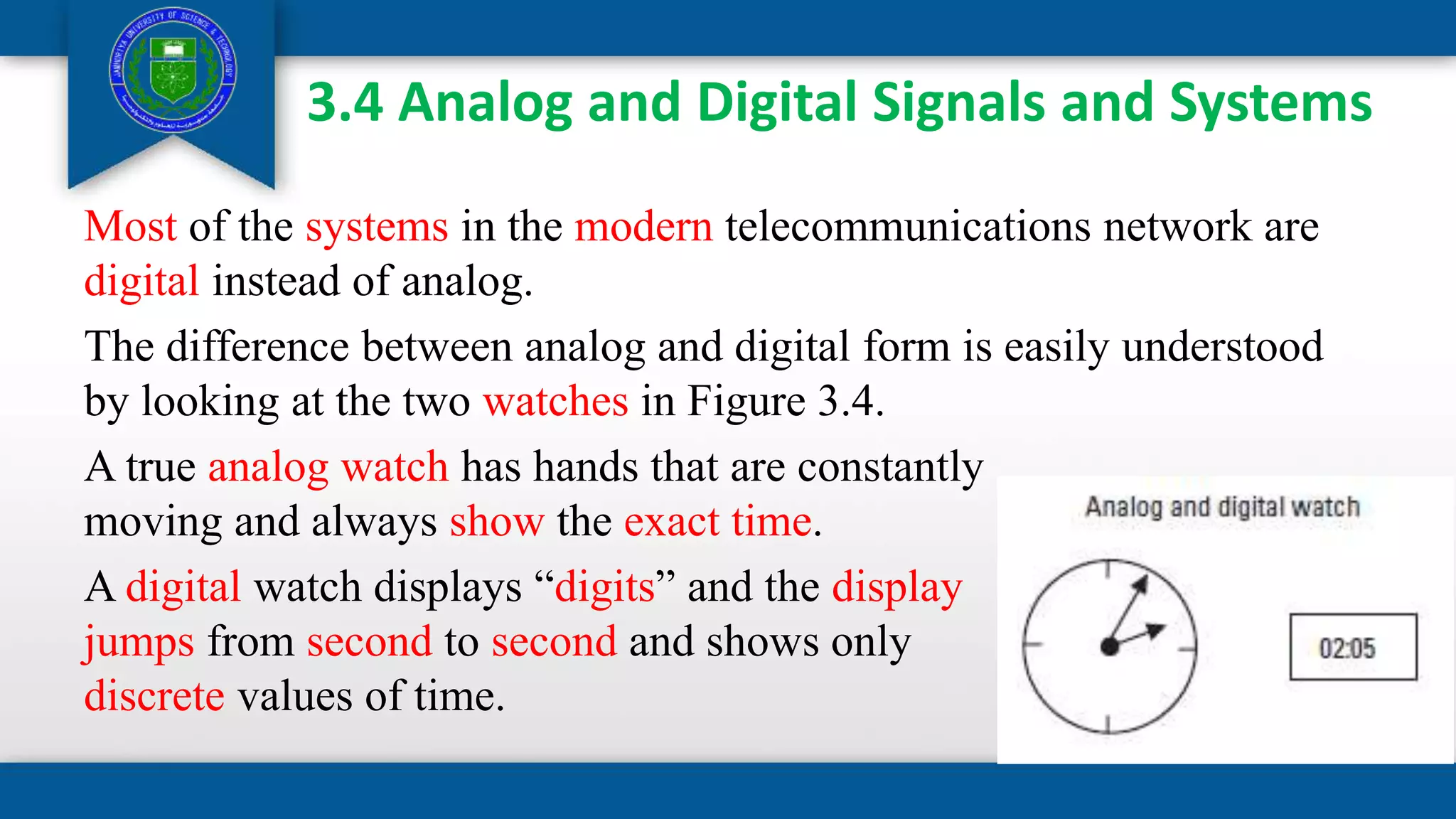
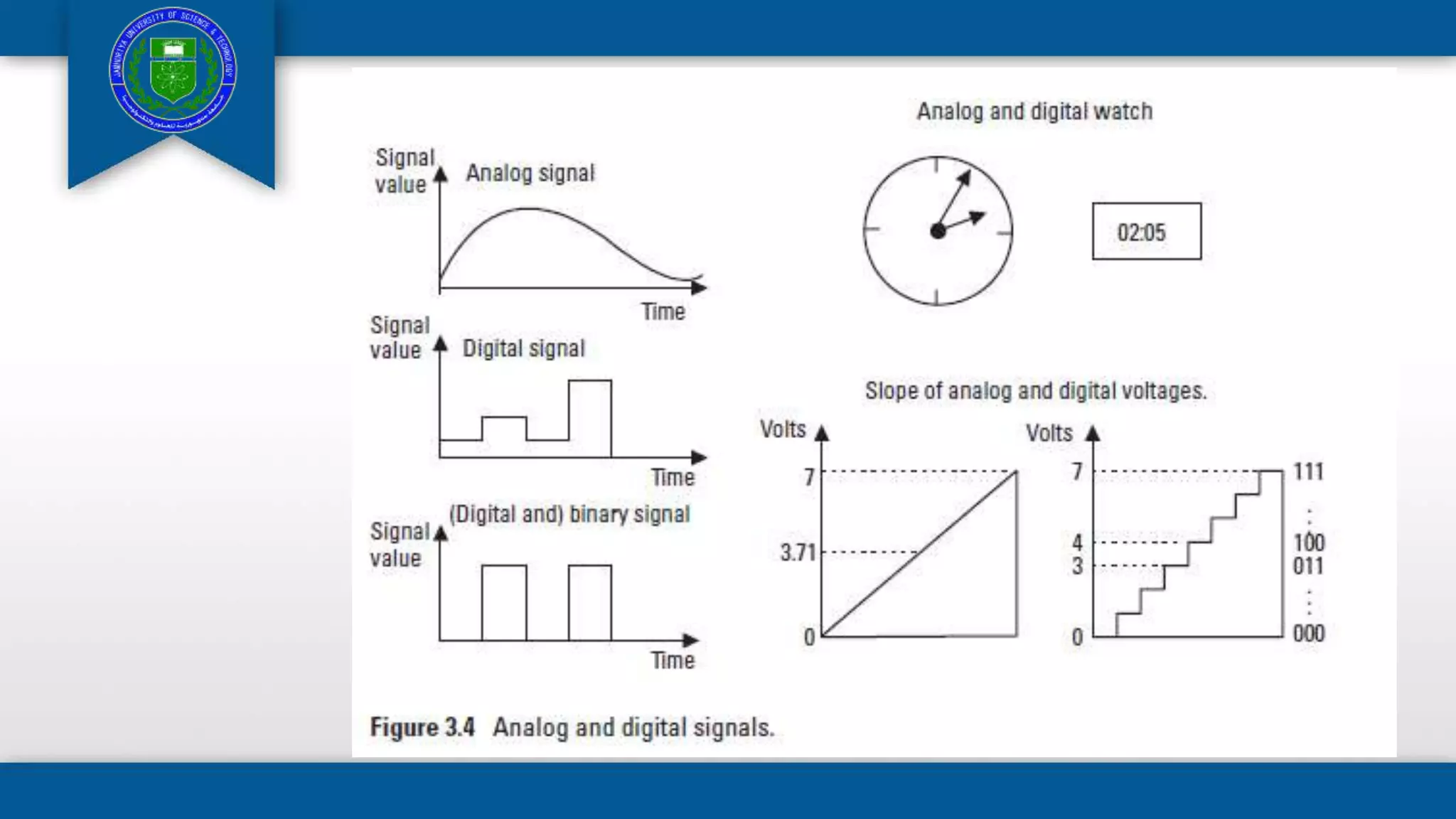
The difference between analog and digital form is easily understood
by looking at the two watches in Figure 3.4.
A true analog watch has hands that are constantly
moving and always show the exact time.
A digital watch displays “digits” and the display
jumps from second to second and shows only
discrete values of time.
 A special and very important case of digital signals is a binary signal
where only two values, binary digits 0 and 1, are present as illustrated
in Figure 3.4.
 Examples of binary signals are light on and off, voltage versus no
voltage, and low current versus high current.
 Binary signals are used internally in computers and other digital
systems to represent any digital signal. For example, we can encode
eight voltage levels of the slope in Figure 3.4 into three binary bits and
each of these three bit words then represents one of the 23
=
8 (0 (000) 𝑡𝑜 7 (111)) different values.
Advantages of Digital Technology
 Analog systems in a telecommunications network have gradually
been replaced with digital systems.
 Development of digital circuits and software technologies has made
digital systems more and more attractive.
 The most important advantages of digital technology over analog
technology are as follows:
 Digital functions make a high scale of integration possible.
 Digital technology results in lower cost, better reliability, less
floor space, and lower power consumption.
Cont…
Digital technology makes communication quality independent
of distance.
Digital technology provides better noise tolerance.
Digital technology makes new services available.
Digital system provides high transmission capacity.
Digital networks offer flexibility.
3.4.3 Examples of Messages
• There are many different information sources, including machines as
well as people, and messages or signals appear in various forms.
• As for signals we can identify the two main distinct message categories:
analog and digital.
• The concept of information is central to communication. However,
information is a loaded word, implying schematic and philosophical
notions and, therefore, we prefer to use the word message instead.
Message means the physical manifestation of information produced by
a source. Systems handling messages convert them into electrical
signals suitable for a certain transmission media.
Analog Message vs Digital message
• An analog message is a physical quantity that varies through time,
usually in a smooth and continuous fashion. Examples of analog
messages are acoustic pressure produced when you speak.
• A digital message is an ordered sequence of symbols selected from a
finite set of discrete elements. Examples of digital messages are the
letters printed on this page or the keys you press at a computer
keyboard. When you press a key at your computer keyboard, each key
stroke represents a digital message that is then encoded into a set of
bits for binary transmission.
3.5 Analog Signals over Digital Networks
• Analog-to-digital conversion (A/D): An analog signal is sampled at the
sampling frequency and the sample values are then represented as
numerical values by the encoder. These values, presented as binary words,
are then transmitted within regular time periods through the digital channel.
• Digital-to-analog conversion (D/A): At the other end of the channel, the
decoder receives numerical values of the samples that indicate the values of
the analog signal at sampling instants. The sample pulses that have
amplitudes corresponding to the values of the original signal at sampling
instants are reconstructed and the series they form is filtered to produce an
analog signal close to the original one.
3.6 Pulse Code Modulation (PCM)
• PCM is a standardized method that is used in the telephone network
to change an analog signal to a digital one for transmission through
the digital telecommunications network. The analog signal is first
sampled at a 8-kHz sampling rate; then each sample is quantized into
1 of 256 levels and then encoded into digital eight-bit words.
• The Pulse Code Modulation process is done through the following
Phases:
• Sampling
• Quantization
• Binary Coding
Cont….
• Now we take a more detailed look at the three main processing phases
of the PCM in the telecommunications network. Note that this
principle is employed by all systems when there is a need to process
analog signals with a digital system. Sampling rates and the number of
quantizing levels vary from application to application, but the basic
principle and phases of the process remain the same.
3.6.1 Sampling
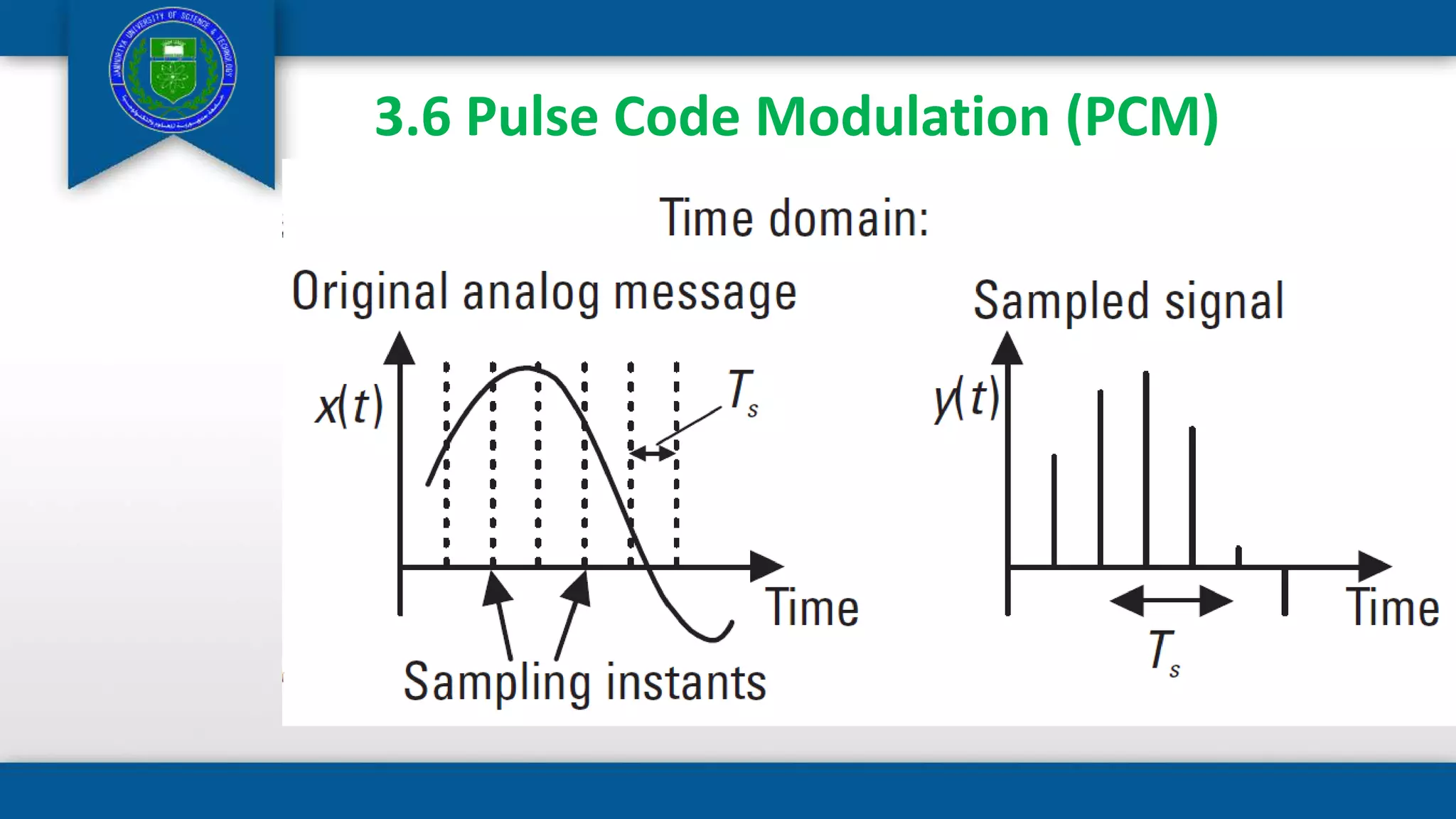
• The amplitude of an analog signal is sampled first. The more samples
per second there are, the more representative of the analog signal the
set of samples will be.
• After sampling, the signal value is known only at discrete points in
time, called sampling instants.
• In the sampling process, a Pulse Amplitude Modulated (PAM) signal
is created. The amplitudes of PAM pulses follow the original analog
signal. Note that the samples are still analog, having any analog value
between the minimum and maximum values of the original signal.
3.6 Pulse Code Modulation (PCM)
3.6.2 Quantizing
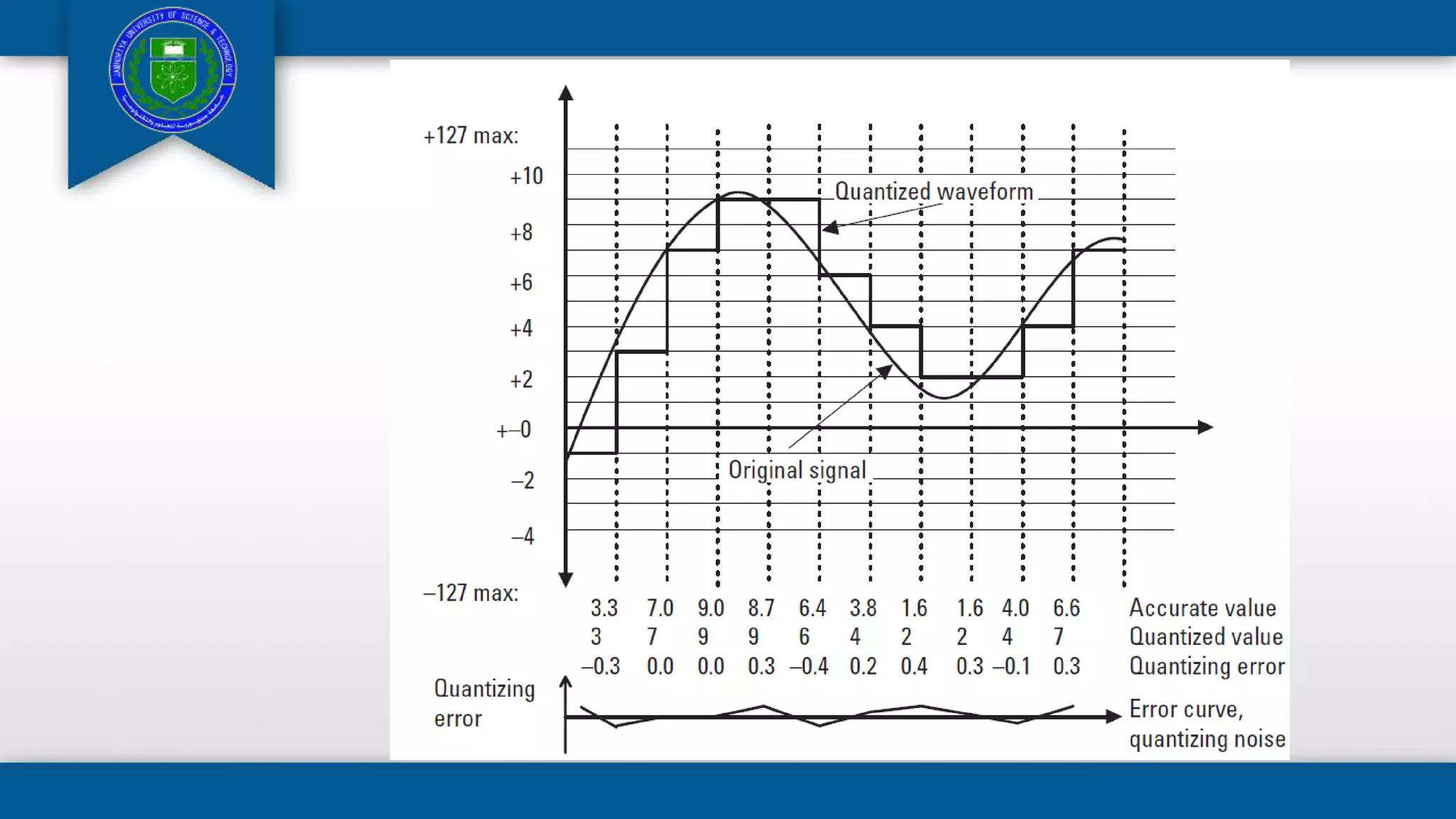
• In the previous section we utilized sampling that produces a PAM
signal that represents discrete but still analog values of the original
analog message at the sampling instants. To transmit the sample values
via a digital system, we have to represent each sample value in
numerical form. This requires quantizing where each accurate sample
value is rounded off to the closest numerical value in a set of digital
words in use.
3.6.2 Quantizing
• In this quantizing process the information in accurate signal values is
lost because of rounding off and the original signal cannot be
reproduced exactly any more. The quality of the coding depends on the
number of quantum levels that is defined to provide the required
performance. The more quantum levels we use, the better performance
we get. For example, for a voice signal 256 levels (8-bit binary words)
are adequate, but for music encoding (CD recording) 65,536 levels (16-
bit binary word) are needed to give sufficient performance.
3.6.6 Binary Coding
• Finally, in the PCM encoding process each sample is represented as
one in the set of eight-bit binary words.
3.8 Power Levels of Signals and Decibels
• Decibel is a measure of signal level and its change.
• We use this logarithmic measure or its variants in the
telecommunications network for many purposes, for example, to
express the voice level or the transmission and reception power of
radio systems, such as mobile telephones, or an optical line system.
3.8.1 Decibel, Gain, and Loss
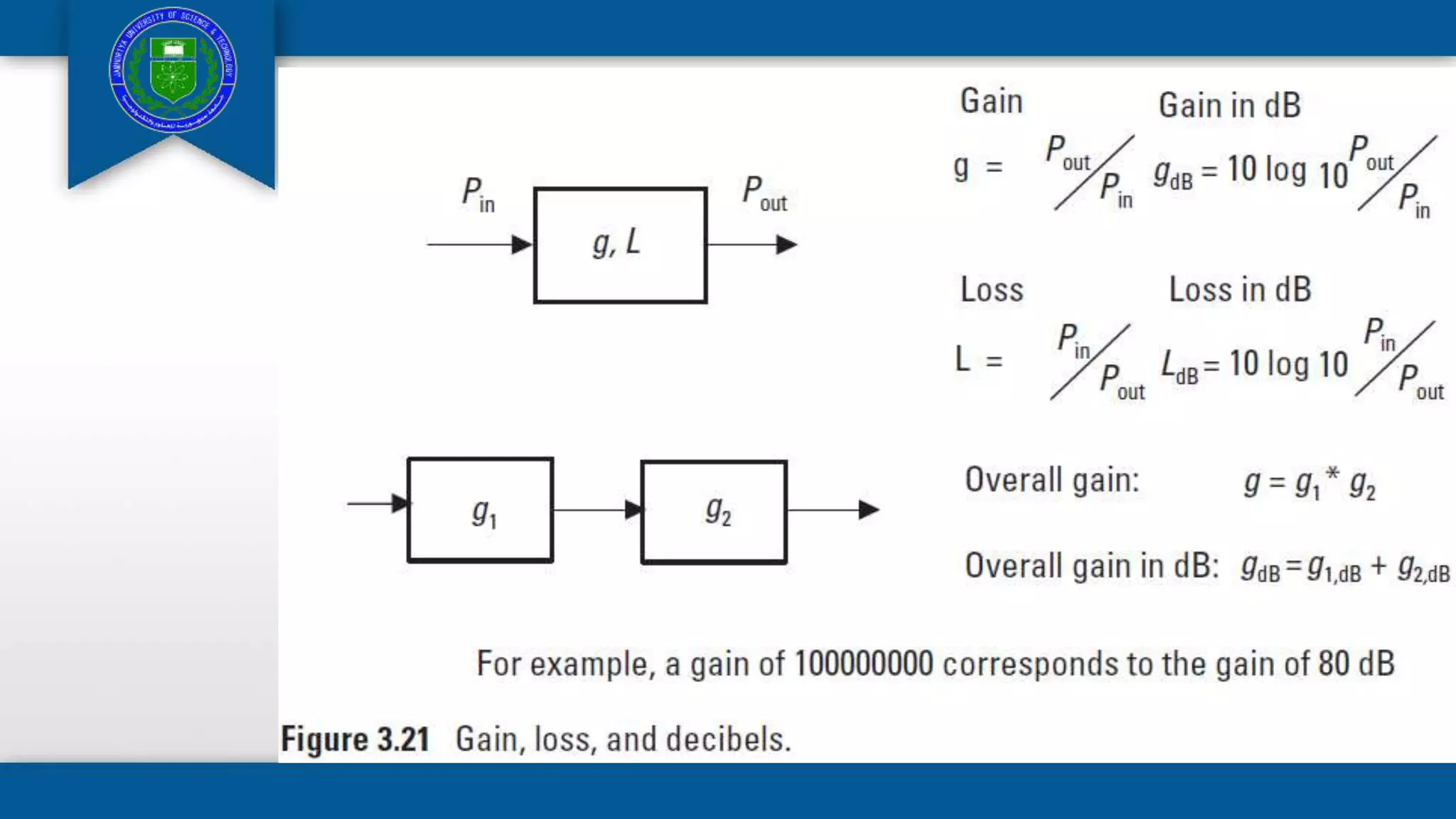
• Along the long-distance communication connection or channel, the power
of the signal is reduced and amplified over and over again.
• The signal power needs to be rigidly controlled to keep it high enough in
relation to background noise and low enough to avoid system overload and
resulting distortion.
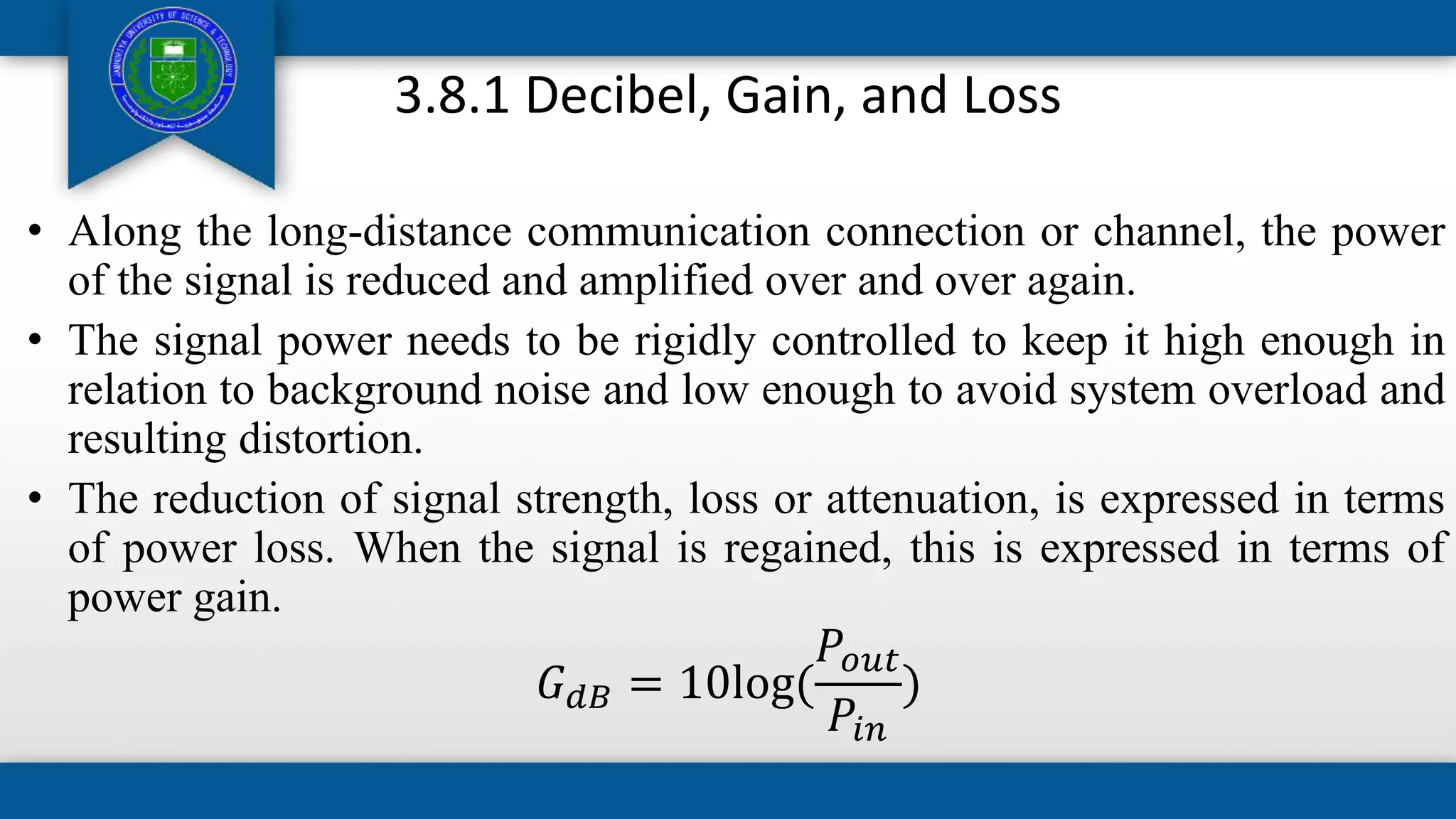
• The reduction of signal strength, loss or attenuation, is expressed in terms
of power loss. When the signal is regained, this is expressed in terms of
power gain.
𝐺𝑑𝐵 = 10log(
𝑃𝑜𝑢𝑡
𝑃𝑖𝑛
)
Power Levels
• Instead of expressing the actual power in watts, we can use the decibel-
based. Power levels in practical systems may vary from pico-watts to tens
of watts.
• The level of absolute power is often expressed in dBm, where the actual
power is compared to 1-mW power. The power level in dBm is given by
the expression 10 log10(𝑃/1 𝑚𝑊) dBm.
• Absolute power level dBm is commonly used instead of the absolute
power in watts to express, for example, the optical output and received
power of optical line systems or the received radio signal strength of a
mobile telephone.
•𝑃𝑑𝐵 = 10 log10(𝑃𝑊𝑎𝑡𝑡)
•𝑃𝑑𝐵𝑚 = 10 log10(
𝑃𝑊𝑎𝑡𝑡
1 𝑚𝑊
)
•𝑃𝑑𝐵𝑚 = 𝑃𝑑𝐵 + 30
Example
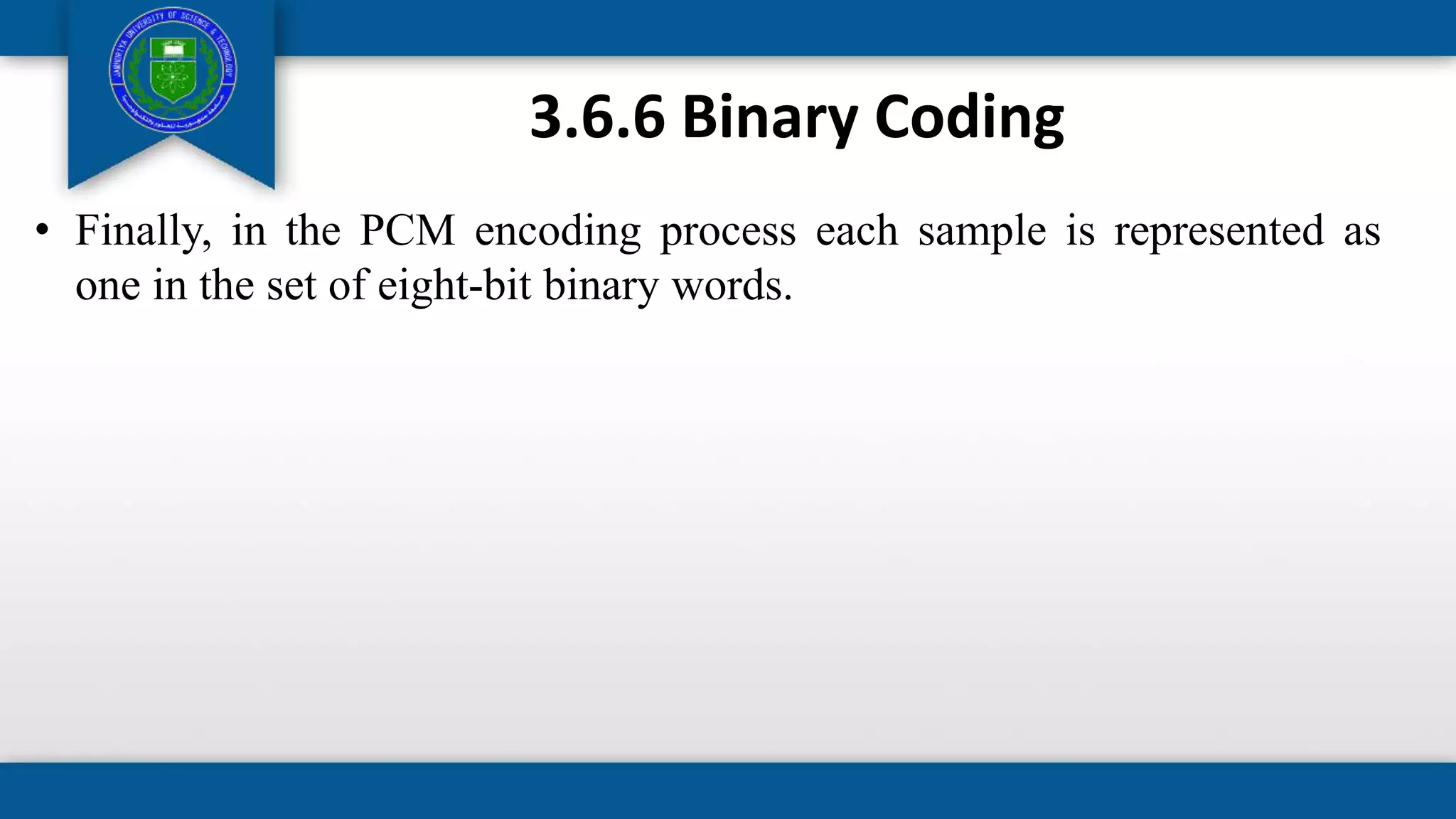
• A radio relay system has antenna gains and radio link loss as shown in
Figure 3.22. determine the received power level in 𝑑𝐵𝑚
• 𝑃1𝑑𝐵 = 0 𝑑𝐵, 𝑃𝑑𝐵𝑚 = 30
• 𝑃2 𝑑𝐵𝑚 = 𝑃1𝑑𝐵𝑚 + 𝑔𝑡𝑑𝐵 − 𝐿𝑑𝐵 + 𝑔𝑟𝑑𝐵 = 30 + 30 − 110 + 30 =
− 20 𝑑𝐵𝑚
Example
Example
• The input power of an amplifier is 2 mW and output power is 1W.
• What are the power levels (dBm) at the input and output and
• What is the gain of the amplifier in decibels?
• 𝑃𝑖𝑑𝐵𝑚
= 10 log10(
2𝑚𝑊
1 𝑚𝑊
) = 3.01 𝑑𝐵𝑚
𝑃𝑜𝑑𝐵𝑚
= 10 log10(
1𝑊
1 𝑚𝑊
) = 30 𝑑𝐵𝑚
• 𝐺𝑑𝐵 = 𝑃𝑜𝑑𝐵𝑚
− 𝑃𝑖𝑑𝐵𝑚
= 30 − 3.01 = 26.99 𝑑𝐵

Ch#3.pptx

  • 1.
    Home of QualityEducation JAMHURIYA UNIVERSITY OF SCIENCE AND TECHNOLOGY EE226 Introduction to Telecommunications Instructor: Bashir Abdirahman Hussein
  • 2.
    Signals Carried overthe Network Home of Quality Education JAMHURIYA UNIVERSITY OF SCIENCE AND TECHNOLOGY
  • 3.
    Signals Carried overthe Network  Services that the telecommunications networks provide have different characteristics.  Required characteristics depend on the applications we use.  To meet these different requirements, many different network technologies that are optimized for each type of service are in use.  To understand the present structure of the telecommunications network, we have to understand what types of signals are transmitted through the telecommunications network and their requirements.
  • 4.
    3.1 Types ofInformation and Their Requirements In this chapter we look at the requirements of various applications, characteristics of analog voice channels, fundamental differences between analog and digital signals, analog-to-digital conversion, and a logarithmic measure of signal level, the decibel. Modern digital networks transmit digital information transparently; that is, the network does not necessarily need to know what kind of information the data contain.
  • 5.
    The information thatis transmitted through the network may be any one of the following: • Speech (telephony, fixed, or cellular); • Moving images (television or video); • Printed pages or still picture (facsimile or multimedia messaging); • Text (electronic mail or short text messaging); • Music; • All types of computer information such as program files. Cont.…
  • 6.
    Cont.…  For digitaltransmission, analog signals such as speech are encoded into digital form and transmitted through the network as a sequence of bits in the same way computer files are transmitted.  However, although all information is coded into digital form, the transmission requirements are highly dependent on the application; because of these different requirements, different networks and technologies are in use. Video and e-mail applications, for example, require different architectures.
  • 7.
     Network technologieshave taken two main development paths: one for speech services and another for data services.  The telephone network and the Integrated Services Digital Network (ISDN) have been developed for constant-bit-rate voice communication that is well suited to speech transmission.  Data networks such as LANs and the Internet have been developed for bursty data transmission Cont.…
  • 8.
     The constant-bit-raterequirement for speech follows from the principle that digitized voice signals have traditionally been transmitted in digital form as samples at regular intervals,  When many different applications are integrated into multimedia communications, both basic types of service requirements of constant-bit-rate voice and bursty data have to be fulfilled and we need a concept that is able to meet both types of requirements. Cont.…
  • 9.
    Data Rate orBandwidth Requirement Voice communication usually requires a constant data rate of 64 Kbps or less and high-resolution video a constant data rate of 2 Mbps or higher over the network. Characteristics of data communication are very different, for example, file transfer requires high-bit-rate transmission only during download, and high-resolution graphics on a Web page require high-data-rate transmission only when we download a new page. When we are reading a Web page we do not need transmission capacity at all. To define data transmission capacity, we sometimes use the term bandwidth instead of data rate these terms are closely related to each other
  • 10.
    Data Loss Tolerance Noise and other disturbances in the network may cause errors in the transmitted data. If errors occur, some amount of data may be lost.  Voice and video transmission services are used by human beings, and they can tolerate accidental short disturbances.  In computer communications a single erroneous bit usually destroys a whole data frame, which may contain a large amount of data.  The loss of one frame destroys the transmission of a large file that is transferred in multiple frames.
  • 11.
    3.2 Simplex, Half-Duplex,and Full-Duplex Communication In telecommunications systems the transmission of information may be unidirectional or bidirectional. The unidirectional systems that transmit in one direction only are called simplex, and the bidirectional systems that are able to transmit in both directions are called duplex systems. We can implement bidirectional information transfer with half- or full-duplex transmission as shown in Figure 3.1.
  • 12.
     In simplexoperation the signal is transmitted in one direction only. An example of this principle is broadcast television, where TV signals are sent from a transmitter to TV sets only and not in the other direction. Another example is a paging system that allows a user to receive only alphanumerical messages.  In half-duplex operation the signal is transmitted in both directions but only in one direction at a time. An example of this is a mobile radio system, LANs use a high-speed, half-duplex transmission over the cable even though users may feel that the communication is continuously bidirectional, that is, full duplex. Cont.…
  • 14.
     In full-duplexoperation signals are transmitted in both directions at the same time. An example of this is an ordinary telephone conversation where it is possible for both people to speak simultaneously.  Most modern telecommunications systems use the full-duplex principle, which we call duplex operation for short. Cont.…
  • 16.
    3.3 Frequency andBandwidth  To understand the requirements of different applications for a telecommunications network, we must understand the fundamental concepts of frequency and bandwidth.  The information that we transmit through a telecommunications network, whether it is analog or digital, is in the form of electrical voltage or current. The value of this voltage or current changes through time, and this alteration contains information.
  • 17.
     The transmittedsignal (the alteration of voltage or current) consists of multiple frequencies. The range of frequencies is called the bandwidth of the signal.  The bandwidth is one of the most important characteristics of analog information and it is also the most important limiting factor for the data rate of digital information transfer.  The frequency refers to the number of cycles through with the wave oscillates in a second. Cont.…
  • 18.
    The periodic timeor period T in seconds represents the time of one complete cycle: Wavelength λ represents the propagation distance in one cycle time, thus,
  • 19.
     The rangeof frequencies that is needed for a good enough quality of voice, so that the speaker can be recognized, was defined to be the range from 300 to 3,400 Hz. This means that the bandwidth of the telephone channel through the network is 3,400 – 300 Hz = 3.1 kHz, as shown in Figure 3.3.  A human voice contains much higher frequencies, but this bandwidth was defined as a compromise between quality and cost. It is wide enough to recognize the speaker, which was one requirement for telephone channel. Cont.…
  • 20.
    Bandwidth, together with noise,is the major factor that determines the information carrying capacity of a telecommunications channel.
  • 21.
    3.4 Analog andDigital Signals and Systems Most of the systems in the modern telecommunications network are digital instead of analog. The difference between analog and digital form is easily understood by looking at the two watches in Figure 3.4. A true analog watch has hands that are constantly moving and always show the exact time. A digital watch displays “digits” and the display jumps from second to second and shows only discrete values of time.
  • 22.
     A specialand very important case of digital signals is a binary signal where only two values, binary digits 0 and 1, are present as illustrated in Figure 3.4.  Examples of binary signals are light on and off, voltage versus no voltage, and low current versus high current.  Binary signals are used internally in computers and other digital systems to represent any digital signal. For example, we can encode eight voltage levels of the slope in Figure 3.4 into three binary bits and each of these three bit words then represents one of the 23 = 8 (0 (000) 𝑡𝑜 7 (111)) different values.
  • 24.
    Advantages of DigitalTechnology  Analog systems in a telecommunications network have gradually been replaced with digital systems.  Development of digital circuits and software technologies has made digital systems more and more attractive.  The most important advantages of digital technology over analog technology are as follows:  Digital functions make a high scale of integration possible.  Digital technology results in lower cost, better reliability, less floor space, and lower power consumption.
  • 25.
    Cont… Digital technology makescommunication quality independent of distance. Digital technology provides better noise tolerance. Digital technology makes new services available. Digital system provides high transmission capacity. Digital networks offer flexibility.
  • 26.
    3.4.3 Examples ofMessages • There are many different information sources, including machines as well as people, and messages or signals appear in various forms. • As for signals we can identify the two main distinct message categories: analog and digital. • The concept of information is central to communication. However, information is a loaded word, implying schematic and philosophical notions and, therefore, we prefer to use the word message instead. Message means the physical manifestation of information produced by a source. Systems handling messages convert them into electrical signals suitable for a certain transmission media.
  • 27.
    Analog Message vsDigital message • An analog message is a physical quantity that varies through time, usually in a smooth and continuous fashion. Examples of analog messages are acoustic pressure produced when you speak. • A digital message is an ordered sequence of symbols selected from a finite set of discrete elements. Examples of digital messages are the letters printed on this page or the keys you press at a computer keyboard. When you press a key at your computer keyboard, each key stroke represents a digital message that is then encoded into a set of bits for binary transmission.
  • 29.
    3.5 Analog Signalsover Digital Networks • Analog-to-digital conversion (A/D): An analog signal is sampled at the sampling frequency and the sample values are then represented as numerical values by the encoder. These values, presented as binary words, are then transmitted within regular time periods through the digital channel. • Digital-to-analog conversion (D/A): At the other end of the channel, the decoder receives numerical values of the samples that indicate the values of the analog signal at sampling instants. The sample pulses that have amplitudes corresponding to the values of the original signal at sampling instants are reconstructed and the series they form is filtered to produce an analog signal close to the original one.
  • 31.
    3.6 Pulse CodeModulation (PCM) • PCM is a standardized method that is used in the telephone network to change an analog signal to a digital one for transmission through the digital telecommunications network. The analog signal is first sampled at a 8-kHz sampling rate; then each sample is quantized into 1 of 256 levels and then encoded into digital eight-bit words. • The Pulse Code Modulation process is done through the following Phases: • Sampling • Quantization • Binary Coding
  • 32.
    Cont…. • Now wetake a more detailed look at the three main processing phases of the PCM in the telecommunications network. Note that this principle is employed by all systems when there is a need to process analog signals with a digital system. Sampling rates and the number of quantizing levels vary from application to application, but the basic principle and phases of the process remain the same.
  • 33.
    3.6.1 Sampling • Theamplitude of an analog signal is sampled first. The more samples per second there are, the more representative of the analog signal the set of samples will be. • After sampling, the signal value is known only at discrete points in time, called sampling instants. • In the sampling process, a Pulse Amplitude Modulated (PAM) signal is created. The amplitudes of PAM pulses follow the original analog signal. Note that the samples are still analog, having any analog value between the minimum and maximum values of the original signal.
  • 34.
    3.6 Pulse CodeModulation (PCM)
  • 35.
    3.6.2 Quantizing • Inthe previous section we utilized sampling that produces a PAM signal that represents discrete but still analog values of the original analog message at the sampling instants. To transmit the sample values via a digital system, we have to represent each sample value in numerical form. This requires quantizing where each accurate sample value is rounded off to the closest numerical value in a set of digital words in use.
  • 37.
    3.6.2 Quantizing • Inthis quantizing process the information in accurate signal values is lost because of rounding off and the original signal cannot be reproduced exactly any more. The quality of the coding depends on the number of quantum levels that is defined to provide the required performance. The more quantum levels we use, the better performance we get. For example, for a voice signal 256 levels (8-bit binary words) are adequate, but for music encoding (CD recording) 65,536 levels (16- bit binary word) are needed to give sufficient performance.
  • 38.
    3.6.6 Binary Coding •Finally, in the PCM encoding process each sample is represented as one in the set of eight-bit binary words.
  • 39.
    3.8 Power Levelsof Signals and Decibels • Decibel is a measure of signal level and its change. • We use this logarithmic measure or its variants in the telecommunications network for many purposes, for example, to express the voice level or the transmission and reception power of radio systems, such as mobile telephones, or an optical line system.
  • 40.
    3.8.1 Decibel, Gain,and Loss • Along the long-distance communication connection or channel, the power of the signal is reduced and amplified over and over again. • The signal power needs to be rigidly controlled to keep it high enough in relation to background noise and low enough to avoid system overload and resulting distortion. • The reduction of signal strength, loss or attenuation, is expressed in terms of power loss. When the signal is regained, this is expressed in terms of power gain. 𝐺𝑑𝐵 = 10log( 𝑃𝑜𝑢𝑡 𝑃𝑖𝑛 )
  • 42.
    Power Levels • Insteadof expressing the actual power in watts, we can use the decibel- based. Power levels in practical systems may vary from pico-watts to tens of watts. • The level of absolute power is often expressed in dBm, where the actual power is compared to 1-mW power. The power level in dBm is given by the expression 10 log10(𝑃/1 𝑚𝑊) dBm. • Absolute power level dBm is commonly used instead of the absolute power in watts to express, for example, the optical output and received power of optical line systems or the received radio signal strength of a mobile telephone.
  • 43.
    •𝑃𝑑𝐵 = 10log10(𝑃𝑊𝑎𝑡𝑡) •𝑃𝑑𝐵𝑚 = 10 log10( 𝑃𝑊𝑎𝑡𝑡 1 𝑚𝑊 ) •𝑃𝑑𝐵𝑚 = 𝑃𝑑𝐵 + 30
  • 45.
    Example • A radiorelay system has antenna gains and radio link loss as shown in Figure 3.22. determine the received power level in 𝑑𝐵𝑚 • 𝑃1𝑑𝐵 = 0 𝑑𝐵, 𝑃𝑑𝐵𝑚 = 30 • 𝑃2 𝑑𝐵𝑚 = 𝑃1𝑑𝐵𝑚 + 𝑔𝑡𝑑𝐵 − 𝐿𝑑𝐵 + 𝑔𝑟𝑑𝐵 = 30 + 30 − 110 + 30 = − 20 𝑑𝐵𝑚
  • 46.
  • 47.
    Example • The inputpower of an amplifier is 2 mW and output power is 1W. • What are the power levels (dBm) at the input and output and • What is the gain of the amplifier in decibels? • 𝑃𝑖𝑑𝐵𝑚 = 10 log10( 2𝑚𝑊 1 𝑚𝑊 ) = 3.01 𝑑𝐵𝑚 𝑃𝑜𝑑𝐵𝑚 = 10 log10( 1𝑊 1 𝑚𝑊 ) = 30 𝑑𝐵𝑚 • 𝐺𝑑𝐵 = 𝑃𝑜𝑑𝐵𝑚 − 𝑃𝑖𝑑𝐵𝑚 = 30 − 3.01 = 26.99 𝑑𝐵