Data structures is representation
of logical relationship exiting
between individual elements of
data
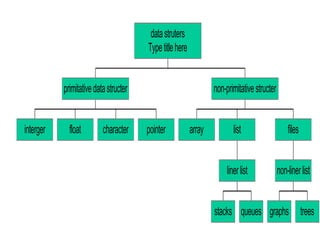
interger float character pointer
primitativedatastructer
array
stacks queues
linerlist
list
graphs trees
non-linerlist
files
non-primitativestructer
datastruters
Typetitlehere
Primitive data structure
• These are basic structures and directly
upon by the machine instructions.these in
general, have different representation on
different computers.
Non-primitive data structures
• These are more sophisticated data
structures. These are derived from
primitive data structures
• The non-primitive data structures
emphasize on structuring of a group of
homogeneous(same type) or non-
homogeneous(different type) data items.
stacks
• Stack is non-primitive linear data structures. It is
an ordered list in which addition of new data item
and deletion of already exiting data items is done
from only one end, know as top of stack (TOS).
• As all the deletion and insertion in a stack is done
from top of the stack ,the last added element will
be the first to be removed from the stack.
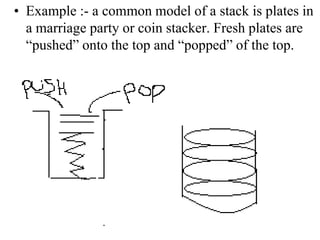
• Example :- a common model of a stack is plates in
a marriage party or coin stacker. Fresh plates are
“pushed” onto the top and “popped” of the top.

Data struters

  • 1.
    Data structures isrepresentation of logical relationship exiting between individual elements of data
  • 2.
    interger float characterpointer primitativedatastructer array stacks queues linerlist list graphs trees non-linerlist files non-primitativestructer datastruters Typetitlehere
  • 3.
    Primitive data structure •These are basic structures and directly upon by the machine instructions.these in general, have different representation on different computers.
  • 4.
    Non-primitive data structures •These are more sophisticated data structures. These are derived from primitive data structures • The non-primitive data structures emphasize on structuring of a group of homogeneous(same type) or non- homogeneous(different type) data items.
  • 5.
    stacks • Stack isnon-primitive linear data structures. It is an ordered list in which addition of new data item and deletion of already exiting data items is done from only one end, know as top of stack (TOS). • As all the deletion and insertion in a stack is done from top of the stack ,the last added element will be the first to be removed from the stack.
  • 6.
    • Example :-a common model of a stack is plates in a marriage party or coin stacker. Fresh plates are “pushed” onto the top and “popped” of the top.