 1. Computer system is used as Data Management
System where ‘Data’ are very important for it.

2. Data are aggregated and summarized in various
ways to form information.

3. All these factors very much depend on the way data
are aggregated.

4. The Data Structures are an effective and reliable way
to achieve this.

 "DATA STRUCTURE is a named group of data
of different data types which can be
processed as a single unit."

 While designing data structures, one must follow
the given steps:
 1. Determine the logical picture of the data in a
particular program.
2. Choose the representation of data.
3. Develop the operations that will be applied on
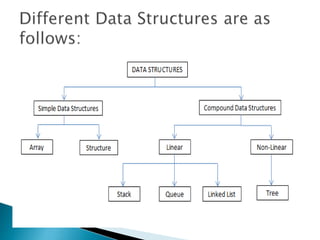
 These are normally built from primitive data
types like integers, real, character, Boolean.
There are following two types of simple data
structures
1. Array
2. Structure
 Simple data structures can be combined in
various ways to form more complex structures
called compound data structures.
 These data structures are single level data
structures.
A data structure is said to be linear if its
elements form a sequence.
There are the following types:
a. Stack
b. Queue
c. Linked List
 These are multilevel data structures.
Example of non-linear data structure is Tree.
 Insertion: Insertion means addition of a new
data element in a data structure.
 Deletion: Deletion means removal of a data
element from a data structure if it is found.
 Searching: Searching involves searching for
the specified data element in a data structure.
 Traversal: Traversal of a data structure means
processing all the data elements present in it.
 Sorting: Arranging data elements of a data
structure in a specified order is called sorting.
 Merging: Combining elements of two similar
data structures to form a new data structure
of the same type, is called merging.
 Analysis of algorithm:
 Time Complexity
 Space complexity

Data structures

  • 2.
     1. Computersystem is used as Data Management System where ‘Data’ are very important for it.  2. Data are aggregated and summarized in various ways to form information.  3. All these factors very much depend on the way data are aggregated.  4. The Data Structures are an effective and reliable way to achieve this. 
  • 3.
     "DATA STRUCTUREis a named group of data of different data types which can be processed as a single unit." 
  • 4.
     While designingdata structures, one must follow the given steps:  1. Determine the logical picture of the data in a particular program. 2. Choose the representation of data. 3. Develop the operations that will be applied on
  • 6.
     These arenormally built from primitive data types like integers, real, character, Boolean. There are following two types of simple data structures 1. Array 2. Structure
  • 7.
     Simple datastructures can be combined in various ways to form more complex structures called compound data structures.
  • 8.
     These datastructures are single level data structures. A data structure is said to be linear if its elements form a sequence. There are the following types: a. Stack b. Queue c. Linked List
  • 9.
     These aremultilevel data structures. Example of non-linear data structure is Tree.
  • 10.
     Insertion: Insertionmeans addition of a new data element in a data structure.  Deletion: Deletion means removal of a data element from a data structure if it is found.  Searching: Searching involves searching for the specified data element in a data structure.
  • 11.
     Traversal: Traversalof a data structure means processing all the data elements present in it.  Sorting: Arranging data elements of a data structure in a specified order is called sorting.  Merging: Combining elements of two similar data structures to form a new data structure of the same type, is called merging.
  • 12.
     Analysis ofalgorithm:  Time Complexity  Space complexity