Introduction to Data Structure
Prof. Neeraj Bhargava
Kapil Chauhan
Department of Computer Science
School of Engineering & Systems Sciences
MDS University, Ajmer
Introduction
 Data Structure can be defined as the group of data
elements which provides an efficient way of storing
and organising data in the computer so that it can be
used efficiently.
 Some examples of Data Structures are arrays, Linked
List, Stack, Queue, etc.
Cont..
 Data Structures are the main part of many computer
science algorithms as they enable the programmers
to handle the data in an efficient way.
 It plays a vitle role in enhancing the performance of
a software or a program as the main function of the
software is to store and retrieve the user's data as
fast as possible
Basic Terminology
 Data: Data can be defined as an elementary value or the
collection of values, for example, student's name and its id
are the data about the student.
 Group Items: Data items which have subordinate data
items are called Group item, for example, name of a
student can have first name and the last name.
 Record: Record can be defined as the collection of various
data items, for example, if we talk about the student entity,
then its name, address, course and marks can be grouped
together to form the record for the student.
Cont..
 File: A File is a collection of various records of one type of
entity, for example, if there are 60 employees in the class,
then there will be 20 records in the related file where each
record contains the data about each employee.
 Attribute and Entity: An entity represents the class of
certain objects. it contains various attributes. Each
attribute represents the particular property of that entity.
 Field: Field is a single elementary unit of information
representing the attribute of an entity.
Need of Data Structures
 Processor speed: To handle very large amout of data, high
speed processing is required, but as the data is growing day by
day to the billions of files per entity, processor may fail to deal
with that much amount of data.
 Data Search: Consider an inventory size of 106 items in a store,
If our application needs to search for a particular item, it needs
to traverse 106 items every time, results in slowing down the
search process.
 Multiple requests: If thousands of users are searching the data
simultaneously on a web server, then there are the chances that a
very large server can be failed during that process
Advantages of Data Structures
 Efficiency: Efficiency of a program depends upon the
choice of data structures.
 Reusability: Data structures are reusable, i.e. once we have
implemented a particular data structure, we can use it at
any other place.
 Abstraction: Data structure is provides a level of
abstraction. The client program uses the data structure
through interface only, without getting into the
implementation details.
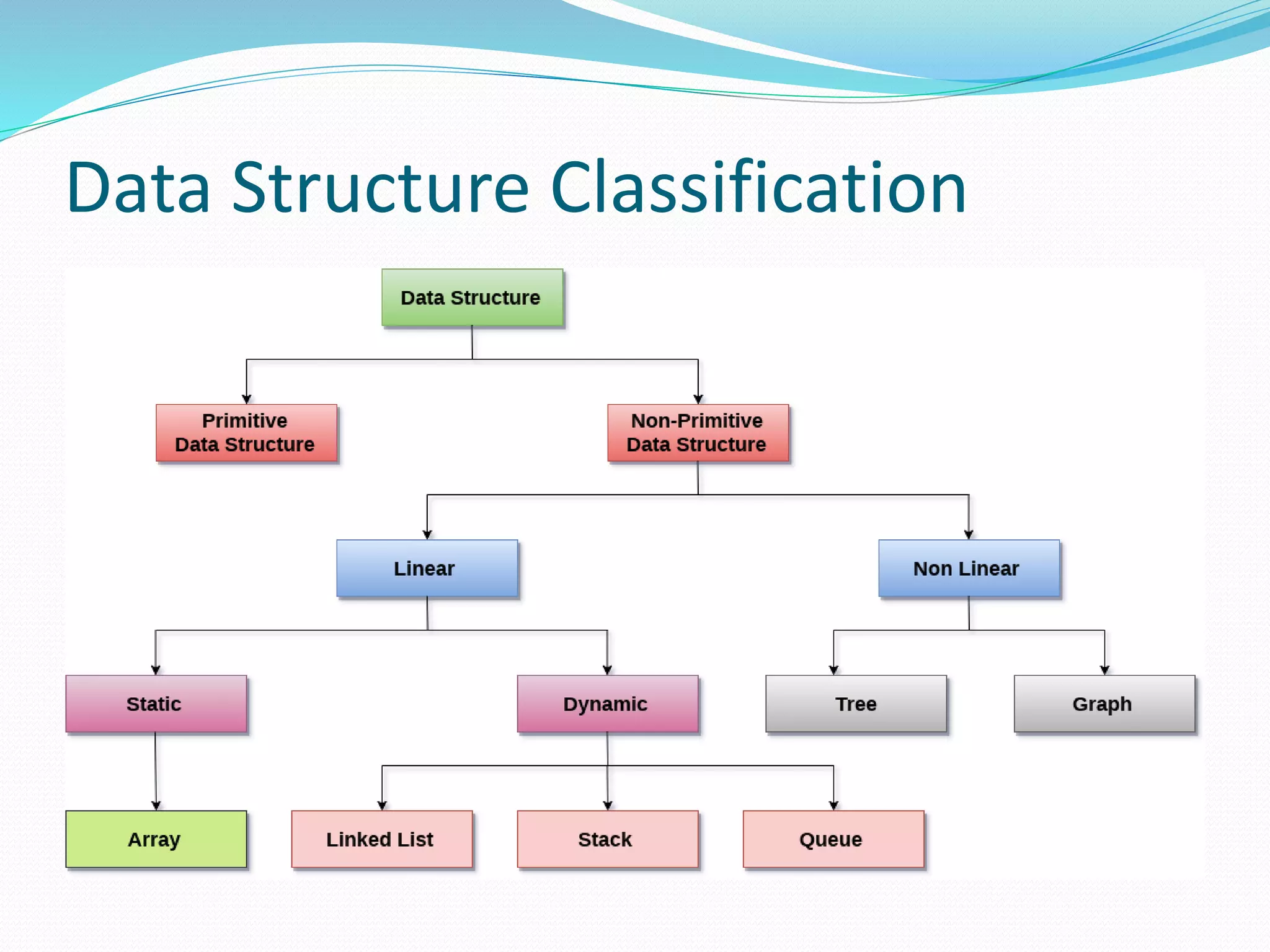
Data Structure Classification
Types of data structure
 Linear Data Structures: A data structure is called
linear if all of its elements are arranged in the
linear order.
 Non Linear Data Structures: This data structure
does not form a sequence i.e. each item or element
is connected with two or more other items in a
non-linear arrangement. The data elements are not
arranged in sequential structure.
Assignment
 Explain data structure with advantages and discuss
data structure classification with example.

introduction to Data Structure and classification

  • 1.
    Introduction to DataStructure Prof. Neeraj Bhargava Kapil Chauhan Department of Computer Science School of Engineering & Systems Sciences MDS University, Ajmer
  • 2.
    Introduction  Data Structurecan be defined as the group of data elements which provides an efficient way of storing and organising data in the computer so that it can be used efficiently.  Some examples of Data Structures are arrays, Linked List, Stack, Queue, etc.
  • 3.
    Cont..  Data Structuresare the main part of many computer science algorithms as they enable the programmers to handle the data in an efficient way.  It plays a vitle role in enhancing the performance of a software or a program as the main function of the software is to store and retrieve the user's data as fast as possible
  • 4.
    Basic Terminology  Data:Data can be defined as an elementary value or the collection of values, for example, student's name and its id are the data about the student.  Group Items: Data items which have subordinate data items are called Group item, for example, name of a student can have first name and the last name.  Record: Record can be defined as the collection of various data items, for example, if we talk about the student entity, then its name, address, course and marks can be grouped together to form the record for the student.
  • 5.
    Cont..  File: AFile is a collection of various records of one type of entity, for example, if there are 60 employees in the class, then there will be 20 records in the related file where each record contains the data about each employee.  Attribute and Entity: An entity represents the class of certain objects. it contains various attributes. Each attribute represents the particular property of that entity.  Field: Field is a single elementary unit of information representing the attribute of an entity.
  • 6.
    Need of DataStructures  Processor speed: To handle very large amout of data, high speed processing is required, but as the data is growing day by day to the billions of files per entity, processor may fail to deal with that much amount of data.  Data Search: Consider an inventory size of 106 items in a store, If our application needs to search for a particular item, it needs to traverse 106 items every time, results in slowing down the search process.  Multiple requests: If thousands of users are searching the data simultaneously on a web server, then there are the chances that a very large server can be failed during that process
  • 7.
    Advantages of DataStructures  Efficiency: Efficiency of a program depends upon the choice of data structures.  Reusability: Data structures are reusable, i.e. once we have implemented a particular data structure, we can use it at any other place.  Abstraction: Data structure is provides a level of abstraction. The client program uses the data structure through interface only, without getting into the implementation details.
  • 8.
  • 9.
    Types of datastructure  Linear Data Structures: A data structure is called linear if all of its elements are arranged in the linear order.  Non Linear Data Structures: This data structure does not form a sequence i.e. each item or element is connected with two or more other items in a non-linear arrangement. The data elements are not arranged in sequential structure.
  • 10.
    Assignment  Explain datastructure with advantages and discuss data structure classification with example.