Data Structures CS-203Data Structures CS-203
Lecture 1,2
Course InformationCourse Information
 Textbooks
◦ Introduction to Data Structures in C
by Ashok N. Kamthane
◦ Data Structures and Algorithms
by A. V. Aho, J. E. Hopcroft, J. D. Ullman
◦ Data Structures Using C and C++
by Y. Langsam, M. J. Augenstein, A. M. Tenenbaum
◦ Algorithms in C++
by Robert Sedgewick
Course OutlineCourse Outline
 Introduction to Data Structure
 Recursion
 Stacks
 Queues
 Lists and linked lists
 Trees
 Sorting
 Searching
 Graphs
 Hashing
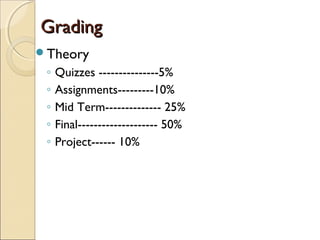
GradingGrading
Theory
◦ Quizzes ---------------5%
◦ Assignments---------10%
◦ Mid Term-------------- 25%
◦ Final-------------------- 50%
◦ Project------ 10%
Introduction to Data Structure and
Abstract Data Types
What is Data Structure?What is Data Structure?
Data structure is a representation of data and the
operations allowed on that data.
• A data structure is a way to store and organize data
in order to facilitate the access and modifications.
• Data Structure are the method of representing of
logical relationships between individual data elements
related to the solution of a given problem.
Basic Data StructureBasic Data Structure
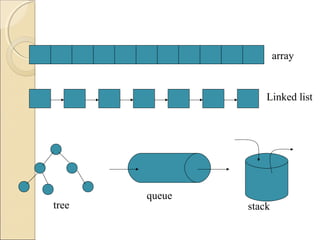
Basic Data Structures
Linear Data Structures Non-Linear Data Structures
Arrays Linked Lists Stacks Queues Trees Graphs Hash Tables
array
Linked list
tree
queue
stack
Selection of Data StructureSelection of Data Structure
The choice of particular data model depends on
two consideration:
◦ It must be rich enough in structure to represent the
relationship between data elements
◦ The structure should be simple enough that one can
effectively process the data when necessary
Types of Data StructureTypes of Data Structure
 Linear: In Linear data structure, values are arrange in linear
fashion.
◦ Array: Fixed-size
◦ Linked-list: Variable-size
◦ Stack: Add to top and remove from top
◦ Queue: Add to back and remove from front
◦ Priority queue: Add anywhere, remove the highest priority
Types of Data StructureTypes of Data Structure
 Non-Linear: The data values in this structure are not
arranged in order.
◦ Hash tables: Unordered lists which use a ‘hash function’ to
insert and search
◦ Tree: Data is organized in branches.
◦ Graph: A more general branching structure, with less strict
connection conditions than for a tree
Type of Data StructuresType of Data Structures
 Homogenous: In this type of data structures, values of
the same types of data are stored.
◦ Array
 Non-Homogenous: In this type of data structures, data
values of different types are grouped and stored.
◦ Structures
◦ Classes
Abstract Data Type and Data StructureAbstract Data Type and Data Structure
 Definition:-
◦ Abstract Data Types (ADTs) stores data and allow various operations on
the data to access and change it.
◦ A mathematical model, together with various operations defined on
the model
◦ An ADT is a collection of data and associated operations for
manipulating that data
 Data Structures
◦ Physical implementation of an ADT
◦ data structures used in implementations are provided in a language
(primitive or built-in) or are built from the language constructs (user-
defined)
◦ Each operation associated with the ADT is implemented by one
or more subroutines in the implementation
Abstract Data TypeAbstract Data Type
 ADTs support abstraction, encapsulation, and information
hiding.
 Abstraction is the structuring of a problem into well-
defined entities by defining their data and operations.
 The principle of hiding the used data structure and to
only provide a well-defined interface is known as
encapsulation.
The Core Operations of ADTThe Core Operations of ADT
Every Collection ADT should provide a way to:
◦ add an item
◦ remove an item
◦ find, retrieve, or access an item
Many, many more possibilities
◦ is the collection empty
◦ make the collection empty
◦ give me a sub set of the collection
• No single data structure works well for all
purposes, and so it is important to know the
strengths and limitations of several of them
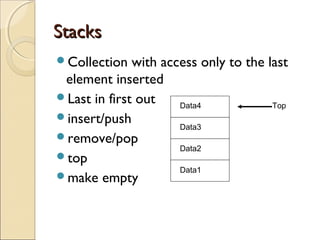
StacksStacks
Collection with access only to the last
element inserted
Last in first out
insert/push
remove/pop
top
make empty
TopData4
Data3
Data2
Data1
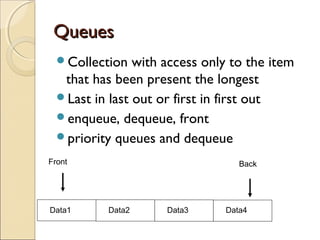
QueuesQueues
Collection with access only to the item
that has been present the longest
Last in last out or first in first out
enqueue, dequeue, front
priority queues and dequeue
Data4Data3Data2Data1
Front Back
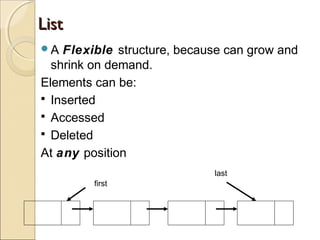
ListList
A Flexible structure, because can grow and
shrink on demand.
Elements can be:
 Inserted
 Accessed
 Deleted
At any position
first
last
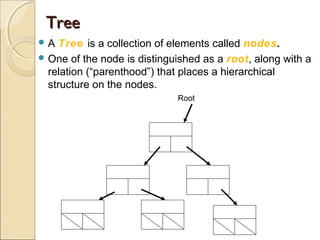
TreeTree
 A Tree is a collection of elements called nodes.
 One of the node is distinguished as a root, along with a
relation (“parenthood”) that places a hierarchical
structure on the nodes.
Root

data structure

  • 1.
    Data Structures CS-203DataStructures CS-203 Lecture 1,2
  • 2.
    Course InformationCourse Information Textbooks ◦ Introduction to Data Structures in C by Ashok N. Kamthane ◦ Data Structures and Algorithms by A. V. Aho, J. E. Hopcroft, J. D. Ullman ◦ Data Structures Using C and C++ by Y. Langsam, M. J. Augenstein, A. M. Tenenbaum ◦ Algorithms in C++ by Robert Sedgewick
  • 3.
    Course OutlineCourse Outline Introduction to Data Structure  Recursion  Stacks  Queues  Lists and linked lists  Trees  Sorting  Searching  Graphs  Hashing
  • 4.
    GradingGrading Theory ◦ Quizzes ---------------5% ◦Assignments---------10% ◦ Mid Term-------------- 25% ◦ Final-------------------- 50% ◦ Project------ 10%
  • 5.
    Introduction to DataStructure and Abstract Data Types
  • 6.
    What is DataStructure?What is Data Structure? Data structure is a representation of data and the operations allowed on that data. • A data structure is a way to store and organize data in order to facilitate the access and modifications. • Data Structure are the method of representing of logical relationships between individual data elements related to the solution of a given problem.
  • 7.
    Basic Data StructureBasicData Structure Basic Data Structures Linear Data Structures Non-Linear Data Structures Arrays Linked Lists Stacks Queues Trees Graphs Hash Tables
  • 8.
  • 9.
    Selection of DataStructureSelection of Data Structure The choice of particular data model depends on two consideration: ◦ It must be rich enough in structure to represent the relationship between data elements ◦ The structure should be simple enough that one can effectively process the data when necessary
  • 10.
    Types of DataStructureTypes of Data Structure  Linear: In Linear data structure, values are arrange in linear fashion. ◦ Array: Fixed-size ◦ Linked-list: Variable-size ◦ Stack: Add to top and remove from top ◦ Queue: Add to back and remove from front ◦ Priority queue: Add anywhere, remove the highest priority
  • 11.
    Types of DataStructureTypes of Data Structure  Non-Linear: The data values in this structure are not arranged in order. ◦ Hash tables: Unordered lists which use a ‘hash function’ to insert and search ◦ Tree: Data is organized in branches. ◦ Graph: A more general branching structure, with less strict connection conditions than for a tree
  • 12.
    Type of DataStructuresType of Data Structures  Homogenous: In this type of data structures, values of the same types of data are stored. ◦ Array  Non-Homogenous: In this type of data structures, data values of different types are grouped and stored. ◦ Structures ◦ Classes
  • 13.
    Abstract Data Typeand Data StructureAbstract Data Type and Data Structure  Definition:- ◦ Abstract Data Types (ADTs) stores data and allow various operations on the data to access and change it. ◦ A mathematical model, together with various operations defined on the model ◦ An ADT is a collection of data and associated operations for manipulating that data  Data Structures ◦ Physical implementation of an ADT ◦ data structures used in implementations are provided in a language (primitive or built-in) or are built from the language constructs (user- defined) ◦ Each operation associated with the ADT is implemented by one or more subroutines in the implementation
  • 14.
    Abstract Data TypeAbstractData Type  ADTs support abstraction, encapsulation, and information hiding.  Abstraction is the structuring of a problem into well- defined entities by defining their data and operations.  The principle of hiding the used data structure and to only provide a well-defined interface is known as encapsulation.
  • 15.
    The Core Operationsof ADTThe Core Operations of ADT Every Collection ADT should provide a way to: ◦ add an item ◦ remove an item ◦ find, retrieve, or access an item Many, many more possibilities ◦ is the collection empty ◦ make the collection empty ◦ give me a sub set of the collection
  • 16.
    • No singledata structure works well for all purposes, and so it is important to know the strengths and limitations of several of them
  • 17.
    StacksStacks Collection with accessonly to the last element inserted Last in first out insert/push remove/pop top make empty TopData4 Data3 Data2 Data1
  • 18.
    QueuesQueues Collection with accessonly to the item that has been present the longest Last in last out or first in first out enqueue, dequeue, front priority queues and dequeue Data4Data3Data2Data1 Front Back
  • 19.
    ListList A Flexible structure,because can grow and shrink on demand. Elements can be:  Inserted  Accessed  Deleted At any position first last
  • 20.
    TreeTree  A Treeis a collection of elements called nodes.  One of the node is distinguished as a root, along with a relation (“parenthood”) that places a hierarchical structure on the nodes. Root