1
Data Structures & Algorithms
Sorting in Linear Time
2
Lower bounds for sorting
The sorting algorithms we’ve looked at
so far are all comparison sorts
 Comparison sorts all have lower bound of
O(nlgn), as we’ve seen
 Why?
 Assume for simplicity that elements in a given
set are distinct, so we only need to worry about
< and > operations
3
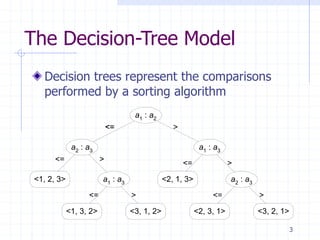
The Decision-Tree Model
Decision trees represent the comparisons
performed by a sorting algorithm
a1
: a2
a2
: a3
a1
: a3
<1, 2, 3> a1
: a3
<1, 3, 2> <3, 1, 2>
<2, 1, 3> a2
: a3
<2, 3, 1> <3, 2, 1>
<=<=
<= >
<= >
>
>
><=
<=
4
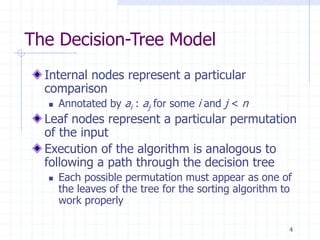
The Decision-Tree Model
Internal nodes represent a particular
comparison
 Annotated by ai : aj for some i and j < n
Leaf nodes represent a particular permutation
of the input
Execution of the algorithm is analogous to
following a path through the decision tree
 Each possible permutation must appear as one of
the leaves of the tree for the sorting algorithm to
work properly
5
Worst Case Lower Bound
The height of the decision tree
represents the worst-case number of
comparisons the sorting algorithm
performs
 This is the same as a lower bound for the
running time of the algorithm
 Theorem 9.1 in the book states that any
decision tree that sorts n elements has
height of at least nlog2n
6
Proof of Worst Case Lower
Bound
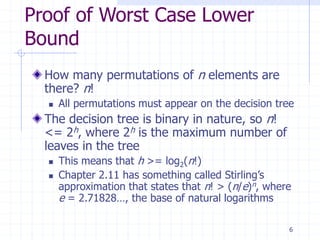
How many permutations of n elements are
there? n!
 All permutations must appear on the decision tree
The decision tree is binary in nature, so n!
<= 2h, where 2h is the maximum number of
leaves in the tree
 This means that h >= log2(n!)
 Chapter 2.11 has something called Stirling’s
approximation that states that n! > (n/e)n, where
e = 2.71828…, the base of natural logarithms
7
Proof of Worst Case Lower
Bound
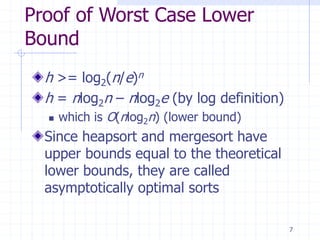
h >= log2(n/e)n
h = nlog2n – nlog2e (by log definition)
 which is O(nlog2n) (lower bound)
Since heapsort and mergesort have
upper bounds equal to the theoretical
lower bounds, they are called
asymptotically optimal sorts
8
Sorting In Linear Time
It is possible to sort in linear time using
something other than a comparison sort
 However, this requires us to make
assumptions or have some foreknowledge
of the input
9
Counting sort
Assumes that each of the n input
elements is an integer in the range 1 to
k, for some integer k
When k = O(n), the sort runs in O(n)
time
10
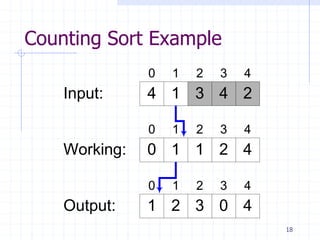
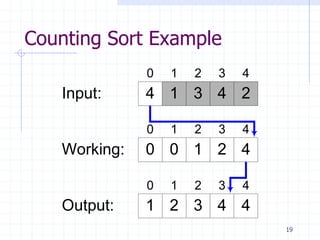
Counting Sort
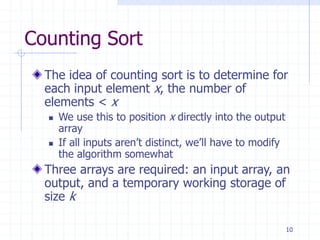
The idea of counting sort is to determine for
each input element x, the number of
elements < x
 We use this to position x directly into the output
array
 If all inputs aren’t distinct, we’ll have to modify
the algorithm somewhat
Three arrays are required: an input array, an
output, and a temporary working storage of
size k
11
Counting Sort
void CountingSort(int Input[], int Output[], int size,
int max)
{
int Work[max] = { 0 }, index;
// Set Work[i] equal to the # elements = i
for ( index = 0 ; index < size ; ++ index )
Work[Input[index]] = Work[Input[index]] + 1;
// Now set each Work[i] equal to # elements <= i
for ( index = 2 ; index < max ; ++ index )
Work[index] = Work[index]+Work[index-1];
// Arrange the input into the output array
for ( index = size-1 ; index >= 0 ; --index )
{
--Work[Input[index]]; // Handles non-distinct input
Output[Work[Input[index]]] = Input[index];
}
}
12
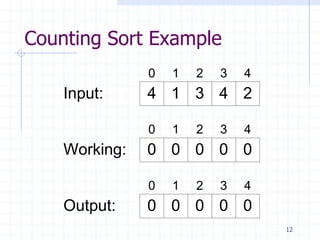
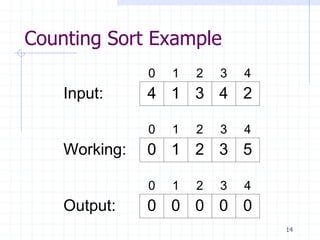
Counting Sort Example
4 1 3 4 2Input:
Working:
0 1 2 3 4
0 0 0 0 0
0 1 2 3 4
Output: 0 0 0 0 0
0 1 2 3 4
13
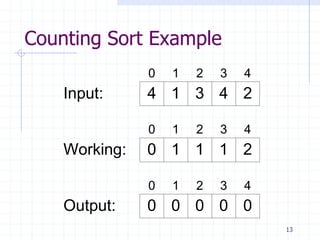
Counting Sort Example
4 1 3 4 2Input:
Working:
0 1 2 3 4
0 1 1 1 2
0 1 2 3 4
Output: 0 0 0 0 0
0 1 2 3 4
14
Counting Sort Example
4 1 3 4 2Input:
Working:
0 1 2 3 4
0 1 2 3 5
0 1 2 3 4
Output: 0 0 0 0 0
0 1 2 3 4
15
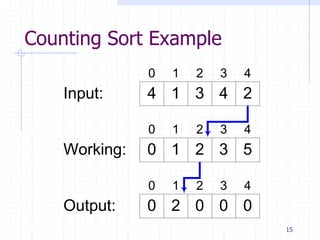
Counting Sort Example
4 1 3 4 2Input:
Working:
0 1 2 3 4
0 1 2 3 5
0 1 2 3 4
Output: 0 2 0 0 0
0 1 2 3 4
16
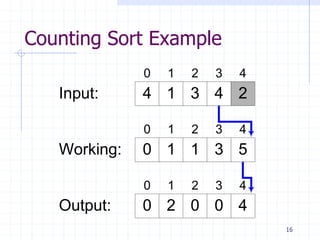
Counting Sort Example
4 1 3 4 2Input:
Working:
0 1 2 3 4
0 1 1 3 5
0 1 2 3 4
Output: 0 2 0 0 4
0 1 2 3 4
17
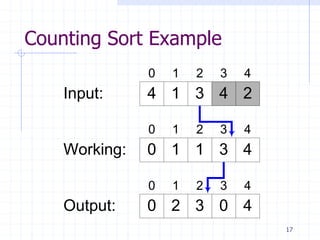
Counting Sort Example
4 1 3 4 2Input:
Working:
0 1 2 3 4
0 1 1 3 4
0 1 2 3 4
Output: 0 2 3 0 4
0 1 2 3 4
18
Counting Sort Example
4 1 3 4 2Input:
Working:
0 1 2 3 4
0 1 1 2 4
0 1 2 3 4
Output: 1 2 3 0 4
0 1 2 3 4
19
Counting Sort Example
4 1 3 4 2Input:
Working:
0 1 2 3 4
0 0 1 2 4
0 1 2 3 4
Output: 1 2 3 4 4
0 1 2 3 4
20
Analysis of Counting Sort
How much time does this take?
 Initialization takes O(max) time
 Each loop takes O(n) time
 Total running time is O(max) + 3*O(n) = O(max
+ n)
Note that as the max approaches n, our
running time approaches O(n)
Why doesn’t the comparison-sort lower
bound apply?
21
Counting Sort
Counting Sort is considered to be a
stable sort
 Ties between non-distinct elements are
resolved by keeping the order of values in
the output array the same as they were in
the input array
 This is important if we have “satellite” data
When is the Counting Sort practical?
22
Radix sort
Radix Sort was developed to be used by
card sorting machines
 Cards were sorted into 80 columns, each
with 12 holes that could be punched
 A d-digit number occupied d-columns
 The machines could only look at one
column at a time, and had only twelve bins
How can the cards be sorted?
23
Radix Sort
An intuitive approach would be to sort
on the most-significant digit, then sort
each bin recursively
 Since these were physical bins, that wasn’t
an option (you only had twelve, one for
each punched hole)
24
Radix Sort
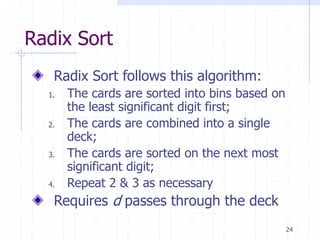
Radix Sort follows this algorithm:
1. The cards are sorted into bins based on
the least significant digit first;
2. The cards are combined into a single
deck;
3. The cards are sorted on the next most
significant digit;
4. Repeat 2 & 3 as necessary
Requires d passes through the deck
25
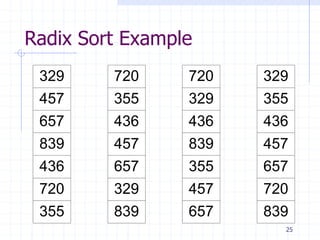
Radix Sort Example
329
457
657
839
436
720
355
720
355
436
457
657
329
839
720
329
436
839
355
457
657
329
355
436
457
657
720
839
26
Radix Sort
Radix Sort requires the per-digit sort to
be stable
In modern computers, a radix-sort
might be used to achieve sorts on
multiple keys
 E.g., by last name, date, and sales figures
27
Radix Sort Algorithm
void RadixSort(ArrayType Input[], int size, int digits)
{
for ( int i = 0 ; i < digits ; ++i )
// perform stable sort on Input using digit i
}
28
Analysis of Radix Sort
How does radix sort compare?
 Running time is O(d*n + d*max)
 If d is constant, and max = O(n), radix sort
runs in O(n) time.
29
Bucket sort
This is another sorting algorithm that
can perform in linear time
 It also requires you to make an assumption
about the input
 Assumption: the input is generated by a
random process that distributes the
elements uniformly over the interval [0, 1)
30
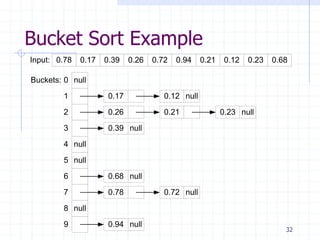
Bucket Sort
Here’s the basic algorithm:
 Divide the interval into n equal-sized subintervals,
or buckets
 Distribute the n input numbers into the buckets
 We don’t expect many numbers to fall into each bucket,
but we must handle for > 1 in each bucket
 Each bucket is therefore a linked list
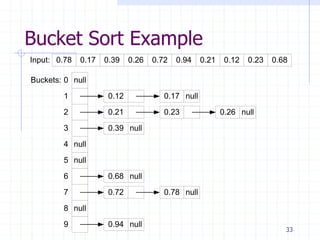
 Sort each bucket
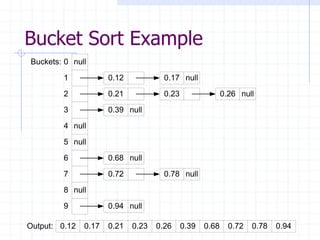
 Iterate across the buckets in order, collecting all of
the elements
31
Bucket Sort Algorithm
void BucketSort(double Input[], int size)
{
list<double> buckets[size];
for ( int idx = 0 ; idx < size ; ++idx )
buckets[n*Input[idx]].insert(Input[idx]);
for ( int idx = 0 ; idx < size ; ++idx )
insertion_sort(buckets[idx]);
// concatenate all buckets
}
32
Bucket Sort Example
0.78 0.17 0.39 0.26 0.72 0.94 0.21 0.12 0.23 0.68Input:
Buckets: null
null
null
null
0
1
2
3
4
5
6
7
8
9
0.78
0.17
0.39
0.26
0.72
0.94
0.21
0.12
0.23
0.68
null
null
null
null
null
null
33
Bucket Sort Example
0.78 0.17 0.39 0.26 0.72 0.94 0.21 0.12 0.23 0.68Input:
Buckets: null
null
null
null
0
1
2
3
4
5
6
7
8
9
0.72
0.12
0.39
0.21
0.78
0.94
0.23
0.17
0.26
0.68
null
null
null
null
null
null
34
Bucket Sort Example
Output:
Buckets: null
null
null
null
0
1
2
3
4
5
6
7
8
9
0.72
0.12
0.39
0.21
0.78
0.94
0.23
0.17
0.26
0.68
null
null
null
null
null
null
0.12 0.17 0.21 0.23 0.26 0.39 0.68 0.72 0.78 0.94
35
Bucket Sort
We can eliminate the insertion sort step
by using a sorted list, that keeps its
elements sorted through insertions, etc.
 This does not significantly change the
running time
 Read through the example on your own;
the math is complicated, but comes out
like this: as the distribution becomes more
uniform, the running time gets more linear

Cis435 week06

  • 1.
    1 Data Structures &Algorithms Sorting in Linear Time
  • 2.
    2 Lower bounds forsorting The sorting algorithms we’ve looked at so far are all comparison sorts  Comparison sorts all have lower bound of O(nlgn), as we’ve seen  Why?  Assume for simplicity that elements in a given set are distinct, so we only need to worry about < and > operations
  • 3.
    3 The Decision-Tree Model Decisiontrees represent the comparisons performed by a sorting algorithm a1 : a2 a2 : a3 a1 : a3 <1, 2, 3> a1 : a3 <1, 3, 2> <3, 1, 2> <2, 1, 3> a2 : a3 <2, 3, 1> <3, 2, 1> <=<= <= > <= > > > ><= <=
  • 4.
    4 The Decision-Tree Model Internalnodes represent a particular comparison  Annotated by ai : aj for some i and j < n Leaf nodes represent a particular permutation of the input Execution of the algorithm is analogous to following a path through the decision tree  Each possible permutation must appear as one of the leaves of the tree for the sorting algorithm to work properly
  • 5.
    5 Worst Case LowerBound The height of the decision tree represents the worst-case number of comparisons the sorting algorithm performs  This is the same as a lower bound for the running time of the algorithm  Theorem 9.1 in the book states that any decision tree that sorts n elements has height of at least nlog2n
  • 6.
    6 Proof of WorstCase Lower Bound How many permutations of n elements are there? n!  All permutations must appear on the decision tree The decision tree is binary in nature, so n! <= 2h, where 2h is the maximum number of leaves in the tree  This means that h >= log2(n!)  Chapter 2.11 has something called Stirling’s approximation that states that n! > (n/e)n, where e = 2.71828…, the base of natural logarithms
  • 7.
    7 Proof of WorstCase Lower Bound h >= log2(n/e)n h = nlog2n – nlog2e (by log definition)  which is O(nlog2n) (lower bound) Since heapsort and mergesort have upper bounds equal to the theoretical lower bounds, they are called asymptotically optimal sorts
  • 8.
    8 Sorting In LinearTime It is possible to sort in linear time using something other than a comparison sort  However, this requires us to make assumptions or have some foreknowledge of the input
  • 9.
    9 Counting sort Assumes thateach of the n input elements is an integer in the range 1 to k, for some integer k When k = O(n), the sort runs in O(n) time
  • 10.
    10 Counting Sort The ideaof counting sort is to determine for each input element x, the number of elements < x  We use this to position x directly into the output array  If all inputs aren’t distinct, we’ll have to modify the algorithm somewhat Three arrays are required: an input array, an output, and a temporary working storage of size k
  • 11.
    11 Counting Sort void CountingSort(intInput[], int Output[], int size, int max) { int Work[max] = { 0 }, index; // Set Work[i] equal to the # elements = i for ( index = 0 ; index < size ; ++ index ) Work[Input[index]] = Work[Input[index]] + 1; // Now set each Work[i] equal to # elements <= i for ( index = 2 ; index < max ; ++ index ) Work[index] = Work[index]+Work[index-1]; // Arrange the input into the output array for ( index = size-1 ; index >= 0 ; --index ) { --Work[Input[index]]; // Handles non-distinct input Output[Work[Input[index]]] = Input[index]; } }
  • 12.
    12 Counting Sort Example 41 3 4 2Input: Working: 0 1 2 3 4 0 0 0 0 0 0 1 2 3 4 Output: 0 0 0 0 0 0 1 2 3 4
  • 13.
    13 Counting Sort Example 41 3 4 2Input: Working: 0 1 2 3 4 0 1 1 1 2 0 1 2 3 4 Output: 0 0 0 0 0 0 1 2 3 4
  • 14.
    14 Counting Sort Example 41 3 4 2Input: Working: 0 1 2 3 4 0 1 2 3 5 0 1 2 3 4 Output: 0 0 0 0 0 0 1 2 3 4
  • 15.
    15 Counting Sort Example 41 3 4 2Input: Working: 0 1 2 3 4 0 1 2 3 5 0 1 2 3 4 Output: 0 2 0 0 0 0 1 2 3 4
  • 16.
    16 Counting Sort Example 41 3 4 2Input: Working: 0 1 2 3 4 0 1 1 3 5 0 1 2 3 4 Output: 0 2 0 0 4 0 1 2 3 4
  • 17.
    17 Counting Sort Example 41 3 4 2Input: Working: 0 1 2 3 4 0 1 1 3 4 0 1 2 3 4 Output: 0 2 3 0 4 0 1 2 3 4
  • 18.
    18 Counting Sort Example 41 3 4 2Input: Working: 0 1 2 3 4 0 1 1 2 4 0 1 2 3 4 Output: 1 2 3 0 4 0 1 2 3 4
  • 19.
    19 Counting Sort Example 41 3 4 2Input: Working: 0 1 2 3 4 0 0 1 2 4 0 1 2 3 4 Output: 1 2 3 4 4 0 1 2 3 4
  • 20.
    20 Analysis of CountingSort How much time does this take?  Initialization takes O(max) time  Each loop takes O(n) time  Total running time is O(max) + 3*O(n) = O(max + n) Note that as the max approaches n, our running time approaches O(n) Why doesn’t the comparison-sort lower bound apply?
  • 21.
    21 Counting Sort Counting Sortis considered to be a stable sort  Ties between non-distinct elements are resolved by keeping the order of values in the output array the same as they were in the input array  This is important if we have “satellite” data When is the Counting Sort practical?
  • 22.
    22 Radix sort Radix Sortwas developed to be used by card sorting machines  Cards were sorted into 80 columns, each with 12 holes that could be punched  A d-digit number occupied d-columns  The machines could only look at one column at a time, and had only twelve bins How can the cards be sorted?
  • 23.
    23 Radix Sort An intuitiveapproach would be to sort on the most-significant digit, then sort each bin recursively  Since these were physical bins, that wasn’t an option (you only had twelve, one for each punched hole)
  • 24.
    24 Radix Sort Radix Sortfollows this algorithm: 1. The cards are sorted into bins based on the least significant digit first; 2. The cards are combined into a single deck; 3. The cards are sorted on the next most significant digit; 4. Repeat 2 & 3 as necessary Requires d passes through the deck
  • 25.
  • 26.
    26 Radix Sort Radix Sortrequires the per-digit sort to be stable In modern computers, a radix-sort might be used to achieve sorts on multiple keys  E.g., by last name, date, and sales figures
  • 27.
    27 Radix Sort Algorithm voidRadixSort(ArrayType Input[], int size, int digits) { for ( int i = 0 ; i < digits ; ++i ) // perform stable sort on Input using digit i }
  • 28.
    28 Analysis of RadixSort How does radix sort compare?  Running time is O(d*n + d*max)  If d is constant, and max = O(n), radix sort runs in O(n) time.
  • 29.
    29 Bucket sort This isanother sorting algorithm that can perform in linear time  It also requires you to make an assumption about the input  Assumption: the input is generated by a random process that distributes the elements uniformly over the interval [0, 1)
  • 30.
    30 Bucket Sort Here’s thebasic algorithm:  Divide the interval into n equal-sized subintervals, or buckets  Distribute the n input numbers into the buckets  We don’t expect many numbers to fall into each bucket, but we must handle for > 1 in each bucket  Each bucket is therefore a linked list  Sort each bucket  Iterate across the buckets in order, collecting all of the elements
  • 31.
    31 Bucket Sort Algorithm voidBucketSort(double Input[], int size) { list<double> buckets[size]; for ( int idx = 0 ; idx < size ; ++idx ) buckets[n*Input[idx]].insert(Input[idx]); for ( int idx = 0 ; idx < size ; ++idx ) insertion_sort(buckets[idx]); // concatenate all buckets }
  • 32.
    32 Bucket Sort Example 0.780.17 0.39 0.26 0.72 0.94 0.21 0.12 0.23 0.68Input: Buckets: null null null null 0 1 2 3 4 5 6 7 8 9 0.78 0.17 0.39 0.26 0.72 0.94 0.21 0.12 0.23 0.68 null null null null null null
  • 33.
    33 Bucket Sort Example 0.780.17 0.39 0.26 0.72 0.94 0.21 0.12 0.23 0.68Input: Buckets: null null null null 0 1 2 3 4 5 6 7 8 9 0.72 0.12 0.39 0.21 0.78 0.94 0.23 0.17 0.26 0.68 null null null null null null
  • 34.
    34 Bucket Sort Example Output: Buckets:null null null null 0 1 2 3 4 5 6 7 8 9 0.72 0.12 0.39 0.21 0.78 0.94 0.23 0.17 0.26 0.68 null null null null null null 0.12 0.17 0.21 0.23 0.26 0.39 0.68 0.72 0.78 0.94
  • 35.
    35 Bucket Sort We caneliminate the insertion sort step by using a sorted list, that keeps its elements sorted through insertions, etc.  This does not significantly change the running time  Read through the example on your own; the math is complicated, but comes out like this: as the distribution becomes more uniform, the running time gets more linear