DATA STRUCTURE
Presented by:
MD ARIF HOSSAIN
ID: 182-15-11395
Sec: D
Semester: SPRING 2019
Department of Computer Science &
Engineering
Presented to:
MR.SHAH MD.TANVIR SIDDIQUEE
Senior Lecturer
Department of FSIT
CONTENTS
DEFINIATION OF DATA STRUCTURE
DATA STRUCTURE OPERATION
TYPES OF DATA STRUCTURE
LINEAR LIST
NON LINEAR LIST
DEFINIATION OF DATA STRUCTURE
Data Structure is a way of collecting and organising data in such a way that we can perform
operations on these data in an effective way. Data Structures is about rendering data
elements in terms of some relationship, for better organization and storage.
DATA STRUCTURE OPERATION
Traversing: Traversing a data structure means: "visiting" or "touching" the elements of the structure,
and doing something with the data.
Searching: Searching is the process of finding a given value position in a list of values.
Insertion: Adding a new record to the structure.
Deletion: Removing a record from the structure.
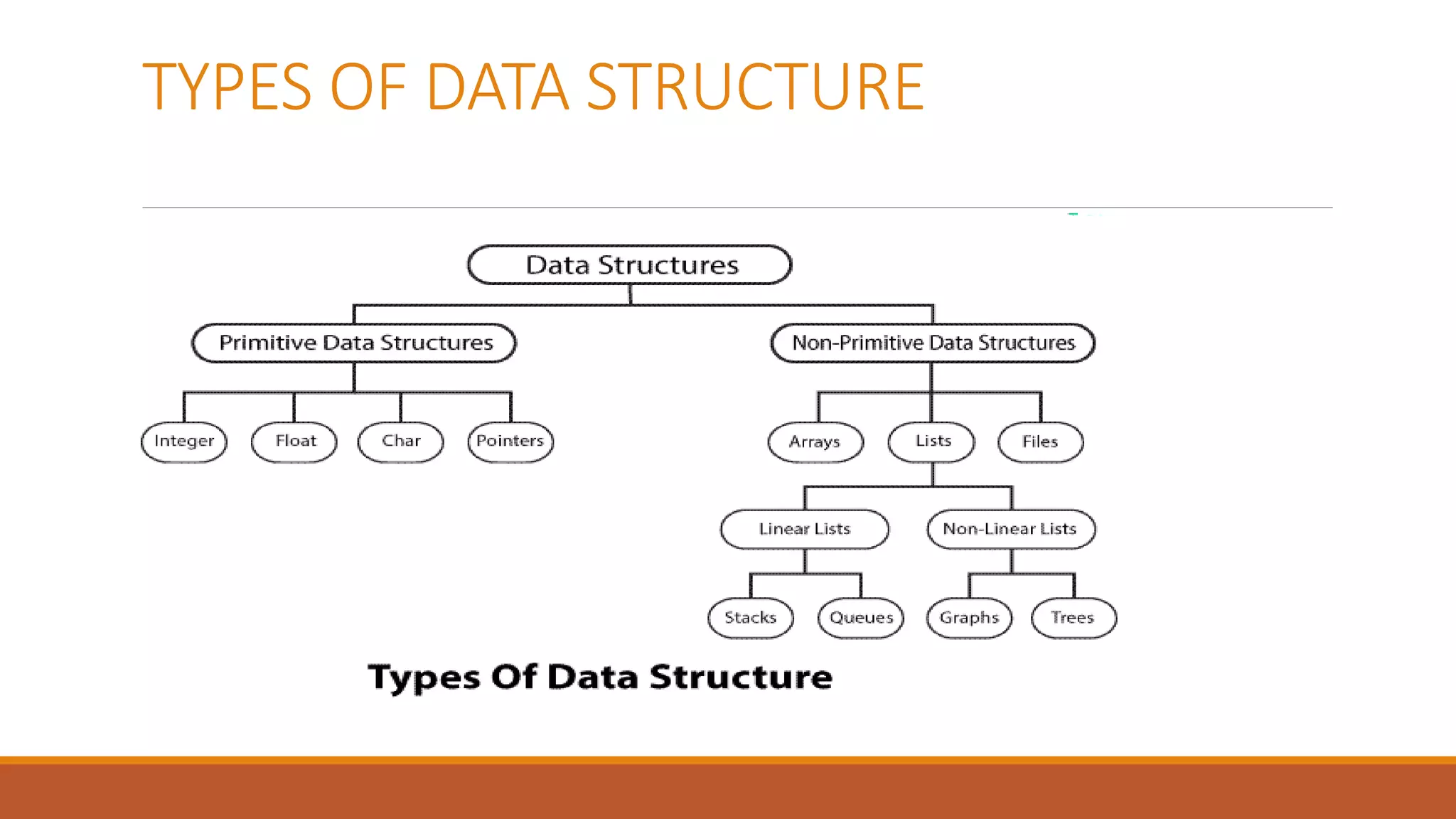
TYPES OF DATA STRUCTURE
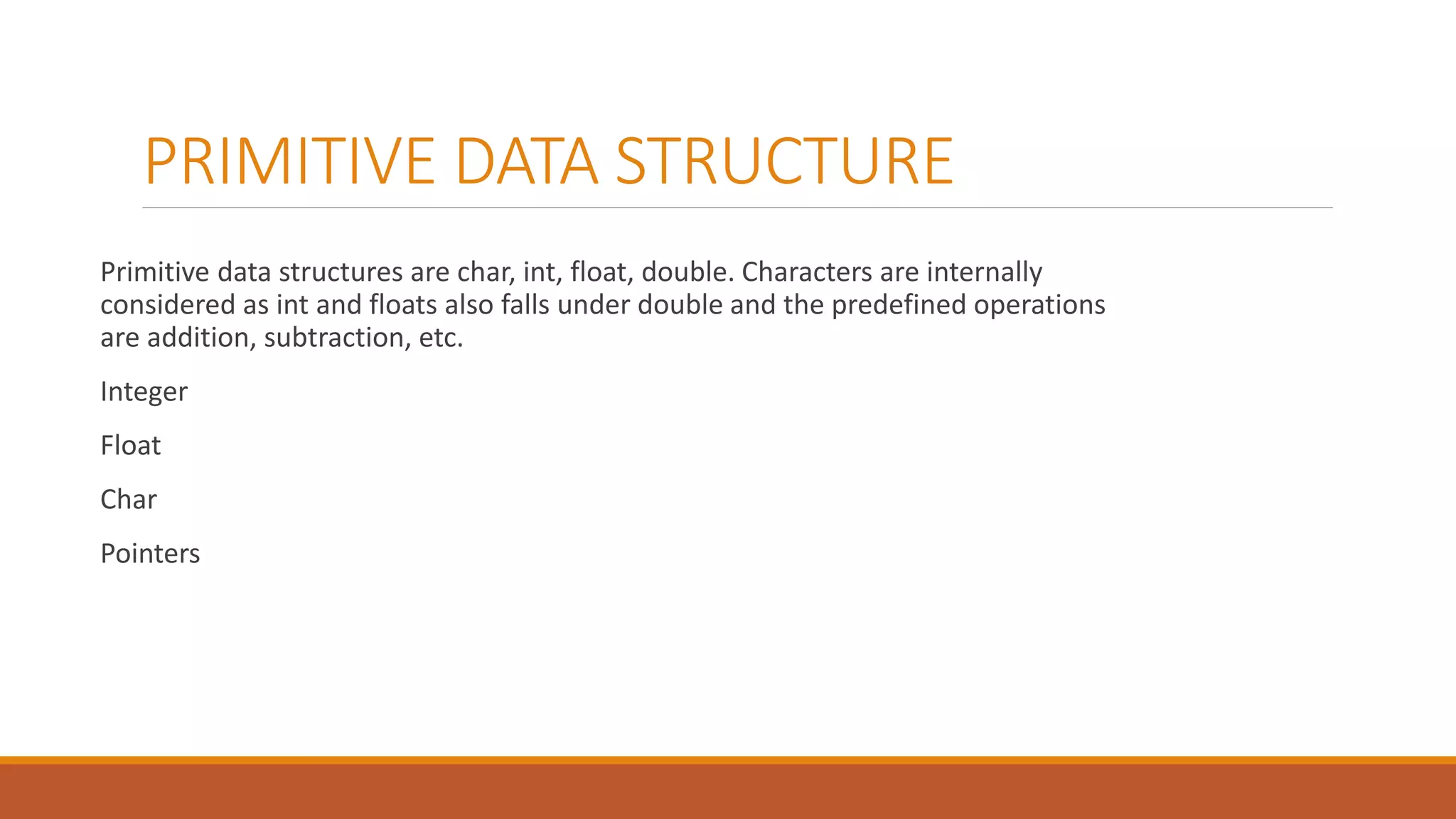
PRIMITIVE DATA STRUCTURE
Primitive data structures are char, int, float, double. Characters are internally
considered as int and floats also falls under double and the predefined operations
are addition, subtraction, etc.
Integer
Float
Char
Pointers
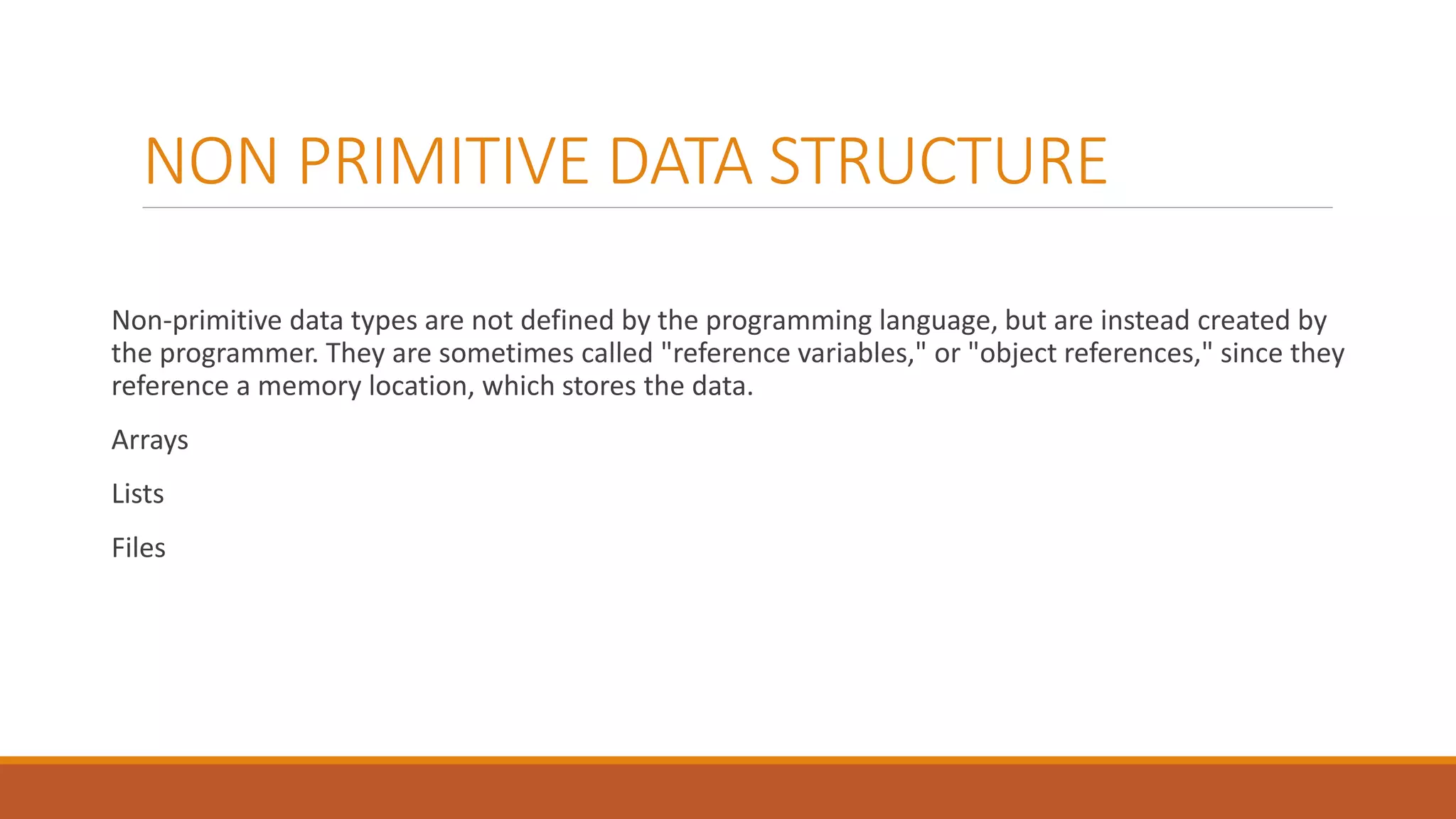
NON PRIMITIVE DATA STRUCTURE
Non-primitive data types are not defined by the programming language, but are instead created by
the programmer. They are sometimes called "reference variables," or "object references," since they
reference a memory location, which stores the data.
Arrays
Lists
Files
LINEAR LIST
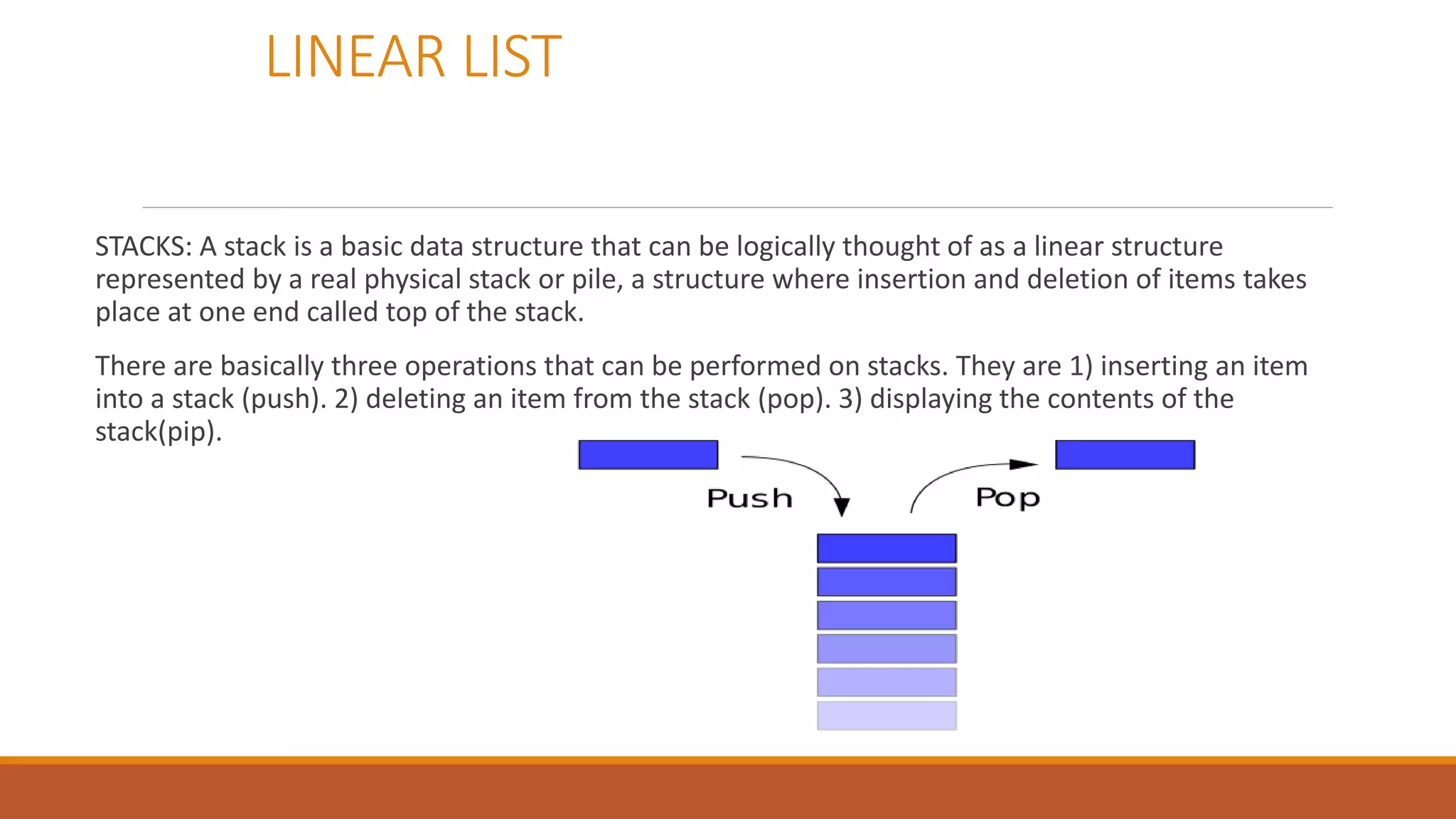
STACKS: A stack is a basic data structure that can be logically thought of as a linear structure
represented by a real physical stack or pile, a structure where insertion and deletion of items takes
place at one end called top of the stack.
There are basically three operations that can be performed on stacks. They are 1) inserting an item
into a stack (push). 2) deleting an item from the stack (pop). 3) displaying the contents of the
stack(pip).
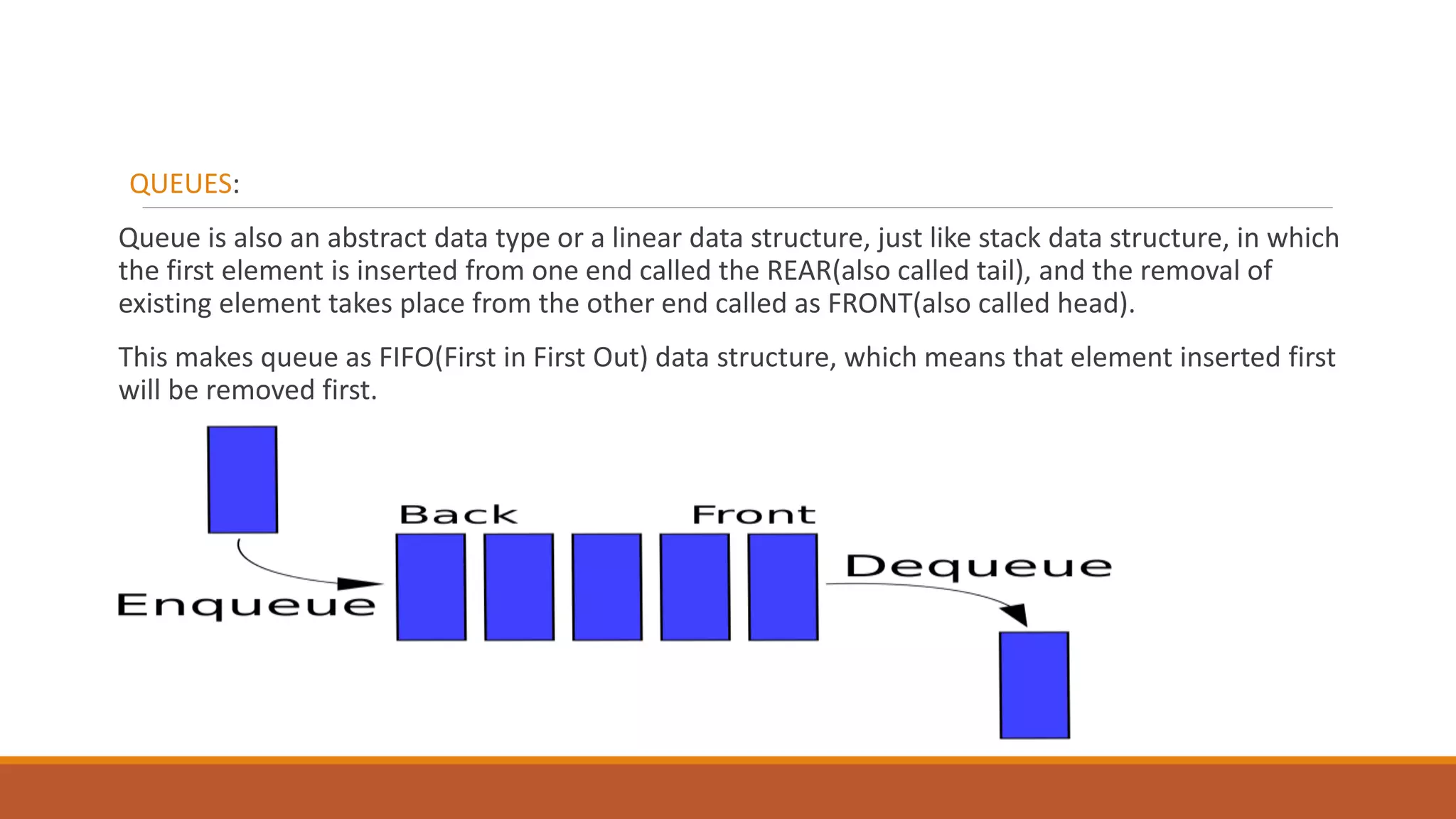
QUEUES:
Queue is also an abstract data type or a linear data structure, just like stack data structure, in which
the first element is inserted from one end called the REAR(also called tail), and the removal of
existing element takes place from the other end called as FRONT(also called head).
This makes queue as FIFO(First in First Out) data structure, which means that element inserted first
will be removed first.
NON LINEAR LIST
The non-linear data structure utilizes the memory efficiently and does not require the memory
declaration in advance. There are the two common examples of the non-linear data structure –
tree and graph. A tree data structure organizes and stores the data elements in a hierarchical
relationship.
Graph
Trees
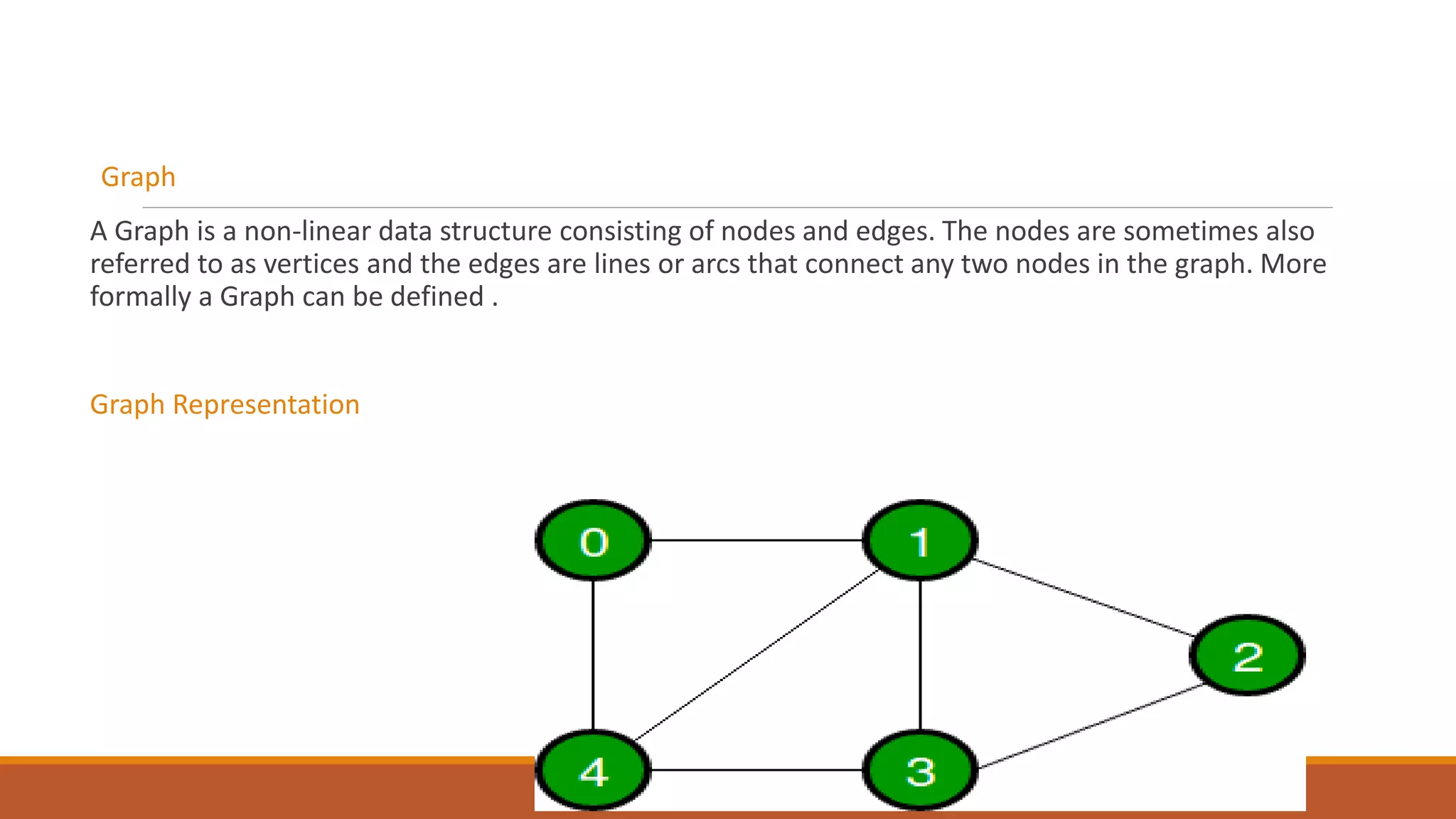
Graph
A Graph is a non-linear data structure consisting of nodes and edges. The nodes are sometimes also
referred to as vertices and the edges are lines or arcs that connect any two nodes in the graph. More
formally a Graph can be defined .
Graph Representation
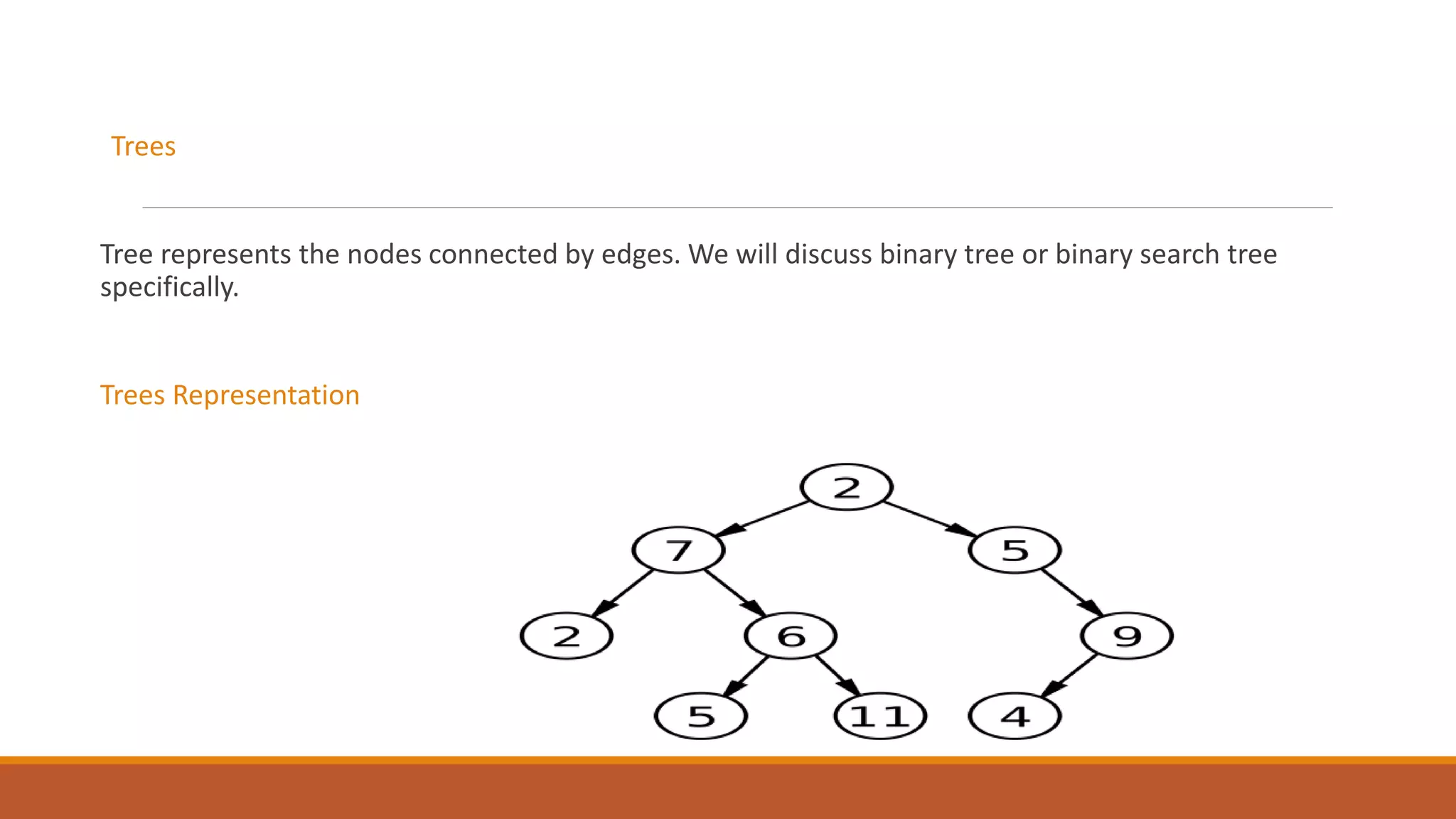
Trees
Tree represents the nodes connected by edges. We will discuss binary tree or binary search tree
specifically.
Trees Representation
THANK YOU

Data structure

  • 1.
    DATA STRUCTURE Presented by: MDARIF HOSSAIN ID: 182-15-11395 Sec: D Semester: SPRING 2019 Department of Computer Science & Engineering Presented to: MR.SHAH MD.TANVIR SIDDIQUEE Senior Lecturer Department of FSIT
  • 2.
    CONTENTS DEFINIATION OF DATASTRUCTURE DATA STRUCTURE OPERATION TYPES OF DATA STRUCTURE LINEAR LIST NON LINEAR LIST
  • 3.
    DEFINIATION OF DATASTRUCTURE Data Structure is a way of collecting and organising data in such a way that we can perform operations on these data in an effective way. Data Structures is about rendering data elements in terms of some relationship, for better organization and storage.
  • 4.
    DATA STRUCTURE OPERATION Traversing:Traversing a data structure means: "visiting" or "touching" the elements of the structure, and doing something with the data. Searching: Searching is the process of finding a given value position in a list of values. Insertion: Adding a new record to the structure. Deletion: Removing a record from the structure.
  • 5.
    TYPES OF DATASTRUCTURE
  • 6.
    PRIMITIVE DATA STRUCTURE Primitivedata structures are char, int, float, double. Characters are internally considered as int and floats also falls under double and the predefined operations are addition, subtraction, etc. Integer Float Char Pointers
  • 7.
    NON PRIMITIVE DATASTRUCTURE Non-primitive data types are not defined by the programming language, but are instead created by the programmer. They are sometimes called "reference variables," or "object references," since they reference a memory location, which stores the data. Arrays Lists Files
  • 8.
    LINEAR LIST STACKS: Astack is a basic data structure that can be logically thought of as a linear structure represented by a real physical stack or pile, a structure where insertion and deletion of items takes place at one end called top of the stack. There are basically three operations that can be performed on stacks. They are 1) inserting an item into a stack (push). 2) deleting an item from the stack (pop). 3) displaying the contents of the stack(pip).
  • 9.
    QUEUES: Queue is alsoan abstract data type or a linear data structure, just like stack data structure, in which the first element is inserted from one end called the REAR(also called tail), and the removal of existing element takes place from the other end called as FRONT(also called head). This makes queue as FIFO(First in First Out) data structure, which means that element inserted first will be removed first.
  • 10.
    NON LINEAR LIST Thenon-linear data structure utilizes the memory efficiently and does not require the memory declaration in advance. There are the two common examples of the non-linear data structure – tree and graph. A tree data structure organizes and stores the data elements in a hierarchical relationship. Graph Trees
  • 11.
    Graph A Graph isa non-linear data structure consisting of nodes and edges. The nodes are sometimes also referred to as vertices and the edges are lines or arcs that connect any two nodes in the graph. More formally a Graph can be defined . Graph Representation
  • 12.
    Trees Tree represents thenodes connected by edges. We will discuss binary tree or binary search tree specifically. Trees Representation
  • 13.