Solving Recurrences and the QuickSort Algorithm 1
Advanced Data Structures &
Algorithm Design
Solving Recurrences and the QuickSort
Algorithm
Solving Recurrences and the QuickSort Algorith2
The Search Problem
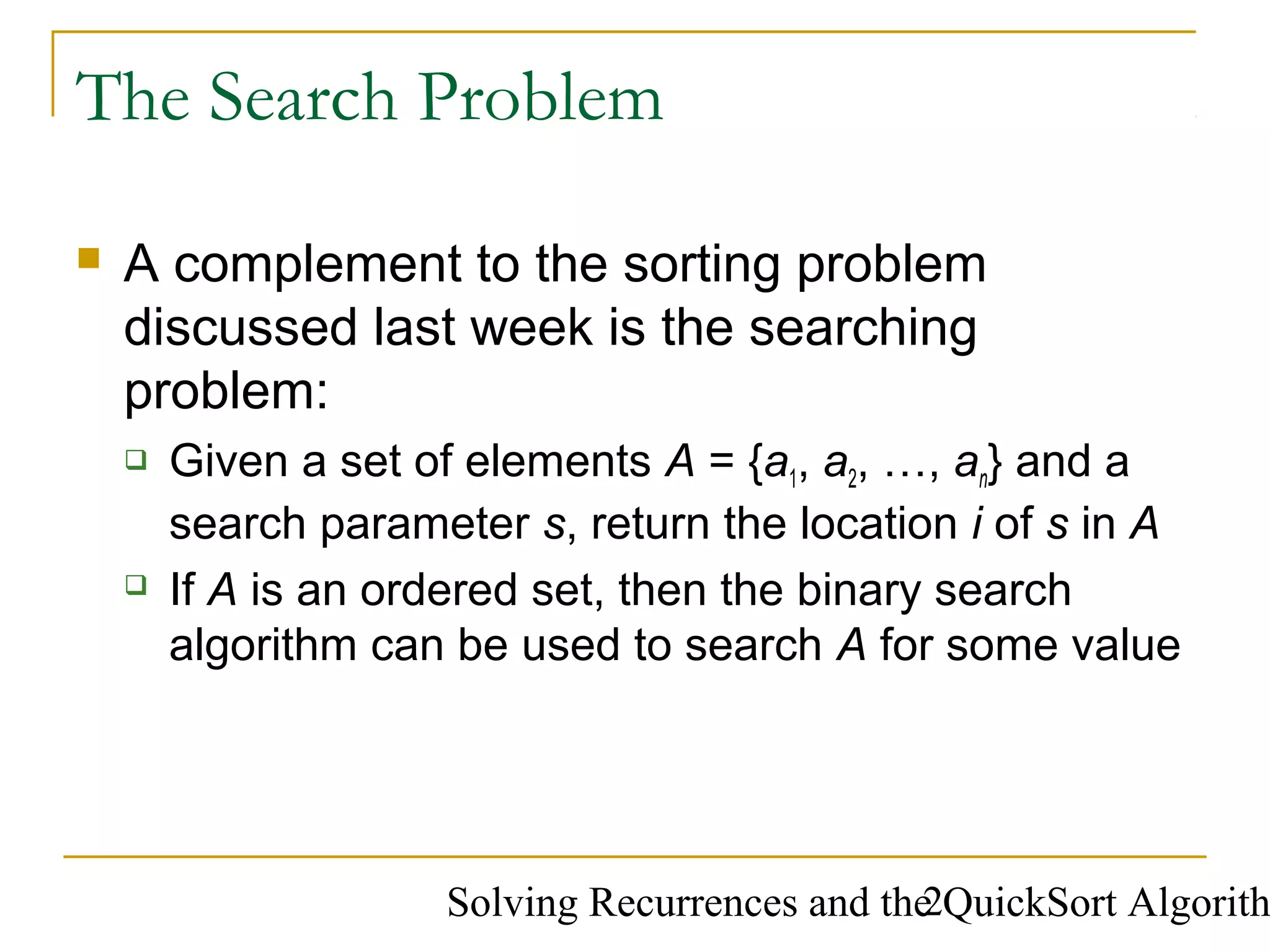
 A complement to the sorting problem
discussed last week is the searching
problem:
 Given a set of elements A = {a1, a2, …, an} and a
search parameter s, return the location i of s in A
 If A is an ordered set, then the binary search
algorithm can be used to search A for some value
Solving Recurrences and the QuickSort Algorith3
The Binary Search Algorithm
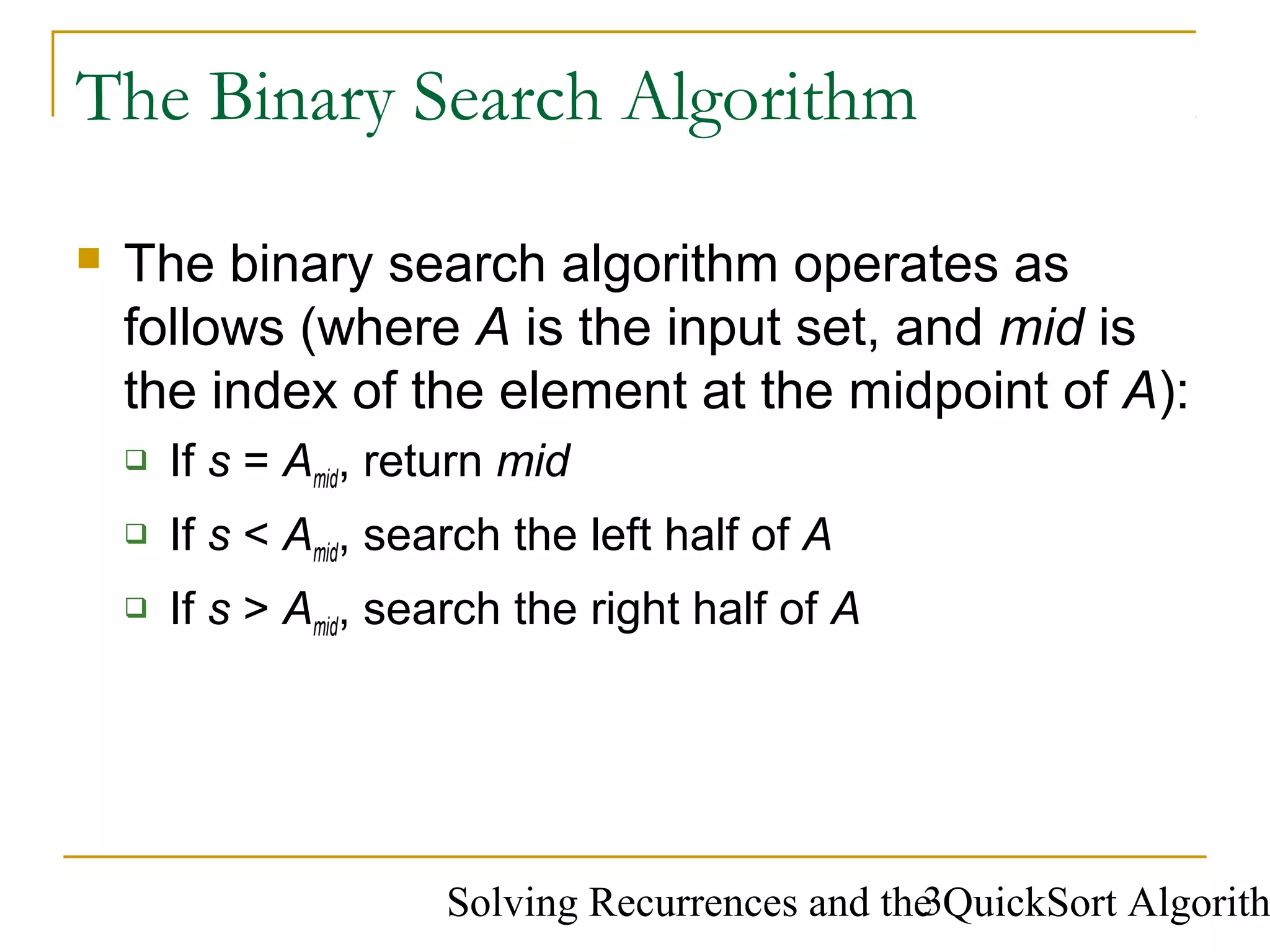
 The binary search algorithm operates as
follows (where A is the input set, and mid is
the index of the element at the midpoint of A):
 If s = Amid, return mid
 If s < Amid, search the left half of A
 If s > Amid, search the right half of A
Solving Recurrences and the QuickSort Algorith4
The Binary Search Algorithm
int BinarySearch(const DataType A[], int first, int
last, const DataType &s)
{
if ( last < first ) return –1; // not found
int mid = (first + last) / 2;
if ( s == A[mid] ) return mid;
if ( s < A[mid] ) // search left
return BinarySearch(A, first, mid-1, s);
else
return BinarySearch(A, mid+1, last, s);
}
int BinarySearch(const DataType A[], int first, int
last, const DataType &s)
{
if ( last < first ) return –1; // not found
int mid = (first + last) / 2;
if ( s == A[mid] ) return mid;
if ( s < A[mid] ) // search left
return BinarySearch(A, first, mid-1, s);
else
return BinarySearch(A, mid+1, last, s);
}
What is the order of growth of the running time of
BinarySearch?
What is the order of growth of the running time of
BinarySearch?
Solving Recurrences and the QuickSort Algorith5
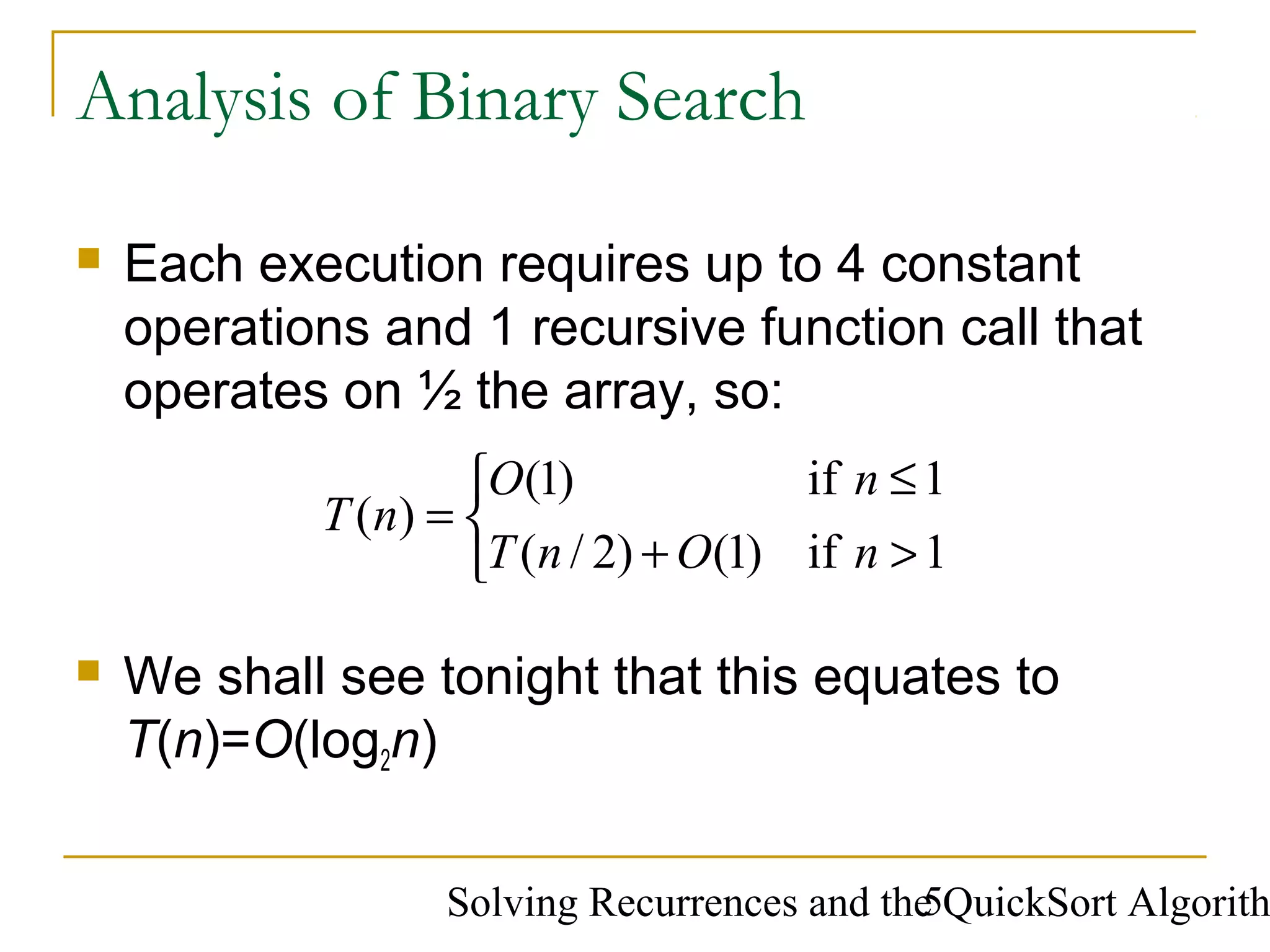
Analysis of Binary Search
 Each execution requires up to 4 constant
operations and 1 recursive function call that
operates on ½ the array, so:



>+
≤
=
1if)1()2/(
1if)1(
)(
nOnT
nO
nT
 We shall see tonight that this equates to
T(n)=O(log2n)
Solving Recurrences and the QuickSort Algorith6
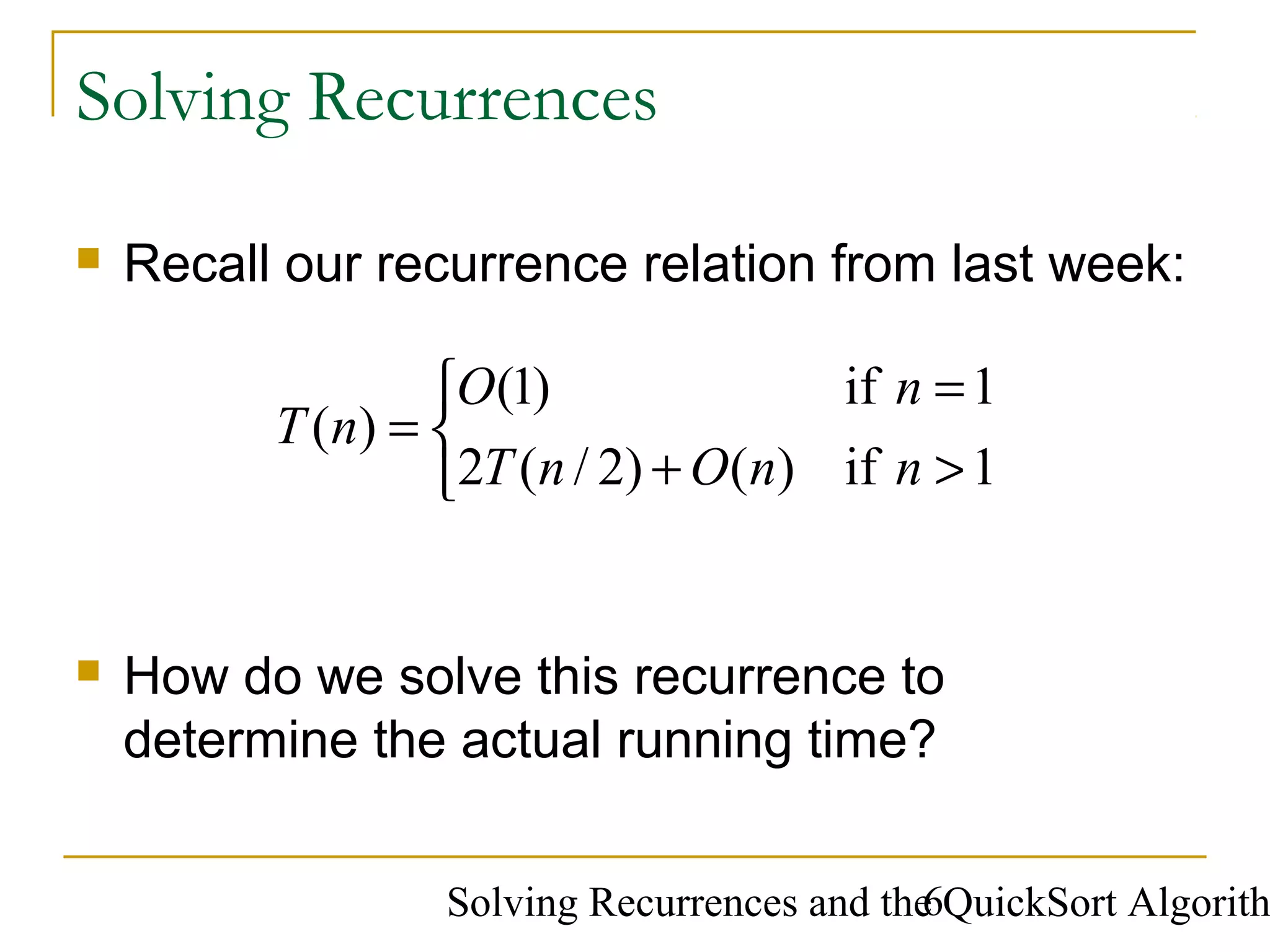
Solving Recurrences
 Recall our recurrence relation from last week:



>+
=
=
1if)()2/(2
1if)1(
)(
nnOnT
nO
nT
 How do we solve this recurrence to
determine the actual running time?
Solving Recurrences and the QuickSort Algorith7
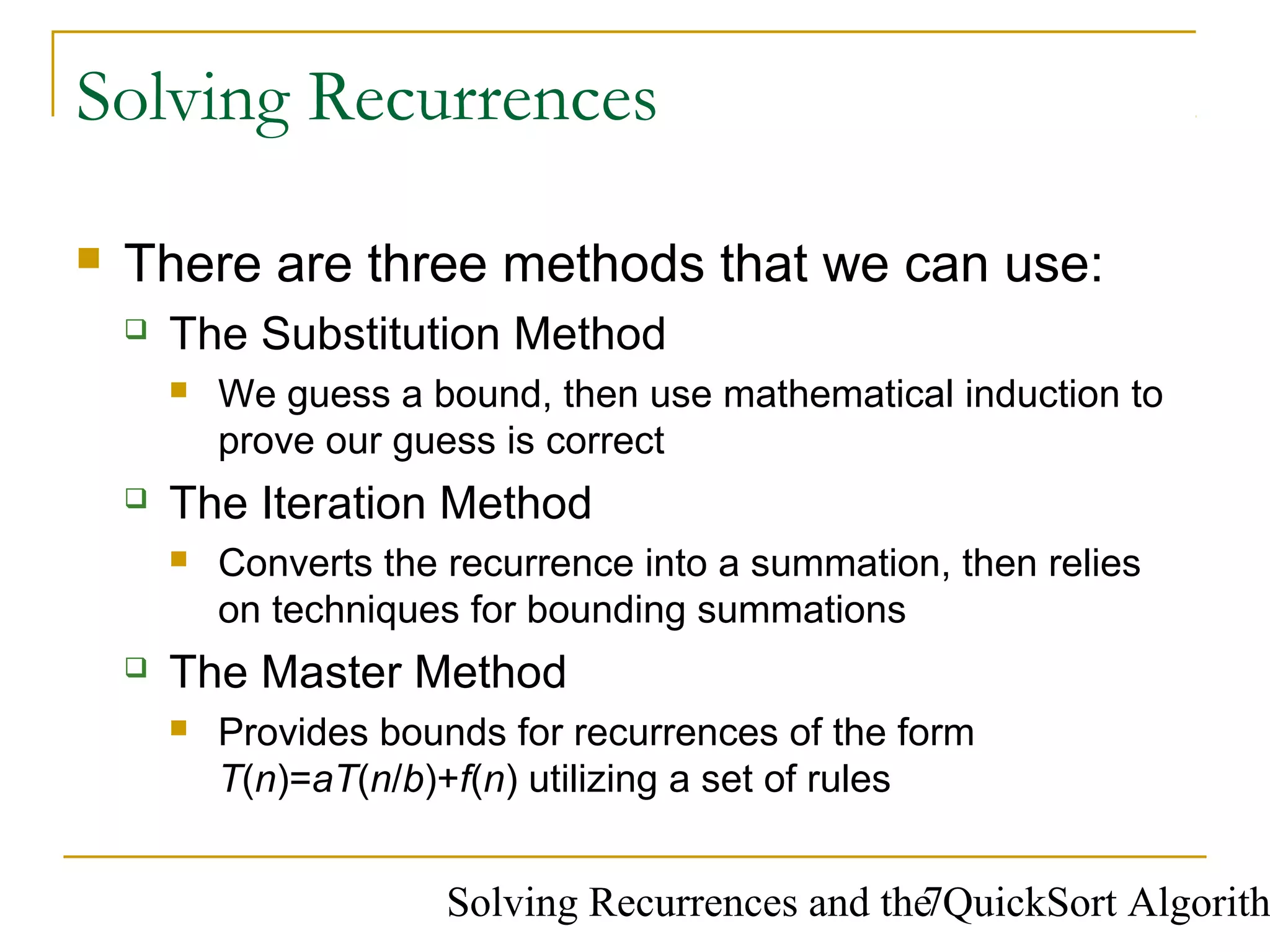
Solving Recurrences
 There are three methods that we can use:
 The Substitution Method
 We guess a bound, then use mathematical induction to
prove our guess is correct
 The Iteration Method
 Converts the recurrence into a summation, then relies
on techniques for bounding summations
 The Master Method
 Provides bounds for recurrences of the form
T(n)=aT(n/b)+f(n) utilizing a set of rules
Solving Recurrences and the QuickSort Algorith8
The Substitution Method
 Involves guessing the form of the solution,
then using mathematical induction to find the
constants and show that the solution works
 Can only be applied in cases when it is easy
to guess the form of the answer
Solving Recurrences and the QuickSort Algorith9
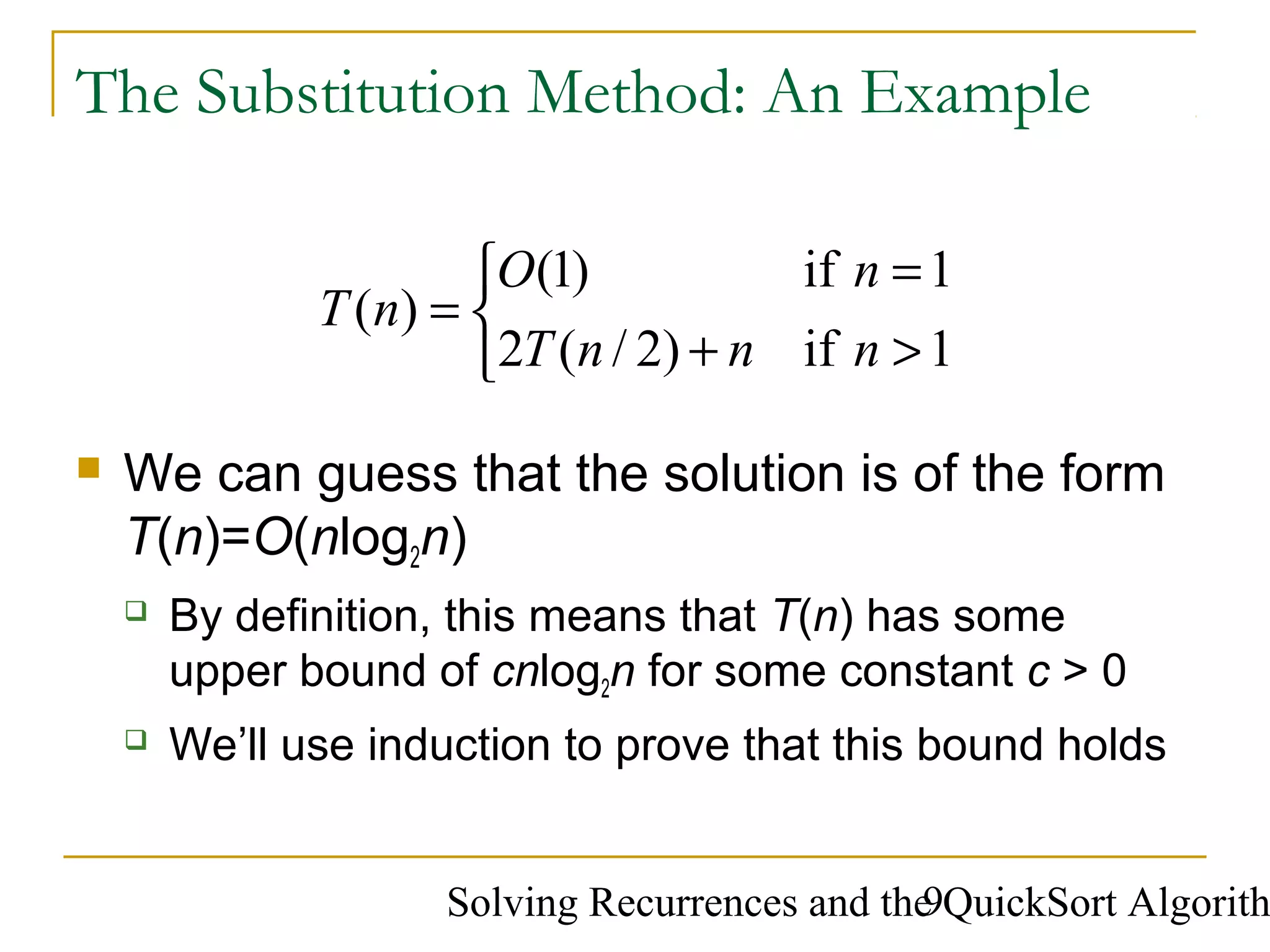
The Substitution Method: An Example
 We can guess that the solution is of the form
T(n)=O(nlog2n)
 By definition, this means that T(n) has some
upper bound of cnlog2n for some constant c > 0
 We’ll use induction to prove that this bound holds



>+
=
=
1if)2/(2
1if)1(
)(
nnnT
nO
nT
Solving Recurrences and the QuickSort Algorith10
The Substitution Method: An Example
1aslongas-log
log
2loglog
)2/(log
))2/(log]2/[(2)(
:yieldsrecurrencetheintothisngSubstituti
)2/(log)2/()2/(
:isthat,2/forholdsboundthat thisassumingbystartWe
2
2
22
2
2
2
≥≤
+−=
+−=
+≤
+≤
≤
cncn
ncnncn
ncnncn
nncn
nnncnT
nncnT
n
Solving Recurrences and the QuickSort Algorith11
The Substitution Method: An Example
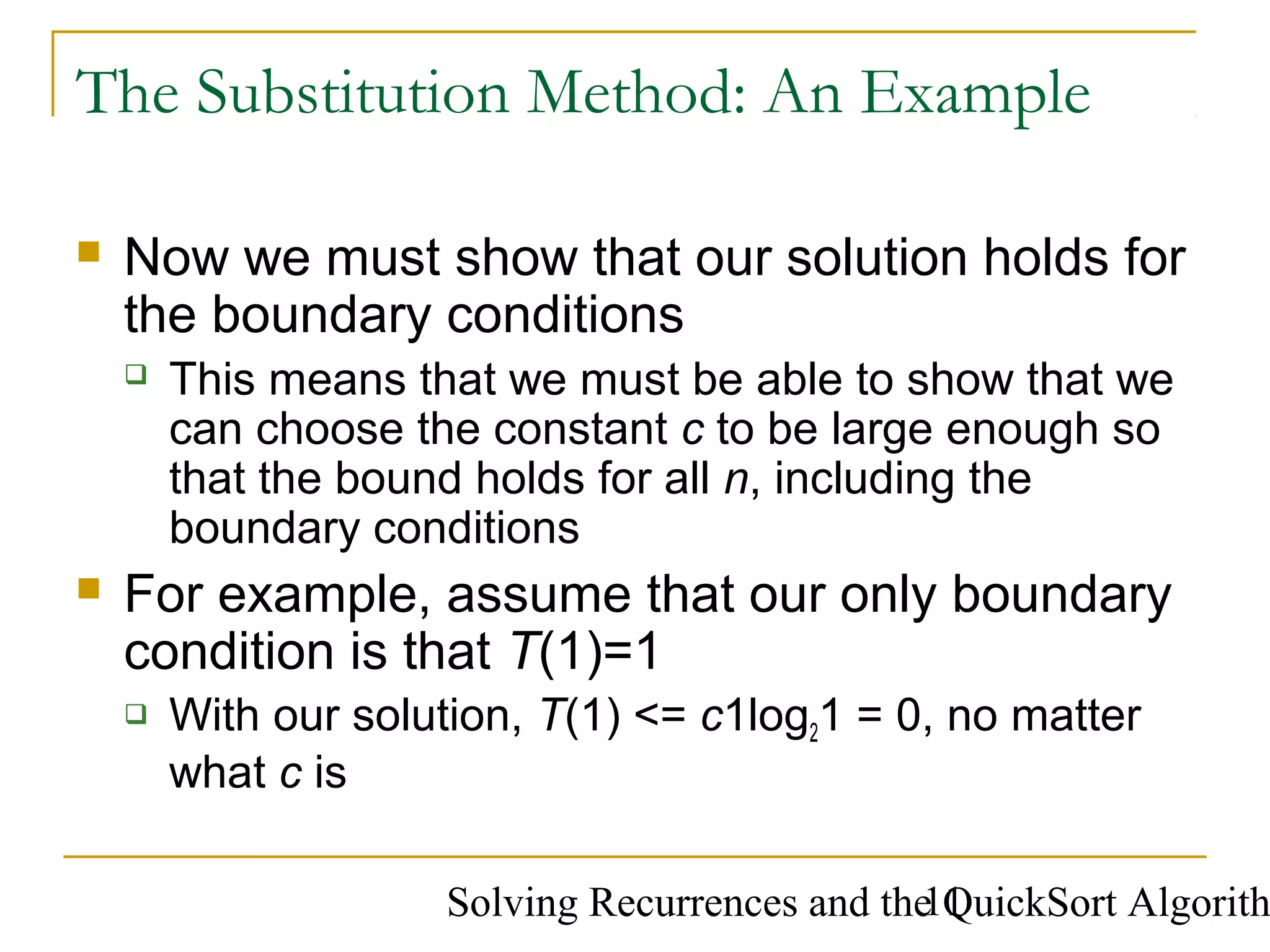
 Now we must show that our solution holds for
the boundary conditions
 This means that we must be able to show that we
can choose the constant c to be large enough so
that the bound holds for all n, including the
boundary conditions
 For example, assume that our only boundary
condition is that T(1)=1
 With our solution, T(1) <= c1log21 = 0, no matter
what c is
Solving Recurrences and the QuickSort Algorith12
The Substitution Method: An Example
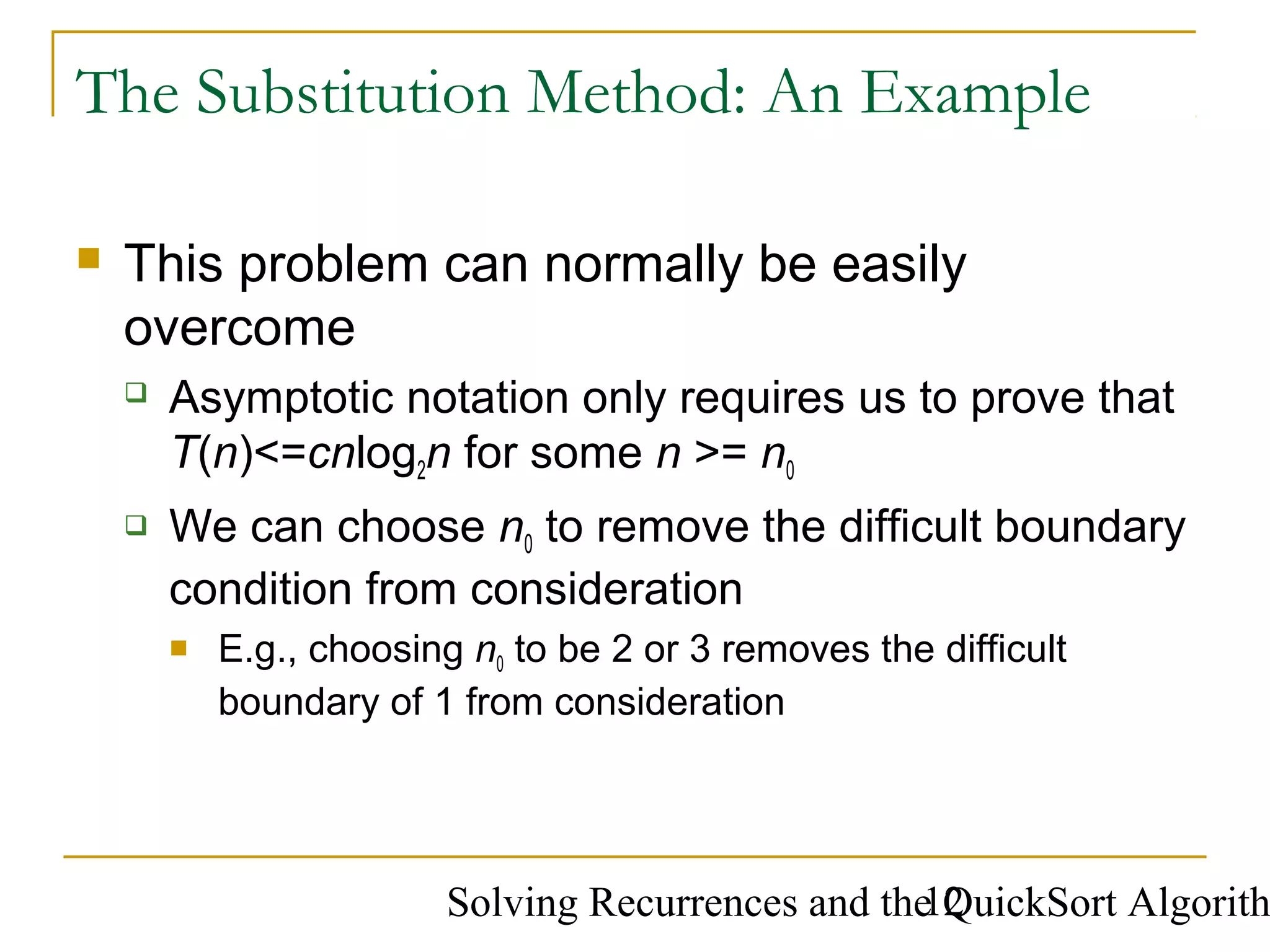
 This problem can normally be easily
overcome
 Asymptotic notation only requires us to prove that
T(n)<=cnlog2n for some n >= n0
 We can choose n0 to remove the difficult boundary
condition from consideration
 E.g., choosing n0 to be 2 or 3 removes the difficult
boundary of 1 from consideration
Solving Recurrences and the QuickSort Algorith13
The Iteration Method
 No guesses are required, but significant
algebra is
 The idea is to expand the recurrence and
express it as a summation of terms
dependent only on n
Solving Recurrences and the QuickSort Algorith14
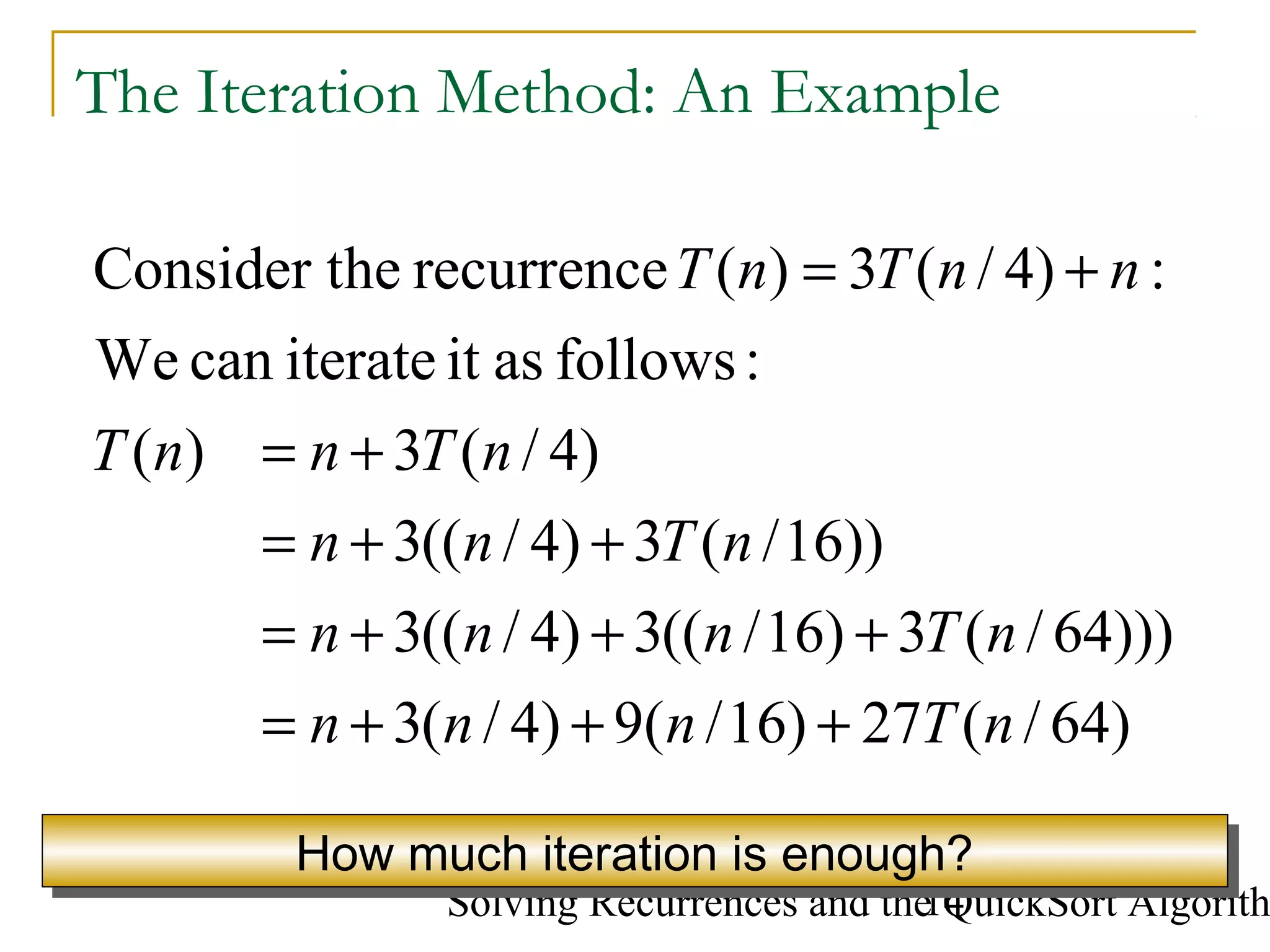
The Iteration Method: An Example
)64/(27)16/(9)4/(3
)))64/(3)16/((3)4/((3
))16/(3)4/((3
)4/(3)(
:followsasititeratecanWe
:)4/(3)(recurrenceheConsider t
nTnnn
nTnnn
nTnn
nTnnT
nnTnT
+++=
+++=
++=
+=
+=
How much iteration is enough?How much iteration is enough?
Solving Recurrences and the QuickSort Algorith15
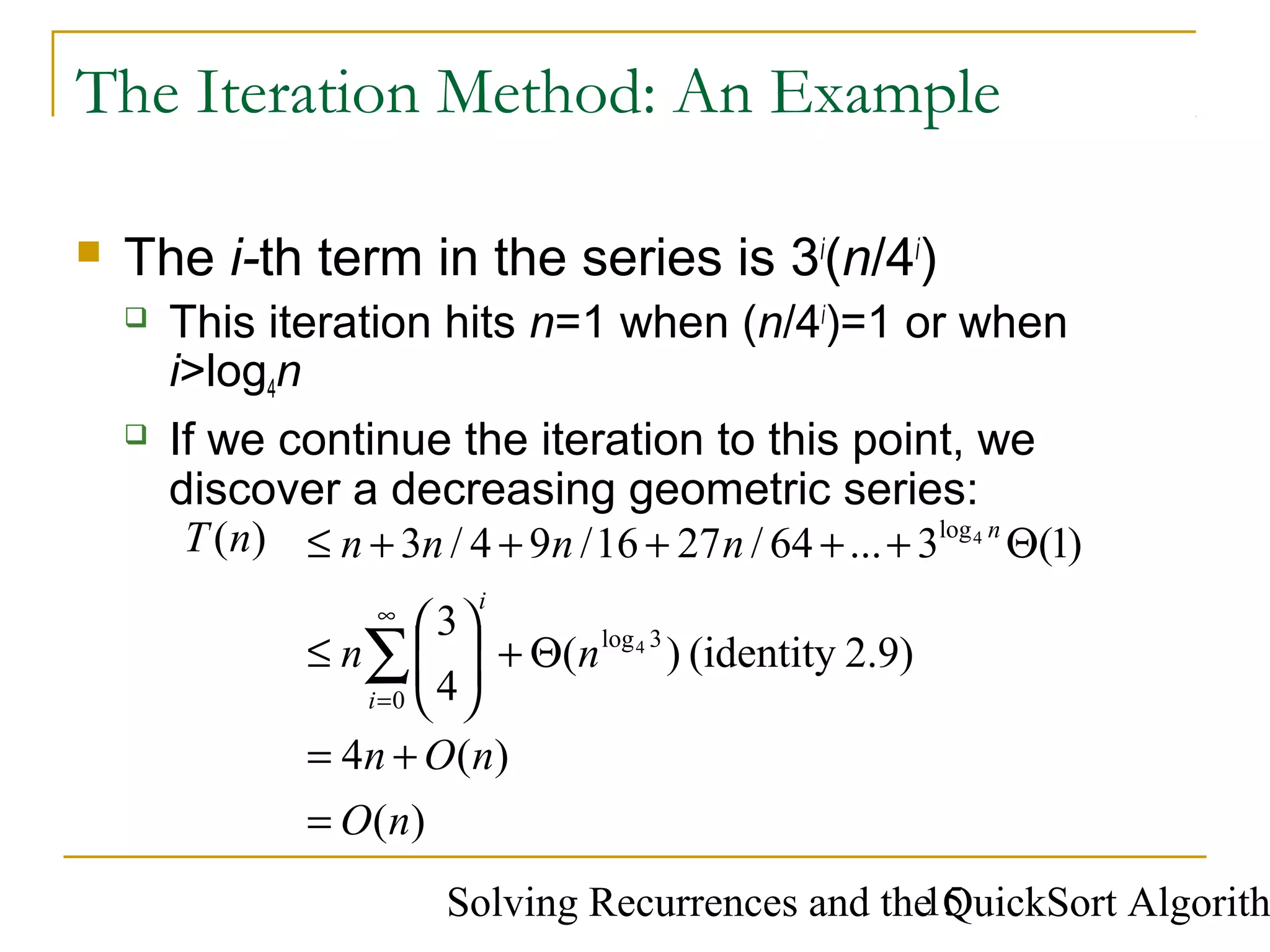
The Iteration Method: An Example
 The i-th term in the series is 3i
(n/4i
)
 This iteration hits n=1 when (n/4i
)=1 or when
i>log4n
 If we continue the iteration to this point, we
discover a decreasing geometric series:
)(
)(4
2.9)(identity)(
4
3
)1(3...64/2716/94/3)(
0
3log
log
4
4
nO
nOn
nn
nnnnnT
i
i
n
=
+=
Θ+





≤
Θ+++++≤
∑
∞
=
Solving Recurrences and the QuickSort Algorith16
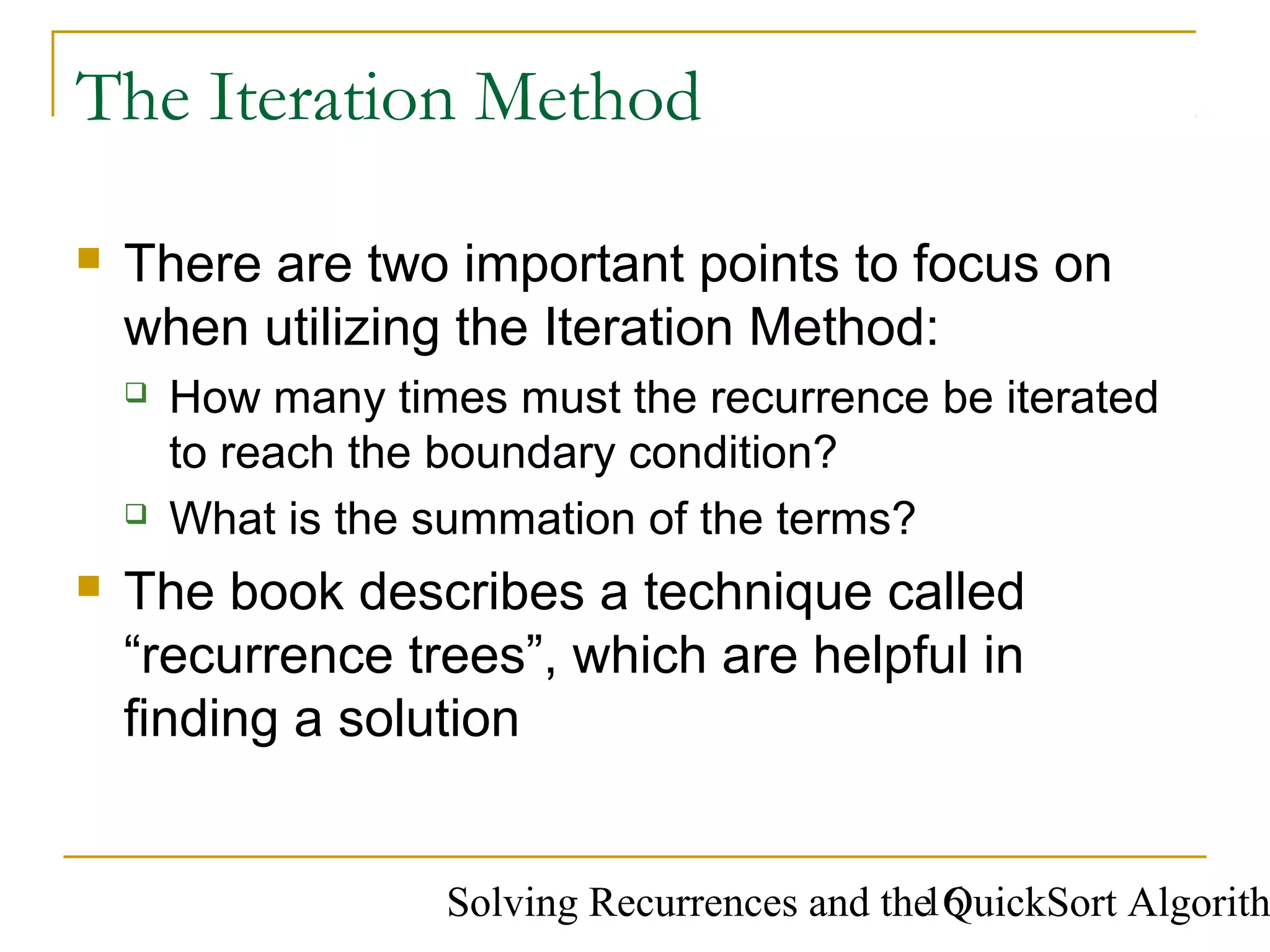
The Iteration Method
 There are two important points to focus on
when utilizing the Iteration Method:
 How many times must the recurrence be iterated
to reach the boundary condition?
 What is the summation of the terms?
 The book describes a technique called
“recurrence trees”, which are helpful in
finding a solution
Solving Recurrences and the QuickSort Algorith17
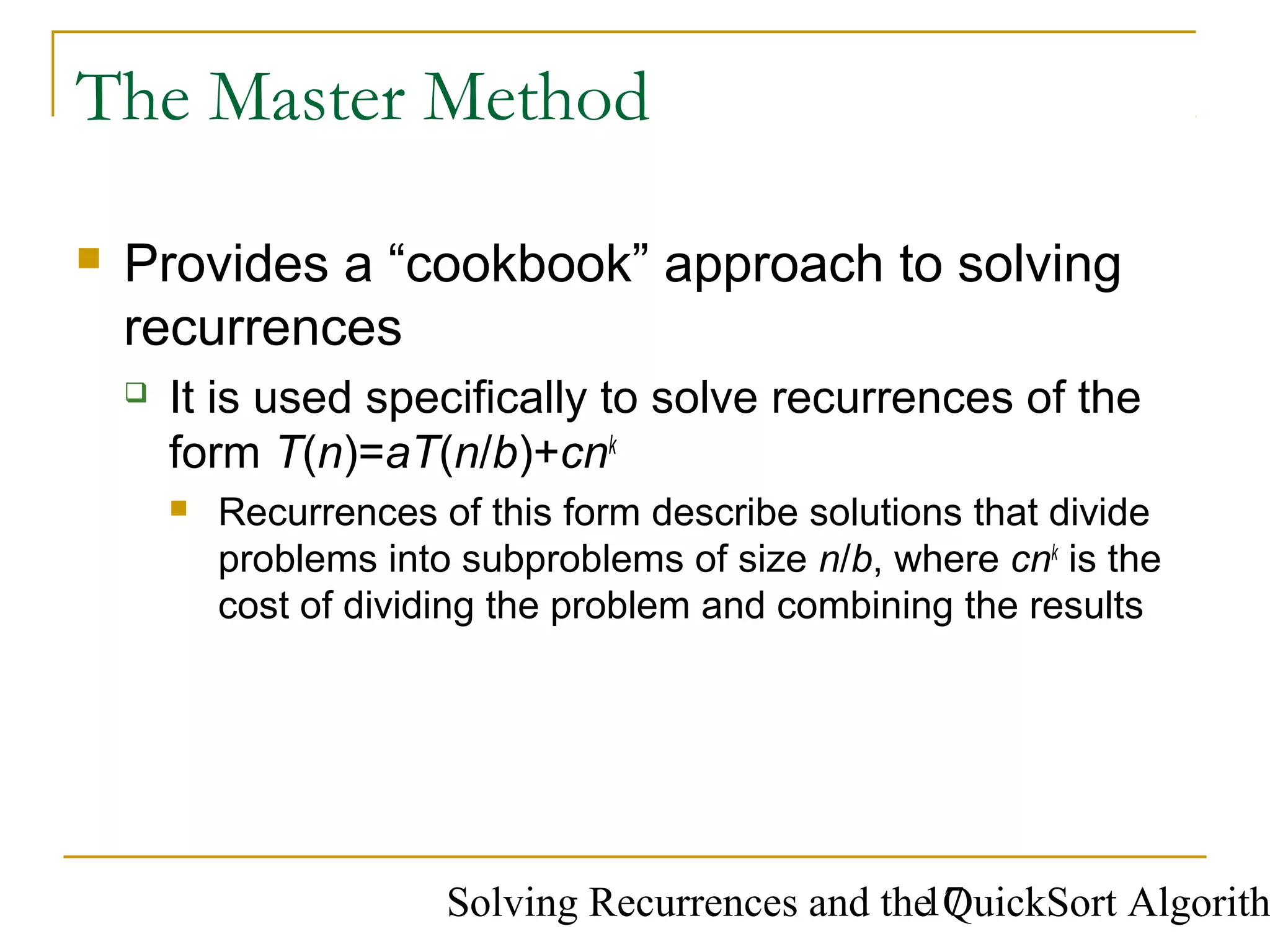
The Master Method
 Provides a “cookbook” approach to solving
recurrences
 It is used specifically to solve recurrences of the
form T(n)=aT(n/b)+cnk
 Recurrences of this form describe solutions that divide
problems into subproblems of size n/b, where cnk
is the
cost of dividing the problem and combining the results
Solving Recurrences and the QuickSort Algorith18
The Master Method
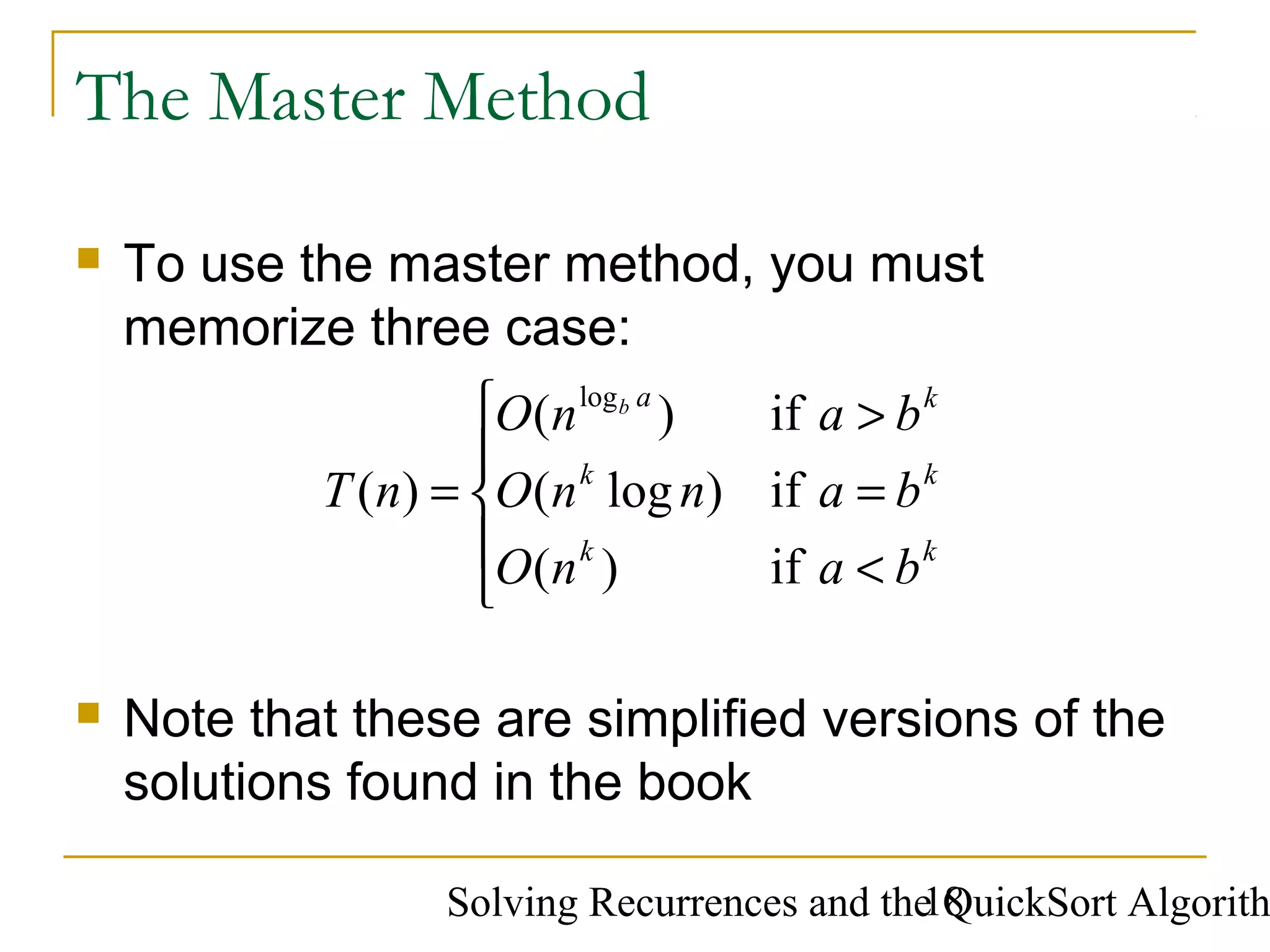
 To use the master method, you must
memorize three case:





<
=
>
=
k
k
k
k
k
a
ba
ba
ba
nO
nnO
nO
nT
b
if
if
if
)(
)log(
)(
)(
log
 Note that these are simplified versions of the
solutions found in the book
Solving Recurrences and the QuickSort Algorith19
QuickSort
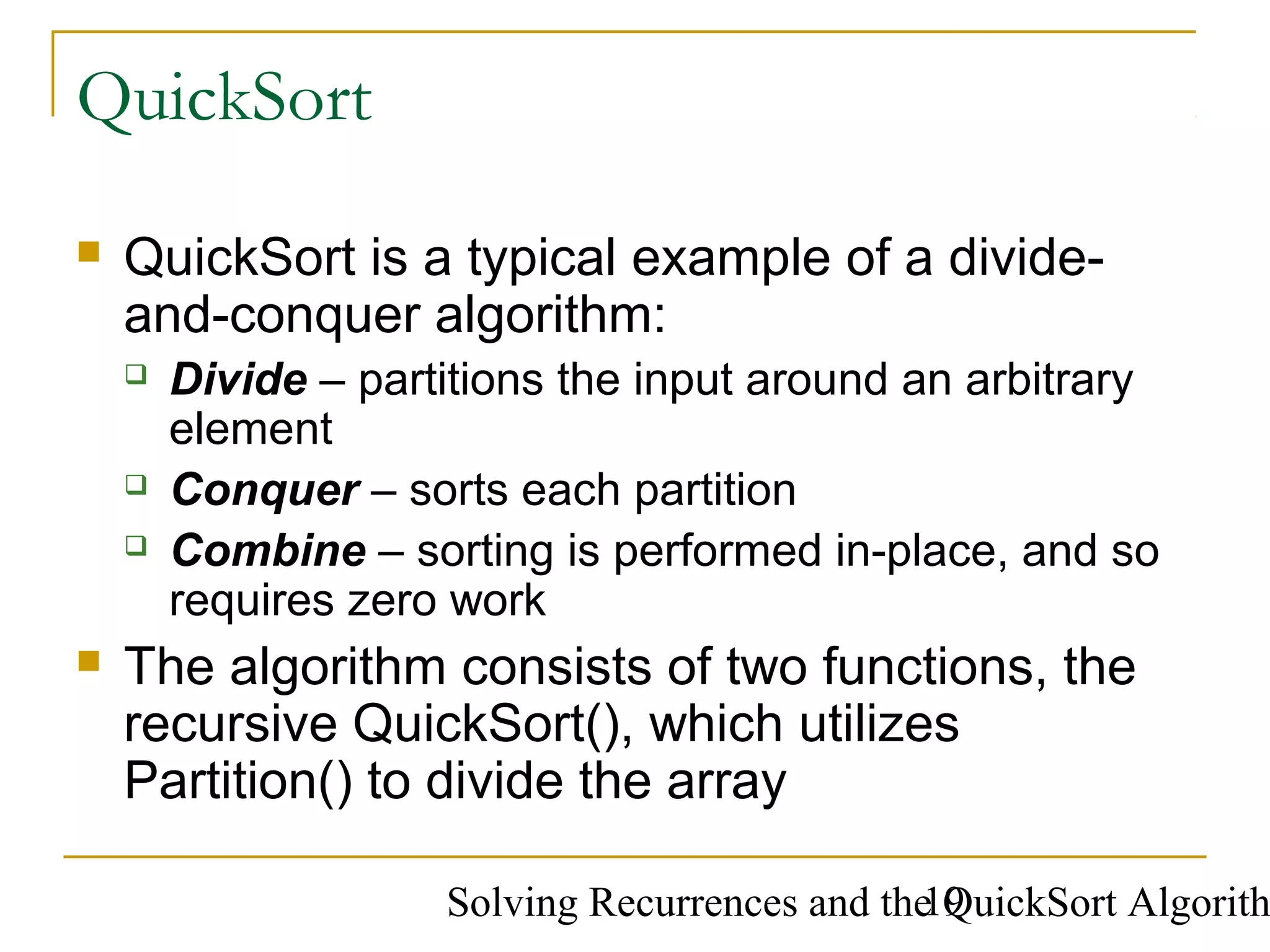
 QuickSort is a typical example of a divide-
and-conquer algorithm:
 Divide – partitions the input around an arbitrary
element
 Conquer – sorts each partition
 Combine – sorting is performed in-place, and so
requires zero work
 The algorithm consists of two functions, the
recursive QuickSort(), which utilizes
Partition() to divide the array
Solving Recurrences and the QuickSort Algorith20
QuickSort
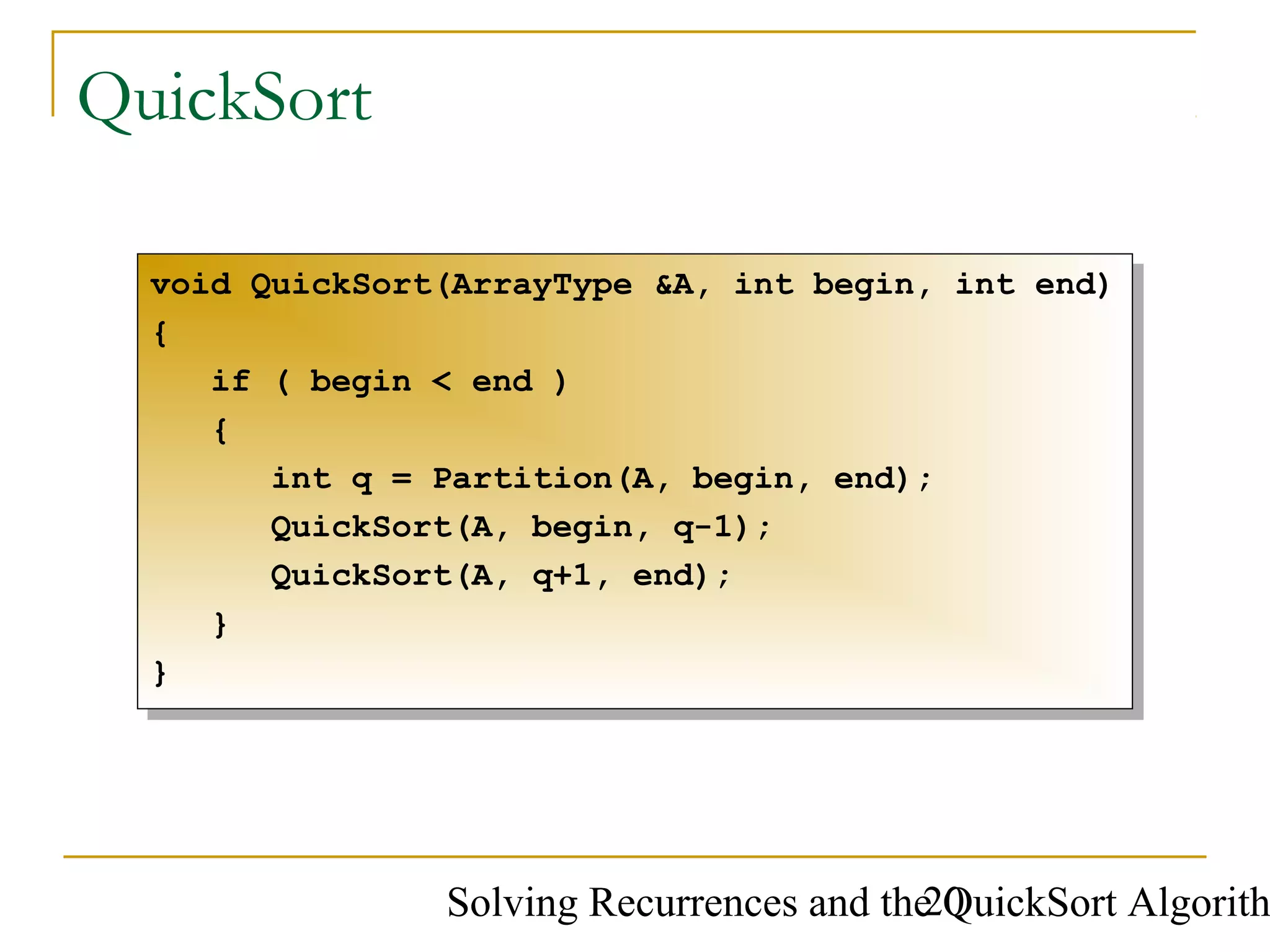
void QuickSort(ArrayType &A, int begin, int end)
{
if ( begin < end )
{
int q = Partition(A, begin, end);
QuickSort(A, begin, q-1);
QuickSort(A, q+1, end);
}
}
void QuickSort(ArrayType &A, int begin, int end)
{
if ( begin < end )
{
int q = Partition(A, begin, end);
QuickSort(A, begin, q-1);
QuickSort(A, q+1, end);
}
}
Solving Recurrences and the QuickSort Algorith21
QuickSort: Partition
int Partition(ArrayType A[], int begin, int end)
{
ArrayType x = A[end];
int i = begin - 1;
for ( int j = begin ; j < end ; ++j )
{
if ( A[j] < x )
{
++i;
swap(A[i], A[j]);
}
}
swap(A[i+1], A[end]);
return i+1;
}
int Partition(ArrayType A[], int begin, int end)
{
ArrayType x = A[end];
int i = begin - 1;
for ( int j = begin ; j < end ; ++j )
{
if ( A[j] < x )
{
++i;
swap(A[i], A[j]);
}
}
swap(A[i+1], A[end]);
return i+1;
}
Solving Recurrences and the QuickSort Algorith22
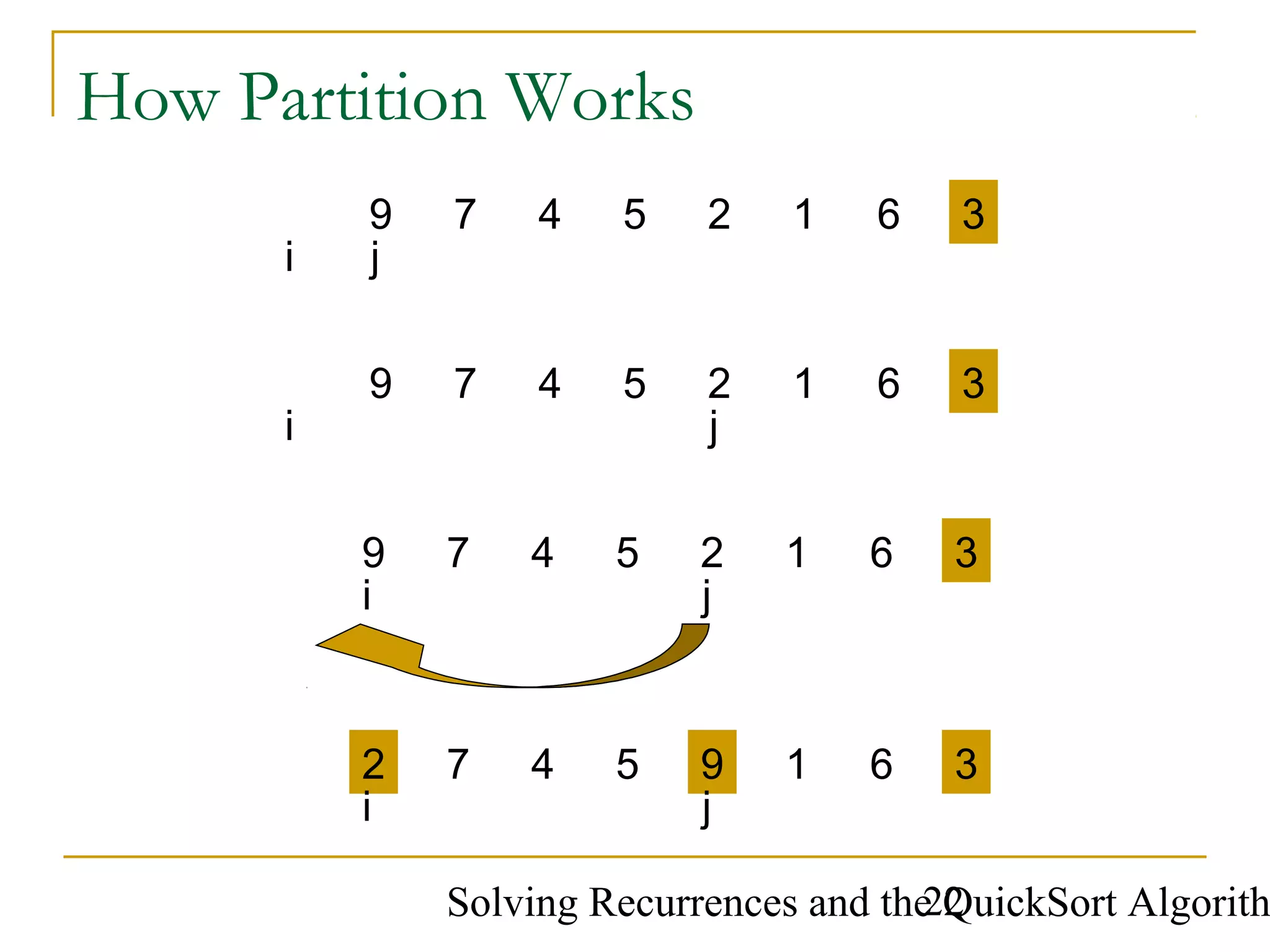
How Partition Works
9 7 4 5 2 1 6 3
i j
9 7 4 5 2 1 6 3
i j
9 7 4 5 2 1 6 3
i j
97 4 52 1 6 3
i j
Solving Recurrences and the QuickSort Algorith23
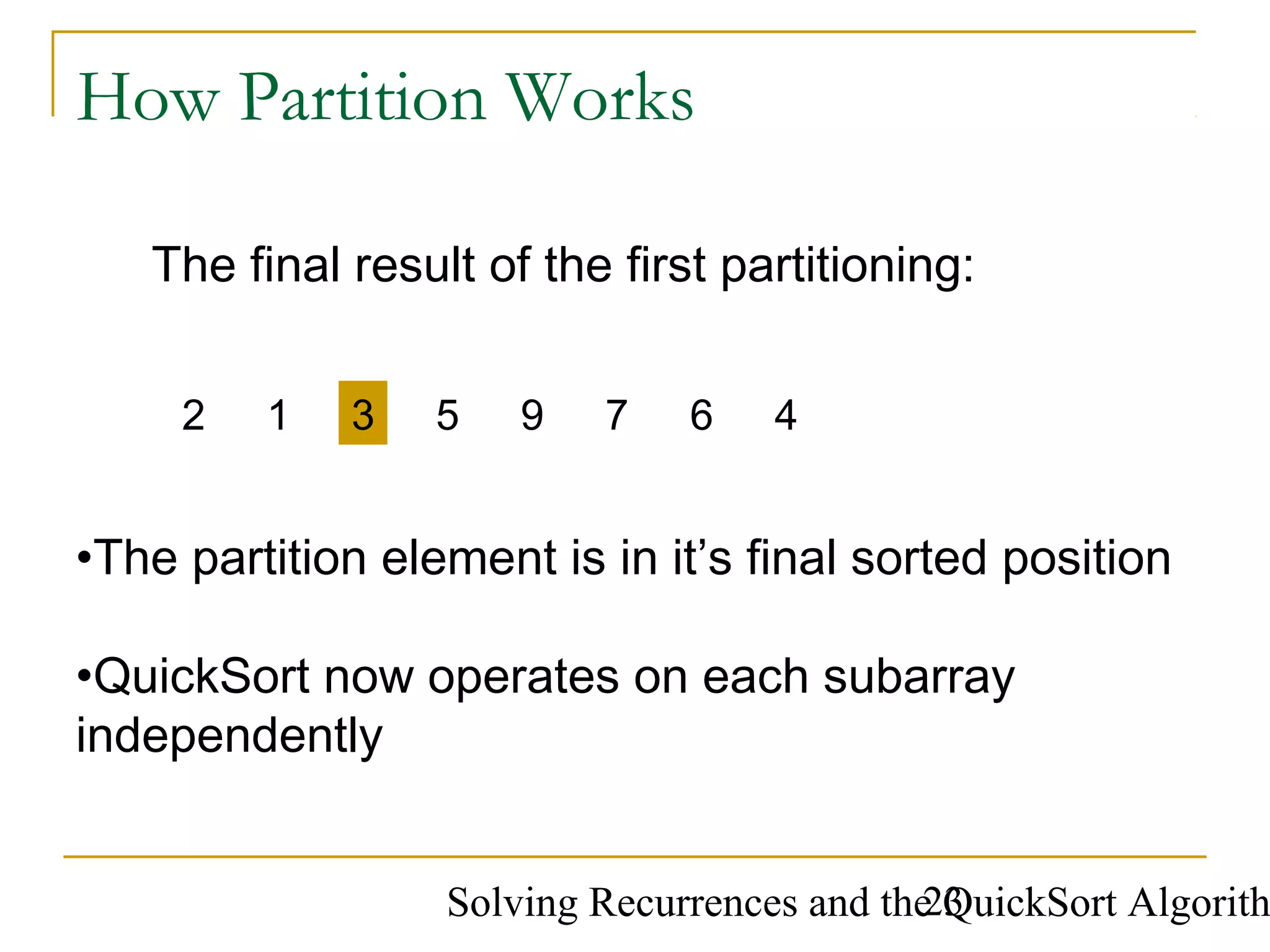
How Partition Works
9 7 452 1 63
The final result of the first partitioning:
•The partition element is in it’s final sorted position
•QuickSort now operates on each subarray
independently
Solving Recurrences and the QuickSort Algorith24
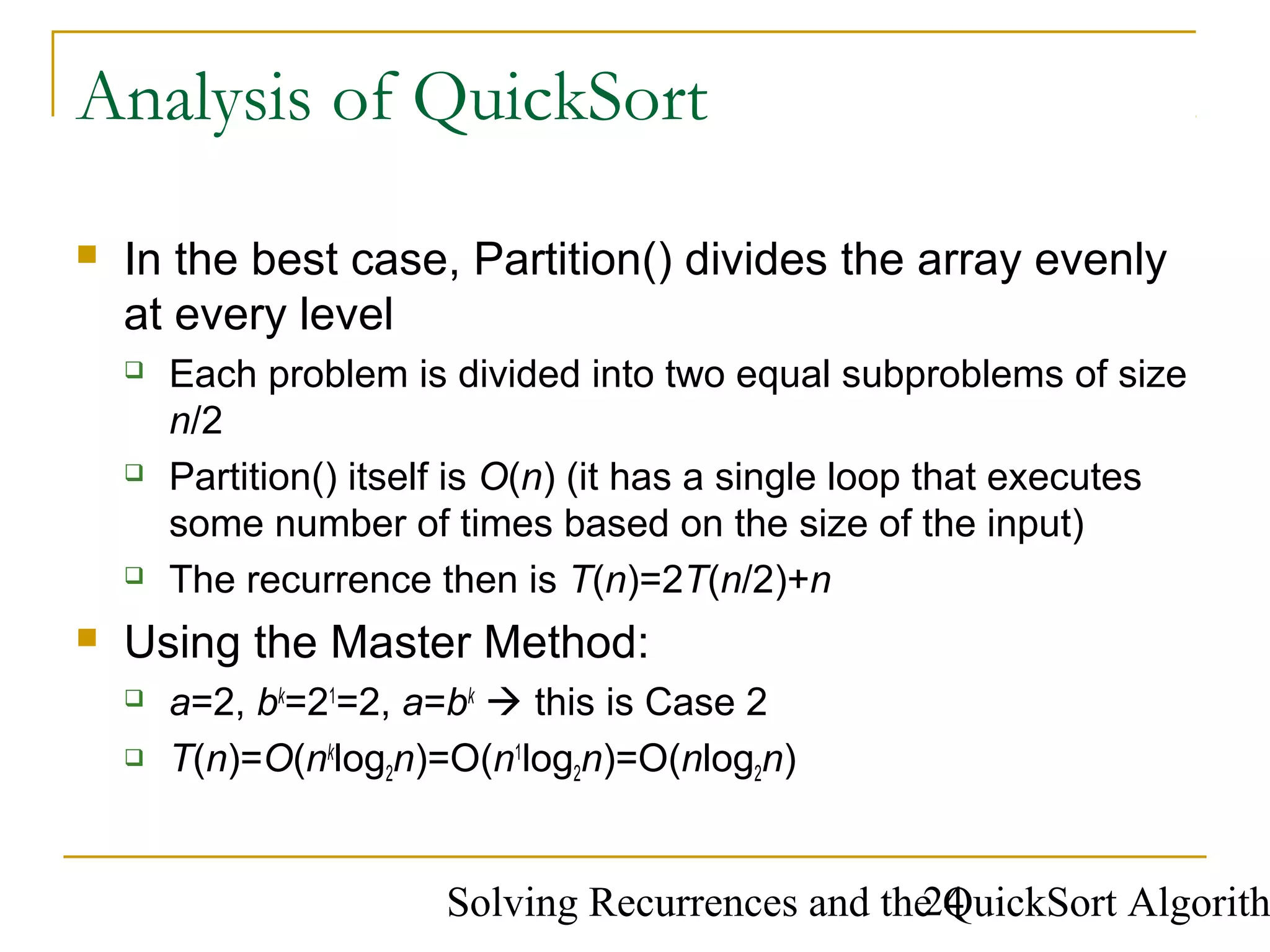
Analysis of QuickSort
 In the best case, Partition() divides the array evenly
at every level
 Each problem is divided into two equal subproblems of size
n/2
 Partition() itself is O(n) (it has a single loop that executes
some number of times based on the size of the input)
 The recurrence then is T(n)=2T(n/2)+n
 Using the Master Method:
 a=2, bk
=21
=2, a=bk
 this is Case 2
 T(n)=O(nk
log2n)=O(n1
log2n)=O(nlog2n)
Solving Recurrences and the QuickSort Algorith25
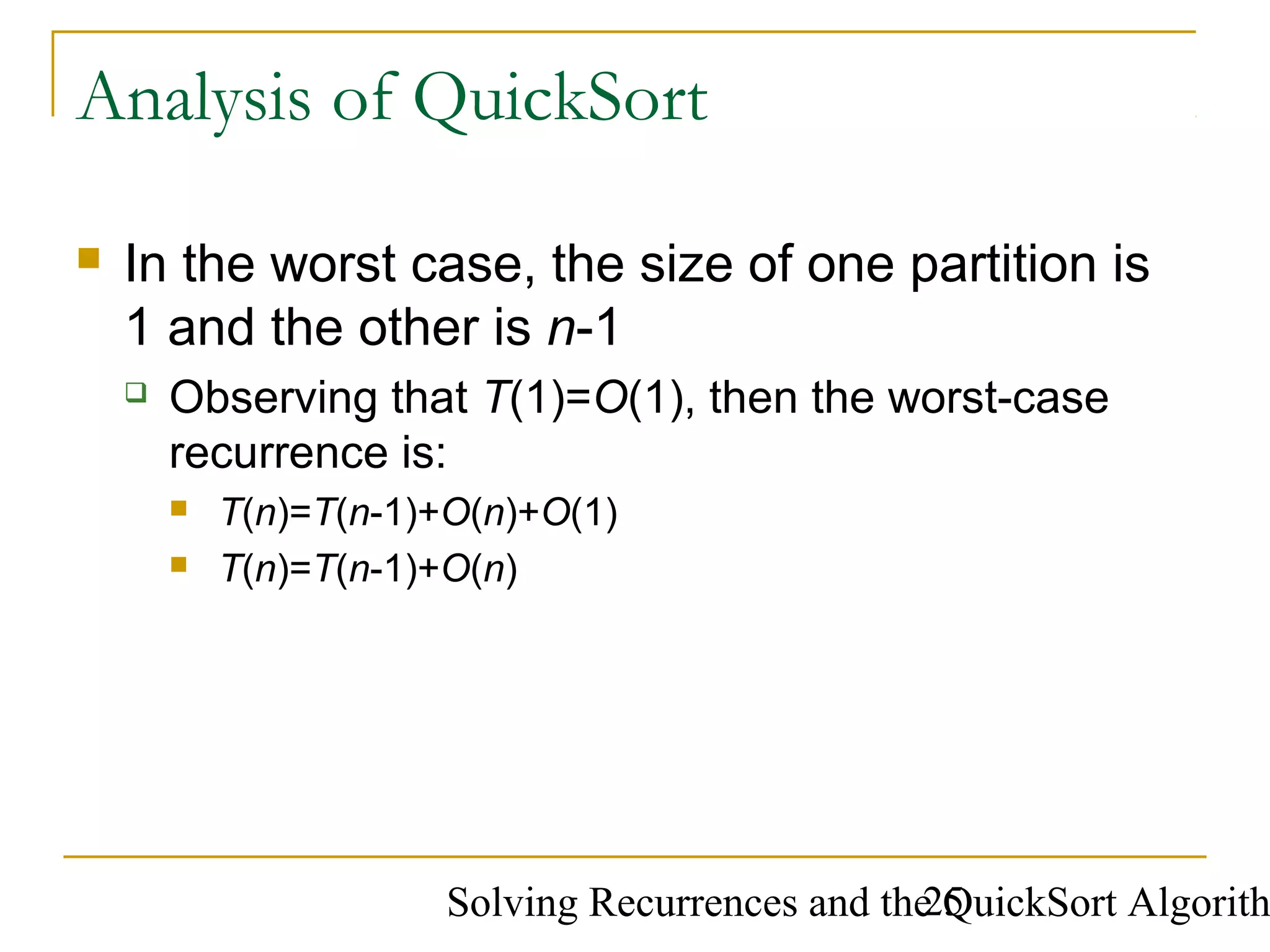
Analysis of QuickSort
 In the worst case, the size of one partition is
1 and the other is n-1
 Observing that T(1)=O(1), then the worst-case
recurrence is:
 T(n)=T(n-1)+O(n)+O(1)
 T(n)=T(n-1)+O(n)
Solving Recurrences and the QuickSort Algorith26
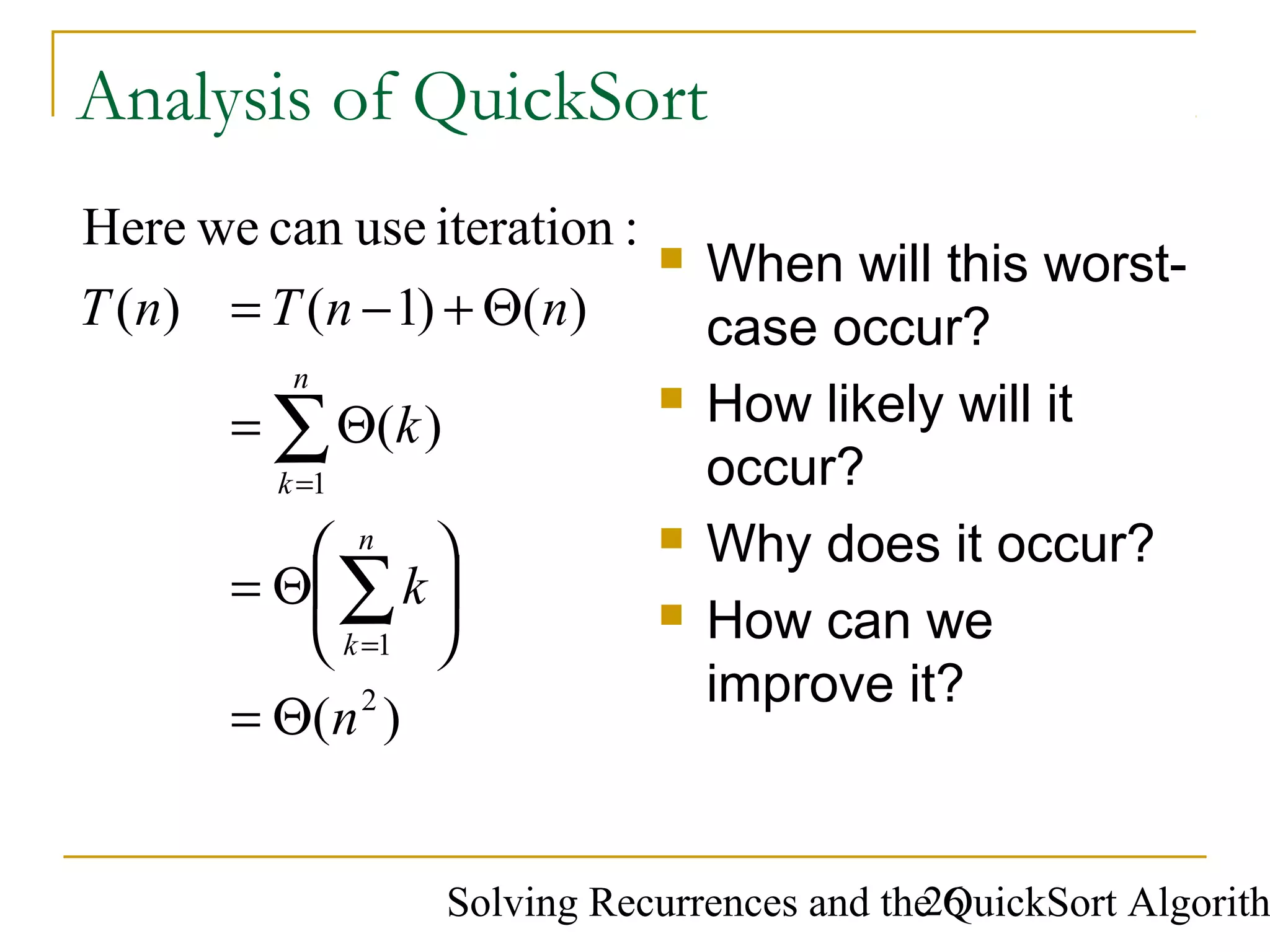
Analysis of QuickSort
 When will this worst-
case occur?
 How likely will it
occur?
 Why does it occur?
 How can we
improve it?
)(
)(
)()1()(
:iterationusecanweHere
2
1
1
n
k
k
nnTnT
n
k
n
k
Θ=






Θ=
Θ=
Θ+−=
∑
∑
=
=
Solving Recurrences and the QuickSort Algorith27
Homework
 Reading: 4.1-4.3; 8.1-8.2; 8.4
 Exercises:
 4.3-1, 2, 3

Cis435 week02

  • 1.
    Solving Recurrences andthe QuickSort Algorithm 1 Advanced Data Structures & Algorithm Design Solving Recurrences and the QuickSort Algorithm
  • 2.
    Solving Recurrences andthe QuickSort Algorith2 The Search Problem  A complement to the sorting problem discussed last week is the searching problem:  Given a set of elements A = {a1, a2, …, an} and a search parameter s, return the location i of s in A  If A is an ordered set, then the binary search algorithm can be used to search A for some value
  • 3.
    Solving Recurrences andthe QuickSort Algorith3 The Binary Search Algorithm  The binary search algorithm operates as follows (where A is the input set, and mid is the index of the element at the midpoint of A):  If s = Amid, return mid  If s < Amid, search the left half of A  If s > Amid, search the right half of A
  • 4.
    Solving Recurrences andthe QuickSort Algorith4 The Binary Search Algorithm int BinarySearch(const DataType A[], int first, int last, const DataType &s) { if ( last < first ) return –1; // not found int mid = (first + last) / 2; if ( s == A[mid] ) return mid; if ( s < A[mid] ) // search left return BinarySearch(A, first, mid-1, s); else return BinarySearch(A, mid+1, last, s); } int BinarySearch(const DataType A[], int first, int last, const DataType &s) { if ( last < first ) return –1; // not found int mid = (first + last) / 2; if ( s == A[mid] ) return mid; if ( s < A[mid] ) // search left return BinarySearch(A, first, mid-1, s); else return BinarySearch(A, mid+1, last, s); } What is the order of growth of the running time of BinarySearch? What is the order of growth of the running time of BinarySearch?
  • 5.
    Solving Recurrences andthe QuickSort Algorith5 Analysis of Binary Search  Each execution requires up to 4 constant operations and 1 recursive function call that operates on ½ the array, so:    >+ ≤ = 1if)1()2/( 1if)1( )( nOnT nO nT  We shall see tonight that this equates to T(n)=O(log2n)
  • 6.
    Solving Recurrences andthe QuickSort Algorith6 Solving Recurrences  Recall our recurrence relation from last week:    >+ = = 1if)()2/(2 1if)1( )( nnOnT nO nT  How do we solve this recurrence to determine the actual running time?
  • 7.
    Solving Recurrences andthe QuickSort Algorith7 Solving Recurrences  There are three methods that we can use:  The Substitution Method  We guess a bound, then use mathematical induction to prove our guess is correct  The Iteration Method  Converts the recurrence into a summation, then relies on techniques for bounding summations  The Master Method  Provides bounds for recurrences of the form T(n)=aT(n/b)+f(n) utilizing a set of rules
  • 8.
    Solving Recurrences andthe QuickSort Algorith8 The Substitution Method  Involves guessing the form of the solution, then using mathematical induction to find the constants and show that the solution works  Can only be applied in cases when it is easy to guess the form of the answer
  • 9.
    Solving Recurrences andthe QuickSort Algorith9 The Substitution Method: An Example  We can guess that the solution is of the form T(n)=O(nlog2n)  By definition, this means that T(n) has some upper bound of cnlog2n for some constant c > 0  We’ll use induction to prove that this bound holds    >+ = = 1if)2/(2 1if)1( )( nnnT nO nT
  • 10.
    Solving Recurrences andthe QuickSort Algorith10 The Substitution Method: An Example 1aslongas-log log 2loglog )2/(log ))2/(log]2/[(2)( :yieldsrecurrencetheintothisngSubstituti )2/(log)2/()2/( :isthat,2/forholdsboundthat thisassumingbystartWe 2 2 22 2 2 2 ≥≤ +−= +−= +≤ +≤ ≤ cncn ncnncn ncnncn nncn nnncnT nncnT n
  • 11.
    Solving Recurrences andthe QuickSort Algorith11 The Substitution Method: An Example  Now we must show that our solution holds for the boundary conditions  This means that we must be able to show that we can choose the constant c to be large enough so that the bound holds for all n, including the boundary conditions  For example, assume that our only boundary condition is that T(1)=1  With our solution, T(1) <= c1log21 = 0, no matter what c is
  • 12.
    Solving Recurrences andthe QuickSort Algorith12 The Substitution Method: An Example  This problem can normally be easily overcome  Asymptotic notation only requires us to prove that T(n)<=cnlog2n for some n >= n0  We can choose n0 to remove the difficult boundary condition from consideration  E.g., choosing n0 to be 2 or 3 removes the difficult boundary of 1 from consideration
  • 13.
    Solving Recurrences andthe QuickSort Algorith13 The Iteration Method  No guesses are required, but significant algebra is  The idea is to expand the recurrence and express it as a summation of terms dependent only on n
  • 14.
    Solving Recurrences andthe QuickSort Algorith14 The Iteration Method: An Example )64/(27)16/(9)4/(3 )))64/(3)16/((3)4/((3 ))16/(3)4/((3 )4/(3)( :followsasititeratecanWe :)4/(3)(recurrenceheConsider t nTnnn nTnnn nTnn nTnnT nnTnT +++= +++= ++= += += How much iteration is enough?How much iteration is enough?
  • 15.
    Solving Recurrences andthe QuickSort Algorith15 The Iteration Method: An Example  The i-th term in the series is 3i (n/4i )  This iteration hits n=1 when (n/4i )=1 or when i>log4n  If we continue the iteration to this point, we discover a decreasing geometric series: )( )(4 2.9)(identity)( 4 3 )1(3...64/2716/94/3)( 0 3log log 4 4 nO nOn nn nnnnnT i i n = += Θ+      ≤ Θ+++++≤ ∑ ∞ =
  • 16.
    Solving Recurrences andthe QuickSort Algorith16 The Iteration Method  There are two important points to focus on when utilizing the Iteration Method:  How many times must the recurrence be iterated to reach the boundary condition?  What is the summation of the terms?  The book describes a technique called “recurrence trees”, which are helpful in finding a solution
  • 17.
    Solving Recurrences andthe QuickSort Algorith17 The Master Method  Provides a “cookbook” approach to solving recurrences  It is used specifically to solve recurrences of the form T(n)=aT(n/b)+cnk  Recurrences of this form describe solutions that divide problems into subproblems of size n/b, where cnk is the cost of dividing the problem and combining the results
  • 18.
    Solving Recurrences andthe QuickSort Algorith18 The Master Method  To use the master method, you must memorize three case:      < = > = k k k k k a ba ba ba nO nnO nO nT b if if if )( )log( )( )( log  Note that these are simplified versions of the solutions found in the book
  • 19.
    Solving Recurrences andthe QuickSort Algorith19 QuickSort  QuickSort is a typical example of a divide- and-conquer algorithm:  Divide – partitions the input around an arbitrary element  Conquer – sorts each partition  Combine – sorting is performed in-place, and so requires zero work  The algorithm consists of two functions, the recursive QuickSort(), which utilizes Partition() to divide the array
  • 20.
    Solving Recurrences andthe QuickSort Algorith20 QuickSort void QuickSort(ArrayType &A, int begin, int end) { if ( begin < end ) { int q = Partition(A, begin, end); QuickSort(A, begin, q-1); QuickSort(A, q+1, end); } } void QuickSort(ArrayType &A, int begin, int end) { if ( begin < end ) { int q = Partition(A, begin, end); QuickSort(A, begin, q-1); QuickSort(A, q+1, end); } }
  • 21.
    Solving Recurrences andthe QuickSort Algorith21 QuickSort: Partition int Partition(ArrayType A[], int begin, int end) { ArrayType x = A[end]; int i = begin - 1; for ( int j = begin ; j < end ; ++j ) { if ( A[j] < x ) { ++i; swap(A[i], A[j]); } } swap(A[i+1], A[end]); return i+1; } int Partition(ArrayType A[], int begin, int end) { ArrayType x = A[end]; int i = begin - 1; for ( int j = begin ; j < end ; ++j ) { if ( A[j] < x ) { ++i; swap(A[i], A[j]); } } swap(A[i+1], A[end]); return i+1; }
  • 22.
    Solving Recurrences andthe QuickSort Algorith22 How Partition Works 9 7 4 5 2 1 6 3 i j 9 7 4 5 2 1 6 3 i j 9 7 4 5 2 1 6 3 i j 97 4 52 1 6 3 i j
  • 23.
    Solving Recurrences andthe QuickSort Algorith23 How Partition Works 9 7 452 1 63 The final result of the first partitioning: •The partition element is in it’s final sorted position •QuickSort now operates on each subarray independently
  • 24.
    Solving Recurrences andthe QuickSort Algorith24 Analysis of QuickSort  In the best case, Partition() divides the array evenly at every level  Each problem is divided into two equal subproblems of size n/2  Partition() itself is O(n) (it has a single loop that executes some number of times based on the size of the input)  The recurrence then is T(n)=2T(n/2)+n  Using the Master Method:  a=2, bk =21 =2, a=bk  this is Case 2  T(n)=O(nk log2n)=O(n1 log2n)=O(nlog2n)
  • 25.
    Solving Recurrences andthe QuickSort Algorith25 Analysis of QuickSort  In the worst case, the size of one partition is 1 and the other is n-1  Observing that T(1)=O(1), then the worst-case recurrence is:  T(n)=T(n-1)+O(n)+O(1)  T(n)=T(n-1)+O(n)
  • 26.
    Solving Recurrences andthe QuickSort Algorith26 Analysis of QuickSort  When will this worst- case occur?  How likely will it occur?  Why does it occur?  How can we improve it? )( )( )()1()( :iterationusecanweHere 2 1 1 n k k nnTnT n k n k Θ=       Θ= Θ= Θ+−= ∑ ∑ = =
  • 27.
    Solving Recurrences andthe QuickSort Algorith27 Homework  Reading: 4.1-4.3; 8.1-8.2; 8.4  Exercises:  4.3-1, 2, 3