Introduction to Data structure
Definition
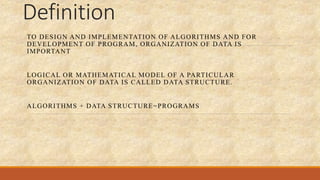
TO DESIGN AND IMPLEMENTATION OF ALGORITHMS AND FOR
DEVELOPMENT OF PROGRAM, ORGANIZATION OF DATA IS
IMPORTANT
LOGICAL OR MATHEMATICAL MODEL OF A PARTICULAR
ORGANIZATION OF DATA IS CALLED DATA STRUCTURE.
ALGORITHMS + DATA STRUCTURE=PROGRAMS
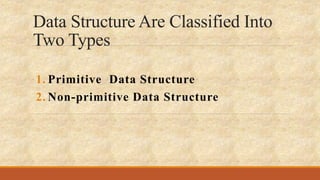
Data Structure Are Classified Into
Two Types
1. Primitive Data Structure
2. Non-primitive Data Structure
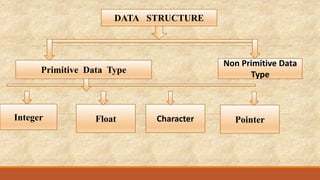
DATA STRUCTURE
Primitive Data Type
Non Primitive Data
Type
Integer Float Character Pointer
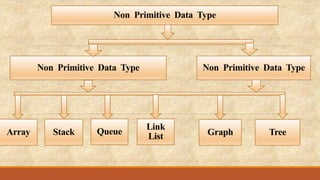
Non Primitive Data Type
Array Stack
Non Primitive Data TypeNon Primitive Data Type
Queue TreeGraph
Link
List
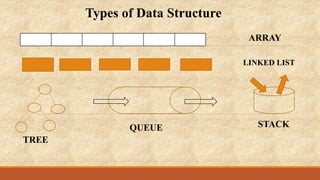
ARRAY
LINKED LIST
TREE
QUEUE STACK
Types of Data Structure
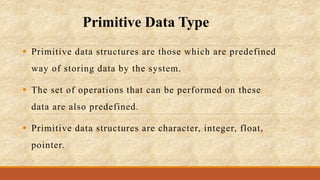
 Primitive data structures are those which are predefined
way of storing data by the system.
 The set of operations that can be performed on these
data are also predefined.
 Primitive data structures are character, integer, float,
pointer.
Primitive Data Type
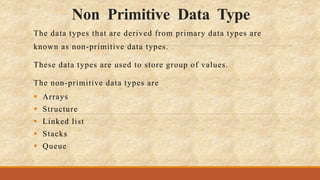
Non Primitive Data Type
The data types that are derived from primary data types are
known as non-primitive data types.
These data types are used to store group of values.
The non-primitive data types are
 Arrays
 Structure
 Linked list
 Stacks
 Queue
Array
ARRAY is a set of finite collection of homogeneous or same types of data items.
Which means that we can store only one type of data in the array.
We can declare array as : int ARR[14]
Int specifies the type of data we want to store in array.
ARR is the name of ARRAY.
The number inside the square bracket denotes the number of items or elements
stored in ARRAY. It is called as the length or size of ARRAY.
Linked List
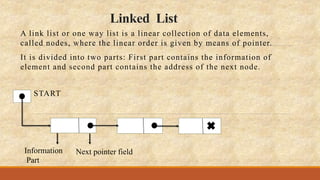
A link list or one way list is a linear collection of data elements,
called nodes, where the linear order is given by means of pointer.
It is divided into two parts: First part contains the information of
element and second part contains the address of the next node.
START
Information
Part
Next pointer field
Stack
 A stack is a linear structure in which items are added or removed only at one end.
 It is also known as “LAST IN FIRST OUT” [LIFO] lists.
 Stack is also known as “PILES” and “ PUSH DOWN ” lists.
 OPERATION ASSOCIATED WITH STACK
1. PUSH: It is used to insert an element into stack.
2. POP: It is used to remove or delete an element from a stack.
Representation of Stack
TOP FFF
DDD
CCC
BBB
AAA
XXX YYY ZZZ
1 2 3 4 65 87
1
TOP
Queue
A queue is also called as FIRST IN FIRST OUT [FIFO] system.
It is a linear list in which deletion can take place only at one end of the list i.e.
“FRONT” of the list
In queue Insertion can take place only at other end of the list. i.e. “REAR”
Figure : Array Representation Of Queue
AAA BBB CCC …………DDD
1 32 4 5 N
Front=1
Rear = 4
Non-Linear Data Structure
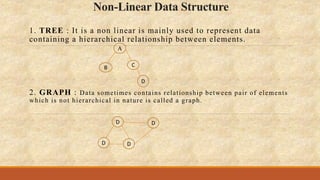
1. TREE : It is a non linear is mainly used to represent data
containing a hierarchical relationship between elements.
2. GRAPH : Data sometimes contains relationship between pair of elements
which is not hierarchical in nature is called a graph.
A
B C
D
D
D D
D

Introduction to data structure

  • 1.
  • 2.
    Definition TO DESIGN ANDIMPLEMENTATION OF ALGORITHMS AND FOR DEVELOPMENT OF PROGRAM, ORGANIZATION OF DATA IS IMPORTANT LOGICAL OR MATHEMATICAL MODEL OF A PARTICULAR ORGANIZATION OF DATA IS CALLED DATA STRUCTURE. ALGORITHMS + DATA STRUCTURE=PROGRAMS
  • 3.
    Data Structure AreClassified Into Two Types 1. Primitive Data Structure 2. Non-primitive Data Structure
  • 4.
    DATA STRUCTURE Primitive DataType Non Primitive Data Type Integer Float Character Pointer
  • 5.
    Non Primitive DataType Array Stack Non Primitive Data TypeNon Primitive Data Type Queue TreeGraph Link List
  • 6.
  • 7.
     Primitive datastructures are those which are predefined way of storing data by the system.  The set of operations that can be performed on these data are also predefined.  Primitive data structures are character, integer, float, pointer. Primitive Data Type
  • 8.
    Non Primitive DataType The data types that are derived from primary data types are known as non-primitive data types. These data types are used to store group of values. The non-primitive data types are  Arrays  Structure  Linked list  Stacks  Queue
  • 9.
    Array ARRAY is aset of finite collection of homogeneous or same types of data items. Which means that we can store only one type of data in the array. We can declare array as : int ARR[14] Int specifies the type of data we want to store in array. ARR is the name of ARRAY. The number inside the square bracket denotes the number of items or elements stored in ARRAY. It is called as the length or size of ARRAY.
  • 10.
    Linked List A linklist or one way list is a linear collection of data elements, called nodes, where the linear order is given by means of pointer. It is divided into two parts: First part contains the information of element and second part contains the address of the next node. START Information Part Next pointer field
  • 11.
    Stack  A stackis a linear structure in which items are added or removed only at one end.  It is also known as “LAST IN FIRST OUT” [LIFO] lists.  Stack is also known as “PILES” and “ PUSH DOWN ” lists.  OPERATION ASSOCIATED WITH STACK 1. PUSH: It is used to insert an element into stack. 2. POP: It is used to remove or delete an element from a stack.
  • 12.
    Representation of Stack TOPFFF DDD CCC BBB AAA XXX YYY ZZZ 1 2 3 4 65 87 1 TOP
  • 13.
    Queue A queue isalso called as FIRST IN FIRST OUT [FIFO] system. It is a linear list in which deletion can take place only at one end of the list i.e. “FRONT” of the list In queue Insertion can take place only at other end of the list. i.e. “REAR” Figure : Array Representation Of Queue AAA BBB CCC …………DDD 1 32 4 5 N Front=1 Rear = 4
  • 14.
    Non-Linear Data Structure 1.TREE : It is a non linear is mainly used to represent data containing a hierarchical relationship between elements. 2. GRAPH : Data sometimes contains relationship between pair of elements which is not hierarchical in nature is called a graph. A B C D D D D D