What does DTP stand for? Name a DTP software
Features of DTP software: Create a master document Create styles Insert images/headers/footers/tables/footnotes Control Orphans/Widows & Hyphenation Track changes if being checked by a number of users Spell & grammar check View the whole document For online publications: create hyperlinks All of these features can help a business to establish a  HOUSESYTLE  AND help to increase the  ACCURACY  of their document
Vocabulary Widow  – a single line of text which appears at the top of the next page Orphan  – The first line of a paragraph that appears at the bottom of the page This is an orphan … this is a widow
This week’s tasks: A. Set up a DTP document called  ICT & publishing Create a Master page layout Create a Heading & Body style B. Take notes about  ICT & Publishing  for your document C. Then create your document and include the following skills:  Insert hyperlinks Insert Header + footer Format Orphans/Widows Insert an image + table Perform a spell + grammar check Print out your document for your file
Use of ICT in Publishing By the end of this presentation you should be able to answer the following questions: Describe how ICT has influenced publishing Explain the terms typesetting and plate making
TASK: Production of a newspaper While you watch the following video Write the key steps that take place to publish a newspaper, from beginning to end Watch this video clip: Y:\ICT\A Level Applied ICT\- Unit 2 - Organisations use of ICT\2e. Publishing\Creating the Newspaper
First stage:  Newspaper production Correspondents write story in word Correspondents send stories to editorial office by email  Photographs will have been taken with a digital camera Editorial staff: collect and edit stories Page layout is created Edited further and proofread
Typesetting This is the setting of the layout of the typed page Features of typesetting: Easy to read Correct font and font size Kerning Leading Length of each line Size of heading, sub heading and body text
Vocabulary Typesetting: layout of the typed page Kerning: space between individual letters Leading: space between lines of the page
Impact of ICT Typesetting  without  ICT:   Originally done manually. Typesetters used individual letter blocks which were inked and pressed onto the paper for printing Typesetting with ICT:  use DTP applications. Graphic designers are highly skilled at creating layouts
 
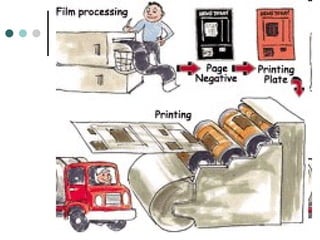
Second stage:  Newspaper production Editor: accepts layout of page Send newspaper to printing plant by: The pages are printed and the image of the page is burned onto a light-sensitive film. This film is put in a large fax machine and the image is transferred to the printing plant The pages are sent in a digital or fax form via satellite and then transmitted to many printing plants at the same time Smaller publishers: burn to a CD or send using a WAN
 
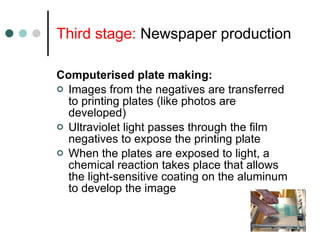
Third stage:  Newspaper production Computerised plate making: Images from the negatives are transferred to printing plates (like photos are developed) Ultraviolet light passes through the film negatives to expose the printing plate When the plates are exposed to light, a chemical reaction takes place that allows the light-sensitive coating on the aluminum to develop the image
Computerised plate making
 
Watch video about how to print a magazine http://videos.howstuffworks.com/howstuffworks/52-how-magazine-printing-works-video.htm
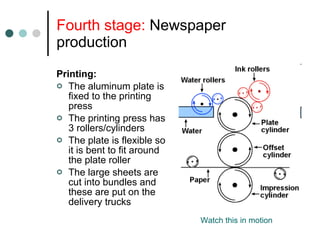
Fourth stage:  Newspaper production Printing: The aluminum plate is fixed to the printing press The printing press has 3 rollers/cylinders The plate is flexible so it is bent to fit around the plate roller The large sheets are cut into bundles and these are put on the delivery trucks Watch this in motion
Printing: Web Offset lithography This the most common form of printing newspapers Offset:  plate does not touch the paper for printing, instead, the roller with the plate has ink put on it and this then rotates against the black cylinder, which is rubberised and so this roller forms an image from the plate roller So it is the  blanket roller  that presses against the paper The third cylinder: presses the paper against the blanket cylinder
Offset lithography
ICT & Publishing These and similar methods are used to produce: magazines, newspapers, CD/DVD covers, books etc
Questions: Explain the terms typesetting and plate making  Create a  visual  timeline to show how a magazine is produced Describe how ICT has influenced publishing in terms of employment
Vocabulary list Write keywords in your vocabulary list

Ict in publishing ca

  • 1.
    What does DTPstand for? Name a DTP software
  • 2.
    Features of DTPsoftware: Create a master document Create styles Insert images/headers/footers/tables/footnotes Control Orphans/Widows & Hyphenation Track changes if being checked by a number of users Spell & grammar check View the whole document For online publications: create hyperlinks All of these features can help a business to establish a HOUSESYTLE AND help to increase the ACCURACY of their document
  • 3.
    Vocabulary Widow – a single line of text which appears at the top of the next page Orphan – The first line of a paragraph that appears at the bottom of the page This is an orphan … this is a widow
  • 4.
    This week’s tasks:A. Set up a DTP document called ICT & publishing Create a Master page layout Create a Heading & Body style B. Take notes about ICT & Publishing for your document C. Then create your document and include the following skills: Insert hyperlinks Insert Header + footer Format Orphans/Widows Insert an image + table Perform a spell + grammar check Print out your document for your file
  • 5.
    Use of ICTin Publishing By the end of this presentation you should be able to answer the following questions: Describe how ICT has influenced publishing Explain the terms typesetting and plate making
  • 6.
    TASK: Production ofa newspaper While you watch the following video Write the key steps that take place to publish a newspaper, from beginning to end Watch this video clip: Y:\ICT\A Level Applied ICT\- Unit 2 - Organisations use of ICT\2e. Publishing\Creating the Newspaper
  • 7.
    First stage: Newspaper production Correspondents write story in word Correspondents send stories to editorial office by email Photographs will have been taken with a digital camera Editorial staff: collect and edit stories Page layout is created Edited further and proofread
  • 8.
    Typesetting This isthe setting of the layout of the typed page Features of typesetting: Easy to read Correct font and font size Kerning Leading Length of each line Size of heading, sub heading and body text
  • 9.
    Vocabulary Typesetting: layoutof the typed page Kerning: space between individual letters Leading: space between lines of the page
  • 10.
    Impact of ICTTypesetting without ICT: Originally done manually. Typesetters used individual letter blocks which were inked and pressed onto the paper for printing Typesetting with ICT: use DTP applications. Graphic designers are highly skilled at creating layouts
  • 11.
  • 12.
    Second stage: Newspaper production Editor: accepts layout of page Send newspaper to printing plant by: The pages are printed and the image of the page is burned onto a light-sensitive film. This film is put in a large fax machine and the image is transferred to the printing plant The pages are sent in a digital or fax form via satellite and then transmitted to many printing plants at the same time Smaller publishers: burn to a CD or send using a WAN
  • 13.
  • 14.
    Third stage: Newspaper production Computerised plate making: Images from the negatives are transferred to printing plates (like photos are developed) Ultraviolet light passes through the film negatives to expose the printing plate When the plates are exposed to light, a chemical reaction takes place that allows the light-sensitive coating on the aluminum to develop the image
  • 15.
  • 16.
  • 17.
    Watch video abouthow to print a magazine http://videos.howstuffworks.com/howstuffworks/52-how-magazine-printing-works-video.htm
  • 18.
    Fourth stage: Newspaper production Printing: The aluminum plate is fixed to the printing press The printing press has 3 rollers/cylinders The plate is flexible so it is bent to fit around the plate roller The large sheets are cut into bundles and these are put on the delivery trucks Watch this in motion
  • 19.
    Printing: Web Offsetlithography This the most common form of printing newspapers Offset: plate does not touch the paper for printing, instead, the roller with the plate has ink put on it and this then rotates against the black cylinder, which is rubberised and so this roller forms an image from the plate roller So it is the blanket roller that presses against the paper The third cylinder: presses the paper against the blanket cylinder
  • 20.
  • 21.
    ICT & PublishingThese and similar methods are used to produce: magazines, newspapers, CD/DVD covers, books etc
  • 22.
    Questions: Explain theterms typesetting and plate making Create a visual timeline to show how a magazine is produced Describe how ICT has influenced publishing in terms of employment
  • 23.
    Vocabulary list Writekeywords in your vocabulary list