Data Leakage Detection

(Synopsis)
ABSTRACT:
We study the following problem: A data distributor has given sensitive
data to a set of supposedly trusted agents (third parties). Some of the data
is leaked and found in an unauthorized place (e.g., on the web or
somebody’s laptop). The distributor must assess the likelihood that the
leaked data came from one or more agents, as opposed to having been
independently gathered by other means. We propose data allocation
strategies (across the agents) that improve the probability of identifying
leakages. These methods do not rely on alterations of the released data
(e.g., watermarks). In some cases we can also inject “realistic but fake” data
records to further improve our chances of detecting leakage and identifying
the guilty party.

Objective
The objective of the system is to detect when the distributor’s
sensitive data has been leaked by hackers, and if possible to identify the
agent that leaked the data.
Existing System
The Existing System can detect the hackers but the total no of cookies
(evidence) will be less and the organization may not be able to proceed
legally for further proceedings due to lack of good amount of cookies and the
chances to escape of hackers are high.

Proposed system
In the Proposed System the hackers can be traced with good amount
of evidence. In this proposed system the leakage of data is detected by
the following methods viz.., generating Fake objects, Watermarking and
by Encrypting the data.

Modules:
Module1

: Administrator Module

Module 2

: Employees Module

Module 3

: Data Leakage Detection Module
Administrator Module:
All the privileges of the website are only available with the administrator.
Admin has privileges to accomplish the following responsibilities/tasks:
•

Manage

Users

(Add,

Edit,

Delete,

Lock/Unlock,

Assign

Permissions).
•

Manage Articles (Add, Edit, Update, Delete).

•

Manage Categories (Add, Edit, Update, Delete).

•

Send Messages

•

Upload Documents

Employee Module:
Some of the privileges are restricted to the employee by the administrator.
Only few permissions are available with the employees. Employees have the
following task/responsibilities. Employees have Read-only access to the
content.
•

Employees can Read the articles

•

Download the Documents

•

Read the messages which are send by the Admin

•

Discuss the content in the Discussion Board.
Data Leakage Detection:
The main scope of this module is provide complete information about the
data/content that is accessed by the users within the website.
•

Forms Authentication technique is used to provide security to the
website in order to prevent the leakage of the data.

•

Continuous observation is made automatically and the information is
send to the administrator so that he can identify whenever the data is
leaked.

•

Above all the important aspect providing proof against the Guilty
Objects. The following techniques are used.
o Fake Object Generation.
o Watermarking.
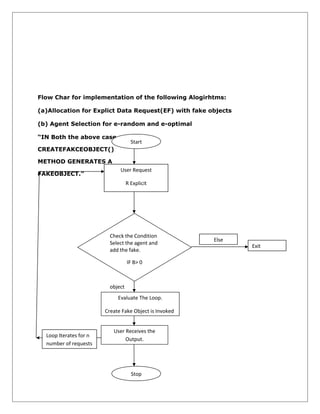
Flow Char for implementation of the following Alogirhtms:
(a)Allocation for Explict Data Request(EF) with fake objects
(b) Agent Selection for e-random and e-optimal
“IN Both the above case

Start

CREATEFAKCEOBJECT()
METHOD GENERATES A
FAKEOBJECT.”

User Request
R Explicit

Check the Condition
Select the agent and
add the fake.
IF B> 0

object
Evaluate The Loop.
Create Fake Object is Invoked

Loop Iterates for n
number of requests

User Receives the
Output.

Stop

Else

Exit
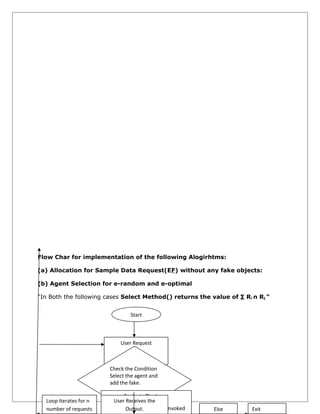
Flow Char for implementation of the following Alogirhtms:
(a) Allocation for Sample Data Request(EF) without any fake objects:
(b) Agent Selection for e-random and e-optimal
“In Both the following cases Select Method() returns the value of ∑ Ri n Rj “
Start

User Request
R Explicit
Check the Condition
Select the agent and
add the fake.
Loop Iterates for n
number of requests

IF B> 0
Evaluate The Loop.
User Receives the
Stop
SelectObject() Method is Invoked
Output.

Else

Exit
object

HARDWARE AND SOFTWARE REQUIREMENTS

Software Requirements:
Language

: Servlets, JSP

Technologies

: JAVA

IDE

: Visual Studio 2008

Operating System

: Microsoft Windows XP SP2 or Later Version

Hardware Requirements:
Processor

: Intel Pentium or more
RAM

: 512 MB (Minimum)

Hard Disk

: 40 GB
RAM

: 512 MB (Minimum)

Hard Disk

: 40 GB

Data leakage detection (synopsis)

  • 1.
  • 2.
    ABSTRACT: We study thefollowing problem: A data distributor has given sensitive data to a set of supposedly trusted agents (third parties). Some of the data is leaked and found in an unauthorized place (e.g., on the web or somebody’s laptop). The distributor must assess the likelihood that the leaked data came from one or more agents, as opposed to having been independently gathered by other means. We propose data allocation strategies (across the agents) that improve the probability of identifying leakages. These methods do not rely on alterations of the released data (e.g., watermarks). In some cases we can also inject “realistic but fake” data records to further improve our chances of detecting leakage and identifying the guilty party. Objective The objective of the system is to detect when the distributor’s sensitive data has been leaked by hackers, and if possible to identify the agent that leaked the data.
  • 3.
    Existing System The ExistingSystem can detect the hackers but the total no of cookies (evidence) will be less and the organization may not be able to proceed legally for further proceedings due to lack of good amount of cookies and the chances to escape of hackers are high. Proposed system In the Proposed System the hackers can be traced with good amount of evidence. In this proposed system the leakage of data is detected by the following methods viz.., generating Fake objects, Watermarking and by Encrypting the data. Modules: Module1 : Administrator Module Module 2 : Employees Module Module 3 : Data Leakage Detection Module
  • 4.
    Administrator Module: All theprivileges of the website are only available with the administrator. Admin has privileges to accomplish the following responsibilities/tasks: • Manage Users (Add, Edit, Delete, Lock/Unlock, Assign Permissions). • Manage Articles (Add, Edit, Update, Delete). • Manage Categories (Add, Edit, Update, Delete). • Send Messages • Upload Documents Employee Module: Some of the privileges are restricted to the employee by the administrator. Only few permissions are available with the employees. Employees have the following task/responsibilities. Employees have Read-only access to the content. • Employees can Read the articles • Download the Documents • Read the messages which are send by the Admin • Discuss the content in the Discussion Board.
  • 5.
    Data Leakage Detection: Themain scope of this module is provide complete information about the data/content that is accessed by the users within the website. • Forms Authentication technique is used to provide security to the website in order to prevent the leakage of the data. • Continuous observation is made automatically and the information is send to the administrator so that he can identify whenever the data is leaked. • Above all the important aspect providing proof against the Guilty Objects. The following techniques are used. o Fake Object Generation. o Watermarking.
  • 6.
    Flow Char forimplementation of the following Alogirhtms: (a)Allocation for Explict Data Request(EF) with fake objects (b) Agent Selection for e-random and e-optimal “IN Both the above case Start CREATEFAKCEOBJECT() METHOD GENERATES A FAKEOBJECT.” User Request R Explicit Check the Condition Select the agent and add the fake. IF B> 0 object Evaluate The Loop. Create Fake Object is Invoked Loop Iterates for n number of requests User Receives the Output. Stop Else Exit
  • 7.
    Flow Char forimplementation of the following Alogirhtms: (a) Allocation for Sample Data Request(EF) without any fake objects: (b) Agent Selection for e-random and e-optimal “In Both the following cases Select Method() returns the value of ∑ Ri n Rj “ Start User Request R Explicit Check the Condition Select the agent and add the fake. Loop Iterates for n number of requests IF B> 0 Evaluate The Loop. User Receives the Stop SelectObject() Method is Invoked Output. Else Exit
  • 8.
    object HARDWARE AND SOFTWAREREQUIREMENTS Software Requirements: Language : Servlets, JSP Technologies : JAVA IDE : Visual Studio 2008 Operating System : Microsoft Windows XP SP2 or Later Version Hardware Requirements: Processor : Intel Pentium or more
  • 9.
    RAM : 512 MB(Minimum) Hard Disk : 40 GB
  • 10.
    RAM : 512 MB(Minimum) Hard Disk : 40 GB