DATA LEAKAGE DETECTION

ABSTRACT:


A data distributor has given sensitive data to a set of supposedly trusted agents
(third parties). Some of the data is leaked and found in an unauthorized place
(e.g., on the web or somebody’s laptop). The distributor must assess the
likelihood that the leaked data came from one or more agents, as opposed to
having been independently gathered by other means. We propose data allocation
strategies (across the agents) that improve the probability of identifying leakages.
These methods do not rely on alterations of the released data (e.g., watermarks).
In some cases we can also inject “realistic but fake” data records to further
improve our chances of detecting leakage and identifying the guilty party.


EXISTING SYSTEM:


    Traditionally, leakage detection is handled by watermarking, e.g., a unique
      code is embedded in each distributed copy.


    If that copy is later discovered in the hands of an unauthorized party, the
      leaker can be identified.


         o Disadvantages of Existing Systems:


    Watermarks can be very useful in some cases, but again, involve some
      modification of the original data. Furthermore, watermarks can sometimes
be destroyed if the data recipient is malicious. E.g. A hospital may give
     patient records to researchers who will devise new treatments.


   Similarly, a company may have partnerships with other companies that
     require sharing customer data. Another enterprise may outsource its data
     processing, so data must be given to various other companies. We call the
     owner of the data the distributor and the supposedly trusted third parties
     the agents.


PROPOSED SYSTEM:


   Our goal is to detect when the distributor’s sensitive data has been leaked

     by agents, and if possible to identify the agent that leaked the data.
   Perturbation is a very useful technique where the data is modified and
     made “less sensitive” before being handed to agents.


   We develop unobtrusive techniques for detecting leakage of a set of
     objects or records.


   We develop a model for assessing the “guilt” of agents.


   We also present algorithms for distributing objects to agents, in a way that
     improves our chances of identifying a leaker.
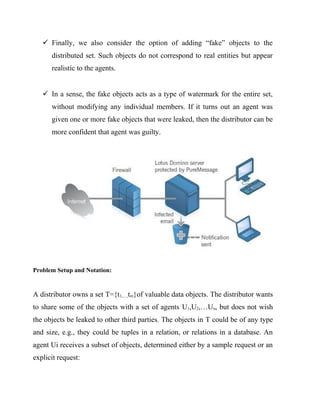
 Finally, we also consider the option of adding “fake” objects to the
      distributed set. Such objects do not correspond to real entities but appear
      realistic to the agents.


    In a sense, the fake objects acts as a type of watermark for the entire set,
      without modifying any individual members. If it turns out an agent was
      given one or more fake objects that were leaked, then the distributor can be
      more confident that agent was guilty.


Problem Setup and Notation:


A distributor owns a set T={t1,…,tm}of valuable data objects. The distributor wants
to share some of the objects with a set of agents U1,U2,…Un, but does not wish
the objects be leaked to other third parties. The objects in T could be of any type
and size, e.g., they could be tuples in a relation, or relations in a database. An
agent Ui receives a subset of objects, determined either by a sample request or an
explicit request:
1. Sample request
                2. Explicit request

Guilt Model Analysis:


Our model parameters interact and to check if the interactions match our
intuition, in this section we study two simple scenarios as Impact of Probability
p and Impact of Overlap between Ri and S. In each scenario we have a target
that has obtained all the distributor’s objects, i.e., T = S.


Algorithms:

1. Evaluation of Explicit Data Request Algorithms
In the first place, the goal of these experiments was to see whether fake objects in
the distributed data sets yield significant improvement in our chances of detecting
a guilty agent. In the second place, we wanted to evaluate our e-optimal
algorithm relative to a random allocation.

2. Evaluation of Sample Data Request Algorithms


With sample data requests agents are not interested in particular objects. Hence,
object sharing is not explicitly defined by their requests. The distributor is
“forced” to allocate certain objects to multiple agents only if the number of
requested objects exceeds the number of objects in set T. The more data objects
the agents request in total, the more recipients on average an object has; and the
more objects are shared among different agents, the more difficult it is to detect a
guilty agent.
MODULES:


1. Login / Registration
2. Data Distributor:
3. Data Allocation Module:
4. Fake Object Module:
5. Data Leakage protection Module:
6. Finding Guilty Agents Module:
7. Mobile Alert:


MODULES DESCRIPTION:


1. Login / Registration:


                This is a module mainly designed to provide the authority to a

user/agent in order to access the other modules of the project. Here a user/agent

can have the accessibility authority after the registration.


2. Data Distributor:


A data Distributor part is developed in this module. A data distributor has given
sensitive data to a set of supposedly trusted agents (third parties). Some of the
data is leaked and found in an unauthorized place (e.g., on the web or
somebody’s laptop). The distributor must assess the likelihood that the leaked
data came from one or more agents, as opposed to having been independently
gathered by other means.


3. Data Allocation Module:


The main focus of our project is the data allocation problem as how can the
distributor “intelligently” give data to agents in order to improve the chances of
detecting a guilty agent.


4. Fake Object Module:


Fake objects are objects generated by the distributor in order to increase the
chances of detecting agents that leak data. The distributor may be able to add
fake objects to the distributed data in order to improve his effectiveness in
detecting guilty agents. Our use of fake objects is inspired by the use of “trace”
records in mailing lists.


5. Data Leakage protection Module:


In this module, to protect the data leakage, a secret key is sent to the agent who
requests for the files. The secret key is sent through the email id of the registered
agents. Without the secret key the agent cannot access the file sent by the
distributor.
6. Finding Guilty Agents Module:


The Optimization Module is the distributor’s data allocation to agents has one
constraint and one objective. The distributor’s constraint is to satisfy agents’
requests, by providing them with the number of objects they request or with all
available objects that satisfy their conditions. His objective is to be able to detect
an agent who leaks any portion of his data. This module is designed using the
agent – guilt model.      Here a count value (also called as fake objects) are
incremented for any transfer of data occurrence when agent transfers data. Fake
objects are stored in database.


7. Mobile Alert:


In this module, an alert is sent to the distributor mobile, regarding the guilty
agents who leaked the files. It is developed using NOKIA SDK 5100. Its only
manual process, not an automatic triggered process.
Hardware Required:


                 System                :      Pentium IV 2.4 GHz
                 Hard Disk             :      40 GB
                 Floppy Drive          :      1.44 MB
                 Monitor               :      15 VGA colour
                 Mouse                 :      Logitech.
 Keyboard          :     110 keys enhanced.
                 RAM               :     256 MB


Software Required:


                 O/S               :     Windows XP.
                 Front End         :     Asp.Net, C#, Nokia SDK 5100.
                 Data Base         :     SQL Server 2005.
                 Browser           :     IE / Firefox with Internet connection


REFERENCE:


Panagiotis Papadimitriou, and Hector Garcia-Molina, “Data Leakage Detection”,
IEEE Transactions on Knowledge and Data Engineering, Vol. 23, NO.1,
January 2011.

Jpdcs1 data leakage detection

  • 1.
    DATA LEAKAGE DETECTION ABSTRACT: Adata distributor has given sensitive data to a set of supposedly trusted agents (third parties). Some of the data is leaked and found in an unauthorized place (e.g., on the web or somebody’s laptop). The distributor must assess the likelihood that the leaked data came from one or more agents, as opposed to having been independently gathered by other means. We propose data allocation strategies (across the agents) that improve the probability of identifying leakages. These methods do not rely on alterations of the released data (e.g., watermarks). In some cases we can also inject “realistic but fake” data records to further improve our chances of detecting leakage and identifying the guilty party. EXISTING SYSTEM:  Traditionally, leakage detection is handled by watermarking, e.g., a unique code is embedded in each distributed copy.  If that copy is later discovered in the hands of an unauthorized party, the leaker can be identified. o Disadvantages of Existing Systems:  Watermarks can be very useful in some cases, but again, involve some modification of the original data. Furthermore, watermarks can sometimes
  • 2.
    be destroyed ifthe data recipient is malicious. E.g. A hospital may give patient records to researchers who will devise new treatments.  Similarly, a company may have partnerships with other companies that require sharing customer data. Another enterprise may outsource its data processing, so data must be given to various other companies. We call the owner of the data the distributor and the supposedly trusted third parties the agents. PROPOSED SYSTEM:  Our goal is to detect when the distributor’s sensitive data has been leaked by agents, and if possible to identify the agent that leaked the data.  Perturbation is a very useful technique where the data is modified and made “less sensitive” before being handed to agents.  We develop unobtrusive techniques for detecting leakage of a set of objects or records.  We develop a model for assessing the “guilt” of agents.  We also present algorithms for distributing objects to agents, in a way that improves our chances of identifying a leaker.
  • 3.
     Finally, wealso consider the option of adding “fake” objects to the distributed set. Such objects do not correspond to real entities but appear realistic to the agents.  In a sense, the fake objects acts as a type of watermark for the entire set, without modifying any individual members. If it turns out an agent was given one or more fake objects that were leaked, then the distributor can be more confident that agent was guilty. Problem Setup and Notation: A distributor owns a set T={t1,…,tm}of valuable data objects. The distributor wants to share some of the objects with a set of agents U1,U2,…Un, but does not wish the objects be leaked to other third parties. The objects in T could be of any type and size, e.g., they could be tuples in a relation, or relations in a database. An agent Ui receives a subset of objects, determined either by a sample request or an explicit request:
  • 4.
    1. Sample request 2. Explicit request Guilt Model Analysis: Our model parameters interact and to check if the interactions match our intuition, in this section we study two simple scenarios as Impact of Probability p and Impact of Overlap between Ri and S. In each scenario we have a target that has obtained all the distributor’s objects, i.e., T = S. Algorithms: 1. Evaluation of Explicit Data Request Algorithms In the first place, the goal of these experiments was to see whether fake objects in the distributed data sets yield significant improvement in our chances of detecting a guilty agent. In the second place, we wanted to evaluate our e-optimal algorithm relative to a random allocation. 2. Evaluation of Sample Data Request Algorithms With sample data requests agents are not interested in particular objects. Hence, object sharing is not explicitly defined by their requests. The distributor is “forced” to allocate certain objects to multiple agents only if the number of requested objects exceeds the number of objects in set T. The more data objects the agents request in total, the more recipients on average an object has; and the more objects are shared among different agents, the more difficult it is to detect a guilty agent.
  • 5.
    MODULES: 1. Login /Registration 2. Data Distributor: 3. Data Allocation Module: 4. Fake Object Module: 5. Data Leakage protection Module: 6. Finding Guilty Agents Module: 7. Mobile Alert: MODULES DESCRIPTION: 1. Login / Registration: This is a module mainly designed to provide the authority to a user/agent in order to access the other modules of the project. Here a user/agent can have the accessibility authority after the registration. 2. Data Distributor: A data Distributor part is developed in this module. A data distributor has given sensitive data to a set of supposedly trusted agents (third parties). Some of the
  • 6.
    data is leakedand found in an unauthorized place (e.g., on the web or somebody’s laptop). The distributor must assess the likelihood that the leaked data came from one or more agents, as opposed to having been independently gathered by other means. 3. Data Allocation Module: The main focus of our project is the data allocation problem as how can the distributor “intelligently” give data to agents in order to improve the chances of detecting a guilty agent. 4. Fake Object Module: Fake objects are objects generated by the distributor in order to increase the chances of detecting agents that leak data. The distributor may be able to add fake objects to the distributed data in order to improve his effectiveness in detecting guilty agents. Our use of fake objects is inspired by the use of “trace” records in mailing lists. 5. Data Leakage protection Module: In this module, to protect the data leakage, a secret key is sent to the agent who requests for the files. The secret key is sent through the email id of the registered agents. Without the secret key the agent cannot access the file sent by the distributor.
  • 7.
    6. Finding GuiltyAgents Module: The Optimization Module is the distributor’s data allocation to agents has one constraint and one objective. The distributor’s constraint is to satisfy agents’ requests, by providing them with the number of objects they request or with all available objects that satisfy their conditions. His objective is to be able to detect an agent who leaks any portion of his data. This module is designed using the agent – guilt model. Here a count value (also called as fake objects) are incremented for any transfer of data occurrence when agent transfers data. Fake objects are stored in database. 7. Mobile Alert: In this module, an alert is sent to the distributor mobile, regarding the guilty agents who leaked the files. It is developed using NOKIA SDK 5100. Its only manual process, not an automatic triggered process. Hardware Required:  System : Pentium IV 2.4 GHz  Hard Disk : 40 GB  Floppy Drive : 1.44 MB  Monitor : 15 VGA colour  Mouse : Logitech.
  • 8.
     Keyboard : 110 keys enhanced.  RAM : 256 MB Software Required:  O/S : Windows XP.  Front End : Asp.Net, C#, Nokia SDK 5100.  Data Base : SQL Server 2005.  Browser : IE / Firefox with Internet connection REFERENCE: Panagiotis Papadimitriou, and Hector Garcia-Molina, “Data Leakage Detection”, IEEE Transactions on Knowledge and Data Engineering, Vol. 23, NO.1, January 2011.