Cryptography
L01- Introduction
outline
 Historically
 What is cryptography
 Cryptography goals
 Cryptography sections
● Encryption
● Decryption
 Cryptography keys and their importance
 Types of Cryptography keys
● public Key
● private key
2
Historically
 Information security is the practice of defending information from
unauthorized access, use, disclosure, disruption, modification,
perusal, inspection, recording or destruction. It is a general term that
can be used regardless of the form the data may take.
 Information security uses cryptography to transform usable
information into a form that renders it unusable by anyone other
than an authorized user; this process is called encryption.
3
What is cryptography
 Known as encryption codes to convert the information is
understandable process , To prevent unauthorized persons from
access to information or misunderstood.
 It uses the science of mathematics is you can store sensitive
information transmitted over insecure networks and secure from
hackers and vandals tamper and thieves.
4
Cryptography goals
 Confidentiality: keeping information secret from all but those who
are authorized to see it.
 Integrity: ensuring information has not been altered by unauthorized
or unknown means.
 Availability: keeping information accessible by authorized users
when required
5
Cryptography goals 6
Confidentiality
Availability Integrity
Cryptography sections
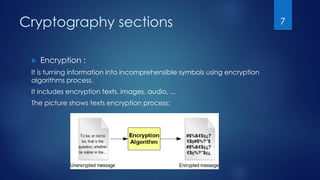
 Encryption :
It is turning information into incomprehensible symbols using encryption
algorithms process.
It includes encryption texts, images, audio, ...
The picture shows texts encryption process:
7
Cryptography sections
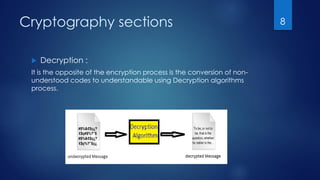
 Decryption :
It is the opposite of the encryption process is the conversion of non-
understood codes to understandable using Decryption algorithms
process.
8
Cryptography keys and their
importance
 What is the key?
Is a secret number by the length algorithm type, for example(6-bit)it is
used for the encryption and decryption process.
► What is importance ?
No one can decryption data without the encryption key that has been
done Encryption.
9
Types of Cryptography keys
 Public key :
Is the number that is traded and spread among the rest of the users to
encrypt any information or customized for you e-mails is a public key
based encryption process nor can one decode that information else
you because they need a PIN number Let it is private key to complete
the calculation and access to the key figure basis and thus open the
files again.
10
Types of Cryptography keys
 Private key :
The other half is supplementing public key to get to the base figure
and restore encrypted information to Normal before encryption , and
this is a key characteristic of all people from other users and serve as
an electronic identity enables the owner of any decryption encrypted
information sent to him on the basis of the public key so you must keep
the private key.
11
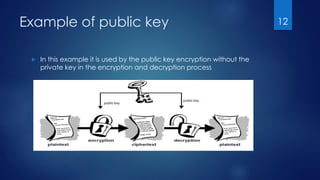
Example of public key
 In this example it is used by the public key encryption without the
private key in the encryption and decryption process
12
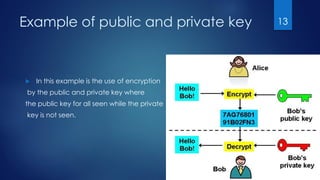
Example of public and private key
 In this example is the use of encryption
by the public and private key where
the public key for all seen while the private
key is not seen.
13
Example of public and private key
 In this example encryption process is done by the public key is not
decryption only by the private key using the public key.
14
In this slide we have talked about the subject of encryption in general
and explain the tools used in encryption ..
In the (L02)we will talk about the types of
encryption depending on the type of the
key And some of the things.
15
Thanks for watching
16

Information Security Cryptography ( L01- introduction )

  • 1.
  • 2.
    outline  Historically  Whatis cryptography  Cryptography goals  Cryptography sections ● Encryption ● Decryption  Cryptography keys and their importance  Types of Cryptography keys ● public Key ● private key 2
  • 3.
    Historically  Information securityis the practice of defending information from unauthorized access, use, disclosure, disruption, modification, perusal, inspection, recording or destruction. It is a general term that can be used regardless of the form the data may take.  Information security uses cryptography to transform usable information into a form that renders it unusable by anyone other than an authorized user; this process is called encryption. 3
  • 4.
    What is cryptography Known as encryption codes to convert the information is understandable process , To prevent unauthorized persons from access to information or misunderstood.  It uses the science of mathematics is you can store sensitive information transmitted over insecure networks and secure from hackers and vandals tamper and thieves. 4
  • 5.
    Cryptography goals  Confidentiality:keeping information secret from all but those who are authorized to see it.  Integrity: ensuring information has not been altered by unauthorized or unknown means.  Availability: keeping information accessible by authorized users when required 5
  • 6.
  • 7.
    Cryptography sections  Encryption: It is turning information into incomprehensible symbols using encryption algorithms process. It includes encryption texts, images, audio, ... The picture shows texts encryption process: 7
  • 8.
    Cryptography sections  Decryption: It is the opposite of the encryption process is the conversion of non- understood codes to understandable using Decryption algorithms process. 8
  • 9.
    Cryptography keys andtheir importance  What is the key? Is a secret number by the length algorithm type, for example(6-bit)it is used for the encryption and decryption process. ► What is importance ? No one can decryption data without the encryption key that has been done Encryption. 9
  • 10.
    Types of Cryptographykeys  Public key : Is the number that is traded and spread among the rest of the users to encrypt any information or customized for you e-mails is a public key based encryption process nor can one decode that information else you because they need a PIN number Let it is private key to complete the calculation and access to the key figure basis and thus open the files again. 10
  • 11.
    Types of Cryptographykeys  Private key : The other half is supplementing public key to get to the base figure and restore encrypted information to Normal before encryption , and this is a key characteristic of all people from other users and serve as an electronic identity enables the owner of any decryption encrypted information sent to him on the basis of the public key so you must keep the private key. 11
  • 12.
    Example of publickey  In this example it is used by the public key encryption without the private key in the encryption and decryption process 12
  • 13.
    Example of publicand private key  In this example is the use of encryption by the public and private key where the public key for all seen while the private key is not seen. 13
  • 14.
    Example of publicand private key  In this example encryption process is done by the public key is not decryption only by the private key using the public key. 14
  • 15.
    In this slidewe have talked about the subject of encryption in general and explain the tools used in encryption .. In the (L02)we will talk about the types of encryption depending on the type of the key And some of the things. 15
  • 16.