SAVYA SACHI
MUZAFFARPUR INSTITUTE OF
TECHNOLOGY
Mu z a ffar pur
Basic Concepts
Cryptography: The art or science encompassing the principles
and methods of transforming an intelligible message into one
that is unintelligible, and then retransforming that message back
to its original form.
Plaintext: The original intelligible message
Cipher text: The transformed (coded) message
Cipher: An algorithm for transforming an intelligible message
into one that is unintelligible by transposition and/or substitution
methods Key : Some critical information used by the cipher,
known only to the sender & receiver
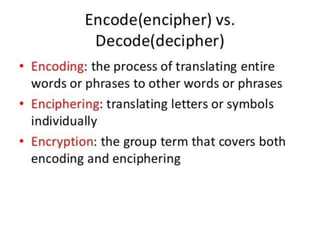
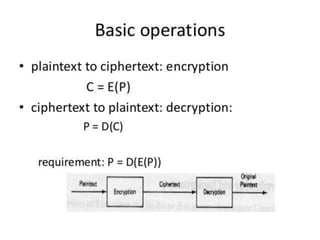
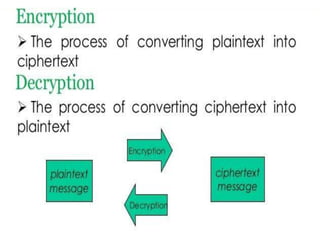
Encipher (encode): The process of converting plaintext to
cipher text using a cipher and a key
Decipher (decode): the process of converting cipher text
back into plaintext using a cipher and a key
• Cryptanalysis: The study of principles and
methods of transforming an unintelligible
message back into an intelligible message
without knowledge of the key. Also called
code breaking
• Cryptology: Both cryptography and
cryptanalysis
• Code: An algorithm for transforming an
intelligible message into an unintelligible
one using a code-book
Basic Terms Used in Cryptography
1) Plain Text- The original message that is easily readable by humans. It is a term
used in cryptography that refers to a message before encryption or after
decryption. For example, A is a person wishes to send “Hello Friend how are
you” message to the person B. Here “Hello Friend how are you” is a plain text
message.
2) 2) Cipher Text- In cryptography, cipher text is data that has been encrypted. This
text is unreadable until it has been converted into plain text with a key. For
example, “phqgiumealy” is a cipher text produced for “abcdefghijk”.
3) 3) Encryption- It is security tool for computer network. It is process of converting
information (known as plain text ) using an algorithm to make it unreadable
(known as cipher text) to anyone except those processing special knowledge,
usually referred to as a key. It is the most efficient method to achieve data
security. Encryption can protect confidentiality of message. For data encryption,
a secret key is used. Encrypted data is called as cipher text and decrypted data
is called as plain text.
4) Decryption- It is process of taking encoded or encrypted text and converting it
back into original text. Decryption is used for un-encrypting the data with keys or
algorithm. Cryptography uses the decryption technique at the receiver side to
obtain the original message from non-readable message (Cipher Text). The
decryption process requires two things- a Decryption algorithm and a key. A
Decryption algorithm indicates the technique that has been used in Decryption.
Usually, the encryption and decryption algorithm are same.
1) 5) Key- A key is a numeric or alpha numeric text or may be a special symbol.
The Key is used at the time of encryption work on the plain text and at the time
of decryption work on the cipher text. The selection of key plays vital rolein
cryptography process as the security of encryption algorithm fully depends on
it. For example, if A uses a key of 2 to encrypt the Plain Text “University” then
Cipher Text produced will be “wpkxgtkva”.
• A. Symmetric Encryption- This type of cryptography
uses a single key, which is used for encryption and
decryption. The sender uses the key to encrypt the
plaintext and sends the cipher text to the receiver. At
the receiver side, same key will be used to decrypt
the message and get the plaintext. Because there is
common key used for encryption and decryption
process, the secret key cryptography is also known as
symmetric encryption. This was the only type of
encryption method widely known until June 1976.
There are various symmetric key algorithms such as
DES, TRIPLE DES, AES, RC4, RC6, and BLOWFISH
[2].
• B. Asymmetric Encryption- Public-key cryptography,
where key used to encrypt a message is differ from
key used to decrypt a message. In asymmetric or
public-key cryptography, there are two cryptographic
keys: a private key and a public key are used. The
private key is kept secret, while public key may be
distributed. Messages are encrypted with recipients’
public key and decrypted with private key. Some
commonly used asymmetric cryptography techniques
are RSA (Rivest Shamir and Adleman), Diffie-Hellman,
and DSA (Digital Signature Algorithm).
• A significant disadvantage of symmetric ciphers is the key
management necessary to use them securely. Each distinct
pair of communicating parties must, ideally, share a different
key, and perhaps each cipher text exchanged as well. The
number of keys required increases as the square of the
number of network members, which very quickly requires
complex key management schemes to keep them all straight
and secret.
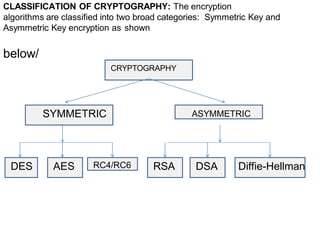
CLASSIFICATION OF CRYPTOGRAPHY: The encryption
algorithms are classified into two broad categories: Symmetric Key and
Asymmetric Key encryption as shown
below/
CRYPTOGRAPHY
SYMMETRIC ASYMMETRIC
DES AES RC4/RC6 RSA DSA Diffie-Hellman
17

Encryption

  • 1.
    SAVYA SACHI MUZAFFARPUR INSTITUTEOF TECHNOLOGY Mu z a ffar pur
  • 2.
    Basic Concepts Cryptography: Theart or science encompassing the principles and methods of transforming an intelligible message into one that is unintelligible, and then retransforming that message back to its original form. Plaintext: The original intelligible message Cipher text: The transformed (coded) message Cipher: An algorithm for transforming an intelligible message into one that is unintelligible by transposition and/or substitution methods Key : Some critical information used by the cipher, known only to the sender & receiver Encipher (encode): The process of converting plaintext to cipher text using a cipher and a key Decipher (decode): the process of converting cipher text back into plaintext using a cipher and a key
  • 3.
    • Cryptanalysis: Thestudy of principles and methods of transforming an unintelligible message back into an intelligible message without knowledge of the key. Also called code breaking • Cryptology: Both cryptography and cryptanalysis • Code: An algorithm for transforming an intelligible message into an unintelligible one using a code-book
  • 4.
    Basic Terms Usedin Cryptography 1) Plain Text- The original message that is easily readable by humans. It is a term used in cryptography that refers to a message before encryption or after decryption. For example, A is a person wishes to send “Hello Friend how are you” message to the person B. Here “Hello Friend how are you” is a plain text message. 2) 2) Cipher Text- In cryptography, cipher text is data that has been encrypted. This text is unreadable until it has been converted into plain text with a key. For example, “phqgiumealy” is a cipher text produced for “abcdefghijk”. 3) 3) Encryption- It is security tool for computer network. It is process of converting information (known as plain text ) using an algorithm to make it unreadable (known as cipher text) to anyone except those processing special knowledge, usually referred to as a key. It is the most efficient method to achieve data security. Encryption can protect confidentiality of message. For data encryption, a secret key is used. Encrypted data is called as cipher text and decrypted data is called as plain text. 4) Decryption- It is process of taking encoded or encrypted text and converting it back into original text. Decryption is used for un-encrypting the data with keys or algorithm. Cryptography uses the decryption technique at the receiver side to obtain the original message from non-readable message (Cipher Text). The decryption process requires two things- a Decryption algorithm and a key. A Decryption algorithm indicates the technique that has been used in Decryption. Usually, the encryption and decryption algorithm are same.
  • 5.
    1) 5) Key-A key is a numeric or alpha numeric text or may be a special symbol. The Key is used at the time of encryption work on the plain text and at the time of decryption work on the cipher text. The selection of key plays vital rolein cryptography process as the security of encryption algorithm fully depends on it. For example, if A uses a key of 2 to encrypt the Plain Text “University” then Cipher Text produced will be “wpkxgtkva”.
  • 14.
    • A. SymmetricEncryption- This type of cryptography uses a single key, which is used for encryption and decryption. The sender uses the key to encrypt the plaintext and sends the cipher text to the receiver. At the receiver side, same key will be used to decrypt the message and get the plaintext. Because there is common key used for encryption and decryption process, the secret key cryptography is also known as symmetric encryption. This was the only type of encryption method widely known until June 1976. There are various symmetric key algorithms such as DES, TRIPLE DES, AES, RC4, RC6, and BLOWFISH [2].
  • 15.
    • B. AsymmetricEncryption- Public-key cryptography, where key used to encrypt a message is differ from key used to decrypt a message. In asymmetric or public-key cryptography, there are two cryptographic keys: a private key and a public key are used. The private key is kept secret, while public key may be distributed. Messages are encrypted with recipients’ public key and decrypted with private key. Some commonly used asymmetric cryptography techniques are RSA (Rivest Shamir and Adleman), Diffie-Hellman, and DSA (Digital Signature Algorithm). • A significant disadvantage of symmetric ciphers is the key management necessary to use them securely. Each distinct pair of communicating parties must, ideally, share a different key, and perhaps each cipher text exchanged as well. The number of keys required increases as the square of the number of network members, which very quickly requires complex key management schemes to keep them all straight and secret.
  • 16.
    CLASSIFICATION OF CRYPTOGRAPHY:The encryption algorithms are classified into two broad categories: Symmetric Key and Asymmetric Key encryption as shown below/ CRYPTOGRAPHY SYMMETRIC ASYMMETRIC DES AES RC4/RC6 RSA DSA Diffie-Hellman
  • 17.