Visit: www.statisticsassignmenthelp.com
Email: support@statisticsassignmenthelp.com
Phone: +1 (315)-557-6473
Calculating Expected Values and
Variances in Statistics
At StatisticsAssignmentHelp.com, we present a detailed example of a
complex statistics assignment. This sample covers essential concepts such as
expected values, variances, and covariances, and demonstrates the problem-
solving techniques necessary for tackling these fundamental topics. By
examining calculations of linear combinations of random variables, the
impact of Jensen's Inequality, and variance and covariance assessments, this
assignment offers a comprehensive look at key statistical operations. Our
expert solutions not only address these problems thoroughly but also provide
valuable insights into their practical applications. Discover how our
specialized assistance can enhance your understanding and performance in
statistics.
Calculating Expected Values and Variances in Statistics
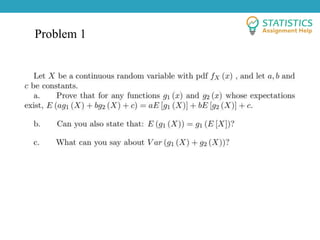
Problem 1
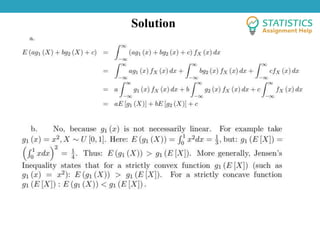
Solution
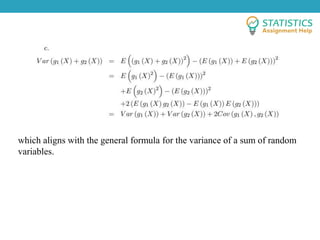
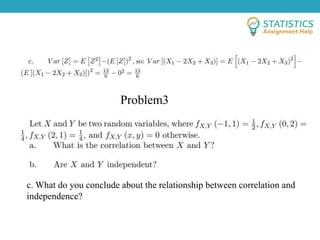
which aligns with the general formula for the variance of a sum of random
variables.
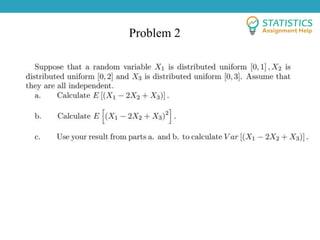
Problem 2
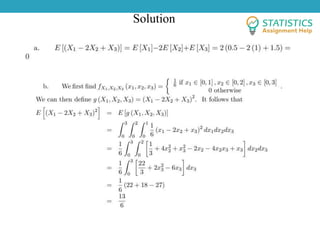
Solution
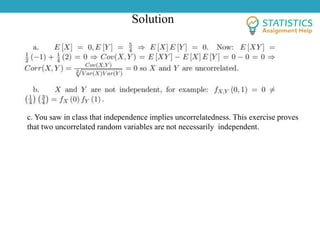
Problem3
c. What do you conclude about the relationship between correlation and
independence?
Solution
c. You saw in class that independence implies uncorrelatedness. This exercise proves
that two uncorrelated random variables are not necessarily independent.
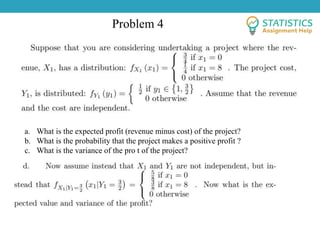
Problem 4
a. What is the expected profit (revenue minus cost) of the project?
b. What is the probability that the project makes a positive profit ?
c. What is the variance of the pro t of the project?
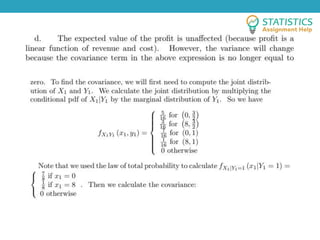
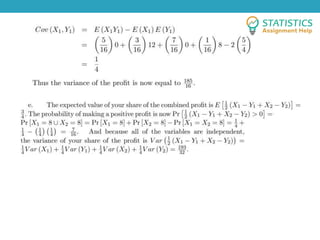
e. Assume again that the cost and revenue are independent, and suppose that now a
friend can undertake a different project where the revenue (X2) is distributed
identically to X1 and the the cost (Y2) is distributed identically to Y1. All the
variables X1;Y1;X2;Y2 are independent. Before you undertake either project your
friend suggests that you equally share the revenue and costs of both projects. What is
the expected pro t to accepting the suggestion relative to not taking up any project?
What is the probability that you make a positive pro t if you accept your friend s
suggestion? And what is the variance of the your share of the combined profit?
Solution
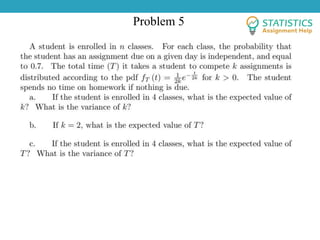
Problem 5
Solution
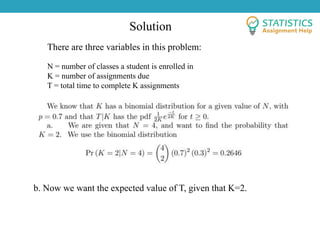
There are three variables in this problem:
N = number of classes a student is enrolled in
K = number of assignments due
T = total time to complete K assignments
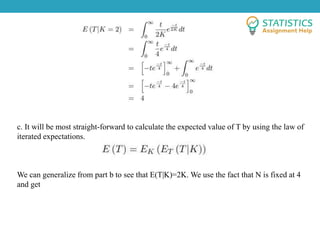
b. Now we want the expected value of T, given that K=2.
c. It will be most straight-forward to calculate the expected value of T by using the law of
iterated expectations.
We can generalize from part b to see that E(T|K)=2K. We use the fact that N is fixed at 4
and get
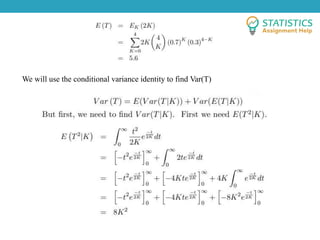
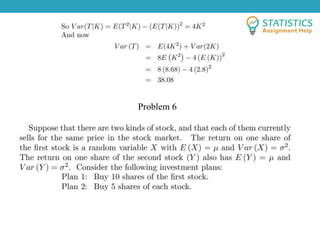
We will use the conditional variance identity to find Var(T)
Problem 6
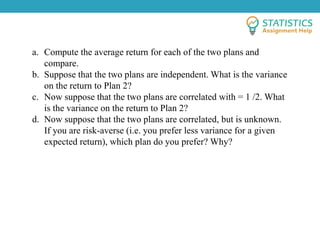
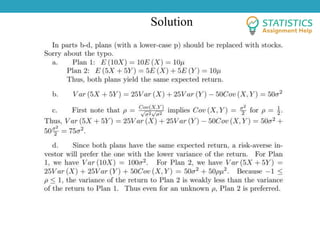
a. Compute the average return for each of the two plans and
compare.
b. Suppose that the two plans are independent. What is the variance
on the return to Plan 2?
c. Now suppose that the two plans are correlated with = 1 /2. What
is the variance on the return to Plan 2?
d. Now suppose that the two plans are correlated, but is unknown.
If you are risk-averse (i.e. you prefer less variance for a given
expected return), which plan do you prefer? Why?
Solution

Calculating Expected Values and Variances in Statistics

  • 1.
    Visit: www.statisticsassignmenthelp.com Email: support@statisticsassignmenthelp.com Phone:+1 (315)-557-6473 Calculating Expected Values and Variances in Statistics
  • 2.
    At StatisticsAssignmentHelp.com, wepresent a detailed example of a complex statistics assignment. This sample covers essential concepts such as expected values, variances, and covariances, and demonstrates the problem- solving techniques necessary for tackling these fundamental topics. By examining calculations of linear combinations of random variables, the impact of Jensen's Inequality, and variance and covariance assessments, this assignment offers a comprehensive look at key statistical operations. Our expert solutions not only address these problems thoroughly but also provide valuable insights into their practical applications. Discover how our specialized assistance can enhance your understanding and performance in statistics. Calculating Expected Values and Variances in Statistics
  • 3.
  • 4.
  • 5.
    which aligns withthe general formula for the variance of a sum of random variables.
  • 6.
  • 7.
  • 8.
    Problem3 c. What doyou conclude about the relationship between correlation and independence?
  • 9.
    Solution c. You sawin class that independence implies uncorrelatedness. This exercise proves that two uncorrelated random variables are not necessarily independent.
  • 10.
    Problem 4 a. Whatis the expected profit (revenue minus cost) of the project? b. What is the probability that the project makes a positive profit ? c. What is the variance of the pro t of the project?
  • 11.
    e. Assume againthat the cost and revenue are independent, and suppose that now a friend can undertake a different project where the revenue (X2) is distributed identically to X1 and the the cost (Y2) is distributed identically to Y1. All the variables X1;Y1;X2;Y2 are independent. Before you undertake either project your friend suggests that you equally share the revenue and costs of both projects. What is the expected pro t to accepting the suggestion relative to not taking up any project? What is the probability that you make a positive pro t if you accept your friend s suggestion? And what is the variance of the your share of the combined profit? Solution
  • 14.
  • 15.
    Solution There are threevariables in this problem: N = number of classes a student is enrolled in K = number of assignments due T = total time to complete K assignments b. Now we want the expected value of T, given that K=2.
  • 16.
    c. It willbe most straight-forward to calculate the expected value of T by using the law of iterated expectations. We can generalize from part b to see that E(T|K)=2K. We use the fact that N is fixed at 4 and get
  • 17.
    We will usethe conditional variance identity to find Var(T)
  • 18.
  • 19.
    a. Compute theaverage return for each of the two plans and compare. b. Suppose that the two plans are independent. What is the variance on the return to Plan 2? c. Now suppose that the two plans are correlated with = 1 /2. What is the variance on the return to Plan 2? d. Now suppose that the two plans are correlated, but is unknown. If you are risk-averse (i.e. you prefer less variance for a given expected return), which plan do you prefer? Why?
  • 20.