For More Visit:
https://www.statisticsassignmenthelp.com/
support@statisticsassignmenthelp.com
+1 (315) 557-6473
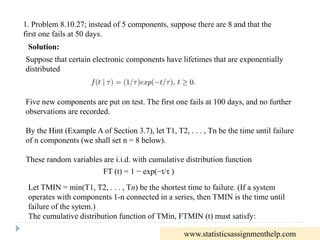
1. Problem 8.10.27; instead of 5 components, suppose there are 8 and that the
first one fails at 50 days.
Suppose that certain electronic components have lifetimes that are exponentially
distributed
Five new components are put on test. The first one fails at 100 days, and no further
observations are recorded.
By the Hint (Example A of Section 3.7), let T1, T2, . . . , Tn be the time until failure
of n components (we shall set n = 8 below).
These random variables are i.i.d. with cumulative distribution function
FT (t) = 1 − exp(−t/τ )
Let TMIN = min(T1, T2, . . . , Tn) be the shortest time to failure. (If a system
operates with components 1-n connected in a series, then TMIN is the time until
failure of the sytem.)
The cumulative distribution function of TMin, FTMIN (t) must satisfy:
Solution:
www.statisticsassignmenthelp.com
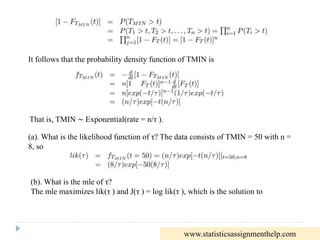
It follows that the probability density function of TMIN is
That is, TMIN ∼ Exponential(rate = n/τ ).
(a). What is the likelihood function of τ? The data consists of TMIN = 50 with n =
8, so
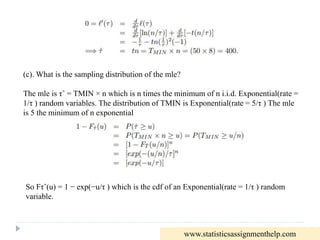
(b). What is the mle of τ?
The mle maximizes lik(τ ) and J(τ ) = log lik(τ ), which is the solution to
www.statisticsassignmenthelp.com
(c). What is the sampling distribution of the mle?
The mle is τˆ = TMIN × n which is n times the minimum of n i.i.d. Exponential(rate =
1/τ ) random variables. The distribution of TMIN is Exponential(rate = 5/τ ) The mle
is 5 the minimum of n exponential
So Fτˆ(u) = 1 − exp(−u/τ ) which is the cdf of an Exponential(rate = 1/τ ) random
variable.
www.statisticsassignmenthelp.com
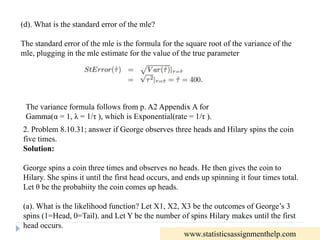
(d). What is the standard error of the mle?
The standard error of the mle is the formula for the square root of the variance of the
mle, plugging in the mle estimate for the value of the true parameter
The variance formula follows from p. A2 Appendix A for
Gamma(α = 1, λ = 1/τ ), which is Exponential(rate = 1/τ ).
2. Problem 8.10.31; answer if George observes three heads and Hilary spins the coin
five times.
Solution:
George spins a coin three times and observes no heads. He then gives the coin to
Hilary. She spins it until the first head occurs, and ends up spinning it four times total.
Let θ be the probabiity the coin comes up heads.
(a). What is the likelihood function? Let X1, X2, X3 be the outcomes of George’s 3
spins (1=Head, 0=Tail). and Let Y be the number of spins Hilary makes until the first
head occurs.
www.statisticsassignmenthelp.com
• X1, X2, X3 are i.i.d. (independent and identically distributed) Bernoulli(θ) random
variables
• Y is independent of X1, X2, X3 and has a geometric distribution with parameter p = θ
(see p. A1 of Appendix A)
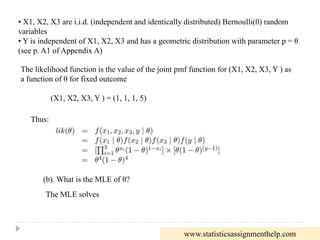
The likelihood function is the value of the joint pmf function for (X1, X2, X3, Y ) as
a function of θ for fixed outcome
(X1, X2, X3, Y ) = (1, 1, 1, 5)
Thus:
(b). What is the MLE of θ?
The MLE solves
www.statisticsassignmenthelp.com
Note that the MLE of θ is identical to the MLE for 8 Bernoulli trials which have 4
Heads and 4 Tails.
3. Problem 8.10.53
Solution:
Let X1, . . . , Xn be i.i.d. uniform on [0, θ]
(a). Find the method of moments estimate of θ and its mean and variance.
The first moment of each Xi is
The method of moments estimate solves
www.statisticsassignmenthelp.com
So
The mean ˆ and variance of θMOM = 2x can be computed from the mean and variance
of the i.i.d. Xi:
µ1 = E[Xi] = θ/2 (shown above)
It follows that
www.statisticsassignmenthelp.com
(b). Find the mle of θ.
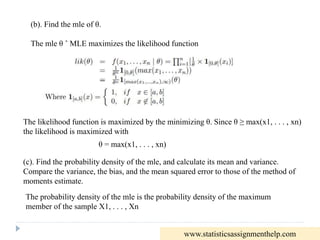
The mle θ ˆ MLE maximizes the likelihood function
The likelihood function is maximized by the minimizing θ. Since θ ≥ max(x1, . . . , xn)
the likelihood is maximized with
θ = max(x1, . . . , xn)
(c). Find the probability density of the mle, and calculate its mean and variance.
Compare the variance, the bias, and the mean squared error to those of the method of
moments estimate.
The probability density of the mle is the probability density of the maximum
member of the sample X1, . . . , Xn
www.statisticsassignmenthelp.com
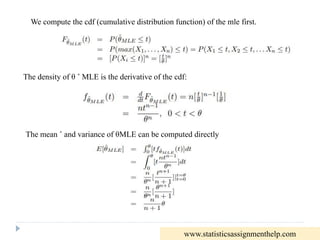
We compute the cdf (cumulative distribution function) of the mle first.
The density of θ ˆ MLE is the derivative of the cdf:
The mean ˆ and variance of θMLE can be computed directly
www.statisticsassignmenthelp.com
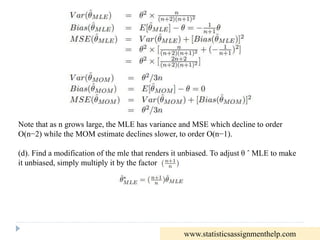
Now, to compare the variance, the bias, and the mean squared error to those of the
method of moments estimate, we apply the formulas:
Bias(θ ˆ) = E[θ ˆ] − θ
MSE(θ ˆ) = V ar(θ ˆ) + [Bias(θ ˆ)]2
So, we can compare:
www.statisticsassignmenthelp.com
Note that as n grows large, the MLE has variance and MSE which decline to order
O(n−2) while the MOM estimate declines slower, to order O(n−1).
(d). Find a modification of the mle that renders it unbiased. To adjust θ ˆ MLE to make
it unbiased, simply multiply it by the factor
www.statisticsassignmenthelp.com
4. Problem 8.10.57
Solution:
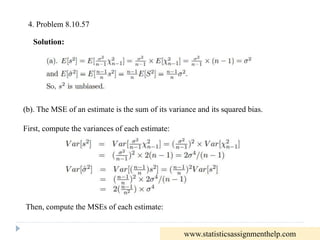
(b). The MSE of an estimate is the sum of its variance and its squared bias.
First, compute the variances of each estimate:
Then, compute the MSEs of each estimate:
www.statisticsassignmenthelp.com
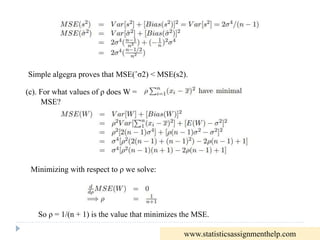
Simple algegra proves that MSE(ˆσ2) < MSE(s2).
(c). For what values of ρ does W =
MSE?
Minimizing with respect to ρ we solve:
So ρ = 1/(n + 1) is the value that minimizes the MSE.
www.statisticsassignmenthelp.com

Probability Assignment Help

  • 1.
  • 2.
    1. Problem 8.10.27;instead of 5 components, suppose there are 8 and that the first one fails at 50 days. Suppose that certain electronic components have lifetimes that are exponentially distributed Five new components are put on test. The first one fails at 100 days, and no further observations are recorded. By the Hint (Example A of Section 3.7), let T1, T2, . . . , Tn be the time until failure of n components (we shall set n = 8 below). These random variables are i.i.d. with cumulative distribution function FT (t) = 1 − exp(−t/τ ) Let TMIN = min(T1, T2, . . . , Tn) be the shortest time to failure. (If a system operates with components 1-n connected in a series, then TMIN is the time until failure of the sytem.) The cumulative distribution function of TMin, FTMIN (t) must satisfy: Solution: www.statisticsassignmenthelp.com
  • 3.
    It follows thatthe probability density function of TMIN is That is, TMIN ∼ Exponential(rate = n/τ ). (a). What is the likelihood function of τ? The data consists of TMIN = 50 with n = 8, so (b). What is the mle of τ? The mle maximizes lik(τ ) and J(τ ) = log lik(τ ), which is the solution to www.statisticsassignmenthelp.com
  • 4.
    (c). What isthe sampling distribution of the mle? The mle is τˆ = TMIN × n which is n times the minimum of n i.i.d. Exponential(rate = 1/τ ) random variables. The distribution of TMIN is Exponential(rate = 5/τ ) The mle is 5 the minimum of n exponential So Fτˆ(u) = 1 − exp(−u/τ ) which is the cdf of an Exponential(rate = 1/τ ) random variable. www.statisticsassignmenthelp.com
  • 5.
    (d). What isthe standard error of the mle? The standard error of the mle is the formula for the square root of the variance of the mle, plugging in the mle estimate for the value of the true parameter The variance formula follows from p. A2 Appendix A for Gamma(α = 1, λ = 1/τ ), which is Exponential(rate = 1/τ ). 2. Problem 8.10.31; answer if George observes three heads and Hilary spins the coin five times. Solution: George spins a coin three times and observes no heads. He then gives the coin to Hilary. She spins it until the first head occurs, and ends up spinning it four times total. Let θ be the probabiity the coin comes up heads. (a). What is the likelihood function? Let X1, X2, X3 be the outcomes of George’s 3 spins (1=Head, 0=Tail). and Let Y be the number of spins Hilary makes until the first head occurs. www.statisticsassignmenthelp.com
  • 6.
    • X1, X2,X3 are i.i.d. (independent and identically distributed) Bernoulli(θ) random variables • Y is independent of X1, X2, X3 and has a geometric distribution with parameter p = θ (see p. A1 of Appendix A) The likelihood function is the value of the joint pmf function for (X1, X2, X3, Y ) as a function of θ for fixed outcome (X1, X2, X3, Y ) = (1, 1, 1, 5) Thus: (b). What is the MLE of θ? The MLE solves www.statisticsassignmenthelp.com
  • 7.
    Note that theMLE of θ is identical to the MLE for 8 Bernoulli trials which have 4 Heads and 4 Tails. 3. Problem 8.10.53 Solution: Let X1, . . . , Xn be i.i.d. uniform on [0, θ] (a). Find the method of moments estimate of θ and its mean and variance. The first moment of each Xi is The method of moments estimate solves www.statisticsassignmenthelp.com
  • 8.
    So The mean ˆand variance of θMOM = 2x can be computed from the mean and variance of the i.i.d. Xi: µ1 = E[Xi] = θ/2 (shown above) It follows that www.statisticsassignmenthelp.com
  • 9.
    (b). Find themle of θ. The mle θ ˆ MLE maximizes the likelihood function The likelihood function is maximized by the minimizing θ. Since θ ≥ max(x1, . . . , xn) the likelihood is maximized with θ = max(x1, . . . , xn) (c). Find the probability density of the mle, and calculate its mean and variance. Compare the variance, the bias, and the mean squared error to those of the method of moments estimate. The probability density of the mle is the probability density of the maximum member of the sample X1, . . . , Xn www.statisticsassignmenthelp.com
  • 10.
    We compute thecdf (cumulative distribution function) of the mle first. The density of θ ˆ MLE is the derivative of the cdf: The mean ˆ and variance of θMLE can be computed directly www.statisticsassignmenthelp.com
  • 11.
    Now, to comparethe variance, the bias, and the mean squared error to those of the method of moments estimate, we apply the formulas: Bias(θ ˆ) = E[θ ˆ] − θ MSE(θ ˆ) = V ar(θ ˆ) + [Bias(θ ˆ)]2 So, we can compare: www.statisticsassignmenthelp.com
  • 12.
    Note that asn grows large, the MLE has variance and MSE which decline to order O(n−2) while the MOM estimate declines slower, to order O(n−1). (d). Find a modification of the mle that renders it unbiased. To adjust θ ˆ MLE to make it unbiased, simply multiply it by the factor www.statisticsassignmenthelp.com
  • 13.
    4. Problem 8.10.57 Solution: (b).The MSE of an estimate is the sum of its variance and its squared bias. First, compute the variances of each estimate: Then, compute the MSEs of each estimate: www.statisticsassignmenthelp.com
  • 14.
    Simple algegra provesthat MSE(ˆσ2) < MSE(s2). (c). For what values of ρ does W = MSE? Minimizing with respect to ρ we solve: So ρ = 1/(n + 1) is the value that minimizes the MSE. www.statisticsassignmenthelp.com