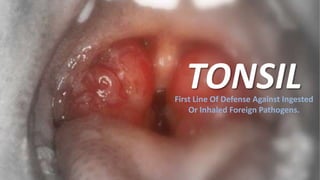
TONSILFirst Line Of Defense Against Ingested
Or Inhaled Foreign Pathogens.
What is Tonsil ?
• Tonsils are collections
of lymphoid tissue facing into the
aerodigestive tract.
Waldeyer’s Ring
• Waldeyer's tonsillar
ring includes
1. Adenoid tonsil
2. Two tubal tonsils
3. Two palatine tonsils
4. Lingual tonsil.
Type Epithelium capsule Crypts Location
Adenoids
Ciliated
pseudostratified
columnar
Incompletely
encapsulated
No crypts, but
small folds
Roof of pharynx
Tubal tonsils
Ciliated
pseudostratified
columnar
Roof of pharynx
Palatine tonsils
Non-keratinized
stratified
squamous
Incompletely
encapsulated
Long, branched
Sides
of oropharynx
between
palatoglossal
and
palatopharyngeal
arches
Lingual tonsils
Non-keratinized
stratified
squamous
Incompletely
encapsulated
Long, branched
Behind terminal
sulcus (tongue)
Functions
• Immune system's first line of defense against ingested or inhaled
foreign pathogens.
• Tonsils have on their surface specialized antigen capture cells called M cells that
allow for the uptake of antigens produced by pathogens. These M cells then alert
the underlying B cells and T cells in the tonsil that a pathogen is present and an
immune response is stimulated.
• B cells are activated and proliferate in areas called germinal centres in the tonsil.
These germinal centres are places where B memory cells are created and secretory
antibody (IgA) is produced.
• Tonsils produce T lymphocytes, also known as T-cells, in a manner similar to, but
different from, the way the thymus does.
Clinical
• Tonsilitis : Tonsils can become enlarged
or inflamed.
• Tonsillolith : It is material that
accumulates on the tonsil. They can
range up to the size of
a peppercorn and are white/cream in
color.
o The main substance is
mostly calcium.
o Have a strong unpleasant odor
because of hydrogen sulfide and
methyl mercaptan and other
chemicals.
Thank You

Tonsil

  • 1.
    TONSILFirst Line OfDefense Against Ingested Or Inhaled Foreign Pathogens.
  • 2.
    What is Tonsil? • Tonsils are collections of lymphoid tissue facing into the aerodigestive tract.
  • 3.
    Waldeyer’s Ring • Waldeyer'stonsillar ring includes 1. Adenoid tonsil 2. Two tubal tonsils 3. Two palatine tonsils 4. Lingual tonsil.
  • 4.
    Type Epithelium capsuleCrypts Location Adenoids Ciliated pseudostratified columnar Incompletely encapsulated No crypts, but small folds Roof of pharynx Tubal tonsils Ciliated pseudostratified columnar Roof of pharynx Palatine tonsils Non-keratinized stratified squamous Incompletely encapsulated Long, branched Sides of oropharynx between palatoglossal and palatopharyngeal arches Lingual tonsils Non-keratinized stratified squamous Incompletely encapsulated Long, branched Behind terminal sulcus (tongue)
  • 5.
    Functions • Immune system'sfirst line of defense against ingested or inhaled foreign pathogens. • Tonsils have on their surface specialized antigen capture cells called M cells that allow for the uptake of antigens produced by pathogens. These M cells then alert the underlying B cells and T cells in the tonsil that a pathogen is present and an immune response is stimulated. • B cells are activated and proliferate in areas called germinal centres in the tonsil. These germinal centres are places where B memory cells are created and secretory antibody (IgA) is produced. • Tonsils produce T lymphocytes, also known as T-cells, in a manner similar to, but different from, the way the thymus does.
  • 6.
    Clinical • Tonsilitis :Tonsils can become enlarged or inflamed. • Tonsillolith : It is material that accumulates on the tonsil. They can range up to the size of a peppercorn and are white/cream in color. o The main substance is mostly calcium. o Have a strong unpleasant odor because of hydrogen sulfide and methyl mercaptan and other chemicals.
  • 7.