1
Dengue Fever
What is it?
Mode of transmission
Symptoms and treatment
Prevention

2
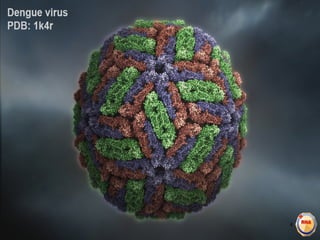
What is Dengue Fever?
• Dengue fever, also know as
breakbone fever, is an acute
communicable disease caused by
virus.
• Infectious agent: Dengue viruses
(categorize into types 1,2,3,4)

3
4
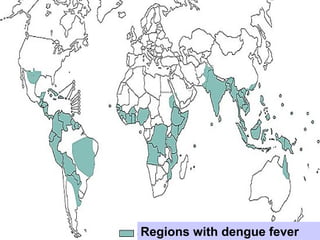
The Situation Worldwide
• About 50 million cases annually
worldwide
• Incidence of dengue fever highest in
tropical and subtropical regions
• Recent increase in disease activity
worldwide
5
6

Regions with dengue fever
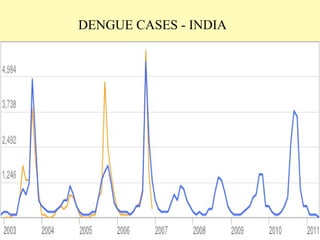
Alarming 80% rise in dengue cases this year
Times of India
Published on 21 Aug 2013
Durgesh Nandan Jha, TNN | Aug 21, 2013, 07.51 AM IST
NEW DELHI: Dengue cases have risen alarmingly across the country this
year, with data showing an 80% rise in the disease till July 31 as compared
to the same period last year.
India has recorded 15,983 dengue cases so far in 2013 as compared to
8,899 cases in the corresponding months last year, latest health ministry
data shows. But the good news is, while the cases have risen sharply,
fatalities have actually declined - 56 as compared to 76 last year.
Kerala reported most dengue cases at 5,801, followed by Karnataka (3,775),
Tamil Nadu (3079) and Maharashtra (961) till end-July. Delhi witnessed a
sharp rise in cases over the last few weeks, with the total this year touching
54. No one has died due to dengue in the capital so far.

7
DENGUE CASES - INDIA

8
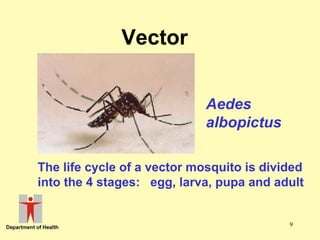
Vector
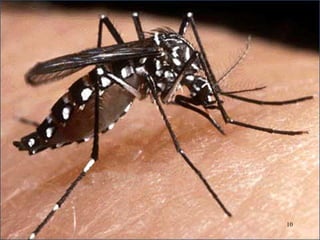
Aedes
albopictus
The life cycle of a vector mosquito is divided
into the 4 stages: egg, larva, pupa and adult

9
10
Habitual Behaviour of
Aedes Albopictus (1)
• Usually breed in stagnant water
• Usually active in dark or shaded
places outdoors, but indoor activity is
also possible

11
Habitual Behaviour of
Aedes Albopictus (2)
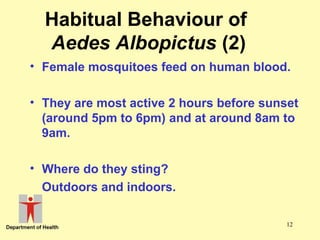
• Female mosquitoes feed on human blood.
• They are most active 2 hours before sunset
(around 5pm to 6pm) and at around 8am to
9am.
• Where do they sting?
Outdoors and indoors.
12
Mode of Transmission
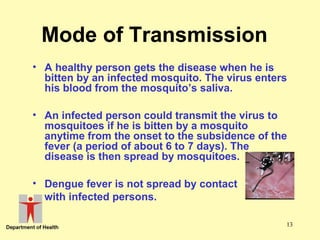
• A healthy person gets the disease when he is
bitten by an infected mosquito. The virus enters
his blood from the mosquito’s saliva.
• An infected person could transmit the virus to
mosquitoes if he is bitten by a mosquito
anytime from the onset to the subsidence of the
fever (a period of about 6 to 7 days). The
disease is then spread by mosquitoes.
• Dengue fever is not spread by contact
with infected persons.
13
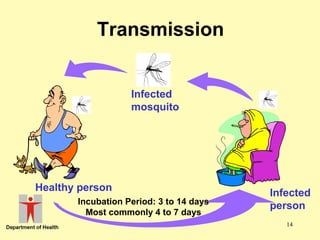
Transmission
Infected
mosquito

Healthy person
Incubation Period: 3 to 14 days
Most commonly 4 to 7 days

Infected
person
14
Types
Classical
dengue

Dengue
haemorrhagic
fever
15
16
Symptoms of
Classical Dengue (1)
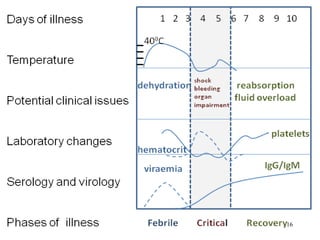
• Fever: continuous for 3 to 5 days
• Severe headache
• Painful limbs, joint pain, muscle
pain, back pain, pain behind
eyeballs
17
Symptoms of
Classical Dengue (2)
•Rash appears on the 3rd to 4th day after onset.
•Nausea, vomiting.
•Slight gum bleeding and nasal bleeding.
•Extreme fatigue and depression may follow
recovery.
• In very rare cases, the condition may worsen
into dengue haemorrhagic fever, leading to
haemorrhage, shock or even death.
18
Treatment (1)
• At present, there is no drug that
can treat dengue fever
effectively. Patients infected with
classical dengue usually
recovers in 1 to 2 weeks.
• For serious cases, supportive
treatments are provided by
hospitals.
• If you suspect that you have
dengue fever, you should seek
medical treatment promptly.
19
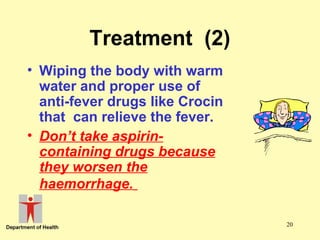
Treatment (2)
• Wiping the body with warm
water and proper use of
anti-fever drugs like Crocin
that can relieve the fever.
• Don’t take aspirincontaining drugs because
they worsen the
haemorrhage.
20
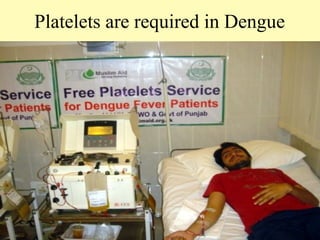
Platelets are required in Dengue

21
Blood Transfusion

22
Protect Yourself against
Dengue Fever
As yet, there is no effective vaccine against
dengue fever. Therefore, the best prevention is
to avoid being bitten by mosquitoes by paying
attention to the following:
•Avoid staying in dark, outdoor places such as
brushwood, pavilions or the shade of a tree
during the hours when Aedes albopictus is
active.

23
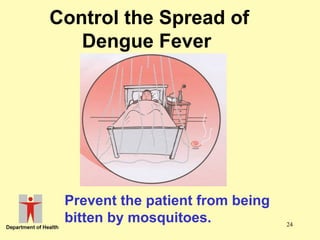
Control the Spread of
Dengue Fever

Prevent the patient from being
bitten by mosquitoes.

24
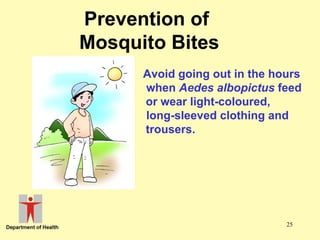
Prevention of
Mosquito Bites
Avoid going out in the hours
when Aedes albopictus feed
or wear light-coloured,
long-sleeved clothing and
trousers.

25
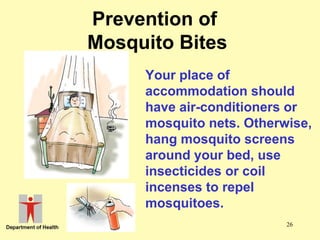
Prevention of
Mosquito Bites
Your place of
accommodation should
have air-conditioners or
mosquito nets. Otherwise,
hang mosquito screens
around your bed, use
insecticides or coil
incenses to repel
mosquitoes.
26
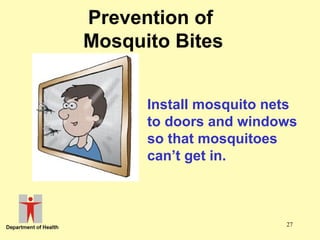
Prevention of
Mosquito Bites
Install mosquito nets
to doors and windows
so that mosquitoes
can’t get in.

27
Elimination of Mosquitoes
The most effective way
to eliminate
mosquitoes is to
keep the environment
clean and to remove
stagnant water so that
mosquitoes can’t
breed.
28
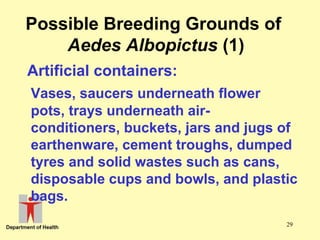
Possible Breeding Grounds of
Aedes Albopictus (1)
Artificial containers:
Vases, saucers underneath flower
pots, trays underneath airconditioners, buckets, jars and jugs of
earthenware, cement troughs, dumped
tyres and solid wastes such as cans,
disposable cups and bowls, and plastic
bags.
29
Possible Breeding Grounds of
Aedes Albopictus (2)
Natural containers:
The hollow space inside a bamboo,
hollows of a tree and the rachis of a
leaf.

30
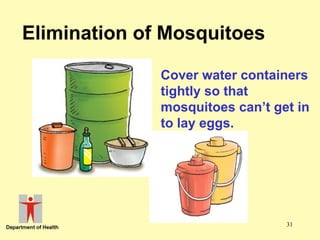
Elimination of Mosquitoes
Cover water containers
tightly so that
mosquitoes can’t get in
to lay eggs.

31
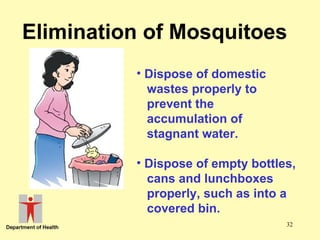
Elimination of Mosquitoes
• Dispose of domestic
wastes properly to
prevent the
accumulation of
stagnant water.
• Dispose of empty bottles,
cans and lunchboxes
properly, such as into a
covered bin.
32
Elimination of Mosquitoes
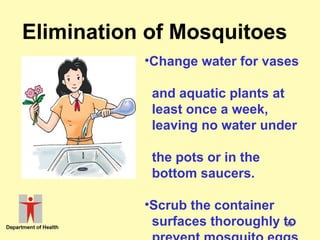
•Change water for vases
and aquatic plants at
least once a week,
leaving no water under
the pots or in the
bottom saucers.
•Scrub the container
surfaces thoroughly to
33
Elimination of Mosquitoes
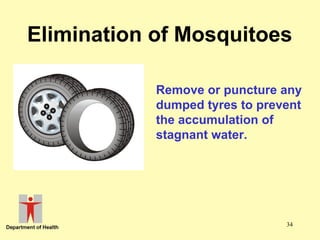
Remove or puncture any
dumped tyres to prevent
the accumulation of
stagnant water.

34
Elimination of Mosquitoes

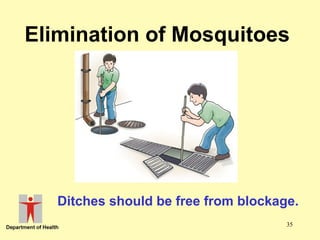
Ditches should be free from blockage.
35
Elimination of Mosquitoes

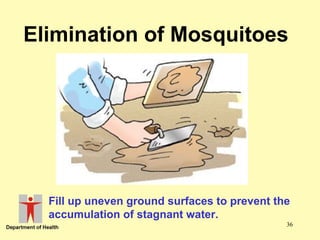
Fill up uneven ground surfaces to prevent the
accumulation of stagnant water.
36
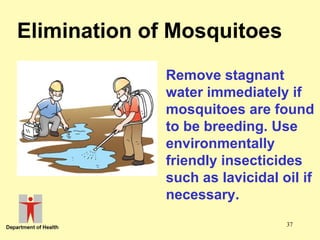
Elimination of Mosquitoes
Remove stagnant
water immediately if
mosquitoes are found
to be breeding. Use
environmentally
friendly insecticides
such as lavicidal oil if
necessary.
37
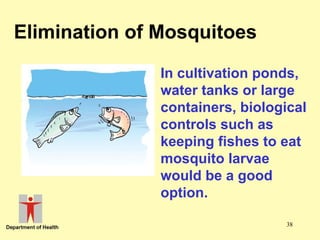
Elimination of Mosquitoes
In cultivation ponds,
water tanks or large
containers, biological
controls such as
keeping fishes to eat
mosquito larvae
would be a good
option.
38
Black Spots of Mosquito
Breeding
• Garden / gardening corner / saucers
underneath flower pots / aquatic
plants
• Truckshop
• Rubbish collection stations /
Scrapyard
• Ditches
• Toilets
• Water tanks / pools
39
Mosquito Elimination
Checklist (1)
• Are containers and other items where
water could accumulate disposed of
properly?
(For example, throwing empty cans,
foam rubber boxes, cups and bottles
into a covered bin.)
• Are water containers covered properly?

40
Mosquito Elimination
Checklist (2)
• Are ditches free from blockage?
• Are containers with stagnant water
cleaned regularly?
(For example, vases, saucers underneath
flower pots, water storage device of an airconditioner, water tanks and pools.)
• Are uneven ground surfaces filled to
prevent the accumulation of stagnant
water?
41
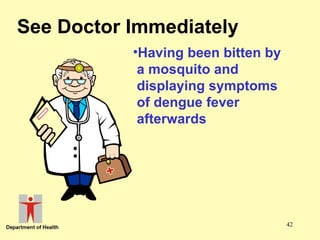
See Doctor Immediately
•Having been bitten by
a mosquito and
displaying symptoms
of dengue fever
afterwards

42
If you suspect that you have
dengue fever, the most
important thing to do is to

see a doctor.
43
Let’s remove stagnant water
and eliminate mosquitoes

44
45

Dengue eng

  • 1.
  • 2.
    Dengue Fever What isit? Mode of transmission Symptoms and treatment Prevention 2
  • 3.
    What is DengueFever? • Dengue fever, also know as breakbone fever, is an acute communicable disease caused by virus. • Infectious agent: Dengue viruses (categorize into types 1,2,3,4) 3
  • 4.
  • 5.
    The Situation Worldwide •About 50 million cases annually worldwide • Incidence of dengue fever highest in tropical and subtropical regions • Recent increase in disease activity worldwide 5
  • 6.
  • 7.
    Alarming 80% risein dengue cases this year Times of India Published on 21 Aug 2013 Durgesh Nandan Jha, TNN | Aug 21, 2013, 07.51 AM IST NEW DELHI: Dengue cases have risen alarmingly across the country this year, with data showing an 80% rise in the disease till July 31 as compared to the same period last year. India has recorded 15,983 dengue cases so far in 2013 as compared to 8,899 cases in the corresponding months last year, latest health ministry data shows. But the good news is, while the cases have risen sharply, fatalities have actually declined - 56 as compared to 76 last year. Kerala reported most dengue cases at 5,801, followed by Karnataka (3,775), Tamil Nadu (3079) and Maharashtra (961) till end-July. Delhi witnessed a sharp rise in cases over the last few weeks, with the total this year touching 54. No one has died due to dengue in the capital so far. 7
  • 8.
  • 9.
    Vector Aedes albopictus The life cycleof a vector mosquito is divided into the 4 stages: egg, larva, pupa and adult 9
  • 10.
  • 11.
    Habitual Behaviour of AedesAlbopictus (1) • Usually breed in stagnant water • Usually active in dark or shaded places outdoors, but indoor activity is also possible 11
  • 12.
    Habitual Behaviour of AedesAlbopictus (2) • Female mosquitoes feed on human blood. • They are most active 2 hours before sunset (around 5pm to 6pm) and at around 8am to 9am. • Where do they sting? Outdoors and indoors. 12
  • 13.
    Mode of Transmission •A healthy person gets the disease when he is bitten by an infected mosquito. The virus enters his blood from the mosquito’s saliva. • An infected person could transmit the virus to mosquitoes if he is bitten by a mosquito anytime from the onset to the subsidence of the fever (a period of about 6 to 7 days). The disease is then spread by mosquitoes. • Dengue fever is not spread by contact with infected persons. 13
  • 14.
    Transmission Infected mosquito Healthy person Incubation Period:3 to 14 days Most commonly 4 to 7 days Infected person 14
  • 15.
  • 16.
  • 17.
    Symptoms of Classical Dengue(1) • Fever: continuous for 3 to 5 days • Severe headache • Painful limbs, joint pain, muscle pain, back pain, pain behind eyeballs 17
  • 18.
    Symptoms of Classical Dengue(2) •Rash appears on the 3rd to 4th day after onset. •Nausea, vomiting. •Slight gum bleeding and nasal bleeding. •Extreme fatigue and depression may follow recovery. • In very rare cases, the condition may worsen into dengue haemorrhagic fever, leading to haemorrhage, shock or even death. 18
  • 19.
    Treatment (1) • Atpresent, there is no drug that can treat dengue fever effectively. Patients infected with classical dengue usually recovers in 1 to 2 weeks. • For serious cases, supportive treatments are provided by hospitals. • If you suspect that you have dengue fever, you should seek medical treatment promptly. 19
  • 20.
    Treatment (2) • Wipingthe body with warm water and proper use of anti-fever drugs like Crocin that can relieve the fever. • Don’t take aspirincontaining drugs because they worsen the haemorrhage. 20
  • 21.
  • 22.
  • 23.
    Protect Yourself against DengueFever As yet, there is no effective vaccine against dengue fever. Therefore, the best prevention is to avoid being bitten by mosquitoes by paying attention to the following: •Avoid staying in dark, outdoor places such as brushwood, pavilions or the shade of a tree during the hours when Aedes albopictus is active. 23
  • 24.
    Control the Spreadof Dengue Fever Prevent the patient from being bitten by mosquitoes. 24
  • 25.
    Prevention of Mosquito Bites Avoidgoing out in the hours when Aedes albopictus feed or wear light-coloured, long-sleeved clothing and trousers. 25
  • 26.
    Prevention of Mosquito Bites Yourplace of accommodation should have air-conditioners or mosquito nets. Otherwise, hang mosquito screens around your bed, use insecticides or coil incenses to repel mosquitoes. 26
  • 27.
    Prevention of Mosquito Bites Installmosquito nets to doors and windows so that mosquitoes can’t get in. 27
  • 28.
    Elimination of Mosquitoes Themost effective way to eliminate mosquitoes is to keep the environment clean and to remove stagnant water so that mosquitoes can’t breed. 28
  • 29.
    Possible Breeding Groundsof Aedes Albopictus (1) Artificial containers: Vases, saucers underneath flower pots, trays underneath airconditioners, buckets, jars and jugs of earthenware, cement troughs, dumped tyres and solid wastes such as cans, disposable cups and bowls, and plastic bags. 29
  • 30.
    Possible Breeding Groundsof Aedes Albopictus (2) Natural containers: The hollow space inside a bamboo, hollows of a tree and the rachis of a leaf. 30
  • 31.
    Elimination of Mosquitoes Coverwater containers tightly so that mosquitoes can’t get in to lay eggs. 31
  • 32.
    Elimination of Mosquitoes •Dispose of domestic wastes properly to prevent the accumulation of stagnant water. • Dispose of empty bottles, cans and lunchboxes properly, such as into a covered bin. 32
  • 33.
    Elimination of Mosquitoes •Changewater for vases and aquatic plants at least once a week, leaving no water under the pots or in the bottom saucers. •Scrub the container surfaces thoroughly to 33
  • 34.
    Elimination of Mosquitoes Removeor puncture any dumped tyres to prevent the accumulation of stagnant water. 34
  • 35.
    Elimination of Mosquitoes Ditchesshould be free from blockage. 35
  • 36.
    Elimination of Mosquitoes Fillup uneven ground surfaces to prevent the accumulation of stagnant water. 36
  • 37.
    Elimination of Mosquitoes Removestagnant water immediately if mosquitoes are found to be breeding. Use environmentally friendly insecticides such as lavicidal oil if necessary. 37
  • 38.
    Elimination of Mosquitoes Incultivation ponds, water tanks or large containers, biological controls such as keeping fishes to eat mosquito larvae would be a good option. 38
  • 39.
    Black Spots ofMosquito Breeding • Garden / gardening corner / saucers underneath flower pots / aquatic plants • Truckshop • Rubbish collection stations / Scrapyard • Ditches • Toilets • Water tanks / pools 39
  • 40.
    Mosquito Elimination Checklist (1) •Are containers and other items where water could accumulate disposed of properly? (For example, throwing empty cans, foam rubber boxes, cups and bottles into a covered bin.) • Are water containers covered properly? 40
  • 41.
    Mosquito Elimination Checklist (2) •Are ditches free from blockage? • Are containers with stagnant water cleaned regularly? (For example, vases, saucers underneath flower pots, water storage device of an airconditioner, water tanks and pools.) • Are uneven ground surfaces filled to prevent the accumulation of stagnant water? 41
  • 42.
    See Doctor Immediately •Havingbeen bitten by a mosquito and displaying symptoms of dengue fever afterwards 42
  • 43.
    If you suspectthat you have dengue fever, the most important thing to do is to see a doctor. 43
  • 44.
    Let’s remove stagnantwater and eliminate mosquitoes 44
  • 45.

Editor's Notes

  • #15 傳播途徑:登革熱病毒只能存在於人、猴及病媒蚊體內。 「登革熱」主要經由帶病毒蚊子(花腳蚊),在叮咬人時,將病毒傳染給人。如果病者在剛發燒前至退燒期內(大約六至七日)被蚊叮,病毒也會傳給花腳蚊,成為帶病毒蚊子。毒蚊的傳染力可維持至其死為止,甚至經受感染的卵而傳給下一代(香港傳染病醫學會,1999)。不過與患者接觸是不會被傳染的。
  • #20 給予支緩性治療,登革熱患者要多休息、補充水份及按醫囑服藥,大約一個星期後就能逐漸康復,不會有後遺症;嚴重者或有出血傾向時則需要輸血或使用皮質類固醇。