DENGUEDENGUE
WHAT IS DENGUE ?
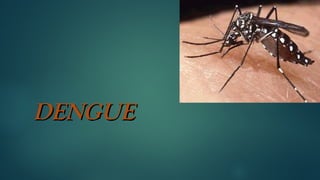
 Dengue is one of the most important arthropod-borne viral
diseases in terms of human morbidity and mortality. Dengue
has become an important public health problem. It affects
tropical and subtropical regions around the world,
predominantly in urban and semi urban areas.
 Dengue fever and Dengue Heomorrhagic (severe dengue)
are caused by DENGUE FEVER VIRUS (DENV) which is an RNA
virus of the family Flaviviridae.
 It is transmitted by Aedes aegypti and Aedes albopictus.
Causes of dengue
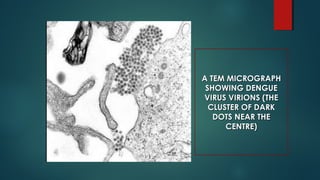
A TEM MICROGRAPHA TEM MICROGRAPH
SHOWING DENGUESHOWING DENGUE
VIRUS VIRIONS (THEVIRUS VIRIONS (THE
CLUSTER OF DARKCLUSTER OF DARK
DOTS NEAR THEDOTS NEAR THE
CENTRE)CENTRE)
 There are four distinct serotypes, DEN-1, 2, 3 and 4. Each episode of infection
induces a life-long protective immunity to the homologous serotype but
confers only partial and transient protection against subsequent infection by
the other three serotypes.
 Secondary infection is a major risk factor for DHF due to antibody-dependent
enhancement.
 Other important contributing factors for DHF are viral virulence, host genetic
background, T-cell activation, viral load and auto-antibodies.
 All four serotypes can be isolated at any one time but the predominant
circulating dengue virus will show a sinusoidal pattern (Figure 5).
 For example, DEN-3 was the predominant serotype in the early 90s with a
peak in 1993, and then subsequently declined. It then re-emerged, reaching
the peak in 2001. Other serotypes had been observed to be co-circulating at
the same time
Each year, an estimated 100 million cases of dengue fever occur worldwide.
Most of these are in tropical areas of the world with the greatest risk
occurring in:
•The Indian subcontinent
•South-east Asia
•Southern China
•Taiwan
•The Pacific Islands
•The Caribbean (except Cuba and the Cayman Islands)
•Mexico
•Africa
•Central and South America (except Chile, Paraguay and Argentina)
Dengue
Dengue
Dengue
Dengue

Dengue

  • 1.
  • 2.
    WHAT IS DENGUE?  Dengue is one of the most important arthropod-borne viral diseases in terms of human morbidity and mortality. Dengue has become an important public health problem. It affects tropical and subtropical regions around the world, predominantly in urban and semi urban areas.  Dengue fever and Dengue Heomorrhagic (severe dengue) are caused by DENGUE FEVER VIRUS (DENV) which is an RNA virus of the family Flaviviridae.  It is transmitted by Aedes aegypti and Aedes albopictus.
  • 3.
  • 4.
    A TEM MICROGRAPHATEM MICROGRAPH SHOWING DENGUESHOWING DENGUE VIRUS VIRIONS (THEVIRUS VIRIONS (THE CLUSTER OF DARKCLUSTER OF DARK DOTS NEAR THEDOTS NEAR THE CENTRE)CENTRE)
  • 7.
     There arefour distinct serotypes, DEN-1, 2, 3 and 4. Each episode of infection induces a life-long protective immunity to the homologous serotype but confers only partial and transient protection against subsequent infection by the other three serotypes.  Secondary infection is a major risk factor for DHF due to antibody-dependent enhancement.  Other important contributing factors for DHF are viral virulence, host genetic background, T-cell activation, viral load and auto-antibodies.  All four serotypes can be isolated at any one time but the predominant circulating dengue virus will show a sinusoidal pattern (Figure 5).  For example, DEN-3 was the predominant serotype in the early 90s with a peak in 1993, and then subsequently declined. It then re-emerged, reaching the peak in 2001. Other serotypes had been observed to be co-circulating at the same time
  • 8.
    Each year, anestimated 100 million cases of dengue fever occur worldwide. Most of these are in tropical areas of the world with the greatest risk occurring in: •The Indian subcontinent •South-east Asia •Southern China •Taiwan •The Pacific Islands •The Caribbean (except Cuba and the Cayman Islands) •Mexico •Africa •Central and South America (except Chile, Paraguay and Argentina)