Darshak Patel
Dhruv Patel
Krunal Patel
Mayur Patel
Project By :
INFANT
MORTALITY
RATE
INFANTINFANT
MORTALITYMORTALITY
RATERATE
INFANT
MORTALITY
RATE
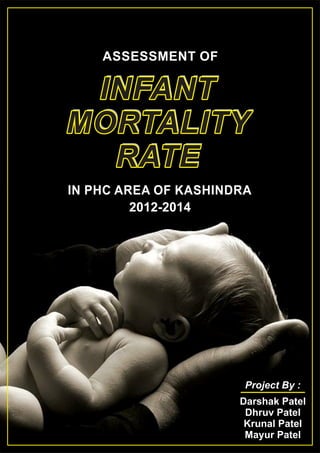
ASSESSMENT OF
IN PHC AREA OF KASHINDRA
2012-2014
INFANT MORTALITY RATE
1
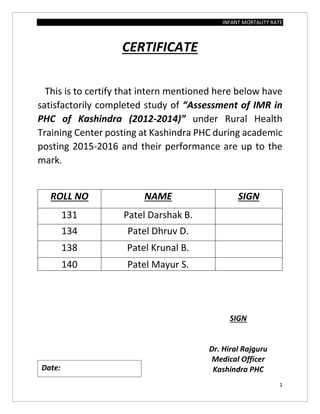
CERTIFICATE
This is to certify that intern mentioned here below have
satisfactorily completed study of “Assessment of IMR in
PHC of Kashindra (2012-2014)” under Rural Health
Training Center posting at Kashindra PHC during academic
posting 2015-2016 and their performance are up to the
mark.
ROLL NO NAME SIGN
131 Patel Darshak B.
134 Patel Dhruv D.
138 Patel Krunal B.
140 Patel Mayur S.
SIGN
Dr. Hiral Rajguru
Medical Officer
Kashindra PHCDate:
INFANT MORTALITY RATE
2
ACKNOWLEDGEMENT
We take this opportunity to express our heartly gratitude
to all those who were associated directly or indirectly with
our project and helped us to make our project up to the
level anticipated.
We are grateful to Dr. Hiral Rajguru, Medical Officer at
Kashindra PHC for providing us with appropriate guidance
and all necessary information to make this project.
We are also thankful to Dr. Krunal Patel, Medical Officer
at Bawla PHC for providing us with opportunity and
guidance to make this project.
We are also thankful to the staff of Kashindra PHC and all
those unmentioned for their contribution of time and
efforts on this project.
INFANT MORTALITY RATE
3
INDEX
1 Introduction 4
2 Aims & Objectives 5
3 Material & Methology 6
4 Review Of Literature 7
5 Observation And Analysis 13
6 Conclusion 18
7 Recommendation 19
8 Bibliography 20
INFANT MORTALITY RATE
4
INTRODUCTION
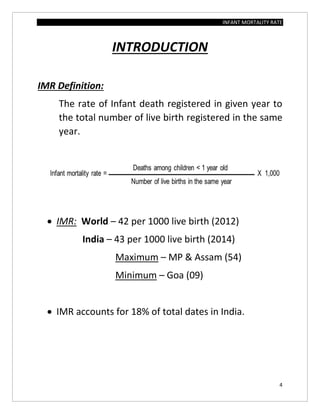
IMR Definition:
The rate of Infant death registered in given year to
the total number of live birth registered in the same
year.
 IMR: World – 42 per 1000 live birth (2012)
India – 43 per 1000 live birth (2014)
Maximum – MP & Assam (54)
Minimum – Goa (09)
 IMR accounts for 18% of total dates in India.
INFANT MORTALITY RATE
5
AIMS & OBJECTIVES
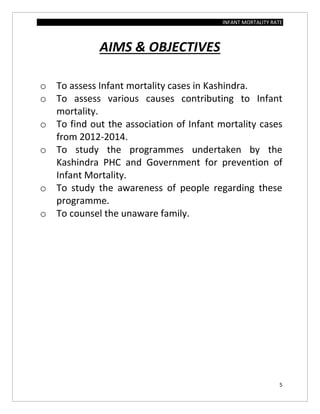
o To assess Infant mortality cases in Kashindra.
o To assess various causes contributing to Infant
mortality.
o To find out the association of Infant mortality cases
from 2012-2014.
o To study the programmes undertaken by the
Kashindra PHC and Government for prevention of
Infant Mortality.
o To study the awareness of people regarding these
programme.
o To counsel the unaware family.
INFANT MORTALITY RATE
6
MATERIALS & METHODOLOGY
o Study type : cross sectional study
o Study area : Kashindra PHC
o Study period : 15 days :
from 1/9/2015
to 15/9/2015
o Data collection : from records of
Kashindra PHC
o Data analysis : Microsoft Excel
INFANT MORTALITY RATE
7
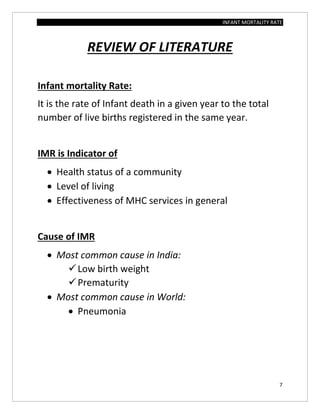
REVIEW OF LITERATURE
Infant mortality Rate:
It is the rate of Infant death in a given year to the total
number of live births registered in the same year.
IMR is Indicator of
 Health status of a community
 Level of living
 Effectiveness of MHC services in general
Cause of IMR
 Most common cause in India:
Low birth weight
Prematurity
 Most common cause in World:
 Pneumonia
INFANT MORTALITY RATE
8
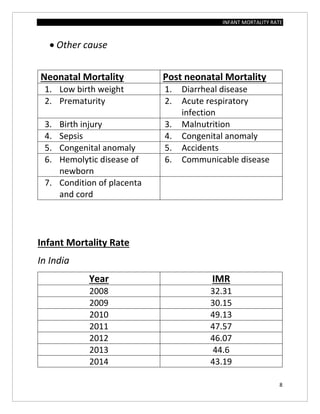
 Other cause
Neonatal Mortality Post neonatal Mortality
1. Low birth weight 1. Diarrheal disease
2. Prematurity 2. Acute respiratory
infection
3. Birth injury 3. Malnutrition
4. Sepsis 4. Congenital anomaly
5. Congenital anomaly 5. Accidents
6. Hemolytic disease of
newborn
6. Communicable disease
7. Condition of placenta
and cord
Infant Mortality Rate
In India
Year IMR
2008 32.31
2009 30.15
2010 49.13
2011 47.57
2012 46.07
2013 44.6
2014 43.19
INFANT MORTALITY RATE
9
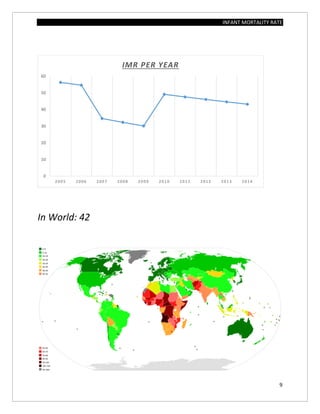
In World: 42
0
10
20
30
40
50
60
2005 2006 2007 2008 2009 2010 2011 2012 2013 2014
IMR PER YEAR
INFANT MORTALITY RATE
10
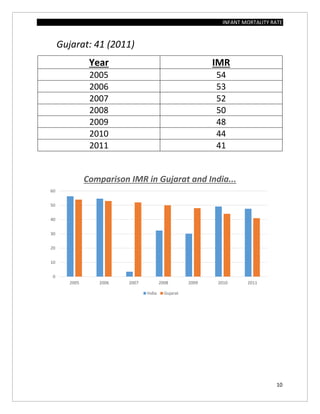
Gujarat: 41 (2011)
Year IMR
2005 54
2006 53
2007 52
2008 50
2009 48
2010 44
2011 41
0
10
20
30
40
50
60
2005 2006 2007 2008 2009 2010 2011
Comparison IMR in Gujarat and India...
India Gujarat
INFANT MORTALITY RATE
11
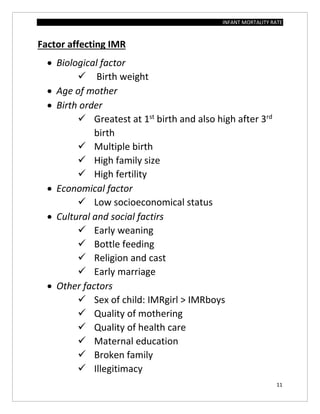
Factor affecting IMR
 Biological factor
 Birth weight
 Age of mother
 Birth order
 Greatest at 1st
birth and also high after 3rd
birth
 Multiple birth
 High family size
 High fertility
 Economical factor
 Low socioeconomical status
 Cultural and social factirs
 Early weaning
 Bottle feeding
 Religion and cast
 Early marriage
 Other factors
 Sex of child: IMRgirl > IMRboys
 Quality of mothering
 Quality of health care
 Maternal education
 Broken family
 Illegitimacy
INFANT MORTALITY RATE
12
 Brutal habits and customs
 Untrained dai
 Bad environment
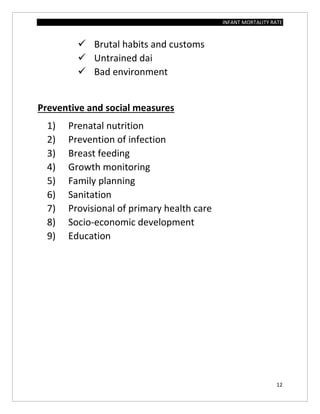
Preventive and social measures
1) Prenatal nutrition
2) Prevention of infection
3) Breast feeding
4) Growth monitoring
5) Family planning
6) Sanitation
7) Provisional of primary health care
8) Socio-economic development
9) Education
INFANT MORTALITY RATE
13
OBSERVATION AND ANALYSIS
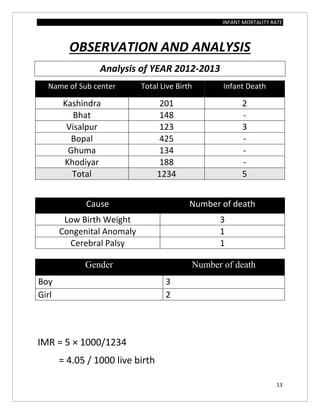
Analysis of YEAR 2012-2013
Name of Sub center Total Live Birth Infant Death
Kashindra 201 2
Bhat 148 -
Visalpur 123 3
Bopal 425 -
Ghuma 134 -
Khodiyar 188 -
Total 1234 5
Cause Number of death
Low Birth Weight 3
Congenital Anomaly 1
Cerebral Palsy 1
IMR = 5 × 1000/1234
= 4.05 / 1000 live birth
Gender Number of death
Boy 3
Girl 2
INFANT MORTALITY RATE
14
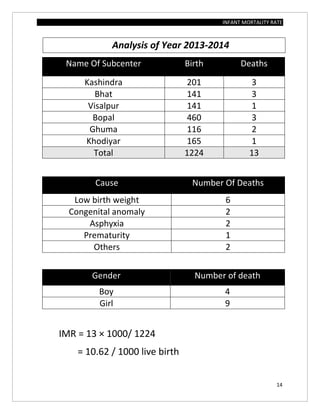
Analysis of Year 2013-2014
Name Of Subcenter Birth Deaths
Kashindra 201 3
Bhat 141 3
Visalpur 141 1
Bopal 460 3
Ghuma 116 2
Khodiyar 165 1
Total 1224 13
Cause Number Of Deaths
Low birth weight 6
Congenital anomaly 2
Asphyxia 2
Prematurity 1
Others 2
Gender Number of death
Boy 4
Girl 9
IMR = 13 × 1000/ 1224
= 10.62 / 1000 live birth
INFANT MORTALITY RATE
15
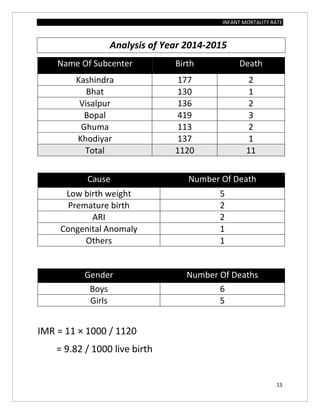
Analysis of Year 2014-2015
Name Of Subcenter Birth Death
Kashindra 177 2
Bhat 130 1
Visalpur 136 2
Bopal 419 3
Ghuma 113 2
Khodiyar 137 1
Total 1120 11
Cause Number Of Death
Low birth weight 5
Premature birth 2
ARI 2
Congenital Anomaly 1
Others 1
IMR = 11 × 1000 / 1120
= 9.82 / 1000 live birth
Gender Number Of Deaths
Boys 6
Girls 5
INFANT MORTALITY RATE
16
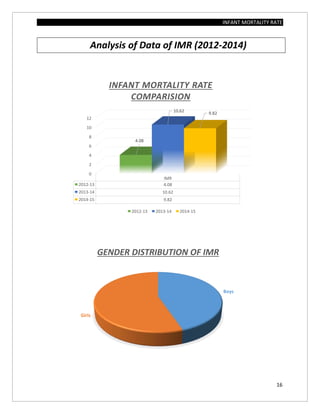
Analysis of Data of IMR (2012-2014)
0
2
4
6
8
10
12
IMR
2012-13 4.08
2013-14 10.62
2014-15 9.82
4.08
10.62 9.82
INFANT MORTALITY RATE
COMPARISION
2012-13 2013-14 2014-15
Boys
Girls
GENDER DISTRIBUTION OF IMR
INFANT MORTALITY RATE
17
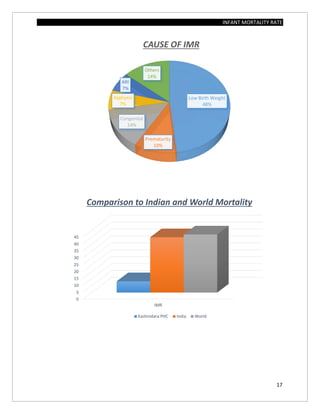
Low Birth Weight
48%
Prematurity
10%
Congenital
14%
Asphyxia
7%
ARI
7%
Others
14%
CAUSE OF IMR
0
5
10
15
20
25
30
35
40
45
IMR
Comparison to Indian and World Mortality
Kashindara PHC India World
INFANT MORTALITY RATE
18
Conclusion
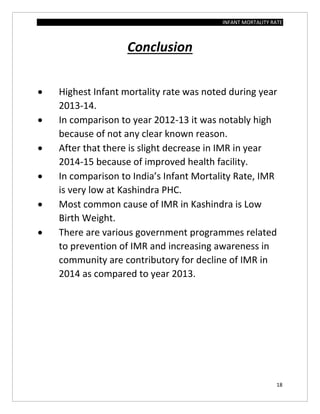
 Highest Infant mortality rate was noted during year
2013-14.
 In comparison to year 2012-13 it was notably high
because of not any clear known reason.
 After that there is slight decrease in IMR in year
2014-15 because of improved health facility.
 In comparison to India’s Infant Mortality Rate, IMR
is very low at Kashindra PHC.
 Most common cause of IMR in Kashindra is Low
Birth Weight.
 There are various government programmes related
to prevention of IMR and increasing awareness in
community are contributory for decline of IMR in
2014 as compared to year 2013.
INFANT MORTALITY RATE
19
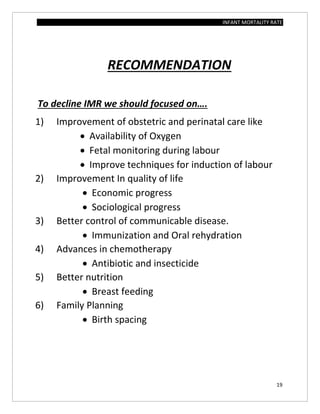
RECOMMENDATION
To decline IMR we should focused on….
1) Improvement of obstetric and perinatal care like
 Availability of Oxygen
 Fetal monitoring during labour
 Improve techniques for induction of labour
2) Improvement In quality of life
 Economic progress
 Sociological progress
3) Better control of communicable disease.
 Immunization and Oral rehydration
4) Advances in chemotherapy
 Antibiotic and insecticide
5) Better nutrition
 Breast feeding
6) Family Planning
 Birth spacing
INFANT MORTALITY RATE
20
BIBLIOGRAPHY
 Data from PHC- Kashindra
 http://data.worldbank.org/indicator/SP.DYN.IMRT.IN
 http://data.worldbank.org
 http://www.who.int/en
 http://www.whoindia/en
 http://www.webmd.com
 Park Textbook of Preventive and Social Medicine
(23rd
Edition)
 http://www.wikipidia.com
 http://www.indexmundi.com/g/g.aspx?c=in&v=29

Infant mortality rate

  • 1.
    Darshak Patel Dhruv Patel KrunalPatel Mayur Patel Project By : INFANT MORTALITY RATE INFANTINFANT MORTALITYMORTALITY RATERATE INFANT MORTALITY RATE ASSESSMENT OF IN PHC AREA OF KASHINDRA 2012-2014
  • 2.
    INFANT MORTALITY RATE 1 CERTIFICATE Thisis to certify that intern mentioned here below have satisfactorily completed study of “Assessment of IMR in PHC of Kashindra (2012-2014)” under Rural Health Training Center posting at Kashindra PHC during academic posting 2015-2016 and their performance are up to the mark. ROLL NO NAME SIGN 131 Patel Darshak B. 134 Patel Dhruv D. 138 Patel Krunal B. 140 Patel Mayur S. SIGN Dr. Hiral Rajguru Medical Officer Kashindra PHCDate:
  • 3.
    INFANT MORTALITY RATE 2 ACKNOWLEDGEMENT Wetake this opportunity to express our heartly gratitude to all those who were associated directly or indirectly with our project and helped us to make our project up to the level anticipated. We are grateful to Dr. Hiral Rajguru, Medical Officer at Kashindra PHC for providing us with appropriate guidance and all necessary information to make this project. We are also thankful to Dr. Krunal Patel, Medical Officer at Bawla PHC for providing us with opportunity and guidance to make this project. We are also thankful to the staff of Kashindra PHC and all those unmentioned for their contribution of time and efforts on this project.
  • 4.
    INFANT MORTALITY RATE 3 INDEX 1Introduction 4 2 Aims & Objectives 5 3 Material & Methology 6 4 Review Of Literature 7 5 Observation And Analysis 13 6 Conclusion 18 7 Recommendation 19 8 Bibliography 20
  • 5.
    INFANT MORTALITY RATE 4 INTRODUCTION IMRDefinition: The rate of Infant death registered in given year to the total number of live birth registered in the same year.  IMR: World – 42 per 1000 live birth (2012) India – 43 per 1000 live birth (2014) Maximum – MP & Assam (54) Minimum – Goa (09)  IMR accounts for 18% of total dates in India.
  • 6.
    INFANT MORTALITY RATE 5 AIMS& OBJECTIVES o To assess Infant mortality cases in Kashindra. o To assess various causes contributing to Infant mortality. o To find out the association of Infant mortality cases from 2012-2014. o To study the programmes undertaken by the Kashindra PHC and Government for prevention of Infant Mortality. o To study the awareness of people regarding these programme. o To counsel the unaware family.
  • 7.
    INFANT MORTALITY RATE 6 MATERIALS& METHODOLOGY o Study type : cross sectional study o Study area : Kashindra PHC o Study period : 15 days : from 1/9/2015 to 15/9/2015 o Data collection : from records of Kashindra PHC o Data analysis : Microsoft Excel
  • 8.
    INFANT MORTALITY RATE 7 REVIEWOF LITERATURE Infant mortality Rate: It is the rate of Infant death in a given year to the total number of live births registered in the same year. IMR is Indicator of  Health status of a community  Level of living  Effectiveness of MHC services in general Cause of IMR  Most common cause in India: Low birth weight Prematurity  Most common cause in World:  Pneumonia
  • 9.
    INFANT MORTALITY RATE 8 Other cause Neonatal Mortality Post neonatal Mortality 1. Low birth weight 1. Diarrheal disease 2. Prematurity 2. Acute respiratory infection 3. Birth injury 3. Malnutrition 4. Sepsis 4. Congenital anomaly 5. Congenital anomaly 5. Accidents 6. Hemolytic disease of newborn 6. Communicable disease 7. Condition of placenta and cord Infant Mortality Rate In India Year IMR 2008 32.31 2009 30.15 2010 49.13 2011 47.57 2012 46.07 2013 44.6 2014 43.19
  • 10.
    INFANT MORTALITY RATE 9 InWorld: 42 0 10 20 30 40 50 60 2005 2006 2007 2008 2009 2010 2011 2012 2013 2014 IMR PER YEAR
  • 11.
    INFANT MORTALITY RATE 10 Gujarat:41 (2011) Year IMR 2005 54 2006 53 2007 52 2008 50 2009 48 2010 44 2011 41 0 10 20 30 40 50 60 2005 2006 2007 2008 2009 2010 2011 Comparison IMR in Gujarat and India... India Gujarat
  • 12.
    INFANT MORTALITY RATE 11 Factoraffecting IMR  Biological factor  Birth weight  Age of mother  Birth order  Greatest at 1st birth and also high after 3rd birth  Multiple birth  High family size  High fertility  Economical factor  Low socioeconomical status  Cultural and social factirs  Early weaning  Bottle feeding  Religion and cast  Early marriage  Other factors  Sex of child: IMRgirl > IMRboys  Quality of mothering  Quality of health care  Maternal education  Broken family  Illegitimacy
  • 13.
    INFANT MORTALITY RATE 12 Brutal habits and customs  Untrained dai  Bad environment Preventive and social measures 1) Prenatal nutrition 2) Prevention of infection 3) Breast feeding 4) Growth monitoring 5) Family planning 6) Sanitation 7) Provisional of primary health care 8) Socio-economic development 9) Education
  • 14.
    INFANT MORTALITY RATE 13 OBSERVATIONAND ANALYSIS Analysis of YEAR 2012-2013 Name of Sub center Total Live Birth Infant Death Kashindra 201 2 Bhat 148 - Visalpur 123 3 Bopal 425 - Ghuma 134 - Khodiyar 188 - Total 1234 5 Cause Number of death Low Birth Weight 3 Congenital Anomaly 1 Cerebral Palsy 1 IMR = 5 × 1000/1234 = 4.05 / 1000 live birth Gender Number of death Boy 3 Girl 2
  • 15.
    INFANT MORTALITY RATE 14 Analysisof Year 2013-2014 Name Of Subcenter Birth Deaths Kashindra 201 3 Bhat 141 3 Visalpur 141 1 Bopal 460 3 Ghuma 116 2 Khodiyar 165 1 Total 1224 13 Cause Number Of Deaths Low birth weight 6 Congenital anomaly 2 Asphyxia 2 Prematurity 1 Others 2 Gender Number of death Boy 4 Girl 9 IMR = 13 × 1000/ 1224 = 10.62 / 1000 live birth
  • 16.
    INFANT MORTALITY RATE 15 Analysisof Year 2014-2015 Name Of Subcenter Birth Death Kashindra 177 2 Bhat 130 1 Visalpur 136 2 Bopal 419 3 Ghuma 113 2 Khodiyar 137 1 Total 1120 11 Cause Number Of Death Low birth weight 5 Premature birth 2 ARI 2 Congenital Anomaly 1 Others 1 IMR = 11 × 1000 / 1120 = 9.82 / 1000 live birth Gender Number Of Deaths Boys 6 Girls 5
  • 17.
    INFANT MORTALITY RATE 16 Analysisof Data of IMR (2012-2014) 0 2 4 6 8 10 12 IMR 2012-13 4.08 2013-14 10.62 2014-15 9.82 4.08 10.62 9.82 INFANT MORTALITY RATE COMPARISION 2012-13 2013-14 2014-15 Boys Girls GENDER DISTRIBUTION OF IMR
  • 18.
    INFANT MORTALITY RATE 17 LowBirth Weight 48% Prematurity 10% Congenital 14% Asphyxia 7% ARI 7% Others 14% CAUSE OF IMR 0 5 10 15 20 25 30 35 40 45 IMR Comparison to Indian and World Mortality Kashindara PHC India World
  • 19.
    INFANT MORTALITY RATE 18 Conclusion Highest Infant mortality rate was noted during year 2013-14.  In comparison to year 2012-13 it was notably high because of not any clear known reason.  After that there is slight decrease in IMR in year 2014-15 because of improved health facility.  In comparison to India’s Infant Mortality Rate, IMR is very low at Kashindra PHC.  Most common cause of IMR in Kashindra is Low Birth Weight.  There are various government programmes related to prevention of IMR and increasing awareness in community are contributory for decline of IMR in 2014 as compared to year 2013.
  • 20.
    INFANT MORTALITY RATE 19 RECOMMENDATION Todecline IMR we should focused on…. 1) Improvement of obstetric and perinatal care like  Availability of Oxygen  Fetal monitoring during labour  Improve techniques for induction of labour 2) Improvement In quality of life  Economic progress  Sociological progress 3) Better control of communicable disease.  Immunization and Oral rehydration 4) Advances in chemotherapy  Antibiotic and insecticide 5) Better nutrition  Breast feeding 6) Family Planning  Birth spacing
  • 21.
    INFANT MORTALITY RATE 20 BIBLIOGRAPHY Data from PHC- Kashindra  http://data.worldbank.org/indicator/SP.DYN.IMRT.IN  http://data.worldbank.org  http://www.who.int/en  http://www.whoindia/en  http://www.webmd.com  Park Textbook of Preventive and Social Medicine (23rd Edition)  http://www.wikipidia.com  http://www.indexmundi.com/g/g.aspx?c=in&v=29