A
SEMINAR REPORT
ON
SELF HEALING CONCRETE
Submitted
In partial fulfillment for the Degree of the
B.TECH
in
Civil Engineering
By
Irshad Ali Ansari
(16EJCCE042)
Mr. Teekam Singh Prof. (Dr.) Om Prakash Netula
Mentor & Asst. Prof. Head
Department of Civil Engineering Department of Civil Engineering
JAIPUR ENGINEERING COLLEGE & RESEARCH CENTRE
DEPARTMENT OF CIVIL ENGINEERING
APRIL, 2020
ii
CANDIDATE’S DECLARATION
_______________________________________________________
I hereby declare that the work, which is being presented in the seminar entitled
“SELF HEALING CONCRETE” in partial fulfillment for the award of
Degree of “Bachelor of Technology” in Dept. of Civil Engineering , and
submitted to the Department of CIVIL ENGINEERING, Jaipur Engineering
College & Research Centre, Rajasthan Technical University is a record of my
own investigations carried under the Guidance of Prof. (Dr.) Om Prakash
Netula, Head, Department of Civil Engineering, Jaipur Engineering College &
Research Centre. I have not submitted the matter presented in this report
anywhere for the award of any other Degree.
Irshad Ali Ansari
(16EJCCE042)
iii
Jaipur Engineering College & Research Centre
Department of Civil Engineering
Session-2019-20
Certificate
This is to certify that Irshad Ali Ansari student of VIII Semester, B.Tech
(Civil Engineering) 2019-20, has presented a seminar report titled “SELF
HEALING CONCRETE” in partial fulfillment for the award of the degree of
Bachelor of Technology at Jaipur Engineering College and Research Centre,
Jaipur under Rajasthan Technical University, Kota.
Date:
Mr. Teekam Singh Prof. (Dr.) Om Prakash Netula
Mentor & Asst. Prof. Head
Department of Civil Engineering Department of Civil Engineering
iv
ACKNOWLEDGEMENT
The satisfaction and euphoria that accompany the successful completion of any
work will be incomplete unless we mention the names of those people who
made it possible, whose valuable guidance and encouragement served as a
beacon light and crowned the efforts with success.
I take this opportunity to thank our Principal Prof. (Dr.) V.K.Chandna for
assigning this seminar as a part of the curriculum.
In the beginning of the report I want to give my thanks to Prof. (Dr.) Om
Prakash Netula ,Head, Department of Civil Engineering JECRC for all the
encouragement and appreciations that I have received from them.
I would like to express my gratitude towards my esteemed faculty Mr.Teekam
Singh, Assistant Professor, Department of Civil Engineering,JECRC for
being more than willing to share their treasure of knowledge with me.
I would like to express my gratitude toward my all esteemed Faculties and
Staff Members of Department of Civil Engineering, JECRC for being more
than willing to impound their treasure of knowledge with me.
Once again, I am also thankful to people who were the part of this work in
various way direct or indirect, people who gave unending support from the
beginning.
Irshad Ali Ansari
(16EJCCE042)
v
ABSTRACT
Concrete is an extensively used building material used for construction works. It is
well known that one of the weaknesses of concrete is its vulnerability to cracking.
Cracks may occur when concrete is in a plastic state or after it has completely
hardened. Micro cracks in concrete also affect durability by allowing ingress of
corrosive substances into the concrete matrix, which lead to corrosion of steel and
loss in tensile strength. Such occurrence may lead to more adverse problems such as
SPALLING and even premature structural failure. Repair and maintenance of
concrete structures are labour and capital intensive. It is difficult to access the degree
of damage after the construction is completed. Self-healing is a possible solution.
There are many approaches of self-healing such as Autogenous and Autonomous
Self-Healing. Bacteria-induced mineral precipitation is an environmentally friendly
technology to enhance the self-healing ability of concrete cracks. The objective of
this paper was to report the effects of bacteria-based additives on the properties of
concrete such as compressive strength, split tensile strength and flexural strength
and a clear comparison can be made for strengths of different specimens of bio
concrete using different bacteria and conventional concrete. Moreover, the water
permeability and chloride penetration resistance properties of concrete specimens
were investigated. Self-healing is also confirmed by SEM photographs and XRD
analysis.
vi
CONTENTS
Candidate’s Declaration ii
Certificate iii
Acknowledgements iv
Abstract v
Contents vi
1. CHAPTER 1 : INTRODUCTION 1-2
1.1 Approches To Self Healing 1
1.2 Suitability Of Self Healing In India 2
2. CHAPTER 2 : MECHANISM OF BIO-CONCRETE 3-4
2.1 Advantages And Disadvantages Of Bio Concrete 4
2.1.1 Advantages 4
2.1.2 Disadvantages 4
3. CHAPTER 3 : MECHANICAL PROPERTIES OF CONCRETE 5-6
4. CHAPTER 4 : DURABILITY PROPERTIES OF CONCRETE 7
CONCLUSION 8
REFERENCES 9
1
CHAPTER 1
INTRODUCTION
Concrete, an extensively used material in construction work, is also a major contributor to
depletion of natural resource and environmental pollution through the production of its major
component-cement. It is strong enough to resist compressive load but prone to cracking due
to weak in tension which ultimately reduce the life of structure. Hence, any effort to improve
the life span of structure will indirectly improve the sustainability of the environment. Cracks
in concrete lead to ingress of chemicals in to concrete structure resulting in lower strength
and durability. To increase the durability of the structure either cracks are repaired which is
expensive or provide extra reinforcement to ensure the cracks width stays within certain limit.
Only for durability reason, this extra steel is not desirable. One way to increase the durability
of structure and reduce such extra cost is to use self-healing concrete. Self- healing of
concrete is any process by the material itself involving the recovery and hence improvement
of performance after an earlier action that had reduce the performance of material. In general,
there are two main approach of self-healing are Autogenous and autonomous self-healing.
1.1 Approaches to Self-Healing
Autogenous self-healing depend on the composition of concrete and is unblemished by
hydration reaction of cementitious products within the concrete matrix. In most of the
conventional concrete matrix, 15-25% of the cement is left un-hydrated. If cracking of the
concrete occurs, un-hydrated cement grains may exposed to moisture penetrating the crack.
In that case the hydration process may start again ad hydration products may fill up and heal
the crack. This inherent self-healing mechanism is known since long and known as
autogenous healing. It is primarily effective for very narrow cracks, but unable to heal wide
cracks. It is more effective in fresh concrete as constant supply of water is required.
Autonomous self-healing depicts the induction of engineered unorthodox supplements into
the concrete matrix to enhance the self-healing ability. Bacteria spores are incorporated to
intermediate the self-healing by precipitation of calcium carbonate but they did not survive
for a long time due to alkaline medium and shrinkage of pores. Furthermore bacterial spores
are capsulated and incorporated in concrete leads to increase in lifespan of bacterial healing
agent. It can heal up to crack width of 0.5 mm. When rainwater or atmospheric moisture
seeping into cracks, the inactive bacteria become active. They reproduce and germinate in the
calcium lactate and combine with carbonate ions to form insoluble calcium carbonate which
2
fills the cracks.
1.2 Suitability of self-healing concrete in India
The climate of India is diverse from region to region due to its topography and having a wide
range of change in temperature from mountains, plains, forests to beaches. Many cities like
New Delhi, Patna, Lucknow, Jalandhar etc. encountering temperature changes from very
warm climate in April to mid-June to very cold climate between November and February.
Extreme climate can deteriorate and tend to cracks in concrete structure which may
ultimately reduce the life span of structure. Bio concrete may be the best alternative to resist
these extreme climatic conditions. In India like developing concrete, infrastructure
development can play a vital role so bio concrete can be used in construction work. Bacterial
induced concrete is environmental friendly carbonate precipitation self-healing technique and
it is highly desirable in underground and offshore structure etc. where minute crack is
detrimental. Apart from this bio concrete can be used for constructing irrigation structure.
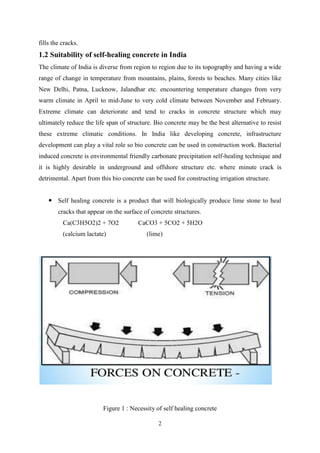
 Self healing concrete is a product that will biologically produce lime stone to heal
cracks that appear on the surface of concrete structures.
Ca(C3H5O2)2 + 7O2 CaCO3 + 5CO2 + 5H2O
(calcium lactate) (lime)
Figure 1 : Necessity of self healing concrete
3
CHAPTER 2
MECHANISM OF SELF-HEALING
The process of using microbes in bio concrete is known as Microbial Induced Calcium
Carbonate Precipitation (MICCP) or Bio-mineralization. After activation, bacteria undergo
some metabolic process such as sulphate reduction, photosynthesis and urea hydrolysis
results in calcium carbonate as their by product. Various bacteria can precipitate calcium
carbonate such as -Bacillus Pasteurii, Bacillus Subtilis, Bacillus Sphaericus, Bacillus Cohnii,
Bacillus Pseudofirmus, Bacillus Halodurans etc. in both normal and laboratory conditions.
Precipitation is mainly governed by pH value, Calcium concentration, DIC (Dissolved
Inorganic Carbon) concentration, Nucleation sites. For accomplishment of self-healing
phenomenon, it is most important that the bacteria should be able to convert the organic
nutrients into insoluble inorganic calcite crystal which fills the cracks. Self-healing agent
consists of bacteria which act as catalyst and calcium calcite that will converted into calcium
carbonate.
BACTERIA USED IN SHC
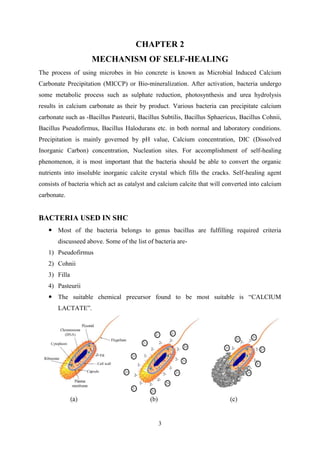
 Most of the bacteria belongs to genus bacillus are fulfilling required criteria
discusseed above. Some of the list of bacteria are-
1) Pseudofirmus
2) Cohnii
3) Filla
4) Pasteurii
 The suitable chemical precursor found to be most suitable is “CALCIUM
LACTATE”.
4
2.1 ADVANTAGES AND DISADVANTAGES OF BIO CONCRETE :
2.1.1 Advantages
a) The use of bio concrete significantly influences the strength of concrete.
b) It has lower permeability than conventional concrete.
c) It offers great resistance to freeze-thaw attacks.
d) Remedying of cracks can be done efficiently.
e) The chances of corrosion in reinforcement are reduced.
f) Maintenance cost of this concrete is low.
2.1.2 Disadvantages
a) Design of bacterial concrete is not mentioned in IS codes or any other codes.
b) Cost of this concrete is comparatively higher than conventional concrete i.e. about 7-
28% more than conventional concrete.
c) The investigations involved in calcite precipitation are costly.
d) Bacteria that grow in concrete are not good for human health and atmosphere and
hence its usage should be limited to the structure.
5
CHAPTER 3
MECHANICAL PROPERTIES OF CONCRETE
Different type of bacteria is embedded in to concrete matrix to analyse the effectiveness of
self-healing phenomenon of concrete. Different mechanical properties test have been carried
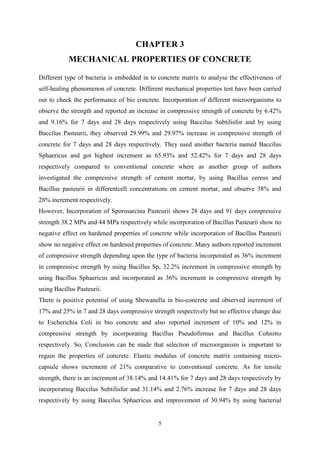
out to check the performance of bio concrete. Incorporation of different microorganisms to
observe the strength and reported an increase in compressive strength of concrete by 6.42%
and 9.16% for 7 days and 28 days respectively using Baccilus Subtilisfor and by using
Baccilus Pasteurii, they observed 29.99% and 29.97% increase in compressive strength of
concrete for 7 days and 28 days respectively. They used another bacteria named Baccilus
Sphaericus and got highest increment as 65.93% and 52.42% for 7 days and 28 days
respectively compared to conventional concrete where as another group of authors
investigated the compressive strength of cement mortar, by using Bacillus cereus and
Bacillus pasteurii in differentcell concentrations on cement mortar, and observe 38% and
28% increment respectively.
However, Incorporation of Sporosarcina Pasteurii shows 28 days and 91 days compressive
strength 38.2 MPa and 44 MPa respectively while incorporation of Bacillus Pasteurii show no
negative effect on hardened properties of concrete while incorporation of Bacillus Pasteurii
show no negative effect on hardened properties of concrete. Many authors reported increment
of compressive strength depending upon the type of bacteria incorporated as 36% increment
in compressive strength by using Bacillus Sp, 32.2% increment in compressive strength by
using Bacillus Sphaericus and incorporated as 36% increment in compressive strength by
using Bacillus Pasteurii.
There is positive potential of using Shewanella in bio-concrete and observed increment of
17% and 25% in 7 and 28 days compressive strength respectively but no effective change due
to Escherichia Coli in bio concrete and also reported increment of 10% and 12% in
compressive strength by incorporating Bacillus Pseudofirmus and Bacillus Cohnitto
respectively. So, Conclusion can be made that selection of microorganism is important to
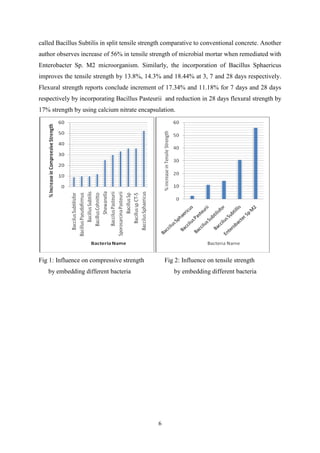
regain the properties of concrete. Elastic modulus of concrete matrix containing micro-
capsule shows increment of 21% comparative to conventional concrete. As for tensile
strength, there is an increment of 38.14% and 14.41% for 7 days and 28 days respectively by
incorporating Baccilus Subtilisfor and 31.14% and 2.76% increase for 7 days and 28 days
respectively by using Baccilus Sphaericus and improvement of 30.94% by using bacterial
6
called Bacillus Subtilis in split tensile strength comparative to conventional concrete. Another
author observes increase of 56% in tensile strength of microbial mortar when remediated with
Enterobacter Sp. M2 microorganism. Similarly, the incorporation of Bacillus Sphaericus
improves the tensile strength by 13.8%, 14.3% and 18.44% at 3, 7 and 28 days respectively.
Flexural strength reports conclude increment of 17.34% and 11.18% for 7 days and 28 days
respectively by incorporating Bacillus Pasteurii and reduction in 28 days flexural strength by
17% strength by using calcium nitrate encapsulation.
Fig 1: Influence on compressive strength Fig 2: Influence on tensile strength
by embedding different bacteria by embedding different bacteria
7
CHAPTER 4
DURABILITY PROPERTIES OF CONCRETE
As for durability concern, water permeability and chloride penetration reduces by bio-
remediating the concrete by incorporating Bacillus Cereus and Bacillus Pasteurii compared to
control mix. There is reduction in water absorption and porosity by incorporating Bacillus
Halodurans Strain KG1 in the concrete mix by 205 and 12.4% at 91 days respectively and
also increase in resistance against penetration of water and hazard material and as max as
40% decrease in water absorption after 28 days bio remediation. By incorporation of Baccilus
Sphaericus, concrete matrix performed better against permeability due to bio deposition. Bio
remediated concrete shows better resistance against chloride penetration compared to control
specimen which is effective in reducing the rate of corrosion of reinforcement. Due to
densification of interfacial transition zone in sporosarcina pasteurii treated concrete matrix
show better resistance against water permeability compared to controlled specimen. Another
article reported the effect of Bacillus pasteurii on water absorption, porosity and chloride
permeability on concrete matrix and found that there is decrease in permeability and porosity
of the concrete and addition of bacteria in mix reduces the capillary absorption capacity of
concrete by an average of 20% compared to control mix. Crack width is reduced by 48% and
63% at 14 and 28 days respectively compared to control mix.
8
CONCLUSIONS
From the experiments reported herein, the following conclusions may be made:
1. Self-healing of concrete yielded by using natural method and is environmentally friendly.
It was done for improving the lifespan of concrete structure which indirectly improvise the
sustainability of environment.
2. Effectiveness of crack repairing and regaining of lost strength is also depend on
microorganism embedded in concrete matrix.
3. Mechanical properties also improve by incorporating bacteria as long term compressive
and tensile strength increases depending on bacteria embedded.
4. Durability properties of concrete improve by incorporating bacteria as concrete perform
better against water permeability, chloride ingression and water absorption.
5. SEM and XRD analysis confirms the precipitation of calcium carbonate which densifies
the concrete matrix and ultimately improve the strength of concrete.
9
REFERENCES
1) ACHAL V & MUKHERJEE A, (2015) A review of microbial precipitation for
sustainable construction. Construction and Building Materials 93:1224-1235.
2) DE KOSTER S. A. L, MORS R M, NUGTEREN H W, JONKERS H M.,
MEESTERS G M H, VAN OMMEN J R, (2015) Geopolymer Coating of Bacteria-
containing Granules for Use in Self-healing Concrete. Procedia Engineering 102:475-
484.
3) HUANG H YE G, QIAN C, SCHLANGEN E. (2016) Self-healing in cementitious
materials: Materials, methods and service conditions. Materials & Design 92:499-511.
4) JONKERS H M. (2007), Self-healing concrete: A biological approach, Self-healing
materials, Springer, Netherlands, 195–204.
5) KAVIA K, HEMA C, Dressing of structural cracks using Bio Concrete. Indian
Journal of Science and Technology. 2015 Nov; 8(32):1–4.
6) KUNAL, SIDDIQUE R, RAJOR, A (2014), Influence of bacterial treated cement kiln
dust on the properties of concrete, Construction and Building Materials 52:42-51.

Self healing concrete

  • 1.
    A SEMINAR REPORT ON SELF HEALINGCONCRETE Submitted In partial fulfillment for the Degree of the B.TECH in Civil Engineering By Irshad Ali Ansari (16EJCCE042) Mr. Teekam Singh Prof. (Dr.) Om Prakash Netula Mentor & Asst. Prof. Head Department of Civil Engineering Department of Civil Engineering JAIPUR ENGINEERING COLLEGE & RESEARCH CENTRE DEPARTMENT OF CIVIL ENGINEERING APRIL, 2020
  • 2.
    ii CANDIDATE’S DECLARATION _______________________________________________________ I herebydeclare that the work, which is being presented in the seminar entitled “SELF HEALING CONCRETE” in partial fulfillment for the award of Degree of “Bachelor of Technology” in Dept. of Civil Engineering , and submitted to the Department of CIVIL ENGINEERING, Jaipur Engineering College & Research Centre, Rajasthan Technical University is a record of my own investigations carried under the Guidance of Prof. (Dr.) Om Prakash Netula, Head, Department of Civil Engineering, Jaipur Engineering College & Research Centre. I have not submitted the matter presented in this report anywhere for the award of any other Degree. Irshad Ali Ansari (16EJCCE042)
  • 3.
    iii Jaipur Engineering College& Research Centre Department of Civil Engineering Session-2019-20 Certificate This is to certify that Irshad Ali Ansari student of VIII Semester, B.Tech (Civil Engineering) 2019-20, has presented a seminar report titled “SELF HEALING CONCRETE” in partial fulfillment for the award of the degree of Bachelor of Technology at Jaipur Engineering College and Research Centre, Jaipur under Rajasthan Technical University, Kota. Date: Mr. Teekam Singh Prof. (Dr.) Om Prakash Netula Mentor & Asst. Prof. Head Department of Civil Engineering Department of Civil Engineering
  • 4.
    iv ACKNOWLEDGEMENT The satisfaction andeuphoria that accompany the successful completion of any work will be incomplete unless we mention the names of those people who made it possible, whose valuable guidance and encouragement served as a beacon light and crowned the efforts with success. I take this opportunity to thank our Principal Prof. (Dr.) V.K.Chandna for assigning this seminar as a part of the curriculum. In the beginning of the report I want to give my thanks to Prof. (Dr.) Om Prakash Netula ,Head, Department of Civil Engineering JECRC for all the encouragement and appreciations that I have received from them. I would like to express my gratitude towards my esteemed faculty Mr.Teekam Singh, Assistant Professor, Department of Civil Engineering,JECRC for being more than willing to share their treasure of knowledge with me. I would like to express my gratitude toward my all esteemed Faculties and Staff Members of Department of Civil Engineering, JECRC for being more than willing to impound their treasure of knowledge with me. Once again, I am also thankful to people who were the part of this work in various way direct or indirect, people who gave unending support from the beginning. Irshad Ali Ansari (16EJCCE042)
  • 5.
    v ABSTRACT Concrete is anextensively used building material used for construction works. It is well known that one of the weaknesses of concrete is its vulnerability to cracking. Cracks may occur when concrete is in a plastic state or after it has completely hardened. Micro cracks in concrete also affect durability by allowing ingress of corrosive substances into the concrete matrix, which lead to corrosion of steel and loss in tensile strength. Such occurrence may lead to more adverse problems such as SPALLING and even premature structural failure. Repair and maintenance of concrete structures are labour and capital intensive. It is difficult to access the degree of damage after the construction is completed. Self-healing is a possible solution. There are many approaches of self-healing such as Autogenous and Autonomous Self-Healing. Bacteria-induced mineral precipitation is an environmentally friendly technology to enhance the self-healing ability of concrete cracks. The objective of this paper was to report the effects of bacteria-based additives on the properties of concrete such as compressive strength, split tensile strength and flexural strength and a clear comparison can be made for strengths of different specimens of bio concrete using different bacteria and conventional concrete. Moreover, the water permeability and chloride penetration resistance properties of concrete specimens were investigated. Self-healing is also confirmed by SEM photographs and XRD analysis.
  • 6.
    vi CONTENTS Candidate’s Declaration ii Certificateiii Acknowledgements iv Abstract v Contents vi 1. CHAPTER 1 : INTRODUCTION 1-2 1.1 Approches To Self Healing 1 1.2 Suitability Of Self Healing In India 2 2. CHAPTER 2 : MECHANISM OF BIO-CONCRETE 3-4 2.1 Advantages And Disadvantages Of Bio Concrete 4 2.1.1 Advantages 4 2.1.2 Disadvantages 4 3. CHAPTER 3 : MECHANICAL PROPERTIES OF CONCRETE 5-6 4. CHAPTER 4 : DURABILITY PROPERTIES OF CONCRETE 7 CONCLUSION 8 REFERENCES 9
  • 7.
    1 CHAPTER 1 INTRODUCTION Concrete, anextensively used material in construction work, is also a major contributor to depletion of natural resource and environmental pollution through the production of its major component-cement. It is strong enough to resist compressive load but prone to cracking due to weak in tension which ultimately reduce the life of structure. Hence, any effort to improve the life span of structure will indirectly improve the sustainability of the environment. Cracks in concrete lead to ingress of chemicals in to concrete structure resulting in lower strength and durability. To increase the durability of the structure either cracks are repaired which is expensive or provide extra reinforcement to ensure the cracks width stays within certain limit. Only for durability reason, this extra steel is not desirable. One way to increase the durability of structure and reduce such extra cost is to use self-healing concrete. Self- healing of concrete is any process by the material itself involving the recovery and hence improvement of performance after an earlier action that had reduce the performance of material. In general, there are two main approach of self-healing are Autogenous and autonomous self-healing. 1.1 Approaches to Self-Healing Autogenous self-healing depend on the composition of concrete and is unblemished by hydration reaction of cementitious products within the concrete matrix. In most of the conventional concrete matrix, 15-25% of the cement is left un-hydrated. If cracking of the concrete occurs, un-hydrated cement grains may exposed to moisture penetrating the crack. In that case the hydration process may start again ad hydration products may fill up and heal the crack. This inherent self-healing mechanism is known since long and known as autogenous healing. It is primarily effective for very narrow cracks, but unable to heal wide cracks. It is more effective in fresh concrete as constant supply of water is required. Autonomous self-healing depicts the induction of engineered unorthodox supplements into the concrete matrix to enhance the self-healing ability. Bacteria spores are incorporated to intermediate the self-healing by precipitation of calcium carbonate but they did not survive for a long time due to alkaline medium and shrinkage of pores. Furthermore bacterial spores are capsulated and incorporated in concrete leads to increase in lifespan of bacterial healing agent. It can heal up to crack width of 0.5 mm. When rainwater or atmospheric moisture seeping into cracks, the inactive bacteria become active. They reproduce and germinate in the calcium lactate and combine with carbonate ions to form insoluble calcium carbonate which
  • 8.
    2 fills the cracks. 1.2Suitability of self-healing concrete in India The climate of India is diverse from region to region due to its topography and having a wide range of change in temperature from mountains, plains, forests to beaches. Many cities like New Delhi, Patna, Lucknow, Jalandhar etc. encountering temperature changes from very warm climate in April to mid-June to very cold climate between November and February. Extreme climate can deteriorate and tend to cracks in concrete structure which may ultimately reduce the life span of structure. Bio concrete may be the best alternative to resist these extreme climatic conditions. In India like developing concrete, infrastructure development can play a vital role so bio concrete can be used in construction work. Bacterial induced concrete is environmental friendly carbonate precipitation self-healing technique and it is highly desirable in underground and offshore structure etc. where minute crack is detrimental. Apart from this bio concrete can be used for constructing irrigation structure.  Self healing concrete is a product that will biologically produce lime stone to heal cracks that appear on the surface of concrete structures. Ca(C3H5O2)2 + 7O2 CaCO3 + 5CO2 + 5H2O (calcium lactate) (lime) Figure 1 : Necessity of self healing concrete
  • 9.
    3 CHAPTER 2 MECHANISM OFSELF-HEALING The process of using microbes in bio concrete is known as Microbial Induced Calcium Carbonate Precipitation (MICCP) or Bio-mineralization. After activation, bacteria undergo some metabolic process such as sulphate reduction, photosynthesis and urea hydrolysis results in calcium carbonate as their by product. Various bacteria can precipitate calcium carbonate such as -Bacillus Pasteurii, Bacillus Subtilis, Bacillus Sphaericus, Bacillus Cohnii, Bacillus Pseudofirmus, Bacillus Halodurans etc. in both normal and laboratory conditions. Precipitation is mainly governed by pH value, Calcium concentration, DIC (Dissolved Inorganic Carbon) concentration, Nucleation sites. For accomplishment of self-healing phenomenon, it is most important that the bacteria should be able to convert the organic nutrients into insoluble inorganic calcite crystal which fills the cracks. Self-healing agent consists of bacteria which act as catalyst and calcium calcite that will converted into calcium carbonate. BACTERIA USED IN SHC  Most of the bacteria belongs to genus bacillus are fulfilling required criteria discusseed above. Some of the list of bacteria are- 1) Pseudofirmus 2) Cohnii 3) Filla 4) Pasteurii  The suitable chemical precursor found to be most suitable is “CALCIUM LACTATE”.
  • 10.
    4 2.1 ADVANTAGES ANDDISADVANTAGES OF BIO CONCRETE : 2.1.1 Advantages a) The use of bio concrete significantly influences the strength of concrete. b) It has lower permeability than conventional concrete. c) It offers great resistance to freeze-thaw attacks. d) Remedying of cracks can be done efficiently. e) The chances of corrosion in reinforcement are reduced. f) Maintenance cost of this concrete is low. 2.1.2 Disadvantages a) Design of bacterial concrete is not mentioned in IS codes or any other codes. b) Cost of this concrete is comparatively higher than conventional concrete i.e. about 7- 28% more than conventional concrete. c) The investigations involved in calcite precipitation are costly. d) Bacteria that grow in concrete are not good for human health and atmosphere and hence its usage should be limited to the structure.
  • 11.
    5 CHAPTER 3 MECHANICAL PROPERTIESOF CONCRETE Different type of bacteria is embedded in to concrete matrix to analyse the effectiveness of self-healing phenomenon of concrete. Different mechanical properties test have been carried out to check the performance of bio concrete. Incorporation of different microorganisms to observe the strength and reported an increase in compressive strength of concrete by 6.42% and 9.16% for 7 days and 28 days respectively using Baccilus Subtilisfor and by using Baccilus Pasteurii, they observed 29.99% and 29.97% increase in compressive strength of concrete for 7 days and 28 days respectively. They used another bacteria named Baccilus Sphaericus and got highest increment as 65.93% and 52.42% for 7 days and 28 days respectively compared to conventional concrete where as another group of authors investigated the compressive strength of cement mortar, by using Bacillus cereus and Bacillus pasteurii in differentcell concentrations on cement mortar, and observe 38% and 28% increment respectively. However, Incorporation of Sporosarcina Pasteurii shows 28 days and 91 days compressive strength 38.2 MPa and 44 MPa respectively while incorporation of Bacillus Pasteurii show no negative effect on hardened properties of concrete while incorporation of Bacillus Pasteurii show no negative effect on hardened properties of concrete. Many authors reported increment of compressive strength depending upon the type of bacteria incorporated as 36% increment in compressive strength by using Bacillus Sp, 32.2% increment in compressive strength by using Bacillus Sphaericus and incorporated as 36% increment in compressive strength by using Bacillus Pasteurii. There is positive potential of using Shewanella in bio-concrete and observed increment of 17% and 25% in 7 and 28 days compressive strength respectively but no effective change due to Escherichia Coli in bio concrete and also reported increment of 10% and 12% in compressive strength by incorporating Bacillus Pseudofirmus and Bacillus Cohnitto respectively. So, Conclusion can be made that selection of microorganism is important to regain the properties of concrete. Elastic modulus of concrete matrix containing micro- capsule shows increment of 21% comparative to conventional concrete. As for tensile strength, there is an increment of 38.14% and 14.41% for 7 days and 28 days respectively by incorporating Baccilus Subtilisfor and 31.14% and 2.76% increase for 7 days and 28 days respectively by using Baccilus Sphaericus and improvement of 30.94% by using bacterial
  • 12.
    6 called Bacillus Subtilisin split tensile strength comparative to conventional concrete. Another author observes increase of 56% in tensile strength of microbial mortar when remediated with Enterobacter Sp. M2 microorganism. Similarly, the incorporation of Bacillus Sphaericus improves the tensile strength by 13.8%, 14.3% and 18.44% at 3, 7 and 28 days respectively. Flexural strength reports conclude increment of 17.34% and 11.18% for 7 days and 28 days respectively by incorporating Bacillus Pasteurii and reduction in 28 days flexural strength by 17% strength by using calcium nitrate encapsulation. Fig 1: Influence on compressive strength Fig 2: Influence on tensile strength by embedding different bacteria by embedding different bacteria
  • 13.
    7 CHAPTER 4 DURABILITY PROPERTIESOF CONCRETE As for durability concern, water permeability and chloride penetration reduces by bio- remediating the concrete by incorporating Bacillus Cereus and Bacillus Pasteurii compared to control mix. There is reduction in water absorption and porosity by incorporating Bacillus Halodurans Strain KG1 in the concrete mix by 205 and 12.4% at 91 days respectively and also increase in resistance against penetration of water and hazard material and as max as 40% decrease in water absorption after 28 days bio remediation. By incorporation of Baccilus Sphaericus, concrete matrix performed better against permeability due to bio deposition. Bio remediated concrete shows better resistance against chloride penetration compared to control specimen which is effective in reducing the rate of corrosion of reinforcement. Due to densification of interfacial transition zone in sporosarcina pasteurii treated concrete matrix show better resistance against water permeability compared to controlled specimen. Another article reported the effect of Bacillus pasteurii on water absorption, porosity and chloride permeability on concrete matrix and found that there is decrease in permeability and porosity of the concrete and addition of bacteria in mix reduces the capillary absorption capacity of concrete by an average of 20% compared to control mix. Crack width is reduced by 48% and 63% at 14 and 28 days respectively compared to control mix.
  • 14.
    8 CONCLUSIONS From the experimentsreported herein, the following conclusions may be made: 1. Self-healing of concrete yielded by using natural method and is environmentally friendly. It was done for improving the lifespan of concrete structure which indirectly improvise the sustainability of environment. 2. Effectiveness of crack repairing and regaining of lost strength is also depend on microorganism embedded in concrete matrix. 3. Mechanical properties also improve by incorporating bacteria as long term compressive and tensile strength increases depending on bacteria embedded. 4. Durability properties of concrete improve by incorporating bacteria as concrete perform better against water permeability, chloride ingression and water absorption. 5. SEM and XRD analysis confirms the precipitation of calcium carbonate which densifies the concrete matrix and ultimately improve the strength of concrete.
  • 15.
    9 REFERENCES 1) ACHAL V& MUKHERJEE A, (2015) A review of microbial precipitation for sustainable construction. Construction and Building Materials 93:1224-1235. 2) DE KOSTER S. A. L, MORS R M, NUGTEREN H W, JONKERS H M., MEESTERS G M H, VAN OMMEN J R, (2015) Geopolymer Coating of Bacteria- containing Granules for Use in Self-healing Concrete. Procedia Engineering 102:475- 484. 3) HUANG H YE G, QIAN C, SCHLANGEN E. (2016) Self-healing in cementitious materials: Materials, methods and service conditions. Materials & Design 92:499-511. 4) JONKERS H M. (2007), Self-healing concrete: A biological approach, Self-healing materials, Springer, Netherlands, 195–204. 5) KAVIA K, HEMA C, Dressing of structural cracks using Bio Concrete. Indian Journal of Science and Technology. 2015 Nov; 8(32):1–4. 6) KUNAL, SIDDIQUE R, RAJOR, A (2014), Influence of bacterial treated cement kiln dust on the properties of concrete, Construction and Building Materials 52:42-51.