A
Major Project
Report
On
A CASE STUDY ON
MULTI FLOW DRAINAGE SYSTEM
Submitted
In
Partial fulfillment for the Degree of
B. Tech
In
Civil Engineering
Name of Project Coordinator Submitted By
Mr. Teekam Singh AdityaKumpawat 16EJCCE007
Assistant Professor AnujBohra 16EJCCE015
DevanshuVerma 16EJCCE024
Name of Guide Irshad Ali Ansari 16EJCCE042
Mr. Narendra Sipani KamleshChoudhary 16EJCCE045
Assistant professor MayankKhatri 16EJCCE058
JAIPUR ENGINEERING COLLEGE & RESEARCH CENTRE
DEPARTMENT OF CIVIL ENGINEERING
APRIL, 2020
ii
Jaipur Engineering College & Research Centre
Department of Civil Engineering
Session-2019-20
Certificate
This is to certify that the project report entitled “MULTI FLOW DRAINAGE SYSTEM”,
submitted by Aditya Kumpawat (16EJCCE007), Anuj Bohra (16EJCCE015),
Devanshu Verma (16EJCCE024), Irshad Ali Ansari (16EJCCE042),
Kamlesh Choudhary (16EJCCE045) and Mayank Khatri (16EJCCE058) to the Jaipur
Engineering College & Research Centre Jaipur in partial fulfillment for the award of the
degree of B. Tech in Civil Engineering is of project work carried out by him under my
supervision. The contents of this report, in full or in parts, have not been submitted to any
other Institution or University for the award of any degree.
Mr. Narendra Sipani Prof. (Dr.) Om Prakash Netula
Supervisor & Coordinator Head
Department Of Civil Engineering Department Of Civil Engineering
Counter signature of HOD with seal
iii
DECLARATION
I declare that this project report titled “MULTI FLOW DRAINAGE SYSTEM”
submitted in partial fulfillment of the degree of B. Tech in Civil Engineering is a record
of original work carried out by maunder the supervision of Mr. NARENDRA SIPANI,
and has not formed the basis for the award of any other degree or diploma, in this or any
other Institution or University. In keeping with the ethical practice in reporting scientific
information, due acknowledgements have been made wherever the findings of others have
been cited.
Aditya Kumpawat 16EJCCE007
Anuj Bohra 16EJCCE015
DevanshuVerma 16EJCCE024
Irshad Ali Ansari 16EJCCE042
Kamlesh Choudhary 16EJCCE045
Mayank Khatri 16EJCCE058
APRIL 24, 2020
iv
ACKNOWLEDGMENTS
The satisfaction and euphoria that accompany the successful completion of any work will be
incomplete unless we mention the names of those people who made it possible, whose
valuable guidance and encouragement served as a beacon light and crowned the efforts with
success.
I take this opportunity to thank Dr V.K. Chandna Principal JECRC Jaipur, Thomas Kurien,
Dean –Students Activities, for assigning this project work as a part of the curriculum.
In the beginning of the report I want to give my thanks to Prof. (Dr.) Om Prakash Netula
,Head, Department of Civil Engineering, JECRC for all the encouragement and
appreciations that I have received from them.
I would like to express my gratitude towards my respected Project Co-ordinator Mr. Teekam
Singh (Assistant Professor, Department Of Civil Engineering) and Project Guide Mr.
Narendra Sipani (Assistant Professor, Department Of Civil Engineering) Jaipur Engineering
College and Research Centre, Sitapura, Jaipur. I am very thankful to sir and grateful to have
an opportunity to work under his supervision which provided me with his generous guidance,
valuable help and endless encouragement by taking personal interest and attention. No words
can fully convey my feeling of respect and regards for him.
I would like to express my gratitude toward my all esteemed Faculties and Staff Members
of Department of Civil Engineering, JECRC for being more than willing to impound their
treasure of knowledge with me.
Once again, I am also thankful to people who were the part of this work in various way
direct or indirect, people who gave unending support from the beginning.
v
ABSTRACT
A scientific drainage system to catch the storm water is a long term need of the society,
particularly incites. Urbanization along with its impermeable structures is one of the major
causes of flooding in urban areas. The rainfall intensity and characteristics of catchment area
are the major factors for designing urban storm water drainage facilities. These facilitates
have a paramount advantage to safely dispose the generated floods to receiving system. Many
cities lack in providing proper drainage system. The present model utilizes the rainfall in
design storm water drainage system.
Multi-Flow drainage systems serve exceptionally well in a wide variety of civil projects. It is
used beneficially in landfill sites, mine and leach pile settings, de-saturation projects, rail
lines, railroad yards, storage lagoons, earthen dams, and in decontamination processes.
Multi-Flow provides a very efficient means for removing excess water from saturated soils.
Whether the goal is to collect contaminated water in order to protect the ground water or
surrounding streams or if it is to collect scarce water for use in recreation or irrigation, Multi-
Flow offers unique advantages. Multi-Flow is well suited for these applications due to its
compressive strength and resistance to almost all known chemicals and corrosives.
vi
CONTENTS
DESCRIPTION PAGE NO.
Certificate ii
Declaration iii
Acknowledgements iv
Abstract v
Contents vi
List of Figures viii
1. INTRODUCTION 1
1.1 Effectiveness 1
1.1.1Water Collection 1
1.1.2 Water transport 2
1.2 Convenience 2
1.2.1 Shape 2
1.2.2 Connectors 3
1.2.3 Flexibility 3
1.3 Durability Strength 3
1.3.1 Longevity 4
1.4 Affordability 4
2. LITERATURE REVIEW 5
2.1 Problem Of Poor Drainage System 5
2.1.1 Drainage Problem of Road 5
2.1.2 Drainage Problem in Field 6
2.2 Multi Flow Drainage System 6
3. PIPES USED IN MULTI FLOW 8
3.1 6-Inch Connector 8
3.1.1 Basic Connectors 8
3.1.2 Multi-Purpose Connectors 10
vii
4. INSTALLATION OF SYSTEM 11
4.1 Natural Turf 11
4.1.1 Trenching 11
4.1.2 Layout pattern 11
4.1.2.1 Crowned or sloped fields 11
4.1.2.2 Flat or irregular fields 12
4.1.3 Coverage 12
4.1.4 Collector line spacing 12
4.1.5 Transport system 13
4.1.6. Backfilling 14
4.2 Synthetic turf 14
4.2.1 No trenching required 14
4.2.2 Layout pattern 15
4.2.3 Collector line spacing 15
4.2.4 Transport system 15
4.2.5 Backfilling 16
4.3 Applications 16
4.4 Implementation of multi flow drainage 17
4.4.1 Esther shiners stadium 17
5. MODEL SPECIFICATION FOR SUB-SURFACE DRAIN SYSTEM 18
5.1 Description 18
5.2 Materials 18
5.3 Construction Requirements 20
6. PROBLEM ARISING 21
6.1 Filtration Problem 21
6.1.1 Drain Envelop 21
6.1.1.1 Filter Function 21
6.1.2 Geo-textile Filter 21
6.2 Alignment 22
6.3 Over-Drain 22
CONCLUSION 23
REFERENCES 24
viii
LIST OF FIGURES
Figures Title Page
1.1 Multi-Flow Drain Products 2
1.2 Multi Flow Channels 2
1.3 Horizontally Laying 3
1.4 Flexibility 3
1.5 Able To Withstand Loads 4
1.6 Cover With Geo-textile Fibre 4
1.7 Cost Effective 5
2.1 Drainage Problem On Street 6
2.2 Drainage Problems On Field 7
2.3 Multi Flow Systems In Athletic Field 8
3.1 End-cap 9
3.2 Coupler 9
3.3 Side Outlet 10
3.4 End-outlet 11
3.5 Cross Connector 11
4.1 Lines Laid Out In A Herringbone Pattern On A Crowned
Field Intercept Water Moving Toward The Side Of The
Field
13
4.2 Multi-Flows Is Used As A Collector Line Along Each Side
Line
14
4.3 Under Turf Installation 14
4.4 Multi-Flow Requires No Trenching Because Of Its' Flat
Profile And Strength
15
ix
4.5 Cross Section Of Multi Flow Drainage At Sub Surface 17
4.6 Very Course Sand Acts As An Excellent Filter,
Dramatically Extending The Life Expectancy Of The
System.
17
4.7 Implementation Of Multi Flow System 18
1
CHAPTER 1
INTRODUCTION
Multi-Flow provides a very efficient means for removing excess water from saturated soils.
Whether the goal is to collect contaminated water in order to protect the ground water or
surrounding streams or if it is to collect scarce water for use in recreation or irrigation, Multi-
Flow offers unique advantages. Multi-Flow is well suited for these applications due to its
compressive strength and resistance to almost all known chemicals and corrosives.
Reasons for using Multi-Flow in a civil drainage project:-
Whether it is for new construction or addressing an existing problem, Multi-Flow is a wise
choice because of its:
a) Effectiveness
b) Convenience
c) Durability
d) Affordability
1.1Effectiveness:
Civil drainage systems must be able to collect water and transport water. Multi-Flow excels
in both regards:
1.1.1Water Collection
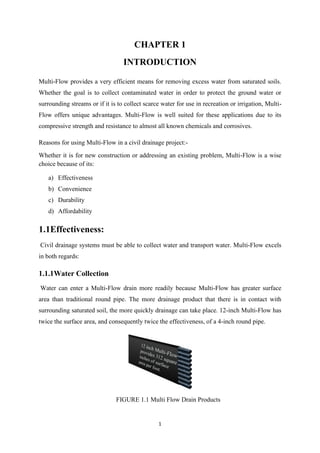
Water can enter a Multi-Flow drain more readily because Multi-Flow has greater surface
area than traditional round pipe. The more drainage product that there is in contact with
surrounding saturated soil, the more quickly drainage can take place. 12-inch Multi-Flow has
twice the surface area, and consequently twice the effectiveness, of a 4-inch round pipe.
FIGURE 1.1 Multi Flow Drain Products
2
1.1.2 Water Transport
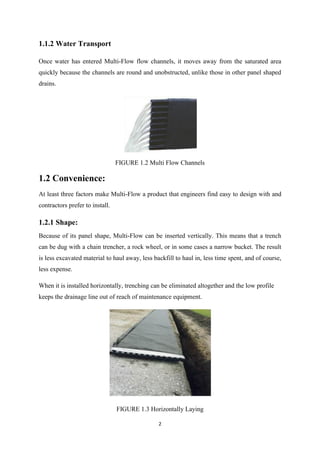
Once water has entered Multi-Flow flow channels, it moves away from the saturated area
quickly because the channels are round and unobstructed, unlike those in other panel shaped
drains.
FIGURE 1.2 Multi Flow Channels
1.2 Convenience:
At least three factors make Multi-Flow a product that engineers find easy to design with and
contractors prefer to install.
1.2.1 Shape:
Because of its panel shape, Multi-Flow can be inserted vertically. This means that a trench
can be dug with a chain trencher, a rock wheel, or in some cases a narrow bucket. The result
is less excavated material to haul away, less backfill to haul in, less time spent, and of course,
less expense.
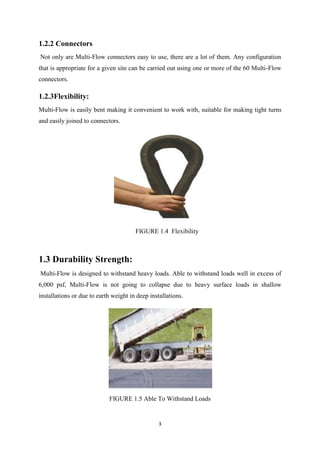
When it is installed horizontally, trenching can be eliminated altogether and the low profile
keeps the drainage line out of reach of maintenance equipment.
FIGURE 1.3 Horizontally Laying
3
1.2.2 Connectors
Not only are Multi-Flow connectors easy to use, there are a lot of them. Any configuration
that is appropriate for a given site can be carried out using one or more of the 60 Multi-Flow
connectors.
1.2.3Flexibility:
Multi-Flow is easily bent making it convenient to work with, suitable for making tight turns
and easily joined to connectors.
FIGURE 1.4 Flexibility
1.3 Durability Strength:
Multi-Flow is designed to withstand heavy loads. Able to withstand loads well in excess of
6,000 psf, Multi-Flow is not going to collapse due to heavy surface loads in shallow
installations or due to earth weight in deep installations.
FIGURE 1.5 Able To Withstand Loads
4
1.3.1Longevity
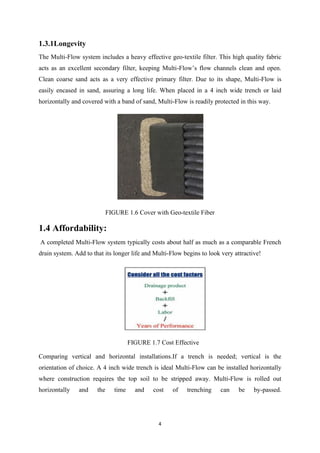
The Multi-Flow system includes a heavy effective geo-textile filter. This high quality fabric
acts as an excellent secondary filter, keeping Multi-Flow’s flow channels clean and open.
Clean coarse sand acts as a very effective primary filter. Due to its shape, Multi-Flow is
easily encased in sand, assuring a long life. When placed in a 4 inch wide trench or laid
horizontally and covered with a band of sand, Multi-Flow is readily protected in this way.
FIGURE 1.6 Cover with Geo-textile Fiber
1.4 Affordability:
A completed Multi-Flow system typically costs about half as much as a comparable French
drain system. Add to that its longer life and Multi-Flow begins to look very attractive!
FIGURE 1.7 Cost Effective
Comparing vertical and horizontal installations.If a trench is needed; vertical is the
orientation of choice. A 4 inch wide trench is ideal Multi-Flow can be installed horizontally
where construction requires the top soil to be stripped away. Multi-Flow is rolled out
horizontally and the time and cost of trenching can be by-passed.
5
CHAPTER 2
LITERATURE REVIEW
2.1 Problem of poor drainage system
The problem of drainage system is a major issue in the athletic fields like any big ground in
which the drainage facility is not proper and paved surface .So we have done a case study of
drainage in the athletic field and paved surface to overcome the excess storm water that had
been collected in the fields or sideway of the road.
2.1.1 Drainage Problem on Road
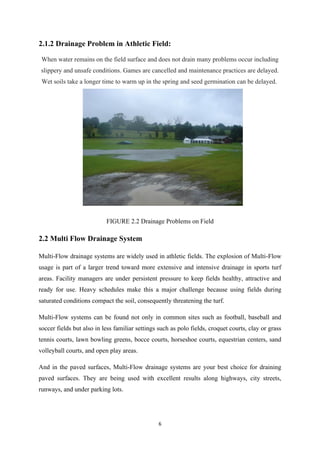
Water has a number of unhelpful characteristics which impact on highway performance. It is
a lubricant reducing the effectiveness of tyre grip on the carriageway wearing surface which
can increase stopping distances. Spray from rainwater being thrown up by car tyres can
reduce visibility which can lead to delays in reacting to events on the carriageway. Drag on
car tyres from local rainwater ponding can alter the balance of vehicles travelling at speed
which can be alarming or cause skidding. It is incompressible therefore standing water
effectively acts as a jackhammer on the wearing course right
FIGURE 2.1 Drainage Problems on Street
6
2.1.2 Drainage Problem in Athletic Field:
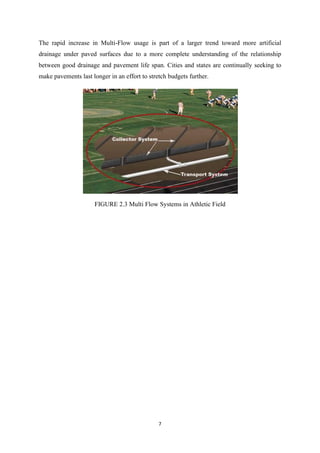
When water remains on the field surface and does not drain many problems occur including
slippery and unsafe conditions. Games are cancelled and maintenance practices are delayed.
Wet soils take a longer time to warm up in the spring and seed germination can be delayed.
FIGURE 2.2 Drainage Problems on Field
2.2 Multi Flow Drainage System
Multi-Flow drainage systems are widely used in athletic fields. The explosion of Multi-Flow
usage is part of a larger trend toward more extensive and intensive drainage in sports turf
areas. Facility managers are under persistent pressure to keep fields healthy, attractive and
ready for use. Heavy schedules make this a major challenge because using fields during
saturated conditions compact the soil, consequently threatening the turf.
Multi-Flow systems can be found not only in common sites such as football, baseball and
soccer fields but also in less familiar settings such as polo fields, croquet courts, clay or grass
tennis courts, lawn bowling greens, bocce courts, horseshoe courts, equestrian centers, sand
volleyball courts, and open play areas.
And in the paved surfaces, Multi-Flow drainage systems are your best choice for draining
paved surfaces. They are being used with excellent results along highways, city streets,
runways, and under parking lots.
7
The rapid increase in Multi-Flow usage is part of a larger trend toward more artificial
drainage under paved surfaces due to a more complete understanding of the relationship
between good drainage and pavement life span. Cities and states are continually seeking to
make pavements last longer in an effort to stretch budgets further.
FIGURE 2.3 Multi Flow Systems in Athletic Field
8
CHAPTER 3
PIPES USED IN MULTI FLOW
3.1.6-Inch Connectors:
Multi-Flow connectors allow for extensive flexibility in drainage system design.
3.1.1 Basic Connectors:
A) 6" End cap:
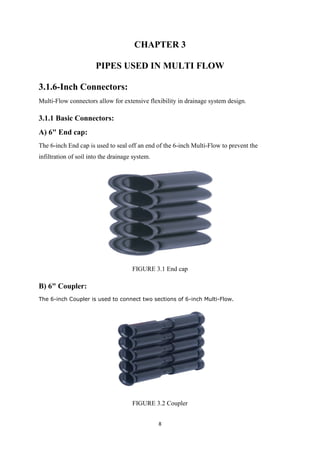
The 6-inch End cap is used to seal off an end of the 6-inch Multi-Flow to prevent the
infiltration of soil into the drainage system.
FIGURE 3.1 End cap
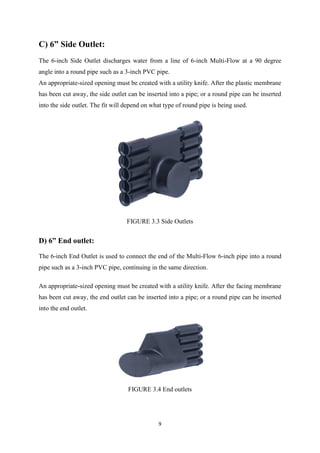
B) 6" Coupler:
The 6-inch Coupler is used to connect two sections of 6-inch Multi-Flow.
FIGURE 3.2 Coupler
9
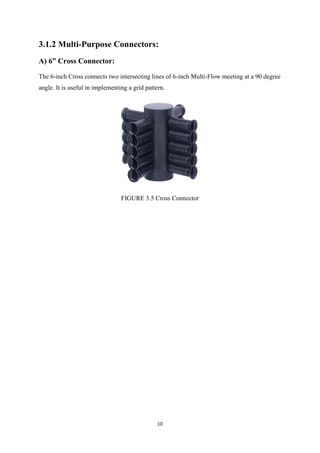
C) 6” Side Outlet:
The 6-inch Side Outlet discharges water from a line of 6-inch Multi-Flow at a 90 degree
angle into a round pipe such as a 3-inch PVC pipe.
An appropriate-sized opening must be created with a utility knife. After the plastic membrane
has been cut away, the side outlet can be inserted into a pipe; or a round pipe can be inserted
into the side outlet. The fit will depend on what type of round pipe is being used.
FIGURE 3.3 Side Outlets
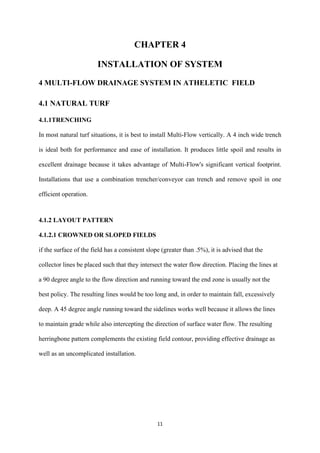
D) 6” End outlet:
The 6-inch End Outlet is used to connect the end of the Multi-Flow 6-inch pipe into a round
pipe such as a 3-inch PVC pipe, continuing in the same direction.
An appropriate-sized opening must be created with a utility knife. After the facing membrane
has been cut away, the end outlet can be inserted into a pipe; or a round pipe can be inserted
into the end outlet.
FIGURE 3.4 End outlets
10
3.1.2 Multi-Purpose Connectors:
A) 6” Cross Connector:
The 6-inch Cross connects two intersecting lines of 6-inch Multi-Flow meeting at a 90 degree
angle. It is useful in implementing a grid pattern.
FIGURE 3.5 Cross Connector
11
CHAPTER 4
INSTALLATION OF SYSTEM
4 MULTI-FLOW DRAINAGE SYSTEM IN ATHELETIC FIELD
4.1 NATURAL TURF
4.1.1TRENCHING
In most natural turf situations, it is best to install Multi-Flow vertically. A 4 inch wide trench
is ideal both for performance and ease of installation. It produces little spoil and results in
excellent drainage because it takes advantage of Multi-Flow's significant vertical footprint.
Installations that use a combination trencher/conveyor can trench and remove spoil in one
efficient operation.
4.1.2 LAYOUT PATTERN
4.1.2.1 CROWNED OR SLOPED FIELDS
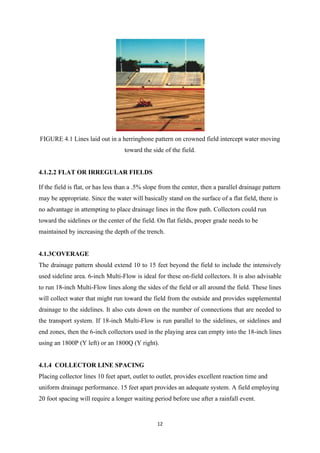
if the surface of the field has a consistent slope (greater than .5%), it is advised that the
collector lines be placed such that they intersect the water flow direction. Placing the lines at
a 90 degree angle to the flow direction and running toward the end zone is usually not the
best policy. The resulting lines would be too long and, in order to maintain fall, excessively
deep. A 45 degree angle running toward the sidelines works well because it allows the lines
to maintain grade while also intercepting the direction of surface water flow. The resulting
herringbone pattern complements the existing field contour, providing effective drainage as
well as an uncomplicated installation.
12
FIGURE 4.1 Lines laid out in a herringbone pattern on crowned field intercept water moving
toward the side of the field.
4.1.2.2 FLAT OR IRREGULAR FIELDS
If the field is flat, or has less than a .5% slope from the center, then a parallel drainage pattern
may be appropriate. Since the water will basically stand on the surface of a flat field, there is
no advantage in attempting to place drainage lines in the flow path. Collectors could run
toward the sidelines or the center of the field. On flat fields, proper grade needs to be
maintained by increasing the depth of the trench.
4.1.3COVERAGE
The drainage pattern should extend 10 to 15 feet beyond the field to include the intensively
used sideline area. 6-inch Multi-Flow is ideal for these on-field collectors. It is also advisable
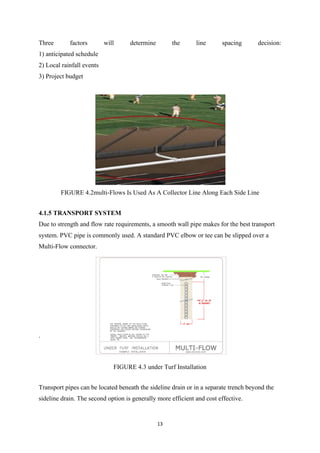
to run 18-inch Multi-Flow lines along the sides of the field or all around the field. These lines
will collect water that might run toward the field from the outside and provides supplemental
drainage to the sidelines. It also cuts down on the number of connections that are needed to
the transport system. If 18-inch Multi-Flow is run parallel to the sidelines, or sidelines and
end zones, then the 6-inch collectors used in the playing area can empty into the 18-inch lines
using an 1800P (Y left) or an 1800Q (Y right).
4.1.4 COLLECTOR LINE SPACING
Placing collector lines 10 feet apart, outlet to outlet, provides excellent reaction time and
uniform drainage performance. 15 feet apart provides an adequate system. A field employing
20 foot spacing will require a longer waiting period before use after a rainfall event.
13
Three factors will determine the line spacing decision:
1) anticipated schedule
2) Local rainfall events
3) Project budget
FIGURE 4.2multi-Flows Is Used As A Collector Line Along Each Side Line
4.1.5 TRANSPORT SYSTEM
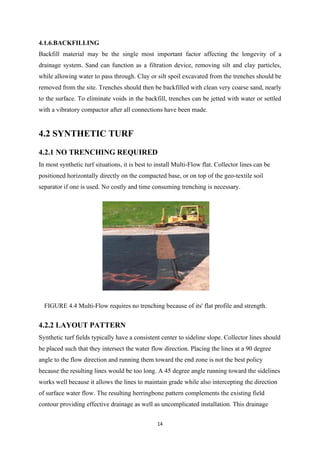
Due to strength and flow rate requirements, a smooth wall pipe makes for the best transport
system. PVC pipe is commonly used. A standard PVC elbow or tee can be slipped over a
Multi-Flow connector.
.
FIGURE 4.3 under Turf Installation
Transport pipes can be located beneath the sideline drain or in a separate trench beyond the
sideline drain. The second option is generally more efficient and cost effective.
14
4.1.6.BACKFILLING
Backfill material may be the single most important factor affecting the longevity of a
drainage system. Sand can function as a filtration device, removing silt and clay particles,
while allowing water to pass through. Clay or silt spoil excavated from the trenches should be
removed from the site. Trenches should then be backfilled with clean very coarse sand, nearly
to the surface. To eliminate voids in the backfill, trenches can be jetted with water or settled
with a vibratory compactor after all connections have been made.
4.2 SYNTHETIC TURF
4.2.1 NO TRENCHING REQUIRED
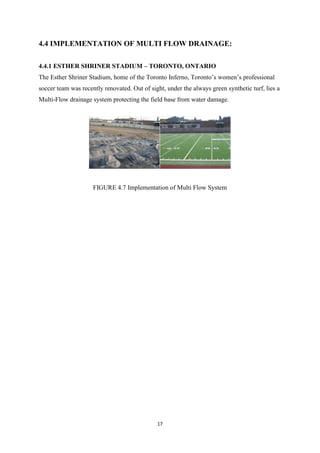
In most synthetic turf situations, it is best to install Multi-Flow flat. Collector lines can be
positioned horizontally directly on the compacted base, or on top of the geo-textile soil
separator if one is used. No costly and time consuming trenching is necessary.
FIGURE 4.4 Multi-Flow requires no trenching because of its' flat profile and strength.
4.2.2 LAYOUT PATTERN
Synthetic turf fields typically have a consistent center to sideline slope. Collector lines should
be placed such that they intersect the water flow direction. Placing the lines at a 90 degree
angle to the flow direction and running them toward the end zone is not the best policy
because the resulting lines would be too long. A 45 degree angle running toward the sidelines
works well because it allows the lines to maintain grade while also intercepting the direction
of surface water flow. The resulting herringbone pattern complements the existing field
contour providing effective drainage as well as uncomplicated installation. This drainage
15
pattern should extend all the way to the edge of the synthetic turf so it will include the
intensively used sideline area. Transport lines should be located at the edges of the field.
4.2.3 COLLECTOR LINE SPACING
the coarse sand and rock used in synthetic turf fields is capable of absorbing substantial
amounts of water. Consequently, it is acceptable to allow more time for desaturating the base
of a synthetic field than a natural turf field and as a result, collectors can be spaced farther
apart. Placing collector lines 15 feet apart, outlet to outlet, provides excellent reaction time
and uniform drainage performance. Twenty feet apart provides an adequate system. A field
employing 25 foot spacing’s will require significantly longer to drain after a rainfall event. It
would be unwise to space them farther apart because allowing water to set on the compacted
base for prolonged periods of time will soften the subgrade and destabilize the base.
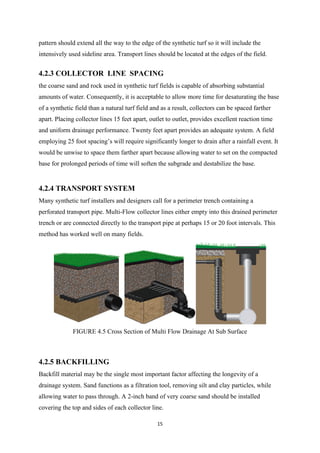
4.2.4 TRANSPORT SYSTEM
Many synthetic turf installers and designers call for a perimeter trench containing a
perforated transport pipe. Multi-Flow collector lines either empty into this drained perimeter
trench or are connected directly to the transport pipe at perhaps 15 or 20 foot intervals. This
method has worked well on many fields.
FIGURE 4.5 Cross Section of Multi Flow Drainage At Sub Surface
4.2.5 BACKFILLING
Backfill material may be the single most important factor affecting the longevity of a
drainage system. Sand functions as a filtration tool, removing silt and clay particles, while
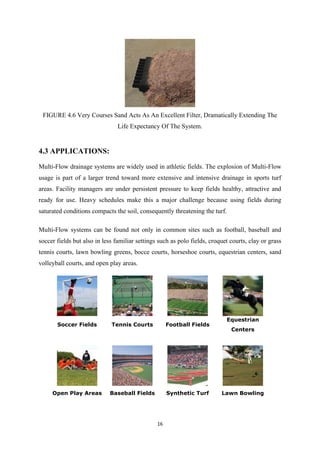
allowing water to pass through. A 2-inch band of very coarse sand should be installed
covering the top and sides of each collector line.
16
FIGURE 4.6 Very Courses Sand Acts As An Excellent Filter, Dramatically Extending The
Life Expectancy Of The System.
4.3 APPLICATIONS:
Multi-Flow drainage systems are widely used in athletic fields. The explosion of Multi-Flow
usage is part of a larger trend toward more extensive and intensive drainage in sports turf
areas. Facility managers are under persistent pressure to keep fields healthy, attractive and
ready for use. Heavy schedules make this a major challenge because using fields during
saturated conditions compacts the soil, consequently threatening the turf.
Multi-Flow systems can be found not only in common sites such as football, baseball and
soccer fields but also in less familiar settings such as polo fields, croquet courts, clay or grass
tennis courts, lawn bowling greens, bocce courts, horseshoe courts, equestrian centers, sand
volleyball courts, and open play areas.
Soccer Fields Tennis Courts Football Fields
Equestrian
Centers
Open Play Areas Baseball Fields Synthetic Turf Lawn Bowling
17
4.4 IMPLEMENTATION OF MULTI FLOW DRAINAGE:
4.4.1 ESTHER SHRINER STADIUM – TORONTO, ONTARIO
The Esther Shriner Stadium, home of the Toronto Inferno, Toronto’s women’s professional
soccer team was recently renovated. Out of sight, under the always green synthetic turf, lies a
Multi-Flow drainage system protecting the field base from water damage.
FIGURE 4.7 Implementation of Multi Flow System
18
CHAPTER 5
MODEL SPECIFICATION FOR SUBSURFACE DRAIN
SYSTEM
5.1 DESCRIPTION
This work shall consist of providing and placing a drainage system comprised of a geo-
composite, prefabricated, water collection system (collection system) and the associated
water transport system (transport pipe) as described in the plans. The drainage system shall
be installed in accordance with these specifications and in close conformity with the locations
and dimensions as shown on the plans or specified by the engineer. The quantities of drainage
system materials as shown on the plans may be increased or decreased at the discretion of the
engineer based on actual site conditions that occur during construction of the project. Such
variations in quantity will not be considered as alterations in the details of construction or a
change in the character of the work.
5.2 MATERIALS
5.2 The collection system shall be of a flexible, prefabricated, rounded rectangular shaped,
composite product, consisting of an inner core and an outer geo-textile wrap. The outer
wrap shall function only as a filter and shall not be a structural component of the core.
5.2.1 The collection system core shall be made of a high-density polyethylene. The core
shall be constructed using interconnected corrugated pipes that define and provide the
flow channels and structural integrity of the collection system. Perforations shall be
evenly distributed on both faces of the core. The core of the collection system shall
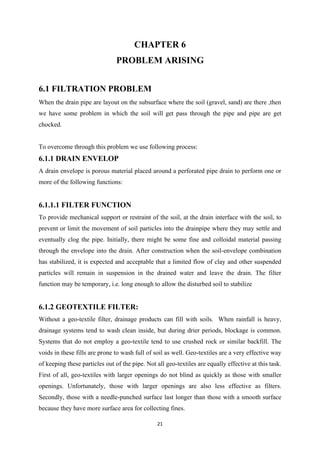
conform to the following physical property requirements.
Thickness, inches ASTM D-1777 1.0
Flow Rate, gpm/ft* ASTM D-4716 29
Compressive Strength, psf ASTM D-1621
(modified sand method)
6000
Perforations / sq. ft --- > 300
* At gradient = 0.1, pressure = 10 psi for 100 hours
19
5.2.2 The collection system shall be wrapped with a non-woven geo-textile. The non-woven
wrap shall be of a needle-punched construction consisting of long-chain polymeric
fibers composed of polypropylene, polyethylene or polyamide. The fibers shall be
oriented into a multidirectional stable network whereby they retain their positions
relative with each other and allow the passage of water as specified. The fabric shall
be free of any chemical treatment or coating, which reduces permeability and it shall
be inert to chemicals commonly found in soil. The geo-textile shall conform to the
following minimum average roll values.
Weight ASTM D - 3776 4.0
Tensile Strength ASTM D - 4632 100
Elongation % ASTM D - 4632 50
Puncture, lb ASTM D - 751 50
Mullen Burst, psi ASTM D - 3786 200
Trapezoidal Tear, lb ASTM D - 4533 42
Coefficient of Permeability ASTM D - 4491 .1 cm/sec
Flow Rate, gpm/ft2 ASTM D - 4491 100
Permittivity, 1/sec ASTM D - 4491 1.8
Apparent Opening Size ASTM D - 4751 70 Max US Std Sieve Opening
Seam Strength, lb/ft ASTM D - 4595 100
Fungus ASTM G - 21 No Growth
5.2.3 Multi-Flow meets or exceeds these specifications.
• The connectors used with the collection system shall be of a snap together design. In
no case shall any product be joined without the use of the manufacturer’s connector
designed specifically for the purpose.
• Transport pipe shall be either PVC pipe meeting the requirements of ASTM D- 2729
or ASTM F-949, or high-density polyethylene pipe meeting the requirements of
AASHTO M252.2.4
5.3 CONSTRUCTION REQUIREMENTS
1) The amount of trench excavated at any time shall not exceed the amount of drain that
can be set and backfilled completely in one working day. The trench shall be 4 inches
wide and at the depth specified in the plans. The collection system shall be centered in
the trench, and backfilled with clean coarse sand or an alternate selected by the
engineer. Coarse sand is typically comprised of particles ranging from a # 8 to a # 30
U. S. Standard Sieve.
20
2) The trench excavations for the collection system and transport pipe shall be to the
lines and grades shown on the plans. Over excavation in the bottom of the excavation
shall be backfilled to the proper grade with excavated material or sand prior to the
placement of the collection system.
3) The collection system shall be securely connected to the transport pipe using
connectors approved by the manufacturer.
4) Backfill shall be consolidated in accordance with the plans or as directed by the
engineer.
5) Any damaged collection system or transport pipe shall be replaced or repaired by
splicing in an undamaged section of like material.
21
CHAPTER 6
PROBLEM ARISING
6.1 FILTRATION PROBLEM
When the drain pipe are layout on the subsurface where the soil (gravel, sand) are there ,then
we have some problem in which the soil will get pass through the pipe and pipe are get
chocked.
To overcome through this problem we use following process:
6.1.1 DRAIN ENVELOP
A drain envelope is porous material placed around a perforated pipe drain to perform one or
more of the following functions:
6.1.1.1 FILTER FUNCTION
To provide mechanical support or restraint of the soil, at the drain interface with the soil, to
prevent or limit the movement of soil particles into the drainpipe where they may settle and
eventually clog the pipe. Initially, there might be some fine and colloidal material passing
through the envelope into the drain. After construction when the soil-envelope combination
has stabilized, it is expected and acceptable that a limited flow of clay and other suspended
particles will remain in suspension in the drained water and leave the drain. The filter
function may be temporary, i.e. long enough to allow the disturbed soil to stabilize
6.1.2 GEOTEXTILE FILTER:
Without a geo-textile filter, drainage products can fill with soils. When rainfall is heavy,
drainage systems tend to wash clean inside, but during drier periods, blockage is common.
Systems that do not employ a geo-textile tend to use crushed rock or similar backfill. The
voids in these fills are prone to wash full of soil as well. Geo-textiles are a very effective way
of keeping these particles out of the pipe. Not all geo-textiles are equally effective at this task.
First of all, geo-textiles with larger openings do not blind as quickly as those with smaller
openings. Unfortunately, those with larger openings are also less effective as filters.
Secondly, those with a needle-punched surface last longer than those with a smooth surface
because they have more surface area for collecting fines.
22
6.2 ALIGNMENT
In multi flow drainage system the pipes are align in two different ways horizontally or
vertically. So this is a major problem that which type of alignment should be used on a
particular site.
To overcome these problems we analyze that-
The unique features of our drainage site will determine the drainage profile. Vertical
installations are most common. They allow for installation in a narrow trench with less
excavation, less spoil, and less backfilling. Horizontal installations are used when the
situation calls for a low profile or to avoid trenching altogether. Typically vertical
installations are used in natural turf fields and a horizontal profile is employed under
synthetic turf.
6.3 OVER-DRAIN
Many drainage system that works on collecting the storm water and drain out the excess
water but they over drain the water even lower than that require for the grass on the athletic
field due to which optimum moisture content reduced which is necessary for the growth of
the grass on the athletic fields
To overcome this problem we analyses that-
Drainage cannot and will not remove all water from the soil. It only reduces it from the
unacceptable "saturation point" to the desired level of "field capacity." At this point, water
clings to surrounding soil particles which refuse to yield any more moisture to gravity.
Fortunately, plants can still access this remaining soil water. Due to plant usage, combined
with evaporation, soil moisture levels will eventually fall to a "wilting point" at which time
additional water becomes mandatory.
23
CONCLUSION
In this project we have tested the applications of multi flow drainage system in the athletic
fields. Firstly we analyzed the problem related to excess storm water that makes the patches
on athletic field due to collection of water. Then we check the slope of field on the basis of
that we check the alignment of the multi-flow drainage system that it should be horizontal or
vertical.
After that we searched for layout of multi flow drainage system and we found that 6 inch pipe
connectors are the best option for the proper drainage. Then we use the standard methods of
excavation like trenching for installation of the pipes which are exit to main pipeline to drain
out all collected water through multi-flow drainage system. Then we check the requirement
of backfill materials.
After the implementation of multi flow drainage system, there are certain kinds of problems
are raised like chocking of filter, blockage in pipe, alignment and over drain problems in the
athletic fields for that we suggested some solutions to those problems raised in the multi-flow
drainage system.
24
REFERENCES
1. Arisz, h. and B.C. Burrell (2006).Urban drainage infrastructure planning and design
considering climate, IEEE.
2. Aronica G, Freni G, OliveriE(2005) Uncertainty analysis of the influence of rainfall
time resolution in the modeling of urban drainage systems. Hydrological processes
19:1055-1071
3. Hansen A, Liu L,Linde JJ, Mark O, Mikkelsen PS (2005) Accounting for uncertainty
in urban drainage system performance assessment using safety factors applied to
runoff.
4. Nilex/Products/Multi-flow.
5. www.multi-flow.com

Multi-flow drainage system

  • 1.
    A Major Project Report On A CASESTUDY ON MULTI FLOW DRAINAGE SYSTEM Submitted In Partial fulfillment for the Degree of B. Tech In Civil Engineering Name of Project Coordinator Submitted By Mr. Teekam Singh AdityaKumpawat 16EJCCE007 Assistant Professor AnujBohra 16EJCCE015 DevanshuVerma 16EJCCE024 Name of Guide Irshad Ali Ansari 16EJCCE042 Mr. Narendra Sipani KamleshChoudhary 16EJCCE045 Assistant professor MayankKhatri 16EJCCE058 JAIPUR ENGINEERING COLLEGE & RESEARCH CENTRE DEPARTMENT OF CIVIL ENGINEERING APRIL, 2020
  • 2.
    ii Jaipur Engineering College& Research Centre Department of Civil Engineering Session-2019-20 Certificate This is to certify that the project report entitled “MULTI FLOW DRAINAGE SYSTEM”, submitted by Aditya Kumpawat (16EJCCE007), Anuj Bohra (16EJCCE015), Devanshu Verma (16EJCCE024), Irshad Ali Ansari (16EJCCE042), Kamlesh Choudhary (16EJCCE045) and Mayank Khatri (16EJCCE058) to the Jaipur Engineering College & Research Centre Jaipur in partial fulfillment for the award of the degree of B. Tech in Civil Engineering is of project work carried out by him under my supervision. The contents of this report, in full or in parts, have not been submitted to any other Institution or University for the award of any degree. Mr. Narendra Sipani Prof. (Dr.) Om Prakash Netula Supervisor & Coordinator Head Department Of Civil Engineering Department Of Civil Engineering Counter signature of HOD with seal
  • 3.
    iii DECLARATION I declare thatthis project report titled “MULTI FLOW DRAINAGE SYSTEM” submitted in partial fulfillment of the degree of B. Tech in Civil Engineering is a record of original work carried out by maunder the supervision of Mr. NARENDRA SIPANI, and has not formed the basis for the award of any other degree or diploma, in this or any other Institution or University. In keeping with the ethical practice in reporting scientific information, due acknowledgements have been made wherever the findings of others have been cited. Aditya Kumpawat 16EJCCE007 Anuj Bohra 16EJCCE015 DevanshuVerma 16EJCCE024 Irshad Ali Ansari 16EJCCE042 Kamlesh Choudhary 16EJCCE045 Mayank Khatri 16EJCCE058 APRIL 24, 2020
  • 4.
    iv ACKNOWLEDGMENTS The satisfaction andeuphoria that accompany the successful completion of any work will be incomplete unless we mention the names of those people who made it possible, whose valuable guidance and encouragement served as a beacon light and crowned the efforts with success. I take this opportunity to thank Dr V.K. Chandna Principal JECRC Jaipur, Thomas Kurien, Dean –Students Activities, for assigning this project work as a part of the curriculum. In the beginning of the report I want to give my thanks to Prof. (Dr.) Om Prakash Netula ,Head, Department of Civil Engineering, JECRC for all the encouragement and appreciations that I have received from them. I would like to express my gratitude towards my respected Project Co-ordinator Mr. Teekam Singh (Assistant Professor, Department Of Civil Engineering) and Project Guide Mr. Narendra Sipani (Assistant Professor, Department Of Civil Engineering) Jaipur Engineering College and Research Centre, Sitapura, Jaipur. I am very thankful to sir and grateful to have an opportunity to work under his supervision which provided me with his generous guidance, valuable help and endless encouragement by taking personal interest and attention. No words can fully convey my feeling of respect and regards for him. I would like to express my gratitude toward my all esteemed Faculties and Staff Members of Department of Civil Engineering, JECRC for being more than willing to impound their treasure of knowledge with me. Once again, I am also thankful to people who were the part of this work in various way direct or indirect, people who gave unending support from the beginning.
  • 5.
    v ABSTRACT A scientific drainagesystem to catch the storm water is a long term need of the society, particularly incites. Urbanization along with its impermeable structures is one of the major causes of flooding in urban areas. The rainfall intensity and characteristics of catchment area are the major factors for designing urban storm water drainage facilities. These facilitates have a paramount advantage to safely dispose the generated floods to receiving system. Many cities lack in providing proper drainage system. The present model utilizes the rainfall in design storm water drainage system. Multi-Flow drainage systems serve exceptionally well in a wide variety of civil projects. It is used beneficially in landfill sites, mine and leach pile settings, de-saturation projects, rail lines, railroad yards, storage lagoons, earthen dams, and in decontamination processes. Multi-Flow provides a very efficient means for removing excess water from saturated soils. Whether the goal is to collect contaminated water in order to protect the ground water or surrounding streams or if it is to collect scarce water for use in recreation or irrigation, Multi- Flow offers unique advantages. Multi-Flow is well suited for these applications due to its compressive strength and resistance to almost all known chemicals and corrosives.
  • 6.
    vi CONTENTS DESCRIPTION PAGE NO. Certificateii Declaration iii Acknowledgements iv Abstract v Contents vi List of Figures viii 1. INTRODUCTION 1 1.1 Effectiveness 1 1.1.1Water Collection 1 1.1.2 Water transport 2 1.2 Convenience 2 1.2.1 Shape 2 1.2.2 Connectors 3 1.2.3 Flexibility 3 1.3 Durability Strength 3 1.3.1 Longevity 4 1.4 Affordability 4 2. LITERATURE REVIEW 5 2.1 Problem Of Poor Drainage System 5 2.1.1 Drainage Problem of Road 5 2.1.2 Drainage Problem in Field 6 2.2 Multi Flow Drainage System 6 3. PIPES USED IN MULTI FLOW 8 3.1 6-Inch Connector 8 3.1.1 Basic Connectors 8 3.1.2 Multi-Purpose Connectors 10
  • 7.
    vii 4. INSTALLATION OFSYSTEM 11 4.1 Natural Turf 11 4.1.1 Trenching 11 4.1.2 Layout pattern 11 4.1.2.1 Crowned or sloped fields 11 4.1.2.2 Flat or irregular fields 12 4.1.3 Coverage 12 4.1.4 Collector line spacing 12 4.1.5 Transport system 13 4.1.6. Backfilling 14 4.2 Synthetic turf 14 4.2.1 No trenching required 14 4.2.2 Layout pattern 15 4.2.3 Collector line spacing 15 4.2.4 Transport system 15 4.2.5 Backfilling 16 4.3 Applications 16 4.4 Implementation of multi flow drainage 17 4.4.1 Esther shiners stadium 17 5. MODEL SPECIFICATION FOR SUB-SURFACE DRAIN SYSTEM 18 5.1 Description 18 5.2 Materials 18 5.3 Construction Requirements 20 6. PROBLEM ARISING 21 6.1 Filtration Problem 21 6.1.1 Drain Envelop 21 6.1.1.1 Filter Function 21 6.1.2 Geo-textile Filter 21 6.2 Alignment 22 6.3 Over-Drain 22 CONCLUSION 23 REFERENCES 24
  • 8.
    viii LIST OF FIGURES FiguresTitle Page 1.1 Multi-Flow Drain Products 2 1.2 Multi Flow Channels 2 1.3 Horizontally Laying 3 1.4 Flexibility 3 1.5 Able To Withstand Loads 4 1.6 Cover With Geo-textile Fibre 4 1.7 Cost Effective 5 2.1 Drainage Problem On Street 6 2.2 Drainage Problems On Field 7 2.3 Multi Flow Systems In Athletic Field 8 3.1 End-cap 9 3.2 Coupler 9 3.3 Side Outlet 10 3.4 End-outlet 11 3.5 Cross Connector 11 4.1 Lines Laid Out In A Herringbone Pattern On A Crowned Field Intercept Water Moving Toward The Side Of The Field 13 4.2 Multi-Flows Is Used As A Collector Line Along Each Side Line 14 4.3 Under Turf Installation 14 4.4 Multi-Flow Requires No Trenching Because Of Its' Flat Profile And Strength 15
  • 9.
    ix 4.5 Cross SectionOf Multi Flow Drainage At Sub Surface 17 4.6 Very Course Sand Acts As An Excellent Filter, Dramatically Extending The Life Expectancy Of The System. 17 4.7 Implementation Of Multi Flow System 18
  • 10.
    1 CHAPTER 1 INTRODUCTION Multi-Flow providesa very efficient means for removing excess water from saturated soils. Whether the goal is to collect contaminated water in order to protect the ground water or surrounding streams or if it is to collect scarce water for use in recreation or irrigation, Multi- Flow offers unique advantages. Multi-Flow is well suited for these applications due to its compressive strength and resistance to almost all known chemicals and corrosives. Reasons for using Multi-Flow in a civil drainage project:- Whether it is for new construction or addressing an existing problem, Multi-Flow is a wise choice because of its: a) Effectiveness b) Convenience c) Durability d) Affordability 1.1Effectiveness: Civil drainage systems must be able to collect water and transport water. Multi-Flow excels in both regards: 1.1.1Water Collection Water can enter a Multi-Flow drain more readily because Multi-Flow has greater surface area than traditional round pipe. The more drainage product that there is in contact with surrounding saturated soil, the more quickly drainage can take place. 12-inch Multi-Flow has twice the surface area, and consequently twice the effectiveness, of a 4-inch round pipe. FIGURE 1.1 Multi Flow Drain Products
  • 11.
    2 1.1.2 Water Transport Oncewater has entered Multi-Flow flow channels, it moves away from the saturated area quickly because the channels are round and unobstructed, unlike those in other panel shaped drains. FIGURE 1.2 Multi Flow Channels 1.2 Convenience: At least three factors make Multi-Flow a product that engineers find easy to design with and contractors prefer to install. 1.2.1 Shape: Because of its panel shape, Multi-Flow can be inserted vertically. This means that a trench can be dug with a chain trencher, a rock wheel, or in some cases a narrow bucket. The result is less excavated material to haul away, less backfill to haul in, less time spent, and of course, less expense. When it is installed horizontally, trenching can be eliminated altogether and the low profile keeps the drainage line out of reach of maintenance equipment. FIGURE 1.3 Horizontally Laying
  • 12.
    3 1.2.2 Connectors Not onlyare Multi-Flow connectors easy to use, there are a lot of them. Any configuration that is appropriate for a given site can be carried out using one or more of the 60 Multi-Flow connectors. 1.2.3Flexibility: Multi-Flow is easily bent making it convenient to work with, suitable for making tight turns and easily joined to connectors. FIGURE 1.4 Flexibility 1.3 Durability Strength: Multi-Flow is designed to withstand heavy loads. Able to withstand loads well in excess of 6,000 psf, Multi-Flow is not going to collapse due to heavy surface loads in shallow installations or due to earth weight in deep installations. FIGURE 1.5 Able To Withstand Loads
  • 13.
    4 1.3.1Longevity The Multi-Flow systemincludes a heavy effective geo-textile filter. This high quality fabric acts as an excellent secondary filter, keeping Multi-Flow’s flow channels clean and open. Clean coarse sand acts as a very effective primary filter. Due to its shape, Multi-Flow is easily encased in sand, assuring a long life. When placed in a 4 inch wide trench or laid horizontally and covered with a band of sand, Multi-Flow is readily protected in this way. FIGURE 1.6 Cover with Geo-textile Fiber 1.4 Affordability: A completed Multi-Flow system typically costs about half as much as a comparable French drain system. Add to that its longer life and Multi-Flow begins to look very attractive! FIGURE 1.7 Cost Effective Comparing vertical and horizontal installations.If a trench is needed; vertical is the orientation of choice. A 4 inch wide trench is ideal Multi-Flow can be installed horizontally where construction requires the top soil to be stripped away. Multi-Flow is rolled out horizontally and the time and cost of trenching can be by-passed.
  • 14.
    5 CHAPTER 2 LITERATURE REVIEW 2.1Problem of poor drainage system The problem of drainage system is a major issue in the athletic fields like any big ground in which the drainage facility is not proper and paved surface .So we have done a case study of drainage in the athletic field and paved surface to overcome the excess storm water that had been collected in the fields or sideway of the road. 2.1.1 Drainage Problem on Road Water has a number of unhelpful characteristics which impact on highway performance. It is a lubricant reducing the effectiveness of tyre grip on the carriageway wearing surface which can increase stopping distances. Spray from rainwater being thrown up by car tyres can reduce visibility which can lead to delays in reacting to events on the carriageway. Drag on car tyres from local rainwater ponding can alter the balance of vehicles travelling at speed which can be alarming or cause skidding. It is incompressible therefore standing water effectively acts as a jackhammer on the wearing course right FIGURE 2.1 Drainage Problems on Street
  • 15.
    6 2.1.2 Drainage Problemin Athletic Field: When water remains on the field surface and does not drain many problems occur including slippery and unsafe conditions. Games are cancelled and maintenance practices are delayed. Wet soils take a longer time to warm up in the spring and seed germination can be delayed. FIGURE 2.2 Drainage Problems on Field 2.2 Multi Flow Drainage System Multi-Flow drainage systems are widely used in athletic fields. The explosion of Multi-Flow usage is part of a larger trend toward more extensive and intensive drainage in sports turf areas. Facility managers are under persistent pressure to keep fields healthy, attractive and ready for use. Heavy schedules make this a major challenge because using fields during saturated conditions compact the soil, consequently threatening the turf. Multi-Flow systems can be found not only in common sites such as football, baseball and soccer fields but also in less familiar settings such as polo fields, croquet courts, clay or grass tennis courts, lawn bowling greens, bocce courts, horseshoe courts, equestrian centers, sand volleyball courts, and open play areas. And in the paved surfaces, Multi-Flow drainage systems are your best choice for draining paved surfaces. They are being used with excellent results along highways, city streets, runways, and under parking lots.
  • 16.
    7 The rapid increasein Multi-Flow usage is part of a larger trend toward more artificial drainage under paved surfaces due to a more complete understanding of the relationship between good drainage and pavement life span. Cities and states are continually seeking to make pavements last longer in an effort to stretch budgets further. FIGURE 2.3 Multi Flow Systems in Athletic Field
  • 17.
    8 CHAPTER 3 PIPES USEDIN MULTI FLOW 3.1.6-Inch Connectors: Multi-Flow connectors allow for extensive flexibility in drainage system design. 3.1.1 Basic Connectors: A) 6" End cap: The 6-inch End cap is used to seal off an end of the 6-inch Multi-Flow to prevent the infiltration of soil into the drainage system. FIGURE 3.1 End cap B) 6" Coupler: The 6-inch Coupler is used to connect two sections of 6-inch Multi-Flow. FIGURE 3.2 Coupler
  • 18.
    9 C) 6” SideOutlet: The 6-inch Side Outlet discharges water from a line of 6-inch Multi-Flow at a 90 degree angle into a round pipe such as a 3-inch PVC pipe. An appropriate-sized opening must be created with a utility knife. After the plastic membrane has been cut away, the side outlet can be inserted into a pipe; or a round pipe can be inserted into the side outlet. The fit will depend on what type of round pipe is being used. FIGURE 3.3 Side Outlets D) 6” End outlet: The 6-inch End Outlet is used to connect the end of the Multi-Flow 6-inch pipe into a round pipe such as a 3-inch PVC pipe, continuing in the same direction. An appropriate-sized opening must be created with a utility knife. After the facing membrane has been cut away, the end outlet can be inserted into a pipe; or a round pipe can be inserted into the end outlet. FIGURE 3.4 End outlets
  • 19.
    10 3.1.2 Multi-Purpose Connectors: A)6” Cross Connector: The 6-inch Cross connects two intersecting lines of 6-inch Multi-Flow meeting at a 90 degree angle. It is useful in implementing a grid pattern. FIGURE 3.5 Cross Connector
  • 20.
    11 CHAPTER 4 INSTALLATION OFSYSTEM 4 MULTI-FLOW DRAINAGE SYSTEM IN ATHELETIC FIELD 4.1 NATURAL TURF 4.1.1TRENCHING In most natural turf situations, it is best to install Multi-Flow vertically. A 4 inch wide trench is ideal both for performance and ease of installation. It produces little spoil and results in excellent drainage because it takes advantage of Multi-Flow's significant vertical footprint. Installations that use a combination trencher/conveyor can trench and remove spoil in one efficient operation. 4.1.2 LAYOUT PATTERN 4.1.2.1 CROWNED OR SLOPED FIELDS if the surface of the field has a consistent slope (greater than .5%), it is advised that the collector lines be placed such that they intersect the water flow direction. Placing the lines at a 90 degree angle to the flow direction and running toward the end zone is usually not the best policy. The resulting lines would be too long and, in order to maintain fall, excessively deep. A 45 degree angle running toward the sidelines works well because it allows the lines to maintain grade while also intercepting the direction of surface water flow. The resulting herringbone pattern complements the existing field contour, providing effective drainage as well as an uncomplicated installation.
  • 21.
    12 FIGURE 4.1 Lineslaid out in a herringbone pattern on crowned field intercept water moving toward the side of the field. 4.1.2.2 FLAT OR IRREGULAR FIELDS If the field is flat, or has less than a .5% slope from the center, then a parallel drainage pattern may be appropriate. Since the water will basically stand on the surface of a flat field, there is no advantage in attempting to place drainage lines in the flow path. Collectors could run toward the sidelines or the center of the field. On flat fields, proper grade needs to be maintained by increasing the depth of the trench. 4.1.3COVERAGE The drainage pattern should extend 10 to 15 feet beyond the field to include the intensively used sideline area. 6-inch Multi-Flow is ideal for these on-field collectors. It is also advisable to run 18-inch Multi-Flow lines along the sides of the field or all around the field. These lines will collect water that might run toward the field from the outside and provides supplemental drainage to the sidelines. It also cuts down on the number of connections that are needed to the transport system. If 18-inch Multi-Flow is run parallel to the sidelines, or sidelines and end zones, then the 6-inch collectors used in the playing area can empty into the 18-inch lines using an 1800P (Y left) or an 1800Q (Y right). 4.1.4 COLLECTOR LINE SPACING Placing collector lines 10 feet apart, outlet to outlet, provides excellent reaction time and uniform drainage performance. 15 feet apart provides an adequate system. A field employing 20 foot spacing will require a longer waiting period before use after a rainfall event.
  • 22.
    13 Three factors willdetermine the line spacing decision: 1) anticipated schedule 2) Local rainfall events 3) Project budget FIGURE 4.2multi-Flows Is Used As A Collector Line Along Each Side Line 4.1.5 TRANSPORT SYSTEM Due to strength and flow rate requirements, a smooth wall pipe makes for the best transport system. PVC pipe is commonly used. A standard PVC elbow or tee can be slipped over a Multi-Flow connector. . FIGURE 4.3 under Turf Installation Transport pipes can be located beneath the sideline drain or in a separate trench beyond the sideline drain. The second option is generally more efficient and cost effective.
  • 23.
    14 4.1.6.BACKFILLING Backfill material maybe the single most important factor affecting the longevity of a drainage system. Sand can function as a filtration device, removing silt and clay particles, while allowing water to pass through. Clay or silt spoil excavated from the trenches should be removed from the site. Trenches should then be backfilled with clean very coarse sand, nearly to the surface. To eliminate voids in the backfill, trenches can be jetted with water or settled with a vibratory compactor after all connections have been made. 4.2 SYNTHETIC TURF 4.2.1 NO TRENCHING REQUIRED In most synthetic turf situations, it is best to install Multi-Flow flat. Collector lines can be positioned horizontally directly on the compacted base, or on top of the geo-textile soil separator if one is used. No costly and time consuming trenching is necessary. FIGURE 4.4 Multi-Flow requires no trenching because of its' flat profile and strength. 4.2.2 LAYOUT PATTERN Synthetic turf fields typically have a consistent center to sideline slope. Collector lines should be placed such that they intersect the water flow direction. Placing the lines at a 90 degree angle to the flow direction and running them toward the end zone is not the best policy because the resulting lines would be too long. A 45 degree angle running toward the sidelines works well because it allows the lines to maintain grade while also intercepting the direction of surface water flow. The resulting herringbone pattern complements the existing field contour providing effective drainage as well as uncomplicated installation. This drainage
  • 24.
    15 pattern should extendall the way to the edge of the synthetic turf so it will include the intensively used sideline area. Transport lines should be located at the edges of the field. 4.2.3 COLLECTOR LINE SPACING the coarse sand and rock used in synthetic turf fields is capable of absorbing substantial amounts of water. Consequently, it is acceptable to allow more time for desaturating the base of a synthetic field than a natural turf field and as a result, collectors can be spaced farther apart. Placing collector lines 15 feet apart, outlet to outlet, provides excellent reaction time and uniform drainage performance. Twenty feet apart provides an adequate system. A field employing 25 foot spacing’s will require significantly longer to drain after a rainfall event. It would be unwise to space them farther apart because allowing water to set on the compacted base for prolonged periods of time will soften the subgrade and destabilize the base. 4.2.4 TRANSPORT SYSTEM Many synthetic turf installers and designers call for a perimeter trench containing a perforated transport pipe. Multi-Flow collector lines either empty into this drained perimeter trench or are connected directly to the transport pipe at perhaps 15 or 20 foot intervals. This method has worked well on many fields. FIGURE 4.5 Cross Section of Multi Flow Drainage At Sub Surface 4.2.5 BACKFILLING Backfill material may be the single most important factor affecting the longevity of a drainage system. Sand functions as a filtration tool, removing silt and clay particles, while allowing water to pass through. A 2-inch band of very coarse sand should be installed covering the top and sides of each collector line.
  • 25.
    16 FIGURE 4.6 VeryCourses Sand Acts As An Excellent Filter, Dramatically Extending The Life Expectancy Of The System. 4.3 APPLICATIONS: Multi-Flow drainage systems are widely used in athletic fields. The explosion of Multi-Flow usage is part of a larger trend toward more extensive and intensive drainage in sports turf areas. Facility managers are under persistent pressure to keep fields healthy, attractive and ready for use. Heavy schedules make this a major challenge because using fields during saturated conditions compacts the soil, consequently threatening the turf. Multi-Flow systems can be found not only in common sites such as football, baseball and soccer fields but also in less familiar settings such as polo fields, croquet courts, clay or grass tennis courts, lawn bowling greens, bocce courts, horseshoe courts, equestrian centers, sand volleyball courts, and open play areas. Soccer Fields Tennis Courts Football Fields Equestrian Centers Open Play Areas Baseball Fields Synthetic Turf Lawn Bowling
  • 26.
    17 4.4 IMPLEMENTATION OFMULTI FLOW DRAINAGE: 4.4.1 ESTHER SHRINER STADIUM – TORONTO, ONTARIO The Esther Shriner Stadium, home of the Toronto Inferno, Toronto’s women’s professional soccer team was recently renovated. Out of sight, under the always green synthetic turf, lies a Multi-Flow drainage system protecting the field base from water damage. FIGURE 4.7 Implementation of Multi Flow System
  • 27.
    18 CHAPTER 5 MODEL SPECIFICATIONFOR SUBSURFACE DRAIN SYSTEM 5.1 DESCRIPTION This work shall consist of providing and placing a drainage system comprised of a geo- composite, prefabricated, water collection system (collection system) and the associated water transport system (transport pipe) as described in the plans. The drainage system shall be installed in accordance with these specifications and in close conformity with the locations and dimensions as shown on the plans or specified by the engineer. The quantities of drainage system materials as shown on the plans may be increased or decreased at the discretion of the engineer based on actual site conditions that occur during construction of the project. Such variations in quantity will not be considered as alterations in the details of construction or a change in the character of the work. 5.2 MATERIALS 5.2 The collection system shall be of a flexible, prefabricated, rounded rectangular shaped, composite product, consisting of an inner core and an outer geo-textile wrap. The outer wrap shall function only as a filter and shall not be a structural component of the core. 5.2.1 The collection system core shall be made of a high-density polyethylene. The core shall be constructed using interconnected corrugated pipes that define and provide the flow channels and structural integrity of the collection system. Perforations shall be evenly distributed on both faces of the core. The core of the collection system shall conform to the following physical property requirements. Thickness, inches ASTM D-1777 1.0 Flow Rate, gpm/ft* ASTM D-4716 29 Compressive Strength, psf ASTM D-1621 (modified sand method) 6000 Perforations / sq. ft --- > 300 * At gradient = 0.1, pressure = 10 psi for 100 hours
  • 28.
    19 5.2.2 The collectionsystem shall be wrapped with a non-woven geo-textile. The non-woven wrap shall be of a needle-punched construction consisting of long-chain polymeric fibers composed of polypropylene, polyethylene or polyamide. The fibers shall be oriented into a multidirectional stable network whereby they retain their positions relative with each other and allow the passage of water as specified. The fabric shall be free of any chemical treatment or coating, which reduces permeability and it shall be inert to chemicals commonly found in soil. The geo-textile shall conform to the following minimum average roll values. Weight ASTM D - 3776 4.0 Tensile Strength ASTM D - 4632 100 Elongation % ASTM D - 4632 50 Puncture, lb ASTM D - 751 50 Mullen Burst, psi ASTM D - 3786 200 Trapezoidal Tear, lb ASTM D - 4533 42 Coefficient of Permeability ASTM D - 4491 .1 cm/sec Flow Rate, gpm/ft2 ASTM D - 4491 100 Permittivity, 1/sec ASTM D - 4491 1.8 Apparent Opening Size ASTM D - 4751 70 Max US Std Sieve Opening Seam Strength, lb/ft ASTM D - 4595 100 Fungus ASTM G - 21 No Growth 5.2.3 Multi-Flow meets or exceeds these specifications. • The connectors used with the collection system shall be of a snap together design. In no case shall any product be joined without the use of the manufacturer’s connector designed specifically for the purpose. • Transport pipe shall be either PVC pipe meeting the requirements of ASTM D- 2729 or ASTM F-949, or high-density polyethylene pipe meeting the requirements of AASHTO M252.2.4 5.3 CONSTRUCTION REQUIREMENTS 1) The amount of trench excavated at any time shall not exceed the amount of drain that can be set and backfilled completely in one working day. The trench shall be 4 inches wide and at the depth specified in the plans. The collection system shall be centered in the trench, and backfilled with clean coarse sand or an alternate selected by the engineer. Coarse sand is typically comprised of particles ranging from a # 8 to a # 30 U. S. Standard Sieve.
  • 29.
    20 2) The trenchexcavations for the collection system and transport pipe shall be to the lines and grades shown on the plans. Over excavation in the bottom of the excavation shall be backfilled to the proper grade with excavated material or sand prior to the placement of the collection system. 3) The collection system shall be securely connected to the transport pipe using connectors approved by the manufacturer. 4) Backfill shall be consolidated in accordance with the plans or as directed by the engineer. 5) Any damaged collection system or transport pipe shall be replaced or repaired by splicing in an undamaged section of like material.
  • 30.
    21 CHAPTER 6 PROBLEM ARISING 6.1FILTRATION PROBLEM When the drain pipe are layout on the subsurface where the soil (gravel, sand) are there ,then we have some problem in which the soil will get pass through the pipe and pipe are get chocked. To overcome through this problem we use following process: 6.1.1 DRAIN ENVELOP A drain envelope is porous material placed around a perforated pipe drain to perform one or more of the following functions: 6.1.1.1 FILTER FUNCTION To provide mechanical support or restraint of the soil, at the drain interface with the soil, to prevent or limit the movement of soil particles into the drainpipe where they may settle and eventually clog the pipe. Initially, there might be some fine and colloidal material passing through the envelope into the drain. After construction when the soil-envelope combination has stabilized, it is expected and acceptable that a limited flow of clay and other suspended particles will remain in suspension in the drained water and leave the drain. The filter function may be temporary, i.e. long enough to allow the disturbed soil to stabilize 6.1.2 GEOTEXTILE FILTER: Without a geo-textile filter, drainage products can fill with soils. When rainfall is heavy, drainage systems tend to wash clean inside, but during drier periods, blockage is common. Systems that do not employ a geo-textile tend to use crushed rock or similar backfill. The voids in these fills are prone to wash full of soil as well. Geo-textiles are a very effective way of keeping these particles out of the pipe. Not all geo-textiles are equally effective at this task. First of all, geo-textiles with larger openings do not blind as quickly as those with smaller openings. Unfortunately, those with larger openings are also less effective as filters. Secondly, those with a needle-punched surface last longer than those with a smooth surface because they have more surface area for collecting fines.
  • 31.
    22 6.2 ALIGNMENT In multiflow drainage system the pipes are align in two different ways horizontally or vertically. So this is a major problem that which type of alignment should be used on a particular site. To overcome these problems we analyze that- The unique features of our drainage site will determine the drainage profile. Vertical installations are most common. They allow for installation in a narrow trench with less excavation, less spoil, and less backfilling. Horizontal installations are used when the situation calls for a low profile or to avoid trenching altogether. Typically vertical installations are used in natural turf fields and a horizontal profile is employed under synthetic turf. 6.3 OVER-DRAIN Many drainage system that works on collecting the storm water and drain out the excess water but they over drain the water even lower than that require for the grass on the athletic field due to which optimum moisture content reduced which is necessary for the growth of the grass on the athletic fields To overcome this problem we analyses that- Drainage cannot and will not remove all water from the soil. It only reduces it from the unacceptable "saturation point" to the desired level of "field capacity." At this point, water clings to surrounding soil particles which refuse to yield any more moisture to gravity. Fortunately, plants can still access this remaining soil water. Due to plant usage, combined with evaporation, soil moisture levels will eventually fall to a "wilting point" at which time additional water becomes mandatory.
  • 32.
    23 CONCLUSION In this projectwe have tested the applications of multi flow drainage system in the athletic fields. Firstly we analyzed the problem related to excess storm water that makes the patches on athletic field due to collection of water. Then we check the slope of field on the basis of that we check the alignment of the multi-flow drainage system that it should be horizontal or vertical. After that we searched for layout of multi flow drainage system and we found that 6 inch pipe connectors are the best option for the proper drainage. Then we use the standard methods of excavation like trenching for installation of the pipes which are exit to main pipeline to drain out all collected water through multi-flow drainage system. Then we check the requirement of backfill materials. After the implementation of multi flow drainage system, there are certain kinds of problems are raised like chocking of filter, blockage in pipe, alignment and over drain problems in the athletic fields for that we suggested some solutions to those problems raised in the multi-flow drainage system.
  • 33.
    24 REFERENCES 1. Arisz, h.and B.C. Burrell (2006).Urban drainage infrastructure planning and design considering climate, IEEE. 2. Aronica G, Freni G, OliveriE(2005) Uncertainty analysis of the influence of rainfall time resolution in the modeling of urban drainage systems. Hydrological processes 19:1055-1071 3. Hansen A, Liu L,Linde JJ, Mark O, Mikkelsen PS (2005) Accounting for uncertainty in urban drainage system performance assessment using safety factors applied to runoff. 4. Nilex/Products/Multi-flow. 5. www.multi-flow.com