PROJECT PRESENTATION
ON
MULTI-FLOW DRAINAGE
SYSTEM
PRESENTED BY :
IRSHAD ANSARI
CONTENT
Introduction
Objectives
WHY multi-flow drainage system?
Pipes used in multi-flow
Installation of system
Applications
Problems due to poor drainage
Conclusion
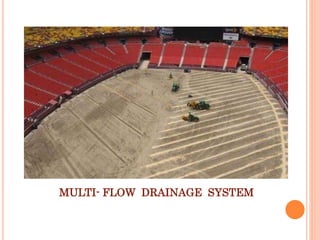
MULTI- FLOW DRAINAGE SYSTEM
INTRODUCTION
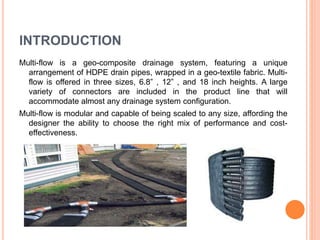
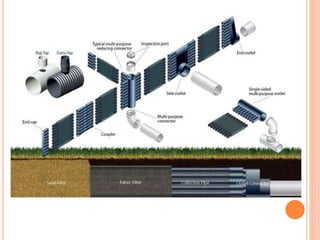
Multi-flow is a geo-composite drainage system, featuring a unique
arrangement of HDPE drain pipes, wrapped in a geo-textile fabric. Multi-
flow is offered in three sizes, 6.8” , 12” , and 18 inch heights. A large
variety of connectors are included in the product line that will
accommodate almost any drainage system configuration.
Multi-flow is modular and capable of being scaled to any size, affording the
designer the ability to choose the right mix of performance and cost-
effectiveness.
OBJECTIVES
 Study of data and problems associated with drainage system.
 To prevent and reduce water logging in the field without
disturbing surface works.
 To encourage measures to reuse storm water.
 Efficient soil drainage ensures that water does not collect on
the athletic surface.
 A well drained athletic surface improves safety and playability,
allows better air exchange, and improves turf grass recovery
potential.
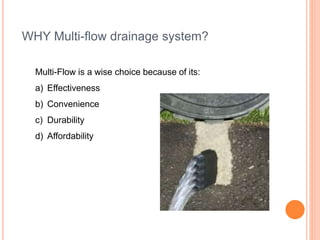
WHY Multi-flow drainage system?
Multi-Flow is a wise choice because of its:
a) Effectiveness
b) Convenience
c) Durability
d) Affordability
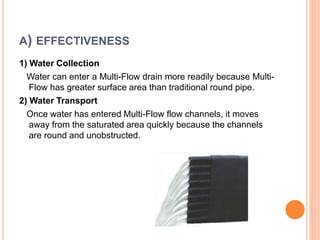
A) EFFECTIVENESS
1) Water Collection
Water can enter a Multi-Flow drain more readily because Multi-
Flow has greater surface area than traditional round pipe.
2) Water Transport
Once water has entered Multi-Flow flow channels, it moves
away from the saturated area quickly because the channels
are round and unobstructed.
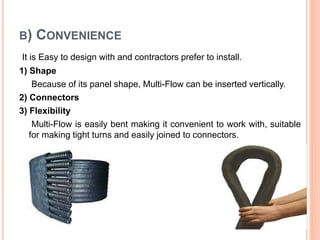
B) CONVENIENCE
It is Easy to design with and contractors prefer to install.
1) Shape
Because of its panel shape, Multi-Flow can be inserted vertically.
2) Connectors
3) Flexibility
Multi-Flow is easily bent making it convenient to work with, suitable
for making tight turns and easily joined to connectors.
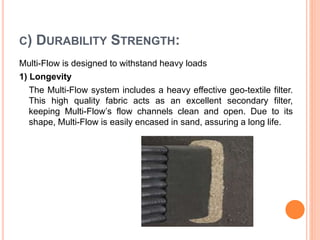
C) DURABILITY STRENGTH:
Multi-Flow is designed to withstand heavy loads
1) Longevity
The Multi-Flow system includes a heavy effective geo-textile filter.
This high quality fabric acts as an excellent secondary filter,
keeping Multi-Flow’s flow channels clean and open. Due to its
shape, Multi-Flow is easily encased in sand, assuring a long life.
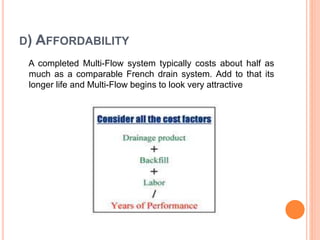
D) AFFORDABILITY
A completed Multi-Flow system typically costs about half as
much as a comparable French drain system. Add to that its
longer life and Multi-Flow begins to look very attractive
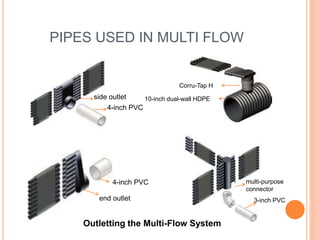
PIPES USED IN MULTI FLOW
4-inch PVC
side outlet 10-inch dual-wall HDPE
Corru-Tap H
end outlet
4-inch PVC multi-purpose
connector
3-inch PVC
Outletting the Multi-Flow System
INSTALLATION OF SYSTEM
Installing multi-flow drainage system in athletic fields:
A) Natural Turf –
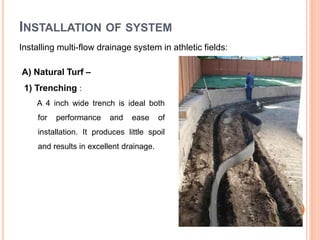
1) Trenching :
A 4 inch wide trench is ideal both
for performance and ease of
installation. It produces little spoil
and results in excellent drainage.
2) Layout Pattern :
I) Crowned Or Sloped Fields - The resulting lines would be too
long and, in order to maintain fall, excessively deep. A 45
degree angle running toward the sidelines works well because it
allows the lines to maintain grade while also intercepting the
direction of surface water flow.
II) Flat Or Irregular Fields - If the field is flat, or has less than a
.5% slope from the center, then a parallel drainage pattern may
be appropriate. Since the water will basically stand on the surface
of a flat field, there is no advantage in attempting to place
drainage lines in the flow path.
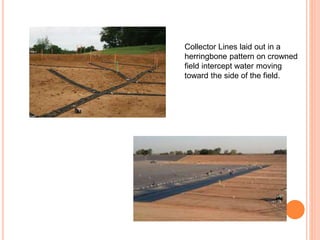
Collector Lines laid out in a
herringbone pattern on crowned
field intercept water moving
toward the side of the field.
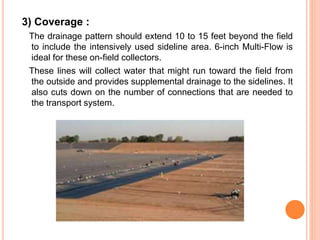
3) Coverage :
The drainage pattern should extend 10 to 15 feet beyond the field
to include the intensively used sideline area. 6-inch Multi-Flow is
ideal for these on-field collectors.
These lines will collect water that might run toward the field from
the outside and provides supplemental drainage to the sidelines. It
also cuts down on the number of connections that are needed to
the transport system.
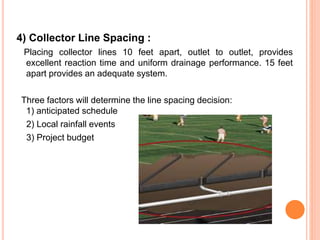
4) Collector Line Spacing :
Placing collector lines 10 feet apart, outlet to outlet, provides
excellent reaction time and uniform drainage performance. 15 feet
apart provides an adequate system.
Three factors will determine the line spacing decision:
1) anticipated schedule
2) Local rainfall events
3) Project budget
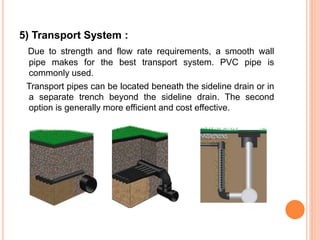
5) Transport System :
Due to strength and flow rate requirements, a smooth wall
pipe makes for the best transport system. PVC pipe is
commonly used.
Transport pipes can be located beneath the sideline drain or in
a separate trench beyond the sideline drain. The second
option is generally more efficient and cost effective.
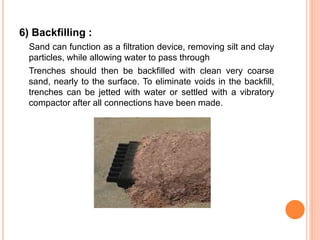
6) Backfilling :
Sand can function as a filtration device, removing silt and clay
particles, while allowing water to pass through
Trenches should then be backfilled with clean very coarse
sand, nearly to the surface. To eliminate voids in the backfill,
trenches can be jetted with water or settled with a vibratory
compactor after all connections have been made.
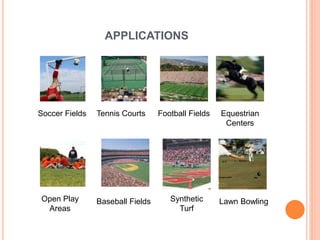
APPLICATIONS
Soccer Fields Tennis Courts Football Fields Equestrian
Centers
Open Play
Areas
Baseball Fields Synthetic
Turf
Lawn Bowling
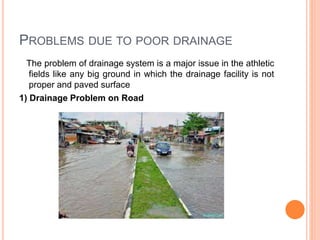
PROBLEMS DUE TO POOR DRAINAGE
The problem of drainage system is a major issue in the athletic
fields like any big ground in which the drainage facility is not
proper and paved surface
1) Drainage Problem on Road
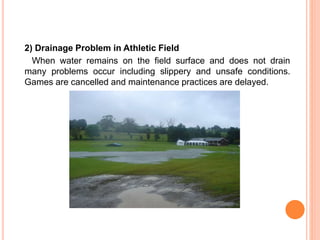
2) Drainage Problem in Athletic Field
When water remains on the field surface and does not drain
many problems occur including slippery and unsafe conditions.
Games are cancelled and maintenance practices are delayed.
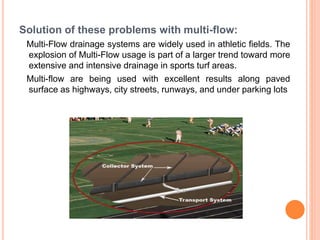
Solution of these problems with multi-flow:
Multi-Flow drainage systems are widely used in athletic fields. The
explosion of Multi-Flow usage is part of a larger trend toward more
extensive and intensive drainage in sports turf areas.
Multi-flow are being used with excellent results along paved
surface as highways, city streets, runways, and under parking lots
CONCLUSION
In this project we have tested the applications of multi flow
drainage system in the athletic fields. Firstly we analyzed the
problem related to excess storm water that makes the patches on
athletic field due to collection of water. Then we check the slope
of field on the basis of that we check the alignment of the multi-
flow drainage system that it should be horizontal or vertical.
After that we searched for layout of multi flow drainage system
and we found that 6 inch pipe connectors are the best option for
the proper drainage. Then we use the standard methods of
excavation like trenching for installation of the pipes which are
exit to main pipeline to drain out all collected water through multi-
flow drainage system. Then we check the requirement of backfill
materials.
THANK YOU

Multi-flow drainage System

  • 1.
  • 2.
    CONTENT Introduction Objectives WHY multi-flow drainagesystem? Pipes used in multi-flow Installation of system Applications Problems due to poor drainage Conclusion
  • 3.
  • 4.
    INTRODUCTION Multi-flow is ageo-composite drainage system, featuring a unique arrangement of HDPE drain pipes, wrapped in a geo-textile fabric. Multi- flow is offered in three sizes, 6.8” , 12” , and 18 inch heights. A large variety of connectors are included in the product line that will accommodate almost any drainage system configuration. Multi-flow is modular and capable of being scaled to any size, affording the designer the ability to choose the right mix of performance and cost- effectiveness.
  • 5.
    OBJECTIVES  Study ofdata and problems associated with drainage system.  To prevent and reduce water logging in the field without disturbing surface works.  To encourage measures to reuse storm water.  Efficient soil drainage ensures that water does not collect on the athletic surface.  A well drained athletic surface improves safety and playability, allows better air exchange, and improves turf grass recovery potential.
  • 6.
    WHY Multi-flow drainagesystem? Multi-Flow is a wise choice because of its: a) Effectiveness b) Convenience c) Durability d) Affordability
  • 7.
    A) EFFECTIVENESS 1) WaterCollection Water can enter a Multi-Flow drain more readily because Multi- Flow has greater surface area than traditional round pipe. 2) Water Transport Once water has entered Multi-Flow flow channels, it moves away from the saturated area quickly because the channels are round and unobstructed.
  • 8.
    B) CONVENIENCE It isEasy to design with and contractors prefer to install. 1) Shape Because of its panel shape, Multi-Flow can be inserted vertically. 2) Connectors 3) Flexibility Multi-Flow is easily bent making it convenient to work with, suitable for making tight turns and easily joined to connectors.
  • 9.
    C) DURABILITY STRENGTH: Multi-Flowis designed to withstand heavy loads 1) Longevity The Multi-Flow system includes a heavy effective geo-textile filter. This high quality fabric acts as an excellent secondary filter, keeping Multi-Flow’s flow channels clean and open. Due to its shape, Multi-Flow is easily encased in sand, assuring a long life.
  • 10.
    D) AFFORDABILITY A completedMulti-Flow system typically costs about half as much as a comparable French drain system. Add to that its longer life and Multi-Flow begins to look very attractive
  • 11.
    PIPES USED INMULTI FLOW 4-inch PVC side outlet 10-inch dual-wall HDPE Corru-Tap H end outlet 4-inch PVC multi-purpose connector 3-inch PVC Outletting the Multi-Flow System
  • 13.
    INSTALLATION OF SYSTEM Installingmulti-flow drainage system in athletic fields: A) Natural Turf – 1) Trenching : A 4 inch wide trench is ideal both for performance and ease of installation. It produces little spoil and results in excellent drainage.
  • 14.
    2) Layout Pattern: I) Crowned Or Sloped Fields - The resulting lines would be too long and, in order to maintain fall, excessively deep. A 45 degree angle running toward the sidelines works well because it allows the lines to maintain grade while also intercepting the direction of surface water flow. II) Flat Or Irregular Fields - If the field is flat, or has less than a .5% slope from the center, then a parallel drainage pattern may be appropriate. Since the water will basically stand on the surface of a flat field, there is no advantage in attempting to place drainage lines in the flow path.
  • 15.
    Collector Lines laidout in a herringbone pattern on crowned field intercept water moving toward the side of the field.
  • 16.
    3) Coverage : Thedrainage pattern should extend 10 to 15 feet beyond the field to include the intensively used sideline area. 6-inch Multi-Flow is ideal for these on-field collectors. These lines will collect water that might run toward the field from the outside and provides supplemental drainage to the sidelines. It also cuts down on the number of connections that are needed to the transport system.
  • 17.
    4) Collector LineSpacing : Placing collector lines 10 feet apart, outlet to outlet, provides excellent reaction time and uniform drainage performance. 15 feet apart provides an adequate system. Three factors will determine the line spacing decision: 1) anticipated schedule 2) Local rainfall events 3) Project budget
  • 18.
    5) Transport System: Due to strength and flow rate requirements, a smooth wall pipe makes for the best transport system. PVC pipe is commonly used. Transport pipes can be located beneath the sideline drain or in a separate trench beyond the sideline drain. The second option is generally more efficient and cost effective.
  • 19.
    6) Backfilling : Sandcan function as a filtration device, removing silt and clay particles, while allowing water to pass through Trenches should then be backfilled with clean very coarse sand, nearly to the surface. To eliminate voids in the backfill, trenches can be jetted with water or settled with a vibratory compactor after all connections have been made.
  • 20.
    APPLICATIONS Soccer Fields TennisCourts Football Fields Equestrian Centers Open Play Areas Baseball Fields Synthetic Turf Lawn Bowling
  • 21.
    PROBLEMS DUE TOPOOR DRAINAGE The problem of drainage system is a major issue in the athletic fields like any big ground in which the drainage facility is not proper and paved surface 1) Drainage Problem on Road
  • 22.
    2) Drainage Problemin Athletic Field When water remains on the field surface and does not drain many problems occur including slippery and unsafe conditions. Games are cancelled and maintenance practices are delayed.
  • 23.
    Solution of theseproblems with multi-flow: Multi-Flow drainage systems are widely used in athletic fields. The explosion of Multi-Flow usage is part of a larger trend toward more extensive and intensive drainage in sports turf areas. Multi-flow are being used with excellent results along paved surface as highways, city streets, runways, and under parking lots
  • 24.
    CONCLUSION In this projectwe have tested the applications of multi flow drainage system in the athletic fields. Firstly we analyzed the problem related to excess storm water that makes the patches on athletic field due to collection of water. Then we check the slope of field on the basis of that we check the alignment of the multi- flow drainage system that it should be horizontal or vertical. After that we searched for layout of multi flow drainage system and we found that 6 inch pipe connectors are the best option for the proper drainage. Then we use the standard methods of excavation like trenching for installation of the pipes which are exit to main pipeline to drain out all collected water through multi- flow drainage system. Then we check the requirement of backfill materials.
  • 25.