By
Bekir Kendirci
Supervised By
Dr. H. Zhu
Device-to-Device(D2D)
Communications in Cellular
Networks
CONTENT
 OVERVIEW OF DEVICE-TO-DEVICE
A.INTRODUCTION
B.ADVANTAGES
C.CHALLENGES
 OBJECTIVES OF PROJECT
 TECHNICAL ISSUES
 SCENARIO
 SIMULATION and RESULTS
 FURTHER WORKS
OVERVIEW OF DEVICE-TO-DEVICE
A.INTRODUCTION
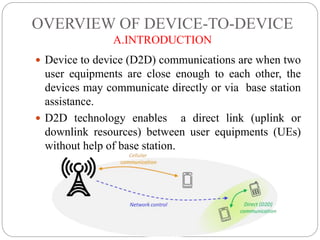
 Device to device (D2D) communications are when two
user equipments are close enough to each other, the
devices may communicate directly or via base station
assistance.
 D2D technology enables a direct link (uplink or
downlink resources) between user equipments (UEs)
without help of base station.
B.ADVANTAGES
 Efficient and improved performance for UEs such as
battery life, energy consumption.
 Lower latency can be achieved.
 Higher data rates can be achieved.
 D2D communication provides offloading in cellular
networks so workload of the base stations are reduced
thus network can be used more effectively.
 D2D can increase resource utilization and also extend
coverage of cellular network.
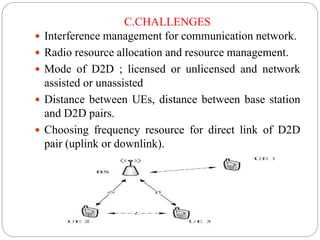
C.CHALLENGES
 Interference management for communication network.
 Radio resource allocation and resource management.
 Mode of D2D ; licensed or unlicensed and network
assisted or unassisted
 Distance between UEs, distance between base station
and D2D pairs.
 Choosing frequency resource for direct link of D2D
pair (uplink or downlink).
OBJECTIVES OF PROJECT
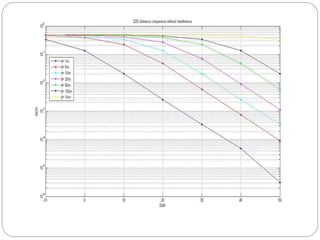
 Measuring efficiency of D2D performance.
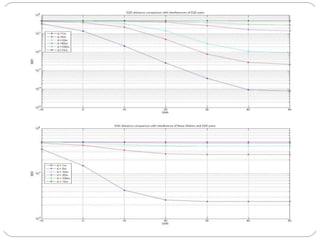
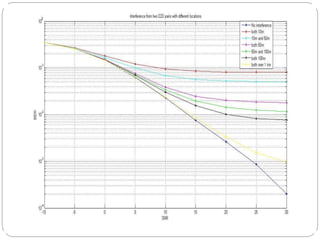
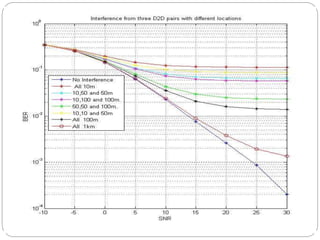
 D2D performance without and with interferences from
each other and base station.
 Radio resource management: comparison of dowlink
and uplink resources for D2D direct link.
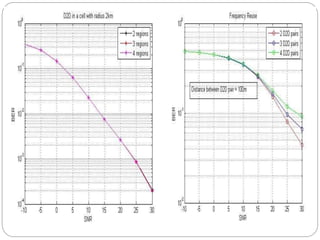
 Frequency reuse for D2D pairs in the cell by diving
cell into sectors.
TECHNICAL ISSUES
 Orthoganal Freqeuncy Division Muliplex (OFDM)
with 256-fft is used .
 Quadrature Amplitude Modulation(QAM) with 4,16
and 64 modulation orders.
 Fading Rayleigh is used as channel
 One cell scenario with D2D pairs, base station and
cellular user.
 Interference from D2D pairs, base station and cellular
user.
 Downlink and uplink frequency resources.
 Sample time is 5.21 us.
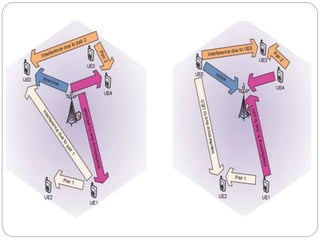
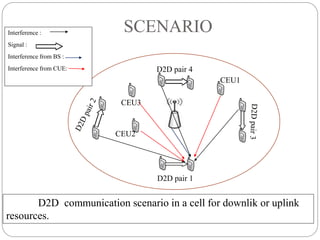
SCENARIO
D2D pair 1
D2D pair 4
CEU1
CEU2
CEU3
Interference :
Signal :
Interference from BS :
Interference from CUE:
D2D communication scenario in a cell for downlik or uplink
resources.
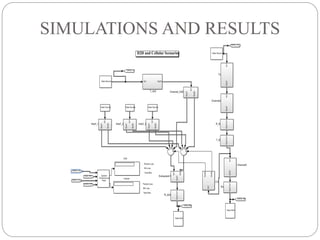
SIMULATIONS AND RESULTS
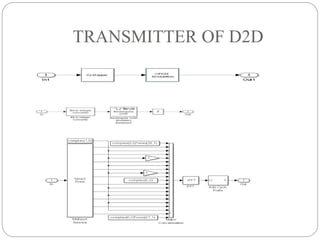
TRANSMITTER OF D2D
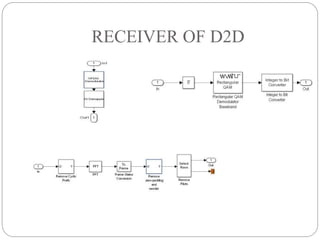
RECEIVER OF D2D
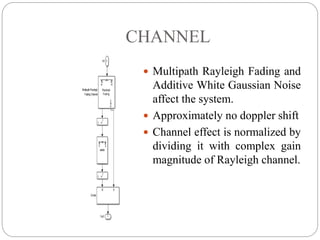
CHANNEL
 Multipath Rayleigh Fading and
Additive White Gaussian Noise
affect the system.
 Approximately no doppler shift
 Channel effect is normalized by
dividing it with complex gain
magnitude of Rayleigh channel.
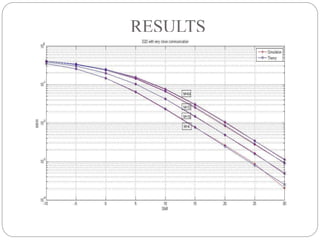
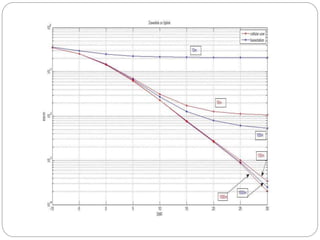
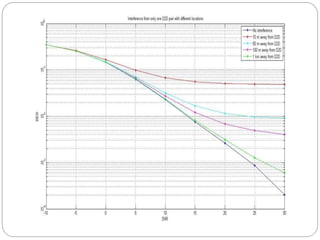
RESULTS
FURTHER WORKS
 D2D communication can be examined by more
cell scenarios.
 D2D devices can be combined with difference
technologies such as MIMO.
 More realistic number of users and scenarios can
be built.
 Different enviroments can be examined instead of
using Rayleigh Channel, for example Nakagami
Channel can be used
 Adaptive modulation techniques can be added to
model.

D2DCommunication

  • 1.
    By Bekir Kendirci Supervised By Dr.H. Zhu Device-to-Device(D2D) Communications in Cellular Networks
  • 2.
    CONTENT  OVERVIEW OFDEVICE-TO-DEVICE A.INTRODUCTION B.ADVANTAGES C.CHALLENGES  OBJECTIVES OF PROJECT  TECHNICAL ISSUES  SCENARIO  SIMULATION and RESULTS  FURTHER WORKS
  • 3.
    OVERVIEW OF DEVICE-TO-DEVICE A.INTRODUCTION Device to device (D2D) communications are when two user equipments are close enough to each other, the devices may communicate directly or via base station assistance.  D2D technology enables a direct link (uplink or downlink resources) between user equipments (UEs) without help of base station.
  • 4.
    B.ADVANTAGES  Efficient andimproved performance for UEs such as battery life, energy consumption.  Lower latency can be achieved.  Higher data rates can be achieved.  D2D communication provides offloading in cellular networks so workload of the base stations are reduced thus network can be used more effectively.  D2D can increase resource utilization and also extend coverage of cellular network.
  • 5.
    C.CHALLENGES  Interference managementfor communication network.  Radio resource allocation and resource management.  Mode of D2D ; licensed or unlicensed and network assisted or unassisted  Distance between UEs, distance between base station and D2D pairs.  Choosing frequency resource for direct link of D2D pair (uplink or downlink).
  • 7.
    OBJECTIVES OF PROJECT Measuring efficiency of D2D performance.  D2D performance without and with interferences from each other and base station.  Radio resource management: comparison of dowlink and uplink resources for D2D direct link.  Frequency reuse for D2D pairs in the cell by diving cell into sectors.
  • 8.
    TECHNICAL ISSUES  OrthoganalFreqeuncy Division Muliplex (OFDM) with 256-fft is used .  Quadrature Amplitude Modulation(QAM) with 4,16 and 64 modulation orders.  Fading Rayleigh is used as channel  One cell scenario with D2D pairs, base station and cellular user.  Interference from D2D pairs, base station and cellular user.  Downlink and uplink frequency resources.  Sample time is 5.21 us.
  • 9.
    SCENARIO D2D pair 1 D2Dpair 4 CEU1 CEU2 CEU3 Interference : Signal : Interference from BS : Interference from CUE: D2D communication scenario in a cell for downlik or uplink resources.
  • 10.
  • 11.
  • 12.
  • 13.
    CHANNEL  Multipath RayleighFading and Additive White Gaussian Noise affect the system.  Approximately no doppler shift  Channel effect is normalized by dividing it with complex gain magnitude of Rayleigh channel.
  • 14.
  • 22.
    FURTHER WORKS  D2Dcommunication can be examined by more cell scenarios.  D2D devices can be combined with difference technologies such as MIMO.  More realistic number of users and scenarios can be built.  Different enviroments can be examined instead of using Rayleigh Channel, for example Nakagami Channel can be used  Adaptive modulation techniques can be added to model.

Editor's Notes

  • #4 Device to Device, D2D, is currently being specified by 3GPP in LTE Rel-12. D2D is also recognized as one of the technology components of the evolving 5G architecture. So, what is D2D?