HSPA essentials
Content
• WCDMA BASICS
• HSDPA In general
• HSUPA
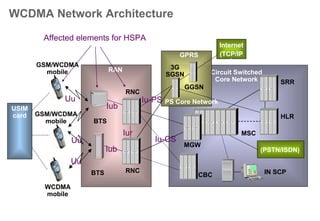
WCDMA Network Architecture
Circuit Switched
Core Network
GGSN
3G
SGSN
GPRS
USIM
card
WCDMA
mobile
GSM/WCDMA
mobile
RAN
BTS
BTS
RNC
RNC
MSC
HLR
MGW
IN SCP
SRR
PS Core Network
(PSTN/ISDN)
Internet
(TCP/IP
)
GSM/WCDMA
mobile
CBC
Affected elements for HSPA
Iu-CS
Iu-PS
Iur
Iub
Iub
Uu
Uu
Uu
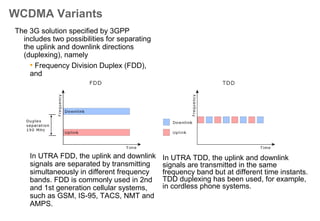
WCDMA Variants
The 3G solution specified by 3GPP
includes two possibilities for separating
the uplink and downlink directions
(duplexing), namely
• Frequency Division Duplex (FDD),
and
• Time Division Duplex (TDD).
In UTRA FDD, the uplink and downlink
signals are separated by transmitting
simultaneously in different frequency
bands. FDD is commonly used in 2nd
and 1st generation cellular systems,
such as GSM, IS-95, TACS, NMT and
AMPS.
In UTRA TDD, the uplink and downlink
signals are transmitted in the same
frequency band but at different time instants.
TDD duplexing has been used, for example,
in cordless phone systems.
Frame
10ms frame
15 time slots (2/3ms each)
TTI = Transmission Time Interval
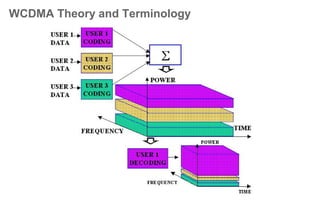
WCDMA Theory and Terminology
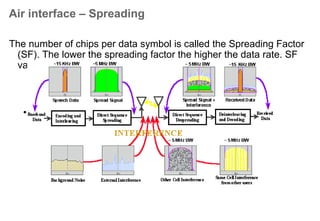
Air interface – Spreading
The number of chips per data symbol is called the Spreading Factor
(SF). The lower the spreading factor the higher the data rate. SF
value varies in FDD from 4 to 512.
•
                                                                                                    
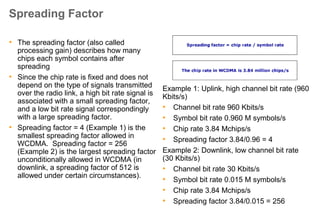
Spreading Factor
• The spreading factor (also called
processing gain) describes how many
chips each symbol contains after
spreading
• Since the chip rate is fixed and does not
depend on the type of signals transmitted
over the radio link, a high bit rate signal is
associated with a small spreading factor,
and a low bit rate signal correspondingly
with a large spreading factor.
• Spreading factor = 4 (Example 1) is the
smallest spreading factor allowed in
WCDMA. Spreading factor = 256
(Example 2) is the largest spreading factor
unconditionally allowed in WCDMA (in
downlink, a spreading factor of 512 is
allowed under certain circumstances).
Example 1: Uplink, high channel bit rate (960
Kbits/s)
• Channel bit rate 960 Kbits/s
• Symbol bit rate 0.960 M symbols/s
• Chip rate 3.84 Mchips/s
• Spreading factor 3.84/0.96 = 4
Example 2: Downlink, low channel bit rate
(30 Kbits/s)
• Channel bit rate 30 Kbits/s
• Symbol bit rate 0.015 M symbols/s
• Chip rate 3.84 Mchips/s
• Spreading factor 3.84/0.015 = 256
Channelisation codes
• Channelisation codes are very
important in downlink, since they are
used for multiplexing (at the
transmitter) and separating (at the
receiver) the signals intended for
different terminals.
• In uplink, channelisation codes are
used for multiplexing the data and
control channel (DPDCH and
DPCCH) signals transmitted from a
single terminal.
• In both directions, the channelisation
codes are employed for spreading the
channel bits to the final chip rate of
3.84 Mchips/s.
• The required bit rate - and thus the
spreading factor - of some services
may change over time. The
transmitter takes care of changes in
the spreading factor among others by
changing the channelisation code.
• The channelisation codes are based
on the Orthogonal Variable Spreading
Factor (OVSF) technique, which
allows the spreading factor to be
changed without disrupting the
orthogonality between different codes
of different lengths simultaneously in
use.
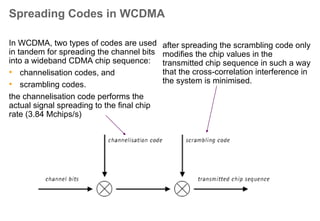
Spreading Codes in WCDMA
In WCDMA, two types of codes are used
in tandem for spreading the channel bits
into a wideband CDMA chip sequence:
• channelisation codes, and
• scrambling codes.
the channelisation code performs the
actual signal spreading to the final chip
rate (3.84 Mchips/s)
after spreading the scrambling code only
modifies the chip values in the
transmitted chip sequence in such a way
that the cross-correlation interference in
the system is minimised.
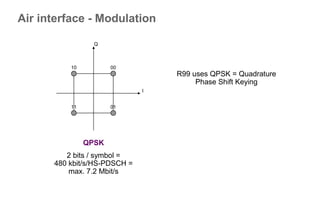
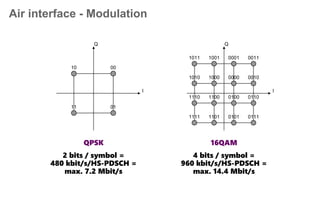
Air interface - Modulation
QPSK
2 bits / symbol =
480 kbit/s/HS-PDSCH =
max. 7.2 Mbit/s
10 00
0111
Q
I
R99 uses QPSK = Quadrature
Phase Shift Keying
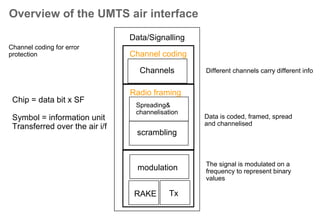
Overview of the UMTS air interface
Channel coding
Channels
scrambling
RAKE
modulation
Tx
Radio framing
Spreading&
channelisation
Channels
Data/Signalling
Channel coding for error
protection
Different channels carry different info
Data is coded, framed, spread
and channelised
The signal is modulated on a
frequency to represent binary
values
Chip = data bit x SF
Symbol = information unit
Transferred over the air i/f
Multipath and RAKE receivers
One of the main advantages of CDMA systems is the capability of using signals
that arrive in the receivers with different time delays. This phenomenon is called
multipath.
Due to its wide bandwidth and rake receivers, CDMA uses the multipath signals
and combines them to make an even stronger signal at the receivers.
Rake receivers - set of several receivers/fingers. One finger constantly searches
for different multipaths and feeds the information to the other three fingers. Each
finger then demodulates the signal corresponding to a strong multipath. The results
are then combined together to make the signal stronger.
combining techniques:
selection, equal gain combining, maximal ratio combining
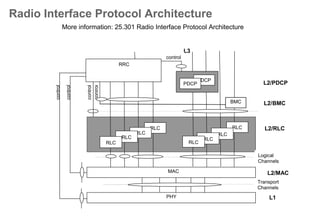
Radio Interface Protocol Architecture
More information: 25.301 Radio Interface Protocol Architecture
L3
control
control
control
control
Logical
Channels
Transport
Channels
PHY
L2/MAC
L1
RLC L2/RLC
MAC
RLC
RLC
RLC
RLC
RLC
RLC
RLC
BMC L2/BMC
RRC
control
PDCP
PDCP L2/PDCP
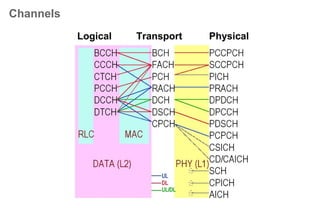
Channels
Logical Transport Physical
HSDPA in General
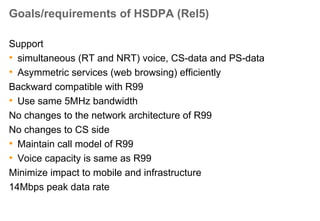
Goals/requirements of HSDPA (Rel5)
Support
• simultaneous (RT and NRT) voice, CS-data and PS-data
• Asymmetric services (web browsing) efficiently
Backward compatible with R99
• Use same 5MHz bandwidth
No changes to the network architecture of R99
No changes to CS side
• Maintain call model of R99
• Voice capacity is same as R99
Minimize impact to mobile and infrastructure
14Mbps peak data rate
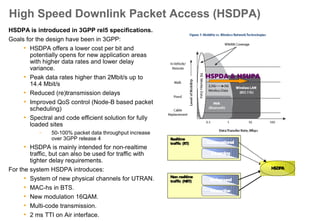
HSDPA is introduced in 3GPP rel5 specifications.
Goals for the design have been in 3GPP:
• HSDPA offers a lower cost per bit and
potentially opens for new application areas
with higher data rates and lower delay
variance.
• Peak data rates higher than 2Mbit/s up to
14.4 Mbit/s
• Reduced (re)transmission delays
• Improved QoS control (Node-B based packet
scheduling)
• Spectral and code efficient solution for fully
loaded sites
– 50-100% packet data throughput increase
over 3GPP release 4
• HSDPA is mainly intended for non-realtime
traffic, but can also be used for traffic with
tighter delay requirements.
For the system HSDPA introduces:
• System of new physical channels for UTRAN.
• MAC-hs in BTS.
• New modulation 16QAM.
• Multi-code transmission.
• 2 ms TTI on Air interface.
HSPDA & HSUPA
Conversational
Streaming
Background
Interactive
Realtime
traffic (RT)
Non-realtime
traffic (NRT)
HSDPA
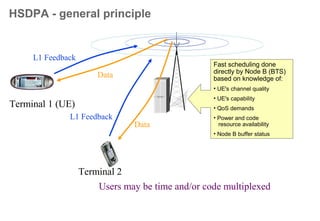
High Speed Downlink Packet Access (HSDPA)
Terminal 1 (UE)
Terminal 2
L1 Feedback
L1 Feedback
Data
Data
Fast scheduling done
directly by Node B (BTS)
based on knowledge of:
• UE's channel quality
• UE's capability
• QoS demands
• Power and code
resource availability
• Node B buffer status
Users may be time and/or code multiplexed
HSDPA - general principle
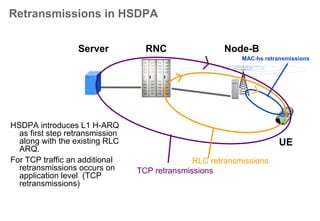
Server RNC Node-B
UE
RLC retransmissions
TCP retransmissions
MAC-hs retransmissions
HSDPA introduces L1 H-ARQ
as first step retransmission
along with the existing RLC
ARQ.
For TCP traffic an additional
retransmissions occurs on
application level (TCP
retransmissions)
Retransmissions in HSDPA
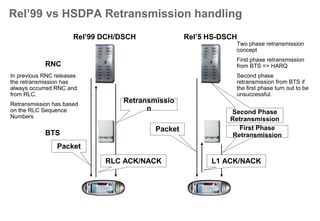
BTS
RNC
Rel’99 DCH/DSCH Rel’5 HS-DSCH
Packet
Retransmissio
n
RLC ACK/NACK
First Phase
Retransmission
L1 ACK/NACK
Packet
In previous RNC releases
the retransmission has
always occurred RNC and
from RLC.
Retransmission has based
on the RLC Sequence
Numbers
Second Phase
Retransmission
Two phase retransmission
concept
First phase retransmission
from BTS => HARQ
Second phase
retransmission from BTS if
the first phase turn out to be
unsuccessful.
Rel’99 vs HSDPA Retransmission handling
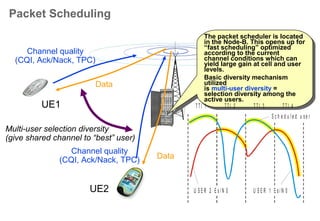
UE2
Channel quality
(CQI, Ack/Nack, TPC)
Channel quality
(CQI, Ack/Nack, TPC)
Data
Data
UE1
The packet scheduler is located
in the Node-B. This opens up for
“fast scheduling” optimized
according to the current
channel conditions which can
yield large gain at cell and user
levels.
Basic diversity mechanism
utilized
is multi-user diversity =
selection diversity among the
active users.
The packet scheduler is located
in the Node-B. This opens up for
“fast scheduling” optimized
according to the current
channel conditions which can
yield large gain at cell and user
levels.
Basic diversity mechanism
utilized
is multi-user diversity =
selection diversity among the
active users.
Multi-user selection diversity
(give shared channel to “best” user)
T T I 1 T T I 2 T T I 3 T T I 4
U S E R 1 E s / N 0U S E R 2 E s / N 0
S c h e d u l e d u s e r
Packet Scheduling
QPSK
2 bits / symbol =
480 kbit/s/HS-PDSCH =
max. 7.2 Mbit/s
16QAM
4 bits / symbol =
960 kbit/s/HS-PDSCH =
max. 14.4 Mbit/s
1011 1001
10001010
0001 0011
00100000
0100 0110
01110101
1110 1100
11011111
Q
I
10 00
0111
Q
I
Air interface - Modulation
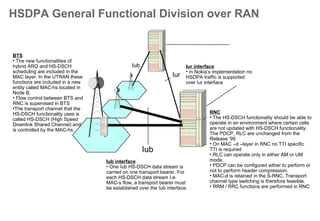
Iub
Iur
Iub
RNC
• The HS-DSCH functionality should be able to
operate in an environment where certain cells
are not updated with HS-DSCH functionality.
The PDCP, RLC are unchanged from the
Release '99
• On MAC –d –layer in RNC no TTI specific
TTI is required
•.RLC can operate only in either AM or UM
mode.
• PDCP can be configured either to perform or
not to perform header compression.
• MAC-d is retained in the S-RNC. Transport
channel type switching is therefore feasible.
• RRM / RRC functions are performed in RNC
BTS
• The new functionalities of
hybrid ARQ and HS-DSCH
scheduling are included in the
MAC layer. In the UTRAN these
functions are included in a new
entity called MAC-hs located in
Node B.
• Flow control between BTS and
RNC is supervised in BTS
•The transport channel that the
HS-DSCH functionality uses is
called HS-DSCH (High Speed
Downlink Shared Channel) and
is controlled by the MAC-hs.
Iub interface
• One Iub HS-DSCH data stream is
carried on one transport bearer. For
each HS-DSCH data stream I.e.
MAC-s flow, a transport bearer must
be established over the Iub interface.
Iur interface
• in Nokia’s implementation no
HSDPA traffic is supported
over Iur interface
HSDPA General Functional Division over RAN
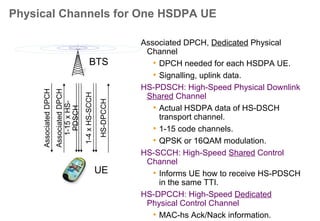
Associated DPCH, Dedicated Physical
Channel
• DPCH needed for each HSDPA UE.
• Signalling, uplink data.
HS-PDSCH: High-Speed Physical Downlink
Shared Channel
• Actual HSDPA data of HS-DSCH
transport channel.
• 1-15 code channels.
• QPSK or 16QAM modulation.
HS-SCCH: High-Speed Shared Control
Channel
• Informs UE how to receive HS-PDSCH
in the same TTI.
HS-DPCCH: High-Speed Dedicated
Physical Control Channel
• MAC-hs Ack/Nack information.
UE
BTS
AssociatedDPCH
AssociatedDPCH
1-15xHS-
PDSCH
1-4xHS-SCCH
HS-DPCCH
Physical Channels for One HSDPA UE
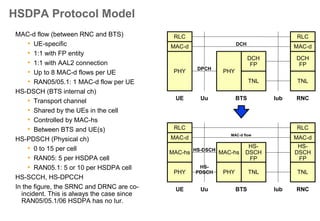
MAC-d flow (between RNC and BTS)
• UE-specific
• 1:1 with FP entity
• 1:1 with AAL2 connection
• Up to 8 MAC-d flows per UE
• RAN05/05.1: 1 MAC-d flow per UE
HS-DSCH (BTS internal ch)
• Transport channel
• Shared by the UEs in the cell
• Controlled by MAC-hs
• Between BTS and UE(s)
HS-PDSCH (Physical ch)
• 0 to 15 per cell
• RAN05: 5 per HSDPA cell
• RAN05.1: 5 or 10 per HSDPA cell
HS-SCCH, HS-DPCCH
In the figure, the SRNC and DRNC are co-
incident. This is always the case since
RAN05/05.1/06 HSDPA has no Iur.
TNL
MAC-d
DCH
FP
DCH
FP
MAC-d
TNL
BTS Iub RNC
RLC RLC
MAC-hs
PHY PHY TNL
MAC-d
MAC-hs
HS-
DSCH
FP
HS-
DSCH
FP
MAC-d
TNL
UE Uu BTS Iub RNC
RLC RLC
MAC-d flow
HS-DSCH
PHY PHY
UE Uu
DCH
DPCH
HS-
PDSCH
HSDPA Protocol Model
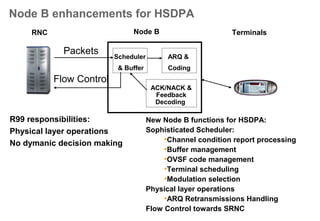
TerminalsNode BRNC
Packets
Scheduler
& Buffer
ARQ &
Coding
ACK/NACK &
Feedback
Decoding
Flow Control
Node B enhancements for HSDPA
R99 responsibilities:
Physical layer operations
No dymanic decision making
New Node B functions for HSDPA:
Sophisticated Scheduler:
•Channel condition report processing
•Buffer management
•OVSF code management
•Terminal scheduling
•Modulation selection
Physical layer operations
•ARQ Retransmissions Handling
Flow Control towards SRNC
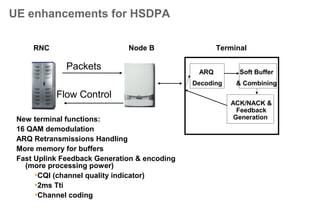
TerminalNode BRNC
Packets ARQ
Decoding
Soft Buffer
& Combining
ACK/NACK &
Feedback
Generation
Flow Control
UE enhancements for HSDPA
New terminal functions:
16 QAM demodulation
ARQ Retransmissions Handling
More memory for buffers
Fast Uplink Feedback Generation & encoding
(more processing power)
•CQI (channel quality indicator)
•2ms Tti
•Channel coding
HSUPA
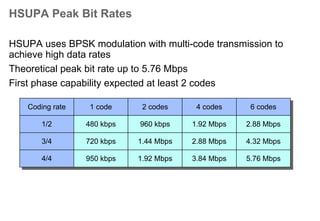
HSUPA Peak Bit Rates
HSUPA uses BPSK modulation with multi-code transmission to
achieve high data rates
Theoretical peak bit rate up to 5.76 Mbps
First phase capability expected at least 2 codes
Coding rateCoding rate
1/21/2
3/43/4
4/44/4
1 code1 code 2 codes2 codes 4 codes4 codes 6 codes6 codes
480 kbps480 kbps 960 kbps960 kbps 1.92 Mbps1.92 Mbps 2.88 Mbps2.88 Mbps
720 kbps720 kbps 1.44 Mbps1.44 Mbps 2.88 Mbps2.88 Mbps 4.32 Mbps4.32 Mbps
950 kbps950 kbps 1.92 Mbps1.92 Mbps 3.84 Mbps3.84 Mbps 5.76 Mbps5.76 Mbps
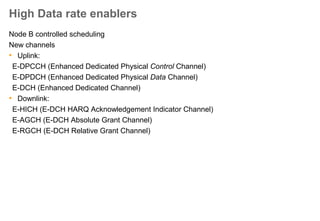
High Data rate enablers
Node B controlled scheduling
New channels
• Uplink:
E-DPCCH (Enhanced Dedicated Physical Control Channel)
E-DPDCH (Enhanced Dedicated Physical Data Channel)
E-DCH (Enhanced Dedicated Channel)
• Downlink:
E-HICH (E-DCH HARQ Acknowledgement Indicator Channel)
E-AGCH (E-DCH Absolute Grant Channel)
E-RGCH (E-DCH Relative Grant Channel)
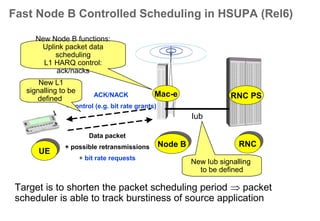
Fast Node B Controlled Scheduling in HSUPA (Rel6)
Target is to shorten the packet scheduling period  packet
scheduler is able to track burstiness of source application
Data packet
+ possible retransmissions
+ bit rate requests
ACK/NACK
+ control (e.g. bit rate grants)
Node BNode B RNCRNC
UEUE
Iub
RNC PS
Iub
Mac-e
New Node B functions:
Uplink packet data
scheduling
L1 HARQ control:
ack/nacks
New Iub signalling
to be defined
New L1
signalling to be
defined
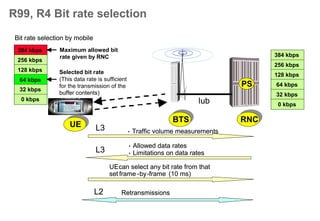
R99, R4 Bit rate selection
BTSBTS RNCRNCUEUE
Iub
PS
Iub
Selected bit rate
(This data rate is sufficient
for the transmission of the
buffer contents)
Maximum allowed bit
rate given by RNC
UEcan select any bit rate from that
set frame -by-frame (10 ms)
• Allowed data rates
• Limitations on data rates
• Traffic volume measurementsL3
L3
384 kbps
256 kbps
128 kbps
64 kbps
32 kbps
0 kbps
Bit rate selection by mobile
384 kbps
256 kbps
128 kbps
64 kbps
32 kbps
0 kbps
RetransmissionsL2
BTSBTS RNCRNCUEUE
Iub
PS
Iub
PS
Iub
Selected bit rate
(This data rate is sufficient
for the transmission of the
buffer contents)
Maximum allowed bit
rate given by RNC
UEcan select any bit rate from that
set frame -by-frame (10 ms)
• Allowed data rates
• Limitations on data rates
• Traffic volume measurementsL3
L3
384 kbps
256 kbps
128 kbps
64 kbps
32 kbps
0 kbps
Bit rate selection by mobile
384 kbps
256 kbps
128 kbps
64 kbps
32 kbps
0 kbps
RetransmissionsL2
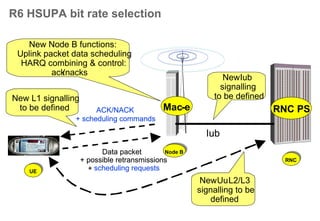
R6 HSUPA bit rate selection
Data packet
+ possible retransmissions
+ scheduling requests
ACK/NACK
+ scheduling commands
Iub
RNC PS
Iub
Mac-e
New Node B functions:
Uplink packet data scheduling
HARQ combining & control:
ack/nacks
NewIub
signalling
to be definedNew L1 signalling
to be defined
NewUuL2/L3
signalling to be
defined
UEUE
Node BNode B
RNCRNC
Data packet
+ possible retransmissions
+ scheduling requests
ACK/NACK
+ scheduling commands
Iub
RNC PS
Iub
Mac-e
New Node B functions:
Uplink packet data scheduling
HARQ combining & control:
ack/nacks
NewIub
signalling
to be definedNew L1 signalling
to be defined
NewUuL2/L3
signalling to be
defined
UEUE
Node BNode B
RNCRNC
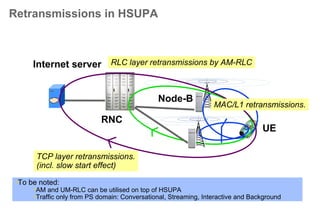
Internet server
RNC
Node-B
UE
RLC layer retransmissions by AM-RLC
TCP layer retransmissions.
(incl. slow start effect)
MAC/L1 retransmissions.
•To be noted:
•AM and UM-RLC can be utilised on top of HSUPA
•Traffic only from PS domain: Conversational, Streaming, Interactive and Background
Retransmissions in HSUPA
New channels for HSUPA
Physical channels
• Uplink:
E-DPCCH (Enhanced Dedicated Physical Control Channel)
and
E-DPDCH (Enhanced Dedicated Physical Data Channel)
– Code multiplexed with current Rel99 physical channels (DPDCH, DPCCH)
– Sent with a power offset relative to the DPCCH
• Downlink:
E-HICH (E-DCH HARQ Acknowledgement Indicator Channel)
E-AGCH (E-DCH Absolute Grant Channel)
E-RGCH (E-DCH Relative Grant Channel)
Transport channel
• E-DCH (Enhanced Dedicated Channel)
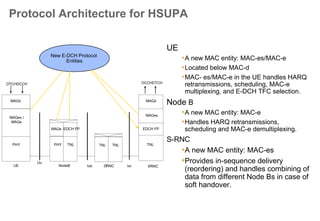
Protocol Architecture for HSUPA
UE
•A new MAC entity: MAC-es/MAC-e
•Located below MAC-d
•MAC- es/MAC-e in the UE handles HARQ
retransmissions, scheduling, MAC-e
multiplexing, and E-DCH TFC selection.
Node B
•A new MAC entity: MAC-e
•Handles HARQ retransmissions,
scheduling and MAC-e demultiplexing.
S-RNC
•A new MAC entity: MAC-es
•Provides in-sequence delivery
(reordering) and handles combining of
data from different Node Bs in case of
soft handover.
New E-DCH Protocol
Entities
PHY PHY
EDCH FP EDCH FP
IubUE NodeB
Uu
DCCHDTCH
TNL TNL
DTCHDCCH
MAC-e
SRNC
MAC-d
MAC-e
MAC-d
MAC-es /
MAC-e
MAC-es
Iur
TNL TNL
DRNC

HSPA Essentials

  • 1.
  • 2.
    Content • WCDMA BASICS •HSDPA In general • HSUPA
  • 3.
    WCDMA Network Architecture CircuitSwitched Core Network GGSN 3G SGSN GPRS USIM card WCDMA mobile GSM/WCDMA mobile RAN BTS BTS RNC RNC MSC HLR MGW IN SCP SRR PS Core Network (PSTN/ISDN) Internet (TCP/IP ) GSM/WCDMA mobile CBC Affected elements for HSPA Iu-CS Iu-PS Iur Iub Iub Uu Uu Uu
  • 4.
    WCDMA Variants The 3Gsolution specified by 3GPP includes two possibilities for separating the uplink and downlink directions (duplexing), namely • Frequency Division Duplex (FDD), and • Time Division Duplex (TDD). In UTRA FDD, the uplink and downlink signals are separated by transmitting simultaneously in different frequency bands. FDD is commonly used in 2nd and 1st generation cellular systems, such as GSM, IS-95, TACS, NMT and AMPS. In UTRA TDD, the uplink and downlink signals are transmitted in the same frequency band but at different time instants. TDD duplexing has been used, for example, in cordless phone systems.
  • 5.
    Frame 10ms frame 15 timeslots (2/3ms each) TTI = Transmission Time Interval
  • 6.
    WCDMA Theory andTerminology
  • 7.
    Air interface –Spreading The number of chips per data symbol is called the Spreading Factor (SF). The lower the spreading factor the higher the data rate. SF value varies in FDD from 4 to 512. •                                                                                                     
  • 8.
    Spreading Factor • Thespreading factor (also called processing gain) describes how many chips each symbol contains after spreading • Since the chip rate is fixed and does not depend on the type of signals transmitted over the radio link, a high bit rate signal is associated with a small spreading factor, and a low bit rate signal correspondingly with a large spreading factor. • Spreading factor = 4 (Example 1) is the smallest spreading factor allowed in WCDMA. Spreading factor = 256 (Example 2) is the largest spreading factor unconditionally allowed in WCDMA (in downlink, a spreading factor of 512 is allowed under certain circumstances). Example 1: Uplink, high channel bit rate (960 Kbits/s) • Channel bit rate 960 Kbits/s • Symbol bit rate 0.960 M symbols/s • Chip rate 3.84 Mchips/s • Spreading factor 3.84/0.96 = 4 Example 2: Downlink, low channel bit rate (30 Kbits/s) • Channel bit rate 30 Kbits/s • Symbol bit rate 0.015 M symbols/s • Chip rate 3.84 Mchips/s • Spreading factor 3.84/0.015 = 256
  • 9.
    Channelisation codes • Channelisationcodes are very important in downlink, since they are used for multiplexing (at the transmitter) and separating (at the receiver) the signals intended for different terminals. • In uplink, channelisation codes are used for multiplexing the data and control channel (DPDCH and DPCCH) signals transmitted from a single terminal. • In both directions, the channelisation codes are employed for spreading the channel bits to the final chip rate of 3.84 Mchips/s. • The required bit rate - and thus the spreading factor - of some services may change over time. The transmitter takes care of changes in the spreading factor among others by changing the channelisation code. • The channelisation codes are based on the Orthogonal Variable Spreading Factor (OVSF) technique, which allows the spreading factor to be changed without disrupting the orthogonality between different codes of different lengths simultaneously in use.
  • 10.
    Spreading Codes inWCDMA In WCDMA, two types of codes are used in tandem for spreading the channel bits into a wideband CDMA chip sequence: • channelisation codes, and • scrambling codes. the channelisation code performs the actual signal spreading to the final chip rate (3.84 Mchips/s) after spreading the scrambling code only modifies the chip values in the transmitted chip sequence in such a way that the cross-correlation interference in the system is minimised.
  • 11.
    Air interface -Modulation QPSK 2 bits / symbol = 480 kbit/s/HS-PDSCH = max. 7.2 Mbit/s 10 00 0111 Q I R99 uses QPSK = Quadrature Phase Shift Keying
  • 12.
    Overview of theUMTS air interface Channel coding Channels scrambling RAKE modulation Tx Radio framing Spreading& channelisation Channels Data/Signalling Channel coding for error protection Different channels carry different info Data is coded, framed, spread and channelised The signal is modulated on a frequency to represent binary values Chip = data bit x SF Symbol = information unit Transferred over the air i/f
  • 13.
    Multipath and RAKEreceivers One of the main advantages of CDMA systems is the capability of using signals that arrive in the receivers with different time delays. This phenomenon is called multipath. Due to its wide bandwidth and rake receivers, CDMA uses the multipath signals and combines them to make an even stronger signal at the receivers. Rake receivers - set of several receivers/fingers. One finger constantly searches for different multipaths and feeds the information to the other three fingers. Each finger then demodulates the signal corresponding to a strong multipath. The results are then combined together to make the signal stronger. combining techniques: selection, equal gain combining, maximal ratio combining
  • 14.
    Radio Interface ProtocolArchitecture More information: 25.301 Radio Interface Protocol Architecture L3 control control control control Logical Channels Transport Channels PHY L2/MAC L1 RLC L2/RLC MAC RLC RLC RLC RLC RLC RLC RLC BMC L2/BMC RRC control PDCP PDCP L2/PDCP
  • 15.
  • 16.
  • 17.
    Goals/requirements of HSDPA(Rel5) Support • simultaneous (RT and NRT) voice, CS-data and PS-data • Asymmetric services (web browsing) efficiently Backward compatible with R99 • Use same 5MHz bandwidth No changes to the network architecture of R99 No changes to CS side • Maintain call model of R99 • Voice capacity is same as R99 Minimize impact to mobile and infrastructure 14Mbps peak data rate
  • 18.
    HSDPA is introducedin 3GPP rel5 specifications. Goals for the design have been in 3GPP: • HSDPA offers a lower cost per bit and potentially opens for new application areas with higher data rates and lower delay variance. • Peak data rates higher than 2Mbit/s up to 14.4 Mbit/s • Reduced (re)transmission delays • Improved QoS control (Node-B based packet scheduling) • Spectral and code efficient solution for fully loaded sites – 50-100% packet data throughput increase over 3GPP release 4 • HSDPA is mainly intended for non-realtime traffic, but can also be used for traffic with tighter delay requirements. For the system HSDPA introduces: • System of new physical channels for UTRAN. • MAC-hs in BTS. • New modulation 16QAM. • Multi-code transmission. • 2 ms TTI on Air interface. HSPDA & HSUPA Conversational Streaming Background Interactive Realtime traffic (RT) Non-realtime traffic (NRT) HSDPA High Speed Downlink Packet Access (HSDPA)
  • 19.
    Terminal 1 (UE) Terminal2 L1 Feedback L1 Feedback Data Data Fast scheduling done directly by Node B (BTS) based on knowledge of: • UE's channel quality • UE's capability • QoS demands • Power and code resource availability • Node B buffer status Users may be time and/or code multiplexed HSDPA - general principle
  • 20.
    Server RNC Node-B UE RLCretransmissions TCP retransmissions MAC-hs retransmissions HSDPA introduces L1 H-ARQ as first step retransmission along with the existing RLC ARQ. For TCP traffic an additional retransmissions occurs on application level (TCP retransmissions) Retransmissions in HSDPA
  • 21.
    BTS RNC Rel’99 DCH/DSCH Rel’5HS-DSCH Packet Retransmissio n RLC ACK/NACK First Phase Retransmission L1 ACK/NACK Packet In previous RNC releases the retransmission has always occurred RNC and from RLC. Retransmission has based on the RLC Sequence Numbers Second Phase Retransmission Two phase retransmission concept First phase retransmission from BTS => HARQ Second phase retransmission from BTS if the first phase turn out to be unsuccessful. Rel’99 vs HSDPA Retransmission handling
  • 22.
    UE2 Channel quality (CQI, Ack/Nack,TPC) Channel quality (CQI, Ack/Nack, TPC) Data Data UE1 The packet scheduler is located in the Node-B. This opens up for “fast scheduling” optimized according to the current channel conditions which can yield large gain at cell and user levels. Basic diversity mechanism utilized is multi-user diversity = selection diversity among the active users. The packet scheduler is located in the Node-B. This opens up for “fast scheduling” optimized according to the current channel conditions which can yield large gain at cell and user levels. Basic diversity mechanism utilized is multi-user diversity = selection diversity among the active users. Multi-user selection diversity (give shared channel to “best” user) T T I 1 T T I 2 T T I 3 T T I 4 U S E R 1 E s / N 0U S E R 2 E s / N 0 S c h e d u l e d u s e r Packet Scheduling
  • 23.
    QPSK 2 bits /symbol = 480 kbit/s/HS-PDSCH = max. 7.2 Mbit/s 16QAM 4 bits / symbol = 960 kbit/s/HS-PDSCH = max. 14.4 Mbit/s 1011 1001 10001010 0001 0011 00100000 0100 0110 01110101 1110 1100 11011111 Q I 10 00 0111 Q I Air interface - Modulation
  • 24.
    Iub Iur Iub RNC • The HS-DSCHfunctionality should be able to operate in an environment where certain cells are not updated with HS-DSCH functionality. The PDCP, RLC are unchanged from the Release '99 • On MAC –d –layer in RNC no TTI specific TTI is required •.RLC can operate only in either AM or UM mode. • PDCP can be configured either to perform or not to perform header compression. • MAC-d is retained in the S-RNC. Transport channel type switching is therefore feasible. • RRM / RRC functions are performed in RNC BTS • The new functionalities of hybrid ARQ and HS-DSCH scheduling are included in the MAC layer. In the UTRAN these functions are included in a new entity called MAC-hs located in Node B. • Flow control between BTS and RNC is supervised in BTS •The transport channel that the HS-DSCH functionality uses is called HS-DSCH (High Speed Downlink Shared Channel) and is controlled by the MAC-hs. Iub interface • One Iub HS-DSCH data stream is carried on one transport bearer. For each HS-DSCH data stream I.e. MAC-s flow, a transport bearer must be established over the Iub interface. Iur interface • in Nokia’s implementation no HSDPA traffic is supported over Iur interface HSDPA General Functional Division over RAN
  • 25.
    Associated DPCH, DedicatedPhysical Channel • DPCH needed for each HSDPA UE. • Signalling, uplink data. HS-PDSCH: High-Speed Physical Downlink Shared Channel • Actual HSDPA data of HS-DSCH transport channel. • 1-15 code channels. • QPSK or 16QAM modulation. HS-SCCH: High-Speed Shared Control Channel • Informs UE how to receive HS-PDSCH in the same TTI. HS-DPCCH: High-Speed Dedicated Physical Control Channel • MAC-hs Ack/Nack information. UE BTS AssociatedDPCH AssociatedDPCH 1-15xHS- PDSCH 1-4xHS-SCCH HS-DPCCH Physical Channels for One HSDPA UE
  • 26.
    MAC-d flow (betweenRNC and BTS) • UE-specific • 1:1 with FP entity • 1:1 with AAL2 connection • Up to 8 MAC-d flows per UE • RAN05/05.1: 1 MAC-d flow per UE HS-DSCH (BTS internal ch) • Transport channel • Shared by the UEs in the cell • Controlled by MAC-hs • Between BTS and UE(s) HS-PDSCH (Physical ch) • 0 to 15 per cell • RAN05: 5 per HSDPA cell • RAN05.1: 5 or 10 per HSDPA cell HS-SCCH, HS-DPCCH In the figure, the SRNC and DRNC are co- incident. This is always the case since RAN05/05.1/06 HSDPA has no Iur. TNL MAC-d DCH FP DCH FP MAC-d TNL BTS Iub RNC RLC RLC MAC-hs PHY PHY TNL MAC-d MAC-hs HS- DSCH FP HS- DSCH FP MAC-d TNL UE Uu BTS Iub RNC RLC RLC MAC-d flow HS-DSCH PHY PHY UE Uu DCH DPCH HS- PDSCH HSDPA Protocol Model
  • 27.
    TerminalsNode BRNC Packets Scheduler & Buffer ARQ& Coding ACK/NACK & Feedback Decoding Flow Control Node B enhancements for HSDPA R99 responsibilities: Physical layer operations No dymanic decision making New Node B functions for HSDPA: Sophisticated Scheduler: •Channel condition report processing •Buffer management •OVSF code management •Terminal scheduling •Modulation selection Physical layer operations •ARQ Retransmissions Handling Flow Control towards SRNC
  • 28.
    TerminalNode BRNC Packets ARQ Decoding SoftBuffer & Combining ACK/NACK & Feedback Generation Flow Control UE enhancements for HSDPA New terminal functions: 16 QAM demodulation ARQ Retransmissions Handling More memory for buffers Fast Uplink Feedback Generation & encoding (more processing power) •CQI (channel quality indicator) •2ms Tti •Channel coding
  • 29.
  • 30.
    HSUPA Peak BitRates HSUPA uses BPSK modulation with multi-code transmission to achieve high data rates Theoretical peak bit rate up to 5.76 Mbps First phase capability expected at least 2 codes Coding rateCoding rate 1/21/2 3/43/4 4/44/4 1 code1 code 2 codes2 codes 4 codes4 codes 6 codes6 codes 480 kbps480 kbps 960 kbps960 kbps 1.92 Mbps1.92 Mbps 2.88 Mbps2.88 Mbps 720 kbps720 kbps 1.44 Mbps1.44 Mbps 2.88 Mbps2.88 Mbps 4.32 Mbps4.32 Mbps 950 kbps950 kbps 1.92 Mbps1.92 Mbps 3.84 Mbps3.84 Mbps 5.76 Mbps5.76 Mbps
  • 31.
    High Data rateenablers Node B controlled scheduling New channels • Uplink: E-DPCCH (Enhanced Dedicated Physical Control Channel) E-DPDCH (Enhanced Dedicated Physical Data Channel) E-DCH (Enhanced Dedicated Channel) • Downlink: E-HICH (E-DCH HARQ Acknowledgement Indicator Channel) E-AGCH (E-DCH Absolute Grant Channel) E-RGCH (E-DCH Relative Grant Channel)
  • 32.
    Fast Node BControlled Scheduling in HSUPA (Rel6) Target is to shorten the packet scheduling period  packet scheduler is able to track burstiness of source application Data packet + possible retransmissions + bit rate requests ACK/NACK + control (e.g. bit rate grants) Node BNode B RNCRNC UEUE Iub RNC PS Iub Mac-e New Node B functions: Uplink packet data scheduling L1 HARQ control: ack/nacks New Iub signalling to be defined New L1 signalling to be defined
  • 33.
    R99, R4 Bitrate selection BTSBTS RNCRNCUEUE Iub PS Iub Selected bit rate (This data rate is sufficient for the transmission of the buffer contents) Maximum allowed bit rate given by RNC UEcan select any bit rate from that set frame -by-frame (10 ms) • Allowed data rates • Limitations on data rates • Traffic volume measurementsL3 L3 384 kbps 256 kbps 128 kbps 64 kbps 32 kbps 0 kbps Bit rate selection by mobile 384 kbps 256 kbps 128 kbps 64 kbps 32 kbps 0 kbps RetransmissionsL2 BTSBTS RNCRNCUEUE Iub PS Iub PS Iub Selected bit rate (This data rate is sufficient for the transmission of the buffer contents) Maximum allowed bit rate given by RNC UEcan select any bit rate from that set frame -by-frame (10 ms) • Allowed data rates • Limitations on data rates • Traffic volume measurementsL3 L3 384 kbps 256 kbps 128 kbps 64 kbps 32 kbps 0 kbps Bit rate selection by mobile 384 kbps 256 kbps 128 kbps 64 kbps 32 kbps 0 kbps RetransmissionsL2
  • 34.
    R6 HSUPA bitrate selection Data packet + possible retransmissions + scheduling requests ACK/NACK + scheduling commands Iub RNC PS Iub Mac-e New Node B functions: Uplink packet data scheduling HARQ combining & control: ack/nacks NewIub signalling to be definedNew L1 signalling to be defined NewUuL2/L3 signalling to be defined UEUE Node BNode B RNCRNC Data packet + possible retransmissions + scheduling requests ACK/NACK + scheduling commands Iub RNC PS Iub Mac-e New Node B functions: Uplink packet data scheduling HARQ combining & control: ack/nacks NewIub signalling to be definedNew L1 signalling to be defined NewUuL2/L3 signalling to be defined UEUE Node BNode B RNCRNC
  • 35.
    Internet server RNC Node-B UE RLC layerretransmissions by AM-RLC TCP layer retransmissions. (incl. slow start effect) MAC/L1 retransmissions. •To be noted: •AM and UM-RLC can be utilised on top of HSUPA •Traffic only from PS domain: Conversational, Streaming, Interactive and Background Retransmissions in HSUPA
  • 36.
    New channels forHSUPA Physical channels • Uplink: E-DPCCH (Enhanced Dedicated Physical Control Channel) and E-DPDCH (Enhanced Dedicated Physical Data Channel) – Code multiplexed with current Rel99 physical channels (DPDCH, DPCCH) – Sent with a power offset relative to the DPCCH • Downlink: E-HICH (E-DCH HARQ Acknowledgement Indicator Channel) E-AGCH (E-DCH Absolute Grant Channel) E-RGCH (E-DCH Relative Grant Channel) Transport channel • E-DCH (Enhanced Dedicated Channel)
  • 37.
    Protocol Architecture forHSUPA UE •A new MAC entity: MAC-es/MAC-e •Located below MAC-d •MAC- es/MAC-e in the UE handles HARQ retransmissions, scheduling, MAC-e multiplexing, and E-DCH TFC selection. Node B •A new MAC entity: MAC-e •Handles HARQ retransmissions, scheduling and MAC-e demultiplexing. S-RNC •A new MAC entity: MAC-es •Provides in-sequence delivery (reordering) and handles combining of data from different Node Bs in case of soft handover. New E-DCH Protocol Entities PHY PHY EDCH FP EDCH FP IubUE NodeB Uu DCCHDTCH TNL TNL DTCHDCCH MAC-e SRNC MAC-d MAC-e MAC-d MAC-es / MAC-e MAC-es Iur TNL TNL DRNC