Phr_ali91@hotmail.com
Overview of Dossier Requirements and
Guidelines for Generic Product
Muhammad Ali
email: phr_ali91@hotmail.com
CTD
Common Technical Document
Phr_ali91@hotmail.comPhr_ali91@hotmail.com
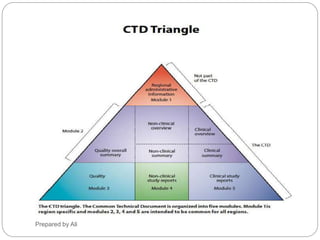
COMMON TECHNICAL DOSSIER
CTD is an internationally agreed “well structured common format” for
the organization of the technical requirements that is to be submitted
to the regulatory authority as an application for the registration of
pharmaceuticals for human use.
2Muhammad Ali
Phr_ali91@hotmail.com
CTD Table of Content
Muhammad Ali 3
Phr_ali91@hotmail.comPhr_ali91@hotmail.com
1.0 Regional Administrative Information
1.1 ToC of Module 1 or overall ToC,
including Module 1
2.1 ToC of the CTD (Mod 2,3,4,5)
2.2 Introduction
2.3 Quality Overall Summary
2.4 Non-clinical Overview
2.5 Clinical Overview
2.7 Clinical Summary
2.6 Non-clinical Written and
Tabulated Summaries
Module 1
Module 3 Module 4 Module 5
2.1
2.2
2.3
2.4 2.5
2.6 2.7
1.0
Quality
Nonclinical
Study Reports
Clinical
Study Reports
Module 2
4Muhammad Ali
CTD format: Overall Table of Contents
Phr_ali91@hotmail.com
Module 2
2.1 OVERALL CTD TABLE OF CONTENTS OF MODULES 2, 3, 4, AND 5
2.2 INTRODUCTION
2.3 QUALITY OVERALL SUMMARY
2.3.S DRUG SUBSTANCE
2.3.S.1 General Information
2.3.S.2 Manufacture
2.3.S.3 Characterization
2.3.S.4 Control of Drug Substance
2.3.S.5 Reference Standards or Materials
2.3.S.6 Container Closure System
2.3.S.7 Stability
2.3.P DRUG PRODUCT
2.3.P.1 Description and Composition of the Drug Product
2.3.P.2 Pharmaceutical Development
2.3.P.3 Manufacture
2.3.P.4 Control of Excipients
2.3.P.5 Control of Drug Product
2.3.P.6 Reference Standards or Materials
2.3.P.7 Container Closure System
2.3.P.8 Stability
Module 2
Muhammad Ali 5
Phr_ali91@hotmail.com
Module 2 (Cont.)
2.3.A APPENDICES
2.3.A.1 Facilities and Equipment
2.3.A.2 Adventitious Agents Safety Evaluation
2.3.A.3 Novel Excipients
2.3.R REGIONAL INFORMATION
2.4 NONCLINICAL OVERVIEW
2.4.1 Overview of the Nonclinical Testing Strategy
2.4.2 Pharmacology
2.4.3 Pharmacokinetics
2.4.4 Toxicology
2.4.5 Integrated Overview and Conclusions
2.4.6 List of Literature Citations
2.5 CLINICAL OVERVIEW
2.5.1 Product Development Rationale
2.5.2 Overview of Biopharmaceutics
2.5.3 Overview of Clinical Pharmacology
2.5.4 Overview of Efficacy
2.5.5 Overview of Safety
2.5.6 Benefits and Risks Conclusions
2.5.7 References
Module 2 (Cont.)
2.6 CONTENT OF NONCLINICAL WRITTEN
AND TABULATED SUMMARIES
2.6.1 Introduction
2.6.2 Pharmacology Written Summary
2.6.3 Pharmacology Tabulated Summary
(Appendix B)
2.6.4 Pharmacokinetics Written Summary
2.6.5 Pharmacokinetics Tabulated Summary
(Appendix B)
2.6.6 Toxicology Written Summary
2.6.7 Toxicology Tabulated Summary (Appendix
B)
2.7 CLINICAL SUMMARY
2.7.1 Summary of Biopharmaceutics and
Associated Analytical Methods
2.7.2 Summary of Clinical Pharmacology Studies
2.7.3 Summary of Clinical Efficacy
2.7.4 Summary of Clinical Safety
2.7.5 References
2.7.6 Synopses of Individual Studies
Module 2
Muhammad Ali 6
Phr_ali91@hotmail.com
Module 3
3.1 MODULE 3 TABLE OF CONTENTS
3.2 BODY OF DATA
3.2.S DRUG SUBSTANCE
3.2.S.1 General Information
3.2.S.2 Manufacture
3.2.S.3 Characterisation
3.2.S.4 Control of Drug Substance
3.2.S.5 Reference Standards or Materials
3.2.S.6 Container Closure System
3.2.S.7 Stability
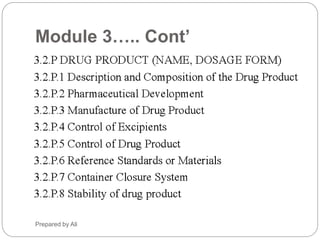
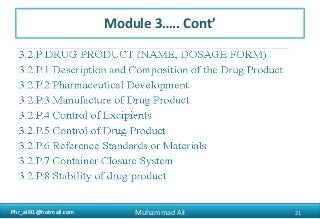
3.2.P DRUG PRODUCT
3.2.P.1 Description and Composition of the Drug
Product
3.2.P.2 Pharmaceutical Development
3.2.P.3 Manufacture
3.2.P.4 Control of Excipients
3.2.P.5 Control of Drug Product
3.2.P.6 Reference Standards or Materials
3.2.P.7 Container Closure System
3.2.P.8 Stability
Module 3 (Cont.)
3.2.A APPENDICES
3.2.A.1 Facilities and Equipment
3.2.A.2 Adventitious Agents Safety Evaluation
3.2.A.3 Novel Excipients
3.2.R REGIONAL INFORMATION
3.3 LITERATURE REFERENCES
Module 3
Muhammad Ali 7
Phr_ali91@hotmail.com
Module 4
4.1 MODULE 4 TABLE OF CONTENTS
4.2 STUDY REPORTS
4.2.1 Pharmacology
4.2.2 Pharmacokinetics
4.2.3 Toxicology
4.3 LITERATURE REFERENCES
Module 4
Muhammad Ali 8
Phr_ali91@hotmail.com
Module 5
5.1 MODULE 5 TABLE OF CONTENTS
5.2 TABULAR LISTINGS OF ALL CLINICAL STUDIES
5.3 CLINICAL STUDY REPORTS
5.3.1 Reports of Biopharmaceutic Studies
5.3.2 Reports of Studies Pertinent to Pharmacokinetics
using Human Biomaterials
5.3.3 Reports of Human Pharmacokinetic (PK) Studies
5.3.4 Reports of Human Pharmacodynamic (PD) Studies
5.3.5 Reports of Efficacy and Safety Studies
5.3.6 Reports of Post-Marketing Experience
5.3.7 Case Report Forms and Individual Patient Listings
5.4 LITERATURE REFERENCES
Module 5
Muhammad Ali 9
Phr_ali91@hotmail.com
Overview of Dossier Requirements and Guidelines
Generic Products
Muhammad Ali 10
Phr_ali91@hotmail.comPhr_ali91@hotmail.com
Generic Guide: Definitions
Muhammad Ali 11
Active Pharmaceutical Ingredient (API)
A substance or compound that is intended to be used in the manufacture of a
pharmaceutical product as a therapeutically active compound (ingredient)
Pharmaceutical Product
Any preparation for human or veterinary use that is intended to modify or explore
physiological systems or pathological states for the benefit of the recipient.
Finished Pharmaceutical Product (FPP)
A product that has undergone all stages of production, including packaging in its final
container and labelling.
Phr_ali91@hotmail.comPhr_ali91@hotmail.com
Multisource (Generic) product
Multisources are Pharmaceutically equivalent (WHO definition)
• same amount of the same API
• same dosage form
• meet the same or comparable standards
• intended to be administered by the same route
Multisources which are therapeutically equivalent are interchangeable
Muhammad Ali 12
Phr_ali91@hotmail.comPhr_ali91@hotmail.com
Quality of a Generic product
Multisource products must be of good quality and at least as safe and efficacious as
existing products (WHO Manual, Blue Book, P. 29, chapter H., Interchangeability)
Muhammad Ali 13
Demonstration of pharmaceutical equivalence of the FPP including that of the API
Same Safety –
Same efficacy
Equal quality with the
comparator or a quality shown and
assessed to be as acceptable
Phr_ali91@hotmail.comPhr_ali91@hotmail.com
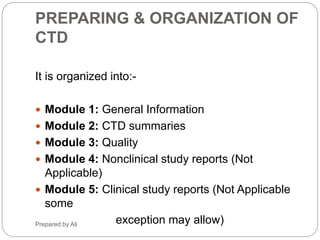
PREPARING & ORGANIZATION OF CTD
It is organized into:-
• Module 1: General Information
• Module 2: Summary (Quality, Non clinical , Clinical)
• Module 3: Quality
• Module 4: Nonclinical study reports (Not Applicable for Generic product)
• Module 5: Clinical study reports (Not Applicable for Generic product some
exception may allow)
14Muhammad Ali
Phr_ali91@hotmail.comPhr_ali91@hotmail.com
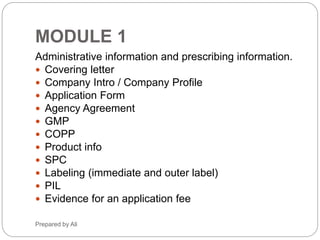
MODULE 1
Administrative information and prescribing information.
• Covering letter
• Company Intro / Company Profile
• Application Form
• Agency Agreement
• GMP
• COPP
• Product info
• SPC
• Labeling (immediate and outer label)
• PIL
• Evidence for an application fee
15Muhammad Ali
Phr_ali91@hotmail.comPhr_ali91@hotmail.com
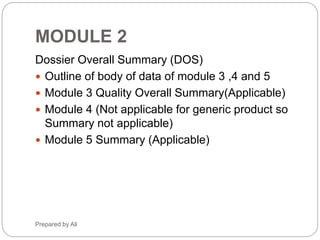
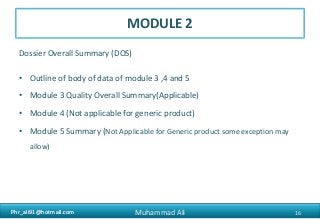
MODULE 2
Dossier Overall Summary (DOS)
• Outline of body of data of module 3 ,4 and 5
• Module 3 Quality Overall Summary(Applicable)
• Module 4 (Not applicable for generic product)
• Module 5 Summary (Not Applicable for Generic product some exception may
allow)
16Muhammad Ali
Phr_ali91@hotmail.comPhr_ali91@hotmail.com
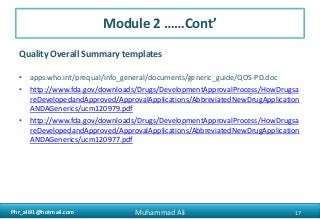
Module 2 ……Cont’
Quality Overall Summary templates
• apps.who.int/prequal/info_general/documents/generic_guide/QOS-PD.doc
• http://www.fda.gov/downloads/Drugs/DevelopmentApprovalProcess/HowDrugsa
reDevelopedandApproved/ApprovalApplications/AbbreviatedNewDrugApplication
ANDAGenerics/ucm120979.pdf
• http://www.fda.gov/downloads/Drugs/DevelopmentApprovalProcess/HowDrugsa
reDevelopedandApproved/ApprovalApplications/AbbreviatedNewDrugApplication
ANDAGenerics/ucm120977.pdf
17Muhammad Ali
Phr_ali91@hotmail.comPhr_ali91@hotmail.com
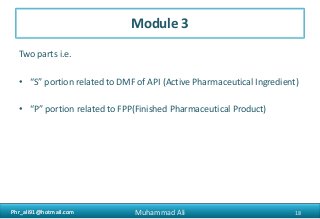
Module 3
Two parts i.e.
• “S” portion related to DMF of API (Active Pharmaceutical Ingredient)
• “P” portion related to FPP(Finished Pharmaceutical Product)
18Muhammad Ali
Phr_ali91@hotmail.comPhr_ali91@hotmail.com
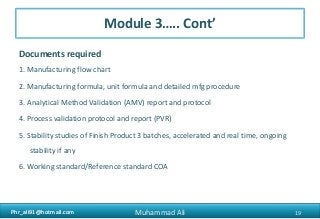
Module 3….. Cont’
Documents required
1. Manufacturing flow chart
2. Manufacturing formula, unit formula and detailed mfg procedure
3. Analytical Method Validation (AMV) report and protocol
4. Process validation protocol and report (PVR)
5. Stability studies of Finish Product 3 batches, accelerated and real time, ongoing
stability if any
6. Working standard/Reference standard COA
19Muhammad Ali
Phr_ali91@hotmail.comPhr_ali91@hotmail.com
Module 3….. Cont’
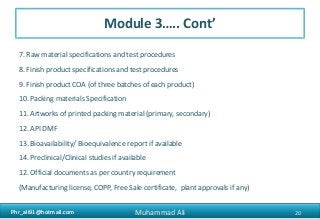
7. Raw material specifications and test procedures
8. Finish product specifications and test procedures
9. Finish product COA (of three batches of each product)
10. Packing materials Specification
11. Artworks of printed packing material (primary, secondary)
12. API DMF
13. Bioavailability/ Bioequivalence report if available
14. Preclinical/Clinical studies if available
12. Official documents as per country requirement
(Manufacturing license, COPP, Free Sale certificate, plant approvals if any)
20Muhammad Ali
Phr_ali91@hotmail.comPhr_ali91@hotmail.com
Module 3….. Cont’
21Muhammad Ali
Phr_ali91@hotmail.comPhr_ali91@hotmail.com
MODULE 5
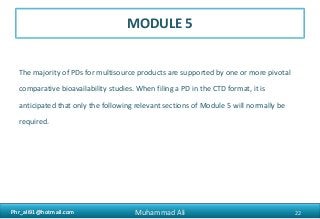
The majority of PDs for multisource products are supported by one or more pivotal
comparative bioavailability studies. When filing a PD in the CTD format, it is
anticipated that only the following relevant sections of Module 5 will normally be
required.
22Muhammad Ali
Phr_ali91@hotmail.comPhr_ali91@hotmail.com
MODULE 5… Cont’
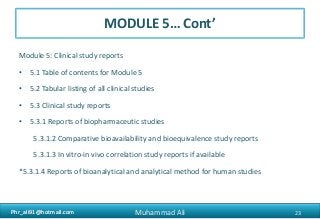
Module 5: Clinical study reports
• 5.1 Table of contents for Module 5
• 5.2 Tabular listing of all clinical studies
• 5.3 Clinical study reports
• 5.3.1 Reports of biopharmaceutic studies
5.3.1.2 Comparative bioavailability and bioequivalence study reports
5.3.1.3 In vitro-in vivo correlation study reports if available
*5.3.1.4 Reports of bioanalytical and analytical method for human studies
23Muhammad Ali
Phr_ali91@hotmail.comPhr_ali91@hotmail.com
MODULE 5… Cont’
• 5.3.7 Case report forms and individual patient listings: Only CRFs for subjects that
experienced serious adverse events should be included. All CRFs should be
available upon request.
• 5.4 Literature references
* Bioanalytical or analytical methods for BA/BE or in vitro dissolution studies should
ordinarily be provided in the individual clinical study reports. However, where a method is used in
multiple studies, the method and its validation should only be included once in section 5.3.1.4 and
referenced in the appropriate individual clinical study reports.
For guidance regarding biowaivers, refer to the biowaiver implementation documents
available on the Prequalification website. For guidance regarding comparator
products, refer to the information available under
24Muhammad Ali
Phr_ali91@hotmail.comPhr_ali91@hotmail.com
Thank you
25Muhammad Ali

CTD Guidelines Overview

  • 1.
    Phr_ali91@hotmail.com Overview of DossierRequirements and Guidelines for Generic Product Muhammad Ali email: phr_ali91@hotmail.com CTD Common Technical Document
  • 2.
    Phr_ali91@hotmail.comPhr_ali91@hotmail.com COMMON TECHNICAL DOSSIER CTDis an internationally agreed “well structured common format” for the organization of the technical requirements that is to be submitted to the regulatory authority as an application for the registration of pharmaceuticals for human use. 2Muhammad Ali
  • 3.
    Phr_ali91@hotmail.com CTD Table ofContent Muhammad Ali 3
  • 4.
    Phr_ali91@hotmail.comPhr_ali91@hotmail.com 1.0 Regional AdministrativeInformation 1.1 ToC of Module 1 or overall ToC, including Module 1 2.1 ToC of the CTD (Mod 2,3,4,5) 2.2 Introduction 2.3 Quality Overall Summary 2.4 Non-clinical Overview 2.5 Clinical Overview 2.7 Clinical Summary 2.6 Non-clinical Written and Tabulated Summaries Module 1 Module 3 Module 4 Module 5 2.1 2.2 2.3 2.4 2.5 2.6 2.7 1.0 Quality Nonclinical Study Reports Clinical Study Reports Module 2 4Muhammad Ali CTD format: Overall Table of Contents
  • 5.
    Phr_ali91@hotmail.com Module 2 2.1 OVERALLCTD TABLE OF CONTENTS OF MODULES 2, 3, 4, AND 5 2.2 INTRODUCTION 2.3 QUALITY OVERALL SUMMARY 2.3.S DRUG SUBSTANCE 2.3.S.1 General Information 2.3.S.2 Manufacture 2.3.S.3 Characterization 2.3.S.4 Control of Drug Substance 2.3.S.5 Reference Standards or Materials 2.3.S.6 Container Closure System 2.3.S.7 Stability 2.3.P DRUG PRODUCT 2.3.P.1 Description and Composition of the Drug Product 2.3.P.2 Pharmaceutical Development 2.3.P.3 Manufacture 2.3.P.4 Control of Excipients 2.3.P.5 Control of Drug Product 2.3.P.6 Reference Standards or Materials 2.3.P.7 Container Closure System 2.3.P.8 Stability Module 2 Muhammad Ali 5
  • 6.
    Phr_ali91@hotmail.com Module 2 (Cont.) 2.3.AAPPENDICES 2.3.A.1 Facilities and Equipment 2.3.A.2 Adventitious Agents Safety Evaluation 2.3.A.3 Novel Excipients 2.3.R REGIONAL INFORMATION 2.4 NONCLINICAL OVERVIEW 2.4.1 Overview of the Nonclinical Testing Strategy 2.4.2 Pharmacology 2.4.3 Pharmacokinetics 2.4.4 Toxicology 2.4.5 Integrated Overview and Conclusions 2.4.6 List of Literature Citations 2.5 CLINICAL OVERVIEW 2.5.1 Product Development Rationale 2.5.2 Overview of Biopharmaceutics 2.5.3 Overview of Clinical Pharmacology 2.5.4 Overview of Efficacy 2.5.5 Overview of Safety 2.5.6 Benefits and Risks Conclusions 2.5.7 References Module 2 (Cont.) 2.6 CONTENT OF NONCLINICAL WRITTEN AND TABULATED SUMMARIES 2.6.1 Introduction 2.6.2 Pharmacology Written Summary 2.6.3 Pharmacology Tabulated Summary (Appendix B) 2.6.4 Pharmacokinetics Written Summary 2.6.5 Pharmacokinetics Tabulated Summary (Appendix B) 2.6.6 Toxicology Written Summary 2.6.7 Toxicology Tabulated Summary (Appendix B) 2.7 CLINICAL SUMMARY 2.7.1 Summary of Biopharmaceutics and Associated Analytical Methods 2.7.2 Summary of Clinical Pharmacology Studies 2.7.3 Summary of Clinical Efficacy 2.7.4 Summary of Clinical Safety 2.7.5 References 2.7.6 Synopses of Individual Studies Module 2 Muhammad Ali 6
  • 7.
    Phr_ali91@hotmail.com Module 3 3.1 MODULE3 TABLE OF CONTENTS 3.2 BODY OF DATA 3.2.S DRUG SUBSTANCE 3.2.S.1 General Information 3.2.S.2 Manufacture 3.2.S.3 Characterisation 3.2.S.4 Control of Drug Substance 3.2.S.5 Reference Standards or Materials 3.2.S.6 Container Closure System 3.2.S.7 Stability 3.2.P DRUG PRODUCT 3.2.P.1 Description and Composition of the Drug Product 3.2.P.2 Pharmaceutical Development 3.2.P.3 Manufacture 3.2.P.4 Control of Excipients 3.2.P.5 Control of Drug Product 3.2.P.6 Reference Standards or Materials 3.2.P.7 Container Closure System 3.2.P.8 Stability Module 3 (Cont.) 3.2.A APPENDICES 3.2.A.1 Facilities and Equipment 3.2.A.2 Adventitious Agents Safety Evaluation 3.2.A.3 Novel Excipients 3.2.R REGIONAL INFORMATION 3.3 LITERATURE REFERENCES Module 3 Muhammad Ali 7
  • 8.
    Phr_ali91@hotmail.com Module 4 4.1 MODULE4 TABLE OF CONTENTS 4.2 STUDY REPORTS 4.2.1 Pharmacology 4.2.2 Pharmacokinetics 4.2.3 Toxicology 4.3 LITERATURE REFERENCES Module 4 Muhammad Ali 8
  • 9.
    Phr_ali91@hotmail.com Module 5 5.1 MODULE5 TABLE OF CONTENTS 5.2 TABULAR LISTINGS OF ALL CLINICAL STUDIES 5.3 CLINICAL STUDY REPORTS 5.3.1 Reports of Biopharmaceutic Studies 5.3.2 Reports of Studies Pertinent to Pharmacokinetics using Human Biomaterials 5.3.3 Reports of Human Pharmacokinetic (PK) Studies 5.3.4 Reports of Human Pharmacodynamic (PD) Studies 5.3.5 Reports of Efficacy and Safety Studies 5.3.6 Reports of Post-Marketing Experience 5.3.7 Case Report Forms and Individual Patient Listings 5.4 LITERATURE REFERENCES Module 5 Muhammad Ali 9
  • 10.
    Phr_ali91@hotmail.com Overview of DossierRequirements and Guidelines Generic Products Muhammad Ali 10
  • 11.
    Phr_ali91@hotmail.comPhr_ali91@hotmail.com Generic Guide: Definitions MuhammadAli 11 Active Pharmaceutical Ingredient (API) A substance or compound that is intended to be used in the manufacture of a pharmaceutical product as a therapeutically active compound (ingredient) Pharmaceutical Product Any preparation for human or veterinary use that is intended to modify or explore physiological systems or pathological states for the benefit of the recipient. Finished Pharmaceutical Product (FPP) A product that has undergone all stages of production, including packaging in its final container and labelling.
  • 12.
    Phr_ali91@hotmail.comPhr_ali91@hotmail.com Multisource (Generic) product Multisourcesare Pharmaceutically equivalent (WHO definition) • same amount of the same API • same dosage form • meet the same or comparable standards • intended to be administered by the same route Multisources which are therapeutically equivalent are interchangeable Muhammad Ali 12
  • 13.
    Phr_ali91@hotmail.comPhr_ali91@hotmail.com Quality of aGeneric product Multisource products must be of good quality and at least as safe and efficacious as existing products (WHO Manual, Blue Book, P. 29, chapter H., Interchangeability) Muhammad Ali 13 Demonstration of pharmaceutical equivalence of the FPP including that of the API Same Safety – Same efficacy Equal quality with the comparator or a quality shown and assessed to be as acceptable
  • 14.
    Phr_ali91@hotmail.comPhr_ali91@hotmail.com PREPARING & ORGANIZATIONOF CTD It is organized into:- • Module 1: General Information • Module 2: Summary (Quality, Non clinical , Clinical) • Module 3: Quality • Module 4: Nonclinical study reports (Not Applicable for Generic product) • Module 5: Clinical study reports (Not Applicable for Generic product some exception may allow) 14Muhammad Ali
  • 15.
    Phr_ali91@hotmail.comPhr_ali91@hotmail.com MODULE 1 Administrative informationand prescribing information. • Covering letter • Company Intro / Company Profile • Application Form • Agency Agreement • GMP • COPP • Product info • SPC • Labeling (immediate and outer label) • PIL • Evidence for an application fee 15Muhammad Ali
  • 16.
    Phr_ali91@hotmail.comPhr_ali91@hotmail.com MODULE 2 Dossier OverallSummary (DOS) • Outline of body of data of module 3 ,4 and 5 • Module 3 Quality Overall Summary(Applicable) • Module 4 (Not applicable for generic product) • Module 5 Summary (Not Applicable for Generic product some exception may allow) 16Muhammad Ali
  • 17.
    Phr_ali91@hotmail.comPhr_ali91@hotmail.com Module 2 ……Cont’ QualityOverall Summary templates • apps.who.int/prequal/info_general/documents/generic_guide/QOS-PD.doc • http://www.fda.gov/downloads/Drugs/DevelopmentApprovalProcess/HowDrugsa reDevelopedandApproved/ApprovalApplications/AbbreviatedNewDrugApplication ANDAGenerics/ucm120979.pdf • http://www.fda.gov/downloads/Drugs/DevelopmentApprovalProcess/HowDrugsa reDevelopedandApproved/ApprovalApplications/AbbreviatedNewDrugApplication ANDAGenerics/ucm120977.pdf 17Muhammad Ali
  • 18.
    Phr_ali91@hotmail.comPhr_ali91@hotmail.com Module 3 Two partsi.e. • “S” portion related to DMF of API (Active Pharmaceutical Ingredient) • “P” portion related to FPP(Finished Pharmaceutical Product) 18Muhammad Ali
  • 19.
    Phr_ali91@hotmail.comPhr_ali91@hotmail.com Module 3….. Cont’ Documentsrequired 1. Manufacturing flow chart 2. Manufacturing formula, unit formula and detailed mfg procedure 3. Analytical Method Validation (AMV) report and protocol 4. Process validation protocol and report (PVR) 5. Stability studies of Finish Product 3 batches, accelerated and real time, ongoing stability if any 6. Working standard/Reference standard COA 19Muhammad Ali
  • 20.
    Phr_ali91@hotmail.comPhr_ali91@hotmail.com Module 3….. Cont’ 7.Raw material specifications and test procedures 8. Finish product specifications and test procedures 9. Finish product COA (of three batches of each product) 10. Packing materials Specification 11. Artworks of printed packing material (primary, secondary) 12. API DMF 13. Bioavailability/ Bioequivalence report if available 14. Preclinical/Clinical studies if available 12. Official documents as per country requirement (Manufacturing license, COPP, Free Sale certificate, plant approvals if any) 20Muhammad Ali
  • 21.
  • 22.
    Phr_ali91@hotmail.comPhr_ali91@hotmail.com MODULE 5 The majorityof PDs for multisource products are supported by one or more pivotal comparative bioavailability studies. When filing a PD in the CTD format, it is anticipated that only the following relevant sections of Module 5 will normally be required. 22Muhammad Ali
  • 23.
    Phr_ali91@hotmail.comPhr_ali91@hotmail.com MODULE 5… Cont’ Module5: Clinical study reports • 5.1 Table of contents for Module 5 • 5.2 Tabular listing of all clinical studies • 5.3 Clinical study reports • 5.3.1 Reports of biopharmaceutic studies 5.3.1.2 Comparative bioavailability and bioequivalence study reports 5.3.1.3 In vitro-in vivo correlation study reports if available *5.3.1.4 Reports of bioanalytical and analytical method for human studies 23Muhammad Ali
  • 24.
    Phr_ali91@hotmail.comPhr_ali91@hotmail.com MODULE 5… Cont’ •5.3.7 Case report forms and individual patient listings: Only CRFs for subjects that experienced serious adverse events should be included. All CRFs should be available upon request. • 5.4 Literature references * Bioanalytical or analytical methods for BA/BE or in vitro dissolution studies should ordinarily be provided in the individual clinical study reports. However, where a method is used in multiple studies, the method and its validation should only be included once in section 5.3.1.4 and referenced in the appropriate individual clinical study reports. For guidance regarding biowaivers, refer to the biowaiver implementation documents available on the Prequalification website. For guidance regarding comparator products, refer to the information available under 24Muhammad Ali
  • 25.