DPNP ( Diabetic Peripheral Neuropathic Pain) Dr. Paul C. Reynolds
Consensus Group 2005 Purpose – create the first DPNP recommendations Review literature Focus on therapies Establish a schema for better patient care
Members Charles Argoff, M.D. Misha-Miroslav Backonja, M.D. Miles Belgrade, M.D. Gary Bennett, PhD. Michael Clark, M.D. Eliot Cole, M.D. Robert Dworkin, PhD. David Fishbain, M.D. Gordon Irving, MBBS Bill McCarlberg, M.D. Michael McLean, M.D., PhD.
FDA Only two medications approved for DPNP treatment Duloxetine (Cymbalta) Pregabalin (Lyrica)
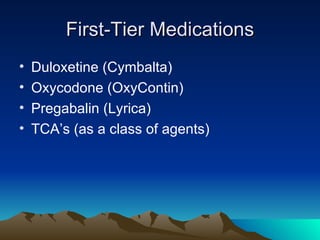
First-Tier Medications Duloxetine (Cymbalta) Oxycodone (OxyContin) Pregabalin (Lyrica) TCA’s (as a class of agents)
Second-Tier Medications Anticonvulsants Carbamazepine (Tegretol) Gabapentin (Neurontin) Lamotragine (Lamictal) Tramadol (Ultram) Venlafaxine (Effexor) [extended release]
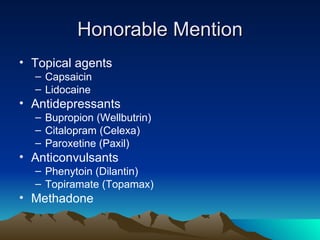
Honorable Mention Topical agents Capsaicin Lidocaine Antidepressants Bupropion (Wellbutrin) Citalopram (Celexa) Paroxetine (Paxil) Anticonvulsants Phenytoin (Dilantin) Topiramate (Topamax) Methadone
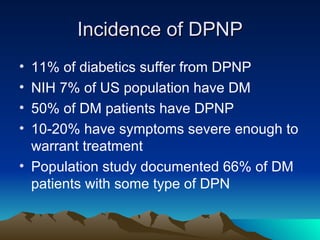
Incidence of DPNP 11% of diabetics suffer from DPNP NIH 7% of US population have DM 50% of DM patients have DPNP 10-20% have symptoms severe enough to warrant treatment Population study documented 66% of DM patients with some type of DPN
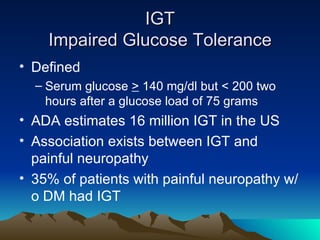
IGT Impaired Glucose Tolerance Defined Serum glucose  >  140 mg/dl but < 200 two hours after a glucose load of 75 grams ADA estimates 16 million IGT in the US Association exists between IGT and painful neuropathy 35% of patients with painful neuropathy w/o DM had IGT
Neuropathic Pain Defined “A spontaneous pain and hypersensitivity to pain in association with damage to or lesion of the nervous system.”
The Difference “ Unlike pain in response to a harmful stimulus, neuropathic pain is maladaptive and represents pain as a disease rather than a warning system.” “ A useful metaphor may be that pain usually functions as an alarm, warning of injury or toxic effects, but that in some cases, including DPNP, the alarm has broken and continues to go off when no injury is imminent.”
Types of Neuropathic Pain Spontaneous Often paroxysmal Described as shooting, stabbing or electric Evoked Stimulus-evoked Allodynia (non-painful stimuli) Hyperpathia (painful stimuli)
Instruments Differentiate between neuropathic and non-neuropathic pain Leeds Assessment of Neuropathic Symptoms and Signs Neuropathic Pain Questionarrie Help define patient’s pain and may be used to monitor effect of treatment Neuropathic Pain Scale
Citations Bennett M. The LANSS Pain Scale: the Leeds assessment of neuropathic symptoms and signs. Pain, 2001; 92: 147-157. Krause SJ, Backonja MM. Development of a neuropathic pain questionnaire. Clin J Pain, 2003; 19:306-314. Galer BS, Jensen MP. Development and preliminary validation of a pain measure specific to neuropathic pain: the Neuropathic Pain Scale. Neurology, 1997; 48: 332-338.
Usual Presentation Insidious onset Burning-type pain Paresthesia (any abnormality of sensation) Numbness First affecting feet and lower limbs “ Stocking and glove” pattern Loss of vibratory, proprioceptive, temperature and eventually pain sensation Proprioceptive loss may lead to impaired gait and falls
Classic Presentation Pain or tingling in the feet Described as ‘burning’ or ‘shooting’ or as a ‘severe aching’ Pain may be accompanied by allodynia and hyperalgesia or the lack of sensation (‘anesthesia dolorosa’) Worse at night
Management Boulton AJM. Management of diabetic peripheral neuropathy. Clin Diabetes, 2005; 23: 9-15. Acute sensory neuropathy Rapid onset of typical symptoms Accompanied by weight loss Seen after episodes of poor glucose control May be resolved in 12 months with good glucose control Blood glucose concentrations are strongly associated with pain in this particular condition
Key Elements in Dx DPNP Lab Dx of DM or IGT Presence of neuropathy Questionnaire PE (10 g monofilament testing, vibratory sensation loss) Pain characteristics Rule out non-diabetic causes Cancer, infection, toxins, other deficiencies
10 g monofilament Semmes-Weinstein 10 gram monofilament Nylon filament bends at 10 g force applied Toe and 1 st , 3 rd  and 5 th  metatarsal heads Predicts feet at risk for ulcerations with 86% – 100% sensitivity (TP/TP+FN) [identifying those with disease]
Differential Diagnosis Pain syndromes Tarsal tunnel syndrome Osteoarthritis Idiopathic Distal Small Fiber Neuropathy Erythromelalgia Malignancy Toxin (especially alcohol) exposure Arsenic Vincristine Ethylene Oxide Infections HIV neuropathy
Co-morbidities Diabetic retinopathy Diabetic nephropathy Depression Sleep disturbances Progressive muscle weakness Foot ulceration Interference with activities of daily living
Foot Care More than half of all lower limb amputations in the United States (86,000 per year) occur in people with DM, and more than 80% of amputations occur after a foot ulcer or injury. These cases are largely preventable
Daily Care Clean feet daily; avoid soaking; dry carefully Inspect feet twice daily (cuts, blisters, redness, swelling, calluses) Moisturize with lotion (not between toes) Pumice stone on calluses Toenail clipping regularly (file edges) Always wear shoes or slippers for protection (thick socks without seems) Well-fitted shoes with room for toe movement Break-in new shoes gradually Inspect insides of shoe before wearing (tears, edges, objects) Inform MD of changes in appearance of pain http://ndep.nih.gov/materials/pubs/feet.feet.htm
Key Points Non-diabetic neuropathy can present in patients with DM Up to 50% of DPN patients may be asymptomatic Asymptomatic patients are at risk for insensate foot injury DPNP patients are at high risk for co-morbidities Symptomatic DPN treatment options exist Patients benefit from education and a feeling of partnership in their care

DPNP

  • 1.
    DPNP ( DiabeticPeripheral Neuropathic Pain) Dr. Paul C. Reynolds
  • 2.
    Consensus Group 2005Purpose – create the first DPNP recommendations Review literature Focus on therapies Establish a schema for better patient care
  • 3.
    Members Charles Argoff,M.D. Misha-Miroslav Backonja, M.D. Miles Belgrade, M.D. Gary Bennett, PhD. Michael Clark, M.D. Eliot Cole, M.D. Robert Dworkin, PhD. David Fishbain, M.D. Gordon Irving, MBBS Bill McCarlberg, M.D. Michael McLean, M.D., PhD.
  • 4.
    FDA Only twomedications approved for DPNP treatment Duloxetine (Cymbalta) Pregabalin (Lyrica)
  • 5.
    First-Tier Medications Duloxetine(Cymbalta) Oxycodone (OxyContin) Pregabalin (Lyrica) TCA’s (as a class of agents)
  • 6.
    Second-Tier Medications AnticonvulsantsCarbamazepine (Tegretol) Gabapentin (Neurontin) Lamotragine (Lamictal) Tramadol (Ultram) Venlafaxine (Effexor) [extended release]
  • 7.
    Honorable Mention Topicalagents Capsaicin Lidocaine Antidepressants Bupropion (Wellbutrin) Citalopram (Celexa) Paroxetine (Paxil) Anticonvulsants Phenytoin (Dilantin) Topiramate (Topamax) Methadone
  • 8.
    Incidence of DPNP11% of diabetics suffer from DPNP NIH 7% of US population have DM 50% of DM patients have DPNP 10-20% have symptoms severe enough to warrant treatment Population study documented 66% of DM patients with some type of DPN
  • 9.
    IGT Impaired GlucoseTolerance Defined Serum glucose > 140 mg/dl but < 200 two hours after a glucose load of 75 grams ADA estimates 16 million IGT in the US Association exists between IGT and painful neuropathy 35% of patients with painful neuropathy w/o DM had IGT
  • 10.
    Neuropathic Pain Defined“A spontaneous pain and hypersensitivity to pain in association with damage to or lesion of the nervous system.”
  • 11.
    The Difference “Unlike pain in response to a harmful stimulus, neuropathic pain is maladaptive and represents pain as a disease rather than a warning system.” “ A useful metaphor may be that pain usually functions as an alarm, warning of injury or toxic effects, but that in some cases, including DPNP, the alarm has broken and continues to go off when no injury is imminent.”
  • 12.
    Types of NeuropathicPain Spontaneous Often paroxysmal Described as shooting, stabbing or electric Evoked Stimulus-evoked Allodynia (non-painful stimuli) Hyperpathia (painful stimuli)
  • 13.
    Instruments Differentiate betweenneuropathic and non-neuropathic pain Leeds Assessment of Neuropathic Symptoms and Signs Neuropathic Pain Questionarrie Help define patient’s pain and may be used to monitor effect of treatment Neuropathic Pain Scale
  • 14.
    Citations Bennett M.The LANSS Pain Scale: the Leeds assessment of neuropathic symptoms and signs. Pain, 2001; 92: 147-157. Krause SJ, Backonja MM. Development of a neuropathic pain questionnaire. Clin J Pain, 2003; 19:306-314. Galer BS, Jensen MP. Development and preliminary validation of a pain measure specific to neuropathic pain: the Neuropathic Pain Scale. Neurology, 1997; 48: 332-338.
  • 15.
    Usual Presentation Insidiousonset Burning-type pain Paresthesia (any abnormality of sensation) Numbness First affecting feet and lower limbs “ Stocking and glove” pattern Loss of vibratory, proprioceptive, temperature and eventually pain sensation Proprioceptive loss may lead to impaired gait and falls
  • 16.
    Classic Presentation Painor tingling in the feet Described as ‘burning’ or ‘shooting’ or as a ‘severe aching’ Pain may be accompanied by allodynia and hyperalgesia or the lack of sensation (‘anesthesia dolorosa’) Worse at night
  • 17.
    Management Boulton AJM.Management of diabetic peripheral neuropathy. Clin Diabetes, 2005; 23: 9-15. Acute sensory neuropathy Rapid onset of typical symptoms Accompanied by weight loss Seen after episodes of poor glucose control May be resolved in 12 months with good glucose control Blood glucose concentrations are strongly associated with pain in this particular condition
  • 18.
    Key Elements inDx DPNP Lab Dx of DM or IGT Presence of neuropathy Questionnaire PE (10 g monofilament testing, vibratory sensation loss) Pain characteristics Rule out non-diabetic causes Cancer, infection, toxins, other deficiencies
  • 19.
    10 g monofilamentSemmes-Weinstein 10 gram monofilament Nylon filament bends at 10 g force applied Toe and 1 st , 3 rd and 5 th metatarsal heads Predicts feet at risk for ulcerations with 86% – 100% sensitivity (TP/TP+FN) [identifying those with disease]
  • 20.
    Differential Diagnosis Painsyndromes Tarsal tunnel syndrome Osteoarthritis Idiopathic Distal Small Fiber Neuropathy Erythromelalgia Malignancy Toxin (especially alcohol) exposure Arsenic Vincristine Ethylene Oxide Infections HIV neuropathy
  • 21.
    Co-morbidities Diabetic retinopathyDiabetic nephropathy Depression Sleep disturbances Progressive muscle weakness Foot ulceration Interference with activities of daily living
  • 22.
    Foot Care Morethan half of all lower limb amputations in the United States (86,000 per year) occur in people with DM, and more than 80% of amputations occur after a foot ulcer or injury. These cases are largely preventable
  • 23.
    Daily Care Cleanfeet daily; avoid soaking; dry carefully Inspect feet twice daily (cuts, blisters, redness, swelling, calluses) Moisturize with lotion (not between toes) Pumice stone on calluses Toenail clipping regularly (file edges) Always wear shoes or slippers for protection (thick socks without seems) Well-fitted shoes with room for toe movement Break-in new shoes gradually Inspect insides of shoe before wearing (tears, edges, objects) Inform MD of changes in appearance of pain http://ndep.nih.gov/materials/pubs/feet.feet.htm
  • 24.
    Key Points Non-diabeticneuropathy can present in patients with DM Up to 50% of DPN patients may be asymptomatic Asymptomatic patients are at risk for insensate foot injury DPNP patients are at high risk for co-morbidities Symptomatic DPN treatment options exist Patients benefit from education and a feeling of partnership in their care

Editor's Notes

  • #24 National Diabetes Education Program - ndep