Security 101
Training, awareness, and strategies
Stephen Cobb, CISSP
Senior Security Researcher
ESET NA
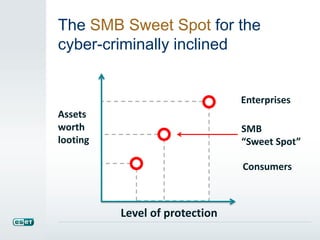
The SMB Sweet Spot for the
cyber-criminally inclined
Enterprises
SMB
“Sweet Spot”
Consumers
Assets
worth
looting
Level of protection
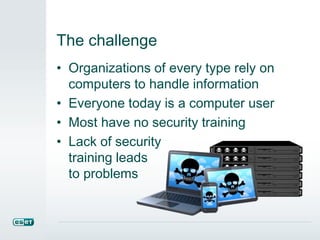
The challenge
• Organizations of every type rely on
computers to handle information
• Everyone today is a computer user
• Most have no security training
• Lack of security
training leads
to problems
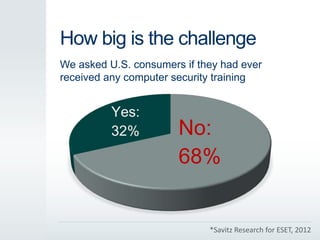
How big is the challenge
We asked U.S. consumers if they had ever
received any computer security training
No:
68%
Yes:
32%
*Savitz Research for ESET, 2012
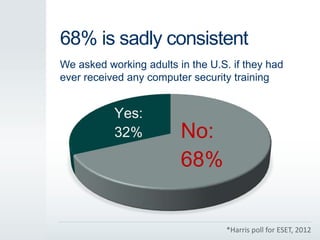
68% is sadly consistent
We asked working adults in the U.S. if they had
ever received any computer security training
No:
68%
Yes:
32%
*Harris poll for ESET, 2012
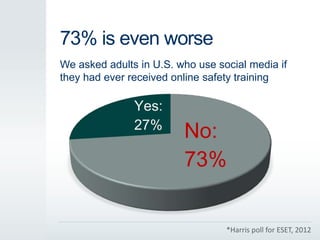
73% is even worse
We asked adults in U.S. who use social media if
they had ever received online safety training
No:
73%
Yes:
27%
*Harris poll for ESET, 2012
Security training is not yet part
of our society*
• This has serious implications for your
business
• 93% of American adults say they’ve
had no computer security training in
the last 12 months
• How many of them work for you, or for
your clients, suppliers, etc?
*Savitz Research for ESET, 2012
Some problems that lack of security
training can cause
• Unauthorized access to information
• Loss of access to information
• Loss of information
• Corruption of information
• Theft of information
The implications are non-trivial
• Loss of revenue
• Loss of business
• Fines, lawsuits, headlines
• Unbudgeted expenses
– Breach costs currently estimated at
around $190 per record exposed*
– 5,263 records = $1 million hit
*Ponemon Institute
Trojan terminates escrow firm
• $1.1 million wired to China and could
not be retrieved
• Firm was closed by state law, now in
receivership, 9 people out of a job
• So what’s the best weapon for keeping
that kind of Trojan code out of your
company’s system?
A well-trained workforce
• Knows not to click on suspicious links
in email or social media
• Knows to report strange activity (e.g.
the two-factor authentication not
working)
• Knows to scan all incoming files for
malware
– Email, USB drives
Does training make a difference?
• Yes
• A significant percentage of problems
can be averted, or their impact
minimized, if more employees get
better security training and education*
*A bunch of different studies in recent years
Security training or awareness
• What’s the difference?
• Training makes sure people at different
levels of IT engagement have the right
knowledge to execute their roles
securely
• Awareness makes sure all people at all
levels know what to look out for
Not that kind of actor…
Do your employees know what
motivates bad actors?
IMPACTADVANTAGEMONEY
CREDENTIALS
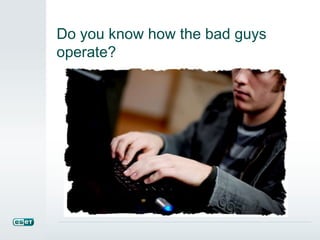
Do you know how the bad guys
operate?
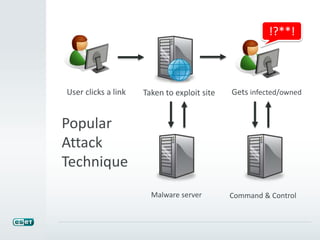
Taken to exploit site
Malware server
Popular
Attack
Technique
!?**!
User clicks a link Gets infected/owned
Command & Control
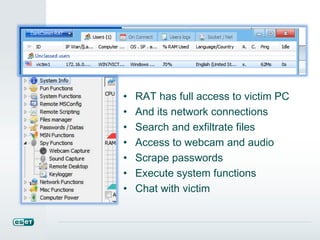
• RAT has full access to victim PC
• And its network connections
• Search and exfiltrate files
• Access to webcam and audio
• Scrape passwords
• Execute system functions
• Chat with victim
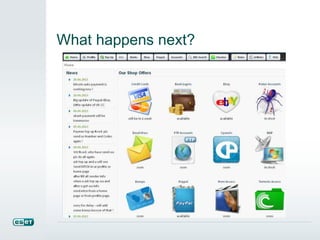
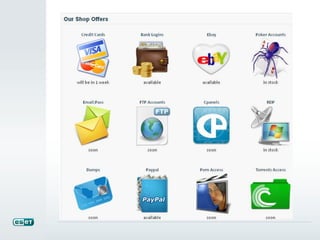
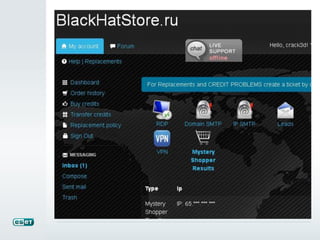
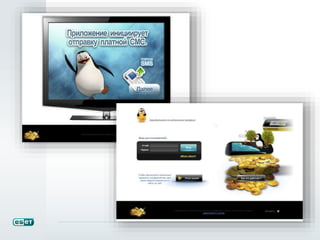
What happens next?
So how do we move forward?
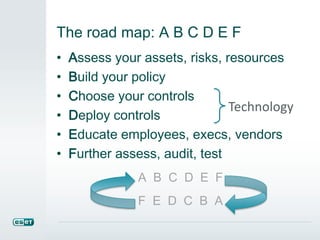
The road map: A B C D E F
• Assess your assets, risks, resources
• Build your policy
• Choose your controls
• Deploy controls
• Educate employees, execs, vendors
• Further assess, audit, test
A B C D E F
F E D C B A
Technology
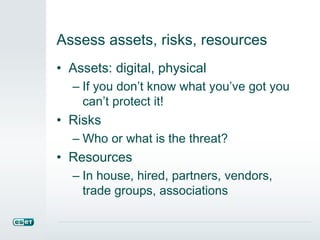
Assess assets, risks, resources
• Assets: digital, physical
– If you don’t know what you’ve got you
can’t protect it!
• Risks
– Who or what is the threat?
• Resources
– In house, hired, partners, vendors,
trade groups, associations
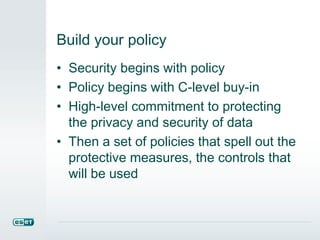
Build your policy
• Security begins with policy
• Policy begins with C-level buy-in
• High-level commitment to protecting
the privacy and security of data
• Then a set of policies that spell out the
protective measures, the controls that
will be used
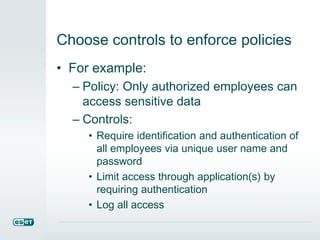
Choose controls to enforce policies
• For example:
– Policy: Only authorized employees can
access sensitive data
– Controls:
• Require identification and authentication of
all employees via unique user name and
password
• Limit access through application(s) by
requiring authentication
• Log all access
Deploy controls, ensure they work
• Put control in place; for example,
antivirus (anti-malware, anti-phishing,
anti-spam)
• Test control
– Does it work technically?
– Does it “work” with your work?
– Can employees work it?
Educate everyone
• Everyone needs to know
– What the security policies are
– How to comply with them through
proper use of controls
• Pay attention to any information-
sharing relationships
– Vendors, partners, even clients
• Clearly state consequences of failure
to comply
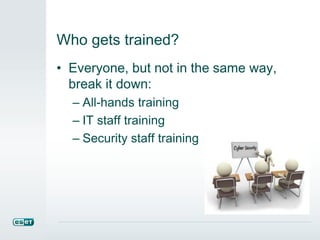
Who gets trained?
• Everyone, but not in the same way,
break it down:
– All-hands training
– IT staff training
– Security staff training
How to deliver training
• In person
• Online
• On paper
• In house
• Outside contractor
• Mix and match
• Be creative
Incentives?
• Yes!
• To launch programs, push agendas
• Prizes do work
• But also make security part of every
job description and evaluation
Use your internal organs
• Of communication!
• Newsletter
• Intranet
• Bulletin board
• Meetings
• Company-wide email
How to do awareness
• Make it fun
• Make it relevant
• Leverage the news
• Bear in mind that everyone benefits
from greater awareness, at work and at
home
Resources to tap
• Industry associations
• FS-ISAC, NH-ISAC, others
• CompTIA, SBA, BBB
• ISSA, ISACA, SANS, (ISC)2
• Local colleges and universities
• Securing Our eCity
Need more motivation?
• Security training is the law
– HIPAA
– Red Flag Identity Theft Prevention
– Gramm-Leach-Bliley, Sarbanes-Oxley
– FISMA
• Or required by industry
– PCI Data Security Standard
Or just plain required
• To get that big juicy contract
• Many companies now require suppliers
to certify that they have security
training and awareness programs in
place as a condition of doing business
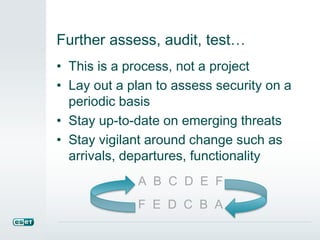
Further assess, audit, test…
• This is a process, not a project
• Lay out a plan to assess security on a
periodic basis
• Stay up-to-date on emerging threats
• Stay vigilant around change such as
arrivals, departures, functionality
A B C D E F
F E D C B A
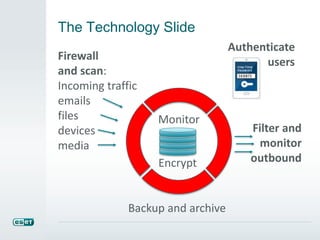
Backup and archive
Firewall
and scan:
Incoming traffic
emails
files
devices
media
Encrypt
Monitor
Filter and
monitor
outbound
Authenticate
users
The Technology Slide
Thank you!
• stephen.cobb@eset.com
• WeLiveSecurity.com
• www.eset.com
• More info in the lobby

Cyber Security 101: Training, awareness, strategies for small to medium sized business

  • 1.
    Security 101 Training, awareness,and strategies Stephen Cobb, CISSP Senior Security Researcher ESET NA
  • 2.
    The SMB SweetSpot for the cyber-criminally inclined Enterprises SMB “Sweet Spot” Consumers Assets worth looting Level of protection
  • 3.
    The challenge • Organizationsof every type rely on computers to handle information • Everyone today is a computer user • Most have no security training • Lack of security training leads to problems
  • 4.
    How big isthe challenge We asked U.S. consumers if they had ever received any computer security training No: 68% Yes: 32% *Savitz Research for ESET, 2012
  • 5.
    68% is sadlyconsistent We asked working adults in the U.S. if they had ever received any computer security training No: 68% Yes: 32% *Harris poll for ESET, 2012
  • 6.
    73% is evenworse We asked adults in U.S. who use social media if they had ever received online safety training No: 73% Yes: 27% *Harris poll for ESET, 2012
  • 7.
    Security training isnot yet part of our society* • This has serious implications for your business • 93% of American adults say they’ve had no computer security training in the last 12 months • How many of them work for you, or for your clients, suppliers, etc? *Savitz Research for ESET, 2012
  • 8.
    Some problems thatlack of security training can cause • Unauthorized access to information • Loss of access to information • Loss of information • Corruption of information • Theft of information
  • 9.
    The implications arenon-trivial • Loss of revenue • Loss of business • Fines, lawsuits, headlines • Unbudgeted expenses – Breach costs currently estimated at around $190 per record exposed* – 5,263 records = $1 million hit *Ponemon Institute
  • 10.
    Trojan terminates escrowfirm • $1.1 million wired to China and could not be retrieved • Firm was closed by state law, now in receivership, 9 people out of a job • So what’s the best weapon for keeping that kind of Trojan code out of your company’s system?
  • 11.
    A well-trained workforce •Knows not to click on suspicious links in email or social media • Knows to report strange activity (e.g. the two-factor authentication not working) • Knows to scan all incoming files for malware – Email, USB drives
  • 12.
    Does training makea difference? • Yes • A significant percentage of problems can be averted, or their impact minimized, if more employees get better security training and education* *A bunch of different studies in recent years
  • 13.
    Security training orawareness • What’s the difference? • Training makes sure people at different levels of IT engagement have the right knowledge to execute their roles securely • Awareness makes sure all people at all levels know what to look out for
  • 14.
    Not that kindof actor… Do your employees know what motivates bad actors? IMPACTADVANTAGEMONEY CREDENTIALS
  • 15.
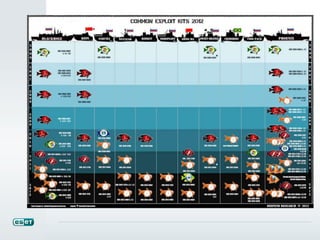
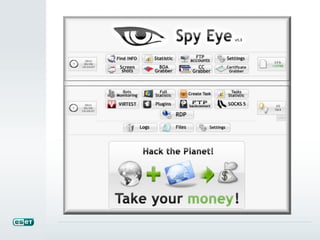
    Do you knowhow the bad guys operate?
  • 16.
    Taken to exploitsite Malware server Popular Attack Technique !?**! User clicks a link Gets infected/owned Command & Control
  • 19.
    • RAT hasfull access to victim PC • And its network connections • Search and exfiltrate files • Access to webcam and audio • Scrape passwords • Execute system functions • Chat with victim
  • 20.
  • 24.
    So how dowe move forward?
  • 25.
    The road map:A B C D E F • Assess your assets, risks, resources • Build your policy • Choose your controls • Deploy controls • Educate employees, execs, vendors • Further assess, audit, test A B C D E F F E D C B A Technology
  • 26.
    Assess assets, risks,resources • Assets: digital, physical – If you don’t know what you’ve got you can’t protect it! • Risks – Who or what is the threat? • Resources – In house, hired, partners, vendors, trade groups, associations
  • 27.
    Build your policy •Security begins with policy • Policy begins with C-level buy-in • High-level commitment to protecting the privacy and security of data • Then a set of policies that spell out the protective measures, the controls that will be used
  • 28.
    Choose controls toenforce policies • For example: – Policy: Only authorized employees can access sensitive data – Controls: • Require identification and authentication of all employees via unique user name and password • Limit access through application(s) by requiring authentication • Log all access
  • 29.
    Deploy controls, ensurethey work • Put control in place; for example, antivirus (anti-malware, anti-phishing, anti-spam) • Test control – Does it work technically? – Does it “work” with your work? – Can employees work it?
  • 30.
    Educate everyone • Everyoneneeds to know – What the security policies are – How to comply with them through proper use of controls • Pay attention to any information- sharing relationships – Vendors, partners, even clients • Clearly state consequences of failure to comply
  • 31.
    Who gets trained? •Everyone, but not in the same way, break it down: – All-hands training – IT staff training – Security staff training
  • 32.
    How to delivertraining • In person • Online • On paper • In house • Outside contractor • Mix and match • Be creative
  • 33.
    Incentives? • Yes! • Tolaunch programs, push agendas • Prizes do work • But also make security part of every job description and evaluation
  • 34.
    Use your internalorgans • Of communication! • Newsletter • Intranet • Bulletin board • Meetings • Company-wide email
  • 35.
    How to doawareness • Make it fun • Make it relevant • Leverage the news • Bear in mind that everyone benefits from greater awareness, at work and at home
  • 36.
    Resources to tap •Industry associations • FS-ISAC, NH-ISAC, others • CompTIA, SBA, BBB • ISSA, ISACA, SANS, (ISC)2 • Local colleges and universities • Securing Our eCity
  • 37.
    Need more motivation? •Security training is the law – HIPAA – Red Flag Identity Theft Prevention – Gramm-Leach-Bliley, Sarbanes-Oxley – FISMA • Or required by industry – PCI Data Security Standard
  • 38.
    Or just plainrequired • To get that big juicy contract • Many companies now require suppliers to certify that they have security training and awareness programs in place as a condition of doing business
  • 39.
    Further assess, audit,test… • This is a process, not a project • Lay out a plan to assess security on a periodic basis • Stay up-to-date on emerging threats • Stay vigilant around change such as arrivals, departures, functionality A B C D E F F E D C B A
  • 40.
    Backup and archive Firewall andscan: Incoming traffic emails files devices media Encrypt Monitor Filter and monitor outbound Authenticate users The Technology Slide
  • 41.
    Thank you! • stephen.cobb@eset.com •WeLiveSecurity.com • www.eset.com • More info in the lobby