2015: Examining the
threatscape for the
year ahead
Stephen Cobb, CISSP
Senior Security Researcher
Today’s topic
• What cyber threats will your business
face in 2015?
• From cyber criminals to nation states
and hacktivists, threats are evolving
• What should you be doing now?
• The best use of resources to protect
your business
The agenda
• Defining moments of 2015
• Lessons for 2015
• Threats and responses
• Strategies for success
Q1: Which 2014 security news
story concerns you the most?
• Sony Pictures hacks
• JPMorgan Chase breach
• PSN DDoS attack
• Community Health Systems breach
• None of the above
Defining moments: Sony+
• Last year it was Snowden/Target
• This year it’s Sony
• Also maybe JP Morgan Chase
• With a touch of The Home Depot
• Plus The Home of a Despot
• Some politics and NSA
• And a sprinkle of IoT
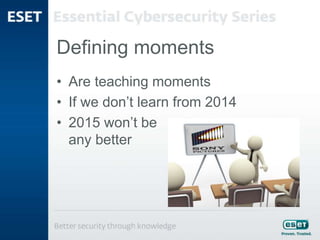
Defining moments
• Are teaching moments
• If we don’t learn from 2014
• 2015 won’t be
any better
Sony Pictures epic hack
• Data destroyed, stolen, exposed
• System availability denied/degraded
• Present and former employees
personally impacted
• Lawsuits
• Brand damage
Systemic security failure?
• A history of being attacked
• A “live with the risk attitude”
• Known weaknesses not remedied
• PWC audit second half of July
– One firewall and more than 100 other devices
not monitored by corporate security team
– Monitored by studio’s in-house group
– "Security incidents impacting these network or
infrastructure devices may not be detected or
resolved timely"
Lesson #1
• Don’t leave unencrypted audit reports in
executive email inboxes
• Don’t put into unencrypted email anything
you may later regret saying or sharing
(words, images, reports, etc.)
• Most email is unencrypted
• If they own your account, encryption is
not going to keep secrets
Lesson #2
• Make your security awesome before
you antagonize known hackers
• Or don’t antagonize known hackers
• Try asking your head of security if
he’s okay with you taunting hackers
• If he says yes, get a second opinion
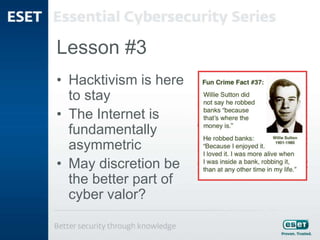
Lesson #3
• Hacktivism is here
to stay
• The Internet is
fundamentally
asymmetric
• May discretion be
the better part of
cyber valor?
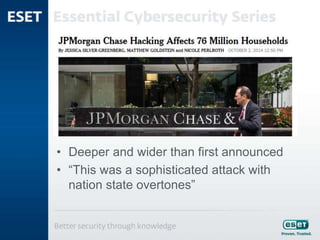
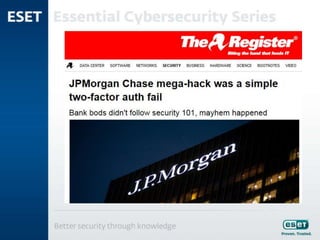
JPMorgan Chase hack
• Deeper and wider than first announced
• “This was a sophisticated attack with
nation state overtones”
Lesson #4
• Do all the right things all the time
• Yes, I know that is very hard to do
• But the scale of targeted attack
activity is higher than ever
• E.g. fewer cyber attacks on retailers,
but more efficient*
*IBM 2014 Retail Intelligence Report
Lesson #5
• Don’t play the “sophisticated nation
state attack” card
• It makes you look bad later
• Both JPMorgan and Sony Pictures
have tried this
• Why? Lays groundwork for legal
defense against negligence claims*
The Home Depot et al.
• Point of sale hacking continues, plus
SQL injection attacks on retailers
• Look for more of the same, even as
chip cards start to take over
• Transition period may offer points of
entry for hackers
• Card data still useful for online fraud
Q2: Chip cards are coming and
they are hard to fake, so the
people who now make money
from card fraud will:
• Get jobs
• Try a different kind of fraud
Lesson #6
• Crime displacement
• EMV technology will make it harder
to turn stolen payment card data into
fake cards
• The people who buy card data to
make fake cards will turn to other
forms of crime: Identity theft?
Tax ID fraud
• Cost taxpayers $5 billion in 2013
• Will be big in 2015
• An easy alternative to card fraud
• IRS needs to do more, but congress
cut the IRS budget
• File early with fingers crossed
• Takes 9 months to correct (average)
Some politics and NSA
• NSA court cases and legislation will
keep privacy top of mind for many
• Political stalemate and lack of trust
will hamper efforts to:
– Share data between .gov and .com
– Boost spending on cybercrime
deterrence
And a sprinkle of IoT
• The Internet of Things will continue
to grow and get hacked
• Security threat to organizations still
low relative to BYOD
• Except in sectors that use SCADA
• Privacy and rights issues may
emerge re: webcams, company
monitoring of IoT devices
Lesson #7
• Threatscape is wider than ever
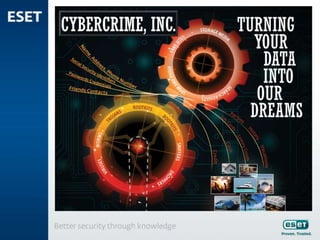
• Cyber Crime, Inc. continues to dominate
– Data about people = money
• Nation state hacking
– From secret sauce to state secrets
• The resurgence of hacktivism
• All of the traditional IT security risks
– Current and former employees, competitors,
natural/human disasters (stormy weather?)
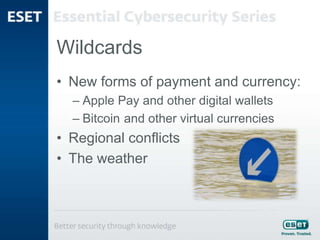
Wildcards
• New forms of payment and currency:
– Apple Pay and other digital wallets
– Bitcoin and other virtual currencies
• Regional conflicts
• The weather
Q3: A disaster puts your offices
and computer off limits for 3
days. Are you:
• Well prepared with a written plan
ready to execute
• Somewhat prepared
• Not clear on how you would cope
• In deep trouble
Security strategies: BCM/IR
• Business Continuity Management and
Incident Response means…
• Preparing to respond to:
– Security breaches, data theft
– Privacy incidents, internal fraud
– Extreme weather, man-made disasters
• At all levels:
– Communications, people, processes, data
and systems, recovery, analysis
Security strategies: Backup
• The ultimate protection against
– Data loss and data ransom
– User error and system failure
– Natural and man-made disasters
• Review current strategies and test
current implementations
• Consider all options (cloud, physical)
Strategies: Encryption
• Time to do more encryption, not less
• Encryption products have improved
• Offer protection in case of breach
• Encrypt in transit as well as at rest
• Check your cloud provider’s use of
encryption e.g. between data centers
Strategies: Policy/compliance
• Start of the new year is a good time
to check:
• Are your information security policies
complete and up-to-date
– New technologies, new data, new hires
• Are you aware of new laws affecting
your compliance around privacy,
data protection?
Strategies for success
• Are you responsible for protecting
data and systems?
• Don’t panic, you are not alone
• Leverage heightened awareness
(courtesy Snowden-Target-
HomeDepot-Sony-JPMorgan)
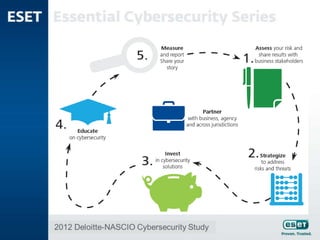
• Take a structured approach
You are not alone
• Network with others, across
departments up/down the org chart
• Within and beyond the organization
• Chamber, BBB, SBA
• ISSA, ISACA, (ISC)2, IAPP
• ISACs, InfraGard, NCSA, VB
• NIST, SOeC
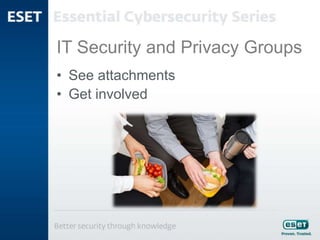
IT Security and Privacy Groups
• See attachments
• Get involved
Revisit roadblocks
• In 2015 the public and press will be
on high alert re: privacy and security
• Bosses may not “like” security but
breaches = lost customers, lost
revenue, lost jobs
• Employees make be more interested
in security than you think
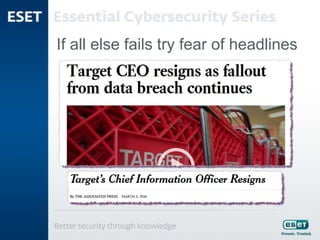
If all else fails try fear of headlines
Last word: Due care
• Remember: complying with rules &
regulations (e.g. PCI, HIPAA, SOX)
is not the same as being secure
• Your security will be judged in the
courts: media, public opinion, law
• Liability under law hinges on
reasonableness, due care
Thank you! Have a safer 2015!
• stephen.cobb@eset.com
• WeLiveSecurity.com
• www.eset.com
• www.slideshare.net/zcobb

2015: The year-ahead-in-cyber-security

  • 1.
    2015: Examining the threatscapefor the year ahead Stephen Cobb, CISSP Senior Security Researcher
  • 2.
    Today’s topic • Whatcyber threats will your business face in 2015? • From cyber criminals to nation states and hacktivists, threats are evolving • What should you be doing now? • The best use of resources to protect your business
  • 3.
    The agenda • Definingmoments of 2015 • Lessons for 2015 • Threats and responses • Strategies for success
  • 4.
    Q1: Which 2014security news story concerns you the most? • Sony Pictures hacks • JPMorgan Chase breach • PSN DDoS attack • Community Health Systems breach • None of the above
  • 5.
    Defining moments: Sony+ •Last year it was Snowden/Target • This year it’s Sony • Also maybe JP Morgan Chase • With a touch of The Home Depot • Plus The Home of a Despot • Some politics and NSA • And a sprinkle of IoT
  • 6.
    Defining moments • Areteaching moments • If we don’t learn from 2014 • 2015 won’t be any better
  • 7.
    Sony Pictures epichack • Data destroyed, stolen, exposed • System availability denied/degraded • Present and former employees personally impacted • Lawsuits • Brand damage
  • 8.
    Systemic security failure? •A history of being attacked • A “live with the risk attitude” • Known weaknesses not remedied • PWC audit second half of July – One firewall and more than 100 other devices not monitored by corporate security team – Monitored by studio’s in-house group – "Security incidents impacting these network or infrastructure devices may not be detected or resolved timely"
  • 9.
    Lesson #1 • Don’tleave unencrypted audit reports in executive email inboxes • Don’t put into unencrypted email anything you may later regret saying or sharing (words, images, reports, etc.) • Most email is unencrypted • If they own your account, encryption is not going to keep secrets
  • 10.
    Lesson #2 • Makeyour security awesome before you antagonize known hackers • Or don’t antagonize known hackers • Try asking your head of security if he’s okay with you taunting hackers • If he says yes, get a second opinion
  • 11.
    Lesson #3 • Hacktivismis here to stay • The Internet is fundamentally asymmetric • May discretion be the better part of cyber valor?
  • 12.
    JPMorgan Chase hack •Deeper and wider than first announced • “This was a sophisticated attack with nation state overtones”
  • 14.
    Lesson #4 • Doall the right things all the time • Yes, I know that is very hard to do • But the scale of targeted attack activity is higher than ever • E.g. fewer cyber attacks on retailers, but more efficient* *IBM 2014 Retail Intelligence Report
  • 15.
    Lesson #5 • Don’tplay the “sophisticated nation state attack” card • It makes you look bad later • Both JPMorgan and Sony Pictures have tried this • Why? Lays groundwork for legal defense against negligence claims*
  • 16.
    The Home Depotet al. • Point of sale hacking continues, plus SQL injection attacks on retailers • Look for more of the same, even as chip cards start to take over • Transition period may offer points of entry for hackers • Card data still useful for online fraud
  • 17.
    Q2: Chip cardsare coming and they are hard to fake, so the people who now make money from card fraud will: • Get jobs • Try a different kind of fraud
  • 18.
    Lesson #6 • Crimedisplacement • EMV technology will make it harder to turn stolen payment card data into fake cards • The people who buy card data to make fake cards will turn to other forms of crime: Identity theft?
  • 19.
    Tax ID fraud •Cost taxpayers $5 billion in 2013 • Will be big in 2015 • An easy alternative to card fraud • IRS needs to do more, but congress cut the IRS budget • File early with fingers crossed • Takes 9 months to correct (average)
  • 20.
    Some politics andNSA • NSA court cases and legislation will keep privacy top of mind for many • Political stalemate and lack of trust will hamper efforts to: – Share data between .gov and .com – Boost spending on cybercrime deterrence
  • 21.
    And a sprinkleof IoT • The Internet of Things will continue to grow and get hacked • Security threat to organizations still low relative to BYOD • Except in sectors that use SCADA • Privacy and rights issues may emerge re: webcams, company monitoring of IoT devices
  • 23.
    Lesson #7 • Threatscapeis wider than ever • Cyber Crime, Inc. continues to dominate – Data about people = money • Nation state hacking – From secret sauce to state secrets • The resurgence of hacktivism • All of the traditional IT security risks – Current and former employees, competitors, natural/human disasters (stormy weather?)
  • 24.
    Wildcards • New formsof payment and currency: – Apple Pay and other digital wallets – Bitcoin and other virtual currencies • Regional conflicts • The weather
  • 25.
    Q3: A disasterputs your offices and computer off limits for 3 days. Are you: • Well prepared with a written plan ready to execute • Somewhat prepared • Not clear on how you would cope • In deep trouble
  • 26.
    Security strategies: BCM/IR •Business Continuity Management and Incident Response means… • Preparing to respond to: – Security breaches, data theft – Privacy incidents, internal fraud – Extreme weather, man-made disasters • At all levels: – Communications, people, processes, data and systems, recovery, analysis
  • 27.
    Security strategies: Backup •The ultimate protection against – Data loss and data ransom – User error and system failure – Natural and man-made disasters • Review current strategies and test current implementations • Consider all options (cloud, physical)
  • 28.
    Strategies: Encryption • Timeto do more encryption, not less • Encryption products have improved • Offer protection in case of breach • Encrypt in transit as well as at rest • Check your cloud provider’s use of encryption e.g. between data centers
  • 29.
    Strategies: Policy/compliance • Startof the new year is a good time to check: • Are your information security policies complete and up-to-date – New technologies, new data, new hires • Are you aware of new laws affecting your compliance around privacy, data protection?
  • 30.
    Strategies for success •Are you responsible for protecting data and systems? • Don’t panic, you are not alone • Leverage heightened awareness (courtesy Snowden-Target- HomeDepot-Sony-JPMorgan) • Take a structured approach
  • 32.
    You are notalone • Network with others, across departments up/down the org chart • Within and beyond the organization • Chamber, BBB, SBA • ISSA, ISACA, (ISC)2, IAPP • ISACs, InfraGard, NCSA, VB • NIST, SOeC
  • 33.
    IT Security andPrivacy Groups • See attachments • Get involved
  • 34.
    Revisit roadblocks • In2015 the public and press will be on high alert re: privacy and security • Bosses may not “like” security but breaches = lost customers, lost revenue, lost jobs • Employees make be more interested in security than you think
  • 35.
    If all elsefails try fear of headlines
  • 36.
    Last word: Duecare • Remember: complying with rules & regulations (e.g. PCI, HIPAA, SOX) is not the same as being secure • Your security will be judged in the courts: media, public opinion, law • Liability under law hinges on reasonableness, due care
  • 37.
    Thank you! Havea safer 2015! • stephen.cobb@eset.com • WeLiveSecurity.com • www.eset.com • www.slideshare.net/zcobb