Stephen Cobb hasbeen researching computer security and
data privacy for 30 years, helping companies, consumers,
and government agencies to manage cyber risks, with a
focus on emerging threats and policy issues. Cobb holds a
master’s in security and risk management and has been a
CISSP since 1996. He heads a US security research team for
ESET, one of the world’s largest security software vendors.
Stephen Cobb
Sr. Security Researcher
ESET North America
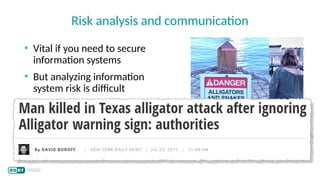
• Vital ifyou need to secure
information systems
• But analyzing information
system risk is difficult
• Communicating risks to all
stakeholders is challenging
• People learn in different ways
• Risk perception varies too
Risk analysis and communication
5.
AN EXAMPLE
Hired byESET in 2011 as
Security Evangelist
Tasked with raising awareness of
information system risks
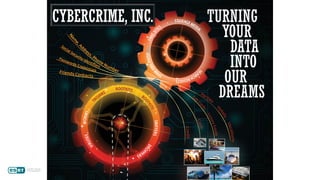
My first thought: people don’t realize
cybercrime is a business
That skews risk assessment
7.
• Show themthe sights
• Let them draw their own conclusions
• Can be more effective than “experts say”
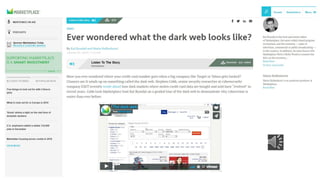
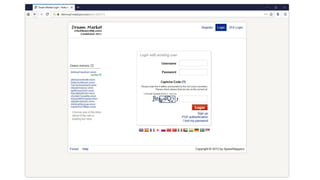
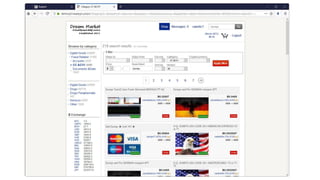
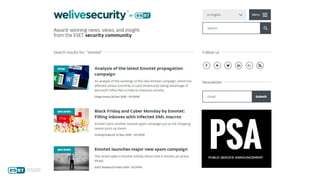
• For example, let’s show the dark web to Kai Ryssdal on
Marketplace, and hear what conclusions he draws
The Guided Tour
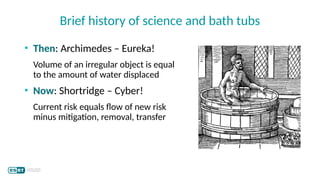
• Then: Archimedes– Eureka!
Volume of an irregular object is equal
to the amount of water displaced
• Now: Shortridge – Cyber!
Current risk equals flow of new risk
minus mitigation, removal, transfer
Brief history of science and bath tubs
13.
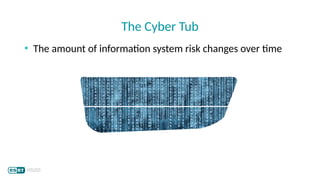
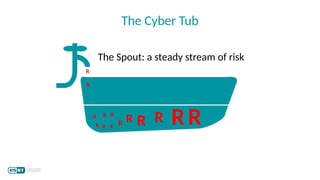
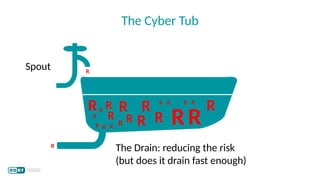
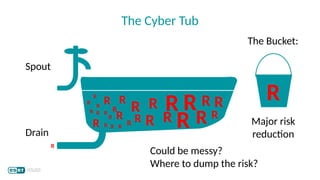
• The amountof information system risk changes over time
The Cyber Tub
14.
The Cyber Tub
R
RR R R R R RR
R
R
R
R R
The Spout: a steady stream of risk
15.
The Cyber Tub
R
RR R R R R RR
R
R
R
R
R R R R
R R R R
R
R
The Drain: reducing the risk
(but does it drain fast enough)
Spout
16.
The Cyber Tub
R
R
RR R R
R R R R
R
R
R
R
R R R R R R R R
R
R
R R
R R
R
R
The Bucket:
Drain
Spout
Major risk
reduction
Could be messy?
Where to dump the risk?
17.
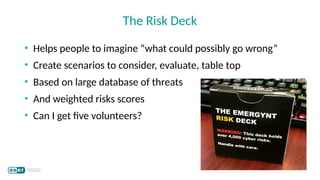
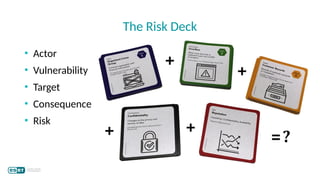
• Helps peopleto imagine “what could possibly go wrong”
• Create scenarios to consider, evaluate, table top
• Based on large database of threats
• And weighted risks scores
• Can I get five volunteers?
The Risk Deck
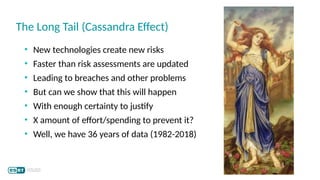
• New technologiescreate new risks
• Faster than risk assessments are updated
• Leading to breaches and other problems
• But can we show that this will happen
• With enough certainty to justify
• X amount of effort/spending to prevent it?
• Well, we have 36 years of data (1982-2018)
The Long Tail (Cassandra Effect)
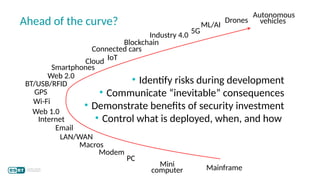
1. PC
2. Modem
3. Macros
4. LAN/WAN
5. Internet
6. Email
7. Web 1.0
8. Wi-Fi
9. GPS
10. USB/BT/RFID
11. Web 2.0
12. Smartphones
13. Cloud
14. Connected cars
15. Industry 4.0
16. Blockchain
17. ML/AI
18. Drones
19. 5G
20. Autonomous cars
20.
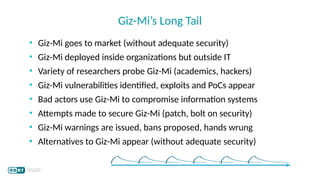
• Giz-Mi goesto market (without adequate security)
• Giz-Mi deployed inside organizations but outside IT
• Variety of researchers probe Giz-Mi (academics, hackers)
• Giz-Mi vulnerabilities identified, exploits and PoCs appear
• Bad actors use Giz-Mi to compromise information systems
• Attempts made to secure Giz-Mi (patch, bolt on security)
• Giz-Mi warnings are issued, bans proposed, hands wrung
• Alternatives to Giz-Mi appear (without adequate security)
Giz-Mi’s Long Tail
#2 I’ve been researching information system security for 30 years. Born in Coventry, England, Britain’s Detroit. So I like car analogies. Here’s one about AI/ML. Has anyone started out on a car journey and arrive seriously late, car troubles, traffic? Yes? So how do you avoid that?
#12 Archimedes' principle states that the upward buoyant force that is exerted on a body immersed in a fluid, whether fully or partially submerged, is equal to the weight of the fluid that the body displaces and acts in the upward direction at the center of mass of the displaced fluid.